Short Fat Women of the Future
I found this on AOL’s Lemondrop.com link this morning, LLOOLLLL!
Well, here’s a self-confidence booster — you’re not short and fat, you’re just highly evolved.
According to a study by Yale researchers, humans are still evolving, and women are evolving to become shorter and fatter. It is estimated that in 10 generations, women will be two centimeters shorter, weigh one kilogram (around 2.5 lbs.) more, and look back and wonder what kind of freakish monster Angelina Jolie was. (“What are these jeans called ‘long’ from the Gap?)
But we won’t just be jolly little trolls, we’ll also be healthier, with the study expecting women to have lower cholesterol and better heart health, start menopause later, and have more children earlier in life. The study observed over 2,000 medical histories from Framingham Heart Studies in Massachusetts. Shorter, heavier women have more children, who also grow up to be shorter and heavier.
Let’s also not forget that in addition to shrinking downward while expanding outward, we’ll all also have super-hot faces. Short, fat, healthy and hot. Totally awesome.
You can read the original article on TheMedGuru.com
Internet Use Changes Older Brains
I love this story – using the internet is good for aging brains!
Internet Use Changes Older Brains
LiveScience
posted: 14 HOURS 46 MINUTES AGOcomments: 10filed under: SCIENCE NEWS
(Oct. 19) — Adults with little internet experience show changes in their brain activity after just one week online, a new study finds.
The results suggest Internet training can stimulate neural activation patterns and could potentially enhance brain function and cognition in older adults.
As the brain ages, a number of structural and functional changes occur, including atrophy, or decay, reductions in cell activity and increases in complex things like deposits of amyloid plaques and tau tangles, which can impact cognitive function.
UCLA/LiveScience
Research has shown that mental stimulation similar to the stimulation that occurs in individuals who frequently use the Internet may affect the efficiency of cognitive processing and alter the way the brain encodes new information.
“We found that for older people with minimal experience, performing Internet searches for even a relatively short period of time can change brain activity patterns and enhance function,” Dr. Gary Small, study author and professor of psychiatry at the Semel Institute for Neuroscience and Human Behavior at UCLA, said in a statement.
The UCLA team worked with 24 neurologically normal volunteers between the ages of 55 and 78. Prior to the study, half the participants used the Internet daily, while the other half had very little experience. Age, educational level and gender were similar between the two groups.
The participants performed Web searches while undergoing functional magnetic resonance imaging (fMRI) scans, which recorded the subtle brain-circuitry changes experienced during this activity. This type of scan tracks brain activity by measuring the level of blood flow in the brain during cognitive tasks. While the study involves a small number of people and more research on this topic is needed, small study sizes are typical of fMRI-based research.
After the initial brain scan, subjects went home and conducted Internet searches for one hour a day for a total of seven days over a two-week period. These practice searches involved using the web to answer questions about various topics by exploring different websites and reading information. Participants then received a second brain scan using the same Internet simulation task, but with different topics.
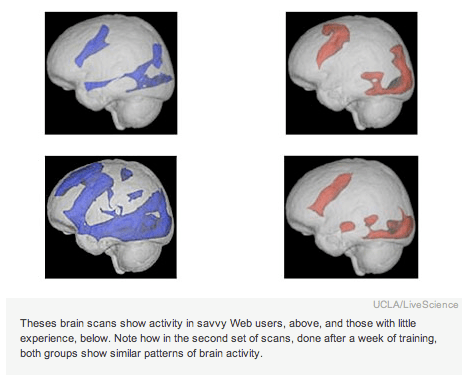
The first scan of participants with little Internet experience showed brain activity in the regions controlling language, reading, memory and visual abilities. The second brain scan of these participants, conducted after the home practice searches, demonstrated activation of these same regions, but there was also activity in the middle frontal gyrus and inferior frontal gyrus – areas of the brain known to be important in working memory and decision-making.
Thus, after Internet training at home, participants with minimal online experience displayed brain activation patterns very similar to those seen in the group of savvy Internet users.
“The results suggest that searching online may be a simple form of brain exercise that might be employed to enhance cognition in older adults,” Teena D. Moody, the study’s first author and UCLA researcher, said in a statement.
You can read the rest of this article from Live Science on AOL News by clicking here.
Live Longer: Marry an Educated Woman
From today’s BBC Health News comes an important discovery for Men’s health – men who marry educated women live longer. Educated women live longer. Who a man marries matters more than his own education. You can read the entire article by clicking on the blue type, above.
This study does not say you need to marry a Swedish woman. . . you need to marry an educated woman!
Educated women ‘aid long life’
A university education is important to longevity, the study suggests
A well-educated woman positively influences both her own and her partner’s chances of a long life, Swedish research suggests.
A man whose partner had only a school education has a 25% greater risk of dying early than if she had had a university education, it suggests.
The authors say educated women may be more likely to understand the various health messages their families needed.
The findings are based on a study of 1.5m working Swedes, aged 30 to 59.
The study, in the journal of Epidemiology and Community Healthcare, says that in the case of men, it is their income and social status that affect women’s lifespan.
The researchers looked at data from the 1990 Swedish census and followed up information on causes of death, including cancer and circulatory diseases like heart disease and stroke from the cause of death registers up to 2003.
University education
A woman’s education and social status were more important for a man’s life chances than his own education, the findings indicate.
Read the entire article HERE
Maid Builds Mansion with Elderly Employer’s ‘Gift’
This is a sticky situation – not a new situation, it is timeless, and not unique to Kuwait – it is everywhere. People with elderly parents need to pay attention; the elderly can be so vulnerable. He may well have given his caretaker the money. His poor 108 year old mother!
Maid coaxes elderly sponsor to sell home, buys villa with cash
KUWAIT CITY, Oct 3: Police have arrested a Sri Lankan housemaid who allegedly duped a Kuwaiti man in his 70s, and lured him into selling his home, reports Al-Watan Arabic daily.
It is reported the woman, who was working for the old man, induced him to sell his home, and then took the money from him. She is said to be worth about KD 120,000. She has also built a mansion in her home country.
A security source said the man’s mother, who is about 108 years old, and his family have lodged a complaint at the police station. However, the maid claims the man had given the money to her of his own free will.
Smoking Ban Quickly Makes a Difference
In some heartening news from BBC Health News studies are showing that the smoking ban is improving heart health for smokers – and for non-smokers who were once exposed to second-hand smoke. The measurable difference has manifested much more quickly than anyone predicted.
Smoking bans ‘cut heart attacks’
Passive smoke raises heart risk
Bans on smoking in public places have had a bigger impact on preventing heart attacks than ever expected, data shows.
Smoking bans cut the number of heart attacks in Europe and North America by up to a third, two studies report.
This “heart gain” is far greater than both originally anticipated and the 10% figure recently quoted by England’s Department of Health.
The studies appear in two leading journals – Circulation and the Journal of the American College of Cardiology.
Heart attacks in the UK alone affect an estimated 275,000 people and kill 146,000 each year.
Big impact
Earlier this month it was announced that heart attack rates fell by about 10% in England in the year after the ban on smoking in public places was introduced in July 2007 – which is more than originally anticipated.
But the latest work, based on the results of numerous different studies collectively involving millions of people, indicated that smoking bans have reduced heart attack rates by as much as 26% per year.
If you are a smoker, the single biggest thing you can do to avoid a heart attack is to give up, which could also protect the heart health of friends and family
Ellen Mason of the British Heart Foundation
Second-hand smoke is thought to increase the chances of a heart attack by making the blood more prone to clotting, reducing levels of beneficial “good” cholesterol, and raising the risk of dangerous heart rhythms.
Dr James Lightwood, of the University of California at San Francisco, led the Circulation study that pooled together 13 separate analyses.
His team found that heart attack rates across Europe and North America started to drop immediately following implementation of anti-smoking laws, reaching 17% after one year, then continuing to decline over time, with a 36% drop three years after enacting the restrictions.
Dr Lightwood said: “While we obviously won’t bring heart attack rates to zero, these findings give us evidence that in the short-to-medium-term, smoking bans will prevent a lot of heart attacks.
“This study adds to the already strong evidence that second-hand smoke causes heart attacks, and that passing 100% smoke-free laws in all workplaces and public places is something we can do to protect the public.”
Ellen Mason, of the British Heart Foundation, said: “These studies add to the growing evidence that a ban on smoking in public places seems to have a positive impact on heart attack rates, which is clearly good news for our nation’s heart health.
“The statistics also show how quickly the benefits can be felt after a smoking ban is implemented and indicate how dangerous second-hand smoke can be to the heart.
“If you are a smoker, the single biggest thing you can do to avoid a heart attack is to give up, which could also protect the heart health of friends and family.”
Latest figures show at least 70,000 lives have been saved by NHS Stop Smoking Services in the 10 years since they were established in England.
Sunrise in Amsterdam (for my Kuwait friends)
OK, OK, now I have to tell you the truth.
I am not celebrating Ramadan in Doha this year.
When we moved to Doha, we didn’t know how long we would be there. It could have been just months. I know, I know, those who knew us and knew the situation just gasped and said “Why would you do this?”
We don’t know.
This is our life. This is the life of expat contractors. You always get a choice, but sometimes you do what will help out the company. The packing and unpacking part, the leaving friends part – all that is bad. Really really bad. The moving to a place you have lived before, where you know the roads, you know the grocery stores and gas stations and don’t have to learn everything all over again, and best of all – where you still have good friends – all that is really really good.
So once we learned that we will be in Doha for longer than three months, I quickly booked a trip to Seattle. If we were moving again soon, I wouldn’t have bothered, because these long trips get harder and harder on us.
As we were about to land in Amsterdam, I just happened to look outside the window – and there was the sun. Thinking of all my friends in Kuwait who got sick and tired of the sun rising over the Gulf (hee hee hee, it’s MY blog, and I never get tired of the sunrise! 🙂 ) I thought you might like to see the sun rising over a bunch of nice cool clouds and an airplane wing in Amsterdam.

“We Be Slangin'” from TrendCentral
Have you heard of TrendCentral.com, another website that keeps track of the most ephemeral of the ephemeral – what is happening now and what might be coming down the pipeline?
Here is an article from TrendCentral.com on new vocabulary, for those who want to understand what the next gen is saying:
WE BE SLANGIN’
Decoding the latest Gen Y vocab
Did you know the word “hipster” didn’t always mean someone who laced every sentence with snark and pretended not to know other people’s names? Yeah, at one time “hipster” was used to describe beatniks that listened to jazz in the “wrong” side of town and took speed-induced road trips across America. As pop culture evolves, so does the slang we use to describe the world around us. Here are a few new words and terms we have been hearing around the block and on the web:
Real Talk
n. This phrase is used to highlight that whatever is being said is the actual truth and not the rose-colored variety. One of the most famous users of this expression is vlogger Mr. Chi-City, who tends to drop the phrase every few seconds.
“Real talk, I was so hungover, I slept next to the toilet, real talk.”
Social Notworking
v. Checking your social networking pages while on the job.
“I got caught Facebook stalking by my boss today. I hope he doesn’t get mad I was social notworking.”
Gypster
n. A person who dresses like a hybrid of a gypsy and a hipster.
“There were hoards of gypsters at that Fleet Foxes concert afterparty in Echo Park last night.”
Shress
n. A tunic or shirt that is scandalously worn as a dress; the term has come into use because of the trend of girls leaving the house without a vital component – their pants. (And we’re not talking about mistaking leggings for pants; we mean the bare-legged girls that seem to be just wearing an oversized men’s shirt.)
“Can you believe she wore a shress to school? She looked like she just came from a slumber party.”
Epicocity
n. A word used to describe just how epic (i.e. awesome) something is.
“Did you see Tony jump out of the tree into the swimming pool? It was totally stupid but I gotta say the epicocity level was 10.”
DT
abbr. This strictly means “down to” and originated in the land of texting. Like other phrases that begin at the thumbs of teenage girls, DT has migrated into actual verbal conversations.
“Do you want to go shopping tomorrow?” “DTGS”
Berry
n. A term used to describe a member of the opposite sex.
“See them berries sipping on martinis? They look ripe for a picking.”
Total LOL at Social Notworking!
Whoda Thunk? People Get Happier as they Age
I never dreamed it when I was younger. Who would want to be OLD? Having nice tight little bodies is fun, right? Even if you have to pay the price of worrying all the time about maintainence, LOL!
As it turns out, people get happier as they get older. Whoda thunk it?
People ‘get happier as they age’
From BBC Health News
Older people appear better able to control their emotions
Most people get happier as they grow older, studies on people aged up to their mid-90s suggest.
Despite worries about ill health, income, changes in social status and bereavements, later life tends to be a golden age, according to psychologists.
They found older adults generally make the best of the time they have left and have learned to avoid situations that make them feel sad or stressed.
The young should do the same, they told the American Psychological Association.
Ageing society
The UK is an ageing nation – in less than 25 years, one in four people in the UK will be over 65 and the number of over-85s will have doubled.
And it is expected there will be 30,000 people aged over 100 by the year 2030.
According to University of California psychologist Dr Susan Turk Charles, this should make the UK a happier society.
By reviewing the available studies on emotions and ageing she found that mental wellbeing generally improved with age, except for people with dementia-related ill health.
Work carried out by Dr Laura Carstensen, a psychology professor at Stanford University, suggested why this might be the case.
Dr Carstensen asked volunteers ranging in age from 18 to mid-90s to take part in various experiments and keep diaries of their emotional state.
She found the older people were far less likely than the younger to experience persistent negative moods and were more resilient to hearing personal criticism.
They were also much better at controlling and balancing their emotions – a skill that appeared to improve the older they became.
TIPS FOR A HAPPY OLD AGE
Envisage ways to thoroughly enjoy the years ahead and imagine living to a healthy and happy 100
Design your life and daily routines to reinforce this goal
Don’t put all your “social” eggs in one basket – invest time outside of your family and career too
Dr Charles explained: “Based on work by Carstensen and her colleagues, we know that older people are increasingly aware that the time they have left in life is growing shorter.
“They want to make the best of it so they avoid engaging in situations that will make them unhappy.
“They have also had more time to learn and understand the intentions of others which helps them to avoid these stressful situations.”
Dr Carstensen said the young would do well to start preparing for their old age now.
This includes adopting a healthy daily routine and ensuring some social investment is spent outside of the workplace and family home.
Andrew Harrop, head of public policy at Age Concern and Help the Aged, said the findings were encouraging.
“For many people, older age and later life is often looked upon with dread and worry.
“Far too many younger people assume that getting older is a process that will inevitably mean sickness, frailty and lack of mobility and greater dependence. However, this is far from the truth in very many cases.
“Many older people lead active, healthy lives enriched by experience and learning.
“This positive advantage can be brought to bear across so many aspects of daily life which – in turn – hugely benefits our ageing society.
“It’s vital that there is growing acceptance that just because someone is getting older, it doesn’t mean they no longer have a significant contribution to make.
“This study is one of many which shows that later life can be a enormously positive experience.”
Happy Birthday, Mom
“You make me sound so OLD!” my Mother scolded me, when I wrote about how she was 85 years old and still living on her own. Mom keeps active. She can’t do all the things she really wants to do – travel, mostly – because she can’t manage a heavy bag or standing too long – but she keeps up her own place, fixes her own meals, goes out with friends, exercises, makes and keeps her own appointments. We should all be so fortunate, when we hit our 80’s.

(This is not my Mother’s birthday cake, but when I looked up cakes I found this on Kay’s Cakes.com and knew it was a cake my Mom would love, if she loved cake. Actually, she loves Lemon Meringue Pie, and that is what she really had at her birthday party.)
My younger sister has shown her a couple really nice places where she could have more assistance on a daily basis, beautiful places with activities and transportation for elders.
(I can already hear her wincing at using the word ‘elder’)
She doesn’t want to be surrounded by old people. She stays young by being as active as she wants to be.
She has signed up for a three-day mini university course at a nearby university, where they use the college facilities during the summer months to offer interesting mini classes. One of the four classes that she has signed up for is Early Islamic Spain. I’m impressed, Mom.
She keeps up with the news, sends me clippings, reads books we tell her are worth reading, and keeps up with her friends. She is good at managing her money, and researching her investments. She does better than most women half her age.
Happy Happy Birthday, Mom, and many more to come.
Coffee ‘may reverse Alzheimer’s’ (In Mice!)
From BBC Health News, July 5, 2009
Coffee ‘may reverse Alzheimer’s’
A possible treatment for dementia?
Drinking five cups of coffee a day could reverse memory problems seen in Alzheimer’s disease, US scientists say.
The Florida research, carried out on mice, also suggested caffeine hampered the production of the protein plaques which are the hallmark of the disease.
Previous research has also suggested a protective effect from caffeine.
But British experts said the Journal of Alzheimer’s disease study did not mean that dementia patients should start using caffeine supplements.
The 55 mice used in the University of South Florida study had been bred to develop symptoms of Alzheimer’s disease.
First the researchers used behavioural tests to confirm the mice were exhibiting signs of memory impairment when they were aged 18 to 19 months, the equivalent to humans being about 70.
Then they gave half the mice caffeine in their drinking water. The rest were given plain water.
The mice were given the equivalent of five 8 oz (227 grams) cups of coffee a day – about 500 milligrams of caffeine.
The researchers say this is the same as is found in two cups of “specialty” coffees such as lattes or cappuccinos from coffee shops, 14 cups of tea, or 20 soft drinks.
When the mice were tested again after two months, those who were given the caffeine performed much better on tests measuring their memory and thinking skills and performed as well as mice of the same age without dementia.
Those drinking plain water continued to do poorly on the tests.
In addition, the brains of the mice given caffeine showed nearly a 50% reduction in levels of the beta amyloid protein, which forms destructive clumps in the brains of dementia patients.
Further tests suggested caffeine affects the production of both the enzymes needed to produce beta amyloid.
The researchers also suggest that caffeine suppresses inflammatory changes in the brain that lead to an overabundance of the protein.
Earlier research by the same team had shown younger mice, who had also been bred to develop Alzheimer’s but who were given caffeine in their early adulthood, were protected against the onset of memory problems.
You can read the entire article at BBC Health News
Recent Comments
intlxpatr on Shampoo Ginger tigerbutterya0c5ff1d… on Shampoo Ginger intlxpatr on British Soldier Kidnapped, Esc… John on British Soldier Kidnapped, Esc… intlxpatr on British Soldier Kidnapped, Esc… Wikipedia Donate Button

Amazina


Early Voting in Florida


