Barbara Nadel: The Ottoman Cage
I got the recommendation for this book from Little Diamond; we have a long family tradition of trading books back and forth, my sisters, our children, even my mother; we are all sending books and exchanging suggestions all the time. I know I can count on Little Diamond and Sparkle for particularly good recommendations, and they never disappoint me.
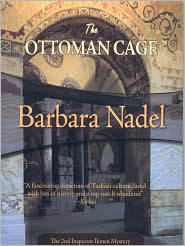
When The Ottoman Cage arrived, I was put off by the cover. “Who’s Likely to Like This?” the cover asked – it seemed like screaming to me – “Fans of Donna Leon and exotic, atmospheric locales”
Remember, I am in a dark time, taxes, turbulence, destabilization. . . I am easily disgruntled when I am vulnerable like this. I don’t want to think I am so predictable. I love reading Donna Leon! So I am predisposed (grumble grumble grumble) NOT to like Barbara Nadel.
I fail miserably. The first five pages I am resisting. By the sixth page, I am ready to stay up all night to read this book (I don’t really, but I did finding myself making more time to read so I could find out what happens next.)
It is like the Donna Leon series in that while the plot is original and interesting, the real focus is on the police inspector, his crew, the relationships with friends and characters, the bureaucracy, and the way systems and institutions function in modern day Turkey.
One particular relationship was of great interest to me, that of Suleyman, who dutifully married his first cousin. They both tried very hard to make it work, but when we meet him, we discover that the marriage has become a painfully dry and desolate place, where each lead their individual lives, with very little of the relationship together.
Another character is detective Cohen, a rare Jew in the police force described as follows:
When one has been known and admired as a prolific womanizer for most of one’s adult life, any change in that situation can come rather hard. Although Cohen had been married since the age of nineteen, he had never let that fact or indeed his rather short stature and dishevelled apearance hold him back from the most ardent pursuit of other women. Jokey charm, of which he possessed copious amounts, had always seen him through. The knowledge that women love a man who can make them laugh had successfully taken him to many bedrooms and had, quite frequently, resulted in his being asked back again. Until this year.
Whether it was because now he was on the ‘wrong’ sied of forty five or just a patch of ill fortune, Cohen didn’t know but the fact was beyond dispute. Women, it seemed, didn’t want him any more. The rbuffs and even in one notable case the cruel sound of mocking laughter were hideously painful for him to bear. Even his long-suffering wife, who had for so many years pleaded with him to leave other women alone and attend to her, had lost interest. He’d tried to find a little comfort in her arms the previous night when he found that he couldn’t sleep, but she, like all the lithe little girls that he still so desired, had just sent him on his way, back to his customary couch, flinging her curses in his unfaithful wake.
It was, Cohen would have been the first to admit, his own fault. Had he bothered to try and be faithful to Estelle he would now, in his middle years, have both a friend and a over with whom he could take comfort as the lines overwhelmed his face and the loose skin around his middle began to sag. His wife was, after all, ageing like himself and, unlike the pretty little tarts he hankered after, unable to point mocking fingers at his inadequacies.
The plot hinges on a dead boy, a beautiful boy, found dead, alone, on a bed in an empty, tasteful but unlived in home. Who is he? Why is he here? Why is he dead?
We meet the gossipy neighbors, we meet the Armenian community, we meet some of the lowest characters you would ever hope to meet, the kind the police deal with every single day. Nothing is simple, one single clue leads slowly, painfully to another. I give credit to Nadel; she relies on good honest police work, chasing down the clues, going through the stacks of old files, interviewing unsavory lowlifes; the things good police really do to solve their cases.
More than the plot, I loved the rich and intricate textures of this mystery novel, I loved the descriptions of the interiors and the interior lives of the characters. Nadel has that in common with the other writers I read serially – Leon, Pattison, Qiu Xiaolon, James Burke and Peter Bowen. It is another rich entry into the genre of the “mystery novel set in exotic, atmospheric locations.”
Definitely worth a read!
Bad News: Brain Decline Begins at 27
Bad news today as BBC reports our brains begin their functional decline as early as age 27:
‘Brain decline’ begins at age 27
Professor Timothy Salthouse of the University of Virginia found reasoning, spatial visualisation and speed of thought all decline in our late 20s.
Therapies designed to stall or reverse the ageing process may need to start much earlier, he said.
His seven-year study of 2,000 healthy people aged 18-60 is published in the journal Neurobiology of Aging.
To test mental agility, the study participants had to solve puzzles, recall words and story details and spot patterns in letters and symbols.
The natural decline of some of our mental abilities as we age starts much earlier than some of us might expect
The same tests are already used by doctors to spot signs of dementia.
In nine out of 12 tests the average age at which the top performance was achieved was 22.
The first age at which there was any marked decline was at 27 in tests of brain speed, reasoning and visual puzzle-solving ability.
Things like memory stayed intact until the age of 37, on average, while abilities based on accumulated knowledge, such as performance on tests of vocabulary or general information, increased until the age of 60.
You can read the rest of the article at BBC Health News
Life Lessons from a 90 Year Old
Thank you, Momcat!
Written By Regina Brett, 90 years old, of The Plain Dealer, Cleveland , Ohio
To celebrate growing older, I once wrote the 45 lessons life taught me.
It is the most-requested column I’ve ever written. My odometer rolled over to 90, in August, so here goes:
1. Life isn’t fair, but it’s still good
2. When in doubt, just take the next small step.
3. Life is too short to waste time hating anyone.
4. Don’t take yourself so seriously. No one else does.
5. Pay off your credit cards every month.
6. You don’t have to win every argument. Agree to disagree.
7. Cry with someone. It’s more healing than crying alone.
8. It’s OK to get angry with God. He can take it.
9. Save for retirement starting with your first p aycheck.
10. When it comes to chocolate, resistance is futile.
11. Make peace with your past so it won’t screw up the present.
12. It’s OK to let your children see you cry
13. Don’t compare your life to others’. You have no idea what their journey is all about.
14. If a relationship has to be a secret, you shouldn’t be in it.
15. Everything can change in the blink of an eye. But don’t worry; God never blinks.
16. Take a deep breath. It calms the mind.
17. Get rid of anything that isn’t useful, beautiful or joyful.
18. Whatever doesn’t kill you really does make you stronger.
19. It’s never too late to have a happy childhood. But the second one is up to you and no one else.
20. When it comes to going after what you love in life, don’t take no for an answer.
21. Burn the candles, use the nice sheets, wear the fancy lingerie. Don’t save it for a special occasion. Today is special.
22. Over prepare, then go with the flow.
23. Be eccentric now. Don’t wait for old age to wear purple.
24. The most important sex organ is the brain.
25. No one is in charge of your happiness but you.
26. Frame every so-called disaster with these words: ‘In five years, will this matter?
27. Always choose life.
28. Forgive everyone everything.
29. What other people think of you is none of your business.
30. Time heals almost everything. Give time time.
31. However good or bad a situation is, it will change.
32. Your job won’t take care of you when you are sick. Your friends and parents will. Stay in touch.
33. Believe in miracles.
34. God loves you because of who God is, not because of anything you did or didn’t do.
35. Don’t audit life. Show up and make the most of it now.
36. Growing old beats the alternative — dying young.
37. Your children get only one childhood.
38. All that truly matters in the end is that you loved.
39. Get outside every day. Miracles are waiting everywhere.
40. If we all threw our problems in a pile and saw everyone else’s, we’d grab ours back.
41. Envy is a waste of time. You already have all you need.
42. The best is yet to come.
43. No matter how you feel, get up, dress up and show up.
44. Yield.
45. Life isn’t tied with a bow, but it’s still a gift.
“It seems before Truth sets you free, it puts you through the wringer…”
When AdventureMan Retires
“When we retire,” AdventureMan begins as we are driving down the street, “I want a tree like that in our front yard.”
This isn’t the first time he has said such a thing.
You know, where you live there are rules, and sometimes those rules aren’t written down. If you violate the rules, people say mean things like “they must not be from around here.”
Like in my neighborhood, most of the houses have some grey in their color. It’s the Pacific Northwest. The sky is grey. Sometimes the sea is grey. People get used to grey, and they paint their houses grey, like blue-grey or brown-grey or green-grey, but always some kind of grey in the color. It’s just the way things are done.
Here, sometimes a house is painted very brightly, like egg yolk yellow, not a hint of grey. Bright bright orange, not a hint of grey. At first, it is shocking to the eye, but in six months, the color mellows with the bright sunlight, and fades to a soothing sand-yellow, or sand-orange.
This is what AdventureMan thinks would look great in our front yard:
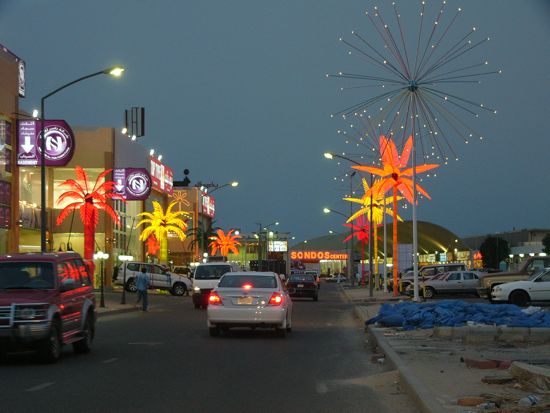
Or maybe he is just yanking on my chain? 😉
Empty Nests Make for Happy Marriage
LLOOLL. To everyone’s great surprise, the results found the empty-nest marriages are HAPPIER than families with children. I think the message is HANG IN THERE! The study found that marital happiness plunged with the first child, and went further south with each addition. Children take time and attention, the more, the more chaotic. The study doesn’t say don’t have children, it just says there is a great satisfaction to having children who successfuly transition to adulthood.
This compilation of studies is reported in today’s New York Times. Clicking on the blue type will take you to the entire article.
The study is important because it tracks the first generation of women to juggle traditional family responsibilities with jobs in the work force. In the empty-nest study, researchers compared the women’s marital happiness in their 40s, when many still had children at home; in their early 50s, when some had older children who had left home; and in their 60s, when virtually all had empty nests. At every point, the empty nesters scored higher on marital happiness than women with children still at home. The finding mirrors that of a report presented last year at the American Psychological Association, tracking a dozen parents who were interviewed at the time of a child’s high school graduation and 10 years later. That small study also showed that a majority of parents scored higher on marital satisfaction after children had left home.
While the Berkeley researchers had hypothesized that the improvement in marital happiness came from couples’ spending more time together, the women in the same study reported spending just as much time with their partners whether the children were living at home or had moved out. But they said the quality of that time was better.
“There are fewer interruptions and less stress when kids are out of the house,” said Dr. Gorchoff, at Berkeley. “It wasn’t that they spent more time with each other after the children moved out. It’s the quality of time they spent with each other that improved.”
She notes that the lesson from the empty nest may be that parents need to work to carve out more stress-free time together. In the sample studied, it was only relationship satisfaction that improved when children left home. Over all, parents were just as happy with children at home as in the empty nest. (What happens when adult children move back home, their job prospects having evaporated in a brutal economy, has not been extensively studied.)
“Kids aren’t ruining parents’ lives,” Dr. Gorchoff said. “It’s just that they’re making it more difficult to have enjoyable interactions together.”
Merry Christmas, Kuwait!
It is seven in the morning, and AdventureMan is sleeping in a little, giving me a chance to catch up with YOU.

We have always waited until morning to open our gifts. Last night, after our guests left, we said “No children! We could open our presents tonight!” and then . . . we laughed. It was late and we were tired and we needed our sleep. (I never thought I would see the day, so old that I would want to go to bed more than to open presents.)
Christmas Eve was so special, spent with dear friends, reminiscing over times together, past Christmases. There is one great thing about being an older adult, and that is you are no longer involved in the frenzy of school and church and after-school youth activities. At nine at night, I am not busy trying to get my son’s acolyte robe ironed, ready for the midnight service, I am not frantically putting together the last few plates of cookies that I am required to provide for a million events I don’t really even want to attend. Christmas is much more peaceful, more measured, less frantic now, and I love being able to enjoy the holiday at a more measured pace. Isn’t life full of delicious ironies, that I can enjoy Christmas more in a Moslem country?
One Christian friend told me years ago that Satan tries to distract us during the holiest days. (I would have imagined that to be true for my Moslem friends, too, but I think I remember that Satan is jailed during the month of Ramadan, and cannot tempt you; that if temptation comes, it is coming from your own heart and shows you where you need to work on your character.) Yesterday, as I was working on the Christmas Eve dinner, my kitchen faucet broke – simply would not shut off. Anytime I wanted to use water, I had to go under the sink and turn two knobs, or water would just continue to run.
My friend called and asked if she could use my oven, which, fortunately, I had just turned on, but wasn’t planning to use immediately, so she came for about half an hour and we had an unexpected and delightful visit while I worked on vegetables and she baked her Christmas cake.
If that was Satan, well, he inconvenienced us, but he certainly didn’t get in the way of our enjoying Christmas. Ha Ha on you, Satan!
I intended to take a bunch of photos showing you our Christmas Eve dinner, but it’s like you get on this track, and then the track takes over, and I only have a few images to show you, and nothing really from the meal.
This is my oldest cookbook, I think I even had it before I was married. The glue has started to fail, pages are falling out, there are drops and stains throughout the book, but I don’t want to replace it because it has so many memories. This is my go-to book when I need an overview on how things work, and a basic, tried and true recipe.
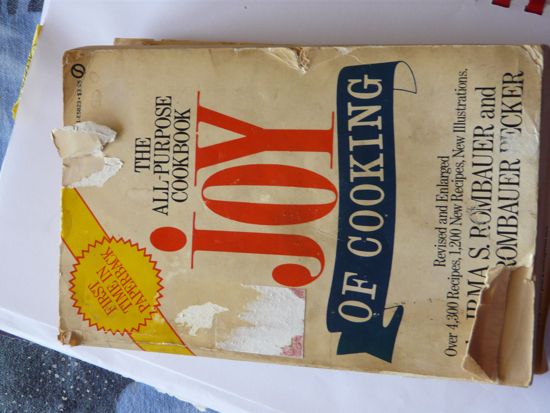
Yesterday was a relatively easy day, pulling things out and putting them together. The harder days were before – creating the menu, figuring out what I needed from the store and getting it (AdventureMan helped) and “prepping”, i.e. getting all the walnuts chopped, the onions, the parsley, the cheese grated, etc. That’s the really hard work, I think.

One thing required a little extra preparation – I wanted to make peppermint candy ice cream, something I have made before. but a long time ago. It requires peppermint candy. Once I saw peppermint candy here, but it was a long time ago, in like February – I guess it hadn’t gotten here in time for Christmas. I brought back some from my recent trip to the US.
The ingredients for peppermint candy ice cream are wonderfully easy:
3 cups cream
2 cups crushed peppermint candy
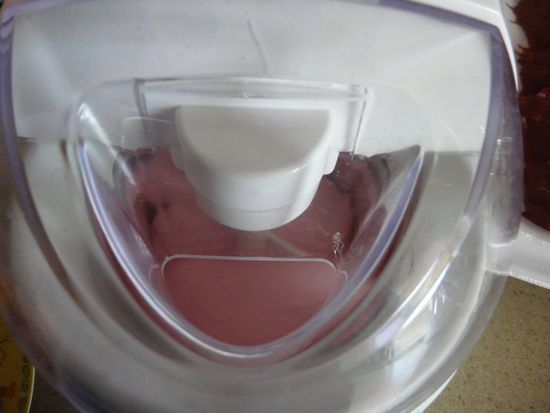
You add one cup to the cream, put it in the refrigerator overnight. The next day, you stir it, and put it in the ice cream making machine to process. When it is nearly finished (it is thickened and the machine starts to labor) you put the remaining one cup of crushed peppermint candy in through the tube where you can make additions, allow it to process maybe 30 seconds, then – it is finished.
No, there was no added sugar, there is enough in the candy to make it sweet enough. Because it is pure cream and no additives, it is very very fattening and very very delicious.
How will we spend Christmas Day? When AdventureMan gets up, I will heat him up a cup of Christmas punch and we will open the presents in our stockings:


Here is what the rule is – laid down in my family many many uncountable years ago – as long as you believe in Santa Claus, Santa Claus will come. To this day, we believe in Santa Claus, so when we wake up on Christmas morning, we have stockings with little gifts. (I think maybe one of mine sparkles 😉 )
We also open gifts from family – and the gifts from our son and his wife arrived just in time, yesterday, and are under the tree!

Then, we will get ready for church, and go and greet all our church friends – Merry Christmas! Merry Christmas!
That is . . . unless the plumber comes to fix the faucet. Yes, for my friends who do not live in Kuwait, for the rest of the world, this is just any old day, and plumbers come on Christmas day. They do NOT come on Fridays, the Moslem world Sunday, so if the plumber comes – and we just never know when that might be – I would have to miss church.
We will gather again tonight with friends for Christmas dinner. Unless the plumber comes.
(No, Satan, I can roll with this. You are NOT going to ruin my Christmas!)
I wish you all a great day, a wonderful, sweet day.
PS. The Qatteri Cat celebrated by eating three Kuwaiti shrimp. For some reason, they are not so good for him, so he only gets them on special occasions. He would live on only shrimp if he had his way.
“Generation of Spoiled Idiots”
I have a dear friend who sends me the most amazing things. This started my day with a howl of laughter:
I am embarrassed to tell you – I remember rotary phones. I even remember party lines, where you had to wait for your neighbor to finish his call before you could make your own, and you never knew who might be listening to your conversation. I remember planes that had large, beautiful lady’s lounges, with a seating area for nursing mothers. I remember when living in Germany was a huge problem to many young people who ran up huge phone bills, calling their families when they were lonely – no internet, no VOIP. I remember transistor radios, and Walkmen! LLLOOOLLLL!
Larger Waist Size Predicts Early Death
This is from today’s BBC Health News
‘Love handles’ raise death risk
A thickening girth can be a sign of type 2 diabetes
Carrying extra fat around your middle dramatically increases your risk of early death, even if your overall weight is normal, say researchers.
A study of almost 360,000 people from nine European countries found waist size a “powerful indicator” of risk.
Each extra 2ins (5cm) raised the chance of early death by between 13% and 17%.
The New England Journal of Medicine study stressed GPs should regulraly measure patients’ waists as a cheap and easy way to assess health.
The link between waist fat and health problems has been established for some time, but the sheer size of the study gives scientists a far more accurate picture.
The researchers, including some from Imperial College London, followed the volunteers, who were an average of 51 years old at the start of the study, for the next 10 years, during which time 14,723 of them died.
The standard measure of obesity, body mass index (BMI) remained a reasonable predictor of health problems, with those with a high reading more likely to die from cardiovascular disease or cancer.
However, the ‘hip/waist ratio’, a number produced by dividing the waist size by the hip measurement, and just the waist measurement on its own, were both good ways of sorting out those at highest risk.
Some people who had a completely normal BMI score, but a larger than average waist, were at significantly higher risk of early death.
At the extremes, men with waists exceeding 47ins (119cm) had a doubled rate of death compared with those with waists under 31.5ins (80cm), and a similar statistic was found when women with waists over 39ins (99cm) were compared to those under 25.5ins (64.7cm).
An increase in risk of death could be plotted every time the belt was let out by another two inches – for two people with the same BMI, every additional 2ins (5cm) on their waistband added up to a 17% increase in risk for men, and 13% for women.
BODY MASS INDEX
Calculated by dividing weight in kilograms by height in metres squared
Normal: 18.5 – 24.9
Overweight: 25 – 29.9
Obese: Above 30
Professor Elio Riboli, from Imperial College London, said: “We were surprised to see the waist size having such a powerful effect on people’s health and premature death.
“There aren’t many simple individual characteristics that can increase a person’s risk of premature death to this extent, independently from smoking and drinking.”
He added: “The good news is that you don’t need to take an expensive test and wait ages for the result to assess this aspect of your health – it costs virtually nothing to measure your hip and waist size.”
Fat message
The reason for the link is not entirely clear, but another researcher, Dr Tobias Pischon, from the German Institute of Human Nutrition at Potsdam-Rehbrucke, said that abdominal fat was not like other fat reserves, but could directly influence the development of chronic disease by releasing “messenger substances”.
A British Heart Foundation spokesman welcomed the findings, saying they supported previous research which found the risk of heart disease to be higher when fat was concentrated around the waist area.
“It is important a variety of measurements are used to assess body weight and shape. – as well as BMI (Body Mass Index), waist circumference and waist-hip ratio can help to provide a better assessment of health risk.
“If you tend to gather weight around your middle, increasing the amount of activity you do and watching what you eat will help to reduce your risk of heart disease and of dying early.”
Alternatives to Statin Drugs
I found this article through Google News at US News and World Report.
I know statins work – many of my friends testify to their having lowered cholesterol through use of statins. But doesn’t it make you nervous that most of the tests proving their efficacy are done by the very drug-merchants who are selling them? For me, it is that way with most medications. I watch people lining up their pills, lowering their blood pressure, lowering their cholesterol, and it makes me very nervous.
My father stayed alive using cortisone. He tried to get off cortisone, but his body was so addicted to it that every time he tried, he suffered horrible pain. By the end of his life, you could barely touch him without injuring his skin, thinned by many years of cortisone usage. We pay a price for the drugs we take – I want to know the price – and the alternatives – before I choose a pill I have to take every day for the rest of my life.
6 Ways to Reduce Inflammation—Without a Statin or a Heart Test
By Deborah Kotz
Posted November 11, 2008
There’s been a lot of hoopla this week over research showing that the cholesterol-lowering drug Crestor lowers the risk of heart attacks and strokes in those with normal cholesterol but high levels of inflammation—measured by a marker called C-reactive protein, or CRP. The Jupiter study, which involved nearly 18,000 people and appears in the current issue of the New England Journal of Medicine, found that people taking the statin Crestor for two to five years cut their risk of having a heart attack or stroke by 50 percent during that period. They also had a lower risk of bypass surgeries and angioplasties.
Experts predict that as a result of the study, many millions of seemingly healthy people will be screened for inflammation using a blood test called high-sensitivity C-reactive protein (hs-CRP) and that millions of them will be put on statins to combat inflammation. While statins certainly are lifesaving for those with high cholesterol or established heart disease, their benefits are more modest for those at fairly low risk of heart disease: About 0.72 percent of the statin takers in the trial had a heart attack or stroke compared with 1.5 percent of those taking placebos.
So, some experts say, if you have high CRP but are otherwise healthy, “go slow,” and consider all the benefits and risks of statins before you decide to take them. Where that hs-CRP screening test might come in handy is to spur you to make lifestyle changes that will naturally lower excess inflammation—and your heart disease risk. Try these six measures:
1. Stop smoking. Smoking hardens the arteries and could send CRP levels surging. But research shows you can reverse all the damaging effects to your arteries within 10 years of quitting. (For help quitting, you can click here.)
2. Think olive oil, fish, and nuts. Researchers have shown that overweight folks who stick with a Mediterranean-style diet—based on fruits, vegetables, whole grains, nuts, and olive oil—can lower their levels of inflammation. “An anti-inflammatory diet is about reducing saturated fat and trans fats and eating more foods rich in alpha-linolenic acid—like flaxseed, walnuts, and canola oil—and omega-3 fats, which fight inflammation,” says Evangeline Lausier, a staff physician at Duke Integrative Medicine. On the flip side, scientists have shown that the typical American fast-food diet increases heart attack risk by 30 percent. (Here’s the latest on four healthful diets and on 11 easy ways to load up on omega-3s.)
3. Get active. No one wants to exercise, but it’s a great way to lower inflammation without any side effects associated with medications. An ideal amount? Not too much (which raises inflammation) and not too little. Aim for five days a week of steady exercise (brisk walking, swimming, biking) for 30 to 45 minutes. (You can read up on how to make your workout quick and sweaty.)
4. Shrink your waist size. Take a tape measure and measure your waist, right around the point of your bellybutton. If you’re a woman with a waist measurement of over 35 inches or a man with a waist of over 40 inches, you probably have high inflammation. Whittling a few inches off the waist by reducing your portions and increasing activity can go a long way toward solving that problem. (Here’s a dietary technique that might help you lose weight.)
5. Get enough sleep. A new study out this week shows that elderly people with high blood pressure who sleep less than 7.5 hours a night have dramatically elevated chances of having a stroke or heart attack or suffering sudden cardiac death. Other research has shown that too little sleep (less than six hours) or too much (more than eight hours) results in more inflammation. The American Academy of Sleep Medicine says most adults need between seven and eight hours of shut-eye a night. (Not convinced? Consider these 10 reasons not to skimp on sleep.)
6. Reduce stress. High levels of stress hormones can lead to the release of excess inflammatory chemicals, so try each day to pencil in 15 minutes of relaxation—deep breathing, meditation, or a bubble bath that lets you leave the world behind.
Andorra, Smoking and Life Expectancy
This little illustration was part of an e-mail a friend sent this week, but it reminded me of a special I heard a couple weeks ago on BBC about Andorra.

Andorra has the highest life expectancy of any country in the world. When people try to figure out why, they think it must be because people are physically active there, all their lives. The elderly are encouraged to go to the gyms, prices are greatly subsidized for all citizens, like gyms and water aerobics classes and EVERYBODY stays fit.
They have the longest life expectancy in spite of the fact that many many of the Andorrans are also smokers. Go figure.
Recent Comments
intlxpatr on Shampoo Ginger tigerbutterya0c5ff1d… on Shampoo Ginger intlxpatr on British Soldier Kidnapped, Esc… John on British Soldier Kidnapped, Esc… intlxpatr on British Soldier Kidnapped, Esc… Wikipedia Donate Button

Amazina


Early Voting in Florida


