Old Cars
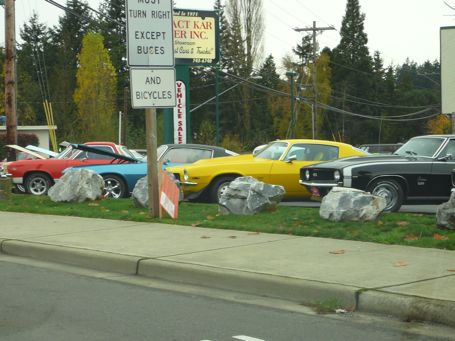
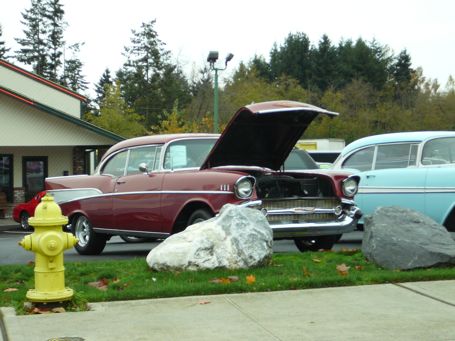
Several years ago, some friends were visiting Seattle and returned, saying “I have never seen so many OLD cars anywhere else.”
(They had never been to Turkey, where they have an art of keeping old cars running.)
I had never really noticed, but there truly are a lot of older cars in this area, and I don’t know why. Maybe one reason is that Seattle had a few leaded gas pumps longer than other states, and most of these old cars ran on leaded gas. You still see them – a lot of them – still on the roads.
Beautiful Weird Thanksgiving
This was a beautiful, wierd Thanksgiving for me. It’s one of the very rare Thanksgivings that Adventure Man and I have not been together. He was down in Florida, at an all day eating, playing and visiting fest with our son, our son’s wife and her family. He shucked his first oysters, and was told he had better keep his day job.
I am in Seattle with my Mom, and we went to my best-friend-from-college’s house. It turned out to be one of the sweetest Thanksgivings I have had. As we sat down at the table, my friend said that in her house it is tradition to go around the table and to tell one thing you give thanks for. I found that incredibly moving. You have a glimpse into another person’s heart when you tell what you are thankful for.
And the food! Oh my! All my good resolutions, all my good intentions, down the drain – the food was SO good.
I took some photos to share with you:
The Veggies and the Salmon-Spinach Dip (oh WOW)

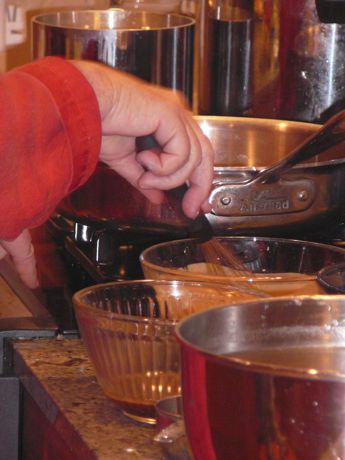
Making the world’s most tasty gravy, with fresh sage and thyme:
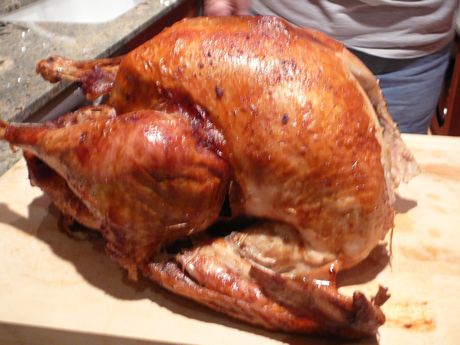
Carving one of the world’s most perfectly cooked turkeys:
The dining table – just before the carnage:

Lack of Resistance
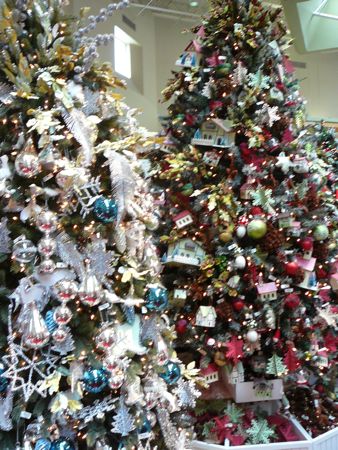
I can feel it starting. I walk into the Mall and my senses go into overload. The colors, the lights, the decorations, the window displays – I am starting to pant with eagerness.
I’m not even a mall shopper! I am just killing time waiting for the Apple shop to open . . . but oh! Look! The Macy’s Christmas shop is open. And oh my! They are having a two hour sale, 40% off!
I have no resistance. I am like a moth to the flame.

I had to take this one for Purg:
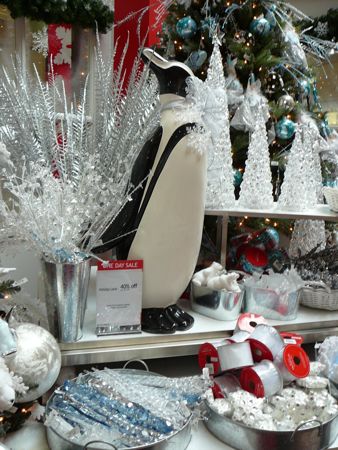
I can’t stop taking photos! I’m in sensory overload!
Not Your Kuwait Starbucks
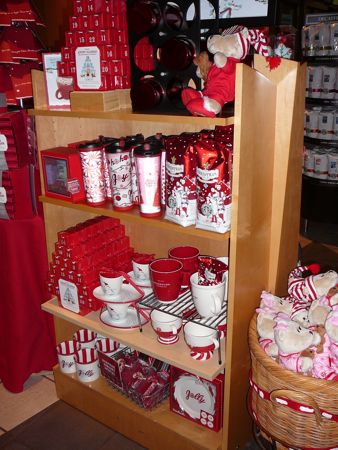
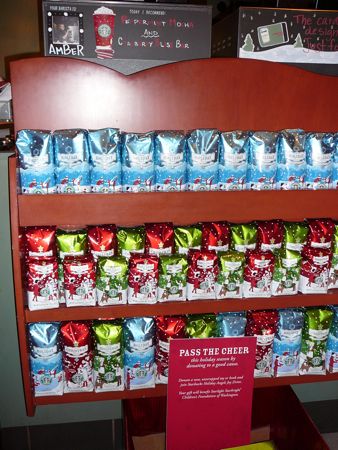
All the Starbucks in Seattle – there is one on every corner, and sometimes on TWO corners of the same crossroads – are tarted up for Christmas. They have special Christmas blend coffees, they have Peppermint Mocha and Gingerbread Latte, and they have all these adorable Christmas theme cups, and hot cups, for your home and for your car:
Ken Follett and World Without End
Oprah has just chosen the predecessor to this book, Pillars of the Earth, as her monthly book club choice. I am so glad! Ken Follett and I have a very mixed relationship; I used to think he was brilliant, and then he wrote one book that just disgusted me so much I stopped reading him altogether until he wrote Pillars of the Earth, which has to do with the building of the very first cathedrals in Europe. It was one of those books that you hated to have it end, and you remember years later.

World Without End follows up Pillars of the Earth. We follow the lives of several people we meet as they are children, and we discover that their lives are intertwined in intricate ways. Two of the characters, Caris and Merthin, love one another from childhood, and we wonder throughout the book if they will ever find a way to be together. Merthin is a builder, descending from the main character of Pillars of the Earth, and shares his way of being able to look at problems from a new perspective and build in new ways based on stepping outside the box to solve problems.
Ken Follett is good at describing the lives of his characters in the 1300s, as farmers try to survive the rainy summers and crop damage, as laborors become independant from the abuses of feudal overlords, as the plague strikes rich and poor alike, as spiritual leaders cope with the demands of daily life and needs. We learn about the living conditions in England in the 1300’s, we learn about the early trade guilds and merchant guilds, we learn how disasters can be an impetus for social and political change, we learn how women used what little control they had over their own lives to their advantage. World Without End is a book rich in texture, sensually layered and visually vivid.
I have a strong feeling that people are pretty much people, and that we haven’t changed too much over the centuries. We HAVE made some advances, we have carved out rule of law, and ways for communities and nations to function together in relative peace, but I still feel that some of the interactions between men and women have a feeling that is too modern. I could be wrong. A few of the the scenes just didn’t ring true to me; it was as if modern people were transposed back to the 1300’s and thinking in modern ways, and it just seemed . . . well, I guess anachronistic!
“Madam, Too Many Words”
We were working together in the garden, and I was explaining what I wanted done with the bougainvilla starts I had collected from various colored shrubs on the compound. It doesn’t take much to get bougainvilla going, but you have to do it right.
When I was done explaining, I said “was that clear? do you understand?”
He shook his head sadly and said “Madam, too many words.”
Ayam Zakat
My niece, Little Diamond in a comment on a previous post reminded me of the “cat containment center,” also called the cat house, that the Qatteri Cat once inhabited so that he could spend time in the garden when we weren’t outside. It had three levels he could climb up to and sleep on, and a long run to the exit. He didn’t like being contained, but he liked being outdoors enough to put up with it.


Little Diamond helped me put it together when it arrived. Little Diamond has a great big brain, she can find anything on the internet in four seconds flat, including all the lyrics to Put the Lime in the Coconut. All we have to do is mention wanting to know something, and she finds it. She also forwards all kinds of fascinating reading for me. She is SMART.
She is not so smart about putting things together. Like she said we didn’t need to look at the instructions, which were sort of in Chinese anyway, but I am a read the instructons kind of woman. Our first try was not so good. We had to resort to looking at the instructions. We finally got it together, but it never was quite right. It worked, however, well enough.
It even had a flag for the top.
Little Diamond speaks Arabic fluently. I only stumble around, but you know how when you are learning a language there are words that sound like other words, or you make jokes about the language that would make no sense to the people speaking that language but make perfect sense to the learner? (I have heard that the English word “unique” will send you into gales of laughter). Little Diamond and Adventure Man love puns, especially in Arabic. We can be rolling on the floor over things that will make YOU native Arabic speaker roll your eyes.
“On the flag” suggested Little Diamond, with a perfectly straight face, “we need to write ‘Ayam Zakat'”! and then we both laughed so hard we rolled on the grass with tears in our eyes, howling with laughter.
In Arabic, Ayam Zakat makes no sense at all. Ayam means something like times and zakat is charity. When you say it in English, however . . . it is the perfect flag for the Qatteri Cat’s house.
You can find the Cat Containment Center (condo) and all kinds of other items for entertaining and transporting cats at Midnight Pass/Kittywalk
“Madam, This is MY Job”
I had all kinds of ideas for my new garden – new climate, new challenges. Yes, I had been told that the climate was too hot for orange trees, but I want to give it a try. Yes, my gardening friends haven’t had much luck with lavendar, but maybe I will have better luck. I toted huge pots and bags of fertilizer, clipped bougainvillia and started more plants, wanting that half/half color, rising early to work in the cool of the day. Rosemary! Basil! Lemon trees! As soon as the weather began to cool, I planted my seeds to see what would sprout, what I could transplant, what would thrive. I’m willing to risk a little failure, but I was hoping for some spectacular results.

Inside once the sun had risen, having a glass of water, my front doorbell rang. Who could it be at this hour of the morning? I checked the security peephole, and it was the compound’s chief gardener. With him was the man assigned to take care of our house. He really didn’t know a lot about gardening.
“Madam,” the chief gardener started, with a wave of his hand indicating all the new potted flowers on my entry stairs, “this is MY job.”
I stood there, looking stupid.
“Madam, your job is to tell us what you want. You don’t want to take our work from us.”
I was stunned. People who garden, all over the world, share a sheer love of getting our hands dirty and watching gardens grow and thrive, we love the patterns, we love the floozies who get all the attention, we love the characters who give depth and texture, and we create the backgrounds, the stage, on which they dance.
Slowly, slowly, we worked out an arrangement. I would bring in pots and plants, the gardener would actually pot them – but I would show him exactly how I wanted it done. From time to time, I would pot one up myself, late at night when no gardeners were around, and he would pretend not to notice. I would do the starts from seeds, he would tend them. On a hot afternoon, he would occasionally drop by and take a rest in the garden, and I would pretend not to notice.


I didn’t achieve spectacular. I had some failures – lavendar and orange trees. I sometimes wonder whether we form the garden, or the garden forms us? My results were not what I had envisioned, but it had its’ own beauty.
Working together, the gardener and I created a lush paradise, a backyard retreat where my husband and I would sit in privacy and enjoy the bougainvillia, and the lemon trees, the pots of rosemary and basil and jasmine, making the garden aromatic as well as beautiful. The Qateri cat would enjoy the marvellous smells, and track the occasional bird who dropped by.
With the cooling temperatures in Kuwait, my hands are just itching to get dirty. 🙂
P.S. Those are illustrations, not my real garden.
Cretan Olive Oil
This response is to a post I wrote October 25th on The Olive Oil scandal, that even when you buy a brand you have thought is reliable, you may not be getting what you paid for. For me, it was particularly horrifying to discover they were adulterating the olive oil with hazlenut oil – I don’t have a severe allergy to hazlenuts, but they make the insides of my ears itch. I avoid hazlenuts!
I keep getting such good responses to the post – and I have a partiality (disclaimer!) to small producers of anything, from olive oil to soap to pecans . . . I love buying from the entrepreneur.
Which is why I have taken this response from the comments page and made it an entry. Thank you, Mr. Sassone, for your thoughtful addition to this subject:
It is indeed a shame that the majority of the olive oil on the American and world market has been adulterated by unscrupulous sellers looking for enormous profits.
That is why I started growing olives on the island of Crete, making extra virgin olive oil-EVOO, and importing it to the US. I personally observe all steps in the process from the time the olive flowers bud on the tree until the EVOO goes in the can. I know it is the cleanest, freshest, highest quality, and most healthful EVOO you can buy at any price.
I also offer all customers copies of test reports from independent laboratories that show the exact quality. Acidity is 0.17%. Total polyphenols are 165ppm. Peroxide value is 6. Nothing can compare at any price.
When people buy EVOOs that are labeled as a mix of oil from several countries, they must take this into account: How clean was process to gather the olives? How clean was the factory that processed the oil? How clean were the trucks that transported the oil to the ship? How clean was the ship that transported the oil? You can see where this is going. At any one or more of dozens of steps in the process, contamination can occur. Some of the olive producing countries do not have food the safety standards like the European Union or US Food and Drug Administration.
My curiosity got the best of me. Recently, I sent samples of 13 EVOOs sold in the US for lab testing to find out just how good or bad they are. I dont have a web site just yet, but will publish the results as a comparison to my oil. So long as I keep complete control of the entire process, I can improve the quality of my oil each year.
My EVOO is now available in the US. It is the finest quality and most healthful EVOO you can buy at any price. Send me and email if interested. kretareserve@cox.net Thanks. Tony
Qatari Cat Loves the Market
The Qatari Cat loves it when I go to the market. Did you ever think about what it must be like to be a cat, to be able to smell the tiniest scent? Do you ever watch a cat lift its’ nose in interest, even open its’ mouth to be able to take in all the nuances of a scent?
I have seen cats bee-line to a person who has been walking on a beach. The Qatari Cat LOVES Adventure Man’s shoes when he gets home from a trip. I try to imagine what it must be like for him, but I imagine when it comes to scent that we are like blind people in the land of the sighted – cats have it all over us.
He spent hours with this sack full of baskets. I think it was like reading a particularly good book for him!

Recent Comments
Kitchen on Isiais: Winding Down intlxpatr on Shampoo Ginger tigerbutterya0c5ff1d… on Shampoo Ginger intlxpatr on British Soldier Kidnapped, Esc… John on British Soldier Kidnapped, Esc… Wikipedia Donate Button

Amazina


Early Voting in Florida


