Boston Pumpkin Carving Contest
Unbelievable. Thousands – thousands of pumpkins.
Halloween Warning
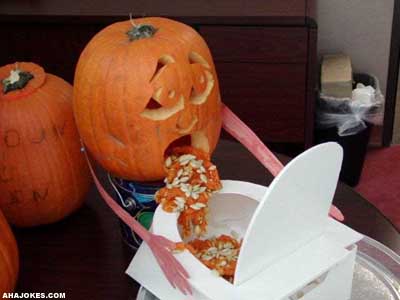
When you eat too much candy, bad things happen.
This is so gross, and too funny.
Not for people with a weak stomach.
More Mubarakiya Art
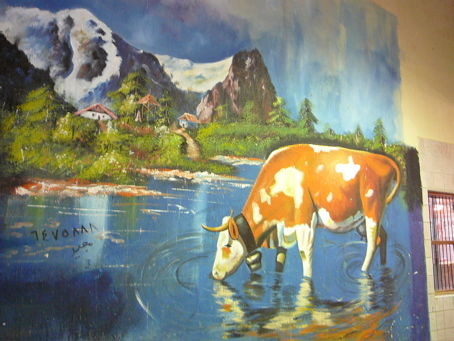
I think this is a total hoot! Along with the Pacific Coast scenery and fish, we have a Swiss Cow, with a bell, and Alpine scenery.
Here is one I love, a genuine Kuwaiti butcher – I love the glasses! Faces and hands are hard to do, and this artist caught his individuality. I wonder if he is still in one of the smaller meat market shops? Also note the bloodstains on the cutting table!

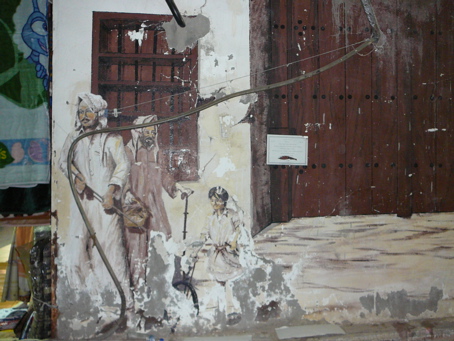
And here is a treasure, just outside the older section, near the date souk, badly damaged, and someone has strung a power cord across it, but one of the best pieces in the market. Love the colors, and look at the stone entry – the artist truly captured the feeling of stone. Look at the depths in the door and the window, the shadows and highlights. Look at the folds in the men’s thobes. This artist had some training.
Olive Oil Scandal Comment
This is a response to my recent post on The Olive Oil Scandal. I am so delighted when I get a thoughtful and enlightening response like this that I want to give it a separate entry so that it won’t be overlooked by all you bloggers with little time and short attention spans. 😉
It certainly is disgusting. One might note that, though, that none of the above named diluters of olive oil come from Spain, by far the largest producer and exporter of the product.
Currently, in fact, the Andalucian regional government (Andalucía, in which I am an olive grower, produces over 30% of the world’s olive oil) is currently funding a project intended to identify through mass spectometry analysis the molecular ‘signature’ of all the different regional denominations of extra virgin olive oil, enabling bottlers to include this information on barcode-like labels on every bottle marketed and against which the contents could be tested. The systematic adoption of this system, when it is completed, would go along way to protect consumers from the present situation, brought on partly through the fraudulent business practices of various Italian and American producers and sellers.
Also, considering that IOOC olive oil standards have no legal force in the United States, effectively permitting virgin or lampante oil to be sold as EVOO (but not diluted with other oils), the seemingly imminent adoption of international nomenclature by the USDA would be a very positive move. It can’t come soon enough.
Charles Butler’s website, The Olive Oil Gazette, is an absolutely fascinating resource, with all kinds of listings for Olive Oil sites and all kinds of olive oil information, including an article on October 21 about the proposal for the DNA “fingerprinting” of olive oil. Here is what it says about author Charles Butler McKay:
The Olive Oil Gazette is published in Cazorla, Jaén, Spain by Charles Butler Mackay, whose Spanish birth certificate states, correctly, that he was born in Toronto, Canada. Aside from editing this news source, he owns and oversees an olive plantation that has been in his family for a century and a half.
Thank you for your input!
Meanwhile, I don’t want to be sceptical. For a very good price, I found the below olive oil at the Sultan Center, and the lable says all the right things:
Cholesterol Free
Less than 1% acidity
Cold Pressed
It even has an expiration date
And it says it is a product of Syria. Because I am sceptical, I bought it because I thought it had a pretty label:

Fish Market Public Art
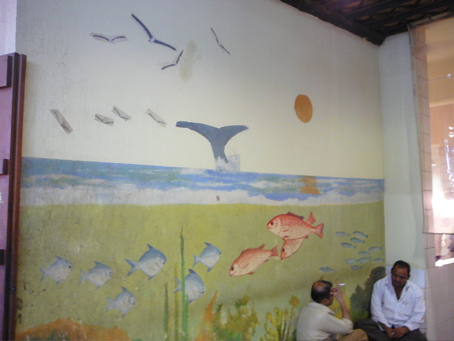
There are so many things I like about the Mubarakiya market. I believe it suffered enormous damage during the Iraqi invasion, and was substantially rebuilt. They did it nicely. The ceilings are high and spacious, and there are beautiful decorations in unlikely places. I found some Fish Market paintings I hadn’t photographed before.
One thing is kind of funny – wouldn’t you think in Kuwait you would have dhows or showies, the Arab Gulf fishing boats? To me, this looks like the Oregon Coast, with the big boulders and rocky coastline! I am thinking those look like Pacific Coast fish, and isn’t that a whale with the seagulls? Are there whales in the Gulf?

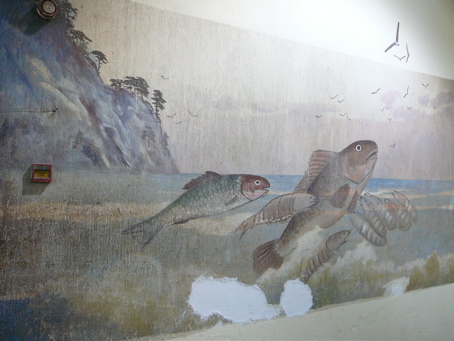
I couldn’t take this one without the two guys taking a break, so I just included them – they ARE part of the Mubarikiya scenery:
Mubarakiya Evening
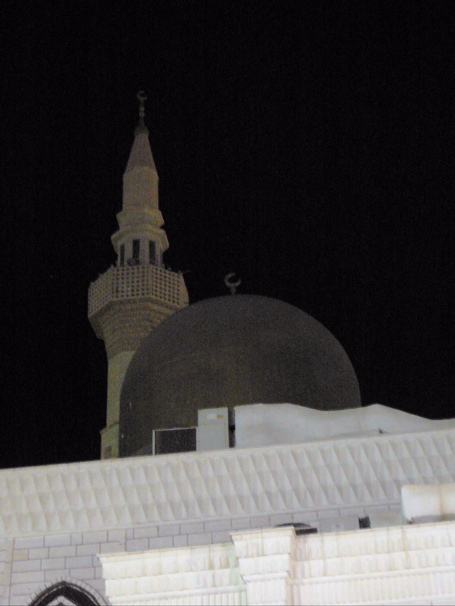
The weather has definitely cooled. We grab out friends and head for one of our very favorite places, the Mubarakiya market downtown, one of the few places still in existence with a flavor of old Kuwait.
We’ve visited in recent months, but the heat defeated us. Last night, our closest 4,000 friends were down there with us, shopping in the markets, having a bite to eat in the outdoor restaurant area (you can only tell which restaurants are which by the different colors of the chairs and tables) relaxing, visiting, just enjoying a beautiful mild weekend evening.
And it was beautful. We have eaten there in the heat, with cooling fans to keep things bearable, we have eaten there in the cold of winter, with little stoves on the table to keep the tea hot and to warm our hands (a little) but this night was utterly perfect. Warm enough, cool enough, and fresh, well prepared local food – it was a perfect evening.
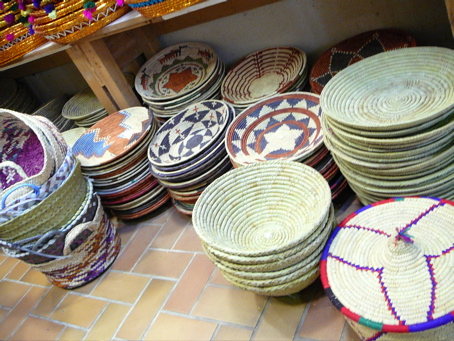
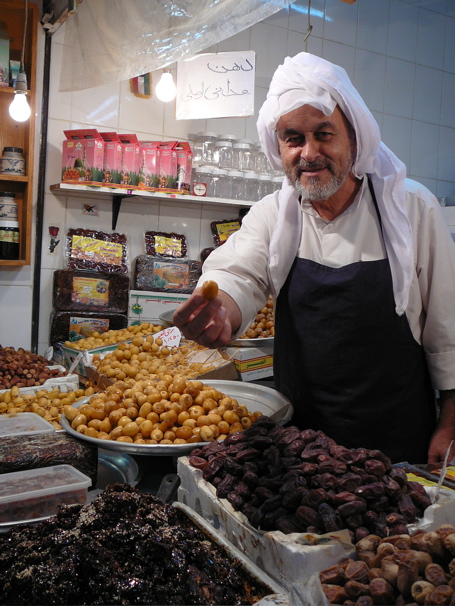
Some new Mubarakiya photos:

The Olive Oil Scandal

A good friend gave me a subscription several years ago to The New Yorker, and at the time I didn’t know how lucky I was. First, I loved the cartoons. A couple magazines later, I got pulled in by some of their excellent travel and political writing. Later, the fiction issues pulled me in and introduced me to authors I had never read before. In no time at all, I was totally addicted.
Now, when The New Yorker arrives, Adventure Man and I fight to see who gets to read it first! Often he wins; he skims it. He knows I will take too long getting through it.
It was the New Yorker magazine who informed me about the great olive oil scandal.
I love olive oil. I only use other oils in baked goods, where the olive oil might give an odd taste, we use olive oil almost exclusively. Or so I thought.
In the August 13 Issue of the New Yorker, Tom Meuller starts like this:
On August 10, 1991, a rusty tanker called the Mazal I docked at the industrial port of Ordu, in Turkey, and pumped twenty-two hundred tons of hazelnut oil into its hold. The ship then embarked on a meandering voyage through the Mediterranean and the North Sea. By September 21st, when the Mazal II reached Barletta, a port in Puglia, in southern Italy, its cargo had become, on the ship’s official documents, Greek olive oil. It slipped through customs, possibly with the connivance of an official, was piped into tanker trucks, and was delivered to the refinery of Riolio, an Italian olive-oil produce based in Barletta. There it was sold—in some instances blended with real olive oil—to Riolio customers
Between August and November of 1991, the Mazal II and another tanker, the Katerina T., delivered nearly ten thousand tons of Turkish hazelnut oil and Argentinean sunflower-seed oil to Riolio, all identified as Greek olive oil.
Riolio’s owner, Domenico Ribatti, grew rich from the bogus oil, assembling substantial real-estate holdings, including a former department store in Bari. He bribed two officials, one with cash, the other with cartons of olive oil, and made trips to Rome, where he stayed at the Grand Hotel, and met with other unscrupulous olive-oil producers from Italy and abroad. As one of Italy’s leading importers of olive oil, Ribatti’s company was a member of ASSITOL, the country’s powerful olive-oil trade association, and Ribatti had enough clout in Rome to ask a favor—preferential treatment of an associate’s nephew, who was seeking admission to a military officers’ school—of a high-ranking official at the Finance Ministry, a fellow-pugliese.
However, by early 1992 Ribatti and his associates were under investigation by the Guardia di Finanza, the Finance Ministry’s military-police force. One officer, wearing a miniature video camera on his tie, posed as a waiter at a lunch hosted by Ribatti at the Grand Hotel. Others, eavesdropping on telephone calls among Riolio executives, heard the rustle of bribe money being counted out. During the next two years, the Guardia di Finanza team, working closely with agents of the European Union’s anti-fraud office, pieced together the details of Ribatti’s crime, identifying Swiss bank accounts and Caribbean shell companies that Ribatti had used to buy the ersatz olive oil.
The investigators discovered that seed and hazelnut oil had reached Riolio’s refinery by tanker truck and by train, as well as by ship, and they found stocks of hazelnut oil waiting in Rotterdam for delivery to Riolio and other olive-oil companies.
The investigators also discovered where Ribatti’s adulterated oil had gone: to some of the largest producers of Italian olive oil, among them Nestlé, Unilever, Bertolli, and Oleifici Fasanesi, who sold it to consumers as olive oil, and collected about twelve million dollars in E.U. subsidies intended to support the olive-oil industry. (These companies claimed that they had been swindled by Ribatti, and prosecutors were unable to prove complicity on their part.)
You can read this entire fascinating article here: Tom Meuller: Slippery BusinessGive yourself plenty of time. It is an article well worth reading.
There is another good reference here: The Great Olive Oil Scandal from PalestinianOliveOil.org
Investigators have gathered evidence indicating that the biggest olive oil brands in Italy — Bertolli, Sasso, and Cirio — have for years been systematically diluting their extra-virgin olive oil with cheap, highly-refined hazelnut oil imported from Turkey. [1]
A 1996 study by the FDA found that 96 percent of the olive oils they tested, while being labeled 100 percent olive oil, had been diluted with other oils. A study in Italy found that only 40 percent of the olive oil brands labeled “extra-virgin” actually met those standards. Italy produces 400,000 tons of olive oil for domestic consumption, but 750,000 tons are sold. The difference is made up with highly refined nut and seed oils. [2]
EVEN THE BIGGEST OF THEM WILL MISLEAD THE PUBLIC…
“In 1998, the New York law firm Rabin and Peckel, LLP, took on the olive oil labeling misnomer and filed a class action suit in the New York Supreme Court against Unilever, the English-Dutch manufacturer of Bertolli olive oil. The firm argued that Bertolli’s labels, which read “Imported from Italy,” did not meet full disclosure laws because, even though the oil had passed through Italian ports, most of it had originated in Tunisia, Turkey, Spain or Greece. “Bertolli olive oil is imported from Italy, but contains no measurable quantity of Italian oil,” according to court documents.”
Curezone lists manufacturers of adulterated olive oil and marketers of the same oil. It is disgusting. We pay high prices for junk-olive oil. From Curezone.com/forums
The Guilty
Below is a list of known adulterated brands and dishonest distributors with links to information about their cases.
Adulterated brands of extra virgin olive oil
with country of origin
Andy’s Pure Olive Oil (Italy)
Bertolli (Italy)
Castel Tiziano (Italy)
Cirio (Italy)
Cornelia (Italy)
Italico (Italy)
Ligaro (Italy)
Olivio (Greece)
Petrou Bros. Olive Oil (California)
Primi (Italy)
Regale (Italy)
Ricetta Antica (Italy)
Rubino (Italy)
San Paolo (Italy)
Sasso (Italy)
Terra Mia (Italy)
Distributors caught selling adulterated olive oil
Altapac Trading
AMT Fine Foods
Bella International Food Brokers
Cher-Mor Foods International
D&G Foods
Deluca Brothers International
Gestion Trorico Inc.
Itaical Trading
Kalamata Foods
Les Ailments MIA Food Distributing
Lonath International
Mario Sardo Sales, Inc.
Petrou Foods, Inc.
Rubino USA Inc.
Siena Foods Ltd.
Vernon Foods
So who do we trust? How do we know that we are getting a quality, unadulterated product? This is fraud in an international scale!
Three Movies
Most of the time, I work in silence. I have a lot of things I need to think about, and the silence helps me think. When I am ready for some entertainment, I usually listen to BBC. Occasionally, as in the last three days, I turn on the TV, more for background noise than anything else.
Most of the shows I like the best have sharp women as main characters – I love Veronica Mars! I enjoy The Closer, and Crossing Jordan. I love how they overcome their dysfunctions, and how they use their smarts to solve cases. I love it that they screw up from time to time, and have to suffer the consequences, but that they overcome their screw-ups and prevail.
The last three days, I watched parts of three movies. In the first, Braveheart, we were watching Mel Gibson playing Braveheart, but I was constantly distracted by his preening. Have you seen Braveheart? It’s like he is conscious of the camera on him every minute, we the viewers are merely mirrors, absorbing and reflecting his glorious countenance – how annoying! His vanity distracted from a pretty good movie.
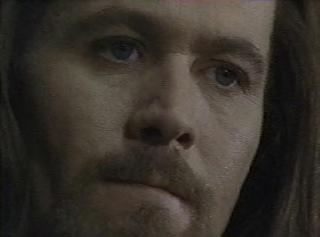
Then I watched segments of Dracula playing Ludwig von Beethoven. I am from a family of movie watchers; my son and husband know all the names and rush to IMDb to check out anachronisms, historical inaccuracies, goofs in continuity, etc. All I know is that every time he went to kiss one of those Viennese women, I wanted to scream “Watch your neck!”
The movie was interesting, and they made good use of all Beethoven’s most loved music, and they used it appropriately. Oldman did a good job of bringing Beethoven to life and making his deafness tragic and believable. He also shows the fickleness and cruelty of the audience for whom he made his music.

Then, yesterday, there was Jack Bauer playing Paul Gauguin! In the early parts of the movie, he lived in a luminously violet painted interior, one I am dying to copy. But that is not the point. Jack Bauer is a stoic. Stoicism is great when it comes to playing a guy who has so many bad things happen to him in the space of 24 hours.
(this is also beside the point, but can you imagine being married to a guy like Jack Bauer? Like he would never tell you what he was really up to, the most exciting times in his life are not with you and his children but off protecting the United States of America, he comes back to you addicted to heroin, or totally burned out and just when you have him all patched up again he gets a call that his services are needed, and you don’t hear from him because he is all caught up in his latest adventure and then after 24 hours he comes home again, a total wreck? What kind of family life is THAT??)
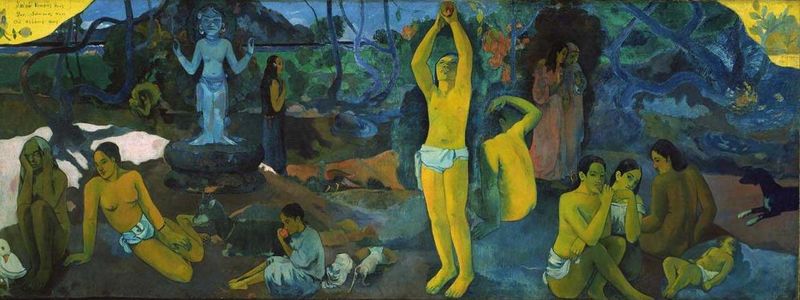
As Paul Gauguin, he leaves his stockbroker existence and becomes a starving painter, then a starving painter who somehow makes it to the South Seas to paint some of the most amazingly colored art every created but his facial expression never changes much. Paul Gauguin was all about passion – and it is just too much a stretch for Jack Bauer. He is not a believable Gauguin. He is not even a believable Frenchman. He barely moves his hands! I would watch the movie again, however, just for a glimpse of those violet colored walls.
It must be a problem for actors, especially TV actors who become too closely associated with one role. I had to look up his real name: Kiefer Sutherland. Fortunately, a new season of 24 starts in just three days. If you ever want to feel sorry for Kiefer Southerland, look at his dad’s resume’ of movies: Donald Sutherland. It wouldn’t be easy to live up to that legend.
Tareq Rajab Museum of Islamic Calligraphy
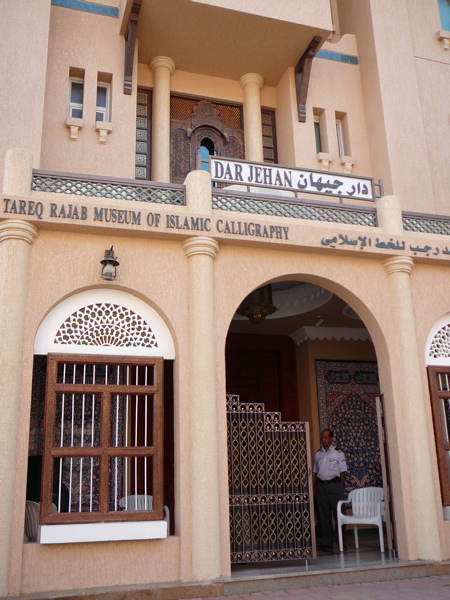
One of the most beautiful buildings in Kuwait is the new – open only since March – Museum of Islamic Calligraphy in Kuwait. I am in total awe of this family, who have an eye for the history and culture of this area, collect it lovingly, and then display it – free of cost – to all who wish to visit.
The TR Museum of Islamic Calligraphy is on the same street as the Dar al Cid, where many art exhibits are held, also under the auspices of the Tareq Rajab family. It is around the corner from the Tareq Rejab Museum.
It is open every day:
Mornings 9 am – 12 noon
Afternoon 4 pm – 7 pm
Friday 9am – 12 noon
We visited recently. The museum is beautiful, and well organized. We wished only that more of the exhibits had explanations; sometimes we would be looking at something very beautiful, but we didn’t know the significance of what we were seeing.
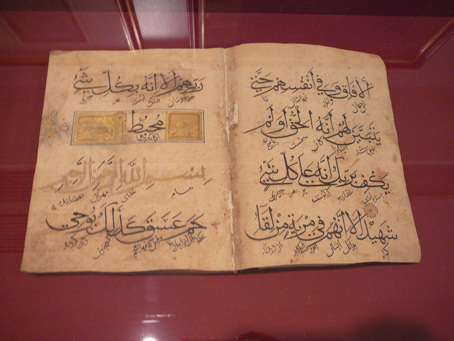
The calligraphy is manifest in hangings, ancient Qurans, quiltings, posters and carved wood. Each item is a work of art. We were fascinated by some of the Chinese calligraphy, and by the video they run showing how calligraphic quills are made, how the paper is prepared, even how the calligrapher prepares for work.
This is the entry to the Museum of Islamic Calligraphy:
Some examples of the beautiful works on display:


If you are looking for books about Kuwait, and/or Islamic Arts, the Tareq Rajab Museum has a well stocked little shop with books, cards, postcards, etc. for reasonable prices.
We take all our houseguests to these museums, and every time we go, we are moved by the generous hearts that create these museums and then offer them to the public – free of charge. They give so much to their community. It’s like a little piece of heaven. Visit soon!
Kitchen Before and After
Wooo Hoooooooo! The ugly kitchen is gone! The new kitchen is finished!
Before:

After:

Recent Comments
Kitchen on Isiais: Winding Down intlxpatr on Shampoo Ginger tigerbutterya0c5ff1d… on Shampoo Ginger intlxpatr on British Soldier Kidnapped, Esc… John on British Soldier Kidnapped, Esc… Wikipedia Donate Button

Amazina


Early Voting in Florida


