On Our Own in the Souks of Marrakesh and the Jemaa el-Fna
Free at last!
We are as giddy as children let out of school as the groups head left and we head right, going deeper into our favorite territory, the souks (small shops) in the great city of Marrakesh.
Before we ever went to Marrakesh, many years ago, we read a book by Elizabeth Warnock Fernea, author of Guests of the Sheikh, called A Street in Marrakesh, talking about how her family lived in the center of Marrakesh, among Moroccans, and the adjustments they made as they grew to learn more about their environment. You know how you can read a book and feel like you had lived it? We felt we had lived in Marrakesh.
When we visited with our son, we had a car and were driving all through Morocco. We had left Ouazazarte and driven over the Atlas Mountains, stopping here and there to buy fossils and “thunderballs” which are also called geodes. It was late, and dark when we got to Marrakesh, and we had to stop and ask directions at a gas station how to find our hotel. We knew we were near, and we didn’t know how to close the distance. This was before smart phones and Google Maps.
Our son and I watched AdventureMan from the car, and as we watched him ask the two men working there, one pointed left and one pointed right. We were dying laughing. And, actually, both were right, there was an obstacle between us and the hotel and you could go right – or you could go left. At that moment, a motorcycle drove up, listened to the question and offered to guide us to our hotel. This is the essence of Morocco to us; the kindness and the hospitality of the Moroccans.
I wish I could remember the name of the hotel, but our room was huge, and full of tile work. Our son had his own area, on a separate level in the same room, and his own TV. It was a far cry from a sterile, modern hotel; this was full of color and detail, tile and wood work.
The next day, we hired a private guide for a tour of Marrakesh, and had a wonderful time exploring all kinds of wonderful places.
So now, off we go, and the smells and the feel of the souks almost make us giddy; we are back in our element.
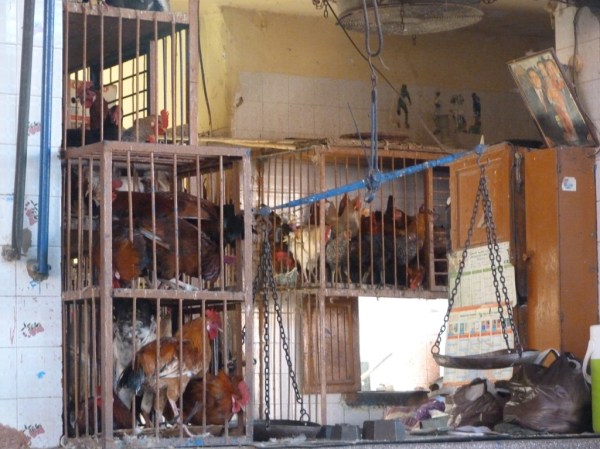
As we wander, we can hear roosters crowing, and, in the middle of the souks, we find a souk devoted to roosters. It is the middle of the afternoon, a quiet time of day, perfect for wandering.
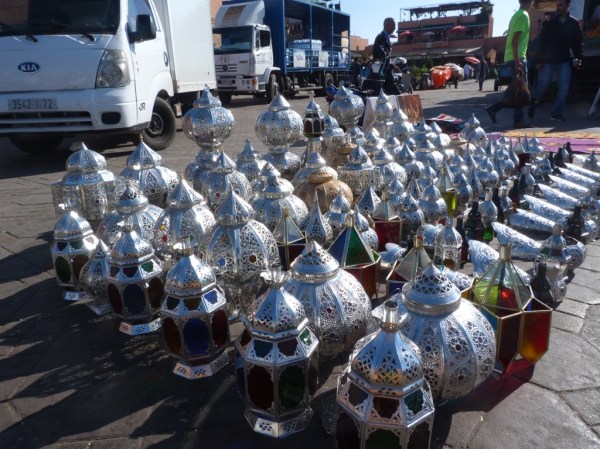
Me and my attraction to light fixtures 🙂
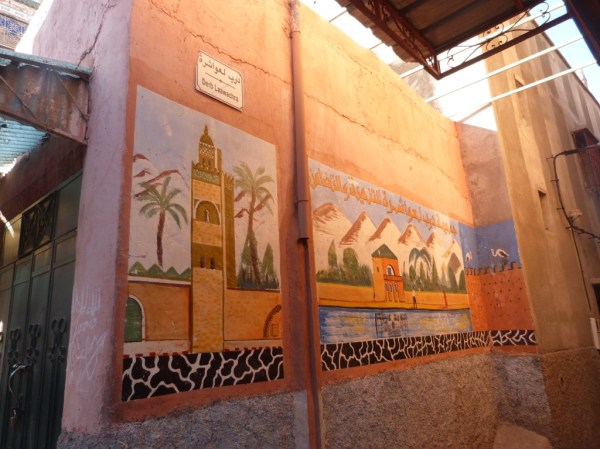
A mural of the Koutoubia mosque; one of the reasons we felt so secure in this souk is that if you get lost, you just look for the highest tower around, and that is the Koutoubia mosque, which takes you to Jemaa el-Fna.


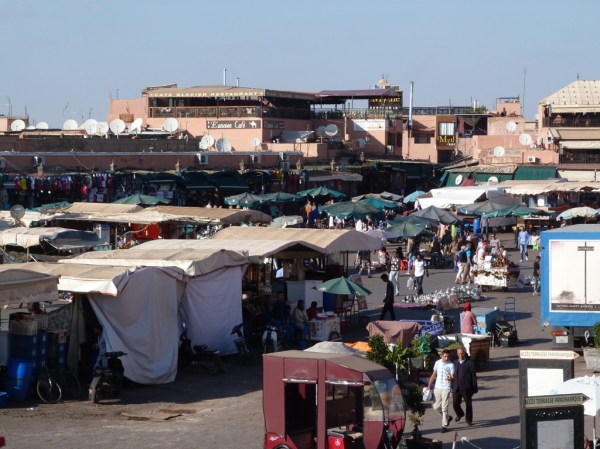
We walked to our content, and then settled in at late afternoon to a cafe with a terrace high over the Jemaa el-Fna, where we had our choice of tables and could watch the market come to life. As we sipped our mint tea, the other tables filled; Moroccan families, tourist couples, assorted characters. The day is gorgeous, we have a shaded location, life is sweet. We’ve soaked in the sights and the smells. We’ve done more than our 10,000 steps. We enjoyed this afternoon immensely.


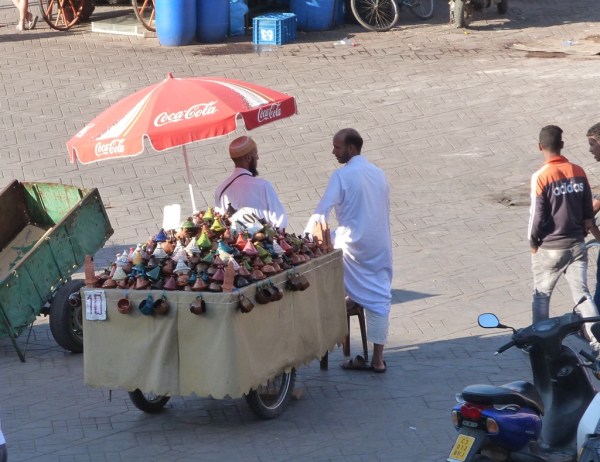


Dining in the Dar Es Salaam, Marrakech

We have driven a couple hours to get from Casablanca to Marrakech, and the bus lets us off just a short walk from the restaurant, the Dar Es Salaam. I don’t believe this restaurant is open to the public; I believe this restaurant is a dedicated group-tours service restaurant.
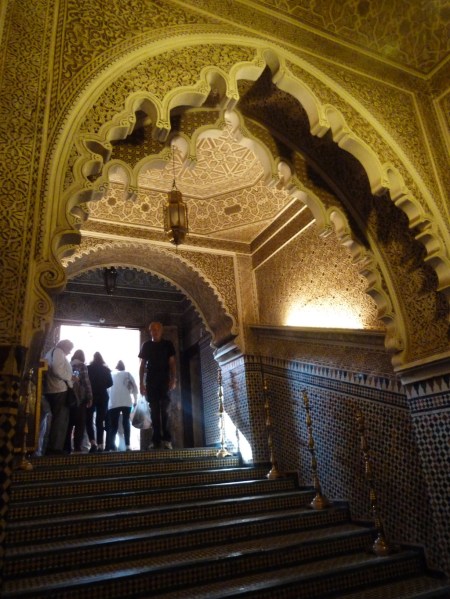
I admire what they do. They have a lovely venue, it looks like it might have been one of the grand old homes in the city, or even an old mosque. It has elaborate decorations, and lovely spaces. Whatever it was at one time, it has been gutted, and turned into a restaurant that can seat and feed many many people in a very short amount of time.

Those are not leftover bread crumbs on the table, they are rose petals to welcome groups.


Tables were marked with signs indicating Smithsonian and/or Purple, and as soon as eight people were seated around a table, service began, first hot towels, then water and small appetizers/mezze. They were pretty good. Most were not heavily spiced.


Appetizers were some kind of lentils, a beet salad, a mashed potato and pea combination, something maybe with a little lamb, and olives. The olives were delicious.
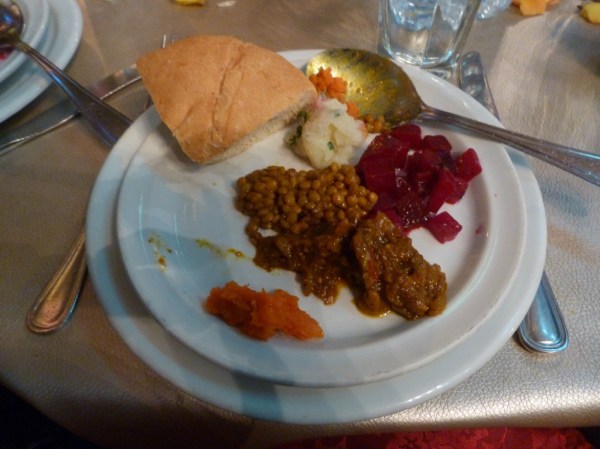


They served a huge tajine with some kind of beef dish. It was well cooked, like beef and carrots, with little or no spices that I could detect. Nourishing. Filling.
The venue is spectacular. It is truly a fabulous environment in which to take a meal. The catering service has paid attention to detail, with rose petals on the table, good settings, enough water, good sweets at the end of the meal and hot mint tea poured with a flourish. The restrooms were clean and there were several. I admire the way they can serve so many people so quickly, get-them-in, get-them-out and give them a meal in which there is little to object to . . . unless you’ve had Moroccan cooking before, and like a little taste in your food. We like taste in our food.
We’ve been married and traveling together for so long now that we know we aren’t going to be able to stay with the group. We love Marrakech; we’ve been here before. The last time was with our son, about fifteen years ago, but not a lot has changed. Our group leader looks a little worried, until we explain that we know the city, we speak Arabic and French, we know the customs, and we can find our way to the hotel on our own when we are finished. We walk – we almost run – away before anyone else knows we are gone.
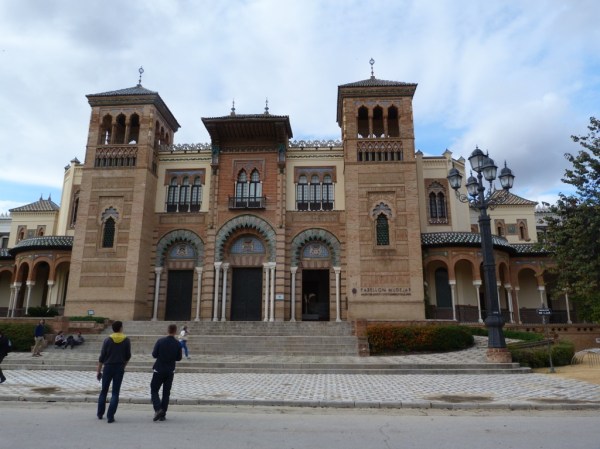
Seville’s Folklorique Museum
Just across a large plaze is another wonderful museum, one I could happily spend many days in. Once again, they waved us through, they would not take our money. There were several exhibits showing us how things came about, how they developed wheat grinding, for example, how fabrics were woven, all with tableaux and short videos. We watched one very long video about a church that carries the Saint or Madonna around the town on a special cart once a year, and celebrates with a festival.
My favorite part of this museum is one whole wing devoted to textiles, embroidery and gossamer shawls, that remind me so much of the ancient, transparent “shayla” the elderly women used to wear as veils in old Qatar and old Kuwait. Nothing like the black opaque headscarves and face coverings of today; these were light and airy and as fragile as a spider’s web. I have one I treasure, but I keep it wrapped in a box because it can tear so easily. Here is a whole wing of a museum with glorious examples of exquisite handiwork of this nature.
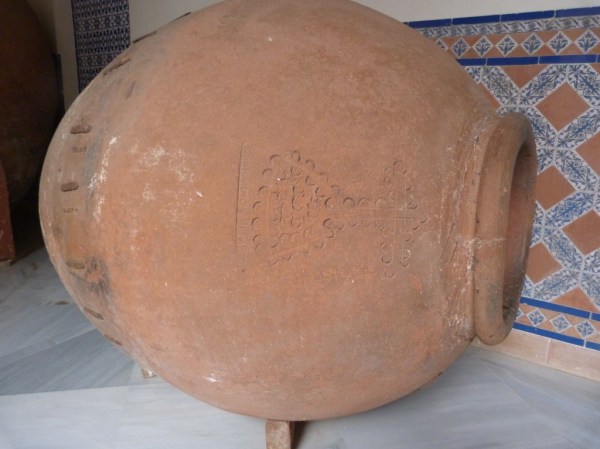
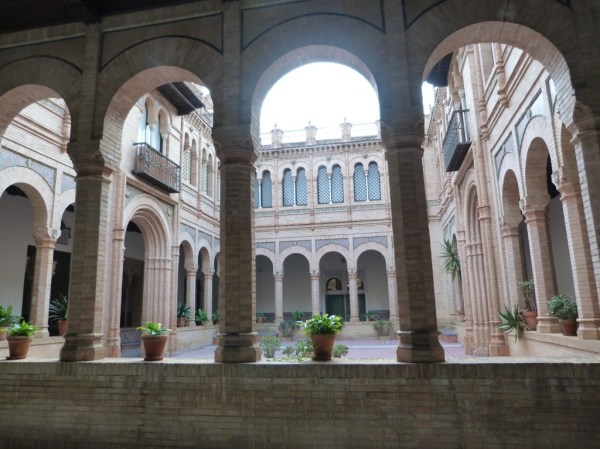
Hand embroidered cut-work:
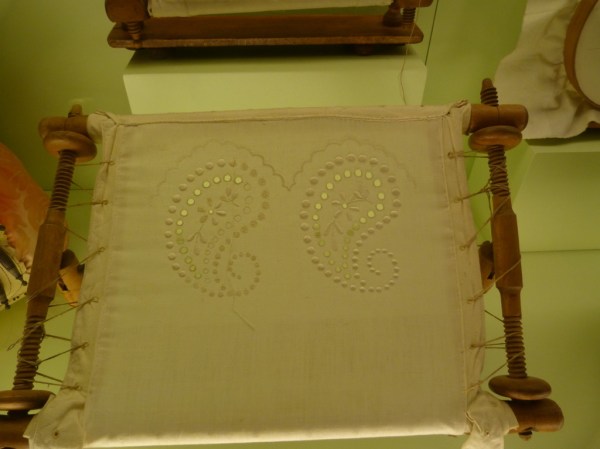
Hand worked lace and cut-work on fine linen:
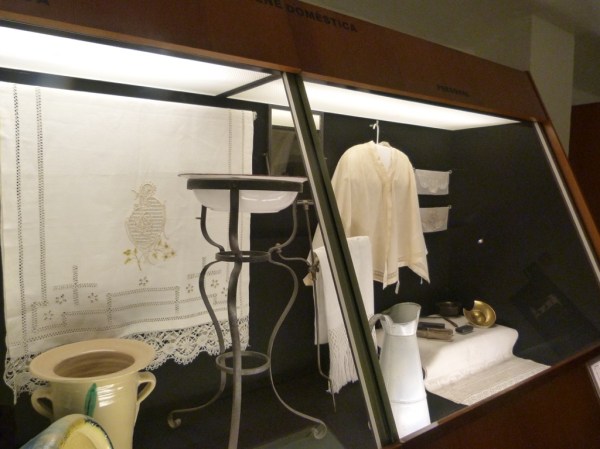
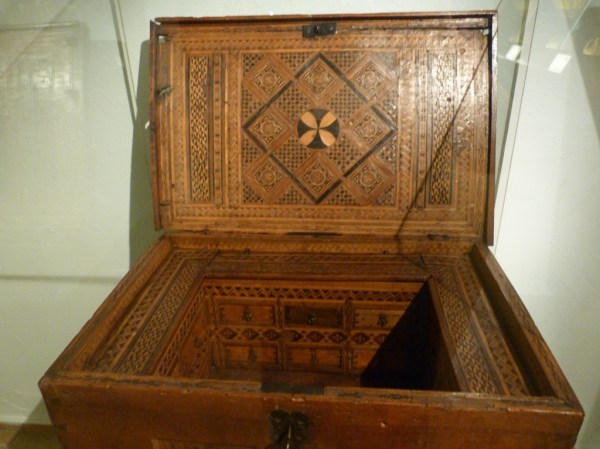
Decorative tools and utensils:
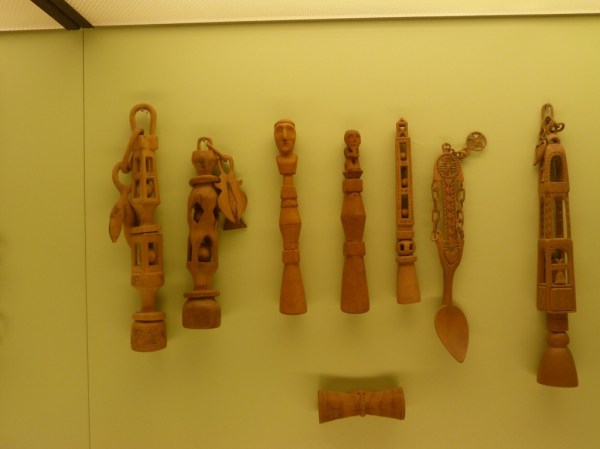
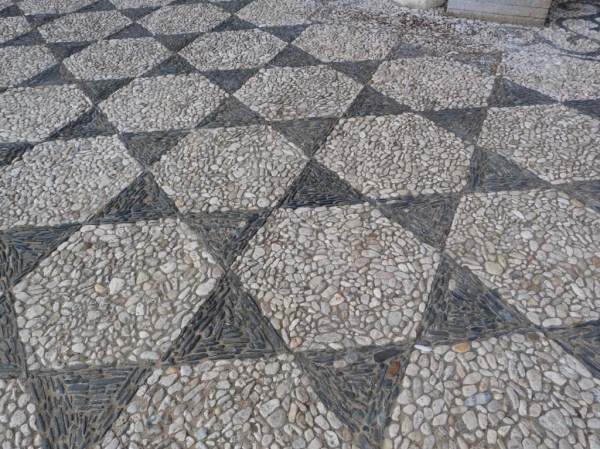
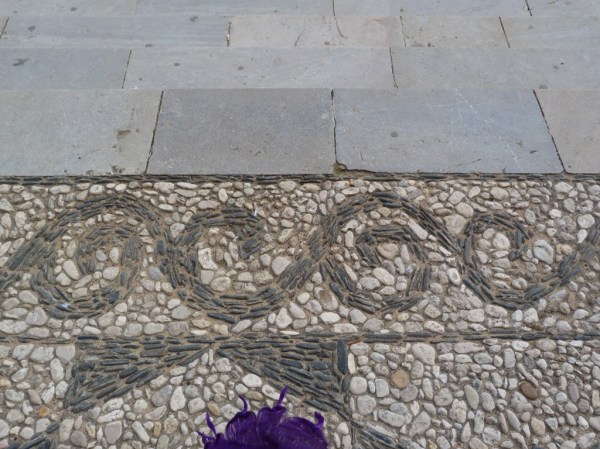
The Folklorique Museum and tile patterns done in stone and mosaic:
Gossamer lace work:

Glorious white work:

Finely woven and embroidered silk:

We would haunt the flea markets of France, and find many similar treasures in France, tossed out by people who wanted new and glossy. I bought linens of all kinds, but nothing of this quality.
We were thrilled to have this extra day to see Seville more thoroughly, and to explore these two museums. Once again, and easy 10,000 steps 🙂
Hopping off at Seville’s Museum of Archaeology
We had wanted to see this museum, and thanks to this bonus day, woo hoooooo, the Hop-On Hop-Off bus lets us off just a short walk through the park to the Museum. The Museum attendants waved us through, wouldn’t even take our money, and directed us to start down-stairs.

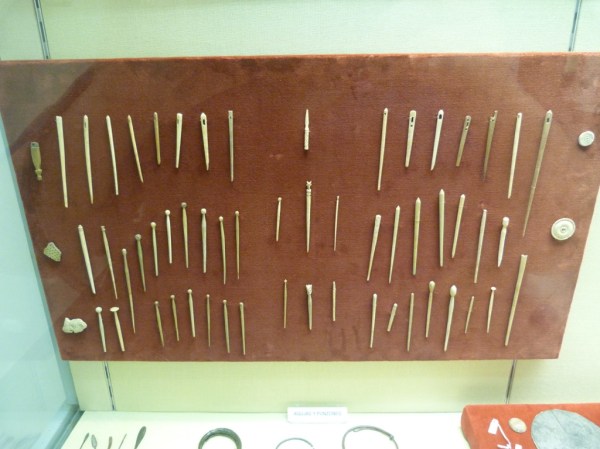
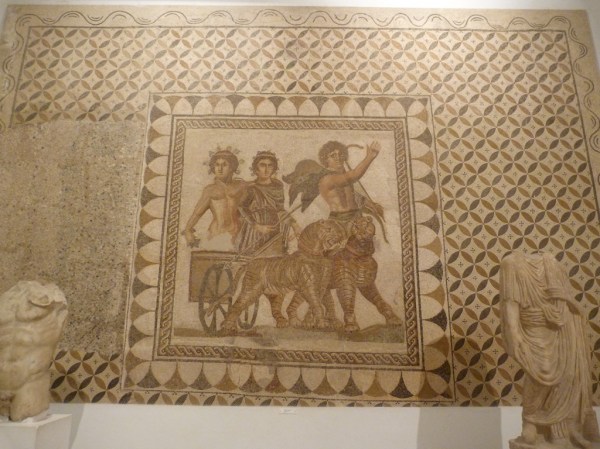
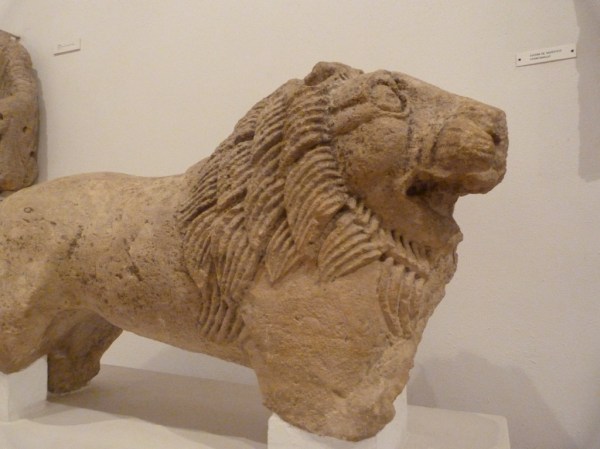
This museum is full of treasures, carefully curated, beautifully edited. The pieces they display give good information. We found something lovely in every room. MdventureMan often commented about how good this museum was about placing the find in a meaningful context:


I am always interested in early needles 🙂 How man figured out how to make them from tiny bones, how they got the eyes in the needles without splitting them, fascinates me.

Cordoba, The Mezquita, and Sharing Sacred Spaces
(Yes, it is Christmas Eve, and my part of the preparations are all done. AdventureMan is cooking a duck for the family dinner tonight, the Gulf Coast jumbo shrimp is all cooked and shelled and de-veined, the Rotkohl spicing up the kitchen, the salads and side dishes ready to go. 🙂 I have time, oh, the great luxury of time, to write . . . )
When we lived in Amman, we often went to Syria. I went once with an archaeological group, visiting several sites in the bleak cold of the Syrian winter. One site I didn’t see a lot of hope for, the site of St. Simon the Stylite, a hermit who sat atop a pillar and was considered holy. In truth . . . I scoffed.
I scoffed until I reached that isolated hilltop, and saw the giant pillar, and felt how very cold it was as the icy wind blew. We were there two or three hours. I had to confront my unwillingness to believe and the fact that with every zinging atom in my body, I could feel that this was a sacred place. Saint Simon chose a weird sort of sacrificial life, but in God’s eyes, I suspect it mattered. I know visiting that site changed me, and changed my ideas about sacred spaces.
Today, I get to write about a visit to another sacred space, a space you can feel resonating from the moment you enter, the Mezquita.
* * * * * * * * *
It’s early breakfast for the Smithsonian group, and then we check our whisper guides and board our bus en route to Cordoba.
Traveling with a group is a novelty for us. It means using an alarm clock to be at scheduled breakfast and getting on a bus for a 2 hour drive. On our own, we wake when we wish – usually early, but not so early as with this group. We are not usually at a breakfast with a lot of people looking for food at the same time. We are not used to coffee makers that make one cup of coffee at a time while a 100 people line up for coffee. These are things that are not normal in our experience. We might find a local small store, pick up some water and some small snacks, and hit the road, stopping here and there to take a photo or just savor a view, have some water, soak in the fresh air. On the other hand, these bus drivers know where to go and there is no getting lost trying to find the right route out of town.
En route to Cordoba, most of the jet lagged Smithsonian group slept. Wide awake, I watched as acres and acres of olive groves and wind farms passed by. We saw an ancient fortification on the side of a hill that had a view to die for – 270 degrees plus of visibility.
It is raining once again as we arrive in Cordoba, but almost immediately it stops, and by the time our group has walked up the hill by the Mezquita, the sun is out and the day shows great promise. Cordoba is beautiful. Everywhere you look is some exquisite detail. Cordoba is a treat for the eyes.
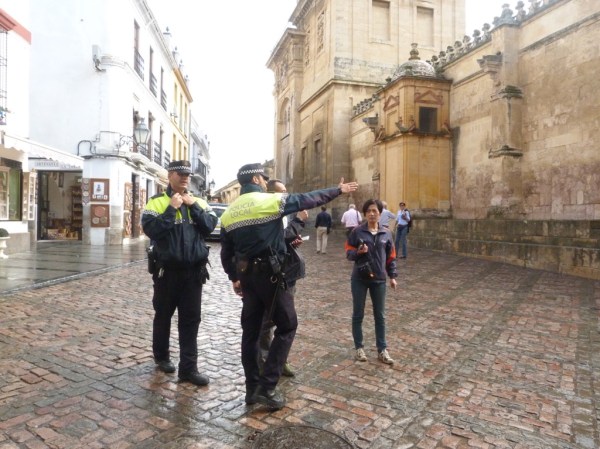
Even the police are polite and helpful, directing tourists to where they need to go:
Art Nouveau bench:
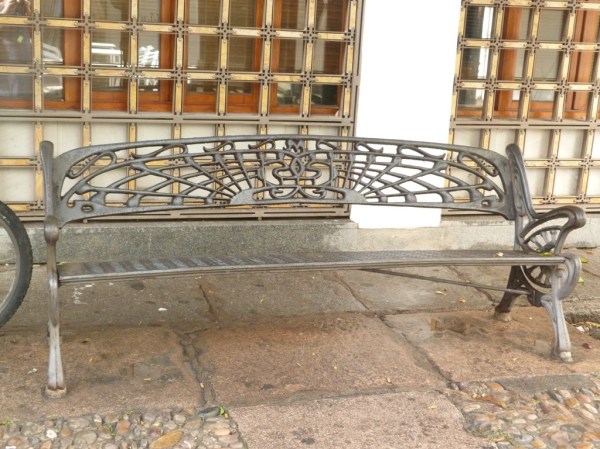
Flower pots on the stucco walls:

Tourists coming up to The Mezquita:

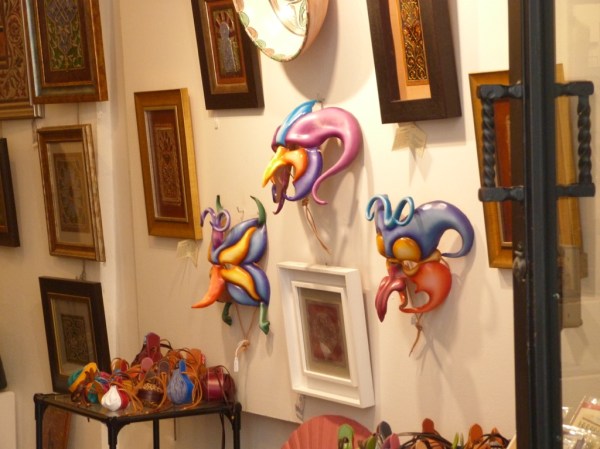
Masques in a local art shop:
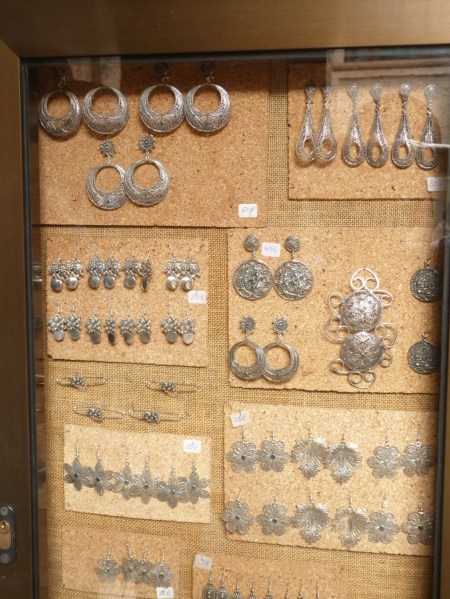
Finely wrought silver filigree jewelry:

At one point, we had a choice: Do we go shopping or do we have lunch in a highly rated local place? I bet we could do both, and we opted for lunch – more on that to come. At the end of lunch, we had only ten minutes to shop and not enough time to get back to this wonderful shop. I won’t call it a regret; lunch was a wonderful experience . . . and I do love filigree, and this artisan had beautiful silver filigree . . .
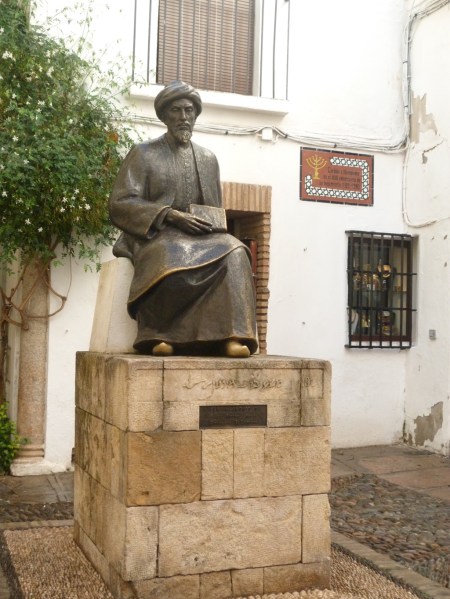
Ben Maimonaides, a Jewish scholar and ethicist, with wide influence. This was a continuing theme on the entire trip, that the interaction between Jew, Christian and Moslem in this period led to a great leap in ideas and artistry. The interaction was like pollination; science and the arts and mathematics and medicine bloomed.
I wonder if this is happening today, as Moslems, Jews and Christians study together in universities, to they interact and inspire one another? Is it possible that in spite of dire political headlines, under the radar, people are learning to cooperate and collaborate in the interest of a better world?
(Wikipedia: Aside from being revered by Jewish historians, Maimonides also figures very prominently in the history of Islamic and Arab sciences and is mentioned extensively in studies. Influenced by Avicenna (c. 980 – 1037), Averroes (1126–1198) and Al-Farabi (ca. 872–950/951), he in his turn influenced other prominent Arab and Muslim philosophers and scientists. He became a prominent philosopher and polymath in both the Jewish and Islamic worlds.
Bulls everywhere, LOL

An artistic courtyard
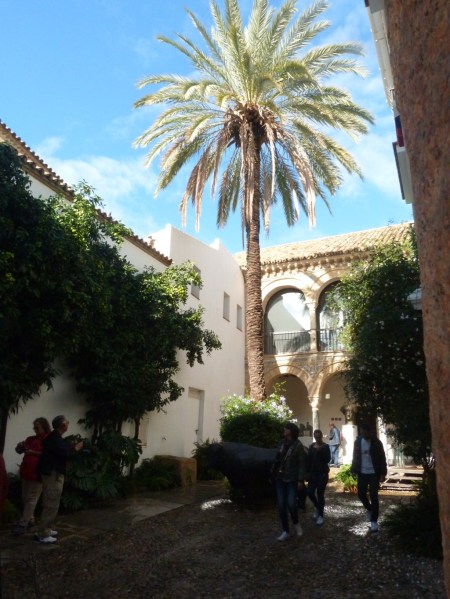
Love the little blue pots, and love the people who take care of them!

After our walking tour of Cordoba central, we gather in the gardens while our guide goes to pick up our tickets to take us inside the Mezquita, built as a mosque, becoming a cathedral after 1492.
Did I mention we learned two major dates on this trip: 711, when Tariq crosses into Spain (Jebal Tariq . . . Gibraltar) and 1492? Americans know 1492 as the year “Columbus sailed the ocean blue in fourteen hundred ninety two, but 1492 is the year that the Moslems were driven out of Spain, weeping at the loss of Andalusia, Al-Andalus.
When the Moslems were driven out of Cordoba, the huge, beautiful mosque, Al Mesquite, was not destroyed, but recycled, repurposed, space holy to one faith became holy to another. I love it that the original mosque, with its spectacular soaring arches and inspirational proportions, was recognized, and re-utilized. Holy space is holy space. We worship the same God. We saw the shrine to John the Baptist in the Grand Ummayad Mosque in Damascus; why should we not share holy spaces?


This is what you see immediately upon entering the Mezquita – a gorgeous kind of meshrabiyya covering the windows, patterning the light as it enters, keeping the harsh heat out and shrinking light in star like patterns across the floor.

The interior of this mosque/cathedral takes my breath away. It was crowded with tourists, but it just swallowed them up and maintained its sacred integrity. We could wander off and still hear our guide, thanks to this whisper-technology, where we all had headphones and our guide could broadcast. This was a place where I needed to wander off and experience it on my own, but felt some responsibility not to get too far afield from the group. I didn’t want to be a pain in the neck for the guide. And I also didn’t want to be a part of the group within this structure. It’s a problem.
Just look at these spaces:

I’ve always had a thing about light fixtures, LOL, I probably should own a lamp show except I would only stock what I like and I would have a hard time selling anything in the shop. Guess it’s just a good thing for me to admire light fixtures and not to have to manage them.

The beautiful Mihrab (points you in the direction of worship in a mosque) from the original mosque:

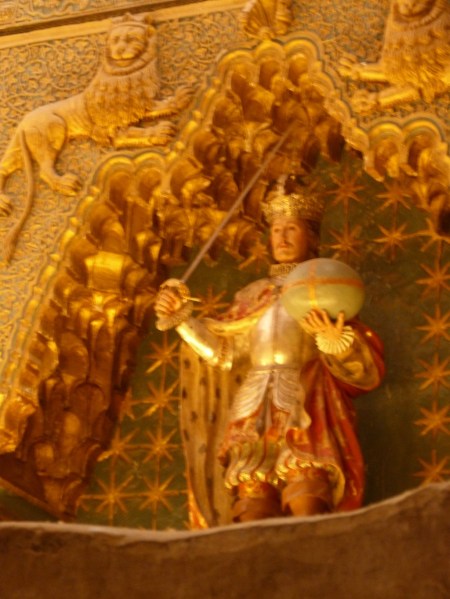
The Christian altar built in a structure added to the original mosque:

With a piece depicting King Ferdinand holding a globe:
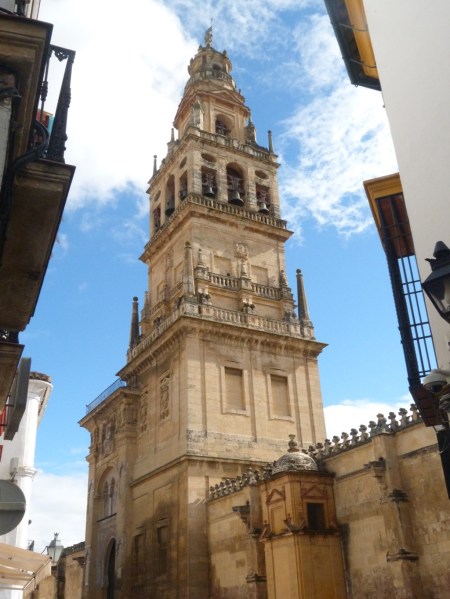
As the tour ended, our tour guide warned us that we had only an hour and a half for lunch, so not to go to a restaurant, just find something quick, or shop, and BE BACK ON THE MEETING PLACE AT TWO!
We had seen a restaurant we wanted to try, so raced to it. We hate being rushed, and part of the fun of traveling is trying new kinds of food in new places!


Sunny Afternoon Stroll in Seville
(Sorry for the lengthy break; Paris terrorism, Thanksgiving, Pre-Christmas and grandparenting takes its toll 🙂 We are taking care of our grandson when he gets out of school, and 5 years olds have so much ENERGY!)
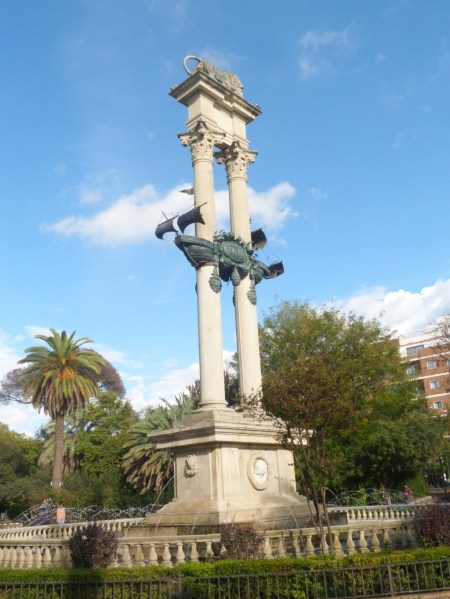
From a torrential morning, we have landed in a warm, sunny afternoon. After lunch, we stroll the avenue, spotting monuments to Ferdinand, Isabela, Columbus and a memorial on the back of the Alcazar.

The Cathedral is glorious in the sun:

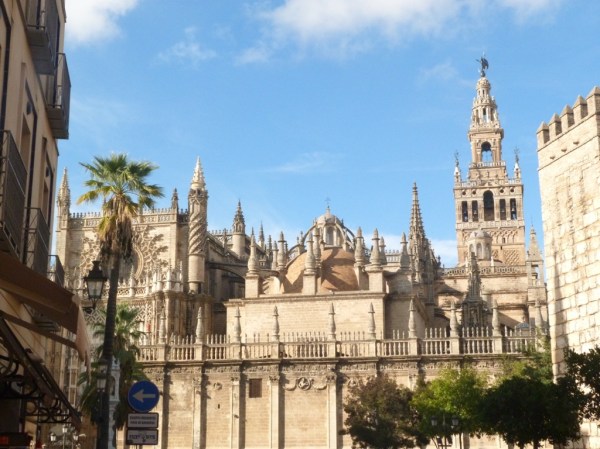
And when we see the line going into the Alcazar, we are so happy we went in the morning:

Pouring Rain and a Herd of Sheep
Our first day in Seville, and we are so excited. We are READY. This trip is rated as having a lot of walking, so in addition to my prettier shoes, I packed my Alaska shoes, a pair of black leather New Balance shoes, and a bunch of brand new socks. I am wearing a dress and tennis shoes, and feeling a little ridiculous, but I don’t care. We are given these “whisper” things, receivers you wear around your neck and earbuds you keep in your ears. Your guide can talk to you without causing a commotion, and you are supposed to always stay within hearing of your guide.
As we head outdoors, the heavens open and the rain pours down. No problem, in my purse I have a brand new sort of mini umbrella I found, so I open it up, and something is not quite right. It doesn’t stay open, as I am walking along it will pop close all by itself now and then, and besides, everyone else is popping out umbrellas and it is congested, and umbrellas are dripping on me. I am miserable.
For a few minutes, I actually contemplate skipping this tour altogether, but when else will I get a chance to tour the Alcazar? The Seville Cathedral? With someone who knows and can tell us what we are seeing? I decide to have a good time, and, for the most part, I do.
Who could not love the Alcazar, the Royal Palace, even in the gloom and the rain? The Alcazar is full of groups, but far fewer than if it were not pouring down rain, sheets of rain.
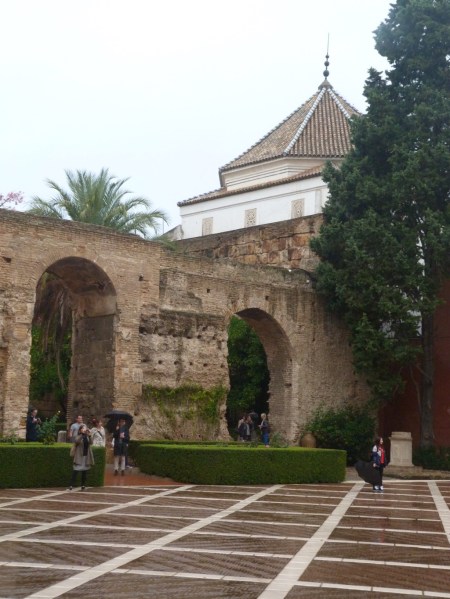
The amount thought and precision that went into the process of creating the Alcazar boggles my mind. What does a little rain matter when contemplating such beauty? So many media; tiles, wood, plaster, stone, and all used with precision and an eye for the overall effect. It is stunning.


And in the middle of all this artistry, one woman works to capture – herself.

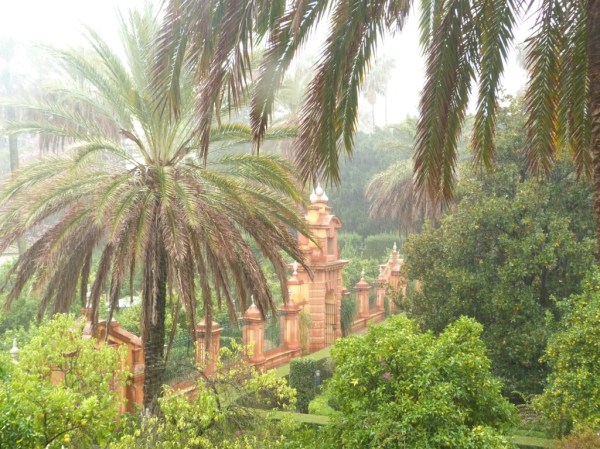
I’ve given up totally on the worthless umbrella and decided to just avoid rain if I can, and if I can’t, oh well. Visiting the gardens, it’s worth getting wet. These gardens, even in the rain, are gorgeous, lush, and I can imagine summer concerts and strolling.

We spend a good long time in the Alcazar, and it is time to head to the Cathedral, but not quite our group’s scheduled time, so we head to a cafe for churros and chocolate, a local specialty. The cafe is so cozy we almost rebel when it comes time to leave. The guide tells us that leading seniors is as bad as leading teen-agers; we argue and think we know what we want to do. We are a small group, twenty people, but similar in goals and values.
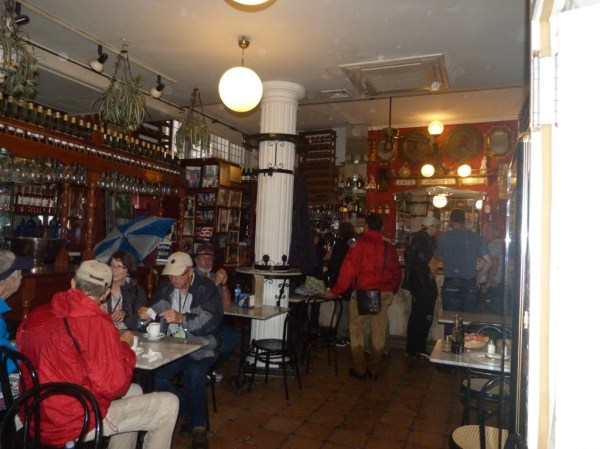
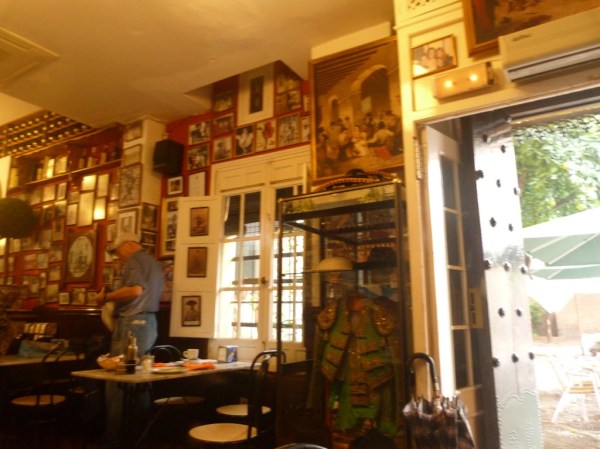
It is warm and dry in the cathedral, but my dress is soaked. My shoes, however, are great, my feet aren’t tired, my socks are dry and I have already walked 10,000 steps! The hard floors of the cathedral tire me, though, so I wasn’t paying as close attention as I meant to. It was beautiful. King Ferdinand and Queen Isabella . . .. something. Beautiful altarpiece by . . . someone. A big gold thing called a montrance which is close enough to French for me to think it was for showing something, probably sacred relics, bones or pieces of the cross? I am ready to be warm and dry and my attention is definately wandering.
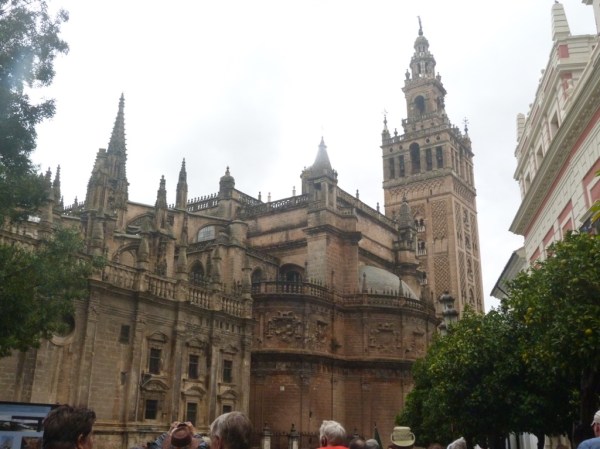


As we leave the Cathedral to head back to our hotel, just a short walk, the sun breaks through. The rain is gone. It’s a whole different day. We walk back in good cheer, change our clothes, and head out for lunch.
Today is the first day we have heard two dates: 711, when the Moslem Tariq invaded near Gibraltar (Jebal Tariq) and burned his ships, telling his men they had to fight because there was no way back. The second date is 1492, which every American associates with “Columbus sailed the ocean blue in fourteen hundred ninety-two” but we learned is the date when the Moslems were forced out of Al-Andalus. We saw paintings of people weeping as they left, and who wouldn’t weep, leaving such beauty and luxury? The same year, the Jews were also forced out, forced into North Africa, Italy, Eastern Europe, forced to seek safety elsewhere. Some converted and were allowed to stay, and are there to this day.
“But where is the herd of sheep?” you ask. This is an experiment for us, to see how well we can handle group travel. We are finding we like our fellow Smithsonian travelers very well, but because we are like cats (more than sheep) we do not herd well. We like to take our time where we wish to stay longer, and to hurry past that which doesn’t much interest us. We were trained, long ago, not to be in large groups of Americans, and here we are, a herd of sheep. It becomes a continuing theme; there are so many things we like, but walking in a group we don’t like.
Arrival in Sevilla, Spain
Except for that moment on our way to the airport, everything was smooth as glass. That moment? As we are in the taxi on the way to the airport, I am thinking how wonderfully lightly I am traveling and suddenly, by the grace of God, remember my carry-on bag, carefully packed, sitting in my room. We quickly turn the taxi around, go back and pick up my bag, and from there on, all goes smoothly.
Connecting in Charles de Gualle airport used to be a lot of fun. So many shops, so much time. Not now. There may be shops, but customs and security are a nightmare, and the new airport configuration boggles the mind. There was one bored, tired, annoyed looking Frenchman for lines of travelers as we arrived, and while we were close to the front of the line, it took forever.
Our trip back was worse; we had a tight connection. Entry was worse, lines and lines of desperate travelers, too few processors. Then we had to try to find E: M 32. It was a maze. I am normally pretty good with navigation, but CDG isn’t any fun, there is no logic, there is no assistance, no explanatory signage. We got to E, then had to find M, then had to get on a shuttle bus to somewhere else; it is purely horrible.
And I suppose it is the price you pay to fly Air France, which we love. Flying Air France is like a step back in time, where flight attendants were plentiful and gracious. We had slide-down-flat seats, great for sleeping, and good meals. We had hot washcloths and good coffee. It was worth every penny.
Our arrival in Malaga was our real introduction to group travel. Meeting us were Maria and Antonio, two consummate professionals who were greeting all the people coming in for this cruise/trip. First, we learned that there were several groups on board, in fact, just about everyone arriving was a member of some group or another. We were with Smithsonian, but others were with alumni groups, or affiliated in other ways. Once everyone on their list was checked off, we strolled to the bus, which required that the heavily laden would need the elevators. They led the group to one elevator, but AdventureMan and I spotted another elevator on the other side, and took that one.
The drive to Seville was 2 and a half hours. Many slept. It was a sunny day with some clouds, so mostly I watched the olive tree groves and the bull signs drift by, happy to be traveling in Spain.

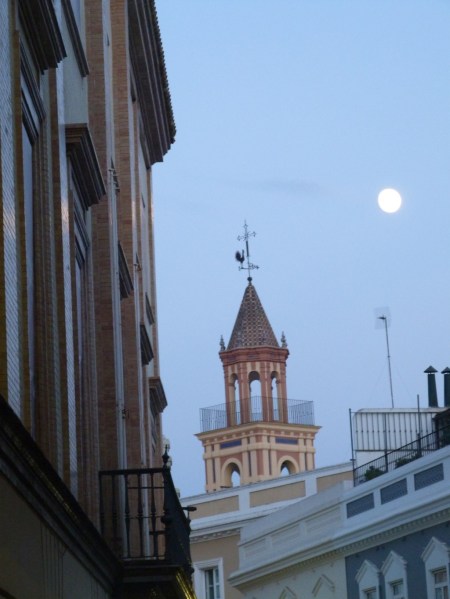
We were so impressed with the process at the hotel when we arrived; there were envelopes with the names of arriving passengers and their keys. It was all done for us, no registering, just straight to our rooms. We were happy to see we had a room in the rear of the hotel. Good firm beds and very quiet. Our our bathroom window, we had a view of a nearby church steeple, and the full moon 🙂
The bar at the Fernando III was a lively place, and a gathering place for locals and hotel patrons:

The breakfast hall had a large buffet but only two one-cup-at-a-time coffeemakers, which was a real bottleneck. If I were not traveling with a group and were staying in this hotel, I would not be happy, as most of the tables had signs on them designating different groups. There were not many for independent travelers, but then again, most of us in the group had early start dates as our tour groups gathered, and the independent travelers could eat at a more leisurely time:

The very best part of this hotel, as you can see in the screen shot above, is that it had a great location. We could walk anywhere, and we did. We walked and walked.
Our first night we were not very hungry, but we knew we would be (in the middle of the night) and that we needed to eat something to get our tummies on local schedule. We found a nearby restaurant, El Cordobes, and while the service was surly and a couple of the dishes mediocre, our main courses were delicious. I had wanted to try the spinach and garbonzos; they were all right. But when the shrimp, sizzling in garlic sauce arrived, oh WOW. AdventureMan had the paella, which was also very very good. We were sitting at a table on a sidewalk in Seville, watching a rugby game for which other tables were cheering and hollaring, drinking good beer, listening to the church bells and life is sweet.
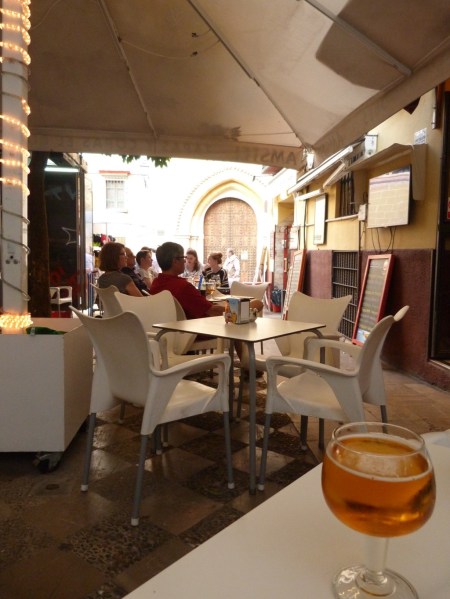
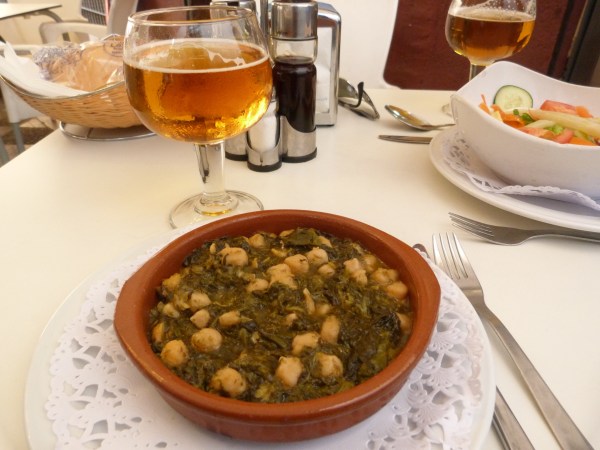

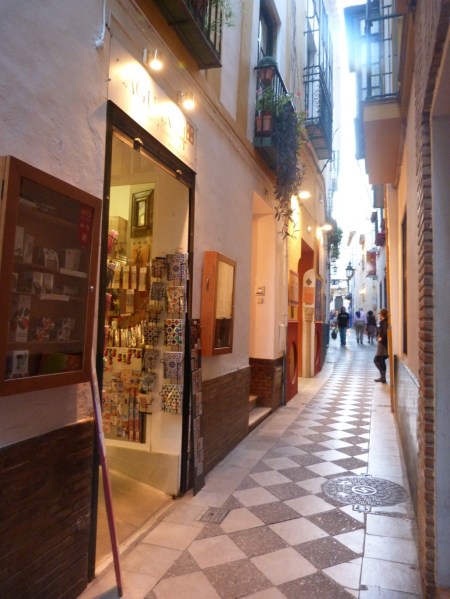
On the way back to the hotel we take a walk in the Santa Cruz barrio and get totally lost, wandering on the narrow little streets, full of flowers, shops, tiny grocery stores, restaurants, bars and tapas bars, stores with flamenco dresses, stores with spices, stores for the locals and stores for the tourists. By the time we were back at the hotel, we were ready for bed, and I had my first no-effort day with more than 10,000 steps. I didn’t even have to try, woooo hoo!
Pensacola’s Pelican Tribute to Native Americans
We’re on our way to lunch at Portobello, the restaurant in the old jail, when AdventureMan says “Look at that Pelican!” and I had just spotted it at the same time. It is fabulous. It is on the corner at the Wentworth Museum and is a tribute to our First Nation inhabitants. It reminds me of Alaska, where the Haida art was mostly black and white, with just a tiny accent of red here and there, or occasionally a tiny bit of blue. I love this Pelican 🙂

Different businesses and organizations in Pensacola sponsor Pelicans, and each one is different. At the main intersection at Garden and Palafox, the Navy, Army, Air Force and Marines have Pelicans stationed. Local artists make the pelicans vibrant and unique. Love the pelicans, but I love this one at the Wentworth most of all.
Perseid Meteor Showers Peak This Week

By MARC TORRENCE (Patch National Staff)
The brightest meteor shower of the year is coming up, and it should be very easy to see.
The 2015 Perseid meteor shower began July 13 and runs to August 26, with activity peaking around August 12 and 13.
The Perseids are typically the brightest of the year. And Earthsky.org says that this year should be an especially good year for Perseids since the moon will not come out until after sunrise, avoiding the pesky bright light it gives off.
Earthsky says the best time for viewing is after midnight, when the meteors will pick up steam until the “wee hours before dawn.”
It will appear to originate from the constellation Perseus, which will be in the northeastern sky on the nights of the August 12 and 13.
Meteor showers happen when the earth passes through the orbit of a comet. Bits of the comet that have broken off pass through earth’s atmosphere, and when they burn up, they create a gorgeous streaking pattern across the night sky.
NASA estimates that at its peak, Perseids will produce up to 100 meteors per hour streaking at 37 miles per second.
Here are some other tips to get the most out of your meteor shower-watching experience:
Find an open location away from bright city lights and other light pollution.
Bring something comfortable to sit or lie down on and try to fill your entire peripheral vision with the night sky.
If you’re in a colder climate, dress warmly.
Give your eyes time to adjust to the darkness. This can take up to 20 minutes and can be disrupted by looking at a bright phone or tablet screen. If you need to shine a light on something, use a flashlight with a red filter, the easiest color on your eyes.
Be patient. Give yourself anywhere between 30 minutes and an hour, and the streaking meteors should be easily spotted against the still night sky once your eyes are fully adjusted.
Don’t worry about using telescopes or binoculars. Those devices may actually make it harder for you to see meteors, since they only cover a small portion of the sky. You should be able to easily see the show, and more of it, with just your own two eyes.
(Photo credit: NASA)
Recent Comments
intlxpatr on Shampoo Ginger tigerbutterya0c5ff1d… on Shampoo Ginger intlxpatr on British Soldier Kidnapped, Esc… John on British Soldier Kidnapped, Esc… intlxpatr on British Soldier Kidnapped, Esc… Wikipedia Donate Button

Amazina


Early Voting in Florida


