A Long Way Gone: Ishmael Beah
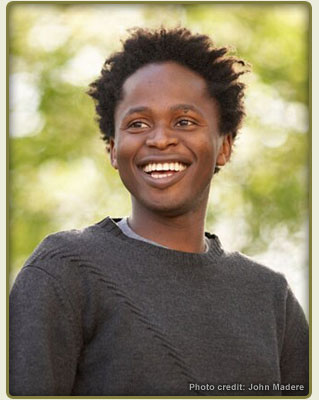

Back when I wrote an update on Dharfur, my blogging friend Chirp recommended a book, A Long Way Gone; Memoirs of a Boy Soldier by Ishmael Beah. I ordered it that very day, and read it this last week.
It is a truly heartbreaking autobiographical book about a young mischievous boy growing up in Sierra Leone, leading a relatively simple and carefree life in his village with his family. It is very African. He talks about the games he and his friends play, his fascination with rap music and the simple joys of the life he is leading.
Then the rebels come. The invade the villages, hopped up on dope, their dead eyes with no pity, raping, killing, chopping off limbs, stealing all the village food and burning the village behind them, often with people locked inside their huts.
Ishmael escapes once with friends, eventually returning to the village to find his entire family gone. Most of the book has to do with what he has to do to survive. Many villages are very afraid of groups of boys, even boys as young as these are – in their early adolescence – and will hurt them. At the very least, most of the villages hurry them along. At one point Ishmael is hiding out in the jungle forest on his own, hiding from lions, giant feral pigs, sleeping up in trees and looking for the rare fruit or grass that he can eat without getting sick.
Finally, after meeting up with some other boys and continuing to try to find his family, a village takes him in, a village run by the state soldiers. As they are attacked by rebels, the boys are forced to make a choice – go out on their own again (where the rebels will also try to recruit them, and if they refuse, will kill them) or agree to be soldiers. These are kids 12, 13, 14 carrying AK 47’s. As part of their training they are given drugs on a regular basis which keep them hopped up, full of energy, and not sleeping for days. The young boys learn to kill without pity. He becomes the very people he was fleeing.
This is a book about redemption. At the center where the boy soldiers are taken, they are constantly told “none of this was your fault.” It is a very African approach, a very human and loving approach to redemption of lives that might have been totally lost to the horrors they have witnessed and inflicted. The author is now nearly 30, and sounds – unlikely as it might be – happy.
Thank you, Chirp, for recommending this wonderful book.
St. Patrick and the Wearing of the Green
Growing up in the USA, everyone knows, as a kid, that on St. Patrick’s Day you wear green. It doesn’t mean you are Catholic, or Christian, it means you don’t want to get a pinch, because that is what happens to kids who don’t wear green. (You know how mean kids can be!)
Later on, maybe in high school, a few people will wear orange and explain that they are Irish protestants. Most of us, as kids, don’t really know a whole lot about St. Patrick other than that he went to Ireland to convert the heathens to believe in the church, and that he cast the snakes out of Ireland.
When you get older, St. Patrick’s Day is often a rollicking night in local taverns with Irish names, where they serve stew, and soda bread, and potatoes, and lots of green beer and live music singing old Irish songs.
There are references below to the short version of St. Patrick’s life, and a longer version. The longer version is the Catholic version and, while less documented, is longer and more interesting.
This is from Wikipedia, and is a short summary of the life of St. Patrick:
Saint Patrick (Latin: Patricius[2], Irish: Naomh Pádraig) was a Christian missionary and is the patron saint of Ireland along with Brigid of Kildare and Columba. Patrick was born in Roman Britain. When he was about sixteen he was captured by Irish raiders and taken as a slave to Ireland, where he lived for six years before escaping and returning to his family. He entered the church, as his father and grandfather had before him, becoming a deacon and a bishop. He later returned to Ireland as a missionary, working in the north and west of the island, but little is known about the places where he actually worked and no link can be made with Patrick and any church. By the eighth century he had become the patron saint of Ireland. The Irish monastery system evolved after the time of Patrick and the Irish church did not develop the diocesan model that Patrick and the other early missionaries had tried to establish.

(From Who Was St. Patrick?)
The available body of evidence does not allow the dates of Patrick’s life to be fixed with certainty, but it appears that he was active as a missionary in Ireland during the second half of the fifth century. Two letters from him survive, along with later hagiographies from the seventh century onwards. Many of these works cannot be taken as authentic traditions. Uncritical acceptance of the Annals of Ulster (see below) would imply that he lived from 378 to 493, and ministered in modern day northern Ireland from 433 onwards.
Corruption at the Morgue
Where is the Kuwaiti detective novel? I follow Guido Brunetti in Donna Leon’s series on Venice, Dave Robicheaux, the James Lee Burke detective in a small town just outside New Orleans, and now, Investigator Chen, who is a chief investigator in China, but where, oh where is the Kuwait detective / mystery? It is just waiting to be written.
In yesterday’s Kuwait Times is an article I would love to link you to, but it isn’t there, not even when I search “female coroner” from the headline on page 3. Did you know Kuwait had a female coroner, a la Kathy Reich’s Temperance Brennan and Patricia Cornwell’s Kay Scarpatta? As you read the article, it makes sense, as the bodies are kept semi-segregated in the morgue, and women work on women (some of the time) and men on men.
I’m impressed. Any time a woman takes on a traditionally men’s job, it takes a whole lot of courage. I imagine the requirements to be a coroner here are similar to other countries – you have to have a medical degree (be a doctor) and then have advanced training in forensics. So when Nawal Boshehri speaks out, I listen. She’s got my attention.
Nawal Boshehri says conditions in the morgue are awful. From a personal point of view, she has been sexually molested by her superior and frozen in her position over false accusations that she has not been going to work or signing in or out. She has asked the minister of interior to look into her complaints.
As an institution, she reports serious issues – labs that lack necessary equipment, to do tests, such as those that measure drugs and alcohol in the bloodstream, outdated machinery, rusty machinery, lack of ventilation (in a morgue! horrors!) and she states they are constantly in fear of getting infections.
She claims that reports have sometimes been manipulated and twisted to give prosecutors the wrong technical information that would sometimes end up setting a guilty person free, and that one time they certified a murder had been insane without him ever having been examined by any mental health professionals. She was once asked to provide a report that made one citizen swap places with the assaulted expatriate, so that the assaulted expatriate would appear to be the guilty party.
She adds that she fears for her life. She says “a senior coroner at the department falsified reports, namely those related to detainees, who underwent police brutality during interrogations. He usually did this as favors to his colleagues to help them get promoted instead of being punished for their brutality.” She added that because she has reported these things, she fears for her own life.
Every nation has corruption. Corruption is chaotic, and when you get serious about rule of law, you still have corruption, but you do your best to root it out. You report it when it happens. I think that Nawal Boshehri has enough confidence in Kuwait’s institutions to go public with her allegations. While it may appear dirty laundry, that she CAN go public is a very positive sign. I can imagine she fears for her life, and yet, she seems to be fighting to retain her job. That’s very brave.
That the Kuwait Times will publish the article on page three, in three columns, that is also very brave, and speaks well of the increasing confidence in a free press.
Wouldn’t this make a great detective novel?
Aidan Hartley’s Zanzibar Chest

I started Zanzibar Chest in December, and could not get into it. It was interesting, but at first the tone was . . . I don’t know, maybe pompous? Something in the tone put me off, and yet I didn’t put it back on the bookshelves, nor did I give it away. It sat on my bed table while I attacked lesser works, more enjoyable fare. Then, one day, I just knew it was time to try it again, and this time, I could hardly put it down.
Born in Kenya, just before the rebellion, Aidan Hartley spent his life mostly in Africa. He skillfully interweaves three main story lines – the life of his mother and father, the life of his father’s best friend and his own life as a news correspondent.
This is not a joyful book. It is not inspirational. It is a tough, hard look at the people who cover the news, and the toll it takes on their lives. It is a story of drugs and alcohol to numb the pain of what they are observing, the comraderie of gallows humor and surviving the intensity of living through life-threatening moments together.
He covers some truly awful events. He covers the wars in Somalia, and in Rwanda. He covers Kosovo and Serbia. He is sent into some of the most dangerous and awful of places. He pays the price.
In his Zanzibar Chest, he takes us with him.
I will share a couple quotes with you, and if you are sensitive, please stop reading now. This book is not for you. It is almost not for me, except that sometimes I think we need to come face to face with just how awful reality can be to put our own lives right, to set appropriate priorities.
“I can’t put my finger on exactly how death smells. The stench of human putrefecation is different from that of all other animals. It moves us as instinctively as the cry of a newly born baby. It lies at one extreme end of the olfactory register. Blood from the injured and the dying smells coppery. After a cadaver’s a day old, you smell it before you see it. From the odor alone, I could tell how long a body had been dead and even, depending on whether brains or bowels had been opened up, where it had been hacked or shot. A body would quickly balloon up in the tropical heat, eyes and tongue swelling, flesh straining against clothes until the skin bursts and fluids spill from lesions. Flies would get in there and within three days the corpse might stink. It became a yellow mass of pupae cascading out of all orifices and the flesh literally undulated beneath the clothes. The tough bits of skin on the palms of their hands and the soles of their feet were the parts of the body that always rotted away last. As living people, these had been peasants who had walked without shoes and worked hard in the fields. A man who had been dead seven days reeks of boiling beans, guava fruit, glue, blown handkerchiefs, cloves and vinegar. After that he starts to dry out into a skeleton until he’s almost inoffensive . . .
The dead accompanied me long after Rwanda. It was months before I could order a plate of red meat served up in a restaurant. I smelled putrefaction in my mouth, or in my dirty socks, or as sweat on my body. I imagined what people I met would look like when dead. . . “
These guys all suffer from Post traumatic stress syndrome, they deaden themselves with drug and alcohol, and they are totally addicted to the adrenalin rush their job gives them. Living on adrenalin takes a huge toll – on their health, on their mental health, on their relationships, on their belief in goodness. They are the witnesses to the enormity of man’s inhumanity against one another.
In another quote, the author tells us:
“It was impossible for latecomers to comprehend the evil committed here but the British military top brass were still so scared of what their soldiers might see and what it would do to their minds that they sent a psychiatrist to accompany the forces to Rwanda. Bald Sam and I were amazed at that. We laughed about it. A shrink! It seemed extravagant. But the truth is that we stuck close to that man for days. We said it was all for a story, but really it was about us. The psychiatrist, whose name was Ian, told us his special area of interest was the minds of war correspondents. I could see Bald Sam squirming with happiness at all the attention, and I felt quite flattered myself. . . .
. . . for years I did endure some sort of payback. I have to try every day to prevent the poison that sits in my mind to spread outward and hurt the people I love. Sometimes I can’t stop it and I wonder if in some way the corruption will be passed on from me to my children.”
Toward the end of the book, the author tells us how hard it is to give up this adrenalin-news-junky life:
“Whenever I see a news headline to this day I half feel I should board the next flight into the heart of it. I’d love to get all charged up again and I could write the story with my eyes closed. I’m sure the sense that I’m missing out while others get in on a great story will never completely pass. . . The sight of people committing acts of unspeakable brutality against others fills a hole in some of us. The activity is made respectable by being paid a salary to do it, but there is a cost.”
This is not a book I really wanted to read, but it is a book I will never forget. Hartley doesn’t spare himself in the telling of this tale. He takes us with us and shows us all of it, and all of his own warts along with the tale. Would I recommend this book? Not for the sensitive, not for those who don’t want to look at the dark side. Between idyllic sequences on the beaches near Mombasa, in the hills of Kenya and Tanzania, in the dusty deserts of Yemen, there are some very intense and bloody moments. This is non-fiction, it is a documentary, it is a slice of the real life one man has seen, and that to which he has been witness. Read the book, and like him, you pay a price. You carry images in your head that you can’t forget, and a sorrow for our inability to solve our differences peaceably.
(Available in paperback from Amazon.com for $10.88. Disclosure: Yes, I own stock in Amazon.com.)
Naughty or Nice?
Blogger N. at One or the Other asks readers and visitors to vote on whether they are naughty or Nice? Blogger Fourme, rightly comments that we don’t have any definition of naughty or nice by which to define ourselves and that she will refrain from voting.
Most of the voters are naughty, by the way.
It gave me a big grin.
Isn’t “naughty” or “nice” greatly in the mind of the beholder?
Once, when I was the young wife of a young army officer, I got up my courage and wrote a letter to the editor. It turned out to be a controversial letter; I got one very sarcastic response from the authority I questioned, and then, a week later, all hell broke loose as readers from all over Europe bombed the one who replied. I felt scared, but a little proud to have raised the issue.
I was working in the library. THE COLONEL’S WIFE (that is how we thought of her) walked in and said to me “we don’t get our names in newspapers. It isn’t done.” And then she walked out.
Then I really felt scared. And I really felt naughty. And at the same time, I wouldn’t change a thing.
Sometimes, don’t you have to say something? When you see something that is not right? And is that really naughty?
John of Damascus
I had never heard of John of Damascus before, but as I did my readings this morning, I discovered that this is his feast day. Out of curiousity – and because I love Damascus – I read up on him. It is a fascinating reading, by James Kiefer, on The Lectionary pages, and has to do with the use of images, an area where Islam and Christianity differ. It makes for some fascinating reading.
HYMN-WRITER, DEFENDER OF ICONS (4 DEC 750)
John is generally accounted “the last of the Fathers”. He was the son of a Christian official at the court of the moslem khalif Abdul Malek, and succeeded to his father’s office.
In his time there was a dispute among Christians between the Iconoclasts (image-breakers) and the Iconodules (image-venerators or image-respectors). The Emperor, Leo III, was a vigorous upholder of the Iconoclast position. John wrote in favor of the Iconodules with great effectiveness. Ironically, he was able to do this chiefly because he had the protection of the moslem khalif (ironic because the moslems have a strong prohibition against the religious use of pictures or images).
John is also known as a hymn-writer. Two of his hymns are sung in English at Easter (“Come ye faithful, raise the strain” and “The Day of Resurrection! Earth, tell it out abroad!”). Many more are sung in the Eastern Church.
His major writing is The Fount of Knowledge, of which the third part, The Orthodox Faith, is a summary of Christian doctrine as expounded by the Greek Fathers.
The dispute about icons was not a dispute between East and West as such. Both the Greek and the Latin churches accepted the final decision.
The Iconoclasts maintained that the use of religious images was a violation of the Second Commandment (“Thou shalt not make a graven image… thou shalt not bow down to them”).
The Iconodules replied that the coming of Christ had radically changed the situation, and that the commandment must now be understood in a new way, just as the commandment to “Remember the Sabbath Day” must be understood in a new way since the Resurrection of Jesus on the first day of the week.
Before the Incarnation, it had indeed been improper to portray the invisible God in visible form; but God, by taking fleshly form in the person of Jesus Christ, had blessed the whole realm of matter and made it a fit instrument for manifesting the Divine Splendor. He had reclaimed everything in heaven and earth for His service, and had made water and oil, bread and wine, means of conveying His grace to men. He had made painting and sculpture and music and the spoken word, and indeed all our daily tasks and pleasures, the common round of everyday life, a means whereby man might glorify God and be made aware of Him. (NOTE: I always use “man” in the gender-inclusive sense unless the context plainly indicates otherwise.)
Obviously, the use of images and pictures in a religious context is open to abuse, and in the sixteenth century abuses had become so prevalent that some (not all) of the early Protestants reacted by denouncing the use of images altogether. Many years ago, I heard a sermon in my home parish (All Saints’ Church, East Lansing, Michigan) on the Commandment, “Thou shalt not make a graven image, nor the likeness of anything in the heavens above, nor in the earth beneath, nor in the waters under the earth — thou shalt not bow down to them, nor worship them.” (Exodus 20:4-5 and Deuteronomy 5:8-9) The preacher (Gordon Jones) pointed out that, even if we refrain completely from the use of statues and paintings in representing God, we will certainly use mental or verbal images, will think of God in terms of concepts that the human mind can grasp, since the alternative is not to think of Him at all. (Here I digress to note that, if we reject the images offered in Holy Scripture of God as Father, Shepherd, King, Judge, on the grounds that they are not literally accurate, we will end up substituting other images — an endless, silent sea, a dome of white radiance, an infinitely attenuated ether permeating all space, an electromagnetic force field, or whatever, which is no more literally true than the image it replaces, and which leaves out the truths that the Scriptural images convey. (One of the best books I know on this subject is Edwyn Bevan’s Symbolism and Belief, Beacon Press, originally a Gifford Lectures series.[note – now out of print]) C S Lewis repeats what a woman of his acquaintance told him: that as a child she was taught to think of God as an infinite “perfect substance,” with the result that for years she envisioned Him as a kind of enormous tapioca pudding. To make matters worse, she disliked tapioca. Back to the sermon.) The sin of idolatry consists of giving to the image the devotion that properly belongs to God. No educated man today is in danger of confusing God with a painting or statue, but we may give to a particular concept of God the unconditional allegiance that properly belongs to God Himself. This does not, of course, mean that one concept of God is as good as another, or that it may not be our duty to reject something said about God as simply false. Images, concepts, of God matter, because it matters how we think about God. The danger is one of intellectual pride, of forgetting that the Good News is, not that we know God, but that He knows us (1 Corinthians 8:3), not that we love Him, but that He loves us (1 John 4:10).
(Incidentally, it was customary in my parish in those days for the preacher to preach a short “Children’s Sermon,” after which the children were dismissed for Sunday School, and the regular sermon and the rest of the service followed. What I have described above was the Children’s Sermon. I remained for the regular sermon, but found it a bit over my head — a salutary correction to my intellectual snobbery.)
In the East Orthodox tradition, three-dimensional representations are seldom used. The standard icon is a painting, highly stylized, and thought of as a window through which the worshipper is looking into Heaven. (Hence, the background of the picture is almost always gold leaf.) In an Eastern church, an iconostasis (icon screen) flanks the altar on each side, with images of angels and saints (including Old Testament persons) as a sign that the whole church in Heaven and earth is one body in Christ, and unites in one voice of praise and thanksgiving in the Holy Liturgy. At one point in the service, the minister takes a censer and goes to each icon in turn, bows and swings the censer at the icon. He then does the same thing to the congregation — ideally, if time permits, to each worshipper separately, as a sign that every Christian is an icon, made in the image and likeness of God, an organ in the body of Christ, a window through whom the splendor of Heaven shines forth.

Mr. Plopper
The plane was filling up fast, but so far, so good – the seat next to me is empty! I can tell that the cabin crew is getting ready to fly – they have started closing up all the bins. I’m afraid to even hope that I will have the serenity of an extra seat, the space, the silence – it’s a very long flight.
“I was hoping this seat would be free!” says a long, tall man who has just plopped himself into the empty seat next to me. I didn’t pay for that seat, it isn’t MY seat, but neither am I feeling particularly friendly to this very tall man who sat himself down so emphatically next to me, and then FLUFFED himself up so that he is everywhere!
His shoes are over on my side, so while he is busy shaking his paper noisily (more fluffing) I quickly scoot them back on his side with my feet. He is leaning over into my seat and OUR SHOULDERS ARE TOUCHING and he isn’t apologizing or moving back away or anything, I guess I have lived in Kuwait for too long but this is a STRANGE MAN and his shoulder is over the arm rest touching my shoulder!
Just in the nick of time, I discover I have one of those slipping-back seats, where you put it in the old “full upright position for take-off” but it won’t stay there, it keeps slipping back, although not too far; the seats don’t seem to be able to go back farther than five inches or so, even when broken. Anyway, for the next ten hours, every time that shoulder encroaches back into my space I hit the button that brings the seat back up with a jolt, hitting his shoulder and reminding him to keep to his own seat.
All this is done without raising my eyes from my book.
This man desperately wants my attention. He has discovered his shoes, back under his own feet, and he gives a deep, disturbed sigh. You can kind of tell that this guy arranges the universe to suit himself, and he is not used to being crossed.
He leans across me and shuts the window shade and says “I am going to be using my laptop and this creates a glare,” and I lean over and open it back up about three inches and say “and I am using it for reading, so we will have to compromise.”
He says “you can use the light” and I reply “and you can turn your laptop” and I give him a huge, insincere smile, the kind with your mouth closed and sort of tight. I am sending a strong strong message – don’t screw with me, buddy. I can’t keep you from sitting here, but you are not going to encroach on ME.
I ignore his deep sighs, which continue every time I press that button to hit his encroaching arm.
I ignore whatever it is on his laptop. I think I am supposed to look and understand that he is an important man, but here it is – I don’t care. I don’t care. I don’t care. You can sit in that seat; I can’t stop you, but I don’t have to interact with you and I don’t have to share my space with you.
It’s a great book. Ken Follet’s new book, the follow up to Pillars of the Earth, called World Without End.
When I finish my book, I sleep for a couple hours so I arrive in Seattle rested enough to pick up my rental car and drive through Seattle. In Kuwait, KLM was kind enough to put big PRIORITY tags on my bags, which, we all know, means “take these bags off the plane last of all” so it took me a while to get through the airport.
It is, once again, L’heure bleu a la Seattle. It may be four in the afternoon, but it is raining and dark, and traffic is slow enough on the interstate heading north that I can even take (very carefully, of course) a couple shots to share with you the thrill of coming into Seattle in November:


Kinda different from L’heure blue in Kuwait, hmmmm? 😉
Care Package
From the time our son was seven years old, we began praying for the girl he would marry – we knew she was probably somewhere in the world! We asked that God keep her sweet, and that when she and our son met, they would recognize one another and love one another faithfully.
Our prayers were answered bountifully. When he met his wife-to-be, he called us and said “there is someone I want you to meet.” He wasn’t talking about marriage – they had just met – but he knew she was special. From the time they started dating, they both kind of knew – this was it.
We knew from the beginning we would love this young woman. What we didn’t know is that we would love her family so much. As we partied together before the wedding, we had so much fun! Her family, like ours, has a great traditions of “aunthood” and “the cousins” and family gatherings. The cousins all attend one another’s weddings, gather together for special weekends (they went white water rafting and hiking this last summer, and are already planning the next gathering.) We all value family.
As my Mother has undergone surgery recently, one of my sweet daughter-in-law’s aunts has called my Mother twice, just to chat, and totally brightened her day. She also sent us a most wonderful Care Package – Texas Pecans!
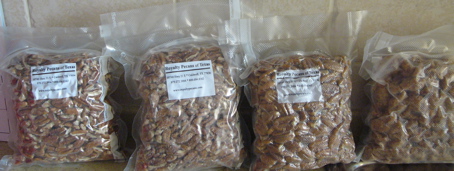
It doesn’t take much to thrill my heart. I feel so blessed.
“Madam, Too Many Words”
We were working together in the garden, and I was explaining what I wanted done with the bougainvilla starts I had collected from various colored shrubs on the compound. It doesn’t take much to get bougainvilla going, but you have to do it right.
When I was done explaining, I said “was that clear? do you understand?”
He shook his head sadly and said “Madam, too many words.”
“Madam, This is MY Job”
I had all kinds of ideas for my new garden – new climate, new challenges. Yes, I had been told that the climate was too hot for orange trees, but I want to give it a try. Yes, my gardening friends haven’t had much luck with lavendar, but maybe I will have better luck. I toted huge pots and bags of fertilizer, clipped bougainvillia and started more plants, wanting that half/half color, rising early to work in the cool of the day. Rosemary! Basil! Lemon trees! As soon as the weather began to cool, I planted my seeds to see what would sprout, what I could transplant, what would thrive. I’m willing to risk a little failure, but I was hoping for some spectacular results.

Inside once the sun had risen, having a glass of water, my front doorbell rang. Who could it be at this hour of the morning? I checked the security peephole, and it was the compound’s chief gardener. With him was the man assigned to take care of our house. He really didn’t know a lot about gardening.
“Madam,” the chief gardener started, with a wave of his hand indicating all the new potted flowers on my entry stairs, “this is MY job.”
I stood there, looking stupid.
“Madam, your job is to tell us what you want. You don’t want to take our work from us.”
I was stunned. People who garden, all over the world, share a sheer love of getting our hands dirty and watching gardens grow and thrive, we love the patterns, we love the floozies who get all the attention, we love the characters who give depth and texture, and we create the backgrounds, the stage, on which they dance.
Slowly, slowly, we worked out an arrangement. I would bring in pots and plants, the gardener would actually pot them – but I would show him exactly how I wanted it done. From time to time, I would pot one up myself, late at night when no gardeners were around, and he would pretend not to notice. I would do the starts from seeds, he would tend them. On a hot afternoon, he would occasionally drop by and take a rest in the garden, and I would pretend not to notice.


I didn’t achieve spectacular. I had some failures – lavendar and orange trees. I sometimes wonder whether we form the garden, or the garden forms us? My results were not what I had envisioned, but it had its’ own beauty.
Working together, the gardener and I created a lush paradise, a backyard retreat where my husband and I would sit in privacy and enjoy the bougainvillia, and the lemon trees, the pots of rosemary and basil and jasmine, making the garden aromatic as well as beautiful. The Qateri cat would enjoy the marvellous smells, and track the occasional bird who dropped by.
With the cooling temperatures in Kuwait, my hands are just itching to get dirty. 🙂
P.S. Those are illustrations, not my real garden.
Recent Comments
ExpatAlien on What Country am I Living … intlxpatr on Yellowstone: Old Faithful to C… Michelle on Yellowstone: Old Faithful to C… Cathy on No Grown-Ups in Charge intlxpatr on Waiting for Snow Wikipedia Donate Button

Amazina


Early Voting in Florida


 Here There and Everywhere