“Generation of Spoiled Idiots”
I have a dear friend who sends me the most amazing things. This started my day with a howl of laughter:
I am embarrassed to tell you – I remember rotary phones. I even remember party lines, where you had to wait for your neighbor to finish his call before you could make your own, and you never knew who might be listening to your conversation. I remember planes that had large, beautiful lady’s lounges, with a seating area for nursing mothers. I remember when living in Germany was a huge problem to many young people who ran up huge phone bills, calling their families when they were lonely – no internet, no VOIP. I remember transistor radios, and Walkmen! LLLOOOLLLL!
The Feast of St. Andrew
This is the Feast of Saint Andrew, one of my favorite of all the Saint’s Days, and the Saint’s feast closest to my very favorite season of the church or all – Advent, during which we prepare our hearts for the arrival of the little baby Jesus.
I learned things I never knew, reading James Kiefer’s write up for The Lectionary including that Andrew is known for bringing others to Christ. He was one of two of the very first Apostles, and while not often mentioned individually, is mentioned as one who brings others to the knowledge of Christ.

ANDREW THE APOSTLE
(30 NOV NT)
Most references to Andrew in the New Testament simply include him on a list of the Twelve Apostles, or group him with his brother, Simon Peter. But he appears acting as an individual three times in the Gospel of John. When a number of Greeks (perhaps simply Greek-speaking Jews) wish to speak with Jesus, they approach Philip, who tells Andrew, and the two of them tell Jesus (Jn 12:20-22). (It may be relevant here that both “Philip” and “Andrew” are Greek names.) Before Jesus feeds the Five Thousand, it is Andrew who says, “Here is a lad with five barley loaves and two fish.” (Jn 6:8f) And the first two disciples whom John reports as attaching themselves to Jesus (Jn 1:35-42) are Andrew and another disciple (whom John does not name, but who is commonly supposed to be John himself — John never mentions himself by name, a widespread literary convention). Having met Jesus, Andrew then finds his brother Simon and brings him to Jesus. Thus, on each occasion when he is mentioned as an individual, it is because he is instrumental in bringing others to meet the Saviour. In the Episcopal Church, the Fellowship of Saint Andrew is devoted to encouraging personal evangelism, and the bringing of one’s friends and colleagues to a knowledge of the Gospel of Christ.
Just as Andrew was the first of the Apostles, so his feast is taken in the West to be the beginning of the Church Year. (Eastern Christians begin their Church Year on 1 September.) The First Sunday of Advent is defined to be the Sunday on or nearest his feast (although it could equivalently be defined as the fourth Sunday before Christmas Day).
Several centuries after the death of Andrew, some of his relics were brought by a missionary named Rule to Scotland, to a place then known as Fife, but now known as St. Andrew’s, and best known as the site of a world-famous golf course and club. For this reason, Andrew is the patron of Scotland.
When the Emperor Constantine established the city of Byzantium, or Constantinople, as the new capital of the Roman Empire, replacing Rome, the bishop of Byzantium became very prominent. Five sees (bishoprics) came to be known as patriarchates: Rome, Alexandria, Antioch, Jerusalem, and Byzantium. Now, the congregation at Rome claimed the two most famous apostles, Peter and Paul, as founders. Antioch could also claim both Peter and Paul, on the explicit testimony of Scripture, and of course Jerusalem had all the apostles. Alexandria claimed that Mark, who had been Peter’s “interpreter” and assistant, and had written down the Gospel of Mark on the basis of what he had heard from Peter, had after Peter’s death gone to Alexandria and founded the church there. Byzantium was scorned by the other patriarchates as a new-comer, a church with the political prestige of being located at the capital of the Empire, but with no apostles in its history. Byzantium responded with the claim that its founder and first bishop had been Andrew the brother of Peter. They pointed out that Andrew had been the first of all the apostles to follow Jesus (John 1:40-41), and that he had brought his brother to Jesus. Andrew was thus, in the words of John Chrysostom, “the Peter before Peter.” As Russia was Christianized by missionaries from Byzantium, Andrew became the patron not only of Byzantium but also of Russia.
Andrew is the national saint of Scotland. George (23 Apr) is the national saint of England, Patrick (17 Mar) of Ireland, and Dewi = David (1 Mar) of Wales. George, who was a soldier, is customarily pictured as a knight with a shield that bears a red cross on a white background. This design is therefore the national flag of England. It is said that Andrew was crucified on a Cross Saltire — an ‘X’ -shaped cross. His symbol is a Cross Saltire, white on a blue background. This is accordingly the national flag of Scotland. A symbol of Patrick is a red cross saltire on a white background. The crosses of George and Andrew were combined to form the Union Jack, or flag of Great Britain, and later the cross of Patrick was added to form the present Union Jack. Wales does not appear as such (sorry!). Whether there is a design known as the cross of David, I have no idea.
by James Kiefer
Doha Museum of Islamic Arts Opens
My friends in Doha tell me that the long-awaited Museum of Islamic Arts, designed by I.M. Pei (who showed up for the opening, along with Robert de Niro) opened this weekend. I can hardly wait to see it for myself.
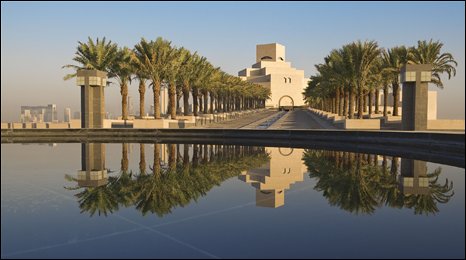
By Lawrence Pollard
BBC News, Doha
A few years ago, prices in London auction houses went through the roof – not for the classic modern or contemporary art, but for works from the Islamic world.
Fabulous jewels, manuscripts and ceramics were fetching 10 times their estimate and more, and it soon emerged this was thanks to the al-Thani family, rulers of Qatar, the tiny gas-rich Gulf state.
They had tempted the veteran architect I M Pei – the man behind the glass pyramid at the Louvre – to design one last statement building, a spectacular museum on a purpose-built island in Doha, which would house only the best Islamic art.
Then they went shopping for their collection.
And this weekend the museum opens, a dramatic pile of white limestone shapes inspired by Islamic architecture and full of 800 of the finest examples of Islamic art.
Not long ago, the idea of culture being a reason to visit the Gulf would have made other Arabs laugh. No longer.
The Syrian cultural historian Rana Kabbani sees a political element to the museum, putting Doha on the cultural map.
“I think all the rulers in the Gulf see what they really lack is culture on a grand scale, as a kind of imperial identity. It’s a political-cultural lack. They have the means, and they’re going for it.”
The hope is that – like hosting a Grand Prix or buying a football club – a fabulous collection of art will bring prestige, attract tourists and create a brand.
That’s why along the coast, two museums are planned for Abu Dhabi – branches of the Louvre and Guggenheim.
New conversation
But what exactly is the Islamic art in the collection? What can ceramics from southern Spain have in common with metalwork from the Silk Route city of Samarkand?
One thing which links them is the misconceptions about Islamic art held by both east and west.
Designer and writer Navid Akhtar explains: “The conversation tends to go: ‘How come you don’t paint people? Because its forbidden.’
“There’s little understanding of the scriptures or commentaries, or the concept of art, so we’re left with a limited conversation.
“There’s a lot of figurative Islamic art. And the geometric patterns aren’t just pattern.”
The Koran has no comment on the visual arts.
The prophet was firmly against idols, but then so were Jews, orthodox Christians and puritan Anglicans at various times.
Many religions mistrust images but their cultures still end up using them – Islam however has had less use for them.
“The Koran is not a narrative like the old or new testament, it doesn’t tell a story, a narration you can illustrate,” says professor Doris Abouseif, author of Beauty in Arabic Culture.
“The Koran is precepts, it guides but doesn’t narrate.”
Any museum will show Persian and Indian miniatures, or Arab pottery with figures of animals or people.
They won’t be from a mosque, but the figure isn’t banned from wider Islamic culture.
‘Whole language’
One element Islamic objects have in common is intricate geometric patterns.
Some scholars think this is a craft habit, pure and simple, but to many younger Muslim artists the geometry holds something else.
“Pattern is a whole language of colour, form and shape,” says Reem al-Faisal, a Saudi artist-photographer.
“Each colour symbolises a state of the soul or being. It’s poetry translated into material elements.”
Mr Akhtar agrees: “Many of these things, as well as being objects of beauty, have functional usage, but then hidden beyond that is the sense of transcendence that they create.”
The chief curator of the new museum, Oliver Watson, is British, as are many of the staff.
The museum houses 800 artistic and historical works from three continents
The study of Islamic art is a western creation, which Ms al-Faisal says is not a problem so long as more Muslims now take up the study.
“I don’t care if it’s Muslims or Westerners – the problem is that there’s not enough research and that’s a mistake of the Muslims.
“They should have studied their own civilisation far more, they’ve been in hibernation for 500 years. There has to be a reawakening – they have to start studying their own history.”
Qatar’s museum will be just a glittering collection of greatest hits unless it manages to become, as promised, a centre of education and research into the history of this beautiful art.
Hildegard of Bingen
I don’t often do this, reprint an entire article. I usually leave it to you to click on the blue type and read it for yourself. I am guessing very few people would make any effort to read this article, so for the few who have the interest, I am making it easy for you.
The article is written by James Kiefer, who writes many of the articles on saints in The Lectionary. He makes them human; his articles are so readable.
I like Hildegard of Bingen because she was a woman ahead of her time. She followed the yearnings of her soul to become a religious person, a nun, but rather than escaping from life, she engaged in it fully, as an administrator and as a musician. She engaged fully – and capably. She would probably be a remarkable woman in any age.

(This photo is from Geocities where there is another extensive article on Hildegard von Bingen and her life and times, with additonal information.)
“Listen: there was once a king sitting on his throne. Around him stood great and wonderfully beautiful columns ornamented with ivory, bearing the banners of the king with great honor. Then it pleased the king to raise a small feather from the ground, and he commanded it to fly. The feather flew, not because of anything in itself but because the air bore it along. Thus am I, a feather on the breath of God.”
Hildegard of Bingen has been called by her admirers “one of the most important figures in the history of the Middle Ages,” and “the greatest woman of her time.” Her time was the 1100’s (she was born in 1098), the century of Eleanor of Aquitaine, of Peter Abelard and Bernard of Clairvaux, of the rise of the great universities and the building of Chartres cathedral. She was the daughter of a knight, and when she was eight years old she went to the Benedictine monastery at Mount St Disibode to be educated.
The monastery was in the Celtic tradition, and housed both men and women (in separate quarters). When Hildegard was eighteen, she became a nun. Twenty years later, she was made the head of the female community at the monastery. Within the next four years, she had a series of visions, and devoted the ten years from 1140 to 1150 to writing them down, describing them (this included drawing pictures of what she had seen), and commenting on their interpretation and significance. During this period, Pope Eugenius III sent a commission to inquire into her work. The commission found her teaching orthodox and her insights authentic, and reported so to the Pope, who sent her a letter of approval. (He was probably encouraged to do so by his friend and former teacher, Bernard of Clairvaux.) She wrote back urging the Pope to work harder for reform of the Church.
The community of nuns at Mount St. Disibode was growing rapidly, and they did not have adequate room. Hildegard accordingly moved her nuns to a location near Bingen, and founded a monastery for them completely independent of the double monastery they had left. She oversaw its construction, which included such features (not routine in her day) as water pumped in through pipes. The abbot they had left opposed their departure, and the resulting tensions took a long time to heal.
Hildegard travelled throughout southern Germany and into Switzerland and as far as Paris, preaching. Her sermons deeply moved the hearers, and she was asked to provide written copies. In the last year of her life, she was briefly in trouble because she provided Christian burial for a young man who had been excommunicated. Her defense was that he had repented on his deathbed, and received the sacraments. Her convent was subjected to an interdict, but she protested eloquently, and the interdict was revoked. She died on 17 September 1179. Her surviving works include more than a hundred letters to emperors and popes, bishops, nuns, and nobility.
(Many persons of all classes wrote to her, asking for advice, and one biographer calls her “the Dear Abby of the twelfth century.”)
She wrote 72 songs including a play set to music. Musical notation had only shortly before developed to the point where her music was recorded in a way that we can read today. Accordingly, some of her work is now available on compact disk, and presumably sounds the way she intended. My former room-mate, a non-Christian and a professional musician, is an enthusiastic admirer of her work and considers her a musical genius. Certainly her compositional style is like nothing else we have from the twelfth century. The play set to music is called the Ordo Virtutum and show us a human soul who listens to the Virtues, turns aside to follow the Devil, and finally returns to the Virtues, having found that following the Devil does not make one happy.
She left us about seventy poems and nine books. Two of them are books of medical and pharmaceutical advice, dealing with the workings of the human body and the properties of various herbs. (These books are based on her observations and those of others, not on her visions.) I am told that some modern researchers are now checking her statements in the hope of finding some medicinal properties of some plant that has been overlooked till now by modern medicine.
She also wrote a commentary on the Gospels and another on the Athanasian Creed. Much of her work has recently been translated into English, part in series like Classics of Western Spirituality, and part in other collections or separately. If your university library or bookstore cannot help you, try a Christian bookstore. If they do not have it, try a trendy (feminist, New Age, ecology) bookstore.
But her major works are three books on theology: Scivias (“Know the paths!”), Liber Vitae Meritorum (on ethics), and De Operatione Dei. They deal (or at least the first and third do) with the material of her visions. The visions, as she describes them, are often enigmatic but deeply moving, and many who have studied them believe that they have learned something from the visions that is not easily put into words.
On the other hand, we have the recent best-seller, The Man Who Mistook His Wife for a Hat, by Oliver Sacks, Professor of Clinical Neurology at Albert Einstein College of Medicine, and author of Migraine and various other books. Professor Sacks is concerned with the relation of the brain to the mind, and ways in which the phsical state of the nervous system can affect our ways of perceiving reality. He views the pictures in Hildegard’s books of what she saw in her visions, and says, “The style of the pictures is a clear indication that the seer suffered regularly from migraine attacks. Migraine sufferers tend to see things in this manner.” And indeed, it is true that Hildegard suffered throughout her life from painful attacks of what may have been migraine. Professor Sacks hastens to add that this has nothing to do with whether her visions are authentic insights into the nature of God and His relation to the Universe.
Hildegard has undergone a remarkable rise in popularity in the last thirty years, since many readers have found in her visions, or read into them, themes that seem to speak to many modern concerns.
For example:
Although she would have rejected much of the rhetoric of women’s liberation, she never hesitated to say what she thought needed to be said, or to do what she thought needed to be done, simply because she was a woman. When Pope or Emperor needed a rebuke, she rebuked them.
Her writings bring science, art, and religion together. She is deeply involved in all three, and looks to each for insights that will enrich her understanding of the others.
Her use of parable and metaphor, of symbols, visual imagery, and non-verbal means to communicate makes her work reach out to many who are totally deaf to more standard approaches.
In particular, non-Western peoples are often accustomed to expressing their views of the world in visionary language, and find that Hildegard’s use of similar language to express a Christian view of reality produces instant rapport, if not necessarily instant agreement.
Hildegard wrote and spoke extensively about social justice, about freeing the downtrodden, about the duty of seeing to it that every human being, made in the image of God, has the opportunity to develop and use the talents that God has given him, and to realize his God-given potential. This strikes a chord today.
Hildegard wrote explicitly about the natural world as God’s creation, charged through and through with His beauty and His energy; entrusted to our care, to be used by us for our benefit, but not to be mangled or destroyed.
You can listen to some of her extraordinary and ethereal music of worship by clicking on the YouTube video below:
Long Way Gone in PB
Just a quick note to say that if you have been waiting to read Long Way Gone in paperback, it is now on the shelves.
The Great Adventure
This week AdventureMan and I are celebrating our wedding anniversary. He kids me – when we were married, we had a goal. We wanted to go to Africa, so we saved our money for a whole year. We didn’t eat meat – or not often. We didn’t go to movies; we went to the library. We did buy cameras, and we saved and saved and saved, and when we had been married a year, we went to Kenya for a month – three weeks on safari and then one week on the beach.
Life has been so good to us, has blessed us so richly. Today we give thanks for the good times, and even the bad times – it takes both to glue a marriage together. We thank God for his abundant mercy on our foolishness and our pride, for our mistakes, and for our good intentions gone wrong. We give thanks for all his blessings and we pray for many more years together.
May the great adventure continue!
Unspectacular Quirks Tag
My friend 3baid tagged me for the 6 Unspectacular Quirks tag.
The Rules:
Link the person(s) who tagged you.
Mention the rules on your blog.
Tell about 6 unspectacular quirks of yours.
Tag 6 following bloggers by linking them.
Leave a comment on each of the tagged blogger’s blogs letting them know they’ve been tagged.
1. In a family of spectacular women, I am a mouse. And yet, after lo these many years, my husband still finds me interesting, so I guess I have something going for me. Men like me, trust me, and work well with me, like a sister.
2. I prefer organization to chaos. My clothes are organized by item and then by color. I don’t like drawers, where things hide and get lost, I like shelves, where I can see things.
3. I have always had to make lists and keep calendars so I can remember things, so no, it’s not creeping dementia, it is just a time of information and option overload.
4. I’m a morning person, I have to have had a nap to be any good after ten at night, and I refuse to discuss finances with AdventureMan after nine p.m.
5. Being a believer is a big part of my life, but you guessed that, didn’t you? 😉 Whether it’s my religion or yours, when people start telling me how I am supposed to live my life, I get real nervous, and feel LESS inclined to follow their rules, rather than more.
6. I like listening and asking questions a whole lot more than talking and giving my opinion. Odd thing for a blogger to say, I guess!
I was sort of hoping no one would notice I hadn’t done this one yet, but the problem is that now there are so few people left to tag!
1. BoJacob
2. Erzulie
3. Fonzy
4. Я at Farragoes
5. Shopaholic
6. Teagirl
Seven Things Tag
Seven things I plan to do:
1. Get more exercise
2. See Canada and the US
3. Be a good aunt
4. Take care of my husband
5. Eat more locally
6. Go back to Alaska for a visit
7. Love God, love my neighbor as myself (I think that is supposed to be #1)
Seven things I can do:
1. Write
2. Spin stories for media
3. Make intuitive connections
4. Calm a terrified child or friend
5. Keep friends for years 🙂
6. Tip generously
7. Speak in public
Seven things I can’t do:
1. Ride a bicycle
2. Run on pavement (knees)
3. Have more than three “things” in one day
4. Lie and get away with it
5. Pass a hungry cat without feeding it if I can
6. Listen to gossip
7. Get by without sleep
Seven things I say the most:
1. Good Morning!
2. Thanks be to God
3. Is this a good time?
4. Aaaarrrgghhh!
5. Who is this?
6. Ayb!
7. 3asel!
I tag Mirror Polisher, who used to be Magical Droplets,, q80Saracen, and Yousef at Some Contrast.
Turning into a Kuwaiti
We were lingering over the last bites of dessert and coffee in our favorite French restaurant when one phone rang and after a brief conversation, my friend turned to the rest of us and said “We have to get home. That was Anwar saying another storm had rolled in.”
We had all known it was a possibility, but wanted to take the chance to get together anyway. It was one of those rare occasions when our husbands were out of town, we could eat at a restaurant WE liked that they didn’t, we could get together and not worry about when we were getting home. We flurried out, I quickly dropped off my friends and headed home.
The streets were relatively quiet and the traffic relatively slow. I found myself thinking about the evening and how far I have come, living in Kuwait. I’m driving at night, and I don’t even feel a surge of fear-filled adrenalin, I’m driving in a sandstorm going ho-hum, just need to get home, and I’ve just had a great evening with female friends.
And I thought “I’m turning into a Kuwaiti woman.”
The West is so couple oriented. I remember when I was living near my parents in Seattle, and my husband was overseas, I hated Sundays; Sundays seemed like couples’ day to me – couples/families go to church, go to breakfast, go out shopping. Mostly on Sunday I would go to church, go to breakfast with a bunch of church friends and then go home, spend the rest of the day reading the Sunday paper and working on projects. If I were out and about, I would only be reminded how lonely I was, how I was missing a piece, I was incomplete.
In the Gulf, most of the social life is segregated – women go to women’s things, men go to men’s things, families do family things. Things are changing, but there isn’t a lot of “married-people-having-dates-with-their-own-spouses going on. Women go to engagement parties, wedding parties, condolence calls, they go shopping, they meet up at restaurants, they get together in one another’s houses. Men meet up at the diwaniyya, a local shisha cafe, they visit their extended family, they hang out and play cards, they race along the streets. The great circle called men’s social life intersects with the great circle called women’s social life intersect only rarely.
And here I am, meeting up for dinner with my female friends, and driving home alone at night through a sandstorm. Yep. I am definitely turning into a Kuwaiti.
Moses Learns to Delegate
When I was young, I never would have thought that I would join a bible study on the life of Moses that took a whole year. When I was young, I was a believer, but never dreamed I would really STUDY the word. One day a person invited me in, and I found myself learning things I never would have dreamed.
I remember learning this segment, from Exodus, which is part of the readings for day. Moses listened to his father-in-law, and he had to learn to delegate, so he wouldn’t be worn out:
Exodus 18:13-27
13 The next day Moses sat as judge for the people, while the people stood around him from morning until evening. 14When Moses’ father-in-law saw all that he was doing for the people, he said, ‘What is this that you are doing for the people? Why do you sit alone, while all the people stand around you from morning until evening?’ 15Moses said to his father-in-law, ‘Because the people come to me to inquire of God. 16When they have a dispute, they come to me and I decide between one person and another, and I make known to them the statutes and instructions of God.’ 17Moses” father-in-law said to him, ‘What you are doing is not good. 18You will surely wear yourself out, both you and these people with you. For the task is too heavy for you; you cannot do it alone. 19Now listen to me. I will give you counsel, and God be with you! You should represent the people before God, and you should bring their cases before God; 20teach them the statutes and instructions and make known to them the way they are to go and the things they are to do. 21You should also look for able men among all the people, men who fear God, are trustworthy, and hate dishonest gain; set such men over them as officers over thousands, hundreds, fifties and tens. 22Let them sit as judges for the people at all times; let them bring every important case to you, but decide every minor case themselves. So it will be easier for you, and they will bear the burden with you. 23If you do this, and God so commands you, then you will be able to endure, and all these people will go to their home in peace.’
24 So Moses listened to his father-in-law and did all that he had said. 25Moses chose able men from all Israel and appointed them as heads over the people, as officers over thousands, hundreds, fifties, and tens. 26And they judged the people at all times; hard cases they brought to Moses, but any minor case they decided themselves. 27Then Moses let his father-in-law depart, and he went off to his own country.
Recent Comments
Kitchen on Isiais: Winding Down intlxpatr on Shampoo Ginger tigerbutterya0c5ff1d… on Shampoo Ginger intlxpatr on British Soldier Kidnapped, Esc… John on British Soldier Kidnapped, Esc… Wikipedia Donate Button

Amazina


Early Voting in Florida


