The Invention of Wings by Sue Monk Kidd
This is one terrific book.

Amazon recommended this book to me, and as a person who loves just about everything Sue Monk Kidd writes, I bought it immediately. AdventureMan had also read a review and said it might be a good book for our book club, so he gets it next. Most of my friends have it on Kindle to read soon.
The book is written in two voices, that of Sarah Gremke’, white, and Charlestonian, of Charleston society families, and the other voice of Hetty/Handful, the slave given to Sarah for her 11th birthday. First Sarah tries to refuse the ‘gift,’ then, using her father’s law books, she writes a letter of emancipation for Hetty, and neither effort works. Sarah and Hetty are stuck with each other, stuck with the times, stuck with their situation, and stuck with the institutions that determine and limit what they will accomplish.
Or are they?
There were times, as I read the book, that I felt like I was going to suffocate. First, the heat and humidity of Charleston, South Carolina, are bad enough without the kinds of close-fitting clothing women were required to wear in that day; the thought of wearing those clothes makes me choke.
The limited expectations for women would stunt and damage the strongest female character in that society where those who thrived were those who were pretty, good at getting married, and good at bearing children, dressing appropriately and socializing endlessly at the same stale events.
Slavery damages everyone. No one should have that kind of power over another human being; studies show that when human beings are given power over another their very worst instincts come to the forefront. Why do we need studies? We have the real world to show us what that kind of power does, how it corrupts the one who holds the power so thoroughly that they don’t even know they are corrupted.
These are stories from my time living in countries where people from poorer countries came to work:
My maid had worked for a family where the men pestered her because she was full time and live-in. They assumed she was sexually available to them and made life very difficult for her. Her mistress saw a beautiful silk blouse she wore, a blouse she had saved for and only wore on her day off, and her mistress borrowed it, stained it, returned it and didn’t take any responsibility for ruining her one really nice blouse. It was never mentioned again. Only when the men complained about this woman was she allowed to leave; her mistress didn’t want the men tempted, she got her passport back and come to work for me. Her previous mistress wanted an ugly maid, and the men were hoping for someone more compliant.
The woman who bought my car had saved and saved, and was working under deplorable conditions in a day care. I told her that she had skills, get another job, and she told me that she hadn’t been paid for three months, and if she left she would never get that pay, and also her employer would never give her her passport or allow her to leave. She was, in effect, a slave.
Most of my friends are very good employers, taking good care of the people who come to work for them, but I have seen those (not my friends) who are violent and abusive. Being a slave is being trapped in an existence with no control over your own life.
Monk makes an interesting comparison of white women’s lives with their limitations being not unlike a variant of slavery. Maybe the conditions were a little better, but the un-free-ness was similar.
Sarah Grimke’ and her sister Angelina, against all odds, break free of family expectations and societal constraints. They forge their own way, with Angelina’s gift for rhetoric and Sarah’s keep legal writing. I had never heard of these women before, and I am so glad Sue Monk Kidd wrote this book to raise their visibility both as abolitionists and as some of the very first proponents for women’s rights to full equality.
As a quilter, I also loved in this book that Handfull’s mother is a quilter, and while she can neither read nor write, she puts down her history in an applique quilt which clearly spells out significant events in her life, and is a tool for passing family history from one generation to another.
Kuwait: Operation Hope Keeps on Giving
Brava, Sheryl Mairza, brava for the good work you are doing that makes so much difference in so many lives. May God bless the work of your hands! From the Kuwait Times:
Spreading cheer in the land
Sheryll Mairza
Operation Hope, an NGO established by Sheryll Mairza, is touching people’s lives throughout the world. A grassroots humanitarian outreach that is motivated by compassion to alleviate suffering in Kuwait, Operation Hope serves those in the greatest of need through the support of the local and international community. Since 2005, more than 50,000 bags of winter clothing have been distributed to impoverished workers in Kuwait.
Operation Hope is now slowly reaching out to people around the world through organizations and individuals. After the recent typhoon in the Philippines, Operation Hope contributed relief goods for the affected areas.
“For the Philippines, we contributed some of our collected goods when we were approached by organizations and individuals to help them in their relief efforts. We have a lot of gently used clothes ready to be sold, but we gave it to third party organizations that shipped it to typhoon victims in Philippines,” Mairza said.
Another instance where Operation Hope reached out to people of other countries was through a proxy. Mairza said a Gambian woman who wanted to stock her library with books had her wish fulfilled. “We were approached by a woman from Gambia who had started a drive to fill her local library with books so she could help boost the literacy rate of adults there. We have an abundance of books here, so we helped her and shipped the books to Gambia,” she said.
According to Mairza, Operation Hope has a very limited budget and people to do international relief efforts, but through third party organizations, they can reach people on the other sides of the world. “We cooperate with people in areas where need arises. If people there want to start volunteering work similar to Operation Hope, they can do so. I allow the use of Operation Hope’s plans,” she mentioned. “I don’t personally want to go to different places to set up Operation Hope. If volunteers like to spread it in other countries and set up their own NGOs, they can take my blueprint and apply it there. They can be founders of Operation Hope for example in Malaysia, Indonesia or Philippines. I will be happy to share the formula I used to set up this NGO,” she said.
Creative Ways
Mairza admitted Operation Hope was affected by the global financial crisis of 2008, which saw a great decline of support from donors. “When it became evident that support was dwindling, we came up with more creative ways to keep the funds flowing. We started Christmas bazaars and sold used clothes and kitchenware to raised funds. With the support of locals and expats, we opened a boutique inside a compound of my in-laws’ house to sell gently used household items.
The need is great and extended beyond winter, so we organized more frequent bazaars. A vast place in my in-laws’ property in Rumaithiya was utilized to display the products. We received so many donations – from toys to clothes to household things – that we didn’t know where to put them; even the embassy shelters had no place to store all of it, so I thought of selling these items,” Mairza said. “With the help of the British Society of Kuwait, we renovated the facility and opened it on January 12, 2012. We are generating income from it and we distribute it in the form of tickets for the repatriation of runaway maids. We also regularly send toiletries and sanitary products for women in the shelters of the Ethiopia, Nepal, Philippines and Sri Lanka embassies,” she explained.
A few months ago, according to Mairza, an Ethiopian woman fell from the third floor of her employer’s house, and her leg was amputated. “Operation Hope provided her with a prosthetic leg, and we helped her rehabilitation,” she noted.
Asked on how he she was able to monitor and control the flow of donations to Operation Hope, she said, “We don’t keep a substantial amount of money in the bank. Whatever we get we give it right away to the needy. We need donations to flow regularly to carry out the work at Operation Hope. We are also lucky to have the support of a woman from the Behbehani family, who has a heart of gold. She is always ready to contribute; always ready to support us financially and emotionally and with words of encouragement. She is a shining star, and one of the Kuwaitis who have been contributing to our cause. This woman calls us and asks what else she can contribute. She is very passionate about helping and serving others
Charity Work
The need for a charity work is great according to Mairza. Apart from individuals and organizations, she is also thankful for the support given to her by educational institutions in Kuwait. “I get phenomenal support from schools. They are very helpful and volunteer time and effort to collect things,” she added.
Mairza dreams a time will come when Operation Hope is no longer needed. “I know this dream is very idealistic, that the gap between the haves and have-nots will narrow,” she said. Realistically, her vision is to continue moving forward to raise the younger generation to be aware of realities and look beyond their personal goals and ambitions.
“I want them to see the persons to their left and right, because at the end of the day, we are brothers and sisters. We come from different places, but we are all brothers and sisters. We need to continue to strive to support and help one another,” she mentioned.
In May 2013, she was presented with $10,000, an award she received for inspiring women of the GCC, sponsored by Philadelphia cheese. “It was a very amazing award which I used to add to our winter program. It was a huge blessing for us,” she concluded.
By Ben Garcia
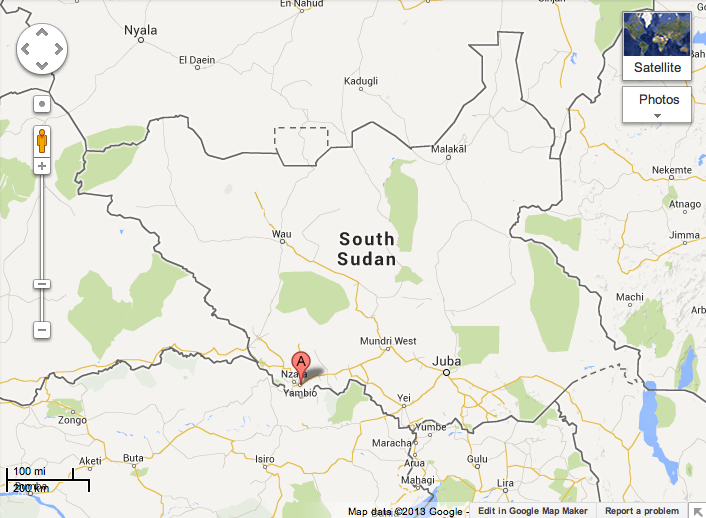
David, and Where is Yambio, South Sudan?
A year ago, we had an extraordinary experience. We often entertain delegates visiting from other countries, and this time we had three African journalists, and, strictly by chance, they all turned out to be Christian. Most of our gatherings are strictly ecumenical, but these were joyful, praying Christians, and the evening took a turn we never anticipated.
“So how did you find Jesus?” one woman asked David, from the newest country in the world, South Sudan. Inside, I was shocked, and when I am shocked, my tendency is to laugh, I don’t know why, it is just the way I am wired. Every culture is so different. In the South, people might ask that of one another, particularly if you worship in a fundamental sect, but our sect is more formal, and to inquire into another’s spiritual life can be perceived as intrusive.
David, however, was not taken aback. “It’s a long story,” he said, and we all settled into comfortable chairs to listen better. It was Christmas, the decorations were up, the lights all twinkling and we had eaten. A good time for a story.
It was a long story. It started with a little boy in a happy family, who one day was told to run! Run! Run into the forest and hide! The riders were coming! His family grabbed a very few things and ran.
His family ran for years. His family ran into forests, across borders, into dry arid spaces. Sometimes some of the children would get separated from their parents for a while, but they would keep asking, and eventually meet up again, only to face separation again. Their whole lives were running, from the Janjaween, from border police, from robbers.
At one point, he and a brother stayed in a church, and a priest taught them about Jesus. Simple stories, simple songs, and he drew letters and numbers in the dirt – that was his early schooling. It was a haven of peace for him.
Many years later, the family was reunited in their village in the new country of South Sudan. Miraculously, every member of his family survived, indeed, most of his village survived. They had maintained lines of communication through all those years of running and separation, and were so thankful. Most of all, now, they were thankful – they had a church in their village. David had learned to love learning, and had completed his education and had found a wonderful job.
“I don’t know the book like you do,” he told us, “I only know it like a little child sitting at the feet of that priest, but I am learning.”
I can’t help but think that David knows more than he thinks. David holds his belief in Jesus like a child, simple and direct. His testimony is powerful and unforgettable. I am in awe, even a year later, of his story and testimony.
Today the church prays for the diocese of Yambio, in the South Sudan:
The Church Remembers John of Damascus
Today the church remembers John of Damascus, our good friend who once was the American Consul in Damascus is visiting with us, and we mourn the loss of peace and security in Damascus, and Syria, and the heartless loss of so many lives, the destruction of beautiful Homs, and so many other villages, named and unnamed, and the use of nerve gas on Syrian people.
I love it that he is most often shown wearing a keffiye

The Liturgical Calendar: The Church Remembers
Today the church remembers John of Damascus, Priest, c. 760.
The son of an important official in the court of the Muslim Caliph of Damascus, John had an easy rapport with the Muslims among whom he was reared, and readily succeeded to his father’s office in the Caliph’s court. Later, he abandoned the wealth and comfort of the fashionable life of Damascus and joined a religious community in Palestine.
As he lived the rigorous life of a monk in the stark wilderness near the Dead Sea, his own strong personality began to emerge. He soon distinguished himself as a theologian and scholar. His chief published work extant is The Fount of Knowledge. He is recognized as a “Doctor of the Universal Church.”
However, John of Damascus is most widely remembered for his contributions to Christian worship. He wrote many fine hymns, including two Easter ones that are still popular today: “Come ye faithful raise the strain…” and “The Day of Resurrection, earth tell it out abroad!” He effectively defended the doctrine of the Real Presence in the Eucharist, the veneration of the Lord’s Mother, and use of icons. He became involved in an international religio-political struggle called the “Icononclastic Controversy” which reached violent proportions and shook the Byzantine world. His life was saved in this controversy by his powerful Muslim friends.
We give thanks for John and for all those who have upheld the truth of our faith and the glory of our worship. Amen.
If You Lived Here, I’d Know Your Name: Heather Lende

“You have to read this!” said my book friend, “You’re from Alaska! It’s about a woman who lives in some small town and writes obituaries!”
I grinned politely and put the book in my bag. Some books sound more interesting than other books – I’ve always loved adventures and mysteries and murders – add a little drama to the day-to-day-ness of everyday life. A woman who writes obituaries? Hmmm, not so much.
But spending my afternoons tending to my sweet little 3-month-old granddaughter means I often sit, anchored by the soundly sleeping baby who I don’t want to disturb, even by twitching. I have one hand free – and you can only play so much iPhone Sudoku.
An Alaskan friend had also recommended this book, so early this week I picked it up and started reading.
Oh. my. goodness. Yes, Haines is a small town, but oh the drama of writing obituaries. Oh, the things you learn about your neighbors and the surprises you get learning about their earlier lives. I love the way Heather Lende weaves the writing of the town obituaries with the current ongoing dramas in her own life and in the lives of her friends and makes it work.
It’s not unlike where I grew up, although my hometown had a hospital. We also had moose and bear and elk in our back yards, and learned to treat wildlife with respect, and that the best option was to back away slowly. There are the same senseless deaths from auto accidents, fishing boat accidents and unexpected changes in weather. There is the same feeling of wonder, almost every day of your life, knowing how very lucky you are to live in the midst of such awe-inspiring beauty. It’s hard for me to imagine being an unbeliever living in Alaska.
It’s also a great book to read before going to bed. Some of the books I read are too exciting or too disturbing to read before bed; books that infiltrate your dreams with images and situations that give you a restless night. While Lende deals with death and sadness and drama, there is an underlying message of hope in the neighborliness of your neighbors, the security of living in a town where everybody knows everybody else, in the civility even of people who strongly disagree with one another. If You Lived Here, I’d Know Your Name gives you peaceful sleep. She ties it all together with an ending that rips your heart out; you will never forget this book once you read it. After reading, you will feel like you have lived in Haines, Alaska.
The paperback version is available from Amazon.com for $9.73. No, I no longer own stock in Amazon.com.
Elizabeth of Hungary
You think life would be sweet if you were born rich and beautiful, but not so much for Elizabeth of Hungary. She saw – and endured – so much in her short life. I can imagine that the best would be that her children were not killed, and the worst would be having them taken from her.

Today the church remembers Elizabeth, Princess of Hungary, 1231.
Being born wealthy does not assure security in life, and one’s own generosity to others does not guarantee repayment in kind by others. Elizabeth was the daughter of the king of Hungary. She married Louis the Fourth, Landgrave of Thuringia, Germany. She was a loving and exemplary wife and mother. However, when she was only twenty years old, her husband was killed and she and her children became the wards of her husband’s cruel and selfish brother, Henry Raspe. Eventually he expelled Elizabeth and her children from the family home, Wartburg Castle.
Elizabeth sought refuge in the church in Marburg, but even there she was not kindly treated. The stern, powerful, and insensitive priest, Conrad, called “the Master of Marburg,” had her children taken from her and placed her in a convent of women Franciscans, known as Poor Clares. There she was treated with almost sadistic severity. “Like grass beaten by a thunderstorm,” to use her own phrase, she revived to become the most beloved “sister of the poor” of Marburg. She often sewed garments for poor children until her fingers bled, or went days without sleep while caring for the sick. She died in 1231, at the age of twenty-four.
In all our struggles, give us strength to cling to you, O God, our only true and lasting hope. Amen.
Almighty God, by your grace your servant Elizabeth of Hungary recognized and honored Jesus in the poor of this world: Grant that we, following her example, may with love and gladness serve those in any need or trouble, in the name and for the sake of Jesus Christ; who lives and reigns with you and the Holy Spirit, one God, for ever and ever. Amen.
“How Have You Managed . . . ?”
“What do you mean?” I asked the elegant grinning lady who was asking me the question. Three former military wives, one Army, one Air Force and one Navy, and we had been talking about our world-wide lives and adventures.
“How are you doing? You haven’t been here long. Are you managing to settle in?” asked with enormous sympathy.
She caught me off guard.
Yes, I am happy. I’ve settled in. I have friends. I’m connected.
But her question caught me off guard, and all of a sudden I couldn’t answer.
“I’m doing OK” I managed to start. “But it’s like this church. I love this church, and at the same time, there are times I walk in and oh, how I miss our churches in the Middle East, where I would walk in and think ‘this is what heaven must look like’ especially at Christmas, with all the Indian families in their saris and finery, and the Africans in their brocades and elaborate head-dresses, and the people from all over the world. The music was simpler, and at the Christmas Eve service, we sang ‘Silent Night’ in every language in the church . . . I miss that.”
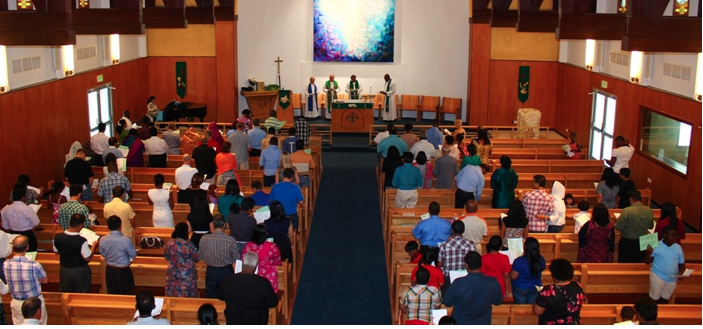
There are times the memories catch me unaware, and leave me breathless.
AdventueMan and I went grocery shopping today and when the cashier told me the total, AdventureMan almost gasped. I just laughed and told him that’s why I never took him grocery shopping with me in Kuwait – the sticker shock would have killed him.
Life here is definitely easier.
On the other hand, we have had to revise our ideas about Kuwait drivers. At first, we just thought there were a lot of Kuwaitis living in Pensacola; now we have realized that there are people who just drive as they please. Some of them are stoned out of their minds. I witnessed an accident last week where when I checked the driver of the car that was hit, she grinned at me loopily – and then disappeared. It was bizarre, and I wonder how many people are on the roads as impaired as she was. She went right through a stop sign as if it weren’t even there, and if the car had hit 6 inches more forward, she would have been dead. She didn’t have a scratch. And she was not at all concerned, just that loopy grin. “Elegantly wasted” said the driver of the car who hit her.
We both have a lot going on. With connection comes commitment and obligation. We try to coordinate our schedules at the beginning of the week so we can help one another out. The highlight is that each afternoon I am taking care of our new little granddaughter. AdventureMan/Baba often comes by and naps in the peaceful environment just to be with us. She is a sweet, laughing little baby, never very fussy. He offers me a day off, which occasionally I take, or he takes a time when I have a meeting or an appointment. We have both discovered how very much we like the ‘work’ of grandparenting. 🙂
We’re managing. 🙂
The Alaska State Museum in Juneau
“Oh,” the docent laughed, “everyone asks about that old bear. He hasn’t been around for years. He got all patchy because all the kids touched him and his hair fell off.”
LOL. I know one of those kids. There was a big sign that said “Do Not Touch the Bear” but he was a snowy white polar bear and . . . irresistible. My Dad worked in the same building as this museum, in its old location, and I would meet him there for a ride home after going to the library.
I loved this museum.
This time, it was one of the highlights of the entire trip. This museum is rich in well-curated pieces, and they are beautifully arranged. A new museum is going up; I can only hope that when it opens, it is at least as well done as this one is. Both AdventureMan and I could spend a lot more time in this museum.
Carving at the entrance:


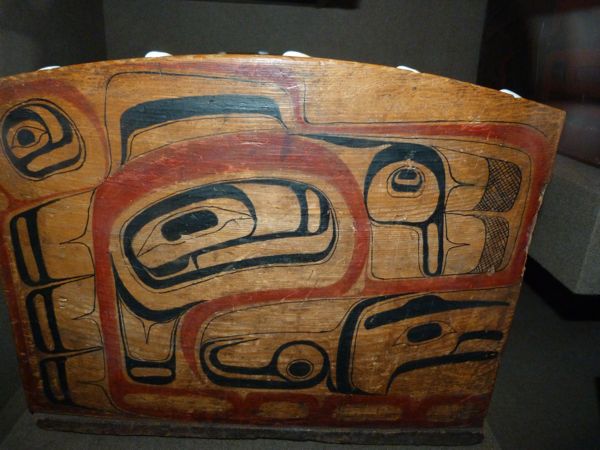
Bent wood box

Painted chest
Ceremonial robe
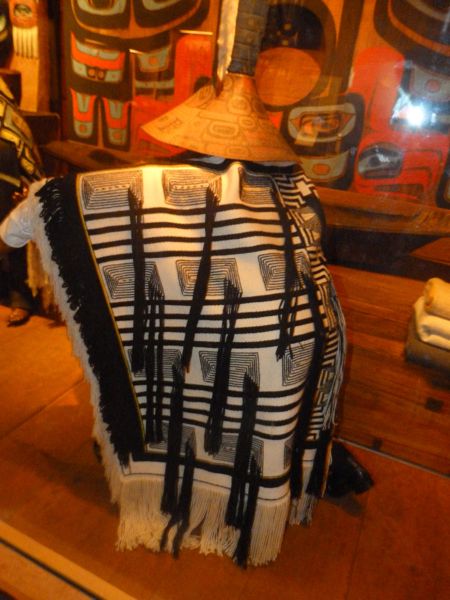
Everyday clothing
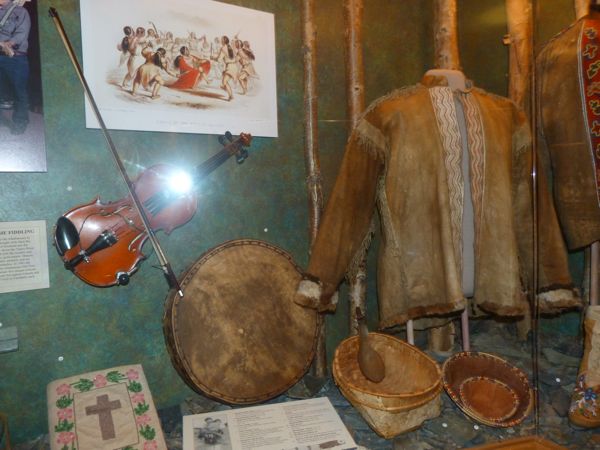
Upiq masks

Close up Upiq masks

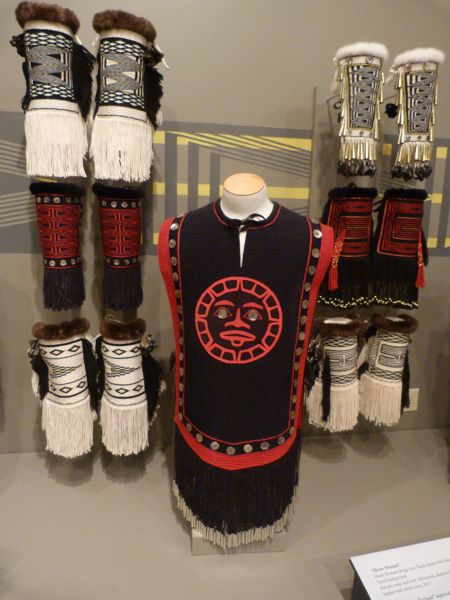
Sun motif ceremonial outfit – look at the leg pieces – don’t they look like Sadu weaving to you?

Moon motif ceremonial outfit
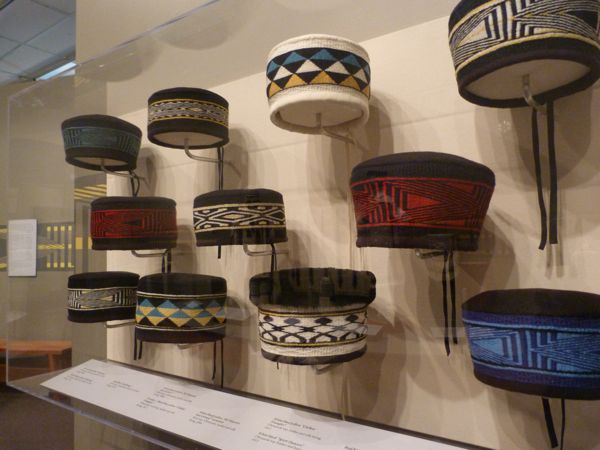
Hand made hats. I was so surprised; these are like prayer caps in Oman and in Pakistan and I think in Indonesia. That they would be so similar in shape and geometric embroidery was amazing to me.
Eagle’s nest display, with eagle sounds. I love this! There is also a bear, but positioned so you really cannot touch . . . 😦


Corner pillars of Alaskan native houses used to look like this, not exactly totemic but with carved spirits:

There is so much more. I focused on the Alaskan Native inhabitants, but there are also exhibits of the coming of the Russians, the gold rush, the transition to territory and statehood . . . I can only take in so much at one time! Good thing we are going back 🙂
ALASKA STATE MUSEUM
395 Whittier Street
Juneau, AK 99811-1718
Tel: 907.465.2901
Fax: 907.465.2976
Americanah and Chimamanda Ngozi Adichie
Rushing from one meeting to another yesterday, I had just an hour – but during that hour, Terry Gross was interviewing one of my favorite authors, Chimamanda Ngozi Adichie, and Chimamanda Ngozi Adichie does GREAT interviews. She is funny, and educated and insightful; she can talk about painful topics and make you laugh and cry with her. That interview was a blessing on my day.
I started reading Chimamanda Ngozi Adichie when I was in Kuwait. A good friend approached me and asked me to form a book club. LOL. This is a friend I can’t say no to. Every introverted bone in my body was screaming “NO! NO!” and I smiled at her and said “Yes.”
God is good. He laughed when I said “yes” and through the book club, introduced me to authors I might never otherwise read. The club was made up of many nationalities, and we read books from everywhere, unforgettable books. We read Chimamanda Ngozi Adichie “Half of a Yellow Sun.” Once you read Chimamanda Ngozi Adichie, there is no going back. I wonder if I will be able to hold out on Americanah until it comes out in paperback?
This is from the National Public Radio website, so you can actually listen to the interview yourself, should you want to get to know this delightful author a little better.
‘Americanah’ Author Explains ‘Learning’ To Be Black In The U.S.

When the novelist Chimamanda Ngozi Adichie was growing up in Nigeria she was not used to being identified by the color of her skin. That changed when she arrived in the United States for college. As a black African in America, Adichie was suddenly confronted with what it meant to be a person of color in the United States. Race as an idea became something that she had to navigate and learn.
The learning process took some time and was episodic. Adichie recalls, for example, an undergraduate class in which the subject of watermelon came up. A student had said something about watermelon to an African-American classmate, who was offended by the comment.
“I remember sitting there thinking, ‘But what’s so bad about watermelons? Because I quite like watermelons,’ ” Adichie tells Fresh Air‘s Terry Gross.
She felt that her African-American classmate was annoyed with her because Adichie didn’t share her anger — but she didn’t have the context to understand why. The history of the trans-Atlantic slave trade was not taught to students in Nigeria. Adichie had yet to learn fully about the history of slavery — and its continuing reverberations — in the U.S.
“Race is such a strange construct,” says Adichie, “because you have to learn what it means to be black in America. So you have to learn that watermelon is supposed to be offensive.”
Adichie is a MacArthur Fellowship winner and author of the novels Purple Hibiscusand Half of A Yellow Sun. Her new novel, Americanah, explores this question of what it means to be black in the U.S., and tells the story of a young Nigerian couple, one of whom leaves for England and the other of whom leaves for America.
The title, she says, is a Nigerian word for those who have been to the U.S. and return with American affectations.
“It’s often used,” she says, “in the context of a kind of gentle mockery.”
The Festival of BERNARD MIZEKI
(Play the video of the Soweto Gospel Choir as you read this summary from today’s Lectionary Readings How I would love to be able to attend this festival!)
BERNARD MIZEKI
CATECHIST AND MARTYR IN AFRICA (18 JUNE 1896)
Bernard Mizeki was born in Portuguese East Africa (Mozambique) in about 1861. When he was twelve or a little older, he left his home and went to Capetown, South Africa, where for the next ten years he worked as a laborer, living in the slums of Capetown, but (perceiving the disastrous effects of drunkenness on many workers in the slums) firmly refusing to drink alcohol, and remaining largely uncorrupted by his surroundings. After his day’s work, he attended night classes at an Anglican school.
Under the influence of his teachers, from the Society of Saint John the Evangelist (SSJE, an Anglican religious order for men, popularly called the Cowley Fathers), he became a Christian and was baptized on 9 March 1886. Besides the fundamentals of European schooling, he mastered English, French, high Dutch, and at least eight local African languages. In time he would be an invaluable assistant when the Anglican church began translating its sacred texts into African languages.
After graduating from the school, he accompanied Bishop Knight-Bruce to Mashonaland, a tribal area in Southern Rhodesia (now Zimbabwe), to work there as a lay catechist. In 1891 the bishop assigned him to Nhowe, the village of paramount-chief Mangwende, and there he built a mission-complex. He prayed the Anglican hours each day, tended his subsistence garden, studied the local language (which he mastered better than any other foreigner in his day), and cultivated friendships with the villagers. He eventually opened a school, and won the hearts of many of the Mashona through his love for their children.
He moved his mission complex up onto a nearby plateau, next to a grove of trees sacred to the ancestral spirits of the Mashona. Although he had the chief’s permission, he angered the local religious leaders when he cut some of the trees down and carved crosses into others. Although he opposed some local traditional religious customs, Bernard was very attentive to the nuances of the Shona Spirit religion. He developed an approach that built on people’s already monotheistic faith in one God, Mwari, and on their sensitivity to spirit life, while at the same time he forthrightly proclaimed the Christ. Over the next five years (1891-1896), the mission at Nhowe produced an abundance of converts.
Many black African nationalists regarded all missionaries as working for the European colonial governments. During an uprising in 1896, Bernard was warned to flee. He refused, since he did not regard himself as working for anyone but Christ, and he would not desert his converts or his post.
On 18 June 1896, he was fatally speared outside his hut. His wife and a helper went to get food and blankets for him. They later reported that, from a distance, they saw a blinding light on the hillside where he had been lying, and heard a rushing sound, as though of many wings. When they returned to the spot his body had disappeared. The place of his death has become a focus of great devotion for Anglicans and other Christians, and one of the greatest of all Christian festivals in Africa takes place there every year around the feast day that marks the anniversary of his martyrdom, June 18.
Recent Comments
Kitchen on Isiais: Winding Down intlxpatr on Shampoo Ginger tigerbutterya0c5ff1d… on Shampoo Ginger intlxpatr on British Soldier Kidnapped, Esc… John on British Soldier Kidnapped, Esc… Wikipedia Donate Button

Amazina


Early Voting in Florida


