A Prayer for Samuel Occum
I don’t always get a chance to read about a saint of the church on his/her saint’s day, but this morning, while reading The Lectionary readings, I took the time, and was glad I did. These readings tell me about ordinary people who made a difference, Samuel Occum by being Mohegan (Mohican?) and serving his community by raising funds for the establishment of Dartmouth College.
But what I loved was the prayer for his saint’s day, which starts “God, Great Spirit” and talks about his voice in the thundering wind.
PRAYER (contemporary language)
God, Great Spirit, whose breath gives life to the world and whose voice thunders in the wind: We thank you for your servant Samson Occom, strong preacher and teacher among the Mohegan people; and we pray that we, cherishing his example, may love learning and by love build up the communities into which you send us, and on all our paths walk in beauty with Jesus Christ; who with you and the Holy Spirit, is alive and reigns, one God, now and for ever. Amen.
SAMSON OCCUM
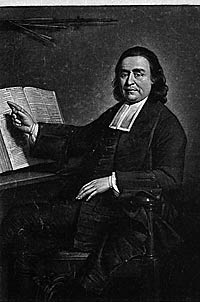
WITNESS TO THE FAITH IN NEW ENGLAND, 1792
The Reverend Samson Occom (1723 – 1792) (also spelled as Occum) was a Native American Presbyterian clergyman and a member of the Mohegan nation near New London, Connecticut. He has the distinction of being the first Native American person to ever publish documents and pamphlets in English.
Born to Joshua Tomacham and his wife Sarah, Occom is believed to be a direct descendant of the famous Mohegan chief, Uncas. In 1740, at the age of sixteen, Occom was exposed to the teachings of Christian evangelical preachers in the Great Awakening. He began to study theology at the “Lattin School” of Eleazar Wheelock in 1743 and stayed for four years until leaving to begin his own career.
Occom served as a missionary to Native American people in New England and Montauk, Long Island, where he married a local woman. It was also on Long Island where he was officially ordained a minister on August 30, 1759, by the presbytery of Suffolk.
Wheelock established an Indian charity school (which became Dartmouth College) with a benefaction from Joshua Moor in 1754, and he persuaded Occom to go to England in 1766 to raise money for the school, along with the Rev. Nathaniel Whitaker. Occom preached his way across the country from February 16, 1766, to July 22, 1767. He delivered in total between three and four hundred sermons, drawing large crowds wherever he went. By the end of his tour he had raised over twelve thousand pounds for Wheelock’s project. King George III himself donated 200 pounds, and William Legge, Earl of Dartmouth subscribed 50 guineas. The friendship between Occom and Wheelock dissolved when Occom learned that Wheelock had neglected to care for Occom’s wife and children while he was away. Occom also took issue with the fact that Wheelock put the funds toward establishing Dartmouth College for the education of Englishmen rather than of Native Americans.
Upon his return from England, Occom lived at Mohegan, then moved in 1786 with some New England and Long Island Indians to Oneida territory in what is known today as New York. He then helped to found Brothertown, and lived among the Brothertown Indians. Occom died on July 14, 1792, in New Stockbridge, New York.
Jeannette Walls: The Glass Castle

The Glass Castle was a hugely popular best seller in the USA, and it must have been while I was gone. A part of me remembers reading a little bit about it and deciding it wasn’t my kind of book, but after reading Half Broke Horses, I had forgotten what the subject matter was and was excited to have another Jeannette Walls book I could read.
Big mistake. This book is nothing like Half Broke Horses.
Or maybe it is. Maybe what I loved about Half Broke Horses was the voice of an amazing woman, and maybe what kept me reading The Glass Castle is the voice of an amazing child who tells a heart breaking story. Or maybe it isn’t so heartbreaking, because the children survive. They are scarred and damaged, but never so damaged or loony or self-deceived as their parents.
I don’t like reading books about kids whose parents don’t take good care of them. Oprah chose a lot of those books in her book club. These books depress me. I cannot imagine how parents can be so self-absorbed, how they can take on the responsibilities of children and then not put those children first. How can they?
The Glass Castle stars the daughter of Lily Casey Smith, who is the mother of Jeannette Walls, and her husband, who is Jeannette’s father. The book opens with little three year old Jeannette proudly cooking up a hot dog. Her mother is busy painting and has told her to find something to eat. Her nightgown catches fire, and she is terribly burned. She spends a long time in the hospital, which ends with her father taking her out in a hurry, bundling her into the car, already loaded with her family, and “doing the skedaddle” which is leaving town just in front of the bill collectors.
This is her life. From time to time, their alcoholic Dad will take a job and bring home some of the paycheck (he drinks and gambles most of it) and when he won’t work, on rare occasion, their mother will take a teaching job, but the kids have to get her out of bed in the morning, have to grade her papers and make her lesson plans. Often there is not enough for the family to eat. They don’t stay in one place; they ‘skedaddle’ before they are evicted for non-payment of rent. They eat cold food – when they eat – because the parents didn’t pay the electric bill.
The Dad is smart, charming and cajoling, and when he is sober, the kids learn amazing things from him, and educated engineer. Unfortunately, he is not often sober. He chases after alcohol and he chases after women; the people in the towns where they live know it and the children learn to know it, too, to their constant humiliation. When he wheedles money off his kids, and promises to repay, he asks “Have I ever let you down?” The answer is so stunningly obvious as to be heartbreaking – Yes. Yes, again and again and again.
The Mother is equally irresponsible. One time, when the family is starving, she is in bed and occasionally goes under the covers, where Jeannette discovers her mother has a chocolate bar hidden that she can eat – while her children go hungry.
The author’s voice is never self pitying, she just lays it all out and leaves us to draw our own conclusions. Each child escapes the family as soon as possible; the children plan and save their money to get out, first sending off the oldest sister, then Jeannette, then the son. They all head for New York, where they find work and support themselves. Like bad pennies, Mom and Dad show up in New York, cadge meals and money and join the ranks of the homeless in New York, going from food pantry to soup kitchen, and diving dumpsters for their worldly needs.
This is not a feel good novel. The good part about it is that children can survive this kind of criminal neglect, and become a successful author as Jeannette Walls has done. I am so glad I read Half Broke Horses first, because her grandmother is such an admirable character, whereas her parents are scum and I just felt so angry when I read the matter-of-fact descriptions of their behavior that I was glad they were not where I could get my hands on them.
I don’t know any parents as bad as Rose Mary and Rex Walls, but I know I believe this – if you choose to marry, and if you choose to have children, know that children require time, and love, and energy, and patience. Know that if you have grand ambitions, or an addiction, or a character flaw, you won’t be able to provide for your children’s physical, emotional and spiritual needs, unless you are willing to sacrifice your own needs and wants. While the children in the book loved their parents, they recognized that their parents were sadly lacking in the parenting roles. The way these children were neglected will make me remember this book for a long time.
Would I recommend it? Yes. It is a gripping book, at times even horrifyingly humorous, as when Jeannette figures out how to find lunch food in the garbage cans when all the other kids have finished eating. It is not a feel-good book. It is a horrifying indictment of self-absorbed, neglectful parents, parents you will love to hate.
If I sound a little overwrought, it’s because I worked with the homeless. We were able to help many, but I also ran into families like this family, families who would prefer not taking any help if it meant they had to play by the rules, you know, rules like “you have to take care of your children.” We had all kinds of classes and forums and mentors to help with learning skills, like feeding children well on a small budget, learning to discipline, simple skills, survival skills.
The problem is that these skills require self-discipline, and many of the parents would rather not take help than have to exercise self-discipline. I saw women who would sacrifice their children for their current boyfriend, a woman who was severely angry with her daughter for reporting a family member had molested her, a man who didn’t want to take a job that would ‘tie him down’ when his family was starving. I saw this, with my own eyes, and there is no way you can MAKE people take good care of their children. You have to ask if the children are better off with these parents, or ‘in the system.’ Not a pretty choice.
This book, too, is on Amazon.com. Reading it is like watching a disaster on CNN. You don’t want to believe it is happening and you can’t look away.
The Minority Prayer

I listen to National Public Radio in my car and in my project room. I finally figured out how to stream WUWF, my local station. Until today, unless I wanted to use my wind-up radio, I had to stream KUOW in Seattle, or NPR which I like because it has so much BBC.
I am really delighted to figure out how to stream WUWF, because it has a lot of local news and events I might miss streaming one of the other stations, and I also like hearing who the sponsors are, so I can tell them how much I enjoy National Public Radio.
So today I am listening to Talk of the Nations, a segment on Pakistani-Americans, and this particularly articulate young lawyer mentions ‘the Minority Prayer.
Do you know what that is? I didn’t. But I laughed when he explained it, because we have prayed it so often living overseas . . .
He was talking about when attending a Muslim-American Lawyers National meeting, and how the buzz spread that Osama Bin Laden had been killed, and how they all sent up a quick minority prayer – “Please, Lord, don’t let it be Pakistan where he was found” – and of course, it was Pakistan. He was very wry, and I enjoyed listening to what he had to say. At the same time, I was grinning. I cannot count the number of times we have heard rumors – in Germany, in Kuwait, in Qatar, in Tunisia, in Jordan – and prayed . . . “Please Lord, don’t let it be the USA who did this . . . ”
It’s very much an expat’s prayer.
If you want to listen to the interview yourself, you can find it here.
Lunch in Paris (A Love Story With Recipes) by Elizabeth Bond
I just finished this book, and I need to review it so that I can pass it along to my daughter-in-law, who sees France, as I do, through eyes of love. Americans either love France or hate it, for some reason France evokes strong emotions one way or the other.

This author is a New Yorker, and her experiences are not my experiences, because her culture is not my culture. New York is a culture all its own. On the other hand, her experiences as an expat are universal, and her insecurity with the language, the culture and the customs are magnified by her commitment to marrying a French man and living in France for the rest of her life.
For the record, I really loved this book.
Can you read a recipe and have a pretty good idea what it is going to look like and how it will taste? In my family, we read cook books for fun. The recipes Elizabeth Bond has included are great recipes, a great start on French cooking the simple and fresh way. Even someone who has never cooked French food can make most of the dishes she creates in this book. In my very favorite chapter, A New Year’s Feast, there are several recipes for North African dishes I have eaten and loved – and oh, I am eager to try these! Chicken Tajine with Two Kinds of Lemon! Tajine with Meatballs and Spiced Apricots! Oh, YUMMMM!
In one part of the book, the author talks about some very basic differences between how Americans approach life and how the French view life:
I watched the couples walking around the lake. “Maybe it’s the New Yorker in me. I’m too used to rushing around. But everyone here is so relaxed, it’s like they’re moving in slow motion.”
“Why should they rush? They’re not going to get anywhere.”
Sometimes I really have no idea what he is taling about.
“You will never understand. You come from a place where everything is possible.” We lay side by side on the grass, our eyes half closed.
“It’s Henry Miller that said, ‘In America, every man is potentially a president. Here, every man is potentially a zero.’ ”
And then he told me a story.
“When I was sixteen it was time to decide what kind of studies I would pursue. I was the best in the class in Math and Physics, but also the best in Literature. I went to the school library and the woman behind the desk gave me a book. It was called All the Jobs in the World. I looked through it. I found two things I liked: scientific researcher and film director. I brought the book to the front and showed her my choices. ‘Ah non,’ she said, ‘You forgot to look at the key.’ And she pointed to the top of the page. Next to each job were the dollar signs – three dollar signs if the job paid a lot of money, one dollar sign if it paid very little. Next to the dollar sign was a door. If the door was wide open it was very easy to tet this job, if the door was open just a little bit, it was very hard. ‘Regard,‘ she said, ‘You have picked only jobs with no dollar signs and a closed door. Tu n’y arriveras jamais. You will never get there.”
‘You should become an engineer,’ she said. My parents never met anyone who did these other things. We don’t come from that world. They had no friends they could call to get me a job. They were afraid I would fail and they couldn’t help me. They were afraid I would have no place in the society. And I didn’t have the force to do it myself. I didn’t want to disappoint them. So I became an engineer.”
“It’s just like that here. If you want to do something different, if you head sticks up just a little, they cut it off. It’s been like that since the Revolution. You know the saying, Liberte,’ Egalite,’ Fraternite,’ equality is right in the middle. Everyone has got to be the same.
Of all the stories Gwendal has told me, before or since, this one shocked me the most. Never in my life, not once, had anyone ever told me there was something I couldn’t do, couldn’t be.
Have you ever known an expat wife (a woman who has married a man of another culture and lived in his country)? Expat wives are some of the bravest women I have ever met. No matter how long you have been married to a man of another culture, you can still be surprised.
The expat wives I have known have been smart, gifted people, woman who have been blessed to see the world through the eyes of more than one culture, and it changes everything. Their children are amazing – most will speak – and think – in more than one language. They have a sort of international fluidity, as well as intercultural fluency. It isn’t everyone’s choice, but those who chose it often live lives you and I can only begin to imagine. Elizabeth Bond has opened the door a little, and shared some of those experiences with us.
The book I bought has Reader’s Groups questions in the back, and they are good questions. Read the questions first; it gives you food for thought as you read through her experiences.
Shoreline Foods in Pensacola
“Oh, it’s on Main Street!” our friend told us, “Or it used to be Main Street, but now part of it is Bayfront, or some such, but we all know it is Main Street.”
My resourceful daughter-in-law is always full of the best hints. She told us about a place she thought I would love, called Shoreline Foods, a grocery store, but the old fashioned kind, and Greek.
I’ve been trying to find it ever since, but as it turns out, I was looking in the wrong direction. I finally asked my friend who knows EVERYTHING; Shoreline Foods IS on Main, at Main and “E” St. very near to Joe Patti’s, just as she said.
From the outside, you would never know how special it is, it just looks like another strip mall kind of store, but lots of parking, always a good thing 🙂

They do carry groceries, and an entire aisle with spices you can’t find most other places, or not all in one place:

And they have a deli! With wonderful sandwiches!
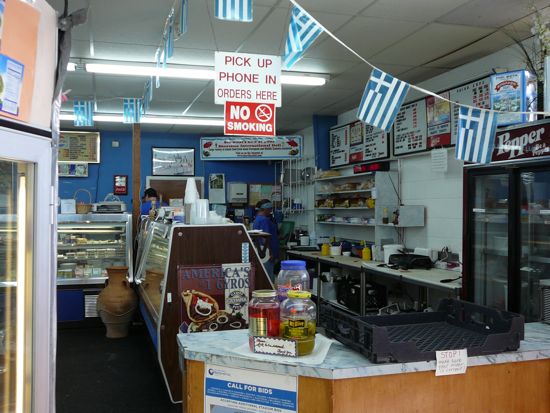
Tantalizing desserts!

Kanafi is a Middle Eastern pastry, so hard it is to find, and here it is in Pensacola!

And for me, the very best part is this:
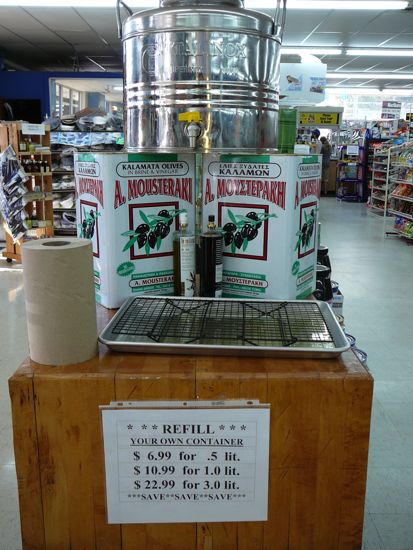
Here I am going to rant for just a little minute. Shopping for olive oil in the USA is the total pits. Even the “best” olive oils, when you read their labels, say that the oil comes from “Spain, Argentina and Tunisia” or some such. Blends. It gives you no guarantee that one month the oil is the same as the next month, or the quality of the oils they are using.
I challenge you! Go to your grocery store and look for an olive oil that tells you it is from one country! Even the specialty shops; few of them have single point of origin olive oils! But at Shoreline Foods, they import an olive oil from Crete (Greece) which is green and fruity and tasty! You can buy it by the litre, or half litre, or the gallon. 🙂 Even better, you can bring your own container and fill it in the shop.
When I lived in Tunisia, I used to do that. Go to the olive oil man (first make sure he has had a delivery; like an oil truck pulls up and fills his barrel) and then grab your container and go stand in line with all the maids until he will fill your container. At Shoreline Foods, there was no line, but lovely lovely olive oil from Crete! I am in heaven!
‘Lost Boy’ Casts Vote for Independence
I found this today on NPR News and it delights me for a number of reasons. For one thing, I didn’t know David Eggars (you remember him from Zeitoun) had helped with the writing of ‘What Is The What?’. Second, who knew that any of these kids would survive? Survive, write a book, thrive, go back to the Sudan, give to the country – and vote. Every now and then in this sad world you hear a good story. This is one.
January 10, 2011
During Sudan’s civil war, in which some 2 million people died, Valentino Achak Deng fled to Ethiopia on foot. Separated from his family for 17 years, Deng is one of Sudan’s so-called Lost Boys, children who were orphaned or separated from their families during the brutal war.
Now, voting is under way in Southern Sudan in a referendum that is expected to split Africa’s largest country. Among those voting this week are the Lost Boys, including Deng, whose life became a best-selling novel in America and who has returned to his homeland to build a school.
After a peace agreement between north and south, Deng returned to Juba, the capital of Southern Sudan, in 2006. He says when he got there, the place was still a wreck.
“On some of these roads, you could see old war tanks. On some of these roads, in some neighborhoods you could see the bones and skulls of dead people,” he recalls now, driving around Juba.
Now, as Southern Sudan appears headed for independence, Deng is optimistic — and Juba looks a lot better. Paved roads, now lined with hotels and restaurants, arrived for the first time in 2007.
Juba is a booming city, one of incredible contrast: Barefoot women selling piles of gravel by the side of the road sit next to a Toyota dealership.
Peace is spurring investment and consumer demand. Juba’s growth is driven by Southern Sudan’s oil revenue as well aid from foreign governments and nongovernmental organizations.
Deng grew up in a tiny village called Marial Bai. In the 1980s, northern bombers and Arab militias came.
“They bombed Marial Bai, destroyed it, killed everything, burned crops and livestock,” he says.
Deng was there when the fighting came. He says he “ran away with the rest.” He was 9 years old.
Deng joined thousands of Lost Boys, who spent months trekking across Sudan to refugee camps in Ethiopia. His experience is captured in What Is the What, a novel by Dave Eggers, which reads like a modern-day story of Job.
The boys, some naked, march across an unforgiving landscape, facing Arab horsemen, bombing raids, lions and crocodiles.
Deng eventually resettled in the U.S., where he attended college and was mentored and sponsored by ordinary Americans.
In 2007, he returned to start a high school in Marial Bai, where there was none.
“We have 250 students. Our annual budget now stands at about $200,000 because the school is free,” he says.
The school is funded by Deng’s private foundation. He says most donations come from Americans touched by his story and the plight of Southern Sudan.
Deng, now 32, has just cast his vote for independence. He says that for a Sudanese child of war, his life’s journey is almost inconceivable.
“I never imagined I would be the person I am right now,” he says.
The King’s Speech
“The movie is sold out!” my friend exclaimed as she and her husband joined me in the theater. We had really good seats. I had accidentally managed to get there early enough to get seats right in the center, close enough, but not too close. People looked at the seats I was saving for my friend and her husband with envy, and it was all I could do not to make a sign against the ‘evil eye.’ 🙂

Whoda thunk? Who would have thought a movie about an English king with a speech problem would sell out the entire theatre?
Must be word of mouth. The film is really, really good, and takes a personal tragedy and turns it into an inspiration. You wouldn’t think there could be anything funny about tackling such a problem, but the movie has some very very funny moments – the king, George VI, actually CAN speak without a stammer when he is swearing, when he is singing, or when he is very very angry.
His unorthodox speech tutor gives the King a new vision of himself, and helps him find insights into how the problem developed. There are some very moving moments, and some highly inspiring ones, too. All in all, the movie keeps moving, keeps you informed and makes you glad you spent the money on movie tickets.
Santa Lucia / Saint Lucy
Today is the feast day of St. Lucy, or, as I was growing up in Alaska, surrounded by Scandinavian fishermen and their families, Santa Lucia. In Swedish families there is a tradition that the eldest daughter, on Santa Lucia day, wears a wreath of candles and brings her parents coffee and special saffron buns in bed. People always make jokes about someone following her with a bucket of water, but I can imagine there were mishaps – imagine, mixing candles and hair. As you can see in the photo, thought, the candles are tall – at least at the beginning.
Never kid yourselves. Children love blood and gore, and love to be a little bit scared. The Grimm Brothers knew this, and if you have ever read their original stories, the hairs on the back of your neck would rise and you would say to yourself “How can these be stories for children??” Think about it – Hansel and Gretel abandoned by their own parents to starve in the woods? Girls with really mean stepmothers, who treated them unfairly?
Back before all the romantic literature on zombies and vampires, we children would stand out in the bus stop (in winter, the sun barely rises during the long Alaskan winters) and tell each other stories of the saints in the bible. Many of them died horrible deaths, and this one ended “and then they took her eyes out of her head, and she was still alive!!!!” I don’t remember ever hearing the miracle of the restoration of her sight, in fact, I thought she was killed, martyred, but here is her story, for those who want to know what Santa Lucia’s day is all about.

LUCY
VIRGIN AND MARTYR, abt. 304
The early Roman lists of martyrs commemorate Lucy, virgin and martyr, on 13 December, and her name, with that of Agatha, appears in the Roman Liturgy as an example of those who have gone before us, in whose company we join in giving thanks and praise to God. Aside from this, little is known of her, except that she lived in Syracuse in Sicily, and probably died around 304. Her name, which means “light,” probably accounts for the story that her eyes were put out and her eyesight miraculously restored, and may be connected with the fact that her feast occurs near the time when (in the Northern Hemisphere) the nights are longest.

In Sweden and elsewhere, the day is observed by having one of the daughters of the house dress in a white robe with a crown of lighted candles and go singing from room to room (presumably followed by an adult with a fire extinguisher) early in the morning when it is still dark to awaken the other family members and to offer them St. Lucy’s Cakes and hot coffee.
Ember Wednesday (of the winter season) is defined as the Wednesday after Lucy’s Day. (An equivalent definition would be: the Wednesday preceding the last Sunday before Christmas.)
The above in dark type is from The Lectionary which publishes daily readings and these stories of the Saints put together by James Kiefer.
“I’m The Present!”
As we were puffing away in one of the partners-exercises in Water Aerobics, my friend mentioned he would be heading up to Atlanta for the next couple weeks to visit children and grandchildren.
“Are you driving?” I asked between huffing and puffing.
“Nope, flying.” His answers were a lot shorter.
“You taking presents?” I asked, trying to keep my mind off my aching limbs.
“I AM the present!” he responded, and we both laughed.
When I was a kid, my favorite present was getting the small wrapped hotel soaps my Dad would bring back from his trips. To this day, I still like soaps!
Recent Comments
ExpatAlien on What Country am I Living … intlxpatr on Yellowstone: Old Faithful to C… Michelle on Yellowstone: Old Faithful to C… Cathy on No Grown-Ups in Charge intlxpatr on Waiting for Snow Wikipedia Donate Button

Amazina


Early Voting in Florida


 Here There and Everywhere