Room by Emma Donoghue
Hardly ever do I order a book in hardcover; they weigh too much, I do a lot of reading when flying, I prefer paperbacks so I can pass them on when I am finished (and no, I do not yet have a Kindle, because I like to pass my books along.) I made an exception for Room when I heard a review on National Public Radio. It sounded so different, and I wondered how it could be written without it being so horrible I couldn’t read it.
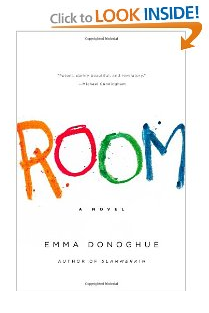
The story is told from the point of view of a five year old boy who lives in Room, an 11 x 11 foot space. He was born there, he has never been out of there.
As you read, you gain such huge admiration for the human spirit. Jake’s mother was abducted off the streets and kept in this room, which is totally soundproofed, surrounded by a chain metal cage, and can be entered and exited only by a door with a code entry lock. She raises Jake as best she can, keeping him hidden from her abductor. She teaches him reading and math, she tries to raise him eating nutritious foods, they have hygiene rules and daily physical education. Every now and then, she has a day when she is “gone”, when Jake wakes up and his mother won’t ‘switch on’ and just stays in her bed, sleeping all day. On those days, he feeds himself and plays quietly, knowing that his Mom will be back ‘on’ the next day – or so. He doesn’t understand his Mother’s despair, and she shelters him from it as best she can.
And then comes the time when she realizes that life is only going to get more and more difficult as Jake gets older. She makes a plan, a plan that relies on Jake, a desperate plan.
The book is fascinating. I have already passed it along; once I read it, I wanted to share it. In many ways, it is a cross-cultural book, because the culture Jake spends his first five years in is so insular, so enclosed. Emma Donoghue did a great job describing his world from his point of view, and dealing with the aftermath. I can’t tell you much more without spoiling the book for you in a major way. 🙂
There is a Reader’s Guide section at the back, and this book would be an excellent selection for a book club.
House Rules by Jodi Picoult
I got it all done – two days before Christmas. Wooo HOOOO, I get the reward, a new book! One I had been eager to read, House Rules by Jodi Picoult. (You can read reviews of other Picoult books by doing a blog search, enter Jodi Picoult in my blog’s search window.)
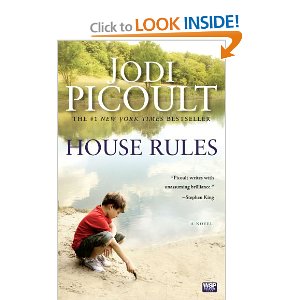
What I really like about Jodi Picoult is that she writes about really tough situations and exposes our ignorance and ambivalence to us. In this book, she writes about a single mother who is raising two sons, one of whom has Asperger’s Syndrome. He is extremely bright, but lives in a world where he is bombarded by too much sensation. He cannot block out sensory input that we learn to ignore, and some of it – noise, colors – in his case, the color orange – or any change in routine can cause him to spin out of control. Imagine a two year old having a tantrum in a grocery store . . . now imagine an eighteen year old young man having the same tantrum. It helps you see what the Mom is dealing with.
Dad left when the second son was born. “It’s too hard,” he said, and left her to cope with all of it.
She gets child support, while her husband is raising his new family a continent away. She free lances as an advice columnist, and edits from her home to supplement the bare bones family existence. She learns to cope with Jacob’s needs, and she advocates for him fiercely, to be mainstreamed in the school system AND to have some special supports to soothe him when he becomes over-stimulated.
Jacob isn’t a burden, although his need for routine – certain colors for different days of the week, including meals – can be burdensome. Jacob is also very very bright, and obsessed with crime scene forensics. He loves setting up “crime scenes” for his mom to solve and the one bright spot in his daily life is the Crime Busters show which comes on every day at 4:30.
And then, suddenly, a life which is already wobbling turns upside down. Jacob is implicated in the murder of his tutor, a young woman Jacob loved working with, who helped him develop an understanding of how people interact and behave. Those who know Jacob understand his quirks and eccentricities are due to his wiring, but Jacob looks very odd, very threatening and even violent to the outside observer – a nightmare client as a defendant.
It is a GREAT read. Picoult keeps her secrets up to the very end; the book is tightly wired and we are given clues all along the way. The edition I read had both a reader’s guide and an interview with the author at the end. It is NOT cheating to read those first! It gives you good guidance on what the author is trying to say, and what may be significant, while not appearing particularly so.
It gave me a great appreciation for parent’s of children outside the realm of ‘normal.’ It gave me an appreciation for the work and persistence and dedication it takes to try to get a more level playing field for their children.
It the book Jacob has some self-awareness, and compares Asperger’s Syndrome to seasonings, and he believes we all have a dose of Asperger’s Syndrome in our wiring, but that some children get a little extra.
‘Lost Boy’ Casts Vote for Independence
I found this today on NPR News and it delights me for a number of reasons. For one thing, I didn’t know David Eggars (you remember him from Zeitoun) had helped with the writing of ‘What Is The What?’. Second, who knew that any of these kids would survive? Survive, write a book, thrive, go back to the Sudan, give to the country – and vote. Every now and then in this sad world you hear a good story. This is one.
January 10, 2011
During Sudan’s civil war, in which some 2 million people died, Valentino Achak Deng fled to Ethiopia on foot. Separated from his family for 17 years, Deng is one of Sudan’s so-called Lost Boys, children who were orphaned or separated from their families during the brutal war.
Now, voting is under way in Southern Sudan in a referendum that is expected to split Africa’s largest country. Among those voting this week are the Lost Boys, including Deng, whose life became a best-selling novel in America and who has returned to his homeland to build a school.
After a peace agreement between north and south, Deng returned to Juba, the capital of Southern Sudan, in 2006. He says when he got there, the place was still a wreck.
“On some of these roads, you could see old war tanks. On some of these roads, in some neighborhoods you could see the bones and skulls of dead people,” he recalls now, driving around Juba.
Now, as Southern Sudan appears headed for independence, Deng is optimistic — and Juba looks a lot better. Paved roads, now lined with hotels and restaurants, arrived for the first time in 2007.
Juba is a booming city, one of incredible contrast: Barefoot women selling piles of gravel by the side of the road sit next to a Toyota dealership.
Peace is spurring investment and consumer demand. Juba’s growth is driven by Southern Sudan’s oil revenue as well aid from foreign governments and nongovernmental organizations.
Deng grew up in a tiny village called Marial Bai. In the 1980s, northern bombers and Arab militias came.
“They bombed Marial Bai, destroyed it, killed everything, burned crops and livestock,” he says.
Deng was there when the fighting came. He says he “ran away with the rest.” He was 9 years old.
Deng joined thousands of Lost Boys, who spent months trekking across Sudan to refugee camps in Ethiopia. His experience is captured in What Is the What, a novel by Dave Eggers, which reads like a modern-day story of Job.
The boys, some naked, march across an unforgiving landscape, facing Arab horsemen, bombing raids, lions and crocodiles.
Deng eventually resettled in the U.S., where he attended college and was mentored and sponsored by ordinary Americans.
In 2007, he returned to start a high school in Marial Bai, where there was none.
“We have 250 students. Our annual budget now stands at about $200,000 because the school is free,” he says.
The school is funded by Deng’s private foundation. He says most donations come from Americans touched by his story and the plight of Southern Sudan.
Deng, now 32, has just cast his vote for independence. He says that for a Sudanese child of war, his life’s journey is almost inconceivable.
“I never imagined I would be the person I am right now,” he says.
A Reliable Wife by Robert Goolrick
You know how wonderful it is when you start a book, and immediately you are hooked? This is not that kind of book. This is a book you start reading and you think “Why am I reading this? I don’t like ANY of the characters!”
And yet, somehow, I kept reading. And slowly, slowly, the hook was set, I could not stop reading.
Actually, I read the book several months ago, and I am still thinking about it. That’s a good book. 🙂
We meet one of the main characters as he stands waiting for a train to arrive, carrying his bride-to-be. As we stand waiting with the man, we discover that he is not very likable. We also learn that winters in his part of the country are long and hard, and very strange things happen to people cooped up together during these long, hard winters. It is a very bleak beginnning.
Then we are riding in the train with a woman who is answering an ad placed by the first man who was advertising for a wife. We get a few clues that she is misrepresenting herself, but . . . isn’t a little misrepresentation part of the mating process? Do we really show all our less attractive features to the person to whom we want to be married? And does she know what she is getting in for with this rather cold and distant man?
Do you really want to read this book?
It gets better. So much better. People are complicated, and they lead complicated lives. Sometimes evil leads only downward, and to more evil, and from time to time, there is a gleam of hope and the slim promise of redemption. It gives a clear slice of time from the early 1900’s, and a much earlier time in America. For anyone with the illusions that life in that turn-of-the-century America was a better, simpler, more moral time, this book is a reality check.
Nothing in the beginning of this book is quite what it seems, and yet every word is finely crafted to give a clue as to where the book is going. Will you be able to figure it out before you get there?
(I did not.)
There are so many good books out there. This one is slow to start, but builds steadily to an unforgettable ending. It is worth a read.
Aftermath: Americans at War in the Muslim World
I guess it is no surprise to you that I love National Public Radio / BBC, etc. I learn things I never even knew I didn’t know. As I sat down to write a very different blog entry, I heard the following interview with journalist Nir Rosen, who talks about Americans and our outdated views of the Middle East and Muslim world.
You may be able to listen to the entire interview live by going to NPR Programs and clicking on The US At War in the Muslim World by Nir Rosen.
The US At War In The Muslim World: ‘Aftermath’ With Nir Rosen
Steve Scher
01/04/2011 at 9:00 a.m.
The US invaded Iraq nearly seven years ago. What have been the consequences of going to war in a Muslim country? Have the US invasions of Iraq and Afghanistan created more militancy among the Muslim population there? Have the radical Islamists gained a stronger following as a result of our presence there?
Journalist Nir Rosen has been asking these questions in his reporting from outside the green zones in Iraq and Afghanistan. His new book “Aftermath” tells a side of the story we rarely hear.
Reading for Saturday, October 16 from Sirach
I love it when our daily Lectionary heads into Sirach, one of the books Episcopalians and Catholics use (and maybe the Orthodox churches, I am not so sure) but which are not included in the Protestant bibles; I find the texts often illuminate or expand my understanding of other readings.
Sirach 3:17-31
17 My child, perform your tasks with humility;*
then you will be loved by those whom God accepts.
18 The greater you are, the more you must humble yourself;
so you will find favour in the sight of the Lord.*
20 For great is the might of the Lord;
but by the humble he is glorified.
21 Neither seek what is too difficult for you,
nor investigate what is beyond your power.
22 Reflect upon what you have been commanded,
for what is hidden is not your concern.
23 Do not meddle in matters that are beyond you,
for more than you can understand has been shown to you.
24 For their conceit has led many astray,
and wrong opinion has impaired their judgement.
25 Without eyes there is no light;
without knowledge there is no wisdom.*
26 A stubborn mind will fare badly at the end,
and whoever loves danger will perish in it.
27 A stubborn mind will be burdened by troubles,
and the sinner adds sin to sins.
28 When calamity befalls the proud, there is no healing,
for an evil plant has taken root in him.
29 The mind of the intelligent appreciates proverbs,
and an attentive ear is the desire of the wise.
30 As water extinguishes a blazing fire,
so almsgiving atones for sin.
31 Those who repay favours give thought to the future;
when they fall they will find support.
Pat Conroy and South of Broad
I don’t know where to start, telling you how much I like this book. I couldn’t wait for reading time to read it. It never flagged, every page kept me glued. I want you to read it, I want to be able to talk about it with you, but there is so much in this book that I don’t want to spoil it for you.
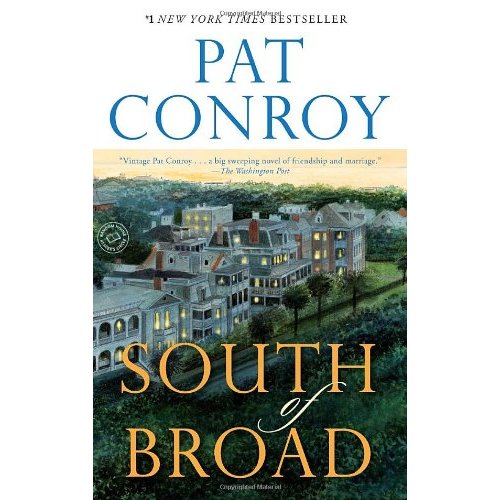
There are huge themes. There are some very bad people. There are some very good people. Sometimes the very good people can do very bad things, and sometimes the bad people can have some redeeming moments.
We meet the main character as he is about to begin his senior year in college. On the day we meet him, his life changes. Several new people come into his life. Two orphans. A beautiful sister and equally beautiful brother. A black football coach and his son. Three rich kids kicked out of the best private school in town for doing dope.
There are two ‘characters’ who are not people. One is the city of Charleston, SC, and there are entire paragraphs in this book which will make you fall in love, through Pat Conroy’s eyes, with this complicated, beautiful city. Another is Hurricane Hugo, which is as destructive as Charleston is beautiful.
South of Broad covers a time of tumult and change, and you see it through the eyes of of Conroy’s endearing characters. Times changes, society changes and change comes hard for those who stand to lose the most. Conroy deals with segregation, integration, child abuse, suicide, gay sex, economic discrimination, and psychiatric illness, a psycopathic criminal, who happens to be the father of two of this friends, and a hurricane.
For me, what was most engrossing was the complicated question of who is righteous? It’s what I want to talk about with you. Who is most like Jesus? (LOL, give examples) Which characters would you expect think themselves closest to God? Do you think they are? (Be prepared to defend your opinion.) What is a good parent? In this book, who do you think was the best parent?
If you decide to buy this book, please buy a copy with the Reader’s Guide in the back – an interview with Pat Conroy and questions that help you think about the book. I’d like to share with you a segment of the interview which I found so brightly illuminating:
. . . . I found the Parisians rarified, vigilant, hypercritical and fabulous. They had made themselves worthy of the great city they lived in. They oozed style and they ate like kings. . . . The Parisians seem special to both the world and themselves. Then it hit me: My God, they are like Charlestonians.
As I see it, you can take out Charlestonians and substitute Kuwaitis. Or New Yorkers. Or Romans. In fact, just about every society I have visited have their elite, who consider themselves rarified and special, and fight to keep themselves so.
So not only is the book dealing with spiritual righteousness, but also with themes of entitlement and deprivation, bullies and the bullied, parenting, self-fulfillment, and the very real and over-arching theme of friendship and the power of a close circle of friends.
I don’t want to tell you too much. I loved this book. I’m still thinking about it. I hope you’ll read it and think about it, too, and then come back and tell me what you’re thinking. 🙂
Edmonds, Washington Street Gardens
In a time where states and counties and cities and towns are cutting back, I am infinitely grateful to my little home town that they find the resources to maintain the street gardens. In the town, you find huge baskets of flowers hanging from poles along the main streets (one of which is called Main Street, in true small town fashion). These are from the street level gardens; they are so beautiful.



Nearby, two of our favorite stores are side by side:

Woo HOOO, Half Price Books is having their annual Labor Day Sale, 20% off everything in the store. Like we need more books. 😉
Short Day to Spokane
After breakfast, we hit the road early, stopping after a couple hours for a leg stretch and coffee. The weather is in the 50’s as we hit the road, and we are both ready for a warm-up. I was all set to order my normal ‘short non-fat Mocha, no whip cream,’ when I saw that they already have the fall specials on the menu, and oh, I love Pumpkin Pie Spice Latte . . .

While the roads are nearly empty, just us and an occasional truck, or pickup, the weather has turned ugly, rain coming down in drizzle, or torrents, or sheets, changing by the minute. By the time we stopped for lunch, I was ready to give up the driver’s seat.
Lunch was at the Fat Belly Deli, in Alberton, Montana, where we had Turkey Pastrami and Swiss sandwiches, oh, and ummm. . . . fries. They were having a little trouble getting the fryer hot enough to fry the fries, so I had time to take a couple photos:


On our way in, AdventureMan spotted a huge used book store – like catnip for cats, we could not resist. I found a copy of Elizabeth Warnock Fernea’s book “A View of the Nile.” If you have never read Elizabeth Warnock Fernea (Guests of the Sheikh, A Street in Marrakesh) read her biography in the link above. She was an amazing woman, who shared her insights in a very readable way. A View of the Nile is hard to find. I want it for my lending library. AdventureMan and I both found books. . . Too many books. We had to drag ourselves away.
(Update: AdventureMan reminds me that HE found the Fernea book and asked me if I wanted it. I promised to correct this entry and give him proper credit. 🙂 )

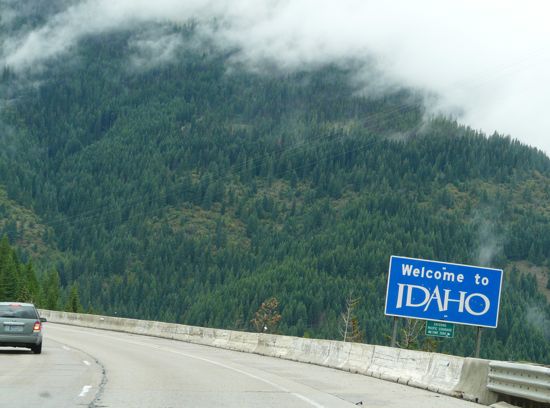
Soon we left soggy Montana to enter an equally soggy Idaho, although the weather cleared by the time we got to Coeur d’Alene:
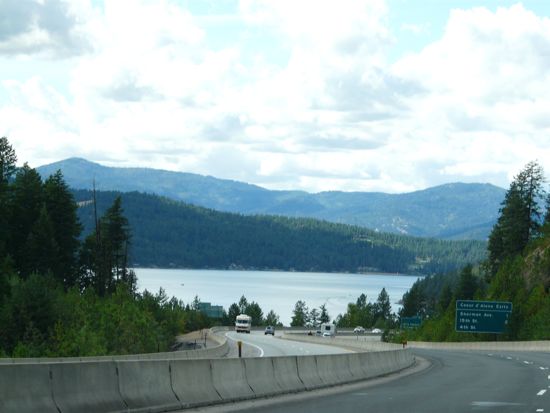
By the time we hit Spokane, the sun is out and we are starting to feel warm once again. We could go on; we have gained an hour, but we see another Mariott Residence Inn along the road and decide to hit the pool and kick back for the rest of the day, with another short day on the road tomorrow to get us to Seattle, where the hard work will begin. We have accounts to close, a storage locker to clear, rugs to gather and plastic carrier boxes to pack. We are hoping we can get everything into AdventureMan’s Barcelona Red (the name of his Rav4) for the long haul back to Pensacola.
Our reward for good behavior will be a few meals with friends and family before we depart. We are looking forward to that part. 🙂
The Camel Bookmobile by Masha Hamilton
It took me a while to get into this book, because it is, in my opinion, badly written. The characters are thin, the story is thin, and yet . . . it is a book I will never forget.
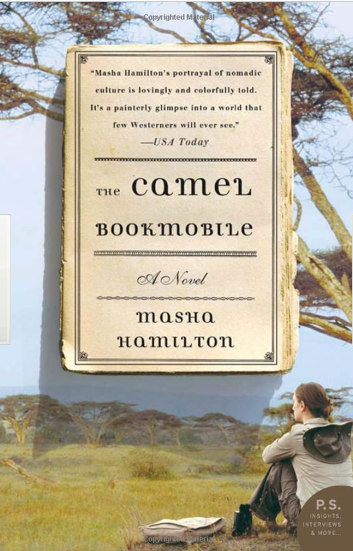
Masha Hamilton writes of a girl with a dream of going to a faraway place; she writes a grant proposal for a Camel Bookmobile, to take books from a remote library in Garissa, Kenya, out to nomadic groups in even more remote locations. As it turns out, the book features a device I like very much – a discussion of what is knowledge, what is learning, what happens when cultures clash and how in every interaction, there is something left that changes those interacting.
As Fiona (“Just call me Fi”) McSweeny follows her dream, there are her actions, how she sees her actions, how her actions are seen from an alternate culture, and how Fi feels she may be missing something in the interaction.
Anyone who has tried to finesse their way living in an alien environment knows that feeling, and the disasters you can bring on with only good intentions. Words, tone of voice, body language – all can be interpreted in ways you never dreamed, blinded by the wisdom of your own culture.
The star of the book is the Kenyan desert. While we do get to know the characters in the small arid desert village of Mididima, it is the way of life that Hamilton captures and which captivates us. The traditional ways are already passing, and the village elders are fighting a losing battle, trying to maintain their old ways. At the same time, there is a lot of wisdom to be learned and stored before the old ways pass, if there is anyone to document, to capture the details.
How can a book be both badly written, so badly written that you are constantly aware of it, and so breathtakingly vivid, so unforgettable?
There is a real Camel Bookmobile, started in 1996, and after visiting, Hamilton began a Camel Book Drive which garnered over 7000 books for the nomadic library. You can visit the website and learn where to donate books for other schools in the Garissa area by clicking here.
Recent Comments
ExpatAlien on What Country am I Living … intlxpatr on Yellowstone: Old Faithful to C… Michelle on Yellowstone: Old Faithful to C… Cathy on No Grown-Ups in Charge intlxpatr on Waiting for Snow Wikipedia Donate Button

Amazina


Early Voting in Florida


 Here There and Everywhere