Kuwaiti Youth Read Books
Wooo HOOOO on you, Kuwait! 😀
Kuwait”s youth bucking the trend, more open to reading books
Nadia AlـNassar
Staff Writer
Al Watan
A solid core of knowledge comes from reading. No matter what book a person reads, numerous benefits come from it; unlike watching TV, reading exercises the brain through an active mental process. Kuwait is often cited as one of the top reading Gulf countries in terms of print news, but is said to be amongst the lowest in terms of books. However, there is a visible trend emerging in the youth, with the number of teenagers reading in Kuwait over the past few years gradually increasing
Talking to a manager of one of Kuwait”s prominent bookstores about the readers who visit the bookstore, he noted that about 50 percent of the customers are now between the ages of 13 and 17 years old. He said that the majority of them choose bestsellers and books that were made into television shows or films.
Most of the readers choose to read English books, while there are some who read English books that are translated to Arabic, said the bookstore manager, bringing up the fact that there has been an increase in the percentage of teenage customers witnessed over the past year.
When students were asked why they think the youth of Kuwait is reading more, their responses were diverse, as well as interesting.
Saud said, “I think that our parents are much more educated than the parents of previous generations, therefore our parents comprehend the significance of reading more than the previous generation of parents.
“Our parents are trying to promote reading by getting us into the habit of reading at a young age.”
Mariam had a different view; “I think that the students are reading more nowadays because Hollywood is creating more movies based on teenage novels, such as Harry Potter, which makes teens compare the book and the movie.”
Many of the students brought up the fact that teens enjoy discussing books together, which influences their friends who do not read to do so and be able to join in the discussion.
Haifa, a 17ـyear old, said that there are more English books than Arabic books available to read in the book market, and more students now are better in English, therefore they have more options to read.
“I personally have always been a reader, and I have noticed that teenagers in Kuwait are reading much more because reading is becoming more worldwide and is being more publicized on the Internet, but yet I do not think that they are reading enough,” stated Jasmine, a high school student.
Faisal, a sophomore in high school, said he is reading over the summer to stay ahead in the courses that he finds challenging, whereas Jasmine reads for a different purpose.
“I read because reading takes you to a different place; it”s like traveling, and I am always willing to explore new places.”
Whether it is to enhance their information about the world or to entertain themselves, numerous students in Kuwait have realized the importance of reading and have taken it into their daily lives.
One of the most popular genres that teenage girls are reading in Kuwait is romantic fantasy, such as the Twilight series. Teenage boys on the other hand are interested in different genres.
“I”m very picky with the books I read; I usually read thrillers, fantasies and series such as Harry Potter and Charlie Bone, said 14ـyearـold Saud.
Sara mentioned that teenagers in Kuwait are also interested in reading psychological books, such as A Million Little Pieces, one of the more adult books making its way into the small but growing new generation of Kuwaiti readers.
Last updated on Tuesday 4/8/2009
James Lee Burke and Swan Peak
When I read the description of this book on Amazon.com, I thought “haven’t I read this before? Dave Robicheaux and his buddy Clete go to Montana for a vacation?” but the description sounded like it was probably a new book and the copyright date was recent. I’ve been burned before – especially with Donna Leon books, where I order a book and discover I have already read it – it was published in England under one title and then – years later – in America, under a different title. That is so frustrating!
It arrived just as all the household goods arrived, so I had something to look forward to reading after the long, grueling days of toting and unwrapping, and putting away.
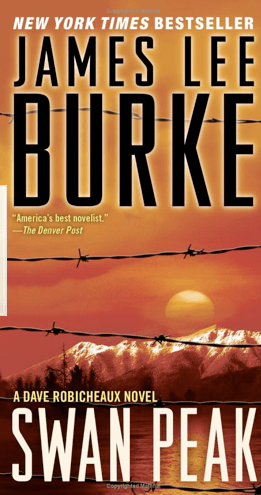
Some of the reviewers say it’s just another James Lee Burke, same story, different setting, and, to some extent, they are correct. I would counter with my opinion that no matter which James Lee Burke story you are reading, there are moments of pure poetry, and moments of keenly cynical insights that lift any book he writes out of the ordinary and puts it in the can’t-live-my-life-without-reading-this-book catagory.
Dave and Clete are vacationing in Montana (Dave’s wife is there, too, but barely appears in this book). As usual, they find themselves peripherally involved with a couple killings, and are interviewing a witness, Jamie Sue Wellstone, wife of a transplanted-from-Texas oil tycoon.
The garden was dissected by gravel pathways and surrounded by a gray stone will that was stippled with lichen in the shade. The flower beds were planted with pansies, English roses that were as big as grapefruit, forget-me-nots, violets, clematis vine and bottlebrush trees. I wondered if the eclectic nature of the ornamentals in the garden said something about the undefined and perhaps deceptive nature of the Wellstones and their ability to acquire an entire culture as easily as writing a check.
In the following section, he writes about the drifters, the people who end up in places like Montana, Alaska – wherever there is still a laxity in formal structures:
The waddies and drifters who worked for him were the kind of men who were out of sync with both history and themselves, pushed further and further by technology and convention into remote corners where the nineteenth century was still visible in the glimmer of the high-ceilinged saloon or an elevated sidewalk that had tethering rings inset in the concrete or an all-night cafe that served steaks and spuds to railroad workers in the lee of a mountain bigger than the sky.
Most of them were honest men. When they got into trouble, it was usually minor and alcohol or women or both. They didn’t file tax returns or waste money on dentists. Many of them didn’t have last names, or at least last names they always spelled the same way. Some had only initials, and even friends who had known them on the drift for years never knew what the initials stood for. If they weren’t paid to be wranglers and ranch workers, most of them would do the work for free. If the couldn’t do it for free, most of them would pay to do it. When one of them called himself a rodeo bum, he wasn’t being humble.
Their enemies were predictability, politic, geographical permanence, formal religion, and any conversation at all about the harmful effects of vice on one’s health. The average waddie woke in the morning with a cigarette cough from hell and considered the Big C an occupational hazard, on the same level as clap and cirrhosis and getting bull hooked or stirrup-drug or flung like a rag doll into the boards. It was just a part of the ride. Anybody who could stay on a sunfishing bolt of lightning eight seconds to the buzzer had already dispensed with questions about mortality.
There are many who object to the violence and brutality in every James Lee Burke novel. The problem is, he is writing about people who have to deal with violence and brutality and a way of life most of us never see. Burke writes about cops, about gangsters and organized crime, and about prisoners and prison life. It isn’t pretty. His main characters in this book, Dave and Clete, have seen too much. They are cynical as only deep-dyed idealists can be cynical. They are the guardians of our society; the enforcers of the codes. Without the police, and those who fight with them against crime, it is the rule of the jungle, where might makes right. The bullies rule, and as we have seen through history, unlimited power invites abuse.
What all predators hated most was to be made accountable. It wasn’t death that they feared. Death was what they sought, onstage, with the attention of the world focused upon them. But when you took away their weapons and their instruments of bondage and torture, when you pulled the gloves off their hands and the mask off their face, every one of them was a pathetic child. They were terrified of their mother and became sycophantic around uniformed men. The fact they were reviled by other felons and that cops would not touch them without wearing polyethylene gloves was not lost on them.
But how do you get your hands on a guy who has probably been killing people for years, in several states, leaving no viable clues, threading his way in and out of normal society? How do you find a sadist who probably looks and acts just like your next-door neighbor?
Much later in the book, he describes the kind of hero that crops up in each book the same way:
But if there is a greater lesson in what occurred inside that clearing, it’s probably the simple fact that the real gladiators of the world are so humble in their origins and unremarkable in appearance that when we stand next to them in a grocery-store line, we never guess how brightly their souls can burn in the dark.
There is only one Dave Robicheaux book I have kept – A Morning for Flamingos, the first one I ever read. I’m pretty sure it was in the late 1980’s, and I have been a James Lee Burke addict ever since. James Lee Burke hates organized crime, and he hates most of all those criminals who make themselves wealthy by bribery and corruption, who attend the society balls and events, whose photos appear in the paper looking like you and me – like respectable folk. People who get photographed making a donation to charity with wealth stolen from the common purse. His heros – and heroines – are modern day gladiators, they are the bureaucrat who refuses to hide the illegal wiretaps, the plodding cops and FBI officers who track down the slightest clue to bring down the Madhoff and the white-collar robbers, the prosecutors who risk their lives to put the bad guys away.
I guess for me, reading James Lee Burke is like reading a fairy-tale (If you have ever read the original fairy-tales, you will know what true gruesome violence and brutality is all about!) where those who flout the law, those who oppress the poor, those who use their ill-gotten wealth to isolate themselves high above the common man – get their justice. They think they are above the law. They are wrong.
The Guernsey Literary and Potato Peel Pie Society
I don’t know why I didn’t read this book sooner! First, I saw people like me reading it in airports, and it certainly has a memorable title. The people reading looked totally engrossed. I’m not one to strike up conversations in airports, but on occasion, when I see people reading a book I don’t know about and it is the size of the books that book groups usually read, I will ask, and write it down, and bother the person no further.

I had ordered it on amazon.com when my son’s wife’s father’s wife (and you thought Gulf relationships were complicated!) mentioned to me in an e-mail that she was reading it and that she could barely tear herself away. She and I often pass really good books and/or recommendations back and forth, so that bumped it up a few notches in priority. When it got here, I had just finished Rutherfurd’s London (oops, I thought I had reviewed it, and I haven’t, so I will,) and I thought it was a southern book, like The Ya-Ya Sisterhood or Sweet Potato Queens, no, you are right, I hadn’t read anything about it, just trusted from all the people I saw reading it that it was good, but because of the name, I thought it would be light.
Wrong!
It isn’t depressingly heavy, like The Little Prisoner was heavy, and it had some totally wonderful laugh-out-loud moments, but the subject matter was the German occupation of the island of Guernsey, in the English Channel, and an author in search of a book topic in post-war London, and a little girl born outside of marriage and cared for by a village of caring people. It is spiced up by a dashing romance, and the process of relationship building that happens in the novel, unlikely relationships, aren’t those the very best kind for spice? 😉
The entire story is told in letters. The primary voice, that of Juliet, a thirty-something author, ties all the letters together, but not all letters are to her or from her. It is a great technique for allowing many different voices and many different perspectives. From the first page, you are captivated. Right now, Guernsey is more real to me than the boxes I need to unpack, and there is a part of me that yearns to flee to Guernsey and find a house near a cliff where I can watch the sun set in the west and the clouds turn colors . . .
Here is one sample of the kind of letters you will find when you read The Guernsey Literary and Potato Peel Pie Society. Don’t wait! This is an unforgettable book!
1st May 1946
Dear Mark,
I didn’t refuse, you know. I said I wanted to think about it. You were so busy ranting about Sidney and Guernsey that perhaps you didn’t notice – I only said I wanted time. I’ve known you two months. It’s not long enough for me to be certain that we should spend the rest of our lives together, even if you are. I once made a terrible mistake and almost married a man I hardly knew (perhaps you read about it in the papers) – and at least in that case, the war was an extenuating circumstance. I won’t be such a fool again.
Think of it: I’ve never seen you home – I don’t even know where it is, really. New York, but which street? What does it look like? What color are your walls? Your sofa? Do you arrange books alphabetically? (I hope not.) Are your drawers tidy or messy? Do you ever hum, and if so, what? Do you prefer cats or dogs? Or fish? What on earth do you eat for breakfast – or do you have a cook?
You see? I don’t know you well enough to marry you.
I have one other piece of news that may interest you: Sidney is not your rival. I am not now nor have I ever been in love with Sidney, nor he with me. Nor will I ever marry him. Is that decisive enough for you?
Are you absolutely certain you wouldn’t rather be married to someone more tractable than I?
Juliet
Written by Mary Ann Shaffer and Annie Barrows, the book will challenge your ideas, will inform you of an obscure episode in World War II, will make your heart sorrow at the inhumanity of which we human beings are capable towards one another, and make your heart sing at the goodness in the human soul. That’s pretty amazing for one book.
Enough! vs “Just in Case”
As I unpack boxes . . . and boxes . . . and boxes . . . I find myself thinking “How much is ENOUGH??”
What is it with women and shoes? Just before we moved, I told you about our short trip to France and Germany when I bought some truly yummy shoes but now, as I am putting shoes away, I wonder how many pairs of shoes I really need. I have some – the French shoes – that I actually wear all the time, in fact some of them are old friends now and really need to go to shoe heaven but I keep telling myself “Just one more time!” before I send them on their way. Others, I have bought “just in case” and they are pristine. One actually still has the shoe store tags on them. I have a lot of these, and every time I consider giving them away, I think “but what if I need to wear that particular dress that those shoes go with??” and I hold on for . . . another move.
Moving often motivates me to part with my old friends, and even with some new friends (we’re talking about shoes here) that didn’t quite make the grade. Then again, as I am unpacking, I am wondering “will I really ever wear these again?” And – once again, I hang on to them, just in case I MIGHT need them at some hypothetical time in the future.
I have finally stopped buying dressy evening clothes. I have some really cool ones, so cool that when we go out to a rare dressy event, I usually wear what I love and feel comfortable in. If you have to sparkle, you want to know you look good! I always used to buy ahead – just in case – because the time to be buying a dress is NOT when you need it; when you really, seriously NEED it, you can never find exactly what you want and you settle for something that is not quite right and sometimes at the last minute you ditch it and go back to an oldie-but-goodie that you know works for you. For us, for most Americans, serious dress events seem to becoming fewer. Even charitable events aren’t as dressy as they used to be – partly, I am guessing, because of the economy, but it may be demographics. The baby boomers are getting older – they may not care about dressing up the way they used to.
I think my Mom still has a lot of her evening gowns from the days when she and my Dad went to balls . . . 🙂 but she still loves to go shopping when a family wedding is coming up.
I’ve actually done just fine with the clothes I brought with me. If not a single item of clothing had shown up . . . well, yeh, I’d have been in trouble. I would have needed a few things. I needed an evening purse for the Army birthday ball, even though I had thought to bring the dress.
The other item both AdventureMan and I have a real problem with is books. Even though I get rid of a lot of books, I pass them along, there are still a lot we hang on to, can’t seem to give them up. We haul a lot of books around, and we still have boxes and boxes of books in storage that we haven’t seen for many years. Is there such a thing as “enough” when it comes to books?
I think I am about a third of a way through the boxes. I conceive it as creating “islands of sanity” in the midst of chaos. My kitchen is always the first island of sanity, and there is always a path to our bed and the bed itself which is clear. Today, our bedroom became another island of sanity.
Little Diamond, the guest room is an island of sanity. 🙂
The Women’s majlis (the small living room downstairs) is an island of sanity.
Where is the chaos? We spend a lot of time in our upstairs family room; it is also our office; it is also an area of utter chaos.
Our living room – I haven’t even started on the boxes in the living room. It is a bedlam of insanity. Many of the boxes contain books, and I have to have places to put all the books before I can put them away. It may stay insane for a little while.
The lady who comes to help me clean came today, and I had a list of things for her to do which mostly did not include cleaning because you can’t really clean when things are chaotic. She and I work well together, she works in her areas and I work in mine with a brief chat-chat-chat now and then when our paths cross. As she was leaving, she showed me how she had broken down all the boxes, hauled them to a small room and stored them neatly, and put all the ones full of paper outside in another holding area . . . that wasn’t on the list. She is a gem. I couldn’t believe it when I saw it. I’m going to have to give her a bonus this month. 🙂 She also takes care of cats when people go away, even taking them to the vet if the cat gets sick. She is worth every penny.
I start every morning around seven. I quit around five, take a shower (I need it!) and clean up. I have about an hour before AdventureMan even thinks about coming home, so I thought I would take a chance to have a chat with you.
So I ask you – what does “enough” look like? When is it prudent to buy “just in case” and when does it become consumerism?
The Paper Moon by Andrea Camilleri
Ahhh! Another book about corruption, but this one is no where near so painful for me to read as The Appeal by John Grisham, because this one is set in Sicily, where we expect a certain level of corruption, and Italy, where the whole system operates by rules we can barely begin to comprehend, but it is ITALY, and fascinating, and funny, and another great page turner for these hot hot hot summer days.

Andrea Camilleri has a whole series of books about Inspector Montalbano, which I love almost as I love the Donna Leon series about the Venetian, Guido Brunetti. Brunetti has the edge because he is married and has a family, and it IS Venice – no competition there, Venice will always win, hands down. But Inspector Montalbano’s single status allows for a whole different flavor permeating his investigations, and he, like Guido Brunetti, shares the Italian reverence for really great food.
I didn’t want to fix dinner. I didn’t want to get out of bed. All I wanted to do was to read the whole book, and, when I finished, I wanted another one!
Inspector Montalbano is asked by a woman to find her missing brother, and he finds him almost immediately, dead, under bizarre circumstances. The brother has a very large amount of money unaccounted for, and unaccounted in terms of earnings, as well. He is a pharmaceutical representative, good at what he does – but he still has way too much money, and Inspector Montalbano finds he is rather fond of the prime suspect.
In the meantime, his office has also been tasked to find the reason several high level politicians have suddenly died, purportedly of a variety of causes, but in reality, all have died of drug overdoses. The problem is, that finding the culprit means exposing the reality of high level drug usage, and the inspector realizes the case has been dumped on his office because no one wants to take responsibility for what happens when the culprit is caught. It’s all very Italian, very Sicilian.
Between investigations, Inspector Montalbano eats some amazing meals. 🙂 He takes his glass of wine and walks in the sand out to the sea. We get to know the characters working out of his office better, and to appreciate their quirkiness. This is a great series, a lot of fun. I think I need to go to Sicily for a visit. I definitely need some Italian food and a glass of vino!
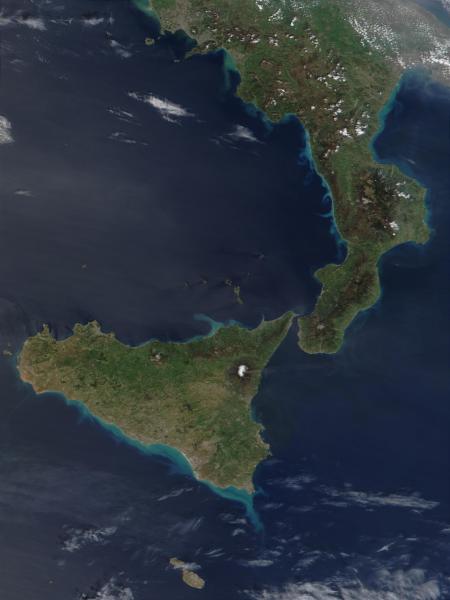
Photo courtesy of http://visibleearth.nasa.gov/)
From time to time a word or phrase would appear that required going to the back of the book where the word is not only translated, but the concept explained, something crucial when reading a novel from another culture. In this series, it is particularly valuable, as the background for the crimes and their investigations with political implications, and if you don’t understand the politics, you can miss the point of the novel.
I found this book at Amazon.com. for a mere $10.19 plus shipping.
The Appeal by John Grisham
One of the things I like about John Grisham is that he really likes the underdog. In his books, the person often the least likely to prevail does so, usually because he has a smart attorney, one who is paying attention and taking good care of the client. Warning – this book review contains a spoiler, so don’t go any further if you don’t want to know too much about the plot and resolution.
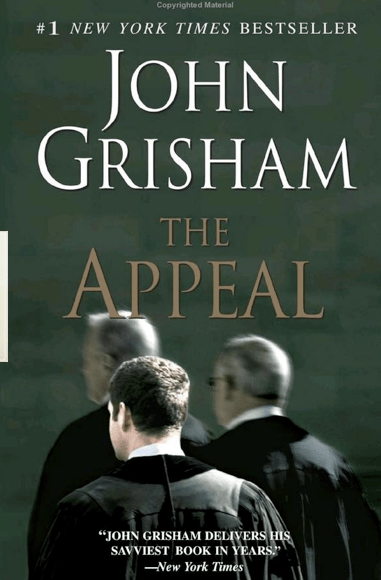
The Appeal is the exception. No one wins, not even the apparent winner, who sails off in the end with his empty, unsatisfying life. He schemes, he exploits, he lies, he buys elections, and he makes a fortune – and he isn’t satisfied. He is married to a woman who sounds more like a greyhound, all skin and bones and self-absorption.
The subject matter is a case where a chemical company has dumped toxic wastes into the ground in Mississippi, it has penetrated into the groundwater, and polluted the entire water system of a small fictional town. Two lawyers, married to one another, sacrifice everything and face bankruptcy to win a case for their client who has lost both husband and son to cancer caused by the toxic chemicals dumped. They win.
There is an appeal.
What this book is about isn’t just about groundwater contamination, or even about buying elections in Mississippi – it is an indictment of every state that elects judges. The core of the novel is about how big money, big corporations, pick candidates and fund them, legally and illegally, and insure that they win. They pack the courts with judges who are opposed to large settlements.
God bless John Grisham. With all his great legal thrillers, he has made a bundle and can take risks like writing a book like The Appeal, which should be an eye opener, and should be read by every caring citizen.
Judges should not be elected. When the judiciary are elected, they have to think about their next election, with every legal decision. It taints objectivity. It corrupts objectivity. It eliminates objectivity. Without an objective judiciary – why bother? They will always rule on the side whose interests are the most powerful and profitable.
Here are a couple quotes that tell you where the novel is going. My Kuwaiti friends are going to love this – I have taken so many shots at Kuwait corruption – so here it is, my friends, exposure of the institutionalized corruption in my country:
Barry laughed and crossed his legs. “We do campaigns. Have a look.” He picked up a remote and pushed the button, and a large white screen dropped from the ceiling and covered most of the wall, then the entire nation appeared. Most of the states were in green, the rest were in a soft yellow. “Thirty-one states are in the green. The yellow ones have the good sense to appoint their courts. We make our living in the green ones.”
“Judicial elections.”
“Yes. That’s all we do, and we do it very quietly. When our clients need help, we target a supreme court justice who is not particularly friendly, and we take him, or her, out of the picture.”
“Just like that.”
“Just like that.”
“Who are your clients?”
“I can’t give you the names, but they’re all on your side of the street. Big companies in energy, insurance, pharmaceuticals, chemicals, timber, all types of manufacturers, plus doctors, hospitals, nursing homes, banks. We raise tons of money and hire the people on the ground to run aggressive campaigns.”
* * * * * * * *
The Senator did not know who owned the jet, not had he ever met Mr. Trudeau, which in most cultures would seem odd since Rudd had taken so much money from the man. But in Washington, money arrives through a myriad of strange and nebulous conduits. Often those taking it have only a vague idea of where it’s coming from; often they have no clue. In most democracies, the transference of so much cash would be considered outright corruption, but in Washington the corruption has been legalized. Senator Rudd didn’t know and didn’t care that he was owned by other people. He had over $11 million in the bank, money he could eventually keep if not forced to waste it on some frivolous campaign. In return for such an investment, Rudd had a perfect voting record on all matters dealing with pharmaceuticals, chemicals, oil, energy, insurance, banks and on and on.
I like almost every book I read by John Grisham. He is a man with a conscience, and he is trying to raise our awareness of corruptive factors before our system goes entirely under. I couldn’t put this book down, and I can hardly wait to read the next one.
Dar Al Thaqafa in Doha, Qatar
I have very special feelings about Dar Al Thaqafa. When I was new in Qatar, as I started to read a very special book, it fell out of the binding. Maybe the heat has melted the glue, I don’t know, but it was not my book! It was loaned to me by the Ambassador to Qatar from Japan, and holy smokes, I had ruined it!
I went ahead and read the book, and then I had to figure out how to get it re-bound. I asked around, no one had any idea. Finally, I asked at one of the Dar al Thaqafa stores (there are several in Doha) and they told me about the Dar al Thaqafa printing plant, which was not far from where I lived.
I took the book there. They said they could rebind it. It would take about a week. I didn’t even ask the cost; it didn’t matter, I had to return the book in good condition.
When I went to pick up the book, they wouldn’t let me pay them. The man who gave it to me – with beautiful bindings and end-papers – had a big prayer bump on his head. He told me he wanted me to remember that not all religious Muslims were terrorists. I almost cried. Maybe I did, a little, when I got back to the car, it is just such a perfect example of God’s grace, and how we are supposed to love one another and be kind to one another.
So this weekend, as I drove around familiarizing myself with my old secret back ways to get places, I came across the first Dar Al Thaqafa book store I ever visited, with Little Diamond, down near the Dira’a fabric souks. You would hardly know it was there, if you didn’t know it was there. We only found it because the toy vendor outside had some dancing Saddam Husseins and Osama bin Ladens – I have never seen them anywhere else. Then we spotted the bookstore – and oh, what heaven, all kinds of books, a bookstore any book lover would love:

Qatar is a conservative country. You might be wondering how I can take pictures so freely – I always ask.
So I asked if I might take photos of the bookstore.
“Why” asked the man at the desk.
“I love this bookstore,” I responded, “and I take photos of places that might not exist in the next five or ten years. I try to record what was special and unique in a country.”
He beamed with delight!
“This is the oldest bookstore in Qatar!” he exclaimed! “This is the original of all the Dar al Thaqafa bookstores!” He gladly gave me permission to photograph.

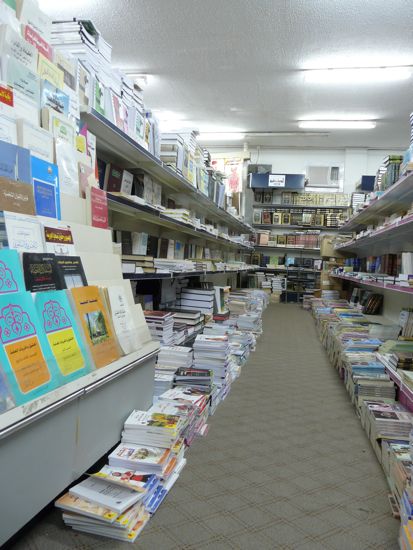
They carry textbooks, reference books, religious books, children’s books, and all kinds of school supplies, from the most elementary grades through the most specialized university courses.
You know I read and write Arabic on a very very basic level. I can proudly say my niece, Little Diamond reads and writes on a fluent level, and as we leave book stores, we are often staggering under the load of the books she buys to take home and read. This store, and the Jarir bookstores, are a couple of our favorite stops.
I had a family cookbook printed with all our best of the best recipes – the Dar al Thaqafa on Merqab did the printing and cover and binding for me. They did a great job.
As much as I like going to a Barnes and Noble, you walk into just about any Barnes and Noble and it is like walking into the same one, whether you are in Pensacola, Seattle, Houston, Charleston – they all pretty much follow the same pattern. It is calculated and more than a little sterile. Not so the Dar al Thaqafa, where books are piled here and there, pens are all in one place, children’s books in piles – you kind of have to search for what you want, but they usually have it, or can find it for you, or tell you where to go for it.
The Little Prisoner and Child Abuse
Of all the books our book club read this year, The Little Prisoner by Jane Elliott (not her real name) was the most troublesome. The first one to finish said it was boring and repetitive. The second refused to read it at all, that the content would have images that would polute her mind. Both were right, and at the same time, if we refuse to look at what troubles us, we collude with the abuser.
I hate bullying. A man who beats and plays sexual games with a child is a bully and worse – he is a betrayer of trust. Children come into the world pure, clean slates. They can create their own mischief, their own evil, but to be corrupted by an adult – that is the absolute worst sin.
Today’s Gospel reading in The Lectionary is about this very behavior – that betrayal and/or corruption of a child is a huge sin against God:
Matthew 18:1-14
18 At that time the disciples came to Jesus and asked, ‘Who is the greatest in the kingdom of heaven?’ 2 He called a child, whom he put among them, 3 and said, ‘Truly I tell you, unless you change and become like children, you will never enter the kingdom of heaven. 4 Whoever becomes humble like this child is the greatest in the kingdom of heaven. 5 Whoever welcomes one such child in my name welcomes me.
6 ‘If any of you put a stumbling-block before one of these little ones who believe in me, it would be better for you if a great millstone were fastened around your neck and you were drowned in the depth of the sea. 7 Woe to the world because of stumbling-blocks! Occasions for stumbling are bound to come, but woe to the one by whom the stumbling-block comes!
8 ‘If your hand or your foot causes you to stumble, cut it off and throw it away; it is better for you to enter life maimed or lame than to have two hands or two feet and to be thrown into the eternal fire. 9 And if your eye causes you to stumble, tear it out and throw it away; it is better for you to enter life with one eye than to have two eyes and to be thrown into the hell* of fire.
10 ‘Take care that you do not despise one of these little ones; for, I tell you, in heaven their angels continually see the face of my Father in heaven.* 12 What do you think? If a shepherd has a hundred sheep, and one of them has gone astray, does he not leave the ninety-nine on the mountains and go in search of the one that went astray? 13 And if he finds it, truly I tell you, he rejoices over it more than over the ninety-nine that never went astray. 14 So it is not the will of your* Father in heaven that one of these little ones should be lost.
The book was, in one sense, an easy read. It only took about three hours to read it. It was, as the first reader said, repetitive, but then once a bully has found a victim, the behavior does tend to be repetitive, and, as in the book, it also escalates.
The victim’s father bullied her, and he abused her sexually from the time she was four until she was seventeen. He terrorized his wife and other children, and he terrorized the neighborhood with his violence and threats of violence. To this day, the author and her family live far away, and fears her step-father finding out where she is.
I found the writer unlikeable. I wanted to feel more compassion for her than I did. I think part of my problem was that she stayed in the situation even into her teens, even into early adulthood, without seeming to rebel, without taking any steps to get herself out of the situation. She tells us straight away that she has personality defects, troubles with trust and betrayal, and that she sometimes turns to drink. A part of me knows that people who have been systematically abused over a long time can lose that ability to resist, rebel, to ask for help, but another part of me can’t understand it at all. A part of me is impatient with her weakness, I want her to stand on her feet and make her life a testament to her survival, I want her success in overcoming her childhood to be the sweetest kind of revenge. Unfortunately, life is more complicated than that, and her murky ending is probably the more realistic. Abuse leaves lasting damage.
The Little Prisoner is not an easy read in terms of content. There were times I felt she exaggerated to sell the book; to make hers just a little more interesting than the other ones out there with which her book is competing. There is a part of me that would prefer not to see, not to have those images in my mind.
We know, from all the literature, that children who are abused can grow up to be abusers. I have had friends who were abused who refused to have children at all, afraid they would perpetuate the behavior, even though they had a horror of the violence, and were gentle and peaceful people. How do we intervene, how do we break the chain of abusers begetting abusers? How do we change the behaviors? Can abusers really change?
The Little Prisoner brings up a whole host of uncomfortable questions. We can read, we can discuss – but if we choose to look the other way, aren’t we in a small way colluding with the abusers, allowing them to continue while we look the other way?
The Richest Man in Town
This is from AOL’s WalletPop, their how to manage money series.
As I read through this very American tale of building wealth, I wonder . . . how does this apply cross-culturally? Do you think the richest men in the Gulf follow these guidelines? The richest in the EU? The richest Asians? Indians?
Review: The Richest Man In Town by W. Randall Jones
Tom Barlow
May 20th 2009 at 7:30PM
Filed under: Wealth
Some people dream of getting rich. Instead of dreaming, W. Randall Jones, author of The Richest Man In Town, set out to talk to the richest person in each of the 100 U.S. towns he visited for his study to see what commonalities he could find. From these interviews he found 12 attributes that ran rich within these mostly self-made magnates. Apparently, while God could get by with 10 commandments, the rich need a dozen; thus the subtitle, The Twelve Commandments of Wealth.
Let’s get those 12 on the table first (I paraphrase)-
Don’t seek money for money’s sake
Find your perfect niche
Be your own boss
Get addicted to ambition
Be early
Execute or get executed
Fail so you can succeed
Location doesn’t matter
Don’t compromise your morals
Embrace selling
Learn from the best and the worst
Never retire
I have the last one nailed.
Book after book about wealth and entrepenuership seem to boil down to these same points, usually derived from the same inductive reasoning that seems to underlie this book; watch what rich people do, then figure out the principles behind their success. What is missing, imho is the study of failed businesspeople. I often wonder if, for every multimillionaire that followed these commandments, there might not be a hundred who followed them yet failed. Everyone talks to the winners, but until you study the losers, it’s hard to know which commandments are the important ones.
Although the “secrets of the millionaires” genre is well mined, Jones does a particularly deft job of weaving the stories of a hundred people within the commandments structure. His many years of experience as a writer and founder of Wealth magazine are evident in the book’s engaging storytelling and brisk pacing. Many writers of similar books have taken the easier person-by-person approach,
which gives the reader more of the personality of the people interviewed but obscures the insights that the readers seek. Kudos to Jones for taking the hard road.
He also manages to land some very colorful subjects to interview, such as Hartley Peavey of Meridian, Miss. who told him “I believe that life is a test to see how much BS you can take.” Ron Rice of Daytona Beach was fired from six teaching jobs in eight years. Phil Ruffin of Wichita wants his tombstone to read, “This is his last real estate deal.”
For readers who are curious about how the richest man (Jones is apologetic about the use of the word man, but sadly, the richest person in most towns is one) in town came by his fortune, this book may well be best in class. And these commandments leave you free to covet all you want.
Eliot Pattison: Prayer of the Dragon
As you can see, I am into some serious reading. Not heavy reading, but books like carrots – I am the donkey, plodding way, packing my boxes, sorting, weeding, throwing out – it is time consuming, and it is pitiless work. I need the promise of a great excape at the end of my day to keep me going.
Prayer of the Dragon was a GREAT carrot. I like all of Eliot Pattison’s Inspector Shan Tao Yun series, set in Tibet. In his very first book, we meet Shan as he is still in the Tibetan prison camp, imprisoned for exposing corrupt officials in China. He learns a huge appreciation, in prison, for a different way of thinking, and his treasured companions become the Bhuddist monks with whom he is imprisoned. If you want to read this series, you can read any book as a stand-alone, but it helps to read them in order, starting with The Skull Mantra. The Chinese eventually free Shan; they find him useful – as long as he is not exposing corruption in the Chinese bureaucracy. He is free on parole; he lives with the sword over his head. At any time, if he crosses an important person, he can be sent back to the merciless gulag.

In The Prayer of the Dragon Inspector Shan finds himself involved in a series of murders on the mountainside, in a small mining village. The village headman has a great scam going, skimming the miners take, charging passage on the mountain trails, and keeping his village hidden from the Chinese bureaucracy.
Here is what I learned that surprised me. There appears to be a connection between the American Navaho nation and the native Tibetans. They share some body-prototype similarities, and they share many symbols and earliest legends. An first-nation Navaho and his niece are exploring similarities, and commonalities, when two members of their party are murdered while sleeping. The Navaho is charged, by the headman, with the death, because he survived although he is covered in blood. It doesn’t make sense, but it doesn’t have to. The headman needs a scapegoat, and he chooses the Navaho.
It is a fascinating read. Here is an excerpt from a conversation Inspector Shan has with the local director of Public Security:
“I know your type so well, Shan, ” Bing said. “God, how well I know you. I was responsible for ten barracks of prisoners, like you – pathetic, morose creatures with no vision, only bitterness about the past. They would sit in reeducation classes and copy out slogans from the little red books like robots, praising the Chairman, reading aloud apologies printed in other books, using someone else’s words. Never a one among them with the balls to stand up and say Fuck the Chairman, screw the Party secretaries, and screw the limo drivers who brought them to town.”
“I tried at first,” Shan replied in a weary voice. “They sent me to a special hospital for the criminally insane.”
“Unfortunately,” Bing said soberly, “you are the sanest person I have ever met.”
AdventureMan knows I love these books. “Do you want to go to Tibet?” he asks me, and I say “No, if I went I would want to hang around with Inspector Shan and his gang of monks, not do tourist things allowed by the Chinese.” These are great reads, Pattison is doing a great job of bringing the plight of the Tibetans to the conscience of his readers, depicting, in graphic, horrorific detail how the Chinese are systematically crushing and obliterating every shred of Tibetan culture, while claiming they are not. I think one of the very worst things they have done is taking over the Tibetan monastery system and corrupting it into something it was never meant to be, a cruel, ugly deformity.
I can hardly wait for the next book to come out. I am on the waiting list for The Lord of Death, yet another book about Chinese bureaucratic corruption and the adventures Inspector Shan has in Tibet confronting and evading all its manifestations.
Recent Comments
ExpatAlien on What Country am I Living … intlxpatr on Yellowstone: Old Faithful to C… Michelle on Yellowstone: Old Faithful to C… Cathy on No Grown-Ups in Charge intlxpatr on Waiting for Snow Wikipedia Donate Button

Amazina


Early Voting in Florida


 Here There and Everywhere