Job and Islamic Tradition
One of the things I learned later in life, like when I lived in Doha, is that you (my Gulf and Moslem readers) have many of the same characters and stories in the Qur’an that we have in the Bible. Interesting, to me, the stories are not always exactly the same. Today’s reading in our lectionary (Old Testament) is from Job (you call him Ayoub, I think.)
First – if you read this, will you tell me if the story in Islam is similar to our story – that Satan is allowed to torment Job, because God believes him to be a faithful servant who will not turn away from him in times of hardship? Satan believes he can demonstrate that Job will be faithless?
Second – why is Satan called “the accuser?” I know Arabic is very close to the old Aramaic; is Satan always called Sheitan? Do you have other names for Satan? (These are not rhetorical questions; these are things I really don’t know) For example, Satan, in our tradition, is called The Father of Lies, The Great Deceiver, etc. But I don’t understand him being called The Accuser.
Third, toward the end of this reading his wife says essentially, give it up, Job, curse God and die. But the little asterisk says “bless”. This is a great puzzlement to me – a curse is the absolute 180° opposite of a blessing, I think. And then again, sometimes what appears to be a curse can be a blessing, and what appears to be a blessing can end up really being a curse. I just don’t understand why, in this context, the word curse could also mean bless? Do you?
Job 2:1-13
2 One day the heavenly beings* came to present themselves before the Lord, and Satan (*Heb the accuser) also came among them to present himself before the Lord. 2 The Lord said to Satan,* ‘Where have you come from?’ Satan* answered the Lord, ‘From going to and fro on the earth, and from walking up and down on it.’ 3 The Lord said to Satan,* ‘Have you considered my servant Job? There is no one like him on the earth, a blameless and upright man who fears God and turns away from evil. He still persists in his integrity, although you incited me against him, to destroy him for no reason.’ 4 Then Satan* answered the Lord, ‘Skin for skin! All that people have they will give to save their lives.* 5But stretch out your hand now and touch his bone and his flesh, and he will curse you to your face.’ 6 The Lord said to Satan,* ‘Very well, he is in your power; only spare his life.’
7 So Satan* went out from the presence of the Lord, and inflicted loathsome sores on Job from the sole of his foot to the crown of his head. 8Job* took a potsherd with which to scrape himself, and sat among the ashes.
9 Then his wife said to him, ‘Do you still persist in your integrity? Curse* (bless) God, and die.’ 10 But he said to her, ‘You speak as any foolish woman would speak. Shall we receive the good at the hand of God, and not receive the bad?’ In all this Job did not sin with his lips.
11 Now when Job’s three friends heard of all these troubles that had come upon him, each of them set out from his home—Eliphaz the Temanite, Bildad the Shuhite, and Zophar the Naamathite. They met together to go and console and comfort him. 12 When they saw him from a distance, they did not recognize him, and they raised their voices and wept aloud; they tore their robes and threw dust in the air upon their heads. 13 They sat with him on the ground for seven days and seven nights, and no one spoke a word to him, for they saw that his suffering was very great.
Long Way Gone in PB
Just a quick note to say that if you have been waiting to read Long Way Gone in paperback, it is now on the shelves.
Geraldine Brooks: March
Geraldine Brooks knocks my socks off. If she writes a book, fiction or non-fiction, I will buy it and read it. The first one I read by her was Nine Parts Desire: The Hidden World of Islamic Women, and the second most memorable book was her Year of Wonders, a book about how the plague comes to a 17th century English village and how the villagers cope with it – how some survive. She has a knack for keen observations, and for writing so as to place you squarely in the scene she is describing.
So when she came out with a new book extrapolating from the experiences protrayed in Louisa May Alcott’s classic favorite Little Women, why didn’t I rush to buy it? March is described by Publisher’s Weekly as “the Civil War experiences of Mr. March, the absent father in Louisa May Alcott’s Little Women.”

Didn’t you love Little Women when you read it? What’s not to love? Those wonderful sisters, their saintly mother, working together, suffering together, prevailing through sheer grit and determination – we can read that book over and over again, loving it every time.
Geraldine Brooks takes us with Mr. March into the grim realities of the American Civil War, the “war to free the slaves,” the war to keep the United States united, or the war between the states. This is not the idealized world of Little Women, this is not the memory we have of the nice letters he writes home from the field, this is the reality of war and all it’s ugliness. As the book opens, Mr. March is fleeing a massacre, struggling to survive, he is surrounded by the dead and seriously wounded, bullets are flying past him and he has to cross a deep, rushing river. A man grabs him who can’t swim, and he has to push him away to gasp for air. The man drowns, March survives, feeling deep guilt. When he finally finds a group of his men, drying out by the side of the river, he sits down and writes to his girls about the sweet breeze in the air. Not a word about the horrors he has witnessed, not his personal despair about having failed a wounded comrade.
As we experience the horrors of this war with Mr. March, we experience with him the brutality, cruelty, and crudity of all conflict. There are no good guys. There is no “just cause,” just winners and losers, and it’s very hard to tell what they are fighting for. Seeing this war from the point of view of the combatants, we realize that no-one will remain untouched; that this experience will resonate through the rest of their lives.
Geraldine Brooks knows how to grab us and keep us gripped. Every chapter reveals a new facet – how March and Marnee met and married, how they built a life together, how, in their idealism, they lost everything. Most discouraging of all is how, below the surface, they understand themselves and one another and their relationship so little.
I dare you to read this book. It isn’t an easy book, and at the same time, it is a book with timeless qualities, and a book that will get you thinking and keep you thinking for a long time. Isn’t that the definition of a good book?
Kuwait’s History – for Children
Thank you, Little Diamond, for your sharp eye spotting this story:
Children”s books about Kuwait”s history translated into English
Al Watan staff
KUWAIT: A new and rare series of stories about Kuwait”s history and
the nature of life in Kuwait in the past can now be found on sale in
Kuwait. The books, written by Dr. Yaqoob Yousef Al-Ghunaim and
translated into English by Dr. Shaban Afifi Abdulaziz, have been
printed by the Center for Study and Research in Kuwait and contain
illustration by artist Suhiala Hussein Al-Jundi.
The stories in the books are written in a simple manner that interests
children and that allows them to learn more about the history of
Kuwait and how Kuwaitis lived in the past. In the stories AlÜGhunaim
discusses traditional Kuwaiti society and the importance of fishing
and the rearing of animals.
The first story entitled Kuwait”s Wall is about a group of children
who ask Abu Abdullah questions about Kuwait”s wall and the reasons
behind its construction.
In the second story, AlÜGhunaim relates in a dramatic style the
stories of old Kuwaiti ships and underlines how society was based on
conservative religious values.
Al-Ghunaim also discusses life in the desert and how people were fond
of hunting gazelles and other wild animals which were commonly found
in the country.
A story about Burqan oil field was also added to the series to show
how the discovery of oil changed the Kuwaiti community.
http://www.alwatan.com.kw/Default.aspx?MgDid=652853&pageId=473
More Three Cups of Tea
The timing couldn’t be better. Thank you, Phantom Man, for sending a link to this New York Times article on Three Cups of Tea, from the July 13th New York Times.
By NICHOLAS D. KRISTOF
Published: July 13, 2008
Since 9/11, Westerners have tried two approaches to fight terrorism in Pakistan, President Bush’s and Greg Mortenson’s.
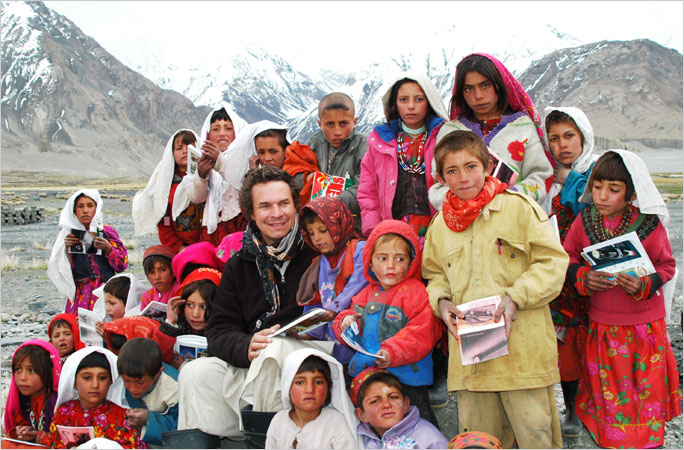
Greg Mortenson with Sitara “Star” schoolchildren. Photo: Fred R. Conrad/The New York Times
Mr. Bush has focused on military force and provided more than $10 billion — an extraordinary sum in the foreign-aid world — to the highly unpopular government of President Pervez Musharraf. This approach has failed: the backlash has radicalized Pakistan’s tribal areas so that they now nurture terrorists in ways that they never did before 9/11.
Mr. Mortenson, a frumpy, genial man from Montana, takes a diametrically opposite approach, and he has spent less than one-ten-thousandth as much as the Bush administration. He builds schools in isolated parts of Pakistan and Afghanistan, working closely with Muslim clerics and even praying with them at times.
The only thing that Mr. Mortenson blows up are boulders that fall onto remote roads and block access to his schools.
Mr. Mortenson has become a legend in the region, his picture sometimes dangling like a talisman from rearview mirrors, and his work has struck a chord in America as well. His superb book about his schools, “Three Cups of Tea,” came out in 2006 and initially wasn’t reviewed by most major newspapers. Yet propelled by word of mouth, the book became a publishing sensation: it has spent the last 74 weeks on the paperback best-seller list, regularly in the No. 1 spot.
Now Mr. Mortenson is fending off several dozen film offers. “My concern is that a movie might endanger the well-being of our students,” he explains.
Mr. Mortenson found his calling in 1993 after he failed in an attempt to climb K2, a Himalayan peak, and stumbled weakly into a poor Muslim village. The peasants nursed him back to health, and he promised to repay them by building the village a school.
Scrounging the money was a nightmare — his 580 fund-raising letters to prominent people generated one check, from Tom Brokaw — and Mr. Mortenson ended up selling his beloved climbing equipment and car. But when the school was built, he kept going. Now his aid group, the Central Asia Institute, has 74 schools in operation. His focus is educating girls.
To get a school, villagers must provide the land and the labor to assure a local “buy-in,” and so far the Taliban have not bothered his schools. One anti-American mob rampaged through Baharak, Afghanistan, attacking aid groups — but stopped at the school that local people had just built with Mr. Mortenson. “This is our school,” the mob leaders decided, and they left it intact.
You can read the entire article in the New York Times by clicking on the blue type.
Three Cups of Tea
My best-friend-from-college and I were chatting the other day and I asked her “what are you reading?” because we have always exchanged book recommendations back and forth.
“I’m reading a biography of Teddy Roosevelt,” she started, and I groaned, because most of the time biographies don’t interest me that much. “And I am reading Three Cups of Tea . . . “ and I interrupted her (rudely) to exclaim “so am I!”
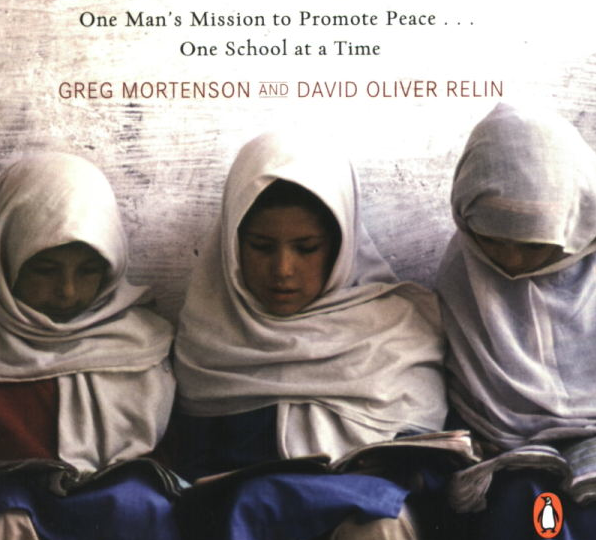
Three Cups of Tea is a must-read in the US. It was actually published in 2006, and has sold more and more books every month, and has been on the New York Times best seller list almost since it was published.
The book begins with a failure. A mountaineer, attempting a climb on K2 runs into problems, including evacuating two severely injured fellow climbers from the mountain. Exhausted, and devastated by his failure to capture the summit, he gets lost on his way back to the base camp, and ends up in a village where the people are very kind to him. He is treated as an honored guest, he regains his strength, and on his last day in the village, learns the children have no school. He rashly promises to come back and build a school for them.
One of the great redeeming features in this book is Greg Mortenson’s endless humility. He has a co-author, to whom he gave a long list of people he could talk with, including all his enemies and people who thought he was crazy. He’s that kind of guy. He talks about his life’s personal failures and his toughest moments, and he moves on.
He doesn’t take credit for the dogged persistence with which he keeps his promise, in spite of daunting obstacles. He doesn’t take any credit for the good will he builds.
Several years ago, I read another book which has changed my life, The Purpose Driven Life (which, by the way, the hardcover is $9.99 and the paperback is $10.19, go figure) in which the basic premise of the book is that we are each created uniquely, individually, by a loving creator, for a purpose. As I read Three Cups of Tea, I thought this man is greatly blessed; he discovered his purpose and nothing kept him from fulfilling it!
The book deserves every single one of it’s Amazon Five Star ratings.
I had a hard time putting the book down. Even though my life is full of other demands, once I had the chance, I spent an entire afternoon finishing this great book.
Greg Mortenson isn’t discouraged that his first school takes three years, and first he has to build a bridge. His second, third and fourth schools take just . . . three months! He has a gift for inspiring others, and people give what they can. The villagers give their time and their efforts, and western supporters donate funds.
By the end of the book, 24 school have been built, in the very poorest mountain villages in Pakistan, where money from the government for education doesn’t trickle at all, until near the end of the book. He doesn’t build the schools himself – he meets with the villagers, they donate a plot. He buys the materials, and together, they all build a school. These villagers are hungry for their children to become educated, to have a chance for a better life. Mortenson learns to focus on the girls.
He learns that as the boys become educated, they leave the villages for the city, but as the girls become educated, they come back, and like yeast, they raise the standard of living for the entire village, providing health care services and information, providing education for the newest crop of children, learning new skills, bringing them back and sharing them.
One of Mortenson’s gifts is that he isn’t interested in changing these mountain people into westerners. He likes them, and he learns from them, just the way they are. He dresses like them, he prays with them, he learns their language, and he has no western agenda for the curriculum in these schools. He also helps the government schools – building an additional room here for an overflowing school, paying a teacher’s salary there – his goal is to educate children. That’s it. No political agenda. The people of the villages love him for it, and give him their full support.
You cannot undertake a project like this without a lot of help. Mortenson had some extraordinary experiences, experiences that to me look like the grace of God, that drew together teams of people to help build and supply his schools.
“I looked at a sign in front of the school and saw that it had been donated by Jean Hoerni, my cousin Jennifer’s husband,” Bergman says. “Jennifer told me Jean had been trying to build a school somewhere in the Himalaya, but to land in that exact spot in a range that stretches thousands of miles felt like more than coincidence. I’m not a religious person,” Bergman says, “but I felt I’d been brought there for a reason and I couldn’t stop crying.”
A few months later, at Hoerni’s memorial service, Bergman introduced herself to Mortenson. “I was there!” she said, wrapping the startled man she’d just met in a bruising hug. “I saw the school!”
“You’re the blonde in the helicopter,” Mortenson said, shaking his head in amazement. “I heard a foreign woman had been in the village, but I didn’t believe it.”
“There’s a message here. This is meant to be,” Julia Bergman said. “I want to help. Is there anything I can do?”
“Well, I want to collect books and create a library for the Korphe School,” Mortenson said.
Bergman felt the same sense of predestination she’d encountered that day at the school. “I’m a librarian,” she said.
After struggling for many years, seeking donors who would help to build a school, Mortenson now has a foundation eagerly supported by many Americans, and especially the mountaineers, who continue to build schools. At the end of the book, the foundation is moving into the poorest sectors in Afghanistan, and building schools there. They have children’s programs in many of the schools in the United States, where children donate pennies to help pay for books for the schools, and for the teacher’s monthly salaries, where salaries are not reaching the teachers. You can donate to the school building fund, teacher’s salaries and books using your credit card, online, at the website Three Cups of Tea. You can order this book there, too, as well as music CD/s and learn more about the work being done.
Maitland and The Company of Liars: A novel of the plague
I had just finished The Swallows of Kabul and still had a long flight to go. Fortunately, I was in the Johannisburg airport, with it’s truly wonderful bookstore, and came across The Company of Liars: a novel of the plague. Well, it isn’t exactly a novel of the plague. The story opens in 1348, a year in which le morte bleu hit the British Isles, only later to be called the plague. The author captures the times, the filth, the lack of bathing, the superstitions, the ways of life.
The plot centers around a group who wanders through the island, just trying to stay alive. The spreading plague impacts on their wandering, but to call this a novel of the plague is just not accurate. The plague is the reason for the journey, but the journey is the center of the novel, not the plague.
Before I started reading the book, I read the Historical Notes in the back, and that is where I came across the most interesting information in the entire book:
The 1348 plague was only the latest in a series of disasters to hit Britain. The period between 1290 and 1348 had seen a rapid and drastic climate change which was so noticeable that the Pope ordered special prayers to be said daily in every church. Eyewitness accounts claimed that 1348 was a particularly bad year, for it rained every day from Midsummer’s Day to Christmas Day. Climate change brought about crop failure, liver fluke in sheep and murrain in cattle, as well as causing widespread flooding which virtually wiped out the salt industry on the east coast. This, combined with a population explosion, meant that as many people died from starvation as from the plague itself.
Interestingly, the book will not be released in the US until September 2008. The cover shown is nothing like the cover of the book I bought.
American issue cover:

Cover on book bought in Johannisburg:
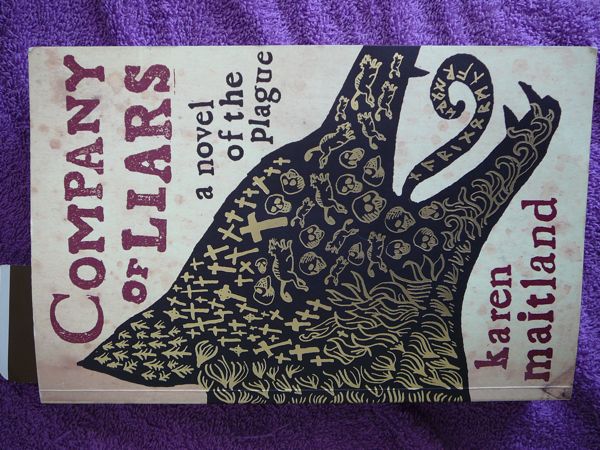
I like the cover of mine better.
Some reviewers call this book “enthralling” or “gripping.” I wans’t all that enthralled or gripped, but it did make good airplane reading. I learned a lot about the grim brutality of life in 1348, but as I told AdventureMan, this is more a book about a slice of time than a book with a great plot. The plot isn’t that great, it is the historical detail that is interesting, and fiction just makes it more easily absorbed. (my opinion)
Khadra and The Swallows of Kabul
While waiting for our luggage to be offloaded, we were passing time, visiting with our greeter / expediter, asking about his family, his life in Zambia.
“How does this work, travelling with your son and your daughter-in-law?” he asked us. “Do you like her?”
Nothing on earth could disguise the delight on our faces as we both said “Yes!” We truly adore her.
When our son was only seven years old, a Christian speaker passing through said that if you have children, it is likely that their mates have also been born, so to start praying now for the unknown mate your child would choose, and we did.
When our son called us from university, and told us there was someone he wanted us to meet at graduation, and graduation was still months away, we knew, we just knew, that this might be THE ONE.
We were so delighted when we met her, we liked her immediately. What parent isn’t happy to see his/her son/daughter happy, and choosing well?
“But!” our meeter/greeter added, “how do you like her family?”
And we laughed again! We love her family! Her father is smart and very funny, and her mother is kind and practical, and we all share the same values on family and friends and living our lives. She comes from a large rowdy family that gathers when they can, and so do we.
And YOU are thinking “what does all this have to do with The Swallows of Kabul?” but I am getting there.
On the trip, we all had books for our quiet time, and I could see EnviroGirl deeply engrossed in this book. When I asked her, she said she had gotten it from her father’s wife, a woman with whom I often talk books, and that she (EnviroGirl) was trying to finish it so that she could leave it with me.
And thank goodness that she did! I couldn’t put it down!
First, you think it is written by Yasmina Khadra, but that is a pseudonym. The real author, Mohammed Moulessehoul, was Algerian army officer, and he used the pseudonym to avoid having to submit the manuscript for approval by military authorities. That got my attention right away.
The book is about Taleban era Afghanistan, and starts out with utter hopelessness, describing the deterioration in life brought about by the arbitrary imposition of religious rule, as interpreted by men who have memorized the Qur’an, but have a poor understanding of what they have memorized. Women lead a dismal, limited life, at the mercy of men who treat them as detestable if they are seen in public, even totally cloaked.
His language is beautiful, poetic and compelling, even describing despair and desolation.
We meet two couples, Atiq, a jailer, and his wife, Musarrat, who risked her own life to save his life back when he was seriously wounded and left for dead, and Mohsen, former member of a moderately successful merchant family, married to the love of his life, Zunaira, who is beautiful, educated and from a wealthy background. These men love their wives, and have a strong, genuine connection to them. Their ability to maintain that connection, and to stay connected to their own values, withers in the dry, dusty context of fundamentalist rule.
Their lives and relationships have been changing gradually, increasingly limited and undignified under the stress of Taleban rule, and the novel follows a rapid spiral of deterioration and folly. The steady decline of their lives speeds when Mohsen makes a terrible impulsive decision, has to live with the consequences, and confesses to his wife.
Atiq, too, faces dismal consequences. Even though we know he is limited, he becomes a sympathetic character. His hardness of heart covers a genuine grief that his wife is dying, and he can do nothing to stop it, nor to alleviate her pain.
We all face hard times. In our family, when someone lashes out unjustly, we often ask “is it something I have done, or am I just the nearest dog to kick?” It always gets a laugh, and it puts things back in perspective, puts us on the same side. Sometimes we can’t always vent our frustrations against those people or events creating the frustration, so we take it out on those we love – and who love us. It’s not right, it’s not fair or just, but it is very human, and once you get that out on the table, it is easier to discuss the real issue.
When Zunaira ends up in jail, Atiq’s world is shattered as if by an earthquake – the earth moves under his feet, all his understanding of life is shaken.
“As he cleans up, he cautiously lifts his eyes to the roof beam looming over the cell like a bird of evil augury, and his gaze lingers on the anemic little lightbulb, growing steadily dimmer in its ceiling socket. Screwing his courage to the sticking point, he walks back to the lone occupied cell, and there, in the very middle of the cage, the magical vision: the prisoner has removed her burqa! She’s sitting cross-legged on the floor. Her elbows are on her knees, her hands are joined under her chin. She’s praying. Atiq is thunderstruck. Never before has he seen such splendor. With her godess’s profile, her long hair spread across her back, and her enormous eyes, like horizons, the condemned woman is beautiful beyond imagination. She’s like a dawn, gathering brightness in the heart of this poisonour, squalid, fatal dungeon.
Except for his wife’s, Atiq hasn’t seen a woman’s face for many years. He’s even learned to live without such sights. For him, women are only ghosts, voiceless, charmless ghosts that pass practically unnoticed along the streets; flocks of infirm swallows – blue, yellow, often faded, several seasons behind – that make a mournful sound when they come into the proximity of men.
And all at once, a veil falls and a miracle appears. Atiq can’t get over it. A complete, solid woman? A genuine tangible woman’s face, also complete, right here in front of him? He’s been cut off from such a forbidden sight for so long that he believed it had been banished even from people’s imaginations. . . ”
Atiq has a friend, Mirza, who thrives under Taleban rule, as a soldier, and also running illegal businesses highly profitable under the current regime. He encourages Atiq to abandon his cancer-striken wife, to get rid of her and to find a fresh, young wife. He offers Atiq shady business opportunities, and tells him a wise man bends with the wind. Ignorance and chaos benefit Mirza, and he has no wish to see the good old days return.
In spite of the bleakness, the desolation, the crushing arbitrariness and inhumanity, there is hope, love, and compassion in a thin, steady stream throughout the book.
Once I started reading, I had to finish. It was a great book for the long trip back to Kuwait, one I am eager to pass along to the next avid reader.
Cormac McCarthy and No Country For Old Men
“Did you get a chance to watch the DVD?” I asked my friend, “because I have the book, and the book is SO much better. You understand so much more.”
“No! No! I started, but I could not watch it,” said my friend, “It was too violent!”

No Country For Old Men was a very violent movie, done by the Coen Brothers. I reviewed it HERE. When we finished watching the movie, I called our son and said “what happened? I’m not sure I understood what happened!” and indeed, there was a lot I missed. My son didn’t tell me anything – he bought me the book. On one of those long Seattle – Amsterdam – Kuwait flights I read it, and at the end – WOW.
My friend hit the nail on the head – the movie was violent, because the book is about violence, about violence in our societies, about increasing violence, violence without conscience, violence with no understanding of suffering of the victims, violence for no purpose, violence with no meaning, no goal, violence, literally, at the flip of a coin.
The movie is an indictment of violence, taking a circumstantial event and building an entire plot around it, a drug trade gone bad. There are a lot of deaths in this movie, most of them just for being in the wrong place at the wrong time and tangling with people who have no morals, no scruples, no compass by which they live. Even money matters less to the drug dealers, and their employees, than an arbitrary code that takes tribalism to the limit – us or them.
The main character, a sheriff and grandson of a sheriff, takes on a case that leads him to wonder more and more if his service to his community and fellow human beings is even making a difference. He ponders on the changing character of Texas, of youth, and how we are raising our children. It is thought-provoking and unforgettable.
I understand someone, not the Coens, are currently making a movie of an earlier book I read by Cormac McCarthy, The Road which is another bleak story. There is an elemental relationship between the father and son, the father is all goodness and protection in a world driven to brutality and unimaginable behavior by an apocalyptic event.
In No Country for Old Men there are decent, moral, sweet relationships, faithful marriages, men of honor who serve their fellow-man as law enforcement officers, men who have served their country as soldiers, etc. but the point McCarthy seems to be making is that the decent people in the world have little hope of surviving against those who band together in gangs using brute force to get what they want.
No country For Old Men is available from Amazon.com for $11.20 + shipping or from $6.00 used. Yes, I own stock in Amazon.com. 🙂
The Morning Test
Back in May, I published an e-mail I had received about The Law of the Garbage Truck. It turns out, as I learned from a comment yesterday, that it is taken from a book by David J. Pollay who has his own blog at Typepad. No, he didn’t write me a nasty e-mail; I only learned the source from a very nice comment on the original post by a co-worker.
I was intrigued, so I checked out his blog. And found his entry for today has to do with The Morning Test.
Here’s how The Morning Test works. Every day for one week write down everything that you do at night. Jot down what you eat for snacks, the TV shows you watch, the radio programs you listen to, the email you read, the sites you surf, and whatever else you may do.
This is just a snippet from what he writes, so I urge you to read his entry for today to understand fully how it works.
The reason I like it is because it ties so closely with the Garbage Truck entry – how we SPEND our time, what we DO every day with our lives truly determines who we are more than our intentions (although the intentions of our heart are important, too). I believe in the old computer adage: Garbage In, Garbage Out.
I am reluctant to take the Morning Test because I know I would have to face where I waste the most time, and where I seriously need improvement. I know I would be aghast at how much time I spend on the computer, just wandering around. There are other areas where I read books that are not enriching, watch brainless TV shows, participate in low level conversations . . . there are so many areas in my life where I fail to live up to the person I was created to be, and I know it.
And I really admire this man for putting the test out there and making us examine who we are and what we want for ourselves and our lives.
Recent Comments
ExpatAlien on What Country am I Living … intlxpatr on Yellowstone: Old Faithful to C… Michelle on Yellowstone: Old Faithful to C… Cathy on No Grown-Ups in Charge intlxpatr on Waiting for Snow Wikipedia Donate Button

Amazina


Early Voting in Florida


 Here There and Everywhere