Bone Mountain by Eliot Pattison
Several times I started Bone Mountain and couldn’t get into it. I love Pattison’s books – they are mysteries, but his mysteries are more about the process of solving the puzzle than it is about the solution. The process is indirect – we travel around Tibet with Shan Tao Yun, Chinese, but who crossed the bureaucracy in his investigation of corruption and ended up exiled in a Tibetan prison camp (Water Touching Stone) where, under the very worst circumstances, he finds a new way of looking at life, as he gets to know and respect the Tibetan monks in prison for their beliefs.

This time, when I started the book, it was as if I had never picked it up before. I picked it up and couldn’t put it down. I kept finding passages I wanted to share – with you, with my other friends – this is an amazing book.
Shan and a a couple monks are on a mission to return a Tibetan relic to the valley from which the Chinese stole it, and are traveling with a group of sheep herders and salt gatherers to disguise themselves. The artifact gets stolen from them, but they continue on to the valley, discovering a hidden passage through the mountains, visiting a destroyed and partially rebuilt monastery, and learning about healing herbs and practices in Tibet, as we see medical practices in a whole new way.
One of the themes in each book has to do with the Chinese bureaucracy, harvesting Tibetan resources relentlessly, timber, minerals, etc. with no regard to the devastation their techniques leave behind, no regard for replenishment.
The other issue is the Chinese hijacking of the Bhuddist religion. The Chinese “re-educate” the monks, bringing Bhuddist thought into alignment with Chinese government goals. The new monasteries are no longer teaching true Bhuddist teachings, but are teaching corrupted and even heretical teachings. The true monks are roaming the country disguised as sheep herders, dung carriers, but are the true carriers of the teachings to the people. The bureaucracy grinds their teeth in frustration as the true monks continually slip through their fingers.
“Has this foreigner been gathering salt too?” he asked Lhandro in Tibetan.
“Just along to enjoy the fresh air,” Winslow quipped in Tibetan, and the monk stared at him, his eyes wide with wonder.
“An American who speaks Tibetan?” he exclaimed, and looked back with intense curiousity, at Lhandro and Shan, as though the news somehow changed his perspective on the party.
As you can imagine, I laughed out loud when I read that passage. We get that all the time, when my husband speaks Arabic and I can follow the conversation. We call it “the dog can talk!” look.
Avoiders. It was part of their particular gulag language, stemming from a teaching given in their barracks by an old monk, in his twenty fifth year of imprisonment, just before he died. Guns were avoiders, he said, and bombs and tanks and cannons. They allowed the users to avoid talking with their enemy, and allowed them to think they were right just because they had more powerful technology for killing. But those who could not speak with their enemies would always lose in the end, because eventually they lost not only the ability to talk with their enemy, but also with their inner deity. And losing the inner deity was the greatest sin of all, for without an inner deity, a man was an empty shell, nothing but a lower life-form.
Pattison hikes us through mountains and valleys, shows us medicinal plants, and talks about how it matters where and when and how they are mixed. We learn of the evil that exists in the best of us, and the good that exists in the worst of us. On our journey to solve a mystery, we gain a wealth of new understanding.
Available from Amazon.com for $10.17 plus shipping. (Yep, I disclose once again, I own stock in Amazon.com. 🙂 )
Joanna Brady and Tumbleweeds
I have a lot going on right now, and that is when I turn to books, I don’t know why. The more scheduled I am, the more important it is that I have fairly lightweight reading. My favorite genre is mystery, and there are a number of authors I follow, some more important than others.
I was reading the lastest Joanna Brady mystery, Dead Wrong, by Seattle author J.A. Jance. Joanna Brady became Police Chief in the small (fictional) Arizona town of Bisbee when her husband, then the police chief, was killed and she was asked to fill his position. Since then (several books) she has been elected and re-elected, and solved a lot of crimes, and re-married.
Now, in Dead Wrong, she is heavily pregnant, trying to solve a tricky murder that involves a puppy breeding mill and dog fighting ring.
“We have to go to Tumbleweeds tonight!” I call out to AdventureMan. “Joanna Brady is pregnant and she can’t eat creme brulee, but she dives right into tacos and enchiladas! Now I am starving for Mexican food!”
AdventureMan just laughs, he is always ready for Mexican food.
So just after sunset, we are king of the road, and we drive to Tumbleweeds.
I would love to say something nice about Tumbleweeds.
The service was slow. The servers were poorly trained. The food was SO mediocre. The chips were thick, and cold, and you could see fat congealed on them. The salsa was dull. The burritos and tacos were bland. No wonder we go there so rarely.
Peter Bowen and Nails
Three men trundle a naked woman through the desert to a remote place, where she was placed in a container, 6 x 6 x 6 with only a candle, a cot, water and a holy book, until she could come to her senses and behave.
Four girls were strangled, one each day, for refusing the sexual advances of their father and his brother. The two youngest girls, their older sisters dead, complied.
Women with inconvenient views, women who start having thoughts of their own disappear. Many in this tribe are home-birthed and home-schooled, so there aren’t records of their existence, and when they disappear, no-one is the wiser.
Saudi Arabia, you ask? Pakistan? Afghanistan? Where on earth are women treated this vilely?

Peter Bowen, in Nails, gives vent to his frustration of minor fundamentalist Christian cults roaming the American West, many of them ending up in Montana where they believe they will have the privacy to practice their beliefs without interference, and where those who are well-funded can influence poverty-stricken school districts to toss out Science classes and incorporate Intelligent Design. Bowen has utter contempt for their studied ignorance, their need to be the sole authority on what the scriptures say, and their insistence on the utter submission of women.
His worst scorn is for their treatment of women – he attributes it to their fears about their own sexuality. Women are often the victims, Bowen states, when men worry about their size, worry about how to keep women faithful, tractable, and docile. (And let’s face it, who can successfully control a woman? 😉 )
This is the latest Gabriel du Pre novel, or at least the latest I have read. Gabriel du Pre is a retired brand inspector (he goes back every now and then when needed, when the brand inspector is overstretched, insuring that the cows sold are from the herds they are being sold from), Metis (French and Indian mix), a renowned fiddler, and a deputy sheriff when the sheriff – or the FBI – needs help solving a particularly tricky murder. It takes a while to get your ear used to his dialect, and he spends a lot of time in bars, but the man has a real knack for figuring things out.
Gabriel du Pre is everything a straight-living woman like myself shouldn’t like. He drinks, morning to night, keeps his flask of whisky under the driver’s seat in his car. He drives way over the speed limit. He doesn’t go to church, he goes to an ancient Indian spiritualist / medicine man when he needs guidance. He isn’t married to the wry, very smart woman with whom he lives. He breaks the rules, he goes outside the boundaries.
For all his flaws, du Pre has a deep down, rock solid core of decency, and a way of looking at life and situations that is practical and . . . forgiving. He is charitable toward his brothers and sisters. He detests cruelty, especially when the strong take advantage of the weak or the arrogant walk all over the humble. There is something about this flawed hero that keeps the reader coming back for more.
His Gabriel du Pre novels are not heavy reading. You can toss one off in about half a day, but they are not so simple as they appear. You find yourself thinking about the issues he raises, and you find yourself looking to see when the next Gabriel du Pre mystery will appear.
You can find this on Amazon.com for $16. new or from $3.07 used, plus shipping of course. (Yes, I own stock in Amazon.com.) 🙂
Job and Islamic Tradition
One of the things I learned later in life, like when I lived in Doha, is that you (my Gulf and Moslem readers) have many of the same characters and stories in the Qur’an that we have in the Bible. Interesting, to me, the stories are not always exactly the same. Today’s reading in our lectionary (Old Testament) is from Job (you call him Ayoub, I think.)
First – if you read this, will you tell me if the story in Islam is similar to our story – that Satan is allowed to torment Job, because God believes him to be a faithful servant who will not turn away from him in times of hardship? Satan believes he can demonstrate that Job will be faithless?
Second – why is Satan called “the accuser?” I know Arabic is very close to the old Aramaic; is Satan always called Sheitan? Do you have other names for Satan? (These are not rhetorical questions; these are things I really don’t know) For example, Satan, in our tradition, is called The Father of Lies, The Great Deceiver, etc. But I don’t understand him being called The Accuser.
Third, toward the end of this reading his wife says essentially, give it up, Job, curse God and die. But the little asterisk says “bless”. This is a great puzzlement to me – a curse is the absolute 180° opposite of a blessing, I think. And then again, sometimes what appears to be a curse can be a blessing, and what appears to be a blessing can end up really being a curse. I just don’t understand why, in this context, the word curse could also mean bless? Do you?
Job 2:1-13
2 One day the heavenly beings* came to present themselves before the Lord, and Satan (*Heb the accuser) also came among them to present himself before the Lord. 2 The Lord said to Satan,* ‘Where have you come from?’ Satan* answered the Lord, ‘From going to and fro on the earth, and from walking up and down on it.’ 3 The Lord said to Satan,* ‘Have you considered my servant Job? There is no one like him on the earth, a blameless and upright man who fears God and turns away from evil. He still persists in his integrity, although you incited me against him, to destroy him for no reason.’ 4 Then Satan* answered the Lord, ‘Skin for skin! All that people have they will give to save their lives.* 5But stretch out your hand now and touch his bone and his flesh, and he will curse you to your face.’ 6 The Lord said to Satan,* ‘Very well, he is in your power; only spare his life.’
7 So Satan* went out from the presence of the Lord, and inflicted loathsome sores on Job from the sole of his foot to the crown of his head. 8Job* took a potsherd with which to scrape himself, and sat among the ashes.
9 Then his wife said to him, ‘Do you still persist in your integrity? Curse* (bless) God, and die.’ 10 But he said to her, ‘You speak as any foolish woman would speak. Shall we receive the good at the hand of God, and not receive the bad?’ In all this Job did not sin with his lips.
11 Now when Job’s three friends heard of all these troubles that had come upon him, each of them set out from his home—Eliphaz the Temanite, Bildad the Shuhite, and Zophar the Naamathite. They met together to go and console and comfort him. 12 When they saw him from a distance, they did not recognize him, and they raised their voices and wept aloud; they tore their robes and threw dust in the air upon their heads. 13 They sat with him on the ground for seven days and seven nights, and no one spoke a word to him, for they saw that his suffering was very great.
Long Way Gone in PB
Just a quick note to say that if you have been waiting to read Long Way Gone in paperback, it is now on the shelves.
Geraldine Brooks: March
Geraldine Brooks knocks my socks off. If she writes a book, fiction or non-fiction, I will buy it and read it. The first one I read by her was Nine Parts Desire: The Hidden World of Islamic Women, and the second most memorable book was her Year of Wonders, a book about how the plague comes to a 17th century English village and how the villagers cope with it – how some survive. She has a knack for keen observations, and for writing so as to place you squarely in the scene she is describing.
So when she came out with a new book extrapolating from the experiences protrayed in Louisa May Alcott’s classic favorite Little Women, why didn’t I rush to buy it? March is described by Publisher’s Weekly as “the Civil War experiences of Mr. March, the absent father in Louisa May Alcott’s Little Women.”

Didn’t you love Little Women when you read it? What’s not to love? Those wonderful sisters, their saintly mother, working together, suffering together, prevailing through sheer grit and determination – we can read that book over and over again, loving it every time.
Geraldine Brooks takes us with Mr. March into the grim realities of the American Civil War, the “war to free the slaves,” the war to keep the United States united, or the war between the states. This is not the idealized world of Little Women, this is not the memory we have of the nice letters he writes home from the field, this is the reality of war and all it’s ugliness. As the book opens, Mr. March is fleeing a massacre, struggling to survive, he is surrounded by the dead and seriously wounded, bullets are flying past him and he has to cross a deep, rushing river. A man grabs him who can’t swim, and he has to push him away to gasp for air. The man drowns, March survives, feeling deep guilt. When he finally finds a group of his men, drying out by the side of the river, he sits down and writes to his girls about the sweet breeze in the air. Not a word about the horrors he has witnessed, not his personal despair about having failed a wounded comrade.
As we experience the horrors of this war with Mr. March, we experience with him the brutality, cruelty, and crudity of all conflict. There are no good guys. There is no “just cause,” just winners and losers, and it’s very hard to tell what they are fighting for. Seeing this war from the point of view of the combatants, we realize that no-one will remain untouched; that this experience will resonate through the rest of their lives.
Geraldine Brooks knows how to grab us and keep us gripped. Every chapter reveals a new facet – how March and Marnee met and married, how they built a life together, how, in their idealism, they lost everything. Most discouraging of all is how, below the surface, they understand themselves and one another and their relationship so little.
I dare you to read this book. It isn’t an easy book, and at the same time, it is a book with timeless qualities, and a book that will get you thinking and keep you thinking for a long time. Isn’t that the definition of a good book?
Kuwait’s History – for Children
Thank you, Little Diamond, for your sharp eye spotting this story:
Children”s books about Kuwait”s history translated into English
Al Watan staff
KUWAIT: A new and rare series of stories about Kuwait”s history and
the nature of life in Kuwait in the past can now be found on sale in
Kuwait. The books, written by Dr. Yaqoob Yousef Al-Ghunaim and
translated into English by Dr. Shaban Afifi Abdulaziz, have been
printed by the Center for Study and Research in Kuwait and contain
illustration by artist Suhiala Hussein Al-Jundi.
The stories in the books are written in a simple manner that interests
children and that allows them to learn more about the history of
Kuwait and how Kuwaitis lived in the past. In the stories AlÜGhunaim
discusses traditional Kuwaiti society and the importance of fishing
and the rearing of animals.
The first story entitled Kuwait”s Wall is about a group of children
who ask Abu Abdullah questions about Kuwait”s wall and the reasons
behind its construction.
In the second story, AlÜGhunaim relates in a dramatic style the
stories of old Kuwaiti ships and underlines how society was based on
conservative religious values.
Al-Ghunaim also discusses life in the desert and how people were fond
of hunting gazelles and other wild animals which were commonly found
in the country.
A story about Burqan oil field was also added to the series to show
how the discovery of oil changed the Kuwaiti community.
http://www.alwatan.com.kw/Default.aspx?MgDid=652853&pageId=473
More Three Cups of Tea
The timing couldn’t be better. Thank you, Phantom Man, for sending a link to this New York Times article on Three Cups of Tea, from the July 13th New York Times.
By NICHOLAS D. KRISTOF
Published: July 13, 2008
Since 9/11, Westerners have tried two approaches to fight terrorism in Pakistan, President Bush’s and Greg Mortenson’s.

Greg Mortenson with Sitara “Star” schoolchildren. Photo: Fred R. Conrad/The New York Times
Mr. Bush has focused on military force and provided more than $10 billion — an extraordinary sum in the foreign-aid world — to the highly unpopular government of President Pervez Musharraf. This approach has failed: the backlash has radicalized Pakistan’s tribal areas so that they now nurture terrorists in ways that they never did before 9/11.
Mr. Mortenson, a frumpy, genial man from Montana, takes a diametrically opposite approach, and he has spent less than one-ten-thousandth as much as the Bush administration. He builds schools in isolated parts of Pakistan and Afghanistan, working closely with Muslim clerics and even praying with them at times.
The only thing that Mr. Mortenson blows up are boulders that fall onto remote roads and block access to his schools.
Mr. Mortenson has become a legend in the region, his picture sometimes dangling like a talisman from rearview mirrors, and his work has struck a chord in America as well. His superb book about his schools, “Three Cups of Tea,” came out in 2006 and initially wasn’t reviewed by most major newspapers. Yet propelled by word of mouth, the book became a publishing sensation: it has spent the last 74 weeks on the paperback best-seller list, regularly in the No. 1 spot.
Now Mr. Mortenson is fending off several dozen film offers. “My concern is that a movie might endanger the well-being of our students,” he explains.
Mr. Mortenson found his calling in 1993 after he failed in an attempt to climb K2, a Himalayan peak, and stumbled weakly into a poor Muslim village. The peasants nursed him back to health, and he promised to repay them by building the village a school.
Scrounging the money was a nightmare — his 580 fund-raising letters to prominent people generated one check, from Tom Brokaw — and Mr. Mortenson ended up selling his beloved climbing equipment and car. But when the school was built, he kept going. Now his aid group, the Central Asia Institute, has 74 schools in operation. His focus is educating girls.
To get a school, villagers must provide the land and the labor to assure a local “buy-in,” and so far the Taliban have not bothered his schools. One anti-American mob rampaged through Baharak, Afghanistan, attacking aid groups — but stopped at the school that local people had just built with Mr. Mortenson. “This is our school,” the mob leaders decided, and they left it intact.
You can read the entire article in the New York Times by clicking on the blue type.
Three Cups of Tea
My best-friend-from-college and I were chatting the other day and I asked her “what are you reading?” because we have always exchanged book recommendations back and forth.
“I’m reading a biography of Teddy Roosevelt,” she started, and I groaned, because most of the time biographies don’t interest me that much. “And I am reading Three Cups of Tea . . . “ and I interrupted her (rudely) to exclaim “so am I!”

Three Cups of Tea is a must-read in the US. It was actually published in 2006, and has sold more and more books every month, and has been on the New York Times best seller list almost since it was published.
The book begins with a failure. A mountaineer, attempting a climb on K2 runs into problems, including evacuating two severely injured fellow climbers from the mountain. Exhausted, and devastated by his failure to capture the summit, he gets lost on his way back to the base camp, and ends up in a village where the people are very kind to him. He is treated as an honored guest, he regains his strength, and on his last day in the village, learns the children have no school. He rashly promises to come back and build a school for them.
One of the great redeeming features in this book is Greg Mortenson’s endless humility. He has a co-author, to whom he gave a long list of people he could talk with, including all his enemies and people who thought he was crazy. He’s that kind of guy. He talks about his life’s personal failures and his toughest moments, and he moves on.
He doesn’t take credit for the dogged persistence with which he keeps his promise, in spite of daunting obstacles. He doesn’t take any credit for the good will he builds.
Several years ago, I read another book which has changed my life, The Purpose Driven Life (which, by the way, the hardcover is $9.99 and the paperback is $10.19, go figure) in which the basic premise of the book is that we are each created uniquely, individually, by a loving creator, for a purpose. As I read Three Cups of Tea, I thought this man is greatly blessed; he discovered his purpose and nothing kept him from fulfilling it!
The book deserves every single one of it’s Amazon Five Star ratings.
I had a hard time putting the book down. Even though my life is full of other demands, once I had the chance, I spent an entire afternoon finishing this great book.
Greg Mortenson isn’t discouraged that his first school takes three years, and first he has to build a bridge. His second, third and fourth schools take just . . . three months! He has a gift for inspiring others, and people give what they can. The villagers give their time and their efforts, and western supporters donate funds.
By the end of the book, 24 school have been built, in the very poorest mountain villages in Pakistan, where money from the government for education doesn’t trickle at all, until near the end of the book. He doesn’t build the schools himself – he meets with the villagers, they donate a plot. He buys the materials, and together, they all build a school. These villagers are hungry for their children to become educated, to have a chance for a better life. Mortenson learns to focus on the girls.
He learns that as the boys become educated, they leave the villages for the city, but as the girls become educated, they come back, and like yeast, they raise the standard of living for the entire village, providing health care services and information, providing education for the newest crop of children, learning new skills, bringing them back and sharing them.
One of Mortenson’s gifts is that he isn’t interested in changing these mountain people into westerners. He likes them, and he learns from them, just the way they are. He dresses like them, he prays with them, he learns their language, and he has no western agenda for the curriculum in these schools. He also helps the government schools – building an additional room here for an overflowing school, paying a teacher’s salary there – his goal is to educate children. That’s it. No political agenda. The people of the villages love him for it, and give him their full support.
You cannot undertake a project like this without a lot of help. Mortenson had some extraordinary experiences, experiences that to me look like the grace of God, that drew together teams of people to help build and supply his schools.
“I looked at a sign in front of the school and saw that it had been donated by Jean Hoerni, my cousin Jennifer’s husband,” Bergman says. “Jennifer told me Jean had been trying to build a school somewhere in the Himalaya, but to land in that exact spot in a range that stretches thousands of miles felt like more than coincidence. I’m not a religious person,” Bergman says, “but I felt I’d been brought there for a reason and I couldn’t stop crying.”
A few months later, at Hoerni’s memorial service, Bergman introduced herself to Mortenson. “I was there!” she said, wrapping the startled man she’d just met in a bruising hug. “I saw the school!”
“You’re the blonde in the helicopter,” Mortenson said, shaking his head in amazement. “I heard a foreign woman had been in the village, but I didn’t believe it.”
“There’s a message here. This is meant to be,” Julia Bergman said. “I want to help. Is there anything I can do?”
“Well, I want to collect books and create a library for the Korphe School,” Mortenson said.
Bergman felt the same sense of predestination she’d encountered that day at the school. “I’m a librarian,” she said.
After struggling for many years, seeking donors who would help to build a school, Mortenson now has a foundation eagerly supported by many Americans, and especially the mountaineers, who continue to build schools. At the end of the book, the foundation is moving into the poorest sectors in Afghanistan, and building schools there. They have children’s programs in many of the schools in the United States, where children donate pennies to help pay for books for the schools, and for the teacher’s monthly salaries, where salaries are not reaching the teachers. You can donate to the school building fund, teacher’s salaries and books using your credit card, online, at the website Three Cups of Tea. You can order this book there, too, as well as music CD/s and learn more about the work being done.
Maitland and The Company of Liars: A novel of the plague
I had just finished The Swallows of Kabul and still had a long flight to go. Fortunately, I was in the Johannisburg airport, with it’s truly wonderful bookstore, and came across The Company of Liars: a novel of the plague. Well, it isn’t exactly a novel of the plague. The story opens in 1348, a year in which le morte bleu hit the British Isles, only later to be called the plague. The author captures the times, the filth, the lack of bathing, the superstitions, the ways of life.
The plot centers around a group who wanders through the island, just trying to stay alive. The spreading plague impacts on their wandering, but to call this a novel of the plague is just not accurate. The plague is the reason for the journey, but the journey is the center of the novel, not the plague.
Before I started reading the book, I read the Historical Notes in the back, and that is where I came across the most interesting information in the entire book:
The 1348 plague was only the latest in a series of disasters to hit Britain. The period between 1290 and 1348 had seen a rapid and drastic climate change which was so noticeable that the Pope ordered special prayers to be said daily in every church. Eyewitness accounts claimed that 1348 was a particularly bad year, for it rained every day from Midsummer’s Day to Christmas Day. Climate change brought about crop failure, liver fluke in sheep and murrain in cattle, as well as causing widespread flooding which virtually wiped out the salt industry on the east coast. This, combined with a population explosion, meant that as many people died from starvation as from the plague itself.
Interestingly, the book will not be released in the US until September 2008. The cover shown is nothing like the cover of the book I bought.
American issue cover:

Cover on book bought in Johannisburg:
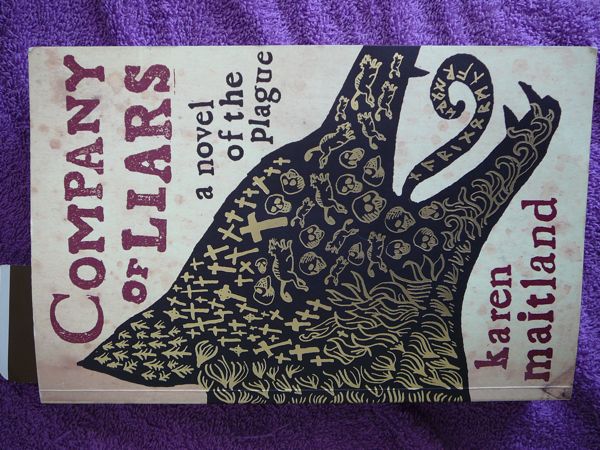
I like the cover of mine better.
Some reviewers call this book “enthralling” or “gripping.” I wans’t all that enthralled or gripped, but it did make good airplane reading. I learned a lot about the grim brutality of life in 1348, but as I told AdventureMan, this is more a book about a slice of time than a book with a great plot. The plot isn’t that great, it is the historical detail that is interesting, and fiction just makes it more easily absorbed. (my opinion)
Recent Comments
Kitchen on Isiais: Winding Down intlxpatr on Shampoo Ginger tigerbutterya0c5ff1d… on Shampoo Ginger intlxpatr on British Soldier Kidnapped, Esc… John on British Soldier Kidnapped, Esc… Wikipedia Donate Button

Amazina


Early Voting in Florida


