Donna Leon: Suffer the Little Children
After reading Zanzibar Chest I decided it was time to give myself a break, and I allowed myself another Donna Leon book, this one Suffer the Little Children. I am currently reading another detective series, recommended by my sister, set in China. What they all seem to have in common is a very tired, sad, jaded view of corruption in society, and particularly among the poorly paid police. Sigh.

In this book, a Doctor and his wife are invaded in the middle of the night by the carabinieri, a kind of police in Venice. I am not sure how the two agencies differ, maybe it is like the difference between state police and local police in the US, but when the paper was faxed over coordinating with Brunetti’s office, it got lost somewhere, and the action was never coordinated, and Brunetti gets a call in the middle of the night.
The doctor and his wife have adopted a child illegally. They bought an unwanted child from an Albanian woman, paid for her pregnancy expenses, paid a huge fee to her, and then had the child taken from them. Here is the saddest part of the story – the child’s mother doesn’t want the child, the illegally adopting parents want him back desperately, but the child is sent to a state orphanage, because of the illegal adoption.
It is a very sad book.
Here is why I read Donna Leon – some of her paragraphs are just brilliant. Memorable. Unforgettable.
“Brunetti’s profession had made him a master of pauses: he could distinguish them in the way a concert-master could distinguish the tones of the various strings. There was the absolute, almost belligerent pause, after which nothing would come unless in response to questions or threats. There was the attentive pause, after which the speaker measured the effect on the listener of what had just been said. And there was the exhausted pause, after which the speaker needed to be left undistrubed until emotional control returned.
Judging that he was listening to the third, Brunetti remained silent, certain that she would eventually continue. A sound came down the corridor: a moan or the cry of a sleeping person. When it stoped, the silence seemed to expand to fill the place.”
When you read Donna Leon, you forget you live anywhere else. For one brief moment, you become Venetian, you live in Guido Brunetti’s shoes. The speak the Venetian dialect, you think like a Venetian. What an escape!
The paperback edition will be out in April for $7.99 at Amazon.com for $7.99 plus shipping.
History of Architecture in Old Kuwait City (5)
One last quote from this wonderful book by Saleh Abdulghani Al-Muttawa, because it summarizes his ideas on what makes house practical for the weather and customs of this region:
Cultural Response
. . .the major critical cultural and customs problems which concern housing are;
1. Privacy for female inhabitants
2. Separation between female and male guests, and separation between guests, in general, and house members.
3. Future family expansion
. . . The approach to solving those critical problems are as follows:
1. To assure privacy for family members, and especially female members. The family part of the house has been pushed all the way to the back; in other words, it is on the north side far away from the street. It is difficult, or impossible, for anyone passing by the house to be able to look through and see the inside, especially with all those trees and plants placed in front of the house. Another conservative step has been taken by separating the family entrance from the guest’s entrance, and placing the family entrance close to the driveway and the garage for easy and private access. All that gave the female members of the family more free and secured mobility inside the house.
2. The prototype design provides a separate quarter for the guests, “Dewania.” The “Dewania” is placed on the southern side of the house away from the family entrance, to provide privacy for both family members and guests. The “dewania” is actually divided into two “dewanias,” female “dewania” and male “dewania.” For more seclusion and privacy of both sexes, the entrance of the female “dewania” is placed on the west side and the entrance of the male “dewania” is placed on the east side. Both entrances are close to the main road to make it more convenient and easy for the guests to come in and out. Each “dewania” has its own bath. There is only one dining room, because most of the time only men stay for dining. (Women have to go home to cook for their families.) If it happens that both sexes stay for dining, women can be accomodated in their “dewania.” A collapsible partition is placed in between the two “dewanias.” In big events like wedding parties or feasts, the partition can be collapsed, so the space would be large enough for a sizable number of people.
In a post last week, How decisions are made in Kuwait we had a long discussion about diwaniyas in the comments section. What I like about al-Muttawa’s concept is that collapsible wall in between the female and male diwaniyya. It could allow the females to listen in on major political discussions – what? You think we aren’t interested? You are wrong! – and participate.
“How can they participate while separated?” my western friends will be asking.
There are emmisaries. When sitting with the women, in Saudi Arabia, I wondered at first how my husband and I would both know when it is time to go. In western society, we have a meeting of the eyes and my husband will give an almost imperceptible nod and I know it is time to begin to make our farewells. As the hour got later and later, and still later, I finally asked one of the women how I would know when my husband wanted to leave.
“You want to leave?” she gasped in horror!
“No, No!” I assured her, “I just don’t know how I will know when my husband wants to leave!”
“Your husband will send for you! The children will tell you!” she laughed, and I stopped worrying. The children were running back and forth from room to room, reporting on the happenings in the men’s diwayya, where a holy man was discussing morality and requirements of morality.
This was one of my favorite places in Saudi Arabia, the house of friends. In the women’s majlis, there was only a TV, and seating around all the walls. There was nothing on the walls, nothing, not a picture, not a calligraphy, nothing, but the furniture was strong and comfortable, and the hospitality never-ending. When dinner time came, we went to an adjacent entirely bare room, bare except for the lavish dinner laid on the floor, where we all sat and ate, and one huge cupboard, full of mattresses. The dining room became one of the sleeping rooms when all the guests departed.
I didn’t get a tour of the house; I only know what I saw from my entrance through the family entrance into the female part of the house, my brief glimpse of the kitchen area – large and utilitarian. What I remember most clearly was the love and joy in the family, and that all the walls were totally devoid of anything decorative.
+ + + + + +
When I came to live in Kuwait, the real estate people showed me 20 villas and one apartment. The villas, each and every one, were HUGE! Most of them were three or four floors, more than one had an elevator, and several had their own swimming pools.
Most of the houses had a large kitchen – separate from the house, outside! Alongside it were the quarters for the maids, the drivers, the guard, etc. Most of the houses had at least five bedrooms, at least two diwaniyyas.
In the newer areas, there was barely two feet between houses, so windows on the sides of the houses were non-existent, or heavily curtained over, making those rooms very dark. In the older houses, the bathrooms were small and the spaces were divided strangely, by western ways of thinking.
Mostly, though, the villas were lovely, full of luxurious materials and beautiful touches. As I would walk though, sounds bounced off the thick cinderblock walls and the marble floors.
AdventureMan works long hours. I would think of me and the Qatteri Cat bouncing around in the huge house like two little peas in a big bowl, and where would I find him if he hid out for a while? The villas were just too much space for our little family, and we opted for the apartment, although the apartment is bigger than many homes in the United States. AdventureMan and the Qatteri Cat still look at me accusingly from time to time; they always enjoyed an hour or two together in the garden on Friday mornings, and now we have no garden. . . all we have (I can’t even keep a straight face as I write this) is that glorious 24-hour-a-day 180° view of the Arabian Gulf. 😉
+ + + + + + +
If I ever see this book for sale, I will come back here and update. If YOU see it for sale, please come back here and let us know!
History of Architecture in Old Kuwait City (3)
I am quoting so much from Saleh Abdulghani Al-Mutawa. Architect, that you may think you don’t need to run out and buy the book but I assure you, I am only sharing with you a few of the gems I found within. The author has done so much research with such loving attention that the book is full of treasure, every page offers something worthy.
The Year of Demolish
It is a sad memorial in Kuwait’s history. In Rajab 1289 A.H. (i.e. in the middle of the nineteenth century), heavy rains accompanied by severe winds hit the old Kuwait city, and demolished most of the mud houses. Sea waves went high and hit and wrecked ships. It was a disaster for Kuwaitis.
A second natural disaster took place in Kuwait on 30 November 1954 when heavy rains fell and demolished houses and forced 18,000 Kuwaitis to seek refuge in newly built schools. Houses built of mud and a little cement were severely affected, while houses built of rock were not affected.
My Kuwait friends – tonight, instead of going out in your cars, stay home! Sit with your grandparents and ask them about the house they grew up in. Ask them about the meals they cooked. Ask them about the heavy rains, so heavy that they could destroy houses and force 18,000 Kuwaitis to abandon their homes and go stay in schools. These are amazing stories – learn your stories from your grandparents . . . and then come tell us all the stories in your own blogs. If you don’t have a blog, or if you want to share here, you are welcome.
Some of my Kuwait friends ask why I care more about these things than the Kuwaitis. First – my Kuwaiti friends care. In my country, we call these people “the silent majority.” Every now and then the majority energizes and asserts itself. Kuwaitis care. Change is happening, it happens slowly. Keep the faith.
Second – I live here. I may not be Kuwaiti, but I care about the places where I live. If God has placed me here, I trust that he has his reasons, and it is my obligation to him to learn as much as I can and to serve – wherever he may place me. He placed me in Kuwait.
Tomorrow I will print my very favorite part of this book – where it describes family living. Meanwhile, run out and buy your own copy. There is so much I am not covering. This book is a part of your heritage.
History of Architecture in Old Kuwait City (2)
I love this book. It is such a treasure. For those of you who have ever wondered about the construction of old Gulf dwellings, this book is a MUST have – so much detail, so much to help us understand what we are seeing.
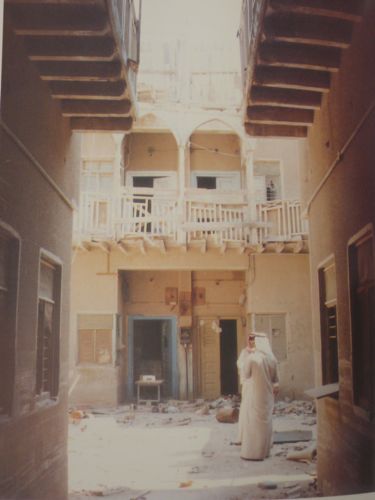
More from author Saleh Abdulghani Al-Mutawa, Architect:
House design and location specified unity existing in the Kuwaiti society. In old times, the poor livednear the rich, where no differences between them. The only difference was that the houses of the rich were vast. Ordinary Kuwaiti house, occupied by the majority of Kuwaitis, consisted of a vast courtyard, surrounded by many rooms, and a hallway secured privacy to the family by separating the house from the street. In that architectural design, the courtyard ventilated the house to find it cool at night and after sunset. This was due to the exchange of radiation between the floor of the courtyard and the outer space. At night the house became cool and sleep was comfortable. During summer, the majority of Kuwaitis prefer to sleep in the courtyard or on the roof. Usually, there is a room on the roof used to store mattresses in or sometimes for napping. A small bath is usually located beside that room. . .
Walls were built of rock and mud, and decorated internally with white gypsum. Ceilings consisted of rows of jandal (trunks), basajeel (bamboo) and manqour (straw mats), covered with a 30cm or a 40cm layer of mud. In winter, when rain was heavy, that layer should be attended to and maintained by adding more mud. Houses of the rich used gypsum for protection. When wood was used in fixing the ceilings, thejandal was only 4 m long, and for the wide rooms they used square pieces of wood of 6m. The floor was covered with mud, then with tiles which was imported from neighboring countries. To let the water flow from the roofs, they used the wooded marazims (gutters) which extended from the roofs to the outside. In the houses there were wells for supplying the underground water, and there were pools to store water in.
As regards the houses of the rich, they were divided into a number of courtyards, each serving a certain purpose. There was a courtyard used to include a Diwaniya for male guests, consisting of a large room annexed with other buildings needed to accomodate the servants or for other purposes.
The other courtyard was located for family female members, including a number of rooms and bathrooms. A third courtyard was used as a kitchen, including the kitchen, storage room for fuel and a store room for the different kinds of food. There were more courtyards for the animals: goats, cows, horses. Kuwaiti houses also had a “baqadeer” (wind tower) which was a natural air-conditioner, not one Kuwaiti house was without it.
History of Architecture in Old Kuwait City
When I came to live in Kuwait, my resourceful niece, Little Diamond went online and found all kinds of fabulous books about Kuwait, books you can’t find in Kuwait. Five interesting books, mostly about an earlier era in Kuwait, when my Kuwaiti friends tell me it was still one community.
“It was like paradise” they say, and they sigh.
I found another book recently, a book I have never seen before, although it was published in 1994, so it is not old. It is The History of Architecture in Old Kuwait City (and the influence of it’s elements on the Architect) by Saleh Abdulghani Al-Mutawa.
Although I intend to give this book as a gift to a friend, I couldn’t resist taking a peek inside, first. Should have resisted – I ended up reading the whole book.

This man loves architectural details the way I do, but he has studied them, and he is on a mission to bring back elements of uniquely Gulf architecture to the Gulf. One reason I love this book is that I know the buildings he has designed; I had a friend who lives in one, and we all marveled at it’s architectural elements.

I particularly love the wind towers.
I lived in Jordan for two years with no air conditioning. I don’t know why, but we didn’t miss it. We had our windows open all night and early mornings, we had rolled down shutters to keep the harsh sunlight out and we had ceiling fans – we managed.
Life would be different without A/C; life styles would change, but it would be manageable.
I want to quote from this book for you. Kuwaiti readers, you probably know all these things, but my readers in other parts of the world – like me – may find this fascinating.
Architecture and Building Materials in Old Kuwait City
Building materials were taken from materials available in nature: sea rock, mud, limestone and gypsum. As old Kuwait’s economy depended on the two journeys for diving and travel to Africa and India, Kuwaitis imported teakwood from India, and jandal (trunk) and basajeel (bamboo) from Africa (Mombassa – Kenya). These completed the elements of the construction. The shape of the old Kuwaiti architecture came to suit the environment and circumstances. Houses were adjacent in a manner that indicated the unity and cooperation of the people. Streets were narrow in such a way that the sun did not fall on the full street, and that made the streets cool and shaded. Mosques were the places for prayers, where they pray five times a day, were near the houses. There was a mosque in each district to enable the elders from walking to it without trouble. Kuwaitis care much for their religion.
Construction depended on Kuwaitis themselves. The engineer, called “ustad’ at that time, supervised the building and the laborers of Kuwaitis prepared for it. They carried rocks, prepared mud bricks, and started building.
Kuwait city was spontaneously and simply divided. In this it is similar to many old world cities, like London. There were three districts: Sharq (east), where the sun rises, Qibla, where the sun sets, and Wosta, which lies between them. The three districts were surrounded by their fence which the Kuwaitis built to defend their city.
By jandal, the author means trunks of trees, which you will see incorporated in the illustration above, painted black. When he talks about the fence around old Kuwait, he is talking about the wall which once existed. You can still find the (re-creations) of the gates to the city, except we can’t fine the one that is supposed to be around B’naid al Gar.
More to follow!
Aidan Hartley’s Zanzibar Chest

I started Zanzibar Chest in December, and could not get into it. It was interesting, but at first the tone was . . . I don’t know, maybe pompous? Something in the tone put me off, and yet I didn’t put it back on the bookshelves, nor did I give it away. It sat on my bed table while I attacked lesser works, more enjoyable fare. Then, one day, I just knew it was time to try it again, and this time, I could hardly put it down.
Born in Kenya, just before the rebellion, Aidan Hartley spent his life mostly in Africa. He skillfully interweaves three main story lines – the life of his mother and father, the life of his father’s best friend and his own life as a news correspondent.
This is not a joyful book. It is not inspirational. It is a tough, hard look at the people who cover the news, and the toll it takes on their lives. It is a story of drugs and alcohol to numb the pain of what they are observing, the comraderie of gallows humor and surviving the intensity of living through life-threatening moments together.
He covers some truly awful events. He covers the wars in Somalia, and in Rwanda. He covers Kosovo and Serbia. He is sent into some of the most dangerous and awful of places. He pays the price.
In his Zanzibar Chest, he takes us with him.
I will share a couple quotes with you, and if you are sensitive, please stop reading now. This book is not for you. It is almost not for me, except that sometimes I think we need to come face to face with just how awful reality can be to put our own lives right, to set appropriate priorities.
“I can’t put my finger on exactly how death smells. The stench of human putrefecation is different from that of all other animals. It moves us as instinctively as the cry of a newly born baby. It lies at one extreme end of the olfactory register. Blood from the injured and the dying smells coppery. After a cadaver’s a day old, you smell it before you see it. From the odor alone, I could tell how long a body had been dead and even, depending on whether brains or bowels had been opened up, where it had been hacked or shot. A body would quickly balloon up in the tropical heat, eyes and tongue swelling, flesh straining against clothes until the skin bursts and fluids spill from lesions. Flies would get in there and within three days the corpse might stink. It became a yellow mass of pupae cascading out of all orifices and the flesh literally undulated beneath the clothes. The tough bits of skin on the palms of their hands and the soles of their feet were the parts of the body that always rotted away last. As living people, these had been peasants who had walked without shoes and worked hard in the fields. A man who had been dead seven days reeks of boiling beans, guava fruit, glue, blown handkerchiefs, cloves and vinegar. After that he starts to dry out into a skeleton until he’s almost inoffensive . . .
The dead accompanied me long after Rwanda. It was months before I could order a plate of red meat served up in a restaurant. I smelled putrefaction in my mouth, or in my dirty socks, or as sweat on my body. I imagined what people I met would look like when dead. . . “
These guys all suffer from Post traumatic stress syndrome, they deaden themselves with drug and alcohol, and they are totally addicted to the adrenalin rush their job gives them. Living on adrenalin takes a huge toll – on their health, on their mental health, on their relationships, on their belief in goodness. They are the witnesses to the enormity of man’s inhumanity against one another.
In another quote, the author tells us:
“It was impossible for latecomers to comprehend the evil committed here but the British military top brass were still so scared of what their soldiers might see and what it would do to their minds that they sent a psychiatrist to accompany the forces to Rwanda. Bald Sam and I were amazed at that. We laughed about it. A shrink! It seemed extravagant. But the truth is that we stuck close to that man for days. We said it was all for a story, but really it was about us. The psychiatrist, whose name was Ian, told us his special area of interest was the minds of war correspondents. I could see Bald Sam squirming with happiness at all the attention, and I felt quite flattered myself. . . .
. . . for years I did endure some sort of payback. I have to try every day to prevent the poison that sits in my mind to spread outward and hurt the people I love. Sometimes I can’t stop it and I wonder if in some way the corruption will be passed on from me to my children.”
Toward the end of the book, the author tells us how hard it is to give up this adrenalin-news-junky life:
“Whenever I see a news headline to this day I half feel I should board the next flight into the heart of it. I’d love to get all charged up again and I could write the story with my eyes closed. I’m sure the sense that I’m missing out while others get in on a great story will never completely pass. . . The sight of people committing acts of unspeakable brutality against others fills a hole in some of us. The activity is made respectable by being paid a salary to do it, but there is a cost.”
This is not a book I really wanted to read, but it is a book I will never forget. Hartley doesn’t spare himself in the telling of this tale. He takes us with us and shows us all of it, and all of his own warts along with the tale. Would I recommend this book? Not for the sensitive, not for those who don’t want to look at the dark side. Between idyllic sequences on the beaches near Mombasa, in the hills of Kenya and Tanzania, in the dusty deserts of Yemen, there are some very intense and bloody moments. This is non-fiction, it is a documentary, it is a slice of the real life one man has seen, and that to which he has been witness. Read the book, and like him, you pay a price. You carry images in your head that you can’t forget, and a sorrow for our inability to solve our differences peaceably.
(Available in paperback from Amazon.com for $10.88. Disclosure: Yes, I own stock in Amazon.com.)
“Bookstores, Bathouses, Bars . . . “
I’m following The Shield, a hard-edged detective show I have followed, when I can, ever since Glen Close was the police chief. If you thought Glen Close was tough as Cruella de Ville, wish you could see her as police chief/ 😉

The guy standing next to her is Detective Vic Mackey, a renegade plainclothes cop who plays fast and loose with the system. You know me, Mrs. Law and Order – whoda thunk I would find myself rooting for this guy as he undergoes close scrutiny from the Internal Affairs Division. He’s really a bad guy. He does really bad things. He is a LIAR! He lies to everybody! He kills people, he steals dope and money. And somehow you find yourself pulling for him. I don’t know why.
But the reason I am writing about this is because in yesterday’s episode, a couple guys get their private organs caught in rat traps because they stuck their organ in a place called a “glory hole” for a little excitement and got more than they had bargained for (ouch). See what you can learn from these shows? And this is on during daylight viewing hours?
So the new police chief, a very cool and tough black woman, tells the detectives to go check “bookstores, bathhouses, bars, you know, the places these perverts hang out. . . ” and I am thinking “BOOKSTORES?” BOOKSTORES?? I hang out in bookstores all the time! I never see any perverts at the Barnes and Noble, or Half Price Books!
The things you learn on televison. I hope children are not watching this show!
Sue Monk Kidd: Mermaid Chair
It took me a long time to buy this book, and an even longer time to read it. I kept reading the description, and I didn’t like it at all. But it kept popping up on the “recommended for you” list on Amazon, and I had this inner feeling that I was meant to read it, even if I didn’t particularly care to.
After treating myself to Leon and Bowen, I thought now was the time.
At first I found The Mermaid Chair a little Anne Rivers Siddon-ish – and I like Anne Rivers Siddons, and I don’t like imitations, which this felt like. And I thought to myself “Anne Rivers Siddons does it better.”
I kept reading, though. The book was intriguing, and I wanted to know what happened next.
Sue Monk Kidd wrote another book I really liked called The Secret Life of Bees in which I learned a lot about bees, and found the story wonderfully redemptive.
Sue Monk Kidd and Anne Rivers Siddons also share a love of the mystical, and the mystical in religion, and the mystical in human relationships, and the mystical in the sisterhood of women, all of which I find fascinating, and parts of which I would like to believe myself.
In this book, there is a lot going on. The main character is feeling stagnant and small, and invisible in her marriage. Her daughter has left for college, and she is oddly unable to find things in life to interest her. Then, her mother cuts off her finger, her mother’s friends call her to come to Egret Island, and she finds herself suddenly caught up in a whirlwind of emotions and torments that she can barely understand.
She has avoided returning to her Egret Island home to avoid the pain of her father’s death when she was 12, and her mother’s decent into moodiness and madness. She returns, meets a monk and falls in love, copes badly with her mother’s demons, and fights her way through her own personal crisis.
Sue Monk Kidd makes it all work. The work floats with artistic references; Gaugain, Matisse, Chagall, their mysterious, delightful women in particular float throught this book in Mermaid guises, and our heroine, Jessie Sullivan, discovers her own mermaid-within.
I won’t say that this is the best book I have ever read – it isn’t. I will say that I loved reading it. I loved the feel of living on Egret Island, with the tides and the birds and the small town friends, the local dog, the raininess and windiness of it all. I feel like I was there. I know the graveyard, I know the winding paths, I know those little golf carts everyone uses to get around. I know what it’s like to have to take a ferry to get to the mainland, I know the tidal currents of life’s more overwhelming moments.
As our Jessie binds her marriage back together, she says this:
Each day we pick our way through unfamiliar terrain. Hugh and I did not resume our old marriage – that was never what I wanted, and it was not what Hugh wanted either – rather we laid it aside and began a whole new one. Our love is not the same. It feels both young and old to me. It feels wise, as an old woman is wise after a long life, but also fresh and tender, something we must cradle and protect. We have become closer in some ways, the pain we experienced weaving tenacious lines of intimacy, but there is a separateness as well, the necessary distance. . . . .
I tell him, smiling, that it was the mermaids who brought me home. I mean, to the water and the mud and the pull of the tides in my own body. To the solitary island submerged so long in myself, which I desperately needed to find. But I also try to explain they brought me home to him. I’m not sure he understands any more than I do how belonging to myself allows me to belong more truly to him. I just know it’s true.”
This is a good read. It’s worth its reputation, it’s worth picking up and reading through. While some might think it’s very much a chick book, I suspect men reading it might also find a lot with which to identify. You can find this book at Amazon.com (disclosure: yes, I own shares in Amazon) for about $11.20.

Bowen: Cruzatte and Maria
Peter Bowen’s tales of Montana in transition are an acquired taste. When I first started reading them, at my sister’s recommendation, I had a hard time getting past the dialect. The main character, Gabriel DuPre, speaks English differently; he is Metis, a mixture of French, Indian and who knows what, here before America was America, as he says “long time gone.”
You get used to it. It still makes me think he should be in New Orleans, speaking as he does, it sounds very Cajun, but you get used to it.
Peter Bowen’s Gabriel DuPre is another treat to myself (like Donna Leon.) Reading the latest book I bought, saved for just this time, a cold wintery January, brightened my outlook considerably.
The first book I read, Wolf, No Wolf had to do with environmentalists putting wolves back into the mountains where once they had flourished, but where now, for a couple centuries, people have been raising cattle. Guess what? Hungry wolves love cattle. It makes for some very hostile feelings.
That theme – local culture against intruding environmentalists – continues in this book, where DuPre is hired as a consultant on a film being made about Lewis and Clark. The locals in the Coronado area are no happier with all the film crews and tourists than the ranchers were with the wolves – and people end up dead.
In addition, DuPre’s friend Benetsee and his daughter Maria spend time together in the sweat lodge, and later, his daughter, Marie, sees a mound and is revisited by a vision she had. She tells her dad, DuPre, to dig, and he uncovers a trove of treasures cached by the Lewis and Clark expedition. Partly, it is the incursion of the spiritual and supernatural that I find so intriguing in these books; there is a reality, and then a greater reality, and they co-exist. Bowen makes it seem and feel entirely natural. I love it.
The book has some highly entertaining, laugh-out-loud moments, takes great pokes at the eco-tourist, and at the same time deals with some serious issues. We get to hear DuPre fiddle his old Voyageur songs, we get to hear what people are saying at the local bar, where cheeseburgers are the plat du jour. It is a great way to pass a winter’s day.

Leon: Friends in High Places
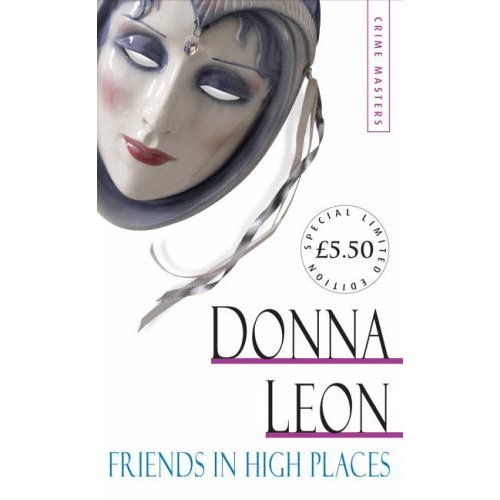
After reading two stinkers, I needed a read I could rely on for a good fix. I needed escape, mixed with good food, good clothes and some social awareness. I needed Guido Brunetti, Donna Leon’s Venetian detective, and his smart, savvy wife Paula, and his family meals of pasta with soft shell crabs and risi e bisi, his children, his disgust for the politics that impinge on his doing his job.
If you think Kuwait has “wasta” (doing business by connections, influence, calling in favors), you aint’ seen nuthin’ till you’ve seen how Byzantine Venetians operate.
Friends in High Places opens with Commissario Brunetti lying on his couch re-reading Anabasis when he receives a visit from a building inspector, who determines that the apartment he owns, on the very top of a building in Venice, was probably built illegally – there are no plans or restoration approvals on file at the bureaucracy regulating residential buildings in Venice – and may have to be torn down.
Wouldn’t that be a shock? It’s a shock to Brunetti and to his family, just as it would be to us. We learn all the ins and outs of housing codes, the impact of becoming part of the EEC, and how the clever Venetians devise ways around the codes, all while Brunetti is investigating one murder – and then three other murders.
It is a VERY satisfying book. I will share with you a lengthy quote from Friends in High Places as Guido and Paola discuss how to deal with the problem:
At no time did it occur to him, as it did not occur to Paola, to approach the matter legally, to find out the names of the proper offices and officials and the proper steps to follow. Nor did it occur to either of them that there might be a clearly defined bureaucratic procedure by which they could resolve this problem. If such things did exist or could be discovered, Venetians ignored them, knowing that the only way to deal with problems like this was by means of conoscienze: acquaintances, friendships, contacts and debts built up over a lifetime of dealing with a system generally agreed, even by those in its employ, perhaps especially by those in it’s employ, prone to the abuses resultant from centuries of bribery, and encumbered by a Byzantine instinct for secrecy and lethargy.
I am sorry to tell you that the only copy of this I could find on Amazon.com cost $99.98. I must have bought this one in England, where, I promise you, it was the normal cost of a paperback book.
I will warn you in addition, I was looking forward to reading a second Leon novel, Quietly in their Sleep, only to discover when I started that I had already read it, as The Death of Faith. The books published by Leon in England are often retitled for the American market. Leon fans, beware!
Recent Comments
ExpatAlien on What Country am I Living … intlxpatr on Yellowstone: Old Faithful to C… Michelle on Yellowstone: Old Faithful to C… Cathy on No Grown-Ups in Charge intlxpatr on Waiting for Snow Wikipedia Donate Button

Amazina


Early Voting in Florida


 Here There and Everywhere