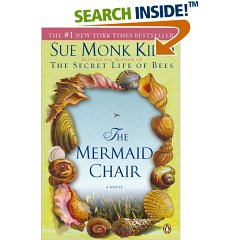
Sue Monk Kidd: Mermaid Chair
It took me a long time to buy this book, and an even longer time to read it. I kept reading the description, and I didn’t like it at all. But it kept popping up on the “recommended for you” list on Amazon, and I had this inner feeling that I was meant to read it, even if I didn’t particularly care to.
After treating myself to Leon and Bowen, I thought now was the time.
At first I found The Mermaid Chair a little Anne Rivers Siddon-ish – and I like Anne Rivers Siddons, and I don’t like imitations, which this felt like. And I thought to myself “Anne Rivers Siddons does it better.”
I kept reading, though. The book was intriguing, and I wanted to know what happened next.
Sue Monk Kidd wrote another book I really liked called The Secret Life of Bees in which I learned a lot about bees, and found the story wonderfully redemptive.
Sue Monk Kidd and Anne Rivers Siddons also share a love of the mystical, and the mystical in religion, and the mystical in human relationships, and the mystical in the sisterhood of women, all of which I find fascinating, and parts of which I would like to believe myself.
In this book, there is a lot going on. The main character is feeling stagnant and small, and invisible in her marriage. Her daughter has left for college, and she is oddly unable to find things in life to interest her. Then, her mother cuts off her finger, her mother’s friends call her to come to Egret Island, and she finds herself suddenly caught up in a whirlwind of emotions and torments that she can barely understand.
She has avoided returning to her Egret Island home to avoid the pain of her father’s death when she was 12, and her mother’s decent into moodiness and madness. She returns, meets a monk and falls in love, copes badly with her mother’s demons, and fights her way through her own personal crisis.
Sue Monk Kidd makes it all work. The work floats with artistic references; Gaugain, Matisse, Chagall, their mysterious, delightful women in particular float throught this book in Mermaid guises, and our heroine, Jessie Sullivan, discovers her own mermaid-within.
I won’t say that this is the best book I have ever read – it isn’t. I will say that I loved reading it. I loved the feel of living on Egret Island, with the tides and the birds and the small town friends, the local dog, the raininess and windiness of it all. I feel like I was there. I know the graveyard, I know the winding paths, I know those little golf carts everyone uses to get around. I know what it’s like to have to take a ferry to get to the mainland, I know the tidal currents of life’s more overwhelming moments.
As our Jessie binds her marriage back together, she says this:
Each day we pick our way through unfamiliar terrain. Hugh and I did not resume our old marriage – that was never what I wanted, and it was not what Hugh wanted either – rather we laid it aside and began a whole new one. Our love is not the same. It feels both young and old to me. It feels wise, as an old woman is wise after a long life, but also fresh and tender, something we must cradle and protect. We have become closer in some ways, the pain we experienced weaving tenacious lines of intimacy, but there is a separateness as well, the necessary distance. . . . .
I tell him, smiling, that it was the mermaids who brought me home. I mean, to the water and the mud and the pull of the tides in my own body. To the solitary island submerged so long in myself, which I desperately needed to find. But I also try to explain they brought me home to him. I’m not sure he understands any more than I do how belonging to myself allows me to belong more truly to him. I just know it’s true.”
This is a good read. It’s worth its reputation, it’s worth picking up and reading through. While some might think it’s very much a chick book, I suspect men reading it might also find a lot with which to identify. You can find this book at Amazon.com (disclosure: yes, I own shares in Amazon) for about $11.20.
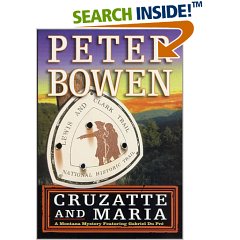
Bowen: Cruzatte and Maria
Peter Bowen’s tales of Montana in transition are an acquired taste. When I first started reading them, at my sister’s recommendation, I had a hard time getting past the dialect. The main character, Gabriel DuPre, speaks English differently; he is Metis, a mixture of French, Indian and who knows what, here before America was America, as he says “long time gone.”
You get used to it. It still makes me think he should be in New Orleans, speaking as he does, it sounds very Cajun, but you get used to it.
Peter Bowen’s Gabriel DuPre is another treat to myself (like Donna Leon.) Reading the latest book I bought, saved for just this time, a cold wintery January, brightened my outlook considerably.
The first book I read, Wolf, No Wolf had to do with environmentalists putting wolves back into the mountains where once they had flourished, but where now, for a couple centuries, people have been raising cattle. Guess what? Hungry wolves love cattle. It makes for some very hostile feelings.
That theme – local culture against intruding environmentalists – continues in this book, where DuPre is hired as a consultant on a film being made about Lewis and Clark. The locals in the Coronado area are no happier with all the film crews and tourists than the ranchers were with the wolves – and people end up dead.
In addition, DuPre’s friend Benetsee and his daughter Maria spend time together in the sweat lodge, and later, his daughter, Marie, sees a mound and is revisited by a vision she had. She tells her dad, DuPre, to dig, and he uncovers a trove of treasures cached by the Lewis and Clark expedition. Partly, it is the incursion of the spiritual and supernatural that I find so intriguing in these books; there is a reality, and then a greater reality, and they co-exist. Bowen makes it seem and feel entirely natural. I love it.
The book has some highly entertaining, laugh-out-loud moments, takes great pokes at the eco-tourist, and at the same time deals with some serious issues. We get to hear DuPre fiddle his old Voyageur songs, we get to hear what people are saying at the local bar, where cheeseburgers are the plat du jour. It is a great way to pass a winter’s day.
Leon: Friends in High Places

After reading two stinkers, I needed a read I could rely on for a good fix. I needed escape, mixed with good food, good clothes and some social awareness. I needed Guido Brunetti, Donna Leon’s Venetian detective, and his smart, savvy wife Paula, and his family meals of pasta with soft shell crabs and risi e bisi, his children, his disgust for the politics that impinge on his doing his job.
If you think Kuwait has “wasta” (doing business by connections, influence, calling in favors), you aint’ seen nuthin’ till you’ve seen how Byzantine Venetians operate.
Friends in High Places opens with Commissario Brunetti lying on his couch re-reading Anabasis when he receives a visit from a building inspector, who determines that the apartment he owns, on the very top of a building in Venice, was probably built illegally – there are no plans or restoration approvals on file at the bureaucracy regulating residential buildings in Venice – and may have to be torn down.
Wouldn’t that be a shock? It’s a shock to Brunetti and to his family, just as it would be to us. We learn all the ins and outs of housing codes, the impact of becoming part of the EEC, and how the clever Venetians devise ways around the codes, all while Brunetti is investigating one murder – and then three other murders.
It is a VERY satisfying book. I will share with you a lengthy quote from Friends in High Places as Guido and Paola discuss how to deal with the problem:
At no time did it occur to him, as it did not occur to Paola, to approach the matter legally, to find out the names of the proper offices and officials and the proper steps to follow. Nor did it occur to either of them that there might be a clearly defined bureaucratic procedure by which they could resolve this problem. If such things did exist or could be discovered, Venetians ignored them, knowing that the only way to deal with problems like this was by means of conoscienze: acquaintances, friendships, contacts and debts built up over a lifetime of dealing with a system generally agreed, even by those in its employ, perhaps especially by those in it’s employ, prone to the abuses resultant from centuries of bribery, and encumbered by a Byzantine instinct for secrecy and lethargy.
I am sorry to tell you that the only copy of this I could find on Amazon.com cost $99.98. I must have bought this one in England, where, I promise you, it was the normal cost of a paperback book.
I will warn you in addition, I was looking forward to reading a second Leon novel, Quietly in their Sleep, only to discover when I started that I had already read it, as The Death of Faith. The books published by Leon in England are often retitled for the American market. Leon fans, beware!
Berry and The Alexandrian Link
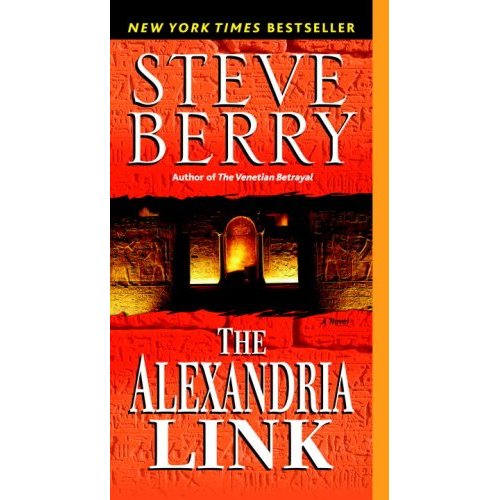
On his way back from a recent trip, AdventureMan bought a book in an airport, which he read and then asked me to read. Here is what he said:
“It’s not a great book, but I don’t know why I say that. It has an interesting idea and I want to know what you think.”
So just after I finished Inheritance of Loss I started in with this book, and it was the second book I will not recommend to you.
It is wooden. The characters are about a millimeter deep. The plot is unbelievable and doesn’t make sense and doesn’t hang together. It is full of adventure and travel and shoot-outs, which our “hero” miraculously comes through without a scratch while all around him his foes are dropping like flies.
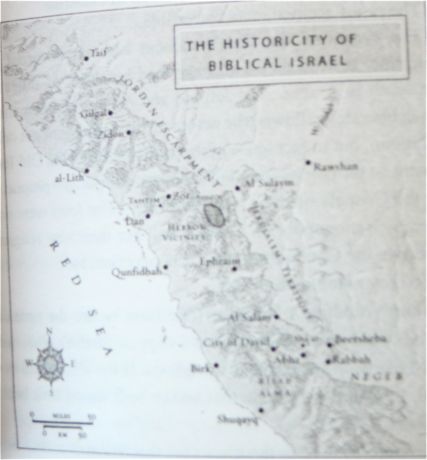
It DOES hinge on an interesting theory, one I had never heard before. There is a Lebanese historian and archaeologist, Kamal Salibi, who published a book called The Bible Came from Arabia. In this book Salibi makes his case for the “holy land” which was given to Abraham not being in Palestine at all, but rather in what is currently Saudi Arabia, along the western coast. He uses the utter lack of archeological findings in current day Israel/Palestine which support biblical accounts, and the plentitude of place names in the Asir region which closely resemble what the place names would have looked like and sounded like in ancient Hebrew, the language of the earliest biblical times.
The book, and the theory was, of course, controversial. If the contentions were true, it would undermine the foundation of the state of Israel in Palestine; it would mean that people have been fighting for the last 60 years over the wrong piece of land.
Here is a (very bad) photo of the map in the book which shows where Salibi believes the biblical cities were actually located. He believes “Jerusalem” was not a city, but an area within which were several cities. He believes “the Jordan” was not a river, but a mountain range, and that here, also, Moses and his refugees from Egypt wandered.
Unless you really love reading badly plotted books with cardboard characters, I would not recommend reading The Alexandrian Link. As a jumping off point for an interesting line of research – AdventureMan was right; this book gives you something new and different to contemplate.
The Door Into Summer
We had a cat, a street cat from Tunisia, named Cinnamon. I had taken our son to see a movie and when I got home, my husband looked funny. You know, a wife can tell. I said “what’s up?” and he gave me those big innocent Bambi eyes that tell you for SURE something is fishy, and he said “Nothing!”
Just then, we could hear loud loud miowing at the back door, the kind only a kitten can make, the kind that attracts attention. We went to the back door and there was this tiny little kitten, barely old enough to be away from her family, and she is stuck between the screen door and the back door.
“How very strange!” I said, looking accusingly at AdventureMan, who continued to try to look innocent.
“She looks cold!” he said. “Maybe we had better bring her in!”
Later he confessed, he has found her wandering around alone, wet and miowing in our backyard and had been feeding her while we were at the movie, then put her in the back door so we could “discover” her. He wanted to keep her. We already had one big cat, but we had wanted another, and here she was.
She was my Door into Summer cat. She still had all her wild instincts, even though we adopted her at such a young age. Once, in Germany, I found a dead hare on my steps, with it’s throat torn out, an offering from Cinnamon – but the hare was at least twice her size! She was always bringing us offerings of a dead nature; she was a born huntress. One time when AdventureMan got out of bed, he stepped on what he thought was a rolled up sock, but it moved! It was a badly wounded mouse!
Cinnamon hated winter. We lived in a house with a lot of doors, and when it would snow, she would go from door to door, asking us to open so she could go out. When the bitter cold with the biting wind would hit her face, she would back into the house and head for the next door – always looking for the door she remembered, the one which led out into summer.

moar funny pictures
I used to read a lot of Robert Heinlein. His books are SO politically incorrect, so sexist, he was an old engineer, but man, could he write. His writing takes you WAAAYYY out of the here and now, and makes you stretch to think in new ways.
He wrote a book called Door into Summer, in which he wrote about another cat:
“…While still a kitten, all fluff and buzzes, Pete had worked out a simple philosophy. I was in charge of quarters, rations, and weather; he was in charge of everything else. But he held me especially responsible for weather. Connecticut winters are good only for Christmas cards; regularly that winter Pete would check his own door, refuse to go out it because of that unpleasant white stuff beyond it (he was no fool), then badger me to open a people door. He had a fixed conviction that at least one of them must lead into summer weather.”
The Door into Summer – Robert A. Heinlein
You can read about Robert Heinlein on Wikipedia and you can find many of his books still in publication on amazon.com.
Inheritance of Loss
Most of the time, if I don’t like a book, I won’t even bother telling you about it. This book, The Inheritance of Loss, by Kiran Desai, is an exception for one reason – it IS worth reading.
Inheiritance of Loss showed up on the book club reading list for the year, and I ordered it. I read the cover when the book came, and it didn’t sound that good to me, so I read other books instead. The next time it came to mind was when a friend, reading the book, said she was having trouble with it, and asked me if I had started it. This friend is a READER, and a thinker. It caught my attention that she would have problems reading a book, so I decided to give it a try.
This is a very uncomfortable book. The characters live in the shadow of the Himalayan mountains. The most sympathetic character is a young orphaned girl, sent to live with her grandfather. With each chapter, we learn more about all the characters, how they came to be here, what they think, what their lives have looked like.
The author of this book has a very sour look on life. She has snotty things to say about every character. You can almost feel her peering around the corner, eyes slit with evil intent. She is that vicious neighbor who comes by and never says anything nice about anybody, and when you see her talking with your neighbor, you get the uneasy feeling she could be saying something mean about you, and she probably is.
The book covers a wide range of topics – Indian politics, Ghurka revolts, English colonization, Indian emigration to the US and UK, everyday vanities and pride in petty things, how people destroy their own lives, how people can be cruel to one another, oh it’s a great read (yes, that is sarcasm).
At the same time, this vicious unwelcome neighbor has a sharp eye for detail. You may not like what she is telling you, but you keep listening, because you can learn important tidbits of information from her. In my case, I learned a lot about how life is lived in a small mountain village in India, the struggles of illegals in America and how class lines are drawn, ever so finely, when people live together. I learned a lot about the legacy of colonialism, and the creep of globalization. This unwelcome neighbor has a sharp tongue, always complaining, and yet . . . some of her complaints have merit.
I don’t believe there was a single redeeming episode in the book. There was not a paragraph to feel good about. I am glad to be finished with the book – but, yes, I finished it, I didn’t just set it aside in disgust, or give it away without finishing.
Here is the reason I am telling you about this book – as uncomfortable as this book is to read, I have the feeling, upon finishing, that ideas and images from this book will stick with me for a long time. I have the feeling that it contributes to my greater understanding of how things work, how people think differently from other people, and on what levels we are very much the same.
Here is an excerpt from the book, at a time during which the Judge is a young Indian, studying in England:
The new boarding house boasted several rooms for rent, and here, among the other lodgers, he was to find his only friend in England: Bose.
They had similar inadequate clothes, similar forlornly empty rooms, similar poor native’s trunks. A look of recognition had passed between them at first sight, but also the assurance that they wouldn’t reveal one another’s secrets, not even to each other.
. . . Together they punted clumsily down the glaceed river to Grantchester and had tea among the jam sozzled wasps just as you were supposed to, enjoying themselves (but not really) as the heavy wasps fell from flight into their laps with a low battery buzz.
They had better luck in London, where they watched the changing of the guard at Buckingham Palace, avoided the other Indian students at Veeraswamy’s, ate shepherd’s pie instead, and agreed on the train home that Trafalgar Square was not quite up to British standards of hygiene – all those defecating pigeons, one of which had done a masala-colored doodle on Bose. It was Bose who showed Jemubhai what records to buy for his new gramophone: Caruso and Gigli. He also corrected his pronunciation: Jheelee, not Giggly. . . .
This it was that the judge eventually took revenge on his early confusions, his embarrassments gloved in something called “keeping up standards,” his accent behind a mask of a quiet. He found he began to be mistaken for something he wasn’t – a man of dignity. This accidental poise became more important than any other thing. He envied the English. He loathed Indians. He worked at being English with the passion of hatred and for what he would become, he would be despised by absolutely everyone, English and Indians both.
I consider this a review, and not particularly a recommendation. I read the book, I finished the book and I learned from the book. I didn’t like the book. I recommend it only as a challenge, for people who like to read and stretch their minds in new directions.
Michael Malone: Handling Sin

Have I told you (only a hundred times?) that our family loves books? We buy them, we discuss them, and we pass them around. The one I am about to review came from my son, who got it from the wife of his wife’s father. Heee heee heeee, figure that one out!
Have you ever read A Confederacy of Dunces by John Kennedy Toole? As soon as you start reading Handling Sin, you get the same impression; this book is whacky, and will probably be an underground cult favorite. The author of Confederacy of Dunces, John Kennedy Toole, committed suicide – or so we are supposed to believe. I am not so sure. Handling Sin sounds SO like it, and they both heavily feature New Orleans.

Right off the top, this books starts out weird and keeps right on going. It opens with our hero, Raleigh Whittier Hayes at a Civitan (social and civic works group, kind of like diwaniyya) meeting at the local Chinese restaurant in Thermopylae, North Carolina, where his fortune cookie at the end of the meal says “You will go completely to pieces by the end of the month.” Raleigh sells insurance, he runs and watches what he eats because most of his family gets diabetes; and Raleigh likes order. When we meet Raleigh, he’s not all that likable.
His dying father takes off, leaving a message for Raleigh that he needs to do seven (crazy-sounding) tasks and meet him in New Orleans at a specific date and time, having accomplished these tasks, otherwise he won’t go back to the hospital for his cancer treatments.
His big fat best friend, Mingo Sheffield, insists on coming along. His wife, Aura, just laughs and tells him he needs to loosen up a little when he starts complaining about his Dad’s quest, and begins her campaign for mayor. His nice, safe structured little universe is flying apart, his twin teen-age daughters are out of control, reality as he knows it has just taken a big crunching shift and Raleigh is out of his element.
Perfect! It’s those times of maximum discomfort that we begin to achieve our maximum potential, isn’t it? If we stay in our safe little world, we aren’t challenged to grow, to think new thoughts, to see things from another perspective.
Handling Sin has a series of events that are at the same time heart warming, serious, and side-splittingly funny. I laughed out loud so many times reading this book, as our hero and his friend and all those he picks up along the way find themselves in the most outrageous and unlikely adventures, and learn what they are capable of (OK, for all you grammarians, do not end your sentences in a preposition, do as I say, not as I do!) I would not be at all surprised if this book were made into a movie, it is so much fun. As you rock along, Malone also deals with serious health issues, racial issues, family issues, political issues and law and order. You laugh, you cry, you learn a little and you laugh again. It’s a great read.
This was my back-up book on my flights back to Kuwait, and worth the weight – it’s a kind of big book. AdventureMan can hardly wait to get into it; he had started it but allowed me to read it while he caught up with his jet lag. Who knows who we will pass it along to when he finishes? It’s that good!
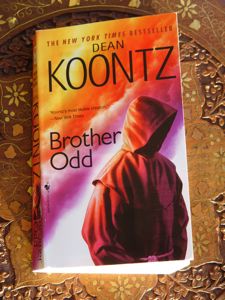
Brother Odd: Dean Koontz
I’ve always liked Dean Koontz; he knows how to be compassionate and funny at the same time. When I showed books I had bought, my long-time friend Momcat said “Oh, you’re going to like that book!” and oh, how right she was. I like it so much that now I have to go back and buy the previous ones to catch me up.
The main character, whose name, to his embarrassment, is Odd Thomas, has secluded himself in a monastery in search of spiritual peace. Or was he brought here for another reason? Odd Thomas has some very odd gifts; he can see the undeparted dead, for example, and he can sense things that normal humans can’t. You would think these would be very cool talents, but Odd is in his early twenties, and his talents only serve to isolate him and make him feel a little alien.
The monastery / nunnery is a good place for him, full of very human monks and nuns, some of them very wise and very compassionate, as well as competant. It’s a good place for Odd Thomas, a healing place and a place where his strange gifts are protected by his spiritual cohabitants. The monastic life attracts a lot of people trying to put their pasts behind them to seek spiritual goals, and also attracts those with their own agendas.
The monastery is well endowed, and contains a special school for young people who have physical and/or mental disabilities. Some can learn enough to return to society, and some will probably spend the rest of their shortened lives under the safety and care of the nuns – until, all of a sudden, a threat appears, directed at the children.
Dean Koontz writes interesting books. He often includes benign animals, he often focuses on threats to women and children, and while his books are not difficult to read, neither are they something you read and easily forget. Both AdventureMan and I read an earlier Dean Koonz book, Watchers, to which we have often referred through the years, as one of his characters ends up homeless and living in a car with her son. She talks about money just giving you more options, and about those who are one paycheck away from homelessness. It was an easy read, but he includes some tough ideas, things you find yourself mulling over even years later. That’s a good read in my book!
The only problem with this book was that it was so good I finished it in one flight. Good thing I had packed a back-up book in my carry-on!
Books on my To Do List
You’ve seen the books stacked next to my bed. I read constantly, but the stacks never seem to diminish. Maybe because I have an addiction – I buy books faster than I can read them.
Here are some of the new acquisitions to my “read me” stacks:

They all look so good, I don’t know where to start.
Not Your Kuwait Book Store
Killing time waiting for Adventure Man to arrive. I always save Barnes and Noble for a special treat. If I go too soon, my bag is full of books, and no room for anything else. B&N is my incentive to get all my business taken care of – my special reward.
I love the bestseller, new hardcover and new paperback sections, where I can get a quick overview of what is hot.

Gregory Maguire’s Wicked is out in a new paperback format; while it first came out about ten years ago, it is as delightful now as it was then. It is the Wizard of Oz story, retold from the point of view of the Wicked Witch of the West, a radical reformer who got bad press. It was also made into a Broadway musical that ran for years. Well worth bringing out for a new generation of readers.

Recent Comments
Kitchen on Isiais: Winding Down intlxpatr on Shampoo Ginger tigerbutterya0c5ff1d… on Shampoo Ginger intlxpatr on British Soldier Kidnapped, Esc… John on British Soldier Kidnapped, Esc… Wikipedia Donate Button

Amazina


Early Voting in Florida


