Ken Follett and World Without End
Oprah has just chosen the predecessor to this book, Pillars of the Earth, as her monthly book club choice. I am so glad! Ken Follett and I have a very mixed relationship; I used to think he was brilliant, and then he wrote one book that just disgusted me so much I stopped reading him altogether until he wrote Pillars of the Earth, which has to do with the building of the very first cathedrals in Europe. It was one of those books that you hated to have it end, and you remember years later.

World Without End follows up Pillars of the Earth. We follow the lives of several people we meet as they are children, and we discover that their lives are intertwined in intricate ways. Two of the characters, Caris and Merthin, love one another from childhood, and we wonder throughout the book if they will ever find a way to be together. Merthin is a builder, descending from the main character of Pillars of the Earth, and shares his way of being able to look at problems from a new perspective and build in new ways based on stepping outside the box to solve problems.
Ken Follett is good at describing the lives of his characters in the 1300s, as farmers try to survive the rainy summers and crop damage, as laborors become independant from the abuses of feudal overlords, as the plague strikes rich and poor alike, as spiritual leaders cope with the demands of daily life and needs. We learn about the living conditions in England in the 1300’s, we learn about the early trade guilds and merchant guilds, we learn how disasters can be an impetus for social and political change, we learn how women used what little control they had over their own lives to their advantage. World Without End is a book rich in texture, sensually layered and visually vivid.
I have a strong feeling that people are pretty much people, and that we haven’t changed too much over the centuries. We HAVE made some advances, we have carved out rule of law, and ways for communities and nations to function together in relative peace, but I still feel that some of the interactions between men and women have a feeling that is too modern. I could be wrong. A few of the the scenes just didn’t ring true to me; it was as if modern people were transposed back to the 1300’s and thinking in modern ways, and it just seemed . . . well, I guess anachronistic!
Mr. Plopper
The plane was filling up fast, but so far, so good – the seat next to me is empty! I can tell that the cabin crew is getting ready to fly – they have started closing up all the bins. I’m afraid to even hope that I will have the serenity of an extra seat, the space, the silence – it’s a very long flight.
“I was hoping this seat would be free!” says a long, tall man who has just plopped himself into the empty seat next to me. I didn’t pay for that seat, it isn’t MY seat, but neither am I feeling particularly friendly to this very tall man who sat himself down so emphatically next to me, and then FLUFFED himself up so that he is everywhere!
His shoes are over on my side, so while he is busy shaking his paper noisily (more fluffing) I quickly scoot them back on his side with my feet. He is leaning over into my seat and OUR SHOULDERS ARE TOUCHING and he isn’t apologizing or moving back away or anything, I guess I have lived in Kuwait for too long but this is a STRANGE MAN and his shoulder is over the arm rest touching my shoulder!
Just in the nick of time, I discover I have one of those slipping-back seats, where you put it in the old “full upright position for take-off” but it won’t stay there, it keeps slipping back, although not too far; the seats don’t seem to be able to go back farther than five inches or so, even when broken. Anyway, for the next ten hours, every time that shoulder encroaches back into my space I hit the button that brings the seat back up with a jolt, hitting his shoulder and reminding him to keep to his own seat.
All this is done without raising my eyes from my book.
This man desperately wants my attention. He has discovered his shoes, back under his own feet, and he gives a deep, disturbed sigh. You can kind of tell that this guy arranges the universe to suit himself, and he is not used to being crossed.
He leans across me and shuts the window shade and says “I am going to be using my laptop and this creates a glare,” and I lean over and open it back up about three inches and say “and I am using it for reading, so we will have to compromise.”
He says “you can use the light” and I reply “and you can turn your laptop” and I give him a huge, insincere smile, the kind with your mouth closed and sort of tight. I am sending a strong strong message – don’t screw with me, buddy. I can’t keep you from sitting here, but you are not going to encroach on ME.
I ignore his deep sighs, which continue every time I press that button to hit his encroaching arm.
I ignore whatever it is on his laptop. I think I am supposed to look and understand that he is an important man, but here it is – I don’t care. I don’t care. I don’t care. You can sit in that seat; I can’t stop you, but I don’t have to interact with you and I don’t have to share my space with you.
It’s a great book. Ken Follet’s new book, the follow up to Pillars of the Earth, called World Without End.
When I finish my book, I sleep for a couple hours so I arrive in Seattle rested enough to pick up my rental car and drive through Seattle. In Kuwait, KLM was kind enough to put big PRIORITY tags on my bags, which, we all know, means “take these bags off the plane last of all” so it took me a while to get through the airport.
It is, once again, L’heure bleu a la Seattle. It may be four in the afternoon, but it is raining and dark, and traffic is slow enough on the interstate heading north that I can even take (very carefully, of course) a couple shots to share with you the thrill of coming into Seattle in November:
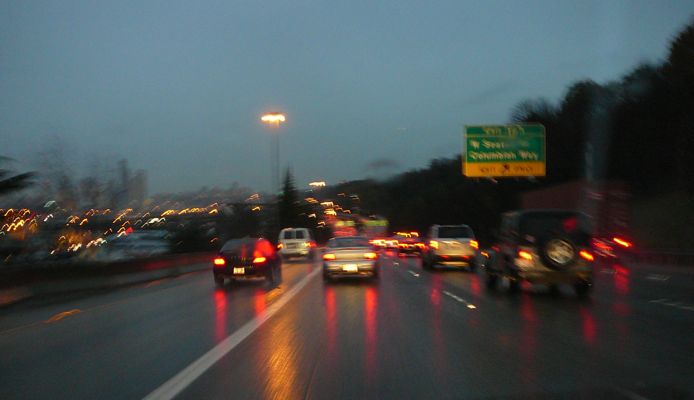
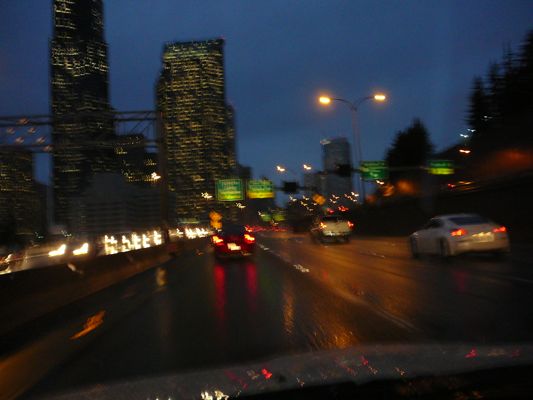
Kinda different from L’heure blue in Kuwait, hmmmm? 😉
Tareq Rajab Museum of Islamic Calligraphy
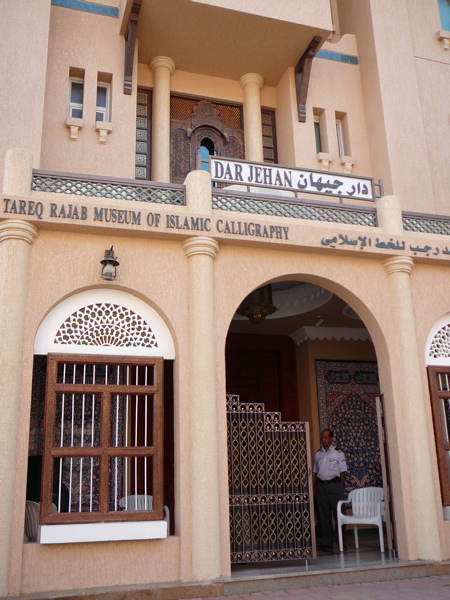
One of the most beautiful buildings in Kuwait is the new – open only since March – Museum of Islamic Calligraphy in Kuwait. I am in total awe of this family, who have an eye for the history and culture of this area, collect it lovingly, and then display it – free of cost – to all who wish to visit.
The TR Museum of Islamic Calligraphy is on the same street as the Dar al Cid, where many art exhibits are held, also under the auspices of the Tareq Rajab family. It is around the corner from the Tareq Rejab Museum.
It is open every day:
Mornings 9 am – 12 noon
Afternoon 4 pm – 7 pm
Friday 9am – 12 noon
We visited recently. The museum is beautiful, and well organized. We wished only that more of the exhibits had explanations; sometimes we would be looking at something very beautiful, but we didn’t know the significance of what we were seeing.
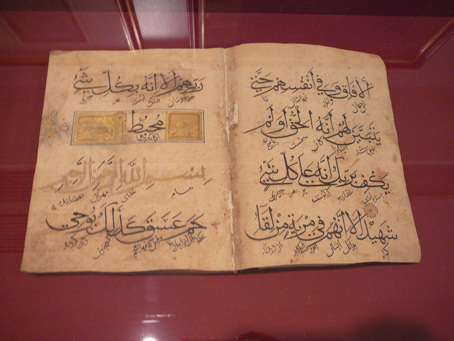
The calligraphy is manifest in hangings, ancient Qurans, quiltings, posters and carved wood. Each item is a work of art. We were fascinated by some of the Chinese calligraphy, and by the video they run showing how calligraphic quills are made, how the paper is prepared, even how the calligrapher prepares for work.
This is the entry to the Museum of Islamic Calligraphy:
Some examples of the beautiful works on display:


If you are looking for books about Kuwait, and/or Islamic Arts, the Tareq Rajab Museum has a well stocked little shop with books, cards, postcards, etc. for reasonable prices.
We take all our houseguests to these museums, and every time we go, we are moved by the generous hearts that create these museums and then offer them to the public – free of charge. They give so much to their community. It’s like a little piece of heaven. Visit soon!
Aimee Leduc: Murder in the Marais
Not every book can be one of the best books you ever read. Some books are so good, so filled with nuance, insights and subtleties that even if they are made into a movie, they can’t begin to capture the experience of having read the book.

(available from Amazon.com at $10.40 new and from $1.97 + shipping used)
This isn’t one of those. As I read this book, as I followed the main character, Aimee LeDuc, through the streets of Paris, solving the mystery of who is killing Jews who survived the Holocaust – and why – I kept thinking “this is like reading a made-for-TV movie, you know, the ones that went almost straight to video/DVD?”
I was intrigued when Amazon recommended this series to me, but not surprised – remember, I read Donna Leon, James Lee Burke, and have a history of buying mysteries and detective stories set in exotic locations. But I only ordered one, to test the waters.
There isn’t a lot of depth. The author, Cara Black, gives her main character Aimee LeDuc about as much substance as a cartoon character. She changes clothes a lot, she has very interesting friends, she is smart, and sassy, and savvy, and more than a little edgy. And . . . I kept reading. I even think I will buy another one, just to see. I’m not enamored, but . . . I am intrigued, mildly intrigued, intrigued enough to give it another shot.
There is something about the book that keeps me reading. Could it be the Paris setting? 🙂 Could it be the gritty reality of Aimee’s interactions? Could it be that her shallowness is deceptive, and that if I read more books in the series I will understand her better? Could it be her amazing cast of characters, including her partner, a computer-savant-dwarf?
She includes a lot of Paris-reality. Aimee’s apartment has serious heating problems, and she often takes a hot bath just to warm up – as long as the hot water lasts. In her Paris it rains. In her Paris, dealing with the bureaucracy, while not particularly corrupt, is endlessly frustrating. Her Paris is peopled with people a whole lot like us, warts and all. For me, this is a plus.
Cara Black is a little skimpy on motivation; the plot reminds me of The DaVinci Code, it doesn’t really hang together all that well. In spite of all that, I found myself enjoying riding through Paris in the rain on a little mo-ped, crashing through the back of the Issa Miyake showroom and grabbing some items from the bin to disguise me as I escaped, and grabbing a croissant here and there, smelling the Tarte Tatin from the alleyway . . . I did not enjoy the fight on the slick tiles of the Paris rooftops at all.
If you like mysteries, you need to get acquainted with Cara Black’s Aimee LeDuc, just to be able to have an opinion when another detective-loving-book-reader asks. If you already have stacks of books waiting to be read – this is a good one for reading in airports while waiting for a delayed flight.
(Side Note: The Marais is the old Jewish Quarter of Paris, and it is in the process of serious gentrification. There is an old post-card and poster store located there, with items to die for – at prices to match. It is also near the Musee Carnavalet, probably one of the best museums in Paris.
Hôtel Carnavalet
23, rue de Sévigné
75003 Paris
Standard : 01 44 59 58 58
Fax : 01 44 59 58 11)
Picoult and My Sister’s Keeper
I don’t know where I got the idea that Jodi Picoult wrote girly books, maybe because when you go to a bookstore there are so many of them? I just assumed they were romance and passed right by until several months ago, in a small used book store, I found one that was in the book club section, and those are usually pretty good reads. I bought it, but put off reading it, assuming it was an easy read, maybe I would read it on an airplane one day.
For some reason I moved it up, maybe I had heard a review or something. It moved to the bedside group, the “in line for immediate reading” group. At a time when we were particularly busy, I finished my other book and this was next, and I thought “Oh well, yes we are busy, but this will be light reading.”
I couldn’t have been more wrong.
This book, My Sister’s Keeper, is not light reading. It is a book a lot like We Need To Talk About Kevin one of the most terrifying and unforgettable books I have ever read. It is a book about motherhood, and parenting and tough choices. It is a book about how sometimes your entire life is yanked, and all the focus is on one area, to the detriment of others. It is a particularly tough book if you are a mother.

The main character, Anna, was conceived so that her stem cells, from the umbilical cord, will be used to help her sister, Kate, who has leukemia. Family life is chaotic, to say the least, as the vigilant parents’ attention is constantly on Kate, who suffers frequent relapses.
Picoult uses the voices of Anna, Kate, Jessie – the brother, a pyromaniac, Brian (the father), Sara (the mother), Campbell (Anna’s lawyer) and Jesse (Anna’s guardian ad litem) to tell the story.
Anna has approached Campbell, a lawyer, to achieve medical emancipation. She loves her sister, she has shared a room and her entire life with her sister, she has given stem cells, she has given bone marrow, she has been through several medical procedures to keep her sister’s cancer in remission, but at 13, she balks when expected to give one of her kidneys is a last ditch attempt that even the doctors have little expectation will succeed. She hires a lawyer.
Sara is a mother you would love to hate. You would love to grab her by the shoulders and say “Pay attention! You have THREE children, and two of them need your attention, too!” but something holds you back, and that something is the serious doubt you have about how you would handle the same situation. In extreme circumstances, people make the best choices they can, and when you are in extreme circumstances day after day, things start to fray, and then they start to fall apart. This family is past the fraying part, and we hold our breaths hoping they won’t fall apart.
It’s not a hard read because of the technical terms; this is a book where a 13 year old knows all the vocabulary of cancer, and we learn it, too. It flows naturally in the book.
Kate has acute promyelocytic leukemia. Actually, that’s not quite true – right now she doesn’t have it, but it’s hibernating under her skin like a bear, until it decides to roar again. She was diagnosed when she was two; she’s sixteen now. Molecular relapse and granulocyte and portacath – these words are part of my vocabulary, even though I’ll never find them on any SAT. I’m an allogeneic donor – a perfect sibling match. When Kate needs leukocytes or stem cells or bone marrow to fool her body into thinking it’s healthy, I’m the one who provides them. Nearly every time Kate’s been hospitalized, I wind up there, too.
None of which means anything except that you shouldn’t believe what you hear about me, least of all that which I tell you about myself.
Aha! We are reading a book with an unreliable main character!
It is a hard read because we all have families, and we all face tough decisions. There is a part of us that says “thank God we are not in this situation” and another part that says “there but for the grace of God . . . ” It is a tough book because we don’t know who we will become when life-changing circumstances hit us, we don’t know what choices we would make, because we are afraid, and because we don’t want to find out.
There are some surprises, though, and you will want to keep reading. There is a lot of love here, in the cracks between the tragedies. My Sister’s Keeper has three sets of sisters, and a lot of focus on that very special relationship. The men, too, come off well at the end.
Not an easy read, but a book that will stay in your heart for a long time.
Iznik Tiles, God whispers . . .
OK, OK, now you are going to see my ditzy side. I remember my mother visiting, and I was telling her what my cat was saying. She gave me one of those long, considering looks, and then said “I hope you don’t talk this way in front of other people. They might think you are a little crazy.”
I guess we all have crazy thoughts, fantasies. I kind of think cats have a very simple kind of telepathy; they can, I think, pull images out of your head. They are simple creatures, but ones we don’t fully understand. Am I crazy for thinking that?
And that has nothing at all with this blog entry, except to warn you that sometimes I am not entirely rational, I can be fanciful.
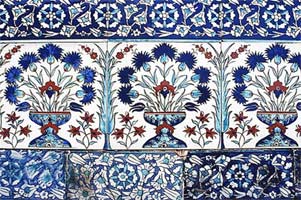
Two books in a row I have most recently read referred to Iznik tiles. The first was a Donna Leon book Death in a Strange Country where a woman who lives very frugally, even on the edge of poverty, sits in her run-down Venetian apartment surrounded by masterpieces of world art, including Iznik tiles.

The second book, which I just finished, is The Janissary Tree by Jason Godwin, in which his detective Yashim Togalu, a eunuch in the early post-Janissary Ottoman Empire, notes the Iznik tiles in the great receiving room of the Sultan.
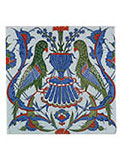
To me, when two books in a row refer to the same tiles I have never heard of, it is like a little whisper from God saying “look this up.” It may be that I don’t even need this information, maybe I am just supposed to pass it along to YOU! I don’t know.
I DO know I am glad I looked it up. I love blue and white. I love intricate, curved design. And oh WOW, I love Iznik tiles and pottery.
“In the late 16th century the tiles of Iznik incorporated new designs and new colors and Iznik immerged as the preeminent city for tile production in the Ottoman empire. A major part of the transformation had to do with the introduction of Persian designs rendered in a distinctly Ottoman style.” From Guide to Iznik Tile and Plates.
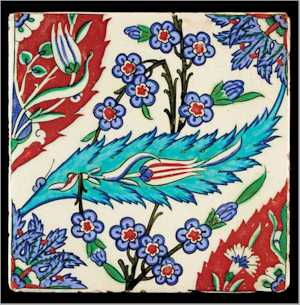
In case you want to know more, this is an excerpt from Nurhan Atasoy’s Article on Iznik Tiles:
The finest Iznik pottery was produced during the reign of Suleyman the Magnificent and up to the end of the 17th century.The tiles and other pieces were exuberantly decorated with hyacinths, tulips, carnations, roses, and stylised floral scrollwork known as hatayi, Chinese clouds, imbrication, cintemani (a design consisting of three spots and pairs of flickering stripes), and geometric patterns.
The Turkish Ministry of Culture proclaimed 1989 as Iznik Year, and numerous events and activities relating to Iznik pottery were held. Iznik has a special place in the history of Turkish art, and thanks to the efforts of Turkish Airlines and Turk Ekonomi Bankasi Iznik Year became Iznik Years. Researchers are continually discovering more about e beautiful type of ceramics, whose designs are enjoying a new wave of popularity.
And here is a source from which you can order your own Iznik tiles: Yurdan.com.
There is no socially redeeming value to this post. Only that I learned something, and discovered something which is, to me, breathtakingly beautiful. One source says Iznik tiles were made of quartz, which gave them a great elasticity when exposed to varying degrees of heat and cold, which I find fascinating in that today the hottest new countertops are done in quartz. I think Adventure Man and I need to visit Iznik, the ancient Nicea, and take a look, don’t you think? I would love to see more of these tiles, in person, maybe somewhere I could touch them. 🙂
Parting the Waters

We all know how Moses parted the Dead Sea to allow passage for the departing Israelites, but in today’s reading from the Old Testament, we are reminded that two other great prophets, Elijah and Elisha, were also able, with God’s help, to part the seas. This is from the Bible; does the Qur’an have a similar reading?
2 Kings 2:1-18
2Now when the Lord was about to take Elijah up to heaven by a whirlwind, Elijah and Elisha were on their way from Gilgal. 2Elijah said to Elisha, ‘Stay here; for the Lord has sent me as far as Bethel.’ But Elisha said, ‘As the Lord lives, and as you yourself live, I will not leave you.’ So they went down to Bethel. 3The company of prophets* who were in Bethel came out to Elisha, and said to him, ‘Do you know that today the Lord will take your master away from you?’ And he said, ‘Yes, I know; keep silent.’
4 Elijah said to him, ‘Elisha, stay here; for the Lord has sent me to Jericho.’ But he said, ‘As the Lord lives, and as you yourself live, I will not leave you.’ So they came to Jericho. 5The company of prophets* who were at Jericho drew near to Elisha, and said to him, ‘Do you know that today the Lord will take your master away from you?’ And he answered, ‘Yes, I know; be silent.’
6 Then Elijah said to him, ‘Stay here; for the Lord has sent me to the Jordan.’ But he said, ‘As the Lord lives, and as you yourself live, I will not leave you.’ So the two of them went on. 7Fifty men of the company of prophets* also went, and stood at some distance from them, as they both were standing by the Jordan. 8Then Elijah took his mantle and rolled it up, and struck the water; the water was parted to the one side and to the other, until the two of them crossed on dry ground.
9 When they had crossed, Elijah said to Elisha, ‘Tell me what I may do for you, before I am taken from you.’ Elisha said, ‘Please let me inherit a double share of your spirit.’ 10He responded, ‘You have asked a hard thing; yet, if you see me as I am being taken from you, it will be granted you; if not, it will not.’ 11As they continued walking and talking, a chariot of fire and horses of fire separated the two of them, and Elijah ascended in a whirlwind into heaven. 12Elisha kept watching and crying out, ‘Father, father! The chariots of Israel and its horsemen!’ But when he could no longer see him, he grasped his own clothes and tore them in two pieces.
13 He picked up the mantle of Elijah that had fallen from him, and went back and stood on the bank of the Jordan. 14He took the mantle of Elijah that had fallen from him, and struck the water, saying, ‘Where is the Lord, the God of Elijah?’ When he had struck the water, the water was parted to the one side and to the other, and Elisha went over.
15 When the company of prophets* who were at Jericho saw him at a distance, they declared, ‘The spirit of Elijah rests on Elisha.’ They came to meet him and bowed to the ground before him. 16They said to him, ‘See now, we have fifty strong men among your servants; please let them go and seek your master; it may be that the spirit of the Lord has caught him up and thrown him down on some mountain or into some valley.’ He responded, ‘No, do not send them.’ 17But when they urged him until he was ashamed, he said, ‘Send them.’ So they sent fifty men who searched for three days but did not find him. 18When they came back to him (he had remained at Jericho), he said to them, ‘Did I not say to you, Do not go?’
Donna Leon: Wilful Behavior
You think Donna Leon is writing about one thing, and then you discover it is about something else entirely. It seems to happen often in that line of work – you see the same thing on Law and Order, and Cold Case, and The Wire – what initially seems like a straightforward crime had depths and switch-backs unfathomable from the initial crime scene.
In Wilful Behavior, Paula, Brunetti’s wife, has just about had it with her university level students. They have no yearning for knowledge and insight, they are rife with materialism, she is feeling burned out and cynical. One student, who bucks the trend, comes to talk with her, and then Brunetti about the possibility of a post-mortem clearing of a person’s name, but she won’t give the name of the person or the crime that person committed. Before Commissario Brunetti has begun to plumb these depths – the student is murdered.
It’s always depressing when a young person dies. You can’t help but think of how treasured they were, how full of potential, and all that is gone now, wasted. A light in the world has gone out, and you grieve for how brightly that light might have shown. Brunetti and his wife only knew the murdered girl briefly, but her murder strikes them deeply.
Here is an excerpt from Brunetti’s discussion with the student before she was killed:
“I didn’t know young people even knew who Il Duce was.” Brunetti said, exaggerating, but not by much, and mindful of the almost total amnesia he had discovered in the minds of anyone, of whatever age, with whom he had attempted to discuss the war or its causes. Or worse, the sort of cock-eyed, retouched history that protrayed the friendly, generously disposed Italians led astray by their wicked Teutonic neighbors to the north.
The girl’s voice drew him back from these reflections. “Most of them don’t. This is old people I’m talking about. You’d think they’d know or remember what things were like then, what he was like.” She shook her head in another sign of exasperation. “But no, all I hear is that nonsense about the trains being on time and no trouble from the Mafia and how happy the Ethiopians were to see our brave soldiers.” She paused as if assessing just how far to go with this conservatively dressed man with the kind eyes; whatever she saw seemed to reassure her, for she continued. “Our brave soldiers come with their poison gas and machine guns to show them the wonders of Fascism.”
So young and yet so cynical, he thought, and how tired she must be already of having people point this out to her. “I’m surprised you aren’t enrolled in the history faculty,” he said.
“Oh, I was, for a year. But I couldn’t stand it, all the lies and dishonest books and the refusal to take a stand about anything that’s happened in the last hundred years.”
“And so?”
“I changed to English Literature. The worst they can do is make us listen to all their idiotic theories about the meaning of literature or whether the text exists or not.” Hearing her, Brunetti had the strange sensation of listening to Paula in one of her wilder moments. “But they can’t change the texts themselves. It’s not like what the people in power do when they remove embarassing documents from the State Archives. They can’t do that to Dante or Manzoni, can they?” she asked speculatively, a question that really asked for an answer.
“No,” Brunetti agreed. “But is suspect that’s only because there are standard editions of the basic texts. Otherwise, I’m sure they’d try, if they thought they could get away with it.” He saw that he had her interest, so he added, “I’ve always been afraid of people in possession of what they believe is the truth. They’ll do anything to see that the facts are changed and whipped into shape to agree with it.”
And, as it turns out, in the persistent corruption of Venetian bureaucracy, that is exactly what this murder is all about – the theft and possession of art during WWII, and how the ramifications are still trickling down today. How people are willing to kill to keep the past safely in the past, and to hang on to their treasured and priceless possessions.
Donna Leon continues to be one of my favorites because she is never formulaic – she has ISSUES, and she uses her Brunetti novels to educate her readers. As we become educated, we continue to experience Venice through all the senses, the smell of the veal cooking for dinner, the taste of the tiny espressos in the corner cafe meeting places, the gruesome murder sites, the sound of the waves in the canals, whipped up by the prevailing winds . . .you read Donna Leon, you become Venetian.
A Thousand Splendid Suns
Once I picked up Khaled Hosseini’s A Thousand Splendid Suns, I barely put it down again until I was finished. I found myself thoroughly involved in the lives of Mariam and Leila, unwilling even to stop to fix dinner! The author of Kiterunner has hit another home run.
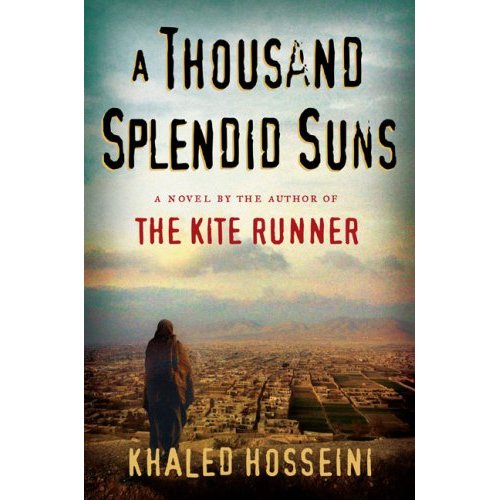
There was a time when we would listen to older state department types talk – with enormous longing – about their tours of duty in Afghanistan, pre-Soviet invasion, pre-Taliban, pre-American occupation. Have you ever read James Michener’s Caravan? There are two countries I long to vist, but the countries they are now are not the countries I heard people talk about – Afghanistan and Ethiopia. Our friends loved their times in these two countries.
A Thousand Splendid Suns opens in a small village outside Herat, and then takes us to Kabul. Mariam is born harami, a bastard, of a village cleaning woman in the house of a very wealthy man. Her father builds a small hut for her mother and herself in a remote part of the small village, and visits Mariam every week. Life is simple, and difficult, but also full of kind people who visit and who are concerned with Mariam’s welfare.
After marrying, Mariam goes to Kabul and learns a new way of life with her husband, Rasheed. What fascinates me with Hosseini is that while Rashid is one of the villians of this novel, he is just a man, doing the best he can given his own upbringing and limitations. In a sense, he is “everyman”, the strutting, domineering, sometimes brutal and abusive husband we find in every culture. But Hosseini also gives him transient bouts of kindness which blow through a little less often than the transient bouts of cruelty.
He also gives us good men, in this book, in the person of Jalil, the father of Mariam, who steps up to the plate in acknowledging Mariam and supporting her and her mother, but fails to nurture in the very real way women need nurturing from their fathers in order to reach their full potential in life. Hosseini also gives us a very strong man in the book, Tariq, who, although he has only one leg, is more wholly a man than any other man in the book. I imagine that this is not unintentional. (How Kissingerian is that for a double negative?!)
Written almost entirely in the Afghan world of women, we see through the eyes of Mariam, and later Leila, the transitions in Afghanistan and their impacts on daily life. We experience happiness with them, and peaceful scenes in quiet moments, raising the children, stepping outside into the garden at night to share a cup of tea and a shared bowl of halwa.
Between the moments of peacefulness, we also experience incoming morter rounds, explosions, marauding bands of warlords, and starvation. We go into a women’s hospital under Taliban control, where there are no medications, no running water, no instruments, and an Afghani female doctor does a C-section with no anaesthesia and is required to keep her burqa on. We watch a mother abandon her role and take to her bed when her two sons are killed fighting the Soviets, we experience betrayal and we experience helplessness, and we experience a Kabul women’s prison. A Thousand Splendid Suns is a rich feast of experiences, juxtaposing the everyday chores of women around the world – cooking, raising children, laundry – with events on the world stage.
(Available from Amazon for $14.27 plus shipping.)
Peter Bowen: Wolf, No Wolf
“You have to take this. You’ll really like it,” Sparkle insisted as I inwardly groaned, thinking of the TWO stacks of unread-must-reads by the side of my bed, and my already bulging suitcases.

“I know it doesn’t sound like something you’ll like,” she went on, slightly frustrated with me, with herself, “but once you start reading, you’ll get into it.”
Not exactly a ringing endorsement, but good enough for me. I always KNOW what I think she will love, and she has done me many a favor in return, introducing me to authors and series worth reading.
“It’s about Montana. The main character is mixed Indian and French and some other things, a grandfather, and it all takes place in a small town in Montana . . . ” she sort of fizzles out. “I’m really not doing a very good job of making this interesting.”
And she sighs in frustration.
So, about a month later, just because I love my sister, I pick the book up and start reading while waiting for my husband to get home for dinner. As it turns out, he is very very late – and I am very very glad. I don’t want to stop reading!
When you first jump into Wolf, No Wolf by Peter Bowen, it takes you a minute to adjust your ear to the way they talk. These aren’t people most of us have met before. Gabriel DuPre´ is m´etis, a mixed blood. His ancestors are French who came early to the great continent that is now the US, Canada and Mexico, and they trapped and hunted, married native American wives, and developed a culture all their own. His language pattern is similar to that of the Cajun in Louisiana.
He is a cattle brand inspector in this small Montana town. His children are grown, he has so many grandchildren he can’t remember all their names. Every now and then, he pins on his deputy sherrif badge to solve a mystery in the small town of Toussaint, Montana.

Here is how Wolf, No Wolf opens:
Du Pre´ fiddled in the Toussaint Bar. The place was packed. some of Madelaine’s relatives had come down from Canada to visit. It was fall and the bird hunters had come, to shoot partridges and grouse on the High Plains.
The bird hungers were pretty OK. The big game hunters were pigs, mostly. The bird hunters were outdoors people; they loved it and knew it, or wanted to. The big game hungers wanted to shoot at something big, often someone’s cows.
Bart had bought a couple thousand dollars’ worth of liquor and several kegs of beer and there was a lot of food people had brought. Everything was free.
Kids ran in and out. The older ones could have beers. Bart was tending bar. Old Booger Tom sat on one of the high stools, cane leaned up against the front of the bar.
“You do that pretty good for someone the booze damn near killed,” said Booger Tom. “I know folks won’t be in the same room with the stuff.”
“Find Jesus,” said Bart. “It’s not too late to save your life.”
He went down to the far end of the bar and took orders. Susan Klein, who owned the saloon, was washing glasses at a great pace.
One of Madelaine’s relatives was playing the accordion, another an electric guitar. They were very good.
Du Pre´ finished. He was wet with sweat. The place was hot and damp and smoky, so smoky it was hard to see across the room. The room wasn’t all that big, either.
Madelaine got up from her seat, her pretty face flushed from drinking the sweet pink wine she loved. She threw her arms around Du Pre´ and kissed him for a long time.
“Du Pre´,” she said, “you make me ver’ happy, you play those good songs.”
. . …
Someday this fine woman marry me, thought Du Pre´, soon as the damn Catholic church, it tell her OK, your missing husband is dead now so you can quit sinning, fornicating with DuPre´.
I’ve never hung out in a bar in Montana, fiddled, or had a girlfriend named Madeleine (!), but already I feel like I know these people and this life. Peter Bowen is the Donna Leon of Montana, introducing us to the kind of crimes that happen in those sleepy looking towns we drive past on the superhighways, glancing at, or stopping to fill our gas tanks.
DuPre´ is a good man, and, like many a good man, sometimes has to do a bad thing to protect those he is sworn to protect. Policing is not pretty business.
The first story has to do with the re-introduction of wolves back into the Montana highlands, something not at all popular with those who have been raising cattle there. The second book in this two-book collection has to do with serial killers, how they stay under the radar, and how very difficult it is to catch them.
In both books, it is as much about a new way of living and thinking as it is about solving the crime. DuPre´ consults often with his friend Benetsee, the local medicine man, who sees things we don’t see. One of the FBI Agents is Harvey Wallace, also more than half native American, whose real name is Harvey Weasel Fat. The books are about how men and women fight, the nature of male friendships and female friendships, and very much about the human condition wherever we may be.
Life is short. I can never live in all these places long enough to even scratch the surface of the flavor of each variety of life. But these books help, they give us glimpses into another way of thinking, another way of doing things, and stretches our little minds just a little so that we learn to think more flexibly.
So who is going to write the Kuwait detective series? Who will take us into the diwaniyyas seeking information, who will take us out on the shoowi to gather information against those delivering drugs to Kuwait, with whom will we camp in the desert, avoiding explosives left over from the Iraqi invasion? I think his name is Anwar al Kout (the light of Kuwait!) and his wife is Suhail (the Yemeni Star!) – somewhere out there is someone who can take us into Kuwait and bring it alive. Where are you?
(You were right, Sparkle. I loved it!)
Recent Comments
Kitchen on Isiais: Winding Down intlxpatr on Shampoo Ginger tigerbutterya0c5ff1d… on Shampoo Ginger intlxpatr on British Soldier Kidnapped, Esc… John on British Soldier Kidnapped, Esc… Wikipedia Donate Button

Amazina


Early Voting in Florida


