Backbiting
Our New Testament reading for today included this passage:
Galatians 5: 13-15
13 You, my brothers, were called to be free. But do not use your freedom to indulge the sinful nature; rather, serve one another in love. 14The entire law is summed up in a single command: “Love your neighbor as yourself.” 15 If you keep on biting and devouring each other, watch out or you will be destroyed by each other.
I love the way this passage describes the truly awful way the things we can say about one another can destroy. “Devour” is a very strong word, and fits perfectly with backbiting, doesn’t it?
I remember one of my first Ramadans, and my friends who were explaining Ramadan to me explained how one of the most important things during Ramadan was absolutely NO BACKBITING.
Answers.com says this:
Back·bit·ing
n.
Secret slander; detraction.
Backbiting, and bearing of false witness.
so I wonder if this is exactly the same in Arabic as in English. The impression I got is that backbiting in Arabic is more like gossip. Backbiting seems to imply that it is not true, but gossip can hurt even if it has a thread of truth. My impression from what my friends were telling me was that saying anything negative or unkind about another during Ramadan was severely discouraged, true or not.
Can you clarify this for me?
Donna Leon Crossing Cultures
I’m in the middle of a Donna Leon read-fest. When I wrote the reviews the last time, I saw three books by her I had never seen – and I comb the aisles of Barnes and Noble when I am in the US, and Half Price Books, looking for titles by her. I am guessing some of her books haven’t been printed in the US, but I was able to find them from the UK Amazon.com.
The two latest books I have read by Donna Leon are timely. The first, Fatal Remedies, starts out being about Commissario Guido Brunetti’s wife, Paola’s crusade against the sex tours to undeveloped countries, her outrage against trips that allow grown men to exploit the poverty and need that the poorest of families will sell their own daughters and even young children to satisfy these men’s uncontrolled lusts. Her outrage leads her to a jail cell in her own husband’s precinct.
But just when you think you know where this story is going, it turns, as many of Leon’s books do, and tackles another subject, one very much in the eye of the news – falsified medications. There is a huge profit to be made, and huge wrongdoings in the medical supplies field, as expired medications are shipped to the most needy countries, and prescription and over-the-counter medications contain ingredients that are at best, harmless, and at worst – poisonous!
Guido Brunetti follows the money, and exposes the cheats.
In the second book, The Death of Faith, the issue – corruption in the church – comes close to home, as Brunetti’s daughter gets a low grade from her religious education instructor for asking questions, logical questions, about the dogma of the Catholic faith. Leon also tackles the issue of the order of Opus Dei, the same mysterious order featured in The DaVinci Code, an order that does exist, but about which solid knowledge is murky. What is known is that the order, in jihadist fashion, seeks to establish the Catholic church as the supreme guide to behavior on earth, it’s own version of sharia law to be the ruling principle in every country.
This is an anethema to Commissario Brunetti, and to all thinking Italians who savor the separation of church and state. He asks the eternal question – who decides? Who decides what behavior is acceptable, what questions are allowable? Religious belief, or the lack of it, is so very personal – this is a very timely issue that all nations are struggling with. Religious rule? Secular rule?
Underlying all the Donna Leon books is the sweetness of daily life with Brunetti’s family, his beautiful and principled wife, his teenaged children, the food they eat, the family discussions they have, the flowers he brings home and the strength of the connection they have with one another. The Venetian setting weaves its own magical thread through every novel, as we ride with Brunetti in the vaporetto on the canals, as we sit with him in a local bar for a quick coffee – or something stronger – and as he walks the streets from home to office, or to talk with a witness.
And last, but not least, the utter corruption in the Venetian system reminds us that veniality is not restricted to the United States, or to Kuwait, or to Nigeria, or Italy, or to any one country, but wherever man seeks to impose order, the chaos of corruption must be slowly and surely overcome by the building of an honest bureaucracy, people like you and me, serving in seemingly hopeless situations, but doing our best, day by day, like Guido Brunetti, to build a better world for our children.
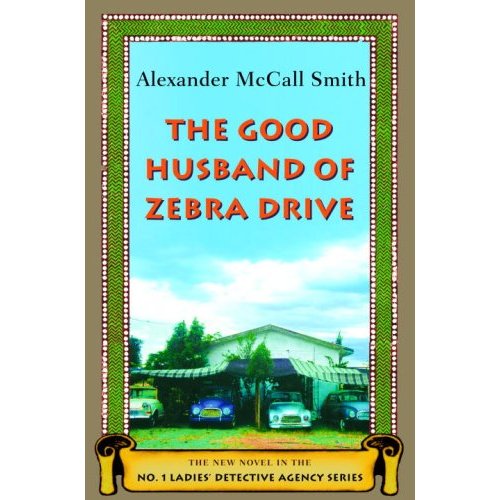
The Good Husband of Zebra Drive
In Alexander McCall Smith’s newest book about Mma Ramotswe, it is a time of transition and unease. Unthinkable things happen. Mma Makutsi quits her job as Mma Ramotswe’s assistant detective, and Charlie, the apprentice, quits to start his own taxi service. Mr. J.L.B. Matekoni feels a restless urge to try out his detecting skills and everything is in turmoil.
And underneath, amazing things happen. When you think differently, there is room for change, and forgiveness.
With Mma Makutsi back in her usual place, the heavy atmosphere that had prevailed that morning lifted. The emotional reunion, as demonstrative and effusive as if Mma Makutsi had been away for months, or even years, had embarrassed the men, who had exchanged glances and then looked away, as if in guilt at an intrusion into essentially female mysteries. But when the ululating from Mma Ramotswe had died down and the tea had been made, everything returned to normal.
“Why did she bother to leave if she was going to be back in five minutes?” asked the younger apprentice.
“It’s because she doesn’t think like anybody else,” said Charlie. “She thinks backwards.”
Mr. J.L.B. Matekoni, who overheard this, shook his head. “It’s a sign of maturity to be able to change your mind when you realize that you’re wrong,” he explained. “It’s the same with fixing a car. If you find out that you’re going along the wrong lines then don’t hesitate to stop and correct yourself. If, for example, you’re changing the oil seal at the back of a gearbox, you might try to save time by doing this without taking the gearbox out. But it’s always quicker to take the gearbox out. If you don’t, you end up taking the floor out and anyway, you have to take the top of the gearbox off, and the prop shaft too. So it’s best to stop and admit your mistake before you go any further and damage things.”
Charlie listened to this – it was a long speech for Mr. J.L.B. Matekoni – and then looked away. He wondered if this was a random example siezed upon by Mr. J.L.B. Matekoni, or if he knew about the seal he had tried to install in the old rear-wheel-drive Ford. Could he have found out somehow?
In another place, Charlie has just told Mma Ramotswe of his plans to start the No. 1 Ladies Taxi Service:
For a minute or two, nobody spoke. Mma Ramotswe was aware of the sound of Charlie’s breathing, which was shallow, from excitement. We must remember, she thought, what it is like to be young and enthusiastic, to have a plan, a dream. There is always a danger that as we went on in life we forget about that; caution – even fear – replaced optimism and courage. When you were young, like Charlie, you believed that you could do anything, and, in some circumstances at least, you could. . . . .
“I will tell all my friends to use your taxi,” she said. “I am sure you will be very busy.”
And oh yes, in the midst of all this, three mysteries get solved – a case of inventory gone missing, a case of a string of inexplicable hospital deaths, and a case of a husband potentialy gone astray.
GREAT summer reading, deceptively simple. You find yourself mulling over the situations, the responses and the outcomes, and trying out new ways of thinking. Give it a try – you don’t have to read the whole series to enjoy each volume.
This eighth book in the series is available from Amazon.com for a mere $12.70. It makes great summer reading.
The Great American Library
Today there is an article in the news about a small library in Vermont that actually sits on the border and is used by both Americans and Canadians. The US government is considering changing that, as they think the unguarded entry to the US is being used by bad people.
Maybe. I don’t know. Post 9/11, the Department of Homeland Security can say or do just about anything in the name of National Security, limit or modify our consititutional rights, behave in ways contrary to everything we believe in, and no one seems to be able to stop them.
And that is not the point. The point is that at one time in our history, an industrialist, Andrew Carnegie, donated money to build libraries throughout the United States, Canada and even Scotland, over 2,000 libraries in all.
In almost every town in America, you will find a library, where you can borrow, free of charge, books on any subject.
When I was a little girl, where I lived was so safe that my mother would put me on the bus with my basket family library books and send me to the library, call the librarian to tell her I was coming, and I could spend hours there, and no-one had to worry about my safety. My Dad would pick me up on his way home from work, and I would have a basket of fresh books – the librarian would pick out books for my Mom.
One day, the desk person was sick, and the librarian let me sit at the desk, checking books ou to library patrons. I must have been six or seven years old, and could barely get on the high chair behind the library desk.
Here is what was so cool. I could read at a very early age, and my nine or ten had worked my way through most of the children’s section, and started choosing books from the adult section. The first time, the librarian called my Mom and asked if it was OK, and my Mom said “if she thinks she can read it, check it out to her.” My library card was annotated to inform all the desk people that I could read whatever I wanted, even from the adult section. Woooo Hoooooooo!
My husband has similar stories, growing up in his home town. He loved the library as I did, and one day, rode his bike to the library and then fell asleep there, hidden from view. The librarian closed the library and he woke up alone and very scared. These were pre mobil phones – I know, I know, it’s hard to believe. His family came looking for him and found his bike, called the librarian, who lived nearby, and she let him out.
We still love libraries. It’s an amazing thing, to be able to walk into a treasury of books, pick up a couple hundred dollars worth, and walk out with just your signature as pledge. The newest books on every subject are available, either in the library itself or through their inter-library loan system. Now, too, most of the libraries have a computer section, where you can check your e-mail or do research online – totally free.
Libraries are staffed mainly by females, I don’t know why, it seems to be seen as a female job. But what power these women have! They are the guardians of so much knowledge! Children and adults come to them and ask all kinds of questions, and they know where to look for the answers!
Isn’t learning how to access knowledge one of the true great secrets in life? So these librarians, the guardians of knowledge, are like Superman, holding the front lines against ignorance, promoting access to new ideas and new ways of doing things, combating the forces of darkness and superstition.
Librarians were a powerful force in my life, and in my husband’s. Has there been a powerful figure in your life who made a difference in how you saw the world, in choices you have made?
Anya Seaton and Avalon
Avalon, by Anya Seaton, is an amazing book, a book I almost didn’t read, but once I picked it up, I could hardly stop reading until I had reached the end. It took me to a whole new world.
It opens in England, around the turn of the first millenium, when people had names like Aethelred and Aelfrhryth which is enough to make me NOT want to read the book. But I read another book by Anya Seaton, Katherine, and I really liked it. It, too, took place in very early English history, and had such an authentic feel. It wasn’t like you pick up the book and all the lords and ladies are in gorgeous clothes, Seaton captures the primitive life many lived in “castles”, freezing cold most of the winter, no plumbing – many of the poorest laborers in Kuwait live better, in terms of food, a roof over their head, toilet facilities – that these early nobles. And the life of villagers was even more basic, a true scrabble for survival, and under filthy conditions, not a lot of time of opportunity for bathing, so people had quite an odor most of the time.
Avalon begins with a chance meeting of a young man and a young woman, a tragedy, and a journey. Their story, as first one love and the other doesn’t, then the other does and misses the opportunity – takes us from the southernmost part of England to Iceland, to Ireland, to Greenland and to the new world, all in the space of these two intertwined lives. They never marry, and yet the book, and their relationship, is a romance.
As you can see, once I got into the book, I couldn’t put it down until the last page. These people are so real, so genuine and so human – and Seaton makes you care about them. She manages to throw in enough detail that I could almost swear I visited these places – a thousand years ago. I have spun wool to buy necessities for our sod house in Iceland, I have embroidered tapestries in the Bower of my husband’s castle, I have sent my son off to settle with his Irish bride in the new world – yes, I think I have done.
The political situation in England at this time is chaotic, with Vikings raiding their coastal cities, and deep up the rivers into the interior, feuding over who will wear the crown, and problems with the capabilities of rulers to rule. There is a constant friction between the church and state, for land, for power, for wealth. The majority of the novel takes place during the reign of – I am not kidding – Ethelred the Unready.
At the very end, I found to my astonishment, that this book also concerned the ramifications of a big lie, just as my previous book reviewed. This is a total co-incidence, something that surprised me, and this book ends in a totally different way, as the main character comes to grips with her deception, owns up to it, willing to suffer the consequences.
Is this what I want? Merwyn thought, and at once came the answer. Yes, it is. There would be boring days ahead, but never again the depressions and miseries of before . . . She felt cleansed, peaceful, and there was much gratitude. . .
That totally cracked me up, but this is a romance of a different nature, a very real romance, with the real kinds of choices that real-life romances entail, and the real life consequences. The hand of God is a major player here, and the beliefs of the characters shape events in a way consistent with the times. Dreams are taken very seriously, and the power of curses, and sorceries, which I never give two thoughts in my daily life in the 21st century.
The main characters have their own nobility, based on their choices, their growth, and their coming to terms with their lives and situations. I learned a lot reading Avalon, and I also had a great time while learning.
All in all, a fascinating read.
The Memory Keeper’s Daughter
Rember the post Lying Hurts The Liar? In The Memory Keeper’s Daughter, the whole plot revolves around a huge lie, and the toll that protecting that lie takes on the lives of everyone it touches.
in the middle of a huge snowstorm, Dr. David Henry’s wife goes into premature labor and he is forced to deliver her in his nearby clinic because he can’t get to the hospital in the snowstorm. To his surprise, he delivers twins. The boy is fine and healthy, the baby girl clearly has Down’s Syndrome. It is the 1960’s.
He hands the baby to the nurse, and tells her to take the baby to a home for Down’s syndrome children and adults. When his wife, Norah, regains consciousness, he tells her she had twins, but that the girl was born dead.
Meanwhile, Caroline, the spinster nurse, takes the baby to the home, but when she sees the lack of caring in the “care” of the patients, she makes an instant decision to walk away. She keeps the baby. She never goes back to the clinic. She drives away and creates a new life for herself and the baby, a joyful life, the life she was waiting for.
To protect his secret, Dr. Henry maintains a distance between himself and his grieving wife. Norah never gets over the loss of her daughter, and she never gets over the change in her relationship with her husband. She knows something is not right, and no matter what she does, she can’t fix it. For a while she drinks. Later she pulls herself together, gets a job, ends up taking over the business (a travel agency) because she has thrown herself into her work.
The son, the healthy baby, grows up in a family where things are not right. His mother loves him, but is distracted by her grief. His father loves him, but is distracted by the energy it takes to protect his terrible secret. It is a family, but a family whose connections to one another are damaged by the tragic secret.
The discarded daughter, meanwhile, grows up surrounded by love and a family who makes a life out of creating opportunities for Down’s Syndrome children.
Late in the book, there is both some resolution and redemption. Things work out, but I find myself thinking of all the wasted years, years of unhappiness and loss, years of happiness sacrificed, brought about by one great big lie. When you read the book, you understand his reasons, and you know how easily, given the times, you and I might have made the same decision.
I think the doctor would have been happier had he risked telling his wife. He often wanted to. He didn’t.
Available for $8.40 + shipping at amazon.com
Government limits freedom of expression
In the United States, news that people want buried comes out on Saturday night, when people are busy with other things and not paying a lot of attention. Does that happen in Kuwait?
I watched for anyone blogging on this yesterday, but saw nothing. I showed the newspaper to my Kuwaiti friends, who were shocked, and hadn’t heard anything about this. Some of it, I get. I am flummoxed by the forbidding of any mention of veterinary medicine!
From yesterday’s Kuwait Times.
KUWAIT: All newspapers, magazines, publishing houses and printing presses in Kuwait were yesterday issued a list by the government of the types of articles, advertisements and banners that can no longer be printed or published without official approval. Following is the list of the banned topics and the ministry concerned:
Interior Ministry:
1. Publication or display of slogans that glorify some countries against others.
2. Displaying pictures that glorify some political personalities or religious figures of countries where political or religious conflicts exist.
3. Publications or displaying slogans that glorify or support some political or religious parties outside Kuwait.
4. Publication of personal interviews with citizens who support or oppose a certain policy which may place the state at war with other countries.
5. Publication or displaying slogans that glorify or support some religious or political parties in Kuwait.
6. Announcement of seminars that may probe tribal or sectarian conflicts.
7. Sale of books on sorcery and magic.
8. Spiritual healing (without a licence).
9. Sorcery and ability to heal.
10. Massage without a licence (because those activities are subject to Law No. 15/1960 dealing with commercial companies).
11. Sale and trade of weapons by commercial companies, individual establishments and individuals (swords, sabers, daggers, spears, knives, arrows and arrowheads, pointy rods, spiked clubs, knives, brass knuckles, electric sticks), because licenses from the Interior Ministry to import these.
12. Sale of airguns without a licence from the Interior Ministry.
13. Fireworks and explosives.
14. Sale of surveillance cameras and listening devices (bugs) of all types without obtaining a licence from the concerned authority.
Education Ministry:
1. Publication of ads for private tuitions.
2. Publication of supplementary school notes.
3. Ads of private institutes and universities that are not accredited by the Ministry of Education.
Ministry of Health:
1. Conventional and veterinary medicine.
2. Botanic, animal or chemical formulae.
3. Foods that have health-enhancing effect, claimed to be prepared for treatment.
4. Preparations that claim to provide energy or reduce or increase weight.
5. Change of structures of body parts. (It is a must that a license be obtained from the licenses committee on advertisements related to health and nutrition).
Ministry of Social Affairs and Labor:
1. Donation and blood money ads.
2. Charity homes’ advertisements.
3. Ads for lectures, cultural and religious gatherings (unless a permission is obtained from the ministry).
The order was signed by Fahd Sayyah Al-Ajmi, Director of Local Press Affairs at the Ministry of Information.
Labyrinth by Kate Mosse
When I saw this book at the Barnes and Noble, I thought “isn’t Kate Moss a fashion model?” but that is a different Kate Moss, a Moss without the ‘e’ at the end.
This book was a New York Times bestseller, but then so was the Da Vinci Code, which I thought badly written and sometimes incoherent. The premise was interesting, but it was done years ago by French authors Michael Baigent, Richard Leigh and Henry Lincoln. Holy Blood, Holy Grail hypothesizes (and pulls together a load of hypothetical evidence to support) that the mystical grail is really a symbolic representation of the blood of Christ, that Jesus was not crucified but instead left Jerusalem with his wife Mary Magdeleine and went to France, and started a family there which eventually became the early French royal line.
I remember telling my son this story, as we travelled through the southern areas of France, and him saying in his smart-mouth-teenager way “only the French would be so arrogant as to believe the blood of God was flowing in their veins!”
We spent a lot of time travelling in France. We love France. So when I discovered that Labyrinth was about the beginning of the French crusade against the Cathars, I was delighted. We know this history. We know this area – it is one of the most beautiful areas of France. We know Carcassone, which in its renovation by Viollet-le-Duc is like Disney-does-fortified-city. It’s formidable, but it’s not entirely authentic.
Who are the Cathars? The Cathars were a break-away sect who were called by others ‘bons hommes’ or ‘bons Chretiens’ (good-Christians), but, pre-Luther, they saw many flaws in the way the Catholic church has become more political than spiritual.
They valued inner faith above outward display. They needed no consecrated buildings, no superstitious rituals, no humiliating obeisance designed to keep ordinary men apart from God. They did not worship images, nor prostrate themselves before idols or instruments of torture. For the ‘Bons Chretiens’ the power of God lay in the word. They needed only books and prayers, words spoken and read aloud. Salvations was nothing to do with alms or relics or Sabbath prayers spoken in a language only the priests understood. . . In their eyes, all were equal in the Grace of the Holy Father – Jew or Saracen, man and woman, the beasts of the fields and the birds of the air. There would be no hell, no final day of judgement, because through God’s grace all would be saved, although many would be destined to live life many times over before they regained God’s kingdom.
They believed the earth was created as a trap, by Satan, and that our lives here keep us apart from the glory of God. They believed we keep coming back, until we purify ourselves spiritually, and that in the end, if we get it right, we end up back where we came from, with God. And they believed we all have the right to read the bible, and to talk directly with God, without the necessity of a priest to interpret or to direct.
But this Crusade, the Fourth Crusade, is little known. This Crusade, declared by the Pope to wipe out the Cathar heresy (sometimes known as Bogomilism or Albigencian heresy) was really the tool of the nobility that was then France, less than half of the France of today, to grab the rich, lush southern lands of the Pays d’Oc. The Fourth Crusade was an opportunity for knights to increase their holdings. And it doubled the size of France.
The Labyrinth takes you inside the walls. The main character is not Cathar, but it didn’t matter – this war wasn’t really about wiping out the Cathars as much as subjugating an independant land and making it part of France. You may have heard one famous quote from this Crusade – as the Crusaders were attacking Besiers, the Abbot of Citeaux was asked how the soldiers could tell the good Catholics from the heritics. “Tuez-les tous. Dieu reconnaitra les sien,” he replied – Kill them all. God will know his own.
The book is lightweight, an easy read. The heroine, Alice, seems to have lived before, as Alais, and has memories she has never lived. You jump back and forth between today, and the time of the Crusade, in the early 1200s. Some of the plot mechanisms don’t make a lot of sense, but you do get a real sense of life in a fortified town during the 1200’s, and of the injustice done to this beautiful area in France. For a book I am lukewarm about in retrospect, I read it avidly, and enjoyed the read.
What I like about this book is that it brings to life a time in history that few pay any attention to. Somewhere in the book, it says that “history is written by the victors.” We see France today, and we know little about the struggle that united these diverse areas into one nation. This book illuminates a slice of time, a grave injustice, and a sense that religion is too often a tool for political ends.
Like the heroine, the big church in Carcassone, where the trials and tortures of the ‘heretics’ took place sends a cold chill up my spine, I can hear the screams of the tortured. I love churches, and I can’t go into this one. It feels unholy. Did you know that the origination of the Inquisition was not in Spain, as most people believe, but in this area of France? And it was aimed, first, at the Cathars.
All in all, not a bad book. Though light in plot, it is heavy in content, a book you will remember and think about in terms of issues, if not the main characters.
Dark, Disturbing Road
Do you remember the happy books you read? Those that are light and breezy? Those with happy-ever-after endings? Most of the time, my bet would be you don’t. You read them, and they’re gone.
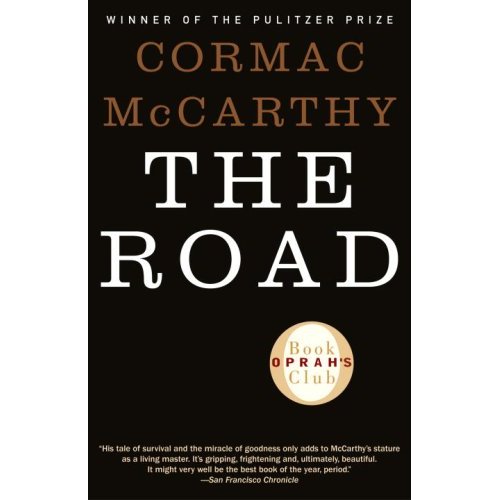
Not this book, The Road, by Cormac McCarthy. I found myself hesitating to even review this book, it is so disturbing to me. The prose is simple, even stark. The atmosphere is relentlessly bleak. The main character, whose name we never know, spends most of the book foraging and scavenging to feed himself and his starving son. The cover says it takes place in America, but it could be anywhere.
It is post-apocalyptic literature at it’s bleakest. All we know is that there were huge balls of light and then everything burned, and kept burning. It is still burning, in some places, during the time span of this novel. It rains or snows most of the time, and the rain is grey and the snow is grey. It is bone-chilling cold, and gathering wood for a fire to keep warm is a constant task.There is never a clear sunny day, only lighter or darker shades of grey. The nights are dark, no moon, no stars, just blackness.
It’s another one of those books I grabbed on the way to the airport without looking too carefully. I saw this was an Oprah Book Club choice and didn’t even read the cover. These books I just grabbed have grabbed me in return – I have read five in a row, books I have to talk over with my husband while I am reading them, they are so full of ideas I need to explore, unsettling settings, shaking to insecurity all that we take for granted.
This one, though, is seriously dark. I read until past midnight last night, adrenaline pumping through my system, as the man and his son evade marauders, thieves, and cannibals. I needed the human warmth of my husband’s body next to mine to drive away the alienation of this book. Even safe in my own bed, though, my sleep is troubled and I wake feeling scared and depressed. As you read The Road, you realize how very thin the veneer of civilization is that holds us together in community, and how that veneer rips when there is no longer law holding back the more powerful, those with weapons, those with more resources. When food becomes scarce, when people become very hungry . . . the rules break down, in serious and unthinkable ways.
If one book can have such an impact on my emotions and feelings of security, I can’t help but think how the trauma of the Iraqi invasion must still be resonating, invisible, below the surface, but an uninvited guest in the daily lives of those who experienced those horrors and trauma in Kuwait. You wonder if you will ever trust in “normal” again?
When your world suddenly shifts in a heartbeat, when your wealth disappears, when you suddenly have only your wits to survive on, how will YOU do?
As the Father and Son travel The Road seeking a warmer climate, and “the good guys”, goodness is remarked by its absence. Our protagonist refuses to help a lost child, a cellar full of people being kept as a food supply, and a couple of men along the road whose situation is even worse than their own. His son, born just after the event which forever changes the world, begs his Dad to share, but the Dad, knowing how spare the food supply is, refuses.
Beyond a crossroads in that wilderness they began to come upon the possessions of travelers abandoned in the road years ago. Boxes and Bags. Everything melted and black. Old suitcases curled shapeless in the heat. Here and there the imprint of things wrested out of the tar by scavengers. A mile on and they began to come upon the dead. Figures half mired in the blacktop, clutching themselves, mouths howling. He put his hand across the boy’s shoulder. Take my hand, he said. I don’t think you should see this.
Yes.
It’s OK Papa.
It’s OK?
They’re already there.
I don’t want you to look.
They’ll still be there.
He stopped and leaned on the cart. He looked down at the road and he looked at the boy. So strangely untroubled.
Why don’t we just go on, the boy said.
Yes. Okay.
They were trying to get away, weren’t they Papa?
Yes. They were.
Why didn’t they leave the road?
They couldn’t. Everything was on fire.
I dropped other things I really needed to do so that I could finish The Road. I can’t spend another night wondering how I would survive in this dog-eat-dog world. I need to move on with my life. I need to shift my focus.
And yet . . . I recommend McCarthy’s The Road to you. It is dark, it is brutal, it is relentlessly bleak, but still there is a thin golden thread of the father and son relationship weaving through the tapestry of despair, which redeems the book. You can’t help but admire the determination to persist, when the signs are all around you that nothing is going to get better. Somehow, in spite of all the despair, there is redemption, and even hope.
Sparkle Plenty Jumps In
Sparkle Plenty has always loved good jewelry. She is on first name terms with the major jeweler in our home town, and they always grin when she walks in. Her blogging name is well chosen!

She is my sister, although almost of another generation. She is the youngest aunt, the “fun” aunt. Everyone likes hanging around Sparkle Plenty’s house – and all the cousins gather there around the pool – or the pool table. Sparkle Plenty and her husband have all the fun toys, the fun gatherings and her house is full of laughter.
Her house is also full of pets. She and her husband, Mariner Man, have a soft spot for anything lost or injured or abandoned. One by one, they have gathered a menagerie of cats, dogs and birds who are all grateful not to be out on the streets. They take the ones who limp, the ones no-one else wants. Sparkle Plenty and Mariner Man are all about heart.
After a couple months of commenting, now she had jumped in to the blogging party, and her theme, Flashes of Light that catch the eye, the mind and the heart is perfectly expressive of her goodness and her compassion and her yearning to be a force for good in the universe. Welcome Sparkle Plenty, and may the force of good be with you!
Please visit Sparkle Plenty and welcome her to our virtual community.
Recent Comments
Kitchen on Isiais: Winding Down intlxpatr on Shampoo Ginger tigerbutterya0c5ff1d… on Shampoo Ginger intlxpatr on British Soldier Kidnapped, Esc… John on British Soldier Kidnapped, Esc… Wikipedia Donate Button

Amazina


Early Voting in Florida


