Nemirovsky: Suite Francaise
Within five seconds of starting this book, you are in Paris, flurrying with the Parisians. It’s hot, it’s June, it’s 1940 and the Germans are coming, it is time to get out of town. We are in the middle of preparations to evacuate, with several families, couples and individuals as they make their preparations.
Have you ever been evacuated from a house or hotel due to sudden fire? Have you ever wondered why, in the seconds you had to prepare to leave, you made the choices you did? I groaned as I lived with people carefully packing their linen tablecloths and bird cages; but it’s different when it is not YOU. What I admire so much about Irene Nemirovsky’s book is that you are THERE, you feel so much a part of it. I can tell you what it was like, the desperation as “we” evacuated Paris, and later, as we lived with the enemy using our house for billeting.
The Suite Francaise is two parts, Storm and Dolce. As you reach the end of Dolce, you have a strong feeling that there should be more, and indeed, as you read, seeking satisfaction, the appendices, you discover the book was intended to have four or five sections. The interpreter who put the manuscript together, filling in from Nemirovsky’s notes, has done a masterful job on the two sections that were somewhat complete, but, unfortunately, Nemirovsky, a Catholic, had a Jewish parent, and that was enough to get her arrested, transported to a concentration camp and executed, all within a very short time. The correspondence between her husband had the authorities, in the short time between her arrest and death, is desperate, and chilling.
You can’t help but be heartsick at the loss to this world of such great talent. You can’t help but wonder what this book, as good at it is, might have been as a larger whole?
Nemirovsky, above all, has an acute eye for French thinking, French manners, French mannerisms, and above all, for French class distinctions. The dialogues are SO perfectly believable, as are the depictions of the manner in which people under the worst kind of stress can behave with both inhuman kindness and insensitive cruelty toward one another.
You know how I am always wondering what my cat is thinking. . . I share an excerpt of the book with you. I believe Nemirovsky knows what a cat is thinking!
The cat poked his nose through the fringes of the armchair and studied the scene with a dreamy expression. He was a very young cat who had only ever lived in the city, where the scent of such June nights was far away. Occasionally he had caught a whiff of something warm and intoxicating, but nothing like here, where the smell rose up to his whiskers and took hold of him, making his head spin. Eyes half closed, he could feel waves of powerful, sweet perfume running through him: the pungent smell of the last lilacs, the sap running through the trees, the cool, dark earth, the animals, birds, moles, mice, all the prey, the musky scent of fur, or skin, the smell of blood . . . His mouth gaping with longing, he jumped on to the window sill and walked slowly along the drainpipe. This was where a strong hand had grabbed him the night before and thrown him back . . . but he would not allow himself to be caught tonight.
He eyed the distance from the drainpipe to the ground. It was an easy jump, but he appeared to want to flatter himself by exaggerating the difficulty of the leap. He balanced his hindquarters, looking fierce and confident, swept his long black tail across the drainpipe and, ears pulled back, leapt forward, landing on the freshly tilled earth. He hesitated for a moment, then buried his muzzle in the ground. Now he was in the very black of night, at the heart of it, at the darkest point. He needed to sniff the earth: here, between the roots and the pebbles, were smells untainted by the scent of humans, smells that had yet to waft into the air and vanish. They were warm, secretive, eloquent. Alive. Each and every scent meant there was some small living creature, hiding, happy, edible . . . June bugs, field mice, crickets and that small toad whose voice seemed full of crystallized tears . . . The cat’s long ears – pink triangles tinged with silver, pointed and delicately curly inside like the flower on bindweed – suddenly shot up. He was listening to faint noises in the shadows, so delicate, so mysterious, but, to him alone, so clear: the rustling wisps of straw in nests where birds watch over their young, the flutter of feathers, the sound of pecking on bark, the beating of insect wings, the patter of mice gently scratching the ground, even the faint bursting of seeds opening. Golden eyes flashed by in the darkness. There were sparrows sleeping under the leaves, fat blackbirds, nightingales; the male nightingales were already awake, singing to one another in the forest and along the river banks.
And I imagine that the above all took place in the space of about 15 – 30 seconds!
If Nemirovsky can capture a cat’s thoughts so eloquently, just imagine what she can do with the French!
The second part of the Suite, Dolce, takes place in a small farming village and ties many of the evacuees from Storm loosely with the village and subsequent events. In Dolce, we live with a young married Frenchwoman in the home of her mother-in-law who blames her for enjoying life while her own son, the young woman’s husband, is a prisoner of war in Germany. If that weren’t bad enough, soon a young German officer is sent to live with them.
We have lived among the evacuating Parisians, in Storm, and now, in Dolce, we are living in the provinces, with it’s stultifying conventions. There are whole passages where the restrictions of polite French countryside society make it so suffocating, you almost have trouble breathing. And yet, as they do in every society, the young find ways around the conventions, risk their lives, risk their reputations, and live thinking that no-one sees what they are doing, while the elders bite their lips in horror. Fascinating reading. Nemirovsky’s genius to to make you feel you really are THERE.
Donna Leon: Death in a Strange Country
Recently I discovered, to my disgust, that I have purchased two Donna Leon books I have already read. I bought them from England, and now they have been published in the US under different titles. Aaaarrrgh! I hate it when that happens.
I have a good friend I want to pass these books along to, an amazing woman who has no idea how amazing she is. When she talks about her early years as a private detective, she refers to herself, with a perfectly straight face, as a “Dickless Dick.”
After I read this book, I passed it along to Adventure Man, who loved it. He aloud to me from it late at night, and we both laughed. Here is the the excerpt he liked, he could identify with it:
In their bedroom, he saw that she had placed a long red dress across the bed. He didn’t remember the dress, but he seldom did remember them and he thought it best not to mention it. If it turned out to be a new dress and he remarked on it, he would sound like he thought she was buying too many clothes, and if it was something she had worn before, he would sound like he paid no attention to her and hadn’t bothered to notice it before. He sighed at the eternal inequality of marriage, opened the closed, and decided that the grey suit would be better.
He, of course, is Commissario Guido Brunetti, Donna Leon’s chief investigator, consumately Venetian, very married, and fighting a lonely battle against the louche corruption of the Italian bureaucracy.
And this book is about the death of an American military man in Venice, except that of course, it turns out to be about something much much bigger. Leon has several axes grinding in this one, but the biggest is illegal dumping, and the arrogance of countries who dump their toxic wastes on smaller countries, eyes wide open, knowing full well that horrorific consequences may result – and not caring.
My favorite part is when Commissario Brunetti visits the American base outside of Venice for the first time:
He left the place and went to stand outside, content to get a sense of the post while waiting for his driver to return. He sat on a bench in front of the shops and watched the people walking past.
A few glanced at him as he sat there, dressed in suit and tie and clearly out of place among them. Many of the people who walked past him, men and women alike, wore uniform. Most of the others wore shorts and tennis shoes, and many of the women, too often those who shouldn’t have, wore halter tops. They appeared to be dressed either for war or for the beach. Many of the men were fit and powerful; many of the women were enormously, terrifyingly fat.
Cars drove by slowly, their drivers searching for parking spaces: big cars, Japanese cars, cars with that same AFI number plate. Most had the windows raised, while from the air-conditioned interiors blared rock music in varying degrees of loudness.
They strolled by, amiable and friendly, greeting one another and exchanging pleasant words, thoroughly at home in their little American village here in Italy.
Donna Leon has a sharp eye for detail, doesn’t she? Don’t you feel like you were sitting there on the bench with Commissario Brunetti, seeing through his eyes?
Reading Donna Leon transports you to another world, Venice, and the joy of reading has less to do with solving the crime than being able, for a short time, to stop and drink coffee while tracking down a criminal, eating a meal or two with Brunetti and his family, experiencing the frustrations of the Venetian bureaucracy in all its radiant corruption, walking along the canals so early in the morning that the delivery men haven’t even begun yet making their deliveries . . .
And yet the problems addressed in the Leon books are part of a greater world picture, and Leon has an enormous capability to draw blurry lines with increasing clarity as we watch how international corruption works hand in hand blindly taking profits while dribble by dribble degrading the world for future inhabitants.
Sex or Backbiting?
Most of you know, I do the daily readings from The Lectionary (you can always click on it from my Blogroll, down to the right) as part of my spiritual discipline. I also read the daily meditations on Forward Movement, (also in the blogroll.)
Rarely do I share them with you, but this one is where Christianity and Islam are so closely intertwined that I dance for joy – that much can be forgiven to one who loves, but our tongues get us into a lot of trouble.
I know that backbiting is one of the great sins to be avoided during the upcoming holy season of Ramadan, too.
James 3:1-12 The tongue is a fire…a world of iniquity…a restless evil, full of deadly poison.
I sometimes wonder if the churchfolk who seem obsessed with sexual behavior are reading the same Bible I am. If I said that someone was “living in sin,” I know what parts of the body you’d think I was talking about. Yet if it were James or other New Testament authors talking, they would probably be referring to the tongue.
For every reference in the New Testament to sins involving sex, there must be ten concerning speech. Why? Because while sex is certainly one form of communication, speech is a more potent one in the daily life of a congregation. Words have power.
God creates the world and keeps in touch with it, after all, by his Word; and words are how we keep in touch with each other. But the word that can create can also destroy–a reputation, an institution, a life. Words tell us who and how we are and whether we belong; words bind the community together-or tear it apart. Sexual misconduct is bad–and easy to recognize as bad.
The sniping, backbiting, spite, and deceit that go on in some communities are often hard to see, let alone root out. Yet their effect is more corrosive over the long term. How did our priorities get so mixed up?
PRAY for the Diocese of South Carolina (United States)
Ps 38 * 119:25-48; 1 Kings 9:24-10:13; Mark 15:1-11
Invasion Kuwait – Jihan Rajab
I have one very ragged copy of Jihan Rajab’s Invasion Kuwait which she published in 1996. All my house guests have been given an opportunity to read it, and not one single one has been other than blown-away.
When you look at Kuwait today, there is no sign that the disasterous invasion took place. The invasion and occupation are barely a blip on the screen of modern history, to those who were not involved.
And yet – when you listen to those who went through it, there are tales of sheer heroism. If you get the conversation started, in a group, you can hear hair-raising tales, heartbreaking tales, told by the people who went through it.
I had to buy the book through Amazon.com because I looked all over Kuwait and couldn’t find it, not even at the Tarek Rajab museum. When I bought it, I bought it used, because there were no new copies available, but this morning when I went to include the book in the Warrior Women post, I found that you can now buy it new, and I decided it was worth a post of it’s own. It is well worth a read, and it makes Kuwait so much more alive when you pass sites mentioned in the book and remember what took place there in Rajab’s book.
I have read one other book detailing the horrorific experience in Kuwait, but that is all. Are there others? Are there books on the invasion, and the individual experiences, written in Arabic?

Levantine/Gulf/Persian Warrior Women?
I’m still reading Sarum, by Edward Rutherford, although I am nearing the end. I am still thinking back to a fictional character – I think she is fictional because when I Google’d her name, I got the name of an English queen, but not this particular Aelfgifu.
In Sarum, Aelfgifu is a warrior woman. As a young girl, she hangs out with all the guys, rides with them, hunts with them, and is accepted by them. When the Vikings raid, she fights them. The Vikings are astounded, and more than a little angry, to be fought – successfully – by a woman. Later, her father reluctantly allows her to ride with the men to counter another Viking raid – they need all the “men” they can get, and she is one of the best.
I am intrigued. History shows that these exceptional women pop up now and then, and usually just at the right time. Joan of Arc for the French, the Amazons, Apache women warriors in Native American lore, Chinese Tang dynasty warrior women, Masai warrior women in Africa. We have women in the US Army, and I often hear their commanders say “some of my best men are women.”
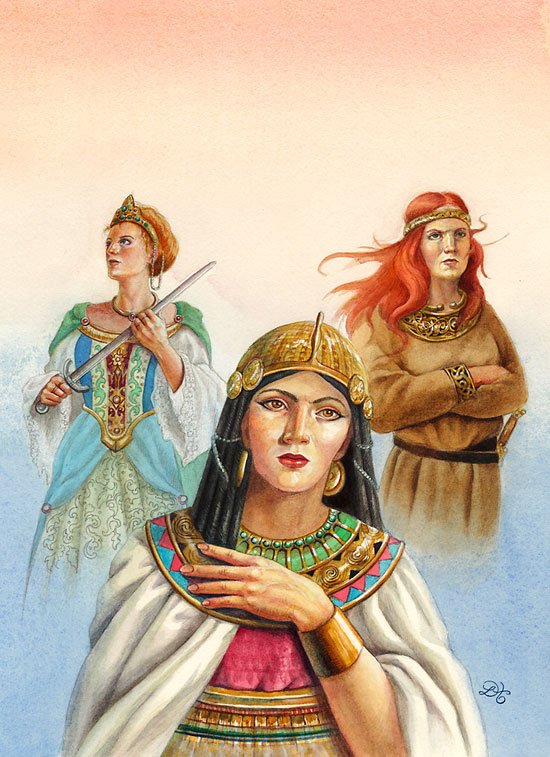
It was hard to find a good warrior women illustration which had women with their clothes on. Most of the illustrator, I guess, being men, they protray women warriors in scanty attire, and most of them have exaggerated breasts and hips, and tiny little wasp waists, and legs about twice as long as a normal woman. Sort of Barbie-doll in warrior women attire. *she snorts in disgust* Leaves a fighter a little vulnerable, don’t you think, fighting in a metal bra and tiny little loincloth? That metal would get uncomfortable in no time, and man, how can you ride a horse for very long without chafing your legs? But then reality wouldn’t sell the drawing, would it?
OK, OK, back to the real question – Warrior women pop up in all cultures. I think that is true, but when I think of the Arabian Gulf, or Persia, or the Levant, no one comes to mind, other than Sheherezad, but she triumphed by her wits, not her brawn, not her fighting skills. I remember hearing that nomadic women could be fierce; are there not legends of Bedouin women?
Is there a woman / are there women who were legendary fighters in Middle East culture? Are there women in Persian culture who fought, or held a castle, or were otherwise brave in the face of danger? Speak now!
Big Girls Don’t Cry?
Listening to SUPERSTATION 99.7 as I am working, I find myself exasperated, from time to time, by the lyrics to some of the songs.
Today, it is Big Girls Don’t Cry. I remember a totally different song with the same name from back a while ago, and actually I like this one better, because she talks about cutting it off and just moving on – and I agree. Sometimes you just have to cut your losses.
But I think big girls – and guys – do cry.

(Picasso’s Weeping Woman)
A researcher actually explored why we cry:
Frey investigated a question his mother had asked him: “Why is it that people cry tears?” He would pursue the answer, alongside his Alzheimer’s work, for many years. He took a scientific approach to her inquiry, and he discovered emotional tears were chemically different from other tears. That research resulted in interviews with People magazine, the Today Show, Good Morning America, and others, as well as a book, Crying: The Mystery of Tears (Harper and Row). “Perhaps the reason people feel better after crying is that they’re removing chemicals that build up during stress,” Frey suggests, adding that the question remains open to further research.
This is from a Washington University Alumni magazine.
I don’t know if there has been any further research on crying, but originally, I remember him stating that emotional tears carried away poisons that stress build in the body. It makes sense to me. I don’t cry all that often, but when I do, when I cry and it’s one of those blow-it-all-out cries, the kind that give you a headache if you carry on for too long – afterwards, you just feel wonderful!
And you wonder why you even let her/him/it assume so much importance in your life?
And you wonder “What was I thinking???”
Sometimes a good cry just puts everything back in proportion and you really CAN move on.
Or that’s how I see it. I don’t mean to go all drama-queen, I am just talking about a good old fashioned lock-yourself-in-the-bedroom-and-cry kind of cry.
But maybe you see it differently. I think big girls DO cry, and for good reasons, and then we move on. But this might be a cultural thing, and I am willing to entertain other ways of looking at it. What do YOU think?
New From Google Book Search!
You know, big guys make me nervous. Sometimes, they get a monopoly, and throw their weight around, making you and me pay more for less and less service.
Not Google.
I love Google. I love Google searches, I love GoogleEarth, and oh man, I love Google Book Search. And this is so totally cool – look what they are coming up with now!
Google Book Search in Google Earth
Monday, August 20, 2007 at 11:54 AM
Posted by Brandon Badger, Product Manager
Did you ever wonder what Lewis and Clark said about your hometown as they passed through? What about if any other historical figures wrote about your part of the world? Earlier this year, we announced a first step toward geomapping the world’s literary information by starting to integrate information from Google Book Search into Google Maps. Today, the Google Book Search and Google Earth teams are excited to announce the next step: a new layer in Earth that allows you to explore locations through the lens of the world’s books.
Now when you turn on the “Google Book Search” layer in Google Earth (found in the “Featured Content” folder in the “Layers” menu), you’ll see small book icons scattered around the globe. When you click on one of the book icons, a pop-up balloon will display a snippet of text from one of Book Search’s public domain books that references that location. You’ll also find links to the Google Book Search page for that snippet so that you can learn more about what it has to say about the city or town.
For example, let’s say that you’re interested in Detroit, Michigan.
You can find out more by clicking here.
Have fun!
(Sorry, can’t write more! Have to go do some book searches! Thanks, Earthling!)
Summer Fruit Crisps
If you haven’t cooked before, and are interested in beginning, Crisps are a good place to start. They are easy, don’t take a lot of time, and you get instant – and delicious! – gratification. Now, while fresh fruit is abundant in Kuwait (and elsewhere) is a great time to try a crisp.
These recipes are from Mary Cullen’s Northwest Cook Book, 1946. My aunt gave it to me before she died, and some of my best cooking efforts have been based on recipes from this book. They are simple, but . . . simply GOOD!
Apple Crisp
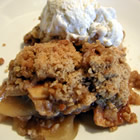
Crisps are wonderful when made with fresh fruit, and not so much trouble as a pie requiring crusts. Here, the topping is delicious, and easy.
5 cups apples
1/2 cup butter
1 cup sugar
3/4 cups all purpose flour
1 teaspoon cinnamon or nutmeg
Peel, core and slice apples and place in a greased baking dish or cassarole (a ceramic pie dish is perfect, but you can also use a ramekin, or something not too deep, not too shallow).
Using a pastry blender, or a metal whisk, or an electric mixer, work together the butter, sugar, salt, flour and spices.
Pack closely around apples.
Bake in 425 degree oven for 45 – 50 minutes. Serve with whipped cream or ice cream.
Berry Crisp or Peach / Apricot / Plum Crisp
Substitute berries (peaches or apricots or plums) for apples. If berries are very tart, sprinkle with 1/2 cup sugar mixed with 1/2 cup flour before covering with crumb mixture.
Rhubarb Crisp
Use diced rhubarb in place of apples. Mix 1/2 to 1 cup sugar and 1/2 cup flour with rhubarb before placing in baking dish.
Burke and Tin Roof Blowdown
“So what are you reading?”
Sparkle’s question didn’t surprise me. It’s one of the things we share, a love of reading, anything really but especially mystery books.
“I just started James Lee Burke’s new book, The Tin Roof Blowdown,” I responded.
Her eyes brightened and she threw back her head and laughed! “I knew it! I saw he had a new book out and I hoped you had already bought it!”
What she’s not saying is “bought it, read it and will pass it along to me!”
It’s what we do. I am in the middle of a series she recommended and loaned to my son, he is 3/4 way through (the Hyperion series) and has passed along the first two volumes to me, which, when finished, I will return to my sis.
James Lee Burke’s newest book, The Tin Roof Blowdown, is Burke at his best. His last book ended with the ominous storm rolling in that has changed the face of New Orleans and this book starts with Hurricane Katrina. The stories are heartbreaking, and all the more so because they are true. New Orleans is one of the most corrupt cities in the United States, about one third of the police force LEFT the city they were hired to protect in the evacuation, and the poorest of the poor were left behind, to suffer, to struggle to live, or to die. Many did all three.
Detective Dave Robicheaux is called into the “Big Sleazy” with the rest of the New Iberia police force to help with rescue operations, and to try to bring some order into the chaos. He gets involved with a missing priest, two looters being shot, a robbery that includes cocaine, counterfeit cash and blood diamonds, and the usual cast of psycopaths and organized crime goombahs.
The book builds inexorably to a nail-biting climax.
This author can WRITE. He is head and shoulders above the average churn-em-out detective writer. Here is one of his less poetic, but more insightful entries:
” . . . the honest to God truth is that law enforcement is not even law “enforcement.” We deal with problems after the fact. We catch criminals by chance and accident, either during the commission of the crimes or through snitches. Because of forensic and evidentiary problems, most of the crimes recidivists commit are not even prosecutable. Most inmates currently in the slams spend lifetimes figuring out ways to come to the attention of the system. Ultimately, jail is the only place they feel safe from their own failures.
Unfortunately, the last people on our minds are the victims of crime. They become an addendum to both the investigation and the prosecution of the case, adverbs instead of nouns. Ask rape victims, or people who have been beaten with gun butts or metal pipes or tied to chairs and tortured how they felt toward the system after they learned that their assailants were released on bond without the victims being notified.
I don’t believe in capital punishment, but I don’t argue with the prosecutors who support it. The mouths of the people they represent are stopped with dust. What kind of advocate would not try to give them voice?

What’s in Your Toolbox?
What do you give a young adult, graduating high school, who has just about everything he wants? What do you give him that he doesn’t even know he wants?
It was Christmas, and we were trying to figure out what to give our son. We eventually decided on a tool box, and we had a lot of fun filling it – hammers, fasteners, screw drivers and Phillips screw drivers in various sizes, nails, putty, screws, a level, a measuring tape . . . he like it, but he was a little underwhelmed.
Until he got to college. At the end of the first week, when he called us, we could hear the joyful confidence in his voice.
“Guess what!” he said. It wasn’t really a question, he was going to tell us.
“No-one else has a tool-box here! All the other kids need help putting their bunks together (there was some smart entrepreneur who was marketing loft-like bunk beds and room-customizing kits to all the incoming students, making, I am willing to bet, a fortune) and I’m the one with the tool box!”
We could hear the smile on his face.
And isn’t that life? The more tools you have in your toolbox, the better equipped you are to handle what life throws at you? Even the unexpected – if you have the right tools.
For me, those tools have been varied.
• Reading books has introduced me to new ways of thinking.
• Learning foreign languages gives me different perspectives.
• Living in foreign countries helps conquer ignorant ideas about people of other cultures.
• I can eat a wide variety of cuisines without fear
• I can swim, use a rifle, cook, and speak in public without my voice quavering
• I can laugh. Thanks be to God.
All these tools have been acquired, some, like patience and kindness, at great price.
So what are your tools? What has helped you deal with what life throws your way? What tools have you grown to deal with life’s challenges?
Recent Comments
Kitchen on Isiais: Winding Down intlxpatr on Shampoo Ginger tigerbutterya0c5ff1d… on Shampoo Ginger intlxpatr on British Soldier Kidnapped, Esc… John on British Soldier Kidnapped, Esc… Wikipedia Donate Button

Amazina


Early Voting in Florida


