Anne Rice and Christ the Lord out of Egypt: A Novel
Remember Interview with a Vampire? Remember the feeling, as you read it, that you were probably treading very close to the essence of evil, and that evil was seductive and incredibly attractive? Anne Rice created a world of believable vampires, vampires you could identify with, vampires who created a cult following, and a legion of goth vampire wannabe’s, her prose was that seductive, that inviting, that . . . . irresistable.
Like a siren song, the voice pulled you from book to book, leading you along. With each book, a twist, and suddenly all the assumptions from the previous book were turned upside down, no longer valid when seen from another perspective. Rice lured you down the garden path step by step, and it’s hard to tell at what point you give up your will to resist the siren call.

Recently Anne Rice experienced a re-conversion to Christianity, and is now devoting her writing talents to serving God. This newest book, Christ the Lord out of Egypt, is as thoroughly researched as all the earlier books, and speculates on the early years of the Christ. The book opens in Egypt, with a seven year old Jesus, wise beyond his years but still a child. He sees things he doesn’t understand, he hears things he knows to be significant but doesn’t know why, and when he asks questions, like what happened in Bethleham around the time of his birth, Joseph and Mary, his parents, won’t answer. In fact, they don’t want him to bring up the subject at all, and they tell him they will give him the answers when he gets a little older.
Meanwhile, he hears things, and ponders them. He asks older relatives, and wise teachers. Little by little, he gathers pieces of a puzzle, the puzzle of his background and his identity. He accidently kills a playmate, and brings him back to life. He prays for snow, and it snows. He learns self control through the exercise of powers he doesn’t know he has, he learns to limit himself, and to hide himself.
With his family, they leave Alexandria and return to Jerusalem and then Nazareth, building a new life with their extended family. He grows, he ponders, and he is given a few more pieces of information.
You would think that with Anne Rice’s talent and with her research skills, this would be a fascinating book, but sadly, it is flat, and dull. I wonder why it is easy to make evil so seductively alluring, but it is so hard to bring goodness to life in a believable way? I read the book all the way through, hoping it would get better, but it never did.
There are people – Jan Karon comes to mind – who write about goodness and good people in a vibrant way, making goodness vital and attractive. Wish Anne Rich could find that vein.
Jean Plaidy and Courts of Love
My last day back in Seattle, I allowed myself a trip to the nearest Barnes and Noble. It was a shorter trip, only ten days, and full of family and family gatherings, centered around my father’s recent death. The days sped by, each full and exhausting.
I had already packed most of my bags. I do this so I know how much, if any, room I have. That way, I won’t buy too many books. I know myself. I know my vices. There is a part of me that says “how can there be too many books? How can there be too much of such a good thing?”
And then I am stuck trying to shovel books into an already overpacked suitcase, stuffing more into my stuffed backpack, shoving, re-arranging, tossing out old underwear to make way for yet another book.
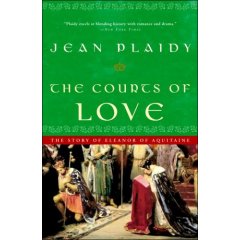
I only bought a few books, one of which was Courts of Love by Jean Plaidy. If you follow this link, you will find many reviews of this book that disagree with my opinion, and gave this book almost five full stars.
I have always held Eleanor of Aquitaine in great awe. Born in the Languedoc region of France, she was raised in a court full of literature and poetry, visitors from distant places bringing news. She was educated, and exposed to rule. She was expected to inheirit the rich province of Aquitaine until a younger brother was born, but, as was not uncommon in the times, he succumbed to a childhood illness, and she once again became the inheiritor of a fabulously wealthy and desirable province, the Aquitaine.
And if being the inheiritor of Aquitaine wasn’t enough, she was also thin, and elegantly beautiful, and educated, and she had spirit. She never felt herself limited by being a woman.
She first married Louis, King of France, who was nowhere near her match. She insisted on accompanying Louis on his crusade to free Jerusalem (failed) and upon her return to France met Henry, the heir to the English throne, secured a divorce from Louis of France based on the fact that they were distantly related, and then quickly married Henry, who was even less distantly related. She did as she wished.
Henry was several years younger than Eleanor, and they were both full of fire, and ambition. They had force, and strategic vision; as a couple, they were unbeatable. Eleanor gave birth almost yearly, mostly sons, and was happy until she discovered her husband’s multiple infidelities. His inability to be a faithful husband created a bitterness in her heart, a wall between the two of them. From time to time, Henry had Eleanor imprisoned to keep her out of his way. He believed she had turned his sons against him. But many times, he would need her, and call her out of her captivity to help him. It’s a bitch, being married to a king.
Where am I going with this review, you might ask?
I finished the book, and all I can wonder is how Jean Plaidy took such a fiery woman, a sensual and vibrant woman, and made her so wooden? It must be some problem in me, as the other reviewers give the book a much higher rating than I would, and I wonder if they are confusing their awe with the subject (Eleanor) with the quality of the book?
Or maybe I have become so used to Phillipa Gregory’s treatment that I am spoiled for Jean Plaidy? When you read The Queen’s Fool, The Other Bolyn Girl and The Constant Princess you are there, you are in their world, feeling their thoughts. The dialogue is rich and lively, you are surrounded by sensory clues, smells, feels, tastes – the world is richly created, and when you finish the book, you feel like you have travelled in time, as if you were really there.
Not so with Courts of Love.
I would rate this book far lower, because I DO admire Eleanor of Aquitaine, and I think she deserves an equally lively, richly sensual treatment. I want to know her world, I want to peek inside her mind and experience a little of what she experienced. I want Philippa Gregory to write about Eleanor of Aquitaine! Jean Plaidy, in my opinion, took an extraordinary woman, and make her less vibrant, and just a little drab. A grave injustice, in my book!
The Mysteries of Blogging
Every blogger will tell you – you can’t anticipate what your audience will love. There are pieces I labor over – mostly the travel pieces – and I get some comments, and the hits are steady over time, but nothing spectacular.
And then I will just jot off something in a hurry, and it will get hit after hit. When WordPress first came out with it’s snap-to feature, I wrote just a short blurb, and it gets several hits a day, even almost a month later.
But yesterday, all of a sudden, I started getting hits on Unexpected Pleasures a very abbreviated book report I wrote back in January on a book about belly dancing. If it were just one or two or three or four, I would have just thought it were a fluke, but it was 17, then 26, and finally 31 – in one day!
Most of the hits were coming from one referrer, and when I tried to check the referrer, it had some posts that were not public, so if she has mentioned my review, it is not visible to me. I wrote to Little Diamond who had reviewed the book, and she said she, too, had received a huge number of hits yesterday on that one obscure review.
It is a total mystery. No comments, just people peeking in. I don’t know what they are looking for. I don’t know why that one entry interests them. It is a blogging mystery.
“I’m A Third Culture Kid, Are You?”
Most of those who read my blog are not Kuwaiti, and it is for you that I am writing this post. So many of you who read me are also “Third Culture Kids.” My blogging friend Amer just wrote a post by the above title, and whoa! The responses will blow you away! Please go to I am a Third Culture Kid, Are You? and check in with your story – where you came from and where you are today.
And how being a third culture kid has affected your life. This is one of the best blog entries I have read.
The book from which the term Third Culture Kids comes from is mentioned in an earlier blog entry of mine, Chicken Nuggets and Big Macs and is by David C. Pollock and Ruth E. Van Reken. You can find it at Amazon.com. If you are a third culture kid, you might want to buy two or three – you will keep giving them away. The book is that good.
In the Headlights: Added to the Blogroll
I don’t remember how I came across this blog, at some time in December, but I remember laughing my head off. After two months, I find that she still delights me every time I visit. Today at In the Headlights (a reference to a common English phrase “deer in the headlights” meaning that wild-eyed-I -don’t-know-what-to-do-next-so-I’ll-just-stand-here-frozen look) Riannan shares an e-mail from a friend with curmudgeonly rules for 2007, and earlier on the page, shares a site where you can have mittens, etc. knit out of your pet’s lost hair! Dying laughing.
(And no, she is not a relative of mine. I don’t know her! I just like her blog!)
This woman comes across some of the most amazing things. She, like me, is all over the map – salsa dancing, books, great recipes (the latest was Oven Baked Sesame Scallops, oh yum!), stories about friends, some of the funniest signs I have ever seen, and screwball ideas. She can give your day a lift.
Google Earth – Map Your Books!
More news from Earthling (not quite my co-blog writer, but he sure gives me some good stuff to share with you 🙂 )
“This just launched, very cool. Google books search now lets you see a map of all the place mentioned in a book.
Go to books.google.com
Search for your book
Click the ‘about this book’ link.
example: Pride and Prejudice
The 9/11 Commission Report
911 Commission Report
Our Vanishing Wild Life: Its Extermination and Preservation
By William Temple Hornaday
Vanishing Wild Life
The great cities of the ancient world, in their glory and their desolation
By Theodore Alois W. Buckley
Ancient Cities
The Book of Ser Marco Polo
By Marco Polo, Henry Yule, Henri Cordier
Marco Polo
Adventures of Sherlock Holmes
By Arthur Conan Doyle
Sherlock Holmes
Kiss Kiss Bang! Bang!: The Unoffical James Bond 007 Film Companion
By Alan Barnes, Marcus Hearn
James Bond”
Travels of Ibn Batuta AD 1325 – 1354
Ibn Batuta
My comment: The maps usually showed up on the lower right part of the page, not always immediately visible, you have to scroll down. Not every page had a map, but the reference led to other similar books which had maps.
I didn’t even know Google had a book search section – and it is good! When I am reading, I like to read a train of books on the same subject – and I like the way Google gives small summaries which can give you an immediate indication whether this book will interest you or not. Thanks, Earthling!
Unexpected Pleasure
As I was leaving Seattle, my niece, Little Diamond, passed a book along to me. It’s part of our family culture – we read, and we pass along.
When my son was in university, I remember him telling me that I had addicted him to books. His first memory of books was living in Tunis, and when we would be going on a long trip, or when he had done something particularly good, I would pull down a new book from the shelf high up in my closet. Knowing he was approaching reading age, I had stocked up on books before we left.
As a student, he told me that as he approached final exams at university, he would motivate himself by telling himself that as soon as his last final was over, he could go to the bookstore and buy whatever the newest book out was that he was eager to read. Reading – for fun – during his school breaks was his great reward.
It’s that way for all of us. Before any trip, we stock up on good books to read. Before I left Seattle, I stocked up books for my Mother to read! We seek out places like Half Price Books (I do NOT own stock in Half Price Books) and Amazon.com to feed our habits. In our concern against running out of good books, we all have piles by our bed of books we intend to read. Some of my books have been there almost a year – since I moved to Kuwait!
So I accepted the book, Snake Hips: Belly Dancing and How I Found True Love, although I looked at the cover in dismay, and actually took it off for the trip. It’s about a Lebanese-American girl who goes in search of her ethnic roots. While at first I didn’t like her, I kept reading in spite of myself – the book drew me in. Little Diamond reviews the book here, (as well as several others that sound really good.)
This book was an unexpected pleasure – as are many of the books my book-voracious niece reads. The main character in this book has an unexpected wryly objective view of herself, is painfully honest, and you find yourself hoping she will find herself, and true love, in spite of her clumsy attempts.
Virginia Hall: A Modest Heroine
The Good Shepherd, a new movie with Angelina Jolie, and Matt Damon, directed by Robert DeNiro (!), will open Friday, a story of the beginnings of the American intelligence services, the OSS and the CIA. I can hardly wait.
Earlier this week, there were some small news articles about Virginia Hall, who served her country risking her life time and time again, fighting the Nazis in the allied clandestine services, facing the possibility of torture and death if she were caught. Hall didn’t let anything hold her back. She believed that what she was doing was worth doing, and when WWII ended, she continued working quietly for the greater good. I would have loved to meet this woman. What a pistol!
Here is what Wikipedia has to say about her:
Virginia Hall MBE DSC (April 6, 1906 – July 14, 1982) was an American spy during World War II. She was also known by many aliases: “Marie Monin,” “Germaine,” “Diane,” and “Camille.”[1]
She was born in Baltimore, Maryland and attended the best schools and colleges, but wanted to finish her studies in Europe. With help from her parents, she traveled the Continent and studied in France, Germany, and Austria, finally landing an appointment as a Consular Service clerk at the American Embassy in Warsaw, Poland in 1931. Hall hoped to join the Foreign Service, but the loss of her lower leg was a terrible setback. Around 1932 she accidentally shot herself in the left leg when hunting in Turkey, it was later amputed from the knee down, which caused her a limp.[2]
The injury foreclosed whatever chance she might have had for a diplomatic career, and she resigned from the Department of State in 1939.
The coming of war that year found Hall in Paris. She joined the Ambulance Service before the fall of France and ended up in Vichy-controlled territory when the fighting stopped in the summer of 1940. Hall made her way to London and volunteered for Britain’s newly formed Special Operations Executive, which sent her back to Vichy in August 1941. She spent the next 15 months there, helping to coordinate the activities of the French Underground in Vichy and the occupied zone of France. When the Germans suddenly seized all of France in November 1942, Hall barely escaped to Spain.[3]
Journeying back to London (after working for SOE for a time in Madrid), in July 1943 she was quietly made a Member of the Order of the British Empire. The British had wanted to recognize her contribution with a higher honor but were afraid it might compromise her identity as she was then still active as an operative.
Virginia Hall joined the U.S. Office of Strategic Services (OSS) Special Operations Branch in March 1944 and asked to return to occupied France. She hardly needed training in clandestine work behind enemy lines, and OSS promptly granted her request and landed her from a British MTB in Brittany (her artificial leg kept her from parachuting in).
Code named “Diane,” she eluded the Gestapo and contacted the French Resistance in central France. She mapped drop zones for supplies and commandos from England, found safe houses, and linked up with a Jedburgh team after the Allied Forces landed at Normandy. Hall helped train three battalions of Resistance forces to wage guerrilla warfare against the Germans and kept up a stream of valuable reporting until Allied troops overtook her small band in September.
For her efforts in France, General William Joseph Donovan in September 1945 personally awarded Virginia Hall a Distinguished Service Cross — the only one awarded to a civilian woman in World War II. (emphasis mine)
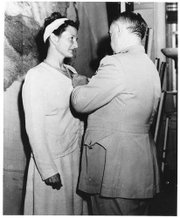
In 1950, she married OSS agent Paul Goillot. In 1951, she joined the Central Intelligence Agency working as an intelligence analyst on French parliamentary affairs. She retired in 1966 to a farm in Barnesville, Maryland.
Virginia Hall Goillot died at the Shady Grove Adventist Hospital in Rockville, MD in 1982.
Her story was told in “The Wolves at the Door : The True Story of America’s Greatest Female Spy” by Judith L. Pearson (2005) The Lyons Press, ISBN 1-59228-762-X
She was honoured in 2006 again, at the French and British embassies for her courageous work.[4]
Santa’s Wish List: Cookbooks
You might think I love to cook. You would be very wrong.
I had a great friend for many years, one of those Southern gals with a last name first name, and when one day I told her of my secret guilt – that cooking wasn’t FUN for me, she said “what we do, every day, is SURVIVAL cooking. We just meet the expectation of getting a meal on the table. That doesn’t have to be fun, it just has to be done.”
That’s pretty much what I do, and why I have been giving you all these great recipes. The truth about the recipes I am giving you is that most of them are EASY and they taste good. A few require special equipment and mastering a new skill, but it’s like swimming – once you’ve done it, it’s easy. There is nothing complicated about the recipes I am sharing with you – they are ones I use, too!
Books About Food and Eating
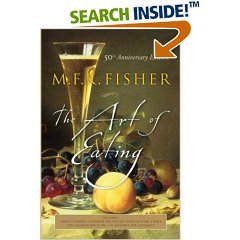
First I will share with you two books available through third party vendors at Amazon. The first is Food Lover’s Companion (A Comprehensive Definition of Over 4000 Food, Wine and Culinary Terms) by Sharon Tyler Herbst, which is available starting at $14.93, and the second is M.F.K Fisher’s The Art of Eating, also available through Amazon at $11.53. The Companion is invaluable when someone uses a term for a cooking technique or ingredient you don’t know; it has words for everything! My husband reads this book sometimes just for fun and is always sharing new information he has learned. The MFK Fisher book is just plain fun reading about food, full of information and anecdotes and stories, written in an enormously readable way.

Beginner Cookbooks
The first cookbook I used was the McCalls Cookbook – no longer in print. It had photos of how do do the things I found so intimidating, and that is where I got my earliers Christmas cookie recipes – the Russian Tea Cakes and the Candy Cane Cookies. The second was The Joy of Cooking, which I mentioned in an earlier blog entry. What is good about these books is that they keep it really simple. In Joy, they give you a long theoretical section, which you can read if you have the time, and which helps, but at the beginning it isn’t always easy to even understand the basics. That takes time. Then you can go back and read later and go “Aha! Now I understand!”
Cookbook Secrets
Actually, I love reading cookbooks. I have a huge collection. And almost all of them are Junior League Cookbooks. So here’s the secret – when you are looking for cookbooks, look for ones where women who contribute have to put their names. If their name is on the recipe, you can trust that the recipe will work, and that it will be one of their best recipes – they don’t want to be embarrassed!
The majority my cookbooks are from the South. And narrowing it down even further, most of my favorites come from Louisiana or Georgia.
The first one I ever bought was Talk About Good! And oh, it WAS good!

These recipes use ingredients like real cream and real butter and lots of salt. Southern people have some of the lowest life-expectancy rates in the United States – I suspect their eating habits have a lot to do with it. But if it isn’t a habit to eat so richly, every now and then it just tastes SO GOOD to use these ingredients. You will also notice that it has what they call a “plastic comb” binding. That means when you open it up to follow a recipe, it will lie flat. That’s a really good thing!
My second favorite is Quail Country, by the Junior League of Albany, Georgia. You would really have to scour the book stores to find this out-of-print classic, because so few people would ever want to part with it. Another gem is The Fort Leavenworth Collection, if you can get your hands on it – again, yard sales, used book stores would be your best bet.
There is a wonderful group of stores in the USA called Half Price Books. If books are not being bought as gifts, if you plan to just read a book and pass it along, or if you like to have a few on hand to pass along because you think they are so great, Half Price Books is a great place. They have the most obscure books, books you never thought you would see again. Many of their books are new, but remaindered (left over from book stores that couldn’t sell the, or from publishers who published too many copies) so they are sold at half price. They will also buy used books from you, but to me, they offer so little that I would just as soon give them away. (No, I don’t own stock in Half Price Books.)
There are some other fabulous Junior League cookbooks – the California Heritage Cookbook, the Seattle Classics, and there are other cookbooks produced by churches and charities that also have “real people” recipes that are drop-dead good. I remember once sharing a recipe for Chocolate Cheesecake from Seattle Classics. My friend told me she made it for Christmas dinner, but everyone was too full to eat dessert. But she said all night she heard doors opening and closing, as people snuck down to the kitchen to slice a little of the cheesecake and eat it, and in the morning, only a fragment was left!
Seeking out the best cookbooks can make every vacation an adventure. I have cookbooks from Kenya and Tunisia, Qatar, Jordan and Saudi Arabia . . . all full of great recipes, recipes with names attatched. I wish you a grand adventure seeking out cookbooks that will thrill your heart. Happy Hunting!
Arabesk and Jon Courtenay Grimwood
I am blessed with friends and family who share books, and Pashazade came into my life courtesy of Little Diamond, my globe-trotting glamourous niece. She always leaves a trail of books as she wanders hither and yon. Some of them are just too deep for me, or need too much attention. This series, the Arabesk Trilogy by Jon Courtenay Grimwood almost fell in that category.
I missed a clue. I kept trying to start the first volume, Pashazade, but was having a problem keeping up with the plot and the technology. I would go back and read again, trying to figure out what I was missing. I know I’m living in Kuwait, but I read! I keep up with the news! When did all this new stuff happen?
And then I just happened to look at the cover of the book and it all became clear – it is a parallel world, it is science fiction, and once I started reading and accepting all the strange words and implants as literary license, the book became fun, and intriguing, and very very hard to put down. And then I had to wait while the second and third volumes (Effendi and Felaheen) because the series is that much fun.
The main character, Ashraf al-Mansur has a complicated past. The plot is complex enough, but Ashraf doesn’t know who he is, we don’t know who he is, and we have to take time out from the plot now and then to get another piece of the puzzle. Fortunately, the puzzle pieces are in all kinds of cool places – Alexandria (but a different Alexandria from current day Alexandria) and the Sudan) but a slightly different Sudan, with a prophetic edge to it) and Seattle and a mental institution, and Tunis and the desert oases . . . oh, this is a lot of fun.
So Ashraf starts out in Alexandria, with his Aunt Nafisa who lives in this marvelous old madresa in Al Iskandriya, but then his aunt is killed, Ashraf becomes guardian to an exceedingly bright and introverted young girl, and falls in love with a young woman with whom he refused an arranged marriage.
Ashraf has friends in high places, is believed to have relations in high places, and although he gets into the worst situations, he has WASTA and a lot of problems just disappear. (For my non-Kuwaiti readers, wasta is sort of like the-power-of-connection-and-who-you-know-and-maybe-who-owes-you-a-favor-or-might-be-open-to-a-little-encouragement). These connections get people killed in the Arabesk trilogy, threaten chaos and mutilation and disaster, and take you on a great ride. Oh! Did I mention this is also a mystery, romance and has political intrigue, too?
It’s modern day – or maybe a year or two in the future – and with a huge twist in the universe here and there, so that it seems familiar, but it isn’t. There are dark shadows and differences that can be critical. And it has a whole raft of “who’s your ally?” kind of situations. It is a richly textured romp, and you are along for the ride. Don’t fight it, just lean back and hang on.
It is pure escapism, no great deep thoughts here. When the trilogy ends, however, you remember the characters, you remember the plots, and you still grin about them months later.
Pashazade, the first volume, is available through Amazon in hardcover and paperback. Paperback starts under $5.00, through used vendors.
Effendi is available from $10.20, new paperback edition.
Felaheen is available new and used from $8.99

Recent Comments
ExpatAlien on What Country am I Living … intlxpatr on Yellowstone: Old Faithful to C… Michelle on Yellowstone: Old Faithful to C… Cathy on No Grown-Ups in Charge intlxpatr on Waiting for Snow Wikipedia Donate Button

Amazina


Early Voting in Florida


 Here There and Everywhere