Virginia Hall: A Modest Heroine
The Good Shepherd, a new movie with Angelina Jolie, and Matt Damon, directed by Robert DeNiro (!), will open Friday, a story of the beginnings of the American intelligence services, the OSS and the CIA. I can hardly wait.
Earlier this week, there were some small news articles about Virginia Hall, who served her country risking her life time and time again, fighting the Nazis in the allied clandestine services, facing the possibility of torture and death if she were caught. Hall didn’t let anything hold her back. She believed that what she was doing was worth doing, and when WWII ended, she continued working quietly for the greater good. I would have loved to meet this woman. What a pistol!
Here is what Wikipedia has to say about her:
Virginia Hall MBE DSC (April 6, 1906 – July 14, 1982) was an American spy during World War II. She was also known by many aliases: “Marie Monin,” “Germaine,” “Diane,” and “Camille.”[1]
She was born in Baltimore, Maryland and attended the best schools and colleges, but wanted to finish her studies in Europe. With help from her parents, she traveled the Continent and studied in France, Germany, and Austria, finally landing an appointment as a Consular Service clerk at the American Embassy in Warsaw, Poland in 1931. Hall hoped to join the Foreign Service, but the loss of her lower leg was a terrible setback. Around 1932 she accidentally shot herself in the left leg when hunting in Turkey, it was later amputed from the knee down, which caused her a limp.[2]
The injury foreclosed whatever chance she might have had for a diplomatic career, and she resigned from the Department of State in 1939.
The coming of war that year found Hall in Paris. She joined the Ambulance Service before the fall of France and ended up in Vichy-controlled territory when the fighting stopped in the summer of 1940. Hall made her way to London and volunteered for Britain’s newly formed Special Operations Executive, which sent her back to Vichy in August 1941. She spent the next 15 months there, helping to coordinate the activities of the French Underground in Vichy and the occupied zone of France. When the Germans suddenly seized all of France in November 1942, Hall barely escaped to Spain.[3]
Journeying back to London (after working for SOE for a time in Madrid), in July 1943 she was quietly made a Member of the Order of the British Empire. The British had wanted to recognize her contribution with a higher honor but were afraid it might compromise her identity as she was then still active as an operative.
Virginia Hall joined the U.S. Office of Strategic Services (OSS) Special Operations Branch in March 1944 and asked to return to occupied France. She hardly needed training in clandestine work behind enemy lines, and OSS promptly granted her request and landed her from a British MTB in Brittany (her artificial leg kept her from parachuting in).
Code named “Diane,” she eluded the Gestapo and contacted the French Resistance in central France. She mapped drop zones for supplies and commandos from England, found safe houses, and linked up with a Jedburgh team after the Allied Forces landed at Normandy. Hall helped train three battalions of Resistance forces to wage guerrilla warfare against the Germans and kept up a stream of valuable reporting until Allied troops overtook her small band in September.
For her efforts in France, General William Joseph Donovan in September 1945 personally awarded Virginia Hall a Distinguished Service Cross — the only one awarded to a civilian woman in World War II. (emphasis mine)
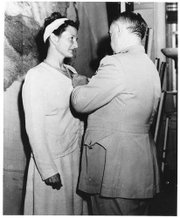
In 1950, she married OSS agent Paul Goillot. In 1951, she joined the Central Intelligence Agency working as an intelligence analyst on French parliamentary affairs. She retired in 1966 to a farm in Barnesville, Maryland.
Virginia Hall Goillot died at the Shady Grove Adventist Hospital in Rockville, MD in 1982.
Her story was told in “The Wolves at the Door : The True Story of America’s Greatest Female Spy” by Judith L. Pearson (2005) The Lyons Press, ISBN 1-59228-762-X
She was honoured in 2006 again, at the French and British embassies for her courageous work.[4]
Santa’s Wish List: Cookbooks
You might think I love to cook. You would be very wrong.
I had a great friend for many years, one of those Southern gals with a last name first name, and when one day I told her of my secret guilt – that cooking wasn’t FUN for me, she said “what we do, every day, is SURVIVAL cooking. We just meet the expectation of getting a meal on the table. That doesn’t have to be fun, it just has to be done.”
That’s pretty much what I do, and why I have been giving you all these great recipes. The truth about the recipes I am giving you is that most of them are EASY and they taste good. A few require special equipment and mastering a new skill, but it’s like swimming – once you’ve done it, it’s easy. There is nothing complicated about the recipes I am sharing with you – they are ones I use, too!
Books About Food and Eating
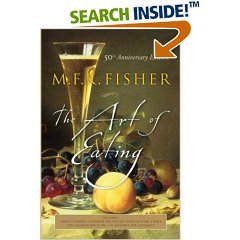
First I will share with you two books available through third party vendors at Amazon. The first is Food Lover’s Companion (A Comprehensive Definition of Over 4000 Food, Wine and Culinary Terms) by Sharon Tyler Herbst, which is available starting at $14.93, and the second is M.F.K Fisher’s The Art of Eating, also available through Amazon at $11.53. The Companion is invaluable when someone uses a term for a cooking technique or ingredient you don’t know; it has words for everything! My husband reads this book sometimes just for fun and is always sharing new information he has learned. The MFK Fisher book is just plain fun reading about food, full of information and anecdotes and stories, written in an enormously readable way.

Beginner Cookbooks
The first cookbook I used was the McCalls Cookbook – no longer in print. It had photos of how do do the things I found so intimidating, and that is where I got my earliers Christmas cookie recipes – the Russian Tea Cakes and the Candy Cane Cookies. The second was The Joy of Cooking, which I mentioned in an earlier blog entry. What is good about these books is that they keep it really simple. In Joy, they give you a long theoretical section, which you can read if you have the time, and which helps, but at the beginning it isn’t always easy to even understand the basics. That takes time. Then you can go back and read later and go “Aha! Now I understand!”
Cookbook Secrets
Actually, I love reading cookbooks. I have a huge collection. And almost all of them are Junior League Cookbooks. So here’s the secret – when you are looking for cookbooks, look for ones where women who contribute have to put their names. If their name is on the recipe, you can trust that the recipe will work, and that it will be one of their best recipes – they don’t want to be embarrassed!
The majority my cookbooks are from the South. And narrowing it down even further, most of my favorites come from Louisiana or Georgia.
The first one I ever bought was Talk About Good! And oh, it WAS good!
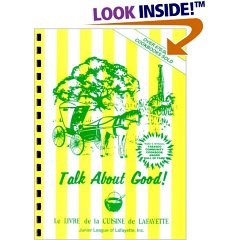
These recipes use ingredients like real cream and real butter and lots of salt. Southern people have some of the lowest life-expectancy rates in the United States – I suspect their eating habits have a lot to do with it. But if it isn’t a habit to eat so richly, every now and then it just tastes SO GOOD to use these ingredients. You will also notice that it has what they call a “plastic comb” binding. That means when you open it up to follow a recipe, it will lie flat. That’s a really good thing!
My second favorite is Quail Country, by the Junior League of Albany, Georgia. You would really have to scour the book stores to find this out-of-print classic, because so few people would ever want to part with it. Another gem is The Fort Leavenworth Collection, if you can get your hands on it – again, yard sales, used book stores would be your best bet.
There is a wonderful group of stores in the USA called Half Price Books. If books are not being bought as gifts, if you plan to just read a book and pass it along, or if you like to have a few on hand to pass along because you think they are so great, Half Price Books is a great place. They have the most obscure books, books you never thought you would see again. Many of their books are new, but remaindered (left over from book stores that couldn’t sell the, or from publishers who published too many copies) so they are sold at half price. They will also buy used books from you, but to me, they offer so little that I would just as soon give them away. (No, I don’t own stock in Half Price Books.)
There are some other fabulous Junior League cookbooks – the California Heritage Cookbook, the Seattle Classics, and there are other cookbooks produced by churches and charities that also have “real people” recipes that are drop-dead good. I remember once sharing a recipe for Chocolate Cheesecake from Seattle Classics. My friend told me she made it for Christmas dinner, but everyone was too full to eat dessert. But she said all night she heard doors opening and closing, as people snuck down to the kitchen to slice a little of the cheesecake and eat it, and in the morning, only a fragment was left!
Seeking out the best cookbooks can make every vacation an adventure. I have cookbooks from Kenya and Tunisia, Qatar, Jordan and Saudi Arabia . . . all full of great recipes, recipes with names attatched. I wish you a grand adventure seeking out cookbooks that will thrill your heart. Happy Hunting!
Arabesk and Jon Courtenay Grimwood
I am blessed with friends and family who share books, and Pashazade came into my life courtesy of Little Diamond, my globe-trotting glamourous niece. She always leaves a trail of books as she wanders hither and yon. Some of them are just too deep for me, or need too much attention. This series, the Arabesk Trilogy by Jon Courtenay Grimwood almost fell in that category.
I missed a clue. I kept trying to start the first volume, Pashazade, but was having a problem keeping up with the plot and the technology. I would go back and read again, trying to figure out what I was missing. I know I’m living in Kuwait, but I read! I keep up with the news! When did all this new stuff happen?
And then I just happened to look at the cover of the book and it all became clear – it is a parallel world, it is science fiction, and once I started reading and accepting all the strange words and implants as literary license, the book became fun, and intriguing, and very very hard to put down. And then I had to wait while the second and third volumes (Effendi and Felaheen) because the series is that much fun.
The main character, Ashraf al-Mansur has a complicated past. The plot is complex enough, but Ashraf doesn’t know who he is, we don’t know who he is, and we have to take time out from the plot now and then to get another piece of the puzzle. Fortunately, the puzzle pieces are in all kinds of cool places – Alexandria (but a different Alexandria from current day Alexandria) and the Sudan) but a slightly different Sudan, with a prophetic edge to it) and Seattle and a mental institution, and Tunis and the desert oases . . . oh, this is a lot of fun.
So Ashraf starts out in Alexandria, with his Aunt Nafisa who lives in this marvelous old madresa in Al Iskandriya, but then his aunt is killed, Ashraf becomes guardian to an exceedingly bright and introverted young girl, and falls in love with a young woman with whom he refused an arranged marriage.
Ashraf has friends in high places, is believed to have relations in high places, and although he gets into the worst situations, he has WASTA and a lot of problems just disappear. (For my non-Kuwaiti readers, wasta is sort of like the-power-of-connection-and-who-you-know-and-maybe-who-owes-you-a-favor-or-might-be-open-to-a-little-encouragement). These connections get people killed in the Arabesk trilogy, threaten chaos and mutilation and disaster, and take you on a great ride. Oh! Did I mention this is also a mystery, romance and has political intrigue, too?
It’s modern day – or maybe a year or two in the future – and with a huge twist in the universe here and there, so that it seems familiar, but it isn’t. There are dark shadows and differences that can be critical. And it has a whole raft of “who’s your ally?” kind of situations. It is a richly textured romp, and you are along for the ride. Don’t fight it, just lean back and hang on.
It is pure escapism, no great deep thoughts here. When the trilogy ends, however, you remember the characters, you remember the plots, and you still grin about them months later.
Pashazade, the first volume, is available through Amazon in hardcover and paperback. Paperback starts under $5.00, through used vendors.
Effendi is available from $10.20, new paperback edition.
Felaheen is available new and used from $8.99

Patricia Wells, France and Fallot Mustard
As I was scrambling through the Salmiyya Sultan, looking desperately for a few good ingredients on Thanksgiving morning, I stopped short in sheer wonder. There, on the shelves, here in Kuwait, were mustards by Edmond Fallot.
Monsieur Fallot makes the best mustards in the entire world. One year, we did a “French” turkey, slivered with a thousand slices of garlic carefully placed in a thousand tiny slits just under the turkey skin. It was magnificent. We served the turkey that year with a variety of Monsieur Fallot’s mustards.
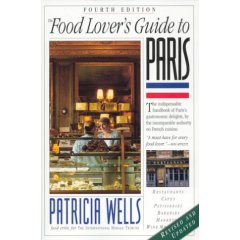
We lived in Germany, and we often travelled to France for a couple weeks at a time, exploring different regions. We used lots of books, but the three we used most often for France were Patricia Wells Food Lover’s Guide to France, Patricia Wells Food Lover’s Guide to Paris, and a book published annually called Europe’s Wonderful Little Hotels and Inns.
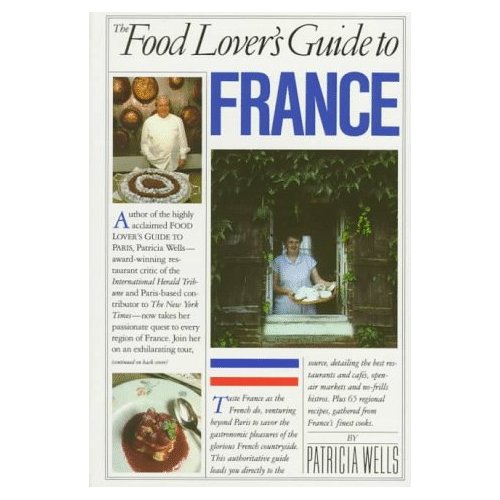
We didn’t have a lot of money, but what we lacked in money, we made up in energy, optimism and research. We found wonderful places to stay, fabulous meals and affordable side trips. We lunched out of charcouteries and boulangeries, we dined demi-pension in Michelin “Red R’s” (good local food at reasonable prices.) We found ourselves in the Burgundy area again and again, and Patricia Wells led us to Monsieur Fallot’s mustard factory in Beaune. Click there for a virtual visit to his factory in preparation for your real time, in person visit.
As I stood there, transfixed, in the Sultan Center, I was back in Beaune, travelling in France with some history and “foodie” friends, and we made a special stop at M. Fallot’s factory, whose address was listed in the original Food Lover’s Guide to France I was using then. I am guessing he has asked NOT to have his address given any more, maybe he had too many visitors like us. We couldn’t get enough of his mustards – we stayed and watch him filling jars with many different kinds, and bought at least one of each variety. His mustard is the gold standard of mustards. Worth a trip to Beaune.
Except you don’t have to go to Beaune – you can find M. Fallot in the Sultan Center in Salmiyya, or in William-Sonoma if you are in the U.S. and in other parts of the world where you find fine condiments.

The latest edition I could find of the Food Lover’s Guide to France was 1987, for $1.99 used, through Amazon. The latest edition I could find of Food Lover’s Guide to Paris was 1999, and the cost, used, was $9.99, again through Amazon. (Disclaimer/Disclosure: yes. I do own stock in Amazon. Help me keep Amazon stock high, please. 🙂 ) I imagine some of the information in both books is outdated, restaurants have closed, newer, haute-er places are open, but I would still say they are worth the price.
Both guides list market days for various arrondisement/towns/villages, and for that alone, they are worth the price. Wells describes local specialities, and best of all, Wells is deliciously readable. Even if you don’t have a trip to Paris or France in your near future, Wells’ books are fun to read, and full of wonderful, valuable information.
The most recent edition I can find of Europe’s Wonderful Little Hotels and Inns on Amazon is 2003, but I know there are more recent editions because mine is 2004. It is edited by Adam & Caroline Raphael, and has hotels listed throughout Europe, not just France, although the lion’s share of hotels listed ARE in France. They range from budget to unbelievable luxury – and the twist is, this book is made up solely of recommendations from customers. Someone has to recommend the hotel, another has to second the recommendation, and readers keep the postings up to date. We have found some truly memorable hotels using this guide, hotels full of charm but affordable for the region. Most of the hotels were awesome. Even used, even outdated, one good hotel stay at a charming but reasonably priced hotel will pay the cost of the book.
Still Learning – Alhamdallah
Another Side of Thanksgiving . . .
My friend asked about my father, and when I told her he was slipping away, losing a little more every day, she said “Alhamdallah!”
I was caught up short. Her face was smiling. I had just told her my father is dying and she says “Thanks be to God?”
I know this woman like my own sister. Her daughters are my own daughters. I am welcome in every corner of her house, I pray for every one of her children, and being in her home is like being in my own home, we are all so comfortable together.
“No,” I said, “You’ve misunderstood what I said!” and she hugged me and said “I understood, but no matter what happens, we say ‘alhamdallah’. If you father is dying, we say ‘alhamdallah’. If Hurricane Katrina strikes, we say ‘alhamdallah’. All things come from Allah, and He knows all things. It is his will, so we say ‘alhamdallah’.”
We are both religious women. My faith says the same thing, to give thanks in all things. In my daily life, I sometimes forget. Truly, in my culture, you would never say “thanks be to God” if someone had just told you something very sad.
Being exposed to the Islamic world has complemented my own faith. No, I don’t need to be a Muslim; I think the differences between us are much smaller than the similarities. But truly, I thank God for all that I learn about my own faith by living is Moslem countries.
I love the call to prayer; nothing wrong with being reminded during the day – and night – to love and honor God. I love living among people who give thanks to God so many times a day, even for Hurricane Katrina, even for my failing father. I love watching the fathers and sons headed to the mosque on Fridays. There’s even a very gentle station with Moslem films in English that I watch from time to time because it is so peaceful, and tolerant and sweetly loving.
My friend took time from her very busy life and made a special trip to the bookstore to buy me a book called Don’t Be Sad. It’s a wonderful book by ‘Aaidh ibn Abdullah al-Qarni with chapters like “How to deal with bitter criticism,” “Do Not Carry the Weight of the Globe on Your Shoulders,” Do Not be Shaken by Hardships'” “Jealousy is Not Something New” and one of my favorites – “Do Not Be Sad – Do Good to Others.” This book is helpful to me in so many ways, including giving me good sura that are very similar to writings in our own book. This helps me clarify to others in my culture how alike we are, and how similar our faith is. My friend loves me, and I know she wants only the best for me. I give thanks to have her as a friend.
Every now and then, I come across something that shakes me – like when my friend said “alhamdallah” about my Father . . . but in the end, I learn something and my understanding broadens. Alhamdallah!
Philippa Gregory and Catherine of Aragon
Being sick has one advantage. . . you can catch up on some of your reading. Philippa Gregory is one of my favorite writers of historical fiction.
To my great shame, I have a very difficult time reading history. Unless it is vigorously written, it puts me to sleep. It is particularly embarassing when my husband has a degree in History, and his eyes light up discussing battles and strategems and who said what to whom and why it matters. It has to do with my hard-wiring, it’s not even a gender thing.
So I gravitate toward historical fiction; give me people and motivations and interactions any day, and I can remember it. Sometimes, I even learn something. Philippa Gregory never lets me down. She researches, she documents, and she might speculate, but you always have a clear idea what is real (historically documented) and what is a good story, putting meat on the bones of the history.
Out of sequence, I read The Queen’s Fool and The Other Boleyn Girl. Each of these books is peripheral to the story of Catherine of Aragon. The first features a woman chosen to be a Fool at the court of Queen Mary, Catherine’s daughter. She is of Jewish descent, hiding as a Christian, escaped from the fires of the Spanish Inquisition. She lives in fear of being caught out in her deception. With her father, a printer, she tries to secrete and maintain many of the books of Moorish Spain, the knowledge of the ancients, which the church begins to declare heretical in England. The second book, The Other Boleyn Girl, is about Anne Boleyn, but told from the perspective of her sister, Lady Mary, who was also mistress to Henry, King of England, while he was married to Catherine of Aragon. The Boleyn girls are portrayed as mere pawns in the great game of power in the English court.
So this newest book, The Constant Princess, opens in Spain, as Queen Isabella of Castile, Catherine’s mother, and King Ferdinand of Aragon fight to eliminate the Moors and to unite their lands into one Kingdom. The little girl, whose mother is the chief strategist and who fights in armor alongside her husband, learns battlefield tactics at her parent’s feet and in their camps and learns diplomatic skills in their throne rooms.
We follow Catherine to England, married first to Arthur, then after Arthur’s death, to Henry. She assures them her marriage to Arthur was never consummated, that Arthur was too young, and impotent. Gregory assumes this was a lie. We don’t know. I would guess that it was one of those lies that nobody believes but was convenient to all to pretend to believe, for money, for power, for alliances.
We stand with Catherine as she sends Henry off to fight the French, then leads her own troops up to vanquish the Scots. We agonize with her as she strives to become pregnant, to carry an heir to the throne full term to birth, and as she loses a seemingly perfect baby boy to infant death. We sit with her in stragegic councils, watch her balance the budgets for court and state, and scheme to protect the English borders against all threats. Whew! Being a Queen of England is hard work!
The book ends with Catherine facing the eccliastical trial as her own husband disputes the validity of her marriage to him and seeks to set her aside for his freedom to marry Anne Boleyn.
I don’t review every book I read, but I was captivated by the cross cultural threads in this book, and by the fact that while we all know the basic facts of the story – Henry divorces Catherine of Aragon to marry Anne Boeyn – Catherine’s history, her talents, her strengths and victories were news to me. The influence of her upbringing in Moorish Spain and the influence it played on her growing understanding of the world is a golden thread woven throughout the story.
Early in her first marriage, the young princess tells her beloved husband of her childhood in Grenada:
” . . . We walk in their gardens, we bathe in their hammams, we step into their scented leather slippers and we live a life that is more refined and more luxurious than they could dream of in Paris or London or Rome. We live graciously. We live, as we have always aspired to do, like Moors. Our fellow Christians herd goats in the mountains, pray at roadside cairns to the Madonna, are terrified by superstition and lousy with disease, live dirty and die young. We learn from Moslem scholars, we are attended by their doctors, study the stars in the sky which they have named, count with their numbers which start at the magical zero, eat of their sweetest fruits and delight in the waters which run through their aquaeducts. Their architecture pleases us: at every turn of every corner we know that we are living inside beauty. . . . We learn their poetry, we laugh at their games, we delight in their gardens in their fruits, we bathe in the waters that have made flow. We are the victors, but they have taught us how to rule. . . .”
I can hardly wait for a trip to Spain!
Lisey’s Story: Stephen King
Mostly I wait for books to come out in paperback, so that they don’t hurt me if I fall asleep while I am reading (!), but for a few authors I will make an exception. One, James Lee Burke, I told you about in a previous post He Had Me From Hello.
My most recent exception was for Lisey’s Story, the newest novel out by Stephen King. It’s a departure from Stephen King as we know him, and yet, there are resonances and echoes of earlier writings. Stephen King is brilliant at capturing the terrors of childhood, and the diaphanously thin membrane separating reality as we know it (not that we agree on what “reality” is! 😉 ) from the “otherworld”. In the Dark Tower series, the otherworld was where all the bad things were created and passed over to this side through leaks, places where the membrane holding worlds apart thinned and even disappeared.
This book is covered with flowers, bright pink and fushia and purple peonies, lupin and daisies, shading into blacks, whites and greys at the top, so that the holleyhocks are only faintly blue. It’s a very odd cover for a Stephen King book, but this is a very odd book. Early reviews say it is about as autobiographical a book by Stephen King as he has ever written, and I believe it. Stephen King writes what he knows – from Misery, written shortly after his nearly fatal accident as he was walking along a road near his Vermont farm and was hit by a van and nearly crippled for life, to this one, Lisey’s Story, in which we spend a lot of time in a dead author’s writing loft in an old barn in – you guessed it – Vermont.
As Lisey’s Story opens, we learn that she is the widow of an author (an author a whole lot like Stephen King) who has made a fortune writing fantasy/horror books. As the book unfolds, we walk with her through her devastating grief, bitter anger, and the endless exhaustion of trying to clear out her husband’s study. Every time she tackles the task, she is distracted by vivid and disturbing memories, memories she has tried to keep deeply buried because of their troubling implications.
King is writing on multiple levels. On one level, it is about a widow coming to terms with the death of her life partner. On another level, it is about a woman who doesn’t know her own strength and who comes to understand more about herself and about her relation to the world, and to her family of sisters. We’re there. We walk with her. If you’ve ever had sisters, you will particularly appreciate King’s treatment of how sisters relate to one another, and how that relationship both stays strong and loyal, and also evolves as sisters become adult people facing adult crises.
Throughout the book are whispers reminding us that the dead are all around us, leaving hints and reminders that their reality, too, is only a thin membrane away from our own.
And, on the most obvious level, King is writing about a boy and the source of his nightmares, the same source of his healing powers, the real life nightmares that haunt us all, and how with bravery and goodness and tools we don’t even know we have, we can triumph over evil.
Stephen King taps into the child within us all. He knows the terrors of our childhood, and he knows that evil gains power from the ability to terrify. Stephen King believes good can triumph over evil – when good people band together, evil can be beaten. In every book, there is a moment when one has to make a choice to stand against evil or be crushed by evil, and while his heroes and heroines are flawed and human – they are good, and they choose to stand against the evil. They may come out scarred and bloody, but they also come out triumphant.
It may not be great literature, but it’s a fine read. Stephen King’s books also are great vocabulary builders. He uses unusual and precise words to paint his word pictures.
Prediction: Kuwaiti Best Sellers
(Whooping with laughter!) I’m on a roll today – again, Kuwaiti Times, page 6
There is no surer way to guarantee books make the best-seller list than to ban them. Imagine the fun you will have smuggling books by Kuwaiti writers Mohammed Abdul Qadar Al-Jassim (Sheikhs of Dignity) and Zaid Jlewi Al-Enezi (25 Constituencies . . . The Best Choice) into the country.
Al-Jassims book is banned because it “discusses taboos concerning Kuwait’s political leadership and the ruling family.” Al-Enezi’s book is banned “for discussing sectarian and tribal issues concerning the electoral system followed in Kuwait.
Even dull books are bought once they are banned. Maybe the Ministry of Information is using reverse psychology?
Addiction and Amy Tan
“I’ll just go in to get the birthday cards,” I said to myself, but the moment I opened the large brass-handled swinging doors, my heart started pounding, my breath came faster and like a moth to the flame, I headed straight toward that huge pile of “Best Sellers” just inside the door.
Mentally slapping myself and forcing myself back on the planned path, I forced myself away from the new arrivals and towards the cards. But oh, the temptations along the path . . . new sudoku. . . .oh a new Gregory Maguire . . . oh! oh! oh!
With great discipline, I manage to buy the cards and only two new books, a new Stephen King book, hot off the press, (my son had mentioned it and that it was getting great reviews) and the new Amy Tan book. Rationalization – I am returning to Kuwait and it is a looooooooooooonnnnnngggggg trip, easily a two book trip. But when you have an addiction, any excuse will do.
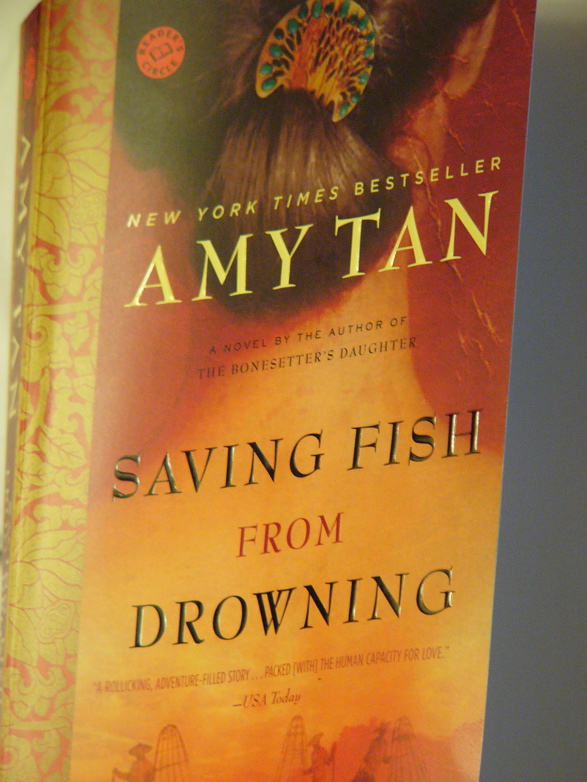
Amy Tan is always a rollicking good read. For one thing, her books focus on that big favorite theme of mine, cross cultural communication – and miscommunication. She has a keen eye, rapier sharp wit, and filets her characters neatly, but humanely.
Saving Fish from Drowning is about a tour group en route to China and Burma, told from the point of view of the tour group organizer – an art and museum patron who dies before the trip begins! She is with the group, however, in spirit – able to see everything, know what people are thinking, but not to intervene. Without her guidance, the group goes desperately awry – and it is funny, but also very very scary. You know something BAD is going to happen, and it isn’t going to be pretty.
Tan writes some great prose. Here is an excerpt about the main character, as she looks back over her life:
“But I ask myself now – was there ever a true great love? Anyone who became the object of my obsession and not simply my affections? I honestly don’t think so. In part, this was my fault. It was my nature, I suppose. I could not let myself become that unmindful. Isn’t that what love is – losing your mind? You don’t care what people think. You don’t see your beloved’s faults, the slight stinginess, the bit of carelessness, the occasional streak of meanness. You don’t mind that he is beneath you socially, educationally, financially and morally – that’t the worst I think, deficient morals.
“I always minded. I was always cautious of what could go wrong, and what was already “not ideal.” I paid attention to the divorce rates. I ask you this: What’s the chance of finding a lasting marriage? Twenty percent? Ten? Did I know any woman who excaped from having her heart crushed like a recyclable can? Not a one. From what I have observed, when the anesthesia of love wears off, there is always the pain of consequences. You don’t have to be stupid to marry the wrong man.”
Whew! Amy! You said a mouthful!
Mary Doria Russell Duo
Some of the very best books on cross-cultural miscommunications are written in science fiction, and by some of the greatest names, the oldies but goodies. Now I know by naming a couple, I am going to offend some of those out there by leaving out your favorites – please feel free to jump in (comments section) and make additonal recommendations.
One of the great classics is Robert Heinlein’s Stranger in a Strange Land. It is a hilarious book, with occasional moments of pathos, but an easy read, and an unforgettable book.
Ursula K. LeGuin’s The Left Hand of Darkness is another primer in the kinds of misunderstandings that can come with the best of intentions. She also deals with the changes that living in an alien culture makes in the visitor, as well as the visited.
More recently written is a duo by Mary Doria Russell. Her hero, Father Emilio Sandoz, is a Jesuit priest. Sent as an intergalactic evangelist, he runs into some serious problems. These are very strong book, adult books with adult topics and sexual content, not for those who want an easy read and feel good at the end. It is about spiritual testing, as well as survival. There are parts of these two books where you will laugh out loud, and parts where you will be so depressed you don’t want to continue reading. At the same time, they are deeply spiritual.
The saddest, funniest, most horrible part of all is that the worst things happen as a result of the very best intentions. Russel’s characters try to get into one another’s way of thinking – and fail miserably. The results are horrorific.
And yet . . . in the end, there is redemption. These are books that get you thinking, and keep you thinking for a long time. They stretch your mind, opening topics you never dreamed existed.
You can read either of these two books, The Sparrow and The Children of God as a stand-alone read, or you can read them together. I personally found The Children of God the better book, but because I find Russell so addictive, so insightful, I recommend them both. They are available from Amazon at around $10/each in paperback.
Recent Comments
Kitchen on Isiais: Winding Down intlxpatr on Shampoo Ginger tigerbutterya0c5ff1d… on Shampoo Ginger intlxpatr on British Soldier Kidnapped, Esc… John on British Soldier Kidnapped, Esc… Wikipedia Donate Button

Amazina


Early Voting in Florida


