Donna Leon: Read and Savor
When I tell you about Donna Leon, I am really introducing you to a friend. I can’t remember when we met, but I can tell you that I seek her out whenever I can. Just listing her books, I realized there were several I hadn’t seen and I ordered them immediately, from the Amazon re-sellers.
“Why the resellers?” you are asking. Donna Leon is not that easy to find, in the United States. Some of the books in her series seem to have been printed only in the UK, which is a pity, because The Donna Leon books really need to be read in order.
While they can be a quick read, they are better read slowly and savored. It’s not that hard. Her humor is subtle, sometimes even sly. Commissario Guido Brunetti, her main character, lives in Venice. He has a family, a sweet wife – Paola, and a daughter and a son. He eats Venetian meals, he lives in an illegal Venetian apartment, he has a glass of wine or two with his lunch. It helps to read the books in order, as his children grow from childhood to teen-agers, and to grow older with him as he solves his cases.
But in Donna Leon’s books, solving the cases is not the goal. As often as not, even while Brunetti solves the case, justice is not served. The books are about the living conditions and social realities of life in Venice, and in Italy. The books are about painful subjects – child prostitution, traffic in women, blood diamonds and African immigrants, and about art fraud and Mafia crime and big business. And the book is about Venetian and Italian interconnections, so that some crimes just disappear, some evidence just disappears, and Brunetti’s dunderhead of a boss tells him to just look the other way.
While each book is deceptively short, and written in clear, simple language, the books are richly complex, weaving a myriad of details into each page.
Thanks to Donna Leon, I know what it is like on a cold, rainy day in Venice, when the water rises and you have to try to walk on raised boards to get where you are going. I know what it is like to have a family emergency and the police vaporetto is in use elsewhere and to try to figure out the fastest way to run home, crossing bridges, grabbing a taxi, complicated by the canal system and tourist infestations in Venice. I know when policement get together for lunch in Venice, you don’t talk business until AFTER you have finished your exquisite pasta with truffles, accompanied by a glass or two of the fabulous house wine. Donna Leon has taken me there.
In Death and Judgement, the book I just finished, Brunetti is called by a police sergeant who has arrested a former police sergeant and wants Brunetti to come to the station. Brunetti’s conversations with the arresting sergeant always require a lot of patience:
(Brunetti) “Did the people in Mestre tell you to make out an arrest report?”
“Well, no, sir,” Alvise said after a particularly long pause. “They told Topa to come back here and make a report about what happened. The only form I saw on the desk was an arrest report, so I thought I should use that.”
“Why didn’t you let him call me, officer?”
“Oh, he’d already called his wife, and I know they’re supposed to get one phone call.”
“That’s on television, officer, on American television,” Brunetti said, straining towards patience.
We’ve all been there. Dealing with those who think they understand, and their understanding is . . . imperfect.
In another part of this book, in which the major issue is the big business of trafficking in women for prostitution, Brunetti is having a conversation with his wife:
Paula pulled gently on his hand. “Why do you use them?”
“Hum?” Brunetti asked, not really paying attention.
“Why do you use whores?” Then, before he could misunderstand, she clarified the question. “Men, that is. Not you. Men.”
He picked up their joined hands and waved them in the air, a vague, aimless gesture. “Guiltless sex, I guess. No strings, no obligations. No need to be polite.”
“Doesn’t sound very appealing,” Paola said, and then added “But I suppose women always want to sentimentalize sex.”
“Yes, you do.” Brunetti said.
Paola freed her hand from his hand and got to her feet. She glanced down at her husband for a moment, then went into the kitchen to begin dinner.
If you are reading that interchange too quickly, too superficially, you will totally miss the significance of the last sentence. If you have been married a long time, you will totally understand that a whole lot happened. This is one of the things I love about Donna Leon.
Death at La Fenice
Death in a Strange Country
Dressed for Death
A Venetian Reckoning
Acqua Alta
The Death of Faith
A Noble Radiance
Fatal Remedies
Friends in High Places
A Sea of Trouble
Willful Behavior
Uniform Justice
Doctored Evidence
Blood From a Stone
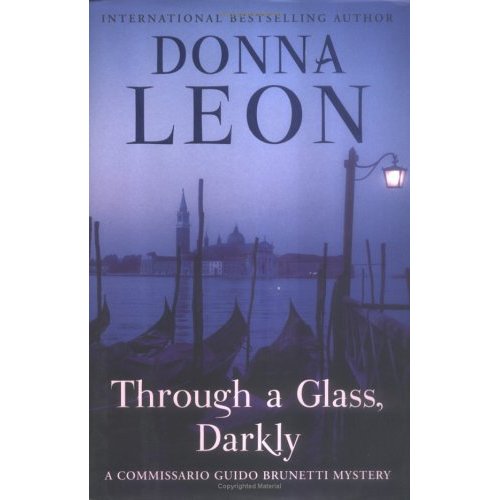
Through a Glass Darkly
“Was That Funny?”
When my son was little, he went through a time when he would make up jokes and tell us, and watch our reaction and ask “was that funny?” He wanted desperately to catch on to humor, but humor is a whole new way of thinking, and he was only four or five years old.
We started with riddles, I think, jokes in which words had more than one meaning, and then we moved on to knock knock jokes. But when he first started making jokes, he started with pure nonsense.
Around eight, we introduced him to Shel Silverstein, a brilliant poet, who writes books for kids that are also a joy for adults.

(photo courtesy of Amazon.com.)
Where The Sidewalk Ends
Light in the Attic
Falling Up
We all loved Shel Silverstein. Our son would read the poems aloud to us as we zipped around the back streets of Europe. We never got tired of him. His poems are funny to both children and adults “One Sister for Sale” “The King Who Loved Peanut Butter” . . . and sometimes poignant, or even sad.
Slowly, slowly, our son built up a huge repetoire of humor. Today, he is one of the funniest men I know, albeit most of his wit is very dry, and sometimes . . . I don’t always get it.
And that doesn’t begin to tackle the problem of “what is funny” crossing national and cultural boundaries! I think you have really arrived in a language when you can tell a joke in another language, and the native speakers find it funny.
Stephen King and Hearts in Atlantis
You can be talking with serious people and watch their eyes change when they find you read Stephen King. I refuse to back down. Yep, I read Stephen King. I think he is a brilliant author, some books better than others, but when I am reading, sometimes I can feel my blood move faster through my veins as I wait for a life-threatening situation to resolve itself.
I can trust Stephen King. He taps into who we really are. I can also trust that most of the good guys will still be standing at the end, and most of the bad guys will meet a truly horrible and well-deserved death. I can trust that when bad things happen to good people, other good people will gather round, band together and the gestalt of all that willingness to help one another will prevail against the darkness.
The scariest book I ever read by Stephen King didn’t have any monsters, per se. It didn’t have the Walking Man, or any Wolves of Calla or any great evil, other than the evil that lurks in the human heart. The scariest book I have ever read by Stephen King was Hearts in Atlantis.
Hearts in Atlantis wasn’t even a novel, it was several shorter stories combined in one book. But the title story, Hearts in Atlantis, was about addiction. Not just any old addiction, either, but an addiction I had experienced.
It was my sophomore year in university. I had sailed through the trauma of freshman year with grace, great grades, I felt very confident. That summer, back home, I had taken bridge lessons, and holy smokes – I loved the game. It all made sense to me, and I loved figuring the probabilities and the possibilities, who had what card, how I could finesse that card, how I could WIN. I loved winning.
During the summer after my freshman year, I played a lot of bridge. So it was no wonder, when I got back to school, that I discovered a whole world of bridge players. Early in the morning, before my first class, I would head for the student union and pick up a coffee – and often a game.
The problem was, if I had a particularly good hand, the little devil on my shoulder would whisper “if you skip your class, you can win this hand!” and the bigger problem was – I would listen. I could afford to skip a class here and there, I did the homework. But through the year, I spent more and more time playing bridge and less and less time in the library. At the end of my sophomore year, my grade point average had fallen one full point.
That got my attention. I really wanted academic success. I spent my junior and senior years desperately working to get my grade point average back up to an acceptable level. Once the GPA falls, however, it only inches back up incrementally. It took almost straight A’s to undo the damage I had done to myself the year of bridge playing.
After graduation, I fell back into bridge playing on the duplicate level. But after a while, I noticed that while I travelled from place to place, it was the same smoke-filled room in every new city where we ended up, surrounded by a vampire-like culture that slept a lot of the day and only came alive at night. I also noticed that most of the conversations were about “the one that got away” – how such and such a hand might have been played best. Yawn. Yawn. Yawn. So one day, I just walked away, and never looked back.
Like all addictions, from time to time I hear bridge calling. From time to time I will enter a friendly game – party bridge, but it is no longer irresistable, no longer so seductive, so attractive. Thank God. Reading Stephen King brings back the terror of addiction.
Anne Rice and Christ the Lord out of Egypt: A Novel
Remember Interview with a Vampire? Remember the feeling, as you read it, that you were probably treading very close to the essence of evil, and that evil was seductive and incredibly attractive? Anne Rice created a world of believable vampires, vampires you could identify with, vampires who created a cult following, and a legion of goth vampire wannabe’s, her prose was that seductive, that inviting, that . . . . irresistable.
Like a siren song, the voice pulled you from book to book, leading you along. With each book, a twist, and suddenly all the assumptions from the previous book were turned upside down, no longer valid when seen from another perspective. Rice lured you down the garden path step by step, and it’s hard to tell at what point you give up your will to resist the siren call.

Recently Anne Rice experienced a re-conversion to Christianity, and is now devoting her writing talents to serving God. This newest book, Christ the Lord out of Egypt, is as thoroughly researched as all the earlier books, and speculates on the early years of the Christ. The book opens in Egypt, with a seven year old Jesus, wise beyond his years but still a child. He sees things he doesn’t understand, he hears things he knows to be significant but doesn’t know why, and when he asks questions, like what happened in Bethleham around the time of his birth, Joseph and Mary, his parents, won’t answer. In fact, they don’t want him to bring up the subject at all, and they tell him they will give him the answers when he gets a little older.
Meanwhile, he hears things, and ponders them. He asks older relatives, and wise teachers. Little by little, he gathers pieces of a puzzle, the puzzle of his background and his identity. He accidently kills a playmate, and brings him back to life. He prays for snow, and it snows. He learns self control through the exercise of powers he doesn’t know he has, he learns to limit himself, and to hide himself.
With his family, they leave Alexandria and return to Jerusalem and then Nazareth, building a new life with their extended family. He grows, he ponders, and he is given a few more pieces of information.
You would think that with Anne Rice’s talent and with her research skills, this would be a fascinating book, but sadly, it is flat, and dull. I wonder why it is easy to make evil so seductively alluring, but it is so hard to bring goodness to life in a believable way? I read the book all the way through, hoping it would get better, but it never did.
There are people – Jan Karon comes to mind – who write about goodness and good people in a vibrant way, making goodness vital and attractive. Wish Anne Rich could find that vein.
Jean Plaidy and Courts of Love
My last day back in Seattle, I allowed myself a trip to the nearest Barnes and Noble. It was a shorter trip, only ten days, and full of family and family gatherings, centered around my father’s recent death. The days sped by, each full and exhausting.
I had already packed most of my bags. I do this so I know how much, if any, room I have. That way, I won’t buy too many books. I know myself. I know my vices. There is a part of me that says “how can there be too many books? How can there be too much of such a good thing?”
And then I am stuck trying to shovel books into an already overpacked suitcase, stuffing more into my stuffed backpack, shoving, re-arranging, tossing out old underwear to make way for yet another book.
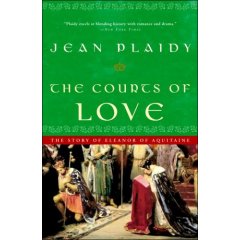
I only bought a few books, one of which was Courts of Love by Jean Plaidy. If you follow this link, you will find many reviews of this book that disagree with my opinion, and gave this book almost five full stars.
I have always held Eleanor of Aquitaine in great awe. Born in the Languedoc region of France, she was raised in a court full of literature and poetry, visitors from distant places bringing news. She was educated, and exposed to rule. She was expected to inheirit the rich province of Aquitaine until a younger brother was born, but, as was not uncommon in the times, he succumbed to a childhood illness, and she once again became the inheiritor of a fabulously wealthy and desirable province, the Aquitaine.
And if being the inheiritor of Aquitaine wasn’t enough, she was also thin, and elegantly beautiful, and educated, and she had spirit. She never felt herself limited by being a woman.
She first married Louis, King of France, who was nowhere near her match. She insisted on accompanying Louis on his crusade to free Jerusalem (failed) and upon her return to France met Henry, the heir to the English throne, secured a divorce from Louis of France based on the fact that they were distantly related, and then quickly married Henry, who was even less distantly related. She did as she wished.
Henry was several years younger than Eleanor, and they were both full of fire, and ambition. They had force, and strategic vision; as a couple, they were unbeatable. Eleanor gave birth almost yearly, mostly sons, and was happy until she discovered her husband’s multiple infidelities. His inability to be a faithful husband created a bitterness in her heart, a wall between the two of them. From time to time, Henry had Eleanor imprisoned to keep her out of his way. He believed she had turned his sons against him. But many times, he would need her, and call her out of her captivity to help him. It’s a bitch, being married to a king.
Where am I going with this review, you might ask?
I finished the book, and all I can wonder is how Jean Plaidy took such a fiery woman, a sensual and vibrant woman, and made her so wooden? It must be some problem in me, as the other reviewers give the book a much higher rating than I would, and I wonder if they are confusing their awe with the subject (Eleanor) with the quality of the book?
Or maybe I have become so used to Phillipa Gregory’s treatment that I am spoiled for Jean Plaidy? When you read The Queen’s Fool, The Other Bolyn Girl and The Constant Princess you are there, you are in their world, feeling their thoughts. The dialogue is rich and lively, you are surrounded by sensory clues, smells, feels, tastes – the world is richly created, and when you finish the book, you feel like you have travelled in time, as if you were really there.
Not so with Courts of Love.
I would rate this book far lower, because I DO admire Eleanor of Aquitaine, and I think she deserves an equally lively, richly sensual treatment. I want to know her world, I want to peek inside her mind and experience a little of what she experienced. I want Philippa Gregory to write about Eleanor of Aquitaine! Jean Plaidy, in my opinion, took an extraordinary woman, and make her less vibrant, and just a little drab. A grave injustice, in my book!
The Mysteries of Blogging
Every blogger will tell you – you can’t anticipate what your audience will love. There are pieces I labor over – mostly the travel pieces – and I get some comments, and the hits are steady over time, but nothing spectacular.
And then I will just jot off something in a hurry, and it will get hit after hit. When WordPress first came out with it’s snap-to feature, I wrote just a short blurb, and it gets several hits a day, even almost a month later.
But yesterday, all of a sudden, I started getting hits on Unexpected Pleasures a very abbreviated book report I wrote back in January on a book about belly dancing. If it were just one or two or three or four, I would have just thought it were a fluke, but it was 17, then 26, and finally 31 – in one day!
Most of the hits were coming from one referrer, and when I tried to check the referrer, it had some posts that were not public, so if she has mentioned my review, it is not visible to me. I wrote to Little Diamond who had reviewed the book, and she said she, too, had received a huge number of hits yesterday on that one obscure review.
It is a total mystery. No comments, just people peeking in. I don’t know what they are looking for. I don’t know why that one entry interests them. It is a blogging mystery.
“I’m A Third Culture Kid, Are You?”
Most of those who read my blog are not Kuwaiti, and it is for you that I am writing this post. So many of you who read me are also “Third Culture Kids.” My blogging friend Amer just wrote a post by the above title, and whoa! The responses will blow you away! Please go to I am a Third Culture Kid, Are You? and check in with your story – where you came from and where you are today.
And how being a third culture kid has affected your life. This is one of the best blog entries I have read.
The book from which the term Third Culture Kids comes from is mentioned in an earlier blog entry of mine, Chicken Nuggets and Big Macs and is by David C. Pollock and Ruth E. Van Reken. You can find it at Amazon.com. If you are a third culture kid, you might want to buy two or three – you will keep giving them away. The book is that good.
In the Headlights: Added to the Blogroll
I don’t remember how I came across this blog, at some time in December, but I remember laughing my head off. After two months, I find that she still delights me every time I visit. Today at In the Headlights (a reference to a common English phrase “deer in the headlights” meaning that wild-eyed-I -don’t-know-what-to-do-next-so-I’ll-just-stand-here-frozen look) Riannan shares an e-mail from a friend with curmudgeonly rules for 2007, and earlier on the page, shares a site where you can have mittens, etc. knit out of your pet’s lost hair! Dying laughing.
(And no, she is not a relative of mine. I don’t know her! I just like her blog!)
This woman comes across some of the most amazing things. She, like me, is all over the map – salsa dancing, books, great recipes (the latest was Oven Baked Sesame Scallops, oh yum!), stories about friends, some of the funniest signs I have ever seen, and screwball ideas. She can give your day a lift.
Google Earth – Map Your Books!
More news from Earthling (not quite my co-blog writer, but he sure gives me some good stuff to share with you 🙂 )
“This just launched, very cool. Google books search now lets you see a map of all the place mentioned in a book.
Go to books.google.com
Search for your book
Click the ‘about this book’ link.
example: Pride and Prejudice
The 9/11 Commission Report
911 Commission Report
Our Vanishing Wild Life: Its Extermination and Preservation
By William Temple Hornaday
Vanishing Wild Life
The great cities of the ancient world, in their glory and their desolation
By Theodore Alois W. Buckley
Ancient Cities
The Book of Ser Marco Polo
By Marco Polo, Henry Yule, Henri Cordier
Marco Polo
Adventures of Sherlock Holmes
By Arthur Conan Doyle
Sherlock Holmes
Kiss Kiss Bang! Bang!: The Unoffical James Bond 007 Film Companion
By Alan Barnes, Marcus Hearn
James Bond”
Travels of Ibn Batuta AD 1325 – 1354
Ibn Batuta
My comment: The maps usually showed up on the lower right part of the page, not always immediately visible, you have to scroll down. Not every page had a map, but the reference led to other similar books which had maps.
I didn’t even know Google had a book search section – and it is good! When I am reading, I like to read a train of books on the same subject – and I like the way Google gives small summaries which can give you an immediate indication whether this book will interest you or not. Thanks, Earthling!
Unexpected Pleasure
As I was leaving Seattle, my niece, Little Diamond, passed a book along to me. It’s part of our family culture – we read, and we pass along.
When my son was in university, I remember him telling me that I had addicted him to books. His first memory of books was living in Tunis, and when we would be going on a long trip, or when he had done something particularly good, I would pull down a new book from the shelf high up in my closet. Knowing he was approaching reading age, I had stocked up on books before we left.
As a student, he told me that as he approached final exams at university, he would motivate himself by telling himself that as soon as his last final was over, he could go to the bookstore and buy whatever the newest book out was that he was eager to read. Reading – for fun – during his school breaks was his great reward.
It’s that way for all of us. Before any trip, we stock up on good books to read. Before I left Seattle, I stocked up books for my Mother to read! We seek out places like Half Price Books (I do NOT own stock in Half Price Books) and Amazon.com to feed our habits. In our concern against running out of good books, we all have piles by our bed of books we intend to read. Some of my books have been there almost a year – since I moved to Kuwait!
So I accepted the book, Snake Hips: Belly Dancing and How I Found True Love, although I looked at the cover in dismay, and actually took it off for the trip. It’s about a Lebanese-American girl who goes in search of her ethnic roots. While at first I didn’t like her, I kept reading in spite of myself – the book drew me in. Little Diamond reviews the book here, (as well as several others that sound really good.)
This book was an unexpected pleasure – as are many of the books my book-voracious niece reads. The main character in this book has an unexpected wryly objective view of herself, is painfully honest, and you find yourself hoping she will find herself, and true love, in spite of her clumsy attempts.
Recent Comments
Kitchen on Isiais: Winding Down intlxpatr on Shampoo Ginger tigerbutterya0c5ff1d… on Shampoo Ginger intlxpatr on British Soldier Kidnapped, Esc… John on British Soldier Kidnapped, Esc… Wikipedia Donate Button

Amazina


Early Voting in Florida


