Hemingway and A Movable Feast

After reading The Paris Wife, I had to read Hemingway’s A Movable Feast. I wanted to see how he saw his Paris years, and how his version integrated with the fiction version of Hadley’s. I was prepared to not like the book.
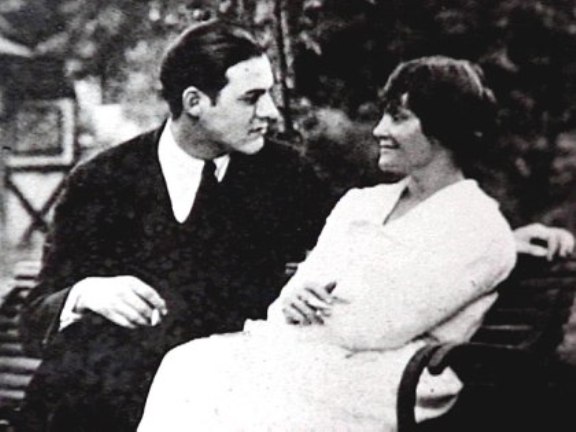
I was not prepared to like it as much as I did. Hemingway writes of the years when he was young, newly married and wildly happy, living a stimulating and lively life with lively friends. They were poor, but he was following his dream. They had a lot of fun.
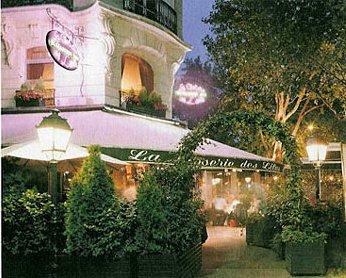
Hemingway wrote this book, full of stories of their Paris life, full of names you know – Ezra Pound, Scott and Zelda Fitzgerald, Picasso, Closerie des Lilas, Les Deux Magots, Brasserie Lipp, the Louvre . . . and as you read it, you are there. He writes in the moment; you are right there experiencing it along with him. He writes of people he likes, and people he doesn’t like. He writes about his own vices – an addiction to horse racing, for example – and he writes with enormous sadness about how he came to be distracted from his marriage and lost the most wonderful relationship that ever happened to him. He blames it on the careless rich. He takes some responsibility.
He also writes very frankly and openly about people he doesn’t like and why. I couldn’t help but think it is a heady thing, being an acclaimed author, where you can take revenge by putting people you dislike in your books. Hemingway uses real names and real people and often portrays them in a distinctly unflattering light. It made me wonder if he was planning to commit suicide all along; that or he just didn’t care what people think, and it seems he might have been the kind just not to care.
Just after finishing this book, and talking one last time with his first wife, Hadly, Hemingway committed suicide. It leaves me wondering if he was driven to suicide by regret, or by fears that his bigger-than-life life of adventure, travel, high life and travel was over, or if he had serious bouts of depression all his life, and this was just another, deeper depression?
It is a great read, especially paired with Paula McLain’s book, The Paris Wife. I thought it might be “he said – she said,” but Hemingway and the fictional Hadley in The Paris Wife both agree that they had a love and marriage that was very special, that Paris was a wonderful stimulating, alive environment, and that it was a great tragedy when the marriage ended. A Movable Feast seems to say that destroying his marriage to Hadley was one of a cocktail of self-destructive behaviors over which he tried to ride herd (gambling on the horse races, drinking, drugs, a coterie of star-struck sex partners outside of marriage, inability to focus on his work, a curmudgeonly nature . . .)

It’s also an easy read. I particularly enjoyed reading it on the iPad because you can do that swirly-finger-thing and find out what words mean or see the street locations as he walks Paris, see whether a cafe or restaurant in Paris still exist. It would be a good airline read – keeps your attention and finishes quickly.
As little as I like Woody Allen, it was fun to see Midnight in Paris, and to have some visuals of this go-go inter-war era.
Two things that stuck out for me: Hemingway loved walking in Paris, as do I. He also talks here and there about the benefits of being hungry. There were times when money was tight; they wore old shabby clothes, and there were times they didn’t have much food. He talks about hunger sharpening your other senses. On the other hand, very quickly when he has money, he has a great meal and a drink – or two – or three.
Bottom line, I’m glad I read this book. It’s given me a lot to think about.
Spy the Lie on the Diane Rehm Show

Thursday, July 24th, Diane Rehm had another wonderful show. Diane Rehm has a gift for asking thoughtful questions, listening carefully, and then following up with another thoughtful question. She treats her guests with great civility, but she never hesitates to ask the tough question.
Thursday, she interviewed Senator Marco Rubio, who did pretty well until she started asking him the tough, revealing questions, and you could actually hear him squirm.
Far more interesting than Senator Rubio was her interview with former CIA employees Philip Houston and Michael Floyd, discussing their new book Spy the Lie. We’ve all heard different ways liars give themselves away, but these two former interrogators told us how to ask questions, and a “cocktail” of responses – not one response, eyes shifting away, but a variety together – which tell you that you are being lied to.
Deflection, change of voice tone, swearing to God, anger at being asked – these and other giveaways work together. Bottom line – if your instincts are screaming “Lie! Lie!” then chances are good you are being lied to.
The truth is, most of us know when we are being lied to. There are times the liar will never admit to it, but you have to work with the knowledge that what he or she is saying is a lie. At least you know. You don’t have to buy into the lie. And you know my position – lying hurts the liar most of all.
James Lee Burke and the Creole Belle
James Lee Burke is number one on my guilty-pleasures list.

I first met his main character Dave Robicheaux in A Morning For Flamingos, a book I picked up in a military library at Lindsay Air Station, a post that doesn’t even exist any more. In the cold dark endless winter in Wiesbaden, Germany, James Lee Burke lit up my life. I had thought I was picking up just another escapist mystery novel, but when James Lee Burke puts words together to describe the way a storm moves in over the bayou, prose becomes poetry.
There is a downside. Whether it is his character Dave Robicheaux, the former New Orleans cop, now head homicide investigator in New Iberia, Louisiana, or his Hackberry Holland series set in West Texas, James Lee Burke’s books are filled with extreme violence and disturbing images that live in your head for a long time.
I’ve recommended James Lee Burke to friends, some of whom have said “Why do you read this trash??? It is HORRIBLE! It is full of over-the-top violence!”
And then again . . . he is writing about some really really bad people. They are out there. There are people who exist who inflict cruelty. I don’t understand it, I can’t begin to fathom where the urge would come from, but I’ve seen it. It’s out there. James Lee Burke pulls up that rock and exposes the dark happenings underneath.
On one level, as I started reading Creole Belle, I thought “Oh James Lee Burke, stop! Stop! It’s the same old formula! A downtrodden victim (often a beautiful woman) cries for help. You and Clete start looking for information and end up beating people up and then they retaliate by threatening your family! There is a rich, beautiful woman who seems vulnerable and who you kind of like, but she is complicated. There are rich amoral people who keep their hands clean, but who are calling the shots and never go to jail! Stop! Stop!”
Well, I should say that, and maybe I should stop. Then he starts talking about the smoke from the sugar cane fields and the bridge over the Bayou Teche, and the big Evangeline oak in St. Martinsville, and I am a goner. I’m sucked in, I’m hooked.
I detest the violence and the images. I keep coming back because James Lee Burke has some important things to say.
I’d love to have him to dinner. I’d love for him and our son to have a chance to talk about Law Enforcement. Here is what James Lee Burke has to say in Creole Bell:
There are three essential truths about law enforcement: Most crimes are not punished; most crimes are not solved through the use of forensic evidence; and informants product the lion’s share of information that puts the bad guys in a cage.
My son hates shows like CSI, and Law and Order, where the evidence convicts the criminals. He says it raises unreal expectations in juries, and makes it harder to get a conviction.
We watched a Violation of Parole hearing, or actually a series of hearings, where the judge asked each individual whose parole was about to be revoked what had happened when he or she was re-arrested. In each case, the parolee had done something stupid; drove a car with an expired license, drove to another state, was arrested driving drunk, etc. EVERY time. The judge made his point, I believe.
From Creole Belle:
But if Caruso was the pro Clete thought she was, she would avoid the mistakes and geographical settings common to the army of miscreants and dysfunctional individuals who constitute the criminal subculture of the United States. Few perpetrators are arrested during the commission of their crimes. They get pulled over for DWI, an expired license tag, or throwing litter on the street. They get busted in barroom beefs, prostitution stings, or fighting with a minimum-wage employee at a roach motel. Their addictions and compulsions govern their lives and place them in predictable circumstances and situations over and over, because they are incapable of changing who and what they are. Their level of stupidity is a source of humor at every stationhouse in the country. Unfortunately, the pros – high end safecrackers and jewel thieves and mobbed-up button men and second story creeps – are usually intelligent, pathological, skilled in what they do, middle class in their tastes and little different in dress and speech and behavior from the rest of us.
And then there are paragraphs like this that discuss the human experience, and have a far wider application than the book:
No one likes to be afraid. Fear is the enemy of love and faith and robs us of all serenity. It steals both our sleep and our sunrise and makes us treacherous and venal and dishonorble. It fills our glands with toxins and effaces our identity and gives flight to any vestige of self-respect. If you have ever been afraid, truly afraid, in a way that makes your hair soggy with sweat and turns your skin gray and fouls your blood and spiritually eviscerates you to the point where you cannot pray lest your prayers be a concesion to your conviction that you’re about to die, you know what I am talking about. This kind of fear has no remedy except motion, no matter what kind. Every person who has experienced war or natural ctastrophe or man-made calamity knows this. The adrenaline surge is so great that you can pick up an automobile with your bare hands, plunge through glass windows in flaming buildings, or attack an enemy whose numbers and weaponry are far superior to yours. No fear of self-injury is as great as the fear that turns your insides to gelatin and shrivels your soul to the size of an amoeba.
Last, but not least, this is what keeps me coming back to James Lee Burke, so much so that I buy the book almost as soon as it is released. James Lee Burke isn’t afraid to take on the big guys. He “gives voice to those who have no voices.” (Proverbs 31:8) His focus is always on the dignity of the common man, the dignity of hard work, done well, and on the dignity of doing unexpected kindnesses to those who have no expectation of kindness.
. . . All was not right with the world. Giant tentacles of oil that had the color and sheen of feces had spread all the way to Florida, and the argument that biodegradation would take care of the problem would be a hard sell with the locals. The photographs of pelicans and egrets and seagulls encased in sludge, their eyes barely visible, wounded the heart and caused parents to shield their children’s eyes. The testimony before congressional committees by Louisiana fisher-people whose way of life was being destroyed did not help matters, either. The oil company responsible for the blowout had spent an estimated $50 million trying to wipe their fingerprints off Louisiana’s wetlands. They hired black people and whites with hush-puppy accents to be their spokesmen on television. The company’s CEO’s tried their best to look ernest and humanitarian, even though the company’s safety record was the worst of any extractive industry doing business in the United States. They also had a way of chartering their offshore enterprises under the flag of countries like Panama. Their record of geopolitical intrigue went all the way back to the installation of the shah of Iran in the 1950’s. Their even bigger problem was an inability to shut their mouths.
They gave misleading information to the media and the government about the volume of oil escaping from the blown well, and made statements on worldwide television about wanting their lives back and the modest impact that millions of gallons of crude would have on the Gulf Coast. For the media, their tone-deafnessness was a gift from a divine hand. Central casting couild not have provided a more inept bunch of villains.
James Lee Burke has a voice, and he uses it. He could just cash in on his reputation as an Edgar Award winning author, but he uses his voice to speak out against injustice and corruption. He is a champion of the people. I’ve written several book reviews, and taken some trips just because I wanted to see James Lee Burke country; if you are interested in those, you can read them here.
I have a concern about this series, in that this book ended differently than all the others. So differently it made me seriously question whether Burke intends to continue writing about Dave Robicheaux or if Dave is about to hang up his shield and call it a day. He’s a guilty pleasure I am not yet ready to give up.
Barnes and Nobles: Paradise
We’d had guests, people we really like and admire, and now I was about to take them shopping. This kind of shopping is special. It is people-on-limited-budget shopping by people-who-may-never-visit-the-United-States-again and who have a lot of people hoping they will bring something back for them. We know this feeling – we’ve been those people on a limited budget who want to delight our family and friends with some exotic treasure.
I had a plan. Truthfully, I should know by now how it is going to work out, but I always plan bigger, just in case. This time, we started at TJ Maxx and The Dollar Store.
We park in a highly visible place. I know it sounds rude, but I escort them in, explain a few little things, then I go back to the car. I have a book with me, and Sudoku; they get to shop at their own pace without feeling like they are inconveniencing me. They have my phone number, and they know where the car is parked. Some groups come back and forth, many times, they bring packages, drop them, and head back again. This time, I didn’t see them, so after two hours, I went in and found them and told them this was their “one hour warning.” I had promised to have them back at their hotel by seven.
Almost on the minute one hour later, they came out, entered the car, and were so excited. One said she had finished all her shopping; she had something just right for everyone. The other said “Look! My friend wanted Bicycle cards! They had Bicycle cards!” They had found special gifts for all their friends and family, but the price was high. They had wanted to go to the Barnes and Noble store, but we had run out of time.
Deep sighs.
“It’s totally worth it,” the older one said, “I really really needed to have the peace of knowing my shopping was done. But . . . I’ve never seen the Barnes and Noble, only heard about it. Maybe I’ll have another chance at our next city . . . ”

I couldn’t bear it.
“The Barnes and Noble is only a short distance away,” I gave in, “I will take responsibility for getting you back late IF you promise me to only go in and look, just take a quick look, and come back out to the car.”
“Yes! Yes!” they both promised enthusiastically.
They were gone for twenty minutes. When they came back out, their faces were stunned. They got in the car, so silent I was afraid there was a problem.
The youngest leaned over, buried her head in her hands. She looked like she was going to be sick.
“What’s the matter?” I asked, alarmed.
“I almost feel sick,” she said. “So many books! We walked everywhere, but I stayed most of the time in the Business Management section; they had EVERYTHING. They had Who Moved My Cheese. Oh! They had so many good books, not the blah-blah-blah you get in textbooks, but the way they teach in parables, it’s so easy to understand their point. I can’t carry all the books I wanted to buy. I’m feeling shocked. All those books, right there where anyone can buy them! I want them all and I can’t have them.”
“You could order them, have them sent,” the older girl offered, and then remembered that no, she couldn’t have things sent in her country. She would never get them.
All the way to the hotel we had a great conversation about the flow of ideas, about censorship and the internet and cable television and Twitter, and how ideas flow more freely everywhere in the world, in spite of those who would try to restrict what their citizens might access. We also talked about freedom to travel – or the lack of freedom. We talked about families, caring for the elderly, and family responsibilities. We talked about what we’ve learned from one another, the truths travel teaches you about your prejudices and opinions, about others, and about yourself.
As I dropped them off, we all hugged, sadly realizing that we may never see one another again. Nonetheless, no regrets. Just the time I had with these two impressive young women was a great gift, and seeing the Barnes and Noble through their eyes – I will never again take a book shop for granted.
Hilary Mantel: Wolf Hall & Bring Up the Bodies
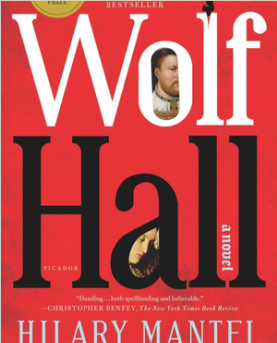

While it is unusual for me to comment on two books at the same time, Bring Up the Bodies follows so seamlessly the preceding book, Wolf Hall, as to be one book. It is also unusual that I would choose to read a book about Thomas Cromwell, whose great-grandson brings into dictionaries the adjective Cromwellian, and whose morals and values drift so far from my own. Most unusual of all is that I would find myself liking – and understanding – Thomas Cromwell as described and defined by Hilary Mantel.
While reading, if forced away from the book, I couldn’t wait to get back to it. I felt totally immersed in the 1500’s, I felt like I was there. Hilary Mantel uses the senses to bring an immediacy to the story that makes you feel you are there, participating, perhaps one of Cromwell’s clerks.
Thomas Cromwell has a rough beginning, son of a blacksmith and sometimes moonshiner, often beaten to within an inch of his life by his father, Walter, who seems to hate him. He leaves home and the next few years of his life are murky – he fights for the French, he becomes a servant and later a clerk in a high ranking Italian household, he learns the wool trade, and the silk trade, he spends some years in Antwerp and then he finds himself as chief clerk and messenger to Cardinal Wolsey, advisor to Henry VIII.
We experience losing our loved one to the plague. In these two books, through Cromwell’s eyes, we watch that spoiled, self-centered King Henry VIII rationalize his divorce of Katherine, and then the beheading of Anne Boleyn.
Here is something I hate about Thomas Cromwell, no matter how human and humane and lovable Hilary Mantel made him, that his primary value throughout was that whatever Henry wanted, he would work to make it so.
We learn early in Wolf Hall how very dangerous it is to go up against King Henry, we watch Cardinal Wolsey stripped of his honors, his luxuries, humiliated and defeated. We see Thomas More badgered to execution. So we can understand, a little, Thomas Cromwell’s motivation to keep his hard-earned money, honors, position, etc.
What I don’t understand is how a really, very smart man like Cromwell doesn’t see that he needs to be hiding his wealth away, investing in places where Henry can never find it, so that he can leave the King’s service, withdraw from public life and from the dangers that go with it. By the end of Bring Up the Bodies, Cromwell has made a lot of enemies. Such a nice man, such a benign man, but he relentlessly prosecutes the four men who may – or may not – have slept with Queen Anne Boleyn. It’s what the king wants. He does it.
This is a protrait of Thomas Cromwell painted by the famous Hans Holbein:

Wolf Hall won the Man Booker Prize in 2009. Bring Up the Bodies is sometimes referred to as Wolf Hall #2. These are books you can’t stop thinking about, and I am hoping there will be one more.
Leaving Nsefu for Chongwe; The Most Exciting Moment of our Trip
Early, early the next morning we heard a crashing and crunching – sounds we can easily identify as elephant. At first we continue sleeping, our only morning for sleeping in, but I can’t resist, I have to get up, and lo! The elephant is between our cabin and the next, obliviously chomping and breaking and tearing the tree for an early breakfast.
I decide to get up and get dressed so I can get the iPad charged before the generator goes off at 10, but I can’t go out until the elephant has departed, and she heads in the direction of the lodge, which is where I need to be. Deb Tuttle, the walking guide, walks with me once we see the elephant walk a little further down the valley, I’m able to get the iPad charging and grab a cup of coffee so to be able to say farewell to some of the guests whom we will not see again.
Sunrise over Nsefu:

Travel agents heading out on a Robin Pope Walking Safari:

Making Toast is the favorite job in the winter, close to the hot coals:

It is so nice to be able to pack in daylight! My iPad is at 100%; I have finished The Paris Wife and am starting Wolf Hall, which also holds my attention. While carrying books is bulky, this constant underlying awareness of needing to recharge camera batteries and iPad is also a deterrence. I find I am less desperate about the camera batteries, I always carry at least one back-up so I always have a charged spare, but when the iPad goes, it has to be recharged before we can use it again.
A couple of the travel agents who didn’t know each other had to bunk together in Nsefu. I don’t feel sorry for them; they get to come free. It seems to me, though, is hard to come on these trips as a single person and not feel the odd one out when the game drives go out. They say it is no problem, but I’ve been the odd one on trips to Kawazaa, etc., when AdventureMan wanted to do some activity and I wanted to do something else. It is possible, anything is possible, but sometimes it is just a little awkward. Sometimes people are nice; sometimes they are not so happy to have someone else with them. We are finding that the best of all worlds is to come with your own little traveling group.
The first time we came as a small group was with our son and his wife. We were able to do game drives with people who share our preferences, have people to talk to at dinner if everyone else has their group, etc. We like meeting up with other people, and at the same time, it gives you more confidence to have a group with you, if the other people are all absorbed in one another, or not great company.
The most difficult people are those who don’t understand that this is not a predictable experience – that’s why it is an adventure. There is no guarantee that the lion will crawl over the lip of the riverbank just in front of your car. There is no guarantee you will find the same great, shaggy maned lion at the salt pans that the other guests found the day before. There are NO guarantees, and so you have to treasure all the moments, great and small, and if you are blessed with an extraordinary experience, you celebrate, but honestly, just being here is cause for celebration. Those whose noses get out of joint because you might have seen something they haven’t aren’t a lot of fun to be around. We had one experience when a group that had been friendly to us got all sour and disgruntled because we had seen the lions at the salt pan and they had not. Hey! The lion don’t always show up! The leopard are elusive. This experience is one that totally has to be lived in the moment.
You have to love the smell of the campfire in the morning, and be willing to sacrifice your one morning of sleeping in to spot the elephant chomping outside your bathroom wall. You have to love the little elephant shrew as much as the elephant. There are some drives that are just quiet. It’s like you can’t expect Christmas every day, and if it were Christmas every day, it wouldn’t be special any more.
Just before Holly arrives to open up the Bend Over Store (LOL, it’s a trunk full of goodies) we are blessed with one last elephant crossing! Two days earlier, the elephant were crossing back and forth like a street in New York, then yesterday – not an elephant! It was so unearthly quiet! Today, groups are massing once again, and crossing. We love watching the baby elephants as they learn how it is done.
Drinking; getting ready to cross:

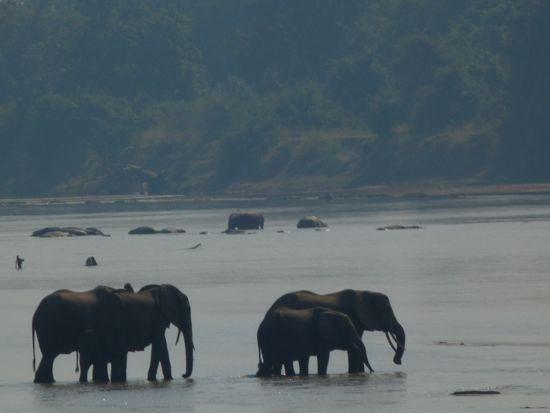

Mom, wait!

On the way to Mfuwe airport, we see Eland – we’ve been looking and looking for these large elk-like ungulates, they are shy and elusive, but Jonah spots them off in the distance, a parting gift from Nsefu.
We have an all-too-brief mad dash through Tribal Textiles, where we ‘invest’ in tablewares, cushion covers and deco for children’s rooms. AdventureMan befriends one of the Tribal Textile cats while I am busy shopping. I have cleared out my backpack so I would have space to put my purchases. 🙂
We have a full flight from Mfuwe to Lusaka, and not a lot of time to spare before our next flight. Smooth flight to Lusaka, just minutes to pick up luggage and transfer to next ProFlight flight, this one is not even on the departure board, only eight passengers, our party of four and a German family from Bavaria. At the very last minute another man comes running, running to catch the plane, we are all busy chatting, it is already a family. They are en route to Chiawa.
It’s a short flight, but here comes the most exciting moment in our day. The pilot is looking at a cheat sheet and the suddenly the plane is saying loudly “Pull Up! Pull Up!Terrain! Terrain!”
The pilots are looking confused and annoyed, one still looking at the instruction sheet, a mountain is rising in front of us, the plane is banking and the loud voice keeps saying “Pull up! Pull up! Terrain!”
I thought I had a movie of all this. I remember making a movie, thinking that if these are my last moments, I will record what happened and try to store the iPad in a place where it might be safely found. Of course, as it turns out, we landed safely and . . . somehow, I don’t have the movie. I must have shut it off too quickly and it didn’t save; I was in a hurry – just in case those were my last moments. I have to admit I am disappointed not to have it to share with you.
Waiting at the airstrip is Victor, our guide, and we rode with him and Chris, who turns out to be one of the owners of Chongwe, to the Chongwe River Camp.

(This is a waterbuck we passed on our way into camp, and again on our way out of camp the next morning; so so sad, part of the circle of life and death, but as we departed Chongwe, his bloated body was in the same field; they suspect he was bitten by a snake and died.)
Arrival is lovely, we are greeted at a tall stand, so we are not climbing in and out of the Land Cruiser, we walk right out onto this stand and down the steps. Flossie greets us and then they tell us that we have been upgraded and put in the family suite.
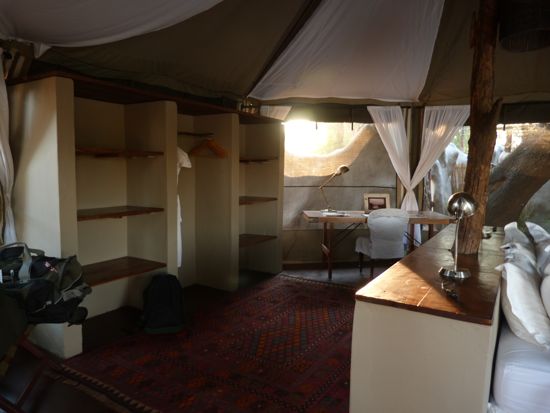
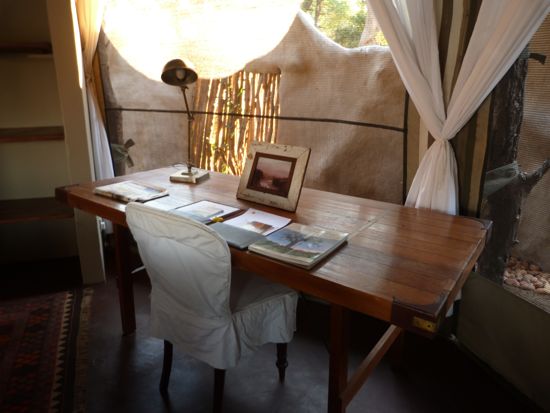
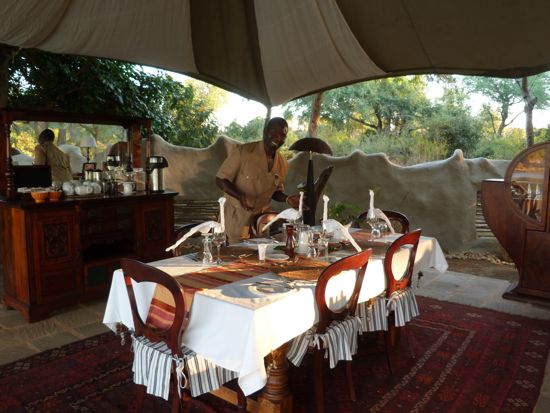
The Family Suite . . . As soon as we see it, we remember. We had totally forgotten . . . we loved our cabins at Chongwe, we were delighted with all the amenities, and we also remember our first boat trip riding by a place that looked like a fantasy from 1001 Nights, a tented living room and dining room, with carpets and nice furniture and linen tablecloths and gleaming candles – it was so lovely. We remember, it was the family suites. And now, the family suite was ours!
We were a little dazed by our good fortune, we couldn’t believe this lovely place was ours. Our butler, Steve, offered us drinks, Flossie, the camp hostess showed us to our bedroom/bathroom/dressing areas and explained how everything worked, where the electrical outlets and switches were, how the double shower works, where the bath oils were for the claw-footed bathtub, gave us the white cotton pique robes and the fluffy thick Turkish Towels.
This is our sleeping area:

This is our dressing area:
This is the view from our tent toward where the Chongwe River meets the Zambezi River:

This is our bathroom, with a two-person shower and claw-foot tub 🙂

And this is the desk area, also where we can charge our batteries and electronics:
This is our dining room:
The Family Room:

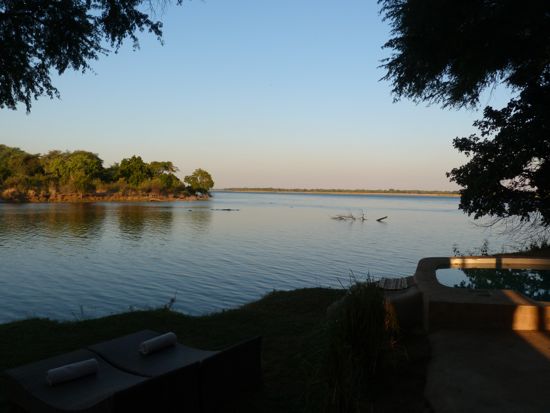
This is the view out over our swimming pool to the Chongwe and Zambezi Rivers, and the hippo pods:
There are woven mats and kelim carpets, and we feel at home, if home can be a huge octagonal tent with an indoor / outdoor feel. Victor comes back, pulling up in a boat next to our swimming pool,to take us for a sundowners up the Chongwe and then back down into the Zambezi.


And Victor has fishing equipment with him for the fishing enthusiast in our party. He is able to cast to his heart’s content with a rod and reel trying to hook a Tiger Fish (catch and release) but no luck.

We see lots of animals coming down to drink at dusk, just across the Chongwe:


Our first Chongwe sunset:

Dusk settles on the Zambezi:

After sundowners, we head back and go to our luxurious tents to clean up, then reassemble around the fire to have a glass of wine before dinner.
The ultimate luxury is privacy. We have met such lovely people in the camps, and still, I am who I am, it is hard for me to exert myself to be charming every night at the end of a long day. I do fine at breakfast around a campfire. I manage at lunch, although after an early start and a long game drive, I am usually eager for a quick snooze. But by night, at the end of the game drive, all I want is comfort food, quick, like tomato soup and a cheese sandwich, not so much chit chat and good night, see you all in the morning when I am more chipper.
I recognize there are people who do well later in the day. I recognize that there is this thing called civilized behavior. I do have manners, I know what is important, and . . . yet . . . late in the day, I have the nature of a curmudgeon. I need some quiet. AdventureMan and our friends are out having a great conversation in our living room area, I can hear them, I delight that they are having such a great conversation, and I really, really need to be in here, writing up my notes. By the grace of God, they understand me and have compassion on me. I am able to join them a little later, and we have a lovely laughter-filled dinner in our private dining room and then off to bed – we have a full day tomorrow in Chongwe!
The butler, Steve, does wonderful napkins:

We did nothing to deserve this beautiful upgrade. We loved the spacious tents we had the last time we were in Chongwe River Camp, but this . . . this is a totally unexpected, undeserved blessing, it just fell in our laps, and we are so appreciative. We feel so cherished, so blessed, so beautifully taken care of. We go to sleep with the sound of hippos . . . . .ZZZzzzzzzzzzzzzzzzzzzzzzzzzzz . . . . . .
PATRICIA WELLS AT HOME IN PROVENCE: Recipes Inspired By Her Farmhouse In France
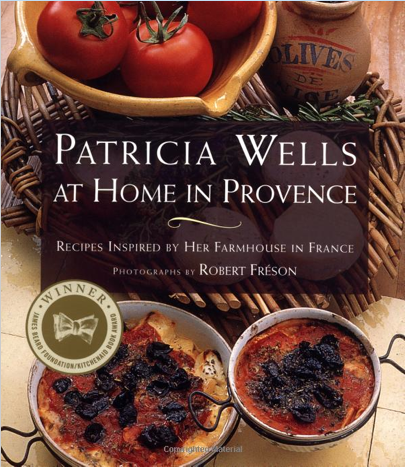
Ahhhhh. . . . . this is a gift for Father’s Day to AdventureMan, a gift that just keeps on giving.
The first night, he read it in bed, enthusiastically reading aloud ingredients for various recipes; they all sounded so delicious we were HUNGRY! Today we headed for the grocery store to find the crucial ingredients, which, because this book is very homey, are not hard to find. AdventureMan is making a pasta with sweet red peppers, and tonight, because we trust Patricia Wells, he is even going to add the Parmesan cheese which he sometimes hates. He has discovered that if it is really really good Parmesan cheese, it’s not so bad. (I don’t think he will ever like the stinky, salty Pecorino that I adore.)
I can hear him whistling in the kitchen as he prepares the onions and red peppers. My tummy is grumbling; I know this is going to be good!
We are Patricia Wells addicts. When we lived our many years in Germany, we had her books The Food Lovers Guide to France, and the Food Lovers Guide to Paris, and they were our major resources to go see things we might never otherwise have even known. She introduced us to Monsieur Fallot’s magnificent moutardes, and to La Duree’s hot chocolate and macaroons. We found kitchen shops and bakeries and charcuteries, and while she often led us into temptation, she never led us astray.
The recipes in this book are doable. She requires GOOD olive oil and fresh ingredients, we can do that. There is nothing very complicated or difficult – it’s home cooking, as only the French can do it. God bless you, Patricia Wells. 🙂
And now . . . to dinner 🙂
The Paris Wife by Paula McLain
The Paris Wife
Pauline Mclain
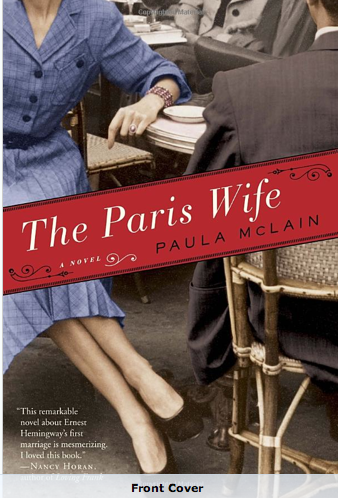
“This isn’t going to end well” you tell yourself when you start reading
this book, and you tell yourself not to read any further but you can’t
stop. This is a very good girl who meets a bad boy – what is it about
bad boys, anyway? You know you should go for the serious guy, the one
who will always have a good job, be a good provider for the family, a
good father to your children. You know all this, and you choose the bad
boy anyway. Why?
Hadley Richardson is a good girl at one of those transitional times in
history; world war I had ended, the damaged young men, including Ernest
Hemingway, are back from war, it is the 1920’s and the world is turned
upside down. When they meet, the chemistry is hot and strong. Their
friends warn Hadley against marrying “Hem” but when the attraction is
so hot and high, who can listen?
You know from the beginning that she is just the first wife, so most of
the book is full of dread, waiting to find out just how awful it is all
going to be. The early years, living in Paris, being dirt poor while
Hemingway gets started with his writing, are good years. They meet lots
of interesting expats living in Paris, they drink a lot, they are off
to Spain for the bullfights, and to Austria for the skiing, on the move
a lot, even once the baby comes.
It’s a fascinating book, a snapshot of the roaring 1920’s, of the
transitional era when women started becoming less submissive and more
free, and of a relationship between a nice girl and a talented but
damaged and self-destructive man. You’ll hate having to put it down.
Post review add: I finished this book while in Zambia and wrote the review. I really want to read A Movable Feast, now, Hemingway’s last book before he killed himself, written about this marriage. I understand it is a nostalgic tribute to his first marriage and to Hadley.
We watched Hemingway and Gelhorn last night, and watched him leave Pauline, the false friend who snatched him from Hadley (this is not a spoiler, folks, this is history) for Gelhorn, and then in anger at Gelhorn, turn to the woman who would become his last wife. She is protrayed as a total twit.
The movie, Hemingway and Gelhorn, was only mildly interesting; Kidman was her glorious self but there was zero chemistry, her romance with Hemingway barely believable. And he comes off as a real jerk. The jerk part is consistent with The Paris Wife, but while The Paris Wife is more sympathetic to Hemingway, portraying him as damaged but vulnerable, in Hemingway and Gelhorn, he is just arrogant, egotistic and obnoxious. Still, after you read The Paris Wife, it is interesting to see the rest of the story.
Jesmyn Ward and Salvage the Bones

You are fifteen, poor, black, and motherless as this book opens. Dad drinks, and isn’t around much. You are the only girl in a family of brothers. Having sex is no big deal, and there is one guy you really like, Manny.
Your oldest brother’s pit bull is having puppies, and you are having trouble with throwing up most of what you eat, especially every morning. Dad says a hurricane is coming, but he’s said that before, no big deal.
As this book opens, it has the feel of a myth of the nightmare kind. We know, because we have the benefit of hindsight, that the impending storm, Katrina, will be catastrophic. The Batiste family has already suffered a catastrophic storm with the death of their Mama, just after the birth of her last child. Throughout the book, we watch these children suffer the daily absence of their mother, raising one another, squabbling, but tenderly looking after one another.
If someone had told me about this book, I don’t think I would have wanted to read it. Amazon.com kept telling me I needed to read it, so finally, I did. From the opening page, I was in a world utterly alien from my own, and yet a world I could understand and inhabit. There are worse things than being poor, and one of them is heartless. This family has heart; they are loyal to one another, they look after one another and they sacrifice for one another. For all the violence – and there is a lot of violence – there is also beauty.
There is the familial love, and there is the love between Skeet, the oldest brother, and his dog, China. There is friendship, and good people who give you refuge in the aftermath of the storm. There is the stunning numbness of surviving the worst hurricane ever.
Jesmyn West has a deft touch, with the language, with the interweaving of the Medea myth, with non-verbal communication, with the complexities of families and love. This is a book worth reading.
Tinker Tailor Soldier Spy

We couldn’t wait. We saw the earlier version of Tinker Tailor Soldier Spy, you know, the one with Alec Guiness, and we couldn’t wait to see this new version, with Gary Oldman playing the Smiley role. He was awesome.
The LeCarre’ books featuring George Smiley are grim and grey, and the opening captures that exactly. The entire movie has a bureaucratic, institutional bleakness, with all the power plays, the petty snobberies, the jockeying for position that these bureaucracies seem to nurture. The only times in the movie when there is color and life is the annual bureau party, once done entirely in Russian, once in French.
The movie is faithful to the book, which I think I need to go back and read once again. It all seems so historical now.
One of the things we noticed was that the theatre was utterly quiet as the movie progressed. A lot of the action is in the mind, figuring things out, and trying not to get caught, so the suspense is of the subtle kind, not the car-crashing and jumping off buildings kind. It was as if the entire theatre were holding its breath; noticeable because of its rarity.
We were oddly jangled as we left the theatre, and over dinner we talked about how we never thought we would be obsolescent, but the Cold War has passed; the soldiers of today weren’t even alive when the Berlin Wall came down and the Iron Curtain parted and the cars flowed east. Life goes on.
There were several quotes, one that made us laugh was spies talking about recruiting other nationalities “You can hire an Arab but you can’t buy ’em.”
Recent Comments
ExpatAlien on What Country am I Living … intlxpatr on Yellowstone: Old Faithful to C… Michelle on Yellowstone: Old Faithful to C… Cathy on No Grown-Ups in Charge intlxpatr on Waiting for Snow Wikipedia Donate Button

Amazina


Early Voting in Florida


 Here There and Everywhere