Chimamanda Ngozi Adichie: The Thing Around Your Neck

Chimamanda Ngozi Adichie has compiled a series of elegant vignettes in her most recent book, The Thing Around Your Neck. I had just read Half of a Yellow Sun, and was still wallowing in stunned admiration, when I heard an interview with the author on BBC, and learned she had written this book, The Thing Around Your Neck.
I loved Half of a Yellow Sun. I loved Purple Hibiscus. I felt I began to understand just a little bit about life in transitional Nigeria, with all the social and political forces blowing to and fro, straining the very fabric of nationhood.
In The Thing Around Your Neck, something else happens. It shares with Cutting for Stone and other books I like the impressions of those who come to live in the USA for the first time.
“Would that the wee wee giftie gi’e us, To see ourselves as others see us . . . ”
I’ve had a lot of experience going to live in foreign countries. One of the things I learned is that most of what I learn the first couple years isn’t much. You learn a lot of things wrong. You filter everything through your own cultural biases; you judge, you interpret, you try to make sense of things that just seem wrong.
I love to watch Chimamanda Ngozi Adichie’s characters do this in reverse, come to America and make judgements based on their own cultural expectations. I love to see us through these eyes.
Once, many many years ago, we entertained a Nigerian in our home, and when we served dinner, steaks, he looked at his plate and said “This would feed my family for a week.” We kind of laughed. We kind of thought he was exaggerating, or even kidding. We just didn’t know. We had never seen anyone truly hungry, we had always lived in this land of plenty. We had no idea what we didn’t know. We saw only what we knew.
Each story is a gem. Each treats the expat experience, coming here, or the reverse, coming to America and then going back and seeing Nigeria through eyes which have changed.
One story I had read before, in the New Yorker magazine and loved reading again, The Headstrong Historian. It starts with a smart woman, weaving her way among the ways of her people, whose husband’s family wants her husband to take another wife. He doesn’t want to. These two chose each other, and managed to live their lives together as best they could, by their own standards. Her son disappoints her, but her granddaughter – she sees her husband’s brave, courageous spirit in the eyes of her little grand daughter. You’ll have to read the story to find out the rest.
Other stories have to do with newlyweds, with students, with love and marriage and affairs – the full spectrum of human experience, through Nigerian expat eyes. There are settings common from all three books, the college campus at Nsukka, a prison outside of town, small villages outside the city. If you read all her books, you recognize place: “Aha! I’ve been her before, in Purple Hibiscus!” You learn how to bribe the guards so you can bring in food for your imprisoned family member, you learn to keep your eyes down to show respect, you learn how Nigeria smells when the rains come, and how dry and dusty it gets during the harmattan.
I’m just sorry there isn’t another book by this author – yet – that I can read!
I guess these books that I love deal with a theme dear to my heart – that we are culturally blind to so many things, and that as human beings we are more alike than we are different. Short of packing up all our lives and our assumptions and moving to many different countries, the best we can hope for in learning different ways of thinking is for books like these by Chimamanda Ngozi Adichie, which show us how differently we perceive things, depending on our cultures, and how alike we are in the things that we feel, as human beings.
Chimamanda Ngozi Adichie: Purple Hibiscus
A couple of years ago, when we had a great book club in Kuwait, I read Half of a Yellow Sun, by this author, and I was blown away. Some books you just read for entertainment, and some books have such a strong, compelling voice that it comes back to you, again and again, and you think about it for a long time.

So when Amazon.com recommended Purple Hibiscus, I bought it, along with The Thing Around Your Neck. Purple Hibiscus is the author’s first book, and The Thing Around Your Neck is her most recent. In 2009, I found an interview with her online; you can watch it by clicking here: An Interview with Chimamanda Ngozi Adichie. She is an enormously talented author.
When I read Half of a Yellow Sun, I became Igbo, growing up in Nigeria. While that story was told through many eyes, I was able to be a boy from the bush brought to the college campus to be a houseboy, I got to be a wife, her sister, her professor husband. We experienced the Biafran succession, the insanity of several regime changes in Nigeria, the total fog and waste of war, through the eyes of the Biafrans.
Reading Purple Hibiscus was a little different; the story is told through the eyes of a girl, Kambili, who lives in a very controlled environment. We know from the very beginning that things are not right in her wealthy, beautiful world. Her father and mother love her, take good care of her, feed her, clothe her – and that is just a part of a bigger picture. Her father has an idea of the way things should be; he attained his position and wealth through his education by the Catholic priests and he has a rigid idea of how everything must be done. Vary from his strictures, and you get beaten, or scalded, or you little finger is broken and disfigured.
Part of what makes this book so compelling is that while the environment is Nigeria, and, to us, exotic, the climate of abuse is the same everywhere. It’s a dirty little secret, even in the wealthiest of families, you keep your mouth shut to stay alive, and to protect your family’s image. Abuse is no stranger to rich or poor families, and can only stay alive because people stay silent.
Kambili, fifteen when we meet her, lives a tiny, small, scared life, following the weekly schedules her father prints out for her and her brother and posts over her desk. She hears her mother beaten over the smallest failure, imagined or real. Her mother miscarries twice due to these beatings, and her father tenderly cares for the mother whose miscarriage his beatings caused. It is crazy-world. Kambeli and her brother are expected to take first in every class; if they do not, they, too, pay a severe penalty.
Just as the political climate in Nigeria starts to tremble and fall apart, so, too, does Kambili’s life, and in the falling apart, comes new ways of doing things, new perspectives, new risks and even learning to run, to laugh, to be ‘normal’ as other children are. She is blessed to have an aunt at the university, no where near so wealthy as her family but able to cajole her father into letting the children visit with her. The aunt, Ifeoma, laughs, and encourages her children to challenge other’s opinions respectfully, and who grows the very rare Purple Hibiscus. Her heart aches for Kambili and her brother, and she tries to give them space to figure things out for themselves, and to chose what they want for themselves.
It is a scary time in Nigeria, a time when men can come to the door and take someone away, and you don’t know if you will ever see them again, or how damaged they will be if they return. Kambili’s own life is full of a similar terror, but the terror is inflicted by someone who she loves, and who loves her.
I love the soul of an author who can write a book like this, a book that makes me feel like in another life I was a Nigerian. I can’t begin to think I know much about Nigeria now, but having read three books by Chimamanda Ngozi Adichie, I have the broad outlines of the divisions which traumatize and fracture Nigeria to this day. Even better, I understand how very different the cultural expectations are from our own, and how very similar we are as human beings.
This is a great read. It is inspirational. You might even learn something. You can find it on Amazon.com.
Jeannette Walls: The Glass Castle

The Glass Castle was a hugely popular best seller in the USA, and it must have been while I was gone. A part of me remembers reading a little bit about it and deciding it wasn’t my kind of book, but after reading Half Broke Horses, I had forgotten what the subject matter was and was excited to have another Jeannette Walls book I could read.
Big mistake. This book is nothing like Half Broke Horses.
Or maybe it is. Maybe what I loved about Half Broke Horses was the voice of an amazing woman, and maybe what kept me reading The Glass Castle is the voice of an amazing child who tells a heart breaking story. Or maybe it isn’t so heartbreaking, because the children survive. They are scarred and damaged, but never so damaged or loony or self-deceived as their parents.
I don’t like reading books about kids whose parents don’t take good care of them. Oprah chose a lot of those books in her book club. These books depress me. I cannot imagine how parents can be so self-absorbed, how they can take on the responsibilities of children and then not put those children first. How can they?
The Glass Castle stars the daughter of Lily Casey Smith, who is the mother of Jeannette Walls, and her husband, who is Jeannette’s father. The book opens with little three year old Jeannette proudly cooking up a hot dog. Her mother is busy painting and has told her to find something to eat. Her nightgown catches fire, and she is terribly burned. She spends a long time in the hospital, which ends with her father taking her out in a hurry, bundling her into the car, already loaded with her family, and “doing the skedaddle” which is leaving town just in front of the bill collectors.
This is her life. From time to time, their alcoholic Dad will take a job and bring home some of the paycheck (he drinks and gambles most of it) and when he won’t work, on rare occasion, their mother will take a teaching job, but the kids have to get her out of bed in the morning, have to grade her papers and make her lesson plans. Often there is not enough for the family to eat. They don’t stay in one place; they ‘skedaddle’ before they are evicted for non-payment of rent. They eat cold food – when they eat – because the parents didn’t pay the electric bill.
The Dad is smart, charming and cajoling, and when he is sober, the kids learn amazing things from him, and educated engineer. Unfortunately, he is not often sober. He chases after alcohol and he chases after women; the people in the towns where they live know it and the children learn to know it, too, to their constant humiliation. When he wheedles money off his kids, and promises to repay, he asks “Have I ever let you down?” The answer is so stunningly obvious as to be heartbreaking – Yes. Yes, again and again and again.
The Mother is equally irresponsible. One time, when the family is starving, she is in bed and occasionally goes under the covers, where Jeannette discovers her mother has a chocolate bar hidden that she can eat – while her children go hungry.
The author’s voice is never self pitying, she just lays it all out and leaves us to draw our own conclusions. Each child escapes the family as soon as possible; the children plan and save their money to get out, first sending off the oldest sister, then Jeannette, then the son. They all head for New York, where they find work and support themselves. Like bad pennies, Mom and Dad show up in New York, cadge meals and money and join the ranks of the homeless in New York, going from food pantry to soup kitchen, and diving dumpsters for their worldly needs.
This is not a feel good novel. The good part about it is that children can survive this kind of criminal neglect, and become a successful author as Jeannette Walls has done. I am so glad I read Half Broke Horses first, because her grandmother is such an admirable character, whereas her parents are scum and I just felt so angry when I read the matter-of-fact descriptions of their behavior that I was glad they were not where I could get my hands on them.
I don’t know any parents as bad as Rose Mary and Rex Walls, but I know I believe this – if you choose to marry, and if you choose to have children, know that children require time, and love, and energy, and patience. Know that if you have grand ambitions, or an addiction, or a character flaw, you won’t be able to provide for your children’s physical, emotional and spiritual needs, unless you are willing to sacrifice your own needs and wants. While the children in the book loved their parents, they recognized that their parents were sadly lacking in the parenting roles. The way these children were neglected will make me remember this book for a long time.
Would I recommend it? Yes. It is a gripping book, at times even horrifyingly humorous, as when Jeannette figures out how to find lunch food in the garbage cans when all the other kids have finished eating. It is not a feel-good book. It is a horrifying indictment of self-absorbed, neglectful parents, parents you will love to hate.
If I sound a little overwrought, it’s because I worked with the homeless. We were able to help many, but I also ran into families like this family, families who would prefer not taking any help if it meant they had to play by the rules, you know, rules like “you have to take care of your children.” We had all kinds of classes and forums and mentors to help with learning skills, like feeding children well on a small budget, learning to discipline, simple skills, survival skills.
The problem is that these skills require self-discipline, and many of the parents would rather not take help than have to exercise self-discipline. I saw women who would sacrifice their children for their current boyfriend, a woman who was severely angry with her daughter for reporting a family member had molested her, a man who didn’t want to take a job that would ‘tie him down’ when his family was starving. I saw this, with my own eyes, and there is no way you can MAKE people take good care of their children. You have to ask if the children are better off with these parents, or ‘in the system.’ Not a pretty choice.
This book, too, is on Amazon.com. Reading it is like watching a disaster on CNN. You don’t want to believe it is happening and you can’t look away.
Jeannette Walls: Half Broke Horses
About a month ago, I picked this up off the stack of “Read Me’s” . . . ummm . . . errr . . . one of the stacks of “Read Me’s.” (If there is some sort of emoticon for mild embarrassment, insert it here; one of my fatal flaws is acquiring book I WANT to read and having more books than I have time to read.)

I think Amazon recommended Half Broke Horses to me, and I didn’t know why. They keep track of what I buy and make recommendations, which over the many years I have been using Amazon.com to buy books has become more and more relevant to the kinds of things I actually buy and read. So I bought Half Broke Horses, and another one recommended by the same author, then put them in the stack. It is only because I had read whatever I put on top of them that I ended up reading.
I casually started reading, without a lot of anticipation. The first chapter starts off in the early early days of our country, in the wilds of West Texas, as a girl and her younger brother and sister are out checking the cows, who suddenly go crazy, even jumping over fences which under almost every circumstance successfully pen them in. The young girl recognized something strange was going on and figured it was a flash flood coming, got her siblings up in the tree and keeps them awake all night, as the flood hits, hoping the tree will hold and not wash away.
What is your first thought, reading that? Mine was – Where are her parents?? No one is out searching for them?
The next day, the flood recedes enough for them to make their way home back to a primitive dwelling hollowed out in the high side of a riverbank, dirt floors, dirt crumbling down on them, dark, small, smokey. Yes, there is a mother and a father, and they love their children, but these are very different times. These are hard times, where there is no grocery store, no nearby doctor, where babies die and children have fatal accidents all the time. Life can be short and brutal. The kids have some schooling, mostly at home, they learn to read and write and add and subtract, so they can keep track of home related business. They also work hard, every child has work around the ranch that needs doing, and work comes first or the family won’t survive.
The heroine, Lily Casey Smith, is a real person, the grandmother of the author, Jeannette Walls. This is called a true-life novel. From all the stories she heard about her grandmother growing up, and from knowing her grandmother, and from all the legends about her grandmother she was able to verify, she built a skeleton, and then filled it in with conversations and even a few events that she had to imagine.
Lily Casey left her family at 15 to ride her horse 25 days across Texas to take a teaching job in a one-room schoolhouse. (My jaw dropped, too!) After several years of teaching, she goes to Chicago to become educated and licensed as a teacher, marries, annuls the marriage, returns home, finds a teaching job, races horses, marries again, has children, has a huge ranch, loses the huge ranch, manages a huge ranch . . . her story is bigger than life, but so is the person of her grandmother, who never falls apart, but looks life in the eye and copes with it. Better than coping, she dominates.
Her major opponents are tough economic times, and dramatic and devastating weather conditions. Rain can fail to fall for months, cattle can die in an unexpected cold snap. At the best of times, you have enough to eat and a roof over your head.
I never wanted the book to end, and, in a sense, it didn’t. Jeannette Walls big best seller, The Glass Castle, takes up with just a little overlap where Half Broke Horses leaves off.
Here is what I loved: I loved the voice of Lily Casey Smith. She’s the kind of woman I want for a friend. She’s smart. She has a sense of how things work in the world. She experiences tragedies, but she doesn’t let them hurt her self-confidence. She can be beaten, but she always gets up again. She’s a problem solver. She never once lets being a woman get in the way of being the person she was born to be. She overcomes. She doesn’t sugar coat; she tells it as she sees it. And you know you can count on what she says to be the truth as she believes it. I truly hated for this book to end.
You can find this book at Amazon.com used under a dollar to new hardcover around $15. It is worth every cent.
Kentucky, Virginia, West Virginia and WOW
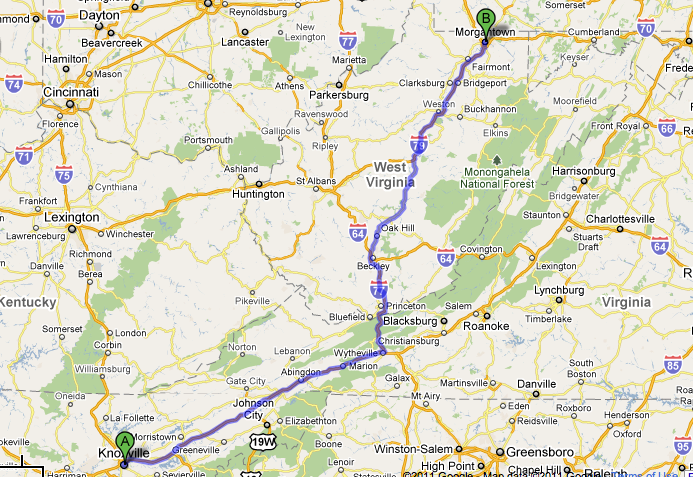
“Isn’t it funny,” I said, “here we are in West Virginia, and I haven’t seen an ounce of coal. Like here are all these mountains, there must be coal, West Virginia is famous for coal mines . . . ”
And just then we saw the first of the coal processing places to our right, huge, and it was just the first. AdventureMan laughed, it happened just as I was saying we had not seen any. I just finished reading The Glass Castle by Jeannette Walls, part of which takes place in Welch, West Virginia, but it was off our route, and I didn’t get to see it. I looked for run down shacks, and saw a few, but found West Virginia green, and beautiful and actually very prosperous looking.
All in all it was a really great day of driving. I got the first shift, and drove until lunch, when AM took over until time to stop. The WOW was that I discovered I can put in a destination and ask for directions on my iPhone, and the iPhone shows where we are as a pulsing blue dot, and draws a line to where we are going. The hotel we wanted was not in view from the highway, and we never would have found it otherwise. It was so totally cool; I could tell AdventueMan which street to turn on and which direction.
It’s quirky. There was actually another way, a way that did not take us through the University of West Virginia (!) and past the hospital entrance and through the parking lot (!) but it got us there, relatively directly, and it was a total hoot getting there.
I love this capability. I love my iPhone. We used to joke about how I needed one for our road trips, but oh, I never knew how much. I am having so much fun. I can just ask “hotel in Morgantown, WV” and it gives me so many options! I ask for BBQ restaurants and it gives me the nearest ones; it knows where I am! I love this capability!
There was another bad storm yesterday, in Oklahoma, with a lot of damage and people missing. Doesn’t it seem like there have been more damaging storms this year than most? I hope this does not foreshadow an active hurricane season.
Hilarious Book by Kuwaiti Author Danderma
Wooooo HOOOOO, Danderma! Published!
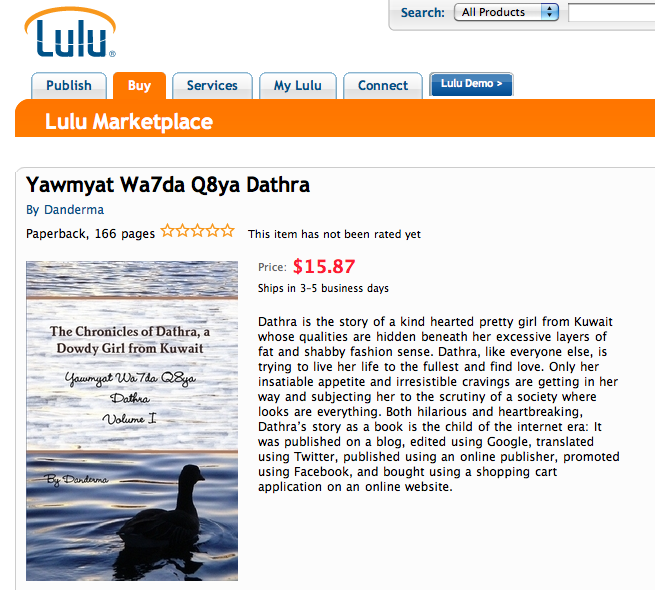
It’s easy to get addicted to Danderma / Dathra; she is unpretentious, sharply insightful, and hilarious. She pokes fun at herself – and at the society in which she (dys)functions. Side-splittingly funny stuff.
By the book or download Here.
More News From Better Books and Cafe in Kuwait
I wish Better Books and Cafe had been in Kuwait while I was there. And are people having luck with Magic Jack in Kuwait? We had one, and it stopped working. We thought it had been blocked or something.
Better Books and Cafe (Kuwait’s only used bookstore and cafe) has several announcements and a new contest for you.
Better Books and Cafe is on FACEBOOK
‘Magic Jacks’ are for sale – they facilitate inexpensive telephone calls between Kuwait and the USA and Canada
A database of our Classics, Cliffs Notes, Autobiographies and Fiction books is now available. Customers can now browse our database and reserve books via email. Nobel and Pulitzer Prize winning authors have been highlighted. Better Books has many more books than are not on the database yet. More will be added every month. Prices of books with multiple entries may differ as per publication;
A new toilet has been constructed just upstairs for Better Books – no m
Better Books and Cafe (Kuwait’s only used bookstore and cafe) has several announcements and a new contest for you.
Better Books and Cafe is on FACEBOOK – click here to ‘Like’ us;
‘Magic Jacks’ are for sale – they facilitate inexpensive telephone calls between Kuwait and the USA and Canada
A database of our Classics, Cliffs Notes, Autobiographies and Fiction books is now available (see attached, press ctrl+F if you’re looking for a particular book or author). Customers can now browse our database and reserve books via email. Nobel and Pulitzer Prize winning authors have been highlighted. Better Books has many more books than are not on the database yet. More will be added every month. Prices of books with multiple entries may differ as per publication;
A new toilet has been constructed just upstairs for Better Books – no more walking past the mechanic two buildings over.
The store has two additional bookcases, an extra beanbag chair and one more plush carpet.
Most genres are now segregated and labeled making books easier to find – we even have a separate shelf for books made into movies!
Upcoming Events at Better Books and Cafe:
Art of Living will start a course 24-28 April. Contact us for more information;
Due to the success of the Nithyananda Yoga Center courses held this month, there will be yoga twice a week and a 3 day ‘silence meditation’ course at their premises. Contact 25635450, 99838117 or 99315825 for more information
A second Gavel Club has been formed so your teenager is welcome to attend a Gavel Club meeting every Friday night free of charge. A nominal charge is requested if/when they join. Gavel Clubs are Toastmasters-sponsored groups for teenagers and allow active members who put in effort to gain confidence and expertise in the art of public speaking and develop their leadership skills. For more information, call/email Anil Lobo 99283020 / anilrlobo@yahoo.com. or Xavier Muthu 9985 0173Xavier.Muthu@trade.gov
Expat Mums is a new online community called recently set up for expatriate mothers of all nationalities here in Kuwait. They have regular events such as playgroups, stroller walks, mums’ lunches/dinners/coffees, and soon to be Story Times and Music Times at Better Books Bookstore. There are also specific sections for Classifieds & Reviews of local businesses in our secure online website. The group is open to all regardless of faith/origin/belief. To join this community, please visit http://www.expatmumskwi.com
And lastly “MOVIE NIGHTS” will return to Better Books and Cafe in May. Please vote for the movie you would like to see:
May 14 6-8pm Georgia O’Keeffe or Blood Wedding
May 21 6-8 pm Himalaya or Pope Joan
May 28 6-8 pm The Hound of the Baskervilles (1939) or Frankenstein (1994)
BETTER BOOKS AND CAFE CONTEST
Match the correct novel to its first line to win a PRIZE.
1. _____ If I am out of my mind, it’s all right with me, thought Moses Herzog.
2. _____ It was a queer, sultry summer, the summer they electrocuted the Rosenbergs, and I didn’t know what I was doing in New York.
3. _____ 124 was spiteful.
4. _____ It was a bright cold day in April, and the clocks were striking thirteen.
5. _____ Many years later, as he faced the firing squad, Colonel Aureliano Buendía was to remember that distant afternoon when his father took him to discover ice.
6. _____ Call me Ishmael.
7. _____ It is a truth universally acknowledged that a single man in possession of a good fortune must be in want of a wife.
8. _____ In my younger and more vulnerable years my father gave me some advice that I’ve been turning over in my mind ever since.
A. Beloved
B. The Great Gatsby
C. 1984
D. Moby-Dick
E. One Hundred Years of Solitude
F. Herzog
G. The Bell Jar
H. Pride and Prejudice
Prizes must be collected at Better Books before 16 May 2011.
All mentioned books are available at Better Books – reserve them today.
Feel free to forward this email to your friends.
Lunch in Paris (A Love Story With Recipes) by Elizabeth Bond
I just finished this book, and I need to review it so that I can pass it along to my daughter-in-law, who sees France, as I do, through eyes of love. Americans either love France or hate it, for some reason France evokes strong emotions one way or the other.

This author is a New Yorker, and her experiences are not my experiences, because her culture is not my culture. New York is a culture all its own. On the other hand, her experiences as an expat are universal, and her insecurity with the language, the culture and the customs are magnified by her commitment to marrying a French man and living in France for the rest of her life.
For the record, I really loved this book.
Can you read a recipe and have a pretty good idea what it is going to look like and how it will taste? In my family, we read cook books for fun. The recipes Elizabeth Bond has included are great recipes, a great start on French cooking the simple and fresh way. Even someone who has never cooked French food can make most of the dishes she creates in this book. In my very favorite chapter, A New Year’s Feast, there are several recipes for North African dishes I have eaten and loved – and oh, I am eager to try these! Chicken Tajine with Two Kinds of Lemon! Tajine with Meatballs and Spiced Apricots! Oh, YUMMMM!
In one part of the book, the author talks about some very basic differences between how Americans approach life and how the French view life:
I watched the couples walking around the lake. “Maybe it’s the New Yorker in me. I’m too used to rushing around. But everyone here is so relaxed, it’s like they’re moving in slow motion.”
“Why should they rush? They’re not going to get anywhere.”
Sometimes I really have no idea what he is taling about.
“You will never understand. You come from a place where everything is possible.” We lay side by side on the grass, our eyes half closed.
“It’s Henry Miller that said, ‘In America, every man is potentially a president. Here, every man is potentially a zero.’ ”
And then he told me a story.
“When I was sixteen it was time to decide what kind of studies I would pursue. I was the best in the class in Math and Physics, but also the best in Literature. I went to the school library and the woman behind the desk gave me a book. It was called All the Jobs in the World. I looked through it. I found two things I liked: scientific researcher and film director. I brought the book to the front and showed her my choices. ‘Ah non,’ she said, ‘You forgot to look at the key.’ And she pointed to the top of the page. Next to each job were the dollar signs – three dollar signs if the job paid a lot of money, one dollar sign if it paid very little. Next to the dollar sign was a door. If the door was wide open it was very easy to tet this job, if the door was open just a little bit, it was very hard. ‘Regard,‘ she said, ‘You have picked only jobs with no dollar signs and a closed door. Tu n’y arriveras jamais. You will never get there.”
‘You should become an engineer,’ she said. My parents never met anyone who did these other things. We don’t come from that world. They had no friends they could call to get me a job. They were afraid I would fail and they couldn’t help me. They were afraid I would have no place in the society. And I didn’t have the force to do it myself. I didn’t want to disappoint them. So I became an engineer.”
“It’s just like that here. If you want to do something different, if you head sticks up just a little, they cut it off. It’s been like that since the Revolution. You know the saying, Liberte,’ Egalite,’ Fraternite,’ equality is right in the middle. Everyone has got to be the same.
Of all the stories Gwendal has told me, before or since, this one shocked me the most. Never in my life, not once, had anyone ever told me there was something I couldn’t do, couldn’t be.
Have you ever known an expat wife (a woman who has married a man of another culture and lived in his country)? Expat wives are some of the bravest women I have ever met. No matter how long you have been married to a man of another culture, you can still be surprised.
The expat wives I have known have been smart, gifted people, woman who have been blessed to see the world through the eyes of more than one culture, and it changes everything. Their children are amazing – most will speak – and think – in more than one language. They have a sort of international fluidity, as well as intercultural fluency. It isn’t everyone’s choice, but those who chose it often live lives you and I can only begin to imagine. Elizabeth Bond has opened the door a little, and shared some of those experiences with us.
The book I bought has Reader’s Groups questions in the back, and they are good questions. Read the questions first; it gives you food for thought as you read through her experiences.
News from Better Books and Cafe in Kuwait
I found this in my e-mail this morning, and I am happy to share it with you – another book store in Kuwait, and this one sounds like it has wonderful books.
I am only curious about one thing . . . they sent it to me by my real name. At my real-name e-mail address. . . How do they know me (she ponders . . .)?
News from Better Books and Cafe – Kuwait’s only used bookstore and cafe (don’t miss the contest!):
Collectible and Rare Books for Sale: 10 KD – 300 KD to include The Arab of the Desert by H.R. Dickson and 40 Years in Kuwait by Violet Dickson. Also, a book signed by President John F. Kennedy.
Return Policy: Return a book bought from us and get 1/2 purchase price back in store credit for your next purchase. Read, return and save.
Book Buying Policy: We give store credit for most books. Bring them in for evaluation.
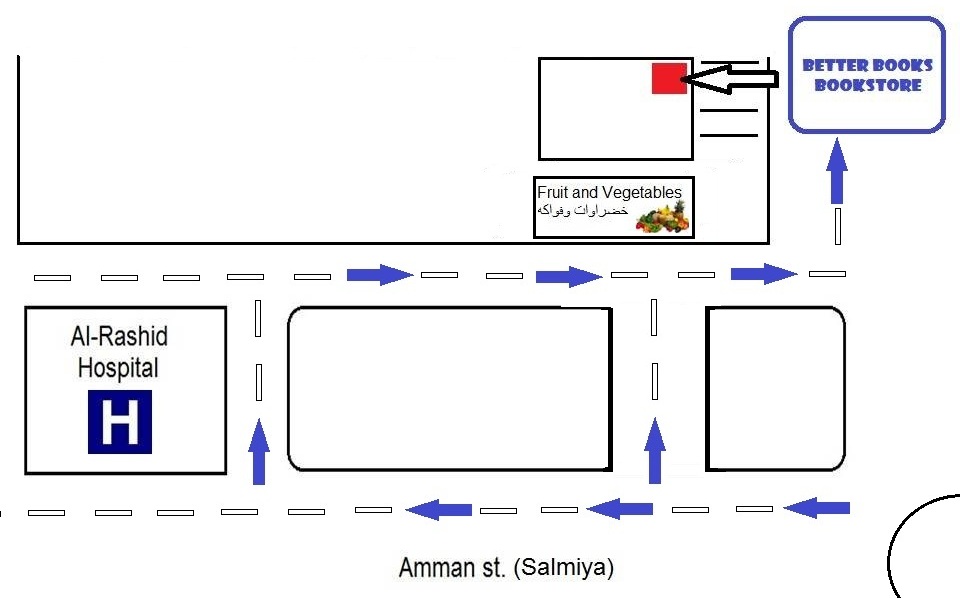
Hours/Phone/Location: 10am-8 pm daily. Cell 66637351. Behind Al Rashid Hospital.
Directions:
Take 4th Ring Road to Salmiya
Past Highway 30
Past Fire Station on Right
At light – Amman Street – take right
through next light
See Al Rashid Hospital on Left
At Roundabout take a U-turn
Now see attached map
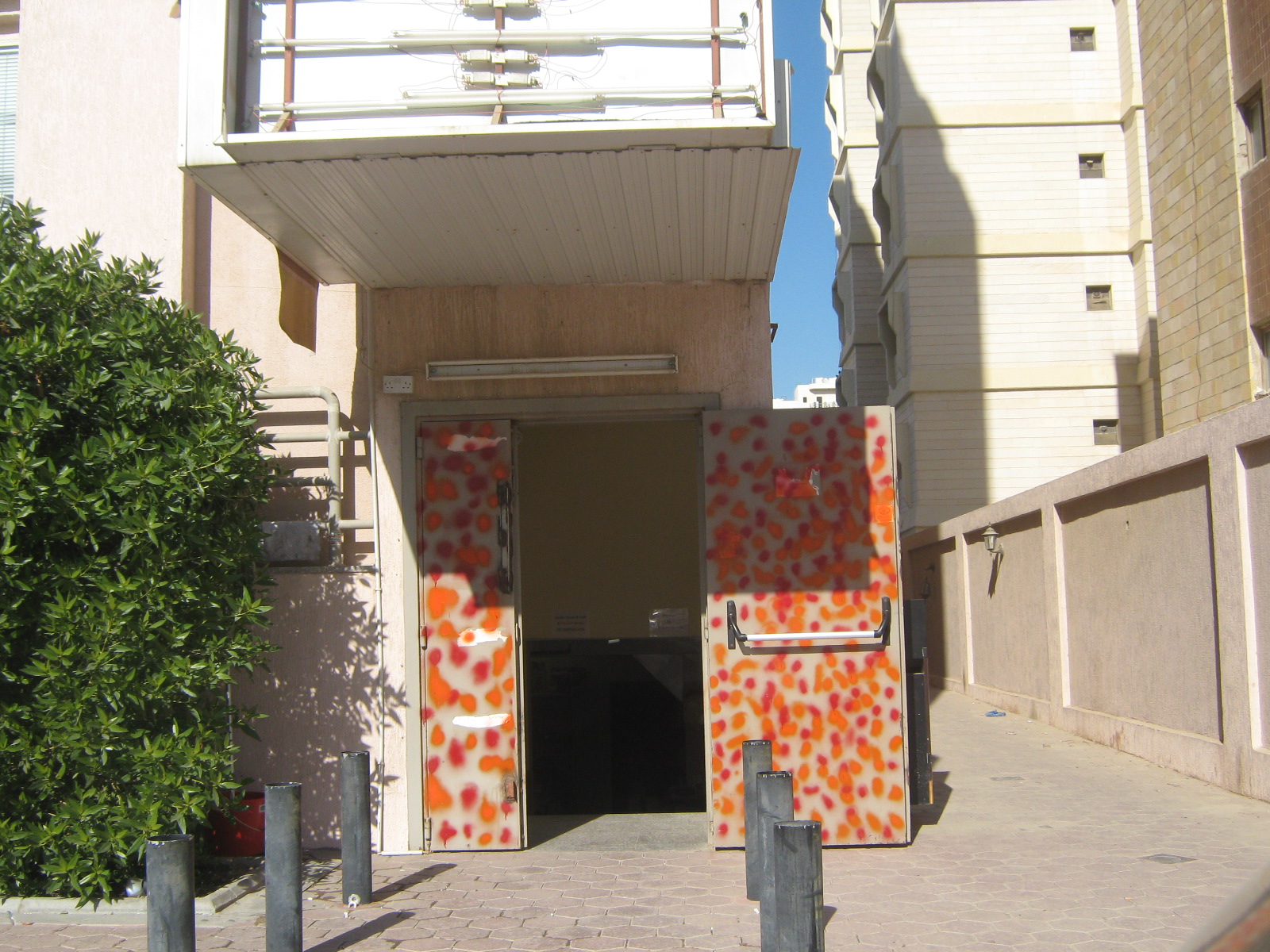
Look for RED/ORANGE door (photo attached)
TOASTMASTERS MEETINGS –
Desert Pioneers Club 2nd and 4th Tuesday 7.15 – 9.05 pm
Timbre Talkers 1st and 3rd Tuesday 7.15 – 9.05 pm
Capitol Speakers 1st and 3rd Saturday 6.30 – 8.30 pm
Bright Horizons 2nd and 4th Friday 9.30 – 11 am.
GAVEL CLUB MEETINGS Every Friday Night 5.30 – 7.30 pm.
In April, there will be Healing, Meditation, and Reiki classes at Better Books. Email jsshetty99@yahoo.com or call 99315825 for more details.
Better Books is now on FACEBOOK! Click THIS and ‘like’ us for regular updates – new arrivals, events etc.
Better Books sells 1 KD books on http://www.souq.com FREE DELIVERY
Contest from Better Books and Cafe:
Answer the following questions correctly and be among the first five correct email replies to receive 1 KD off your next purchase.
1. Who wrote 40 Years in Kuwait?
a. H.R. Dickson
b. Violet Dickson
2. What organization do ‘The Capitol Speakers, Desert Pioneers, Bright Horizons and Timbre Talkers’ belong?
a. Toastmasters
b. Gavel Club
3. What well known British saying adorns a red poster at Better Books?
a. Keep Calm and Carry On
b. When going through hell, keep going
Just return this email with answers to 1, 2, and 3.
Feel free to forward this email to your friends.
Here is what the entrance looks like:
If I were in Kuwait, I would be on their waiting list for copies of The History of Architecture in Old Kuwait City by Saleh Abdulghani Al-Mutawa, one of the most interesting books I read in Kuwait about how houses used to be built, why, and why modern architects need to pay attention to the lessons of the past.
Alexander McCall Smith and The Saturday Big Tent Wedding Party
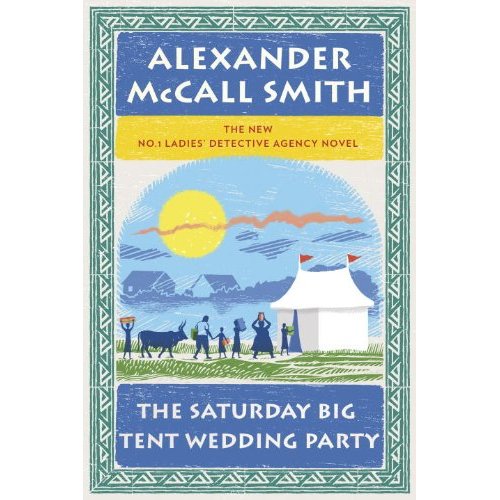
Just back from a wonderful two day trip to Botswana, visiting my dear and beloved friend Precious Ramotswe, who owns the #1 Ladies Detective Agency. For her, I make an exception to the paperback book rule (buy paperbacks because hard covers can hurt you if you fall asleep and they fall over) and get on the pre-publication order list so that Amazon will send me the book as soon as it comes out.
The Saturday Big Tent Wedding Party arrived Wednesday night. My husband was expecting a friend, and when the doorbell rang I thought “oh my, he is really early!” but it was the UPS guy, who had left a book-sized package on my doorstep. I had just finished an easy but fun book (The Map Thief by Heather Terrell) and was at odd ends as to what to read next, and this was an easy answer. As my husband drank Arabic coffee and sweet sweet Arabic tea, and ate delicate Middle Eastern treats downstairs, I got to start The Saturday Big Tent Wedding Party.
You know the books. They aren’t difficult to read, but while you are reading, you are transported to another world. Precious Ramotswe’s Botswana is not a world without problems, but the solutions to the problems are often found in softer gentler ways, ways that would seem counter-intuitive in our culture, but make total sense when you are raised in Botswana. There is a value placed on peaceable interaction, and maintaining relationships, on forgiveness, and going to extra mile. It’s a sweet world, and a great escape.
As usual, there are several intertwining plot lines with ingenious and unexpected solutions. I suspect that is what keeps me glued to this series – I cannot anticipate the solutions. That, and the gentleness of her outlook, the sweetness of life in Botswana, and the dignity and integrity of McCall’s primary characters.
I don’t know how McCall manages to keep the series fresh, but he avoids the formulaic and I find each book a treat. My favorite part of this book is how Mma Potokwane manages to wangle and invitation to Mma Makutsi’s wedding:
Mma Potokwane noticed the other woman’s uncertainty. “Yes,” she continued. “There’s that problem. And then there’s another problem. Problems come in threes, I find, Mma. So the next one – Problem number two, so to speak – is the cooking of food. You know what I find, Mma, it is this: the people doing the cooking never have enough pots. They say they do, but they do not. And right at the last moment they discover that there are not enough pots, or, more likely, the pots they have are too small. A pot may be big enough to cook your meat and pap at home, just for a family, but do not imagine that it will be big enough to cook for a couple of hundred people. You need big, catering-size pots for that.”
She was now warming to her theme. “And the third problem is the food itself. You may think that you have enough for the feast, and you may be right when it comes to the meat. People usually have enough meat – often rather too much, in fact. But they forget that after their guests have eaten a lot of meat, they need something sweet, and often they have made no arrangements for that. A wedding cake? Yes, but there will only be one small piece of that for each guest – usually not enough. So people find themselves wishing that they had had the foresight to get a supply of ordinary cake for the guests to eat with their tea. And where is this cake? Not there, Mma.”
Mma Ramotswe glanced at Mma Makutsi; this was not the way to speak to a nervous bride, she thought. “I’m sure that everything will work out well,” she said reassuringly. “And if there are any problems, they will surely just be small ones – nothing to worry about.”
Mma Potokwane looked doubtful. “I hope so,” she said. “But in my experience, it never works out like that. I think it’s better to be realistic about these things.”
Mma Makutsi picked up her pencil to add something to her list. “You said something about pots, Mma. Where would I be able to get these big, catering-size pots?”
Mma Potokwane examined her fingernails. “Well, we have them at the orphan farm. Each of the house mothers has a very large pot. I’m sure that we could do something . . . ”
Run to your bookstore and buy The Saturday Big Tent Wedding Party!
Recent Comments
ExpatAlien on What Country am I Living … intlxpatr on Yellowstone: Old Faithful to C… Michelle on Yellowstone: Old Faithful to C… Cathy on No Grown-Ups in Charge intlxpatr on Waiting for Snow Wikipedia Donate Button

Amazina


Early Voting in Florida


 Here There and Everywhere