Driving in Qatar
Almost every day, the two articles garnering the greatest number of hits have to do with new traffic rules in Kuwait and in Qatar. I think I wrote the posts in 2009. Here is what the US Department of State has to say to US Nationals about driving in Qatar:
TRAFFIC SAFETY AND ROAD CONDITIONS: While in Qatar, you may encounter road conditions that differ significantly from those in the United States. The information below concerning Qatar is provided for general reference only and is subject to change at any time. Current traffic regulations may be obtained through the Ministry of Interior’s Traffic Police.
Short-term visitors should obtain a valid International Driving Permit prior to arrival and should not drive in Qatar on a U.S. driver’s license. New and prospective residents should obtain a permanent Qatari Driving License immediately after arrival. To obtain a Qatari driver’s license, U.S. citizens need to pass a driving exam, including a road test. Short-term visitors and business travelers can also obtain a Temporary Qatari Driving License by presenting their U.S. driver’s license at any branch of Qatar’s Traffic Police.
Traffic accidents are among Qatar’s leading causes of death. Safety regulations in Qatar are improving, thanks to a more stringent traffic law adopted in October 2007 and a country-wide traffic safety campaign. However, informal rules of the road and the combination of local and third-country-national driving customs often prove frustrating for first-time drivers in Qatar. The combination of Qatar’s extensive use of roundabouts, many road construction projects and the high speeds at which drivers may travel can prove challenging. The rate of automobile accidents due to driver error and excessive speed is declining but remains higher than in the United States. In rural areas, poor lighting, wandering camels and un-shouldered roads present other hazards.
Despite the aggressive driving on Qatar’s roads, drivers should avoid altercations or arguments over traffic incidents, particularly with Qatari citizens who, if insulted, have filed complaints with local police that resulted in the arrest and overnight detention of U.S. citizens. Drivers can be held liable for injuries to other persons involved in a vehicular accident, and local police have detained U.S. citizens overnight until the extent of the person’s injuries were known. Due to its conservative Islamic norms, Qatar maintains a zero-tolerance policy against drinking and driving. Qatar’s Traffic Police have arrested Americans for driving after consuming amounts of alcohol at even smaller levels normally accepted in the U.S.
Any motor vehicle over five years old cannot be imported into the country. For specific information concerning Qatari driver’s permits, vehicle inspection, road tax and mandatory insurance, please contact either the Embassy of the State of Qatar in Washington, DC or the Consulate General of the State of Qatar in Houston, Texas.
There are things that the Department of State is too diplomatic to tell you, and that people living there will not write for fear of having a travel ban put against them, a case filed against them for ‘insulting’ a national or the government.
The beautiful roads in Qatar were wonderful when they had a tenth of the cars on the road they have now. There are two categories of “most dangerous.” One category is the expat $200 car held together with gum and rubber bands that breaks down in the worst possible place, or has a blow-out, or hits someone because the driver not only doesn’t have a license, he also doesn’t know how to drive.
Although there are rules about what trucks are allowed to haul and how it is to be tied down, the laws are ignored and unenforced. It is still important never to travel behind or beside a truck carrying cement blocks. They look like they are not secured. They are not secured. Watch out, too, for any truck delivering bottled water (that makes a huge mess all over the roundabout) or sheep or cows, which regularly overturn.
The worst hazard of all is Qatari male drivers between 11 and 35 years old. They own the roads. They will drive on the sidewalks, down the wrong way of a six lane highway to get to the roundabout, through red lights. They will push you into an unsafe roundabout with the Hummer daddy bought for their 12th birthday. If you insult a Qatari young male driver in any way, they may block you, stop you and threaten you, and no one, least of all the police, will come to your aid. They know no speed limits, blow through stop lights, harass female expat drivers, and they pay no fines for traffic violations. For a short time, the law was applied somewhat equally to all, but there were so many outraged Qataris paying the humungous fines that no one enforced the law against the Qataris anymore, and you rarely see the police stopping anyone except the poorest of the poor.
If you want to drive in Qatar, you will want a sturdy car to get over the unpaved areas and the roads torn up for infrastructure improvements, as well as for protection against the aggressive Qatari male drivers and the accidents that may not be your fault but cannot be avoided. You will want to drive only during the lowest traffic times of the day, if possible. Even during the summer, when much of the population goes elsewhere, anywhere, to avoid the heat, night traffic on the major ring roads, the major arterial roads and on the Corniche is gridlock.
The Department of State will also not tell you that if you are ever in trouble on the road, you are certain to have many kind older Qatari men stop and render assistance. They will insist on giving you water, and fixing whatever they can fix, or at the very least waiting with you until help comes. If they think you are lost as you journey around Qatar, they will make sure you get where you are going. There is a long tradition of taking good care of the guest, and of civility among the Qataris, but mostly it seems to kick in when they mature – like around 35 or so.
This may not be the truth for everyone; we all have our own stories, horror stories and stories of kindness. It’s a little bit of the wild west, driving in Qatar.
Qatar’s Balancing Act (from National Post)
Fascinating article on Qatar – thank you, John Mueller, who sends me these great news articles.

From the National Post
Qatar’s balancing act
Fadi Al-Assaad, Reuters Files
Qatar’s Emir, Sheikh Hamad bin Khalifa Al-Thani, has steadily built a reputation for mediation and seeks to be regarded as an “honest broker” in the Middle East.
TwitterEmail
inShare
Peter Goodspeed, National Post · Feb. 25, 2012 | Last Updated: Feb. 25, 2012 5:16 AM ET
The tiny country of Qatar used the slogan “Expect the Amazing” when it successfully bid to host soccer’s 2022 World Cup.
It’s a phrase that could summarize the reign of Emir Sheik Hamad bin Khalifa Al-Thani, who in just 17 years has turned a small Arabian peninsula of salt and sand flats, once one of the poorest countries in the Persian Gulf, into the world’s richest country and possibly the Middle East’s most influential state.
A former British protectorate, which was noted for its declining pearl fishery when it became independent in 1971, Qatar was once described by the Lonely Planet Travel Guide as “possibly the most boring place on Earth.”
Now, according to the World Bank, its 250,000 citizens and 1.5 million foreign workers have the highest per capita income in the world (US$84,000, twice that of the United States) and an economy that outstripped China by growing 15.8% last year.
Since 2006, Qatar has been the world’s largest exporter of liquefied natural gas and the kingdom is transforming its new wealth into worldwide influence.
Qatar recently led the Arab League’s expulsion of Syria and, on Friday, called for the creation of an Arab military force to open humanitarian corridors to protect civilians in Syria.
Last month, it allowed Afghanistan’s Taliban to open an office in Doha to facilitate peace talks with the U.S.
And in the spring, it was the first Arab country to recognize the rebel government in Libya.
The emirate sent six Mirage fighters to Crete to help NATO enforce a no fly zone over Libya.
It also supplied rebels with the fuel, weapons, cash and the training they needed to overthrow dictator Muammar Gaddafi. Qatari special forces provided basic infantry training in the Nafusa Mountains, west of Tripoli and some helped lead the final assault on Col. Gaddafi’s compound in the capital.
They were so proud of their achievement, they hung a Qatari flag from the wreckage of his palace.
“The Qataris have really adopted a kind of adventurous foreign policy in the last couple of years and shown a willingness to send special forces to these kind of areas of conflict,” said Andrew McGregor, senior editor of the Global Terrorism Monitor for the Jamestown Foundation.
“They’ve used their considerable wealth to supply arms and whatever else is needed.
“I would be keeping a close eye on what they are doing [in Syria]. They are rapidly emerging as a real power in the Arab League, despite their size. They are very influential and very wealthy, and they have shown a willingness to be engaged.”
The Emir, Sheikh Hamad bin Khalifa Al-Thani, sometimes referred to disparagingly as the “Arab World’s Henry Kissinger,” has steadily built a reputation for mediation and seeks to be regarded as an “honest broker” in the Middle East.
“Since the mid-1990s, Qatar has pursued an activist foreign policy, using its affluence, unthreatening military position and skills as a mediator to interject itself in conflicts around the Middle East and beyond,” said David Roberts, deputy director of the Royal United Services Institute’s Doha Centre.
In recent years, Sheikh Hamad has carefully inserted himself in conflicts in Libya, Lebanon, Gaza and the West Bank, Sudan, Syria, Yemen and Afghanistan.
In 2008, an agreement negotiated in Doha averted another civil war in Lebanon by establishing a power sharing agreement between the country’s different factions. Around the same time, Qatar helped negotiate a short-lived ceasefire in Yemen, mediated a border dispute between Djibouti and Eritrea, and hosted peace talks between Sudan and rebel groups in Darfur.
A regional actor with international reach, Sheikh Hamad has pursued a foreign policy that is ripe with conflicts and contradictions.
Qatar maintains good relations with Iran, while still offering the U.S. its biggest and most important air base in the Middle East at al-Udeid, a few kilometres outside Doha.
Unlike most Arab states, Qatar has generally had good relations with Israel and allowed the Israelis to maintain a commercial office in Doha until the 2009 Gaza invasion.
At the same time, it has warm relations with Israel’s enemies Hamas and Hezbollah, and provides safe haven to hardline Islamists from all over the Arab world.
Leaders of the Muslim Brotherhood in Egypt and Syria fled to Qatar in the 1960s and 1970s, even though the kingdom’s rulers frown on organized political Islam and ban all political parties.
Qatar “has a reputation for ‘omni-balancing’ between seemingly incompatible policies,” said Kristian Coates Ulrichsen, a Gulf expert at the London School of Economics.
“Qatar’s rise, seemingly from nowhere, is rooted in deeper political, economic and security shifts and, in turn, is reconfiguring the balance of regional power.”
Those changes highlight Sheikh Hamad’s own rise to power and his reign in Qatar, where his family has ruled since the 19th century.
Raised by a maternal uncle’s family, after his mother died young, the Emir attended the Royal Military Academy at Sandhurst, west of London, graduating in 1971, the year Qatar won its independence and when its first natural gas field was discovered.
He was made a lieutenant colonel in Qatar’s army and, after his father deposed an uncle to become emir in 1972, he rapidly rose to become commander-in-chief of its armed forces.
As crown prince, Sheikh Hamad was gradually given the power to run the country day-to-day, while his father cultivated a taste for extravagance and spent most of his time on the French Riviera.
Sheikh Hamad oversaw development of Qatar’s oil and gas industry and carefully planned an economy that provides Qataris with free education, health care, housing and utilities – and no taxes.
But when his father returned home briefly in 1995 and arbitrarily demoted another son from his position as prime minister, Crown Prince Sheikh Hamad staged a bloodless coup. He informed his father by telephone while he was holidaying in Switzerland.
The old emir returned to the Gulf the following year, publicly disowning his son and trying to drum up support for a countercoup, but Sheik Hamad snuffed out the plot by freezing billions of dollars in his father’s overseas bank accounts.
Then, just 44 and the youngest ruler in the Gulf, he set about to reform and redefine Qatar.
Surrounding himself with young, Western-educated advisors, he drew up a longterm plan to develop a post-oil knowledge-based economy.
He has allocated 40% of Qatar’s budget between now and 2016 to massive infrastructure projects, including an $11billion international airport, a $5.5-billion deep-water seaport and a $1-billion transport corridor in Doha, as well as $20billion in new roads.
He has also invited foreign universities to establish Middle East campuses in a $100-billion Education City in Doha.
Without an elected parliament to advise him, the Emir has final say in the disposition of the country’s $70-billion to $100-billion sovereign wealth fund, which has made it a financial powerhouse internationally by investing heavily in everything from German carmakers Porsche and Volk-swagen to the Agricultural Bank of China, Harrods department store in London, a Brazilian bank, Chinese oil refineries, a Spanish soccer team and a French fashion house.
The Emir’s most influential investment was his creation of the 24-hour Arab-language Al Jazeera television network in 1996.
Granted a level of editorial independence unheard of in the Arab world, Al Jazeera is encouraged to report freely and aggressively on everything but Qatari politics, and is the most watched TV network in the Middle East.
The broadcaster was widely regarded as one of the driving forces behind the spread of the Arab Spring.
“Qatar hopes to insert itself as the key mediator between the Muslim world and the West,” Mr. Roberts said.
“Qatar sees its role as a highly specialized interlocutor between the two worlds, making – from the West’s point of view – unpalatable but necessary friendships and alliances with anti-Western leaders.”
Sheikh Hamad Bin Jasem Al-Thani, Qatar’s Prime Minister and a distant cousin of the Emir, likes to say his country is small and has to be proactive to protect its interest and avoid being run over by more powerful neighbours.
“Our policy is to be friendly with everybody,” the Emir said recently in a television interview. “We are looking for peace. It doesn’t mean if two parties turn against each other, we have to go to one party. No, we would like to stick with the two parties.”
– Formerly a British protectorate, Qatar has been ruled by the Al-Thani family since the mid-1800s. The current Emir, Hamad bin Khalifa Al-Thani, overthrew his father in a bloodless coup in 1995.
– Oil and natural gas revenues have enabled Qatar to attain the highest per-capita income in the world (US$84,000 according to a report this year by Global Finance).
– Oil output at current levels should last 57 years, according to the CIA World Factbook.
– It has a zero unemployment rate and zero percentage below the poverty line.
– The mostly flat and desert land is 11,586 square kilometres – only slightly larger than Jasper National Park.
– It has a population of 848,016 – similar to the population of Edmonton.
SOURCE: NATIONAL POST NEWS SERVICES
JONATHON RIVAIT / NATIONAL POST
pgoodspeed@nationalpost.com
Upcoming Execution in Iran?
Thank you, John Mueller 🙂
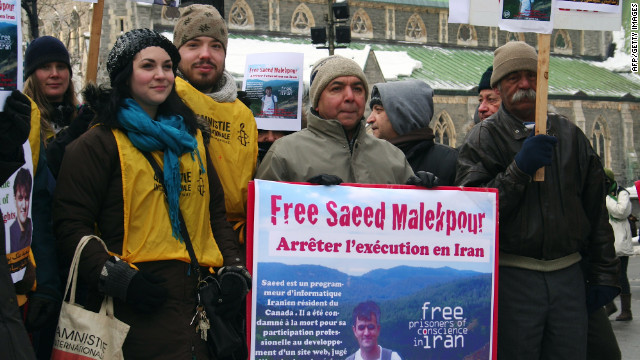
Supporters demonstrate in January for the release of Saeed Malekpour in Montreal, Quebec.
(CNN) — A computer programmer from Canada faces imminent execution in Iran for the actions of another person, which he had no control over, a human rights group says.
Saeed Malekpour wrote a program to upload photos to the Internet, an accomplishment that could cost him his life, Amnesty International reported Friday. Authorities in the Islamic Republic claimed his program was used by someone else to upload pornography and charged him with “insulting and desecrating Islam.”
Malekpour, who is a Toronto resident, was arrested in October 2008 while visiting relatives in Iran. He was convicted in a short trial and was sentenced to death in October 2011, according to Amnesty International.
Iran’s Supreme Court confirmed the sentence on January 17. Malekpour’s lawyers have been unable to ascertain the whereabouts of his court files since Tuesday and fear this could be an indicator that an executioner could carry out the sentence soon, Amnesty said. A court official suggested to the lawyers that the file had been sent to the Office for the Implementation of Sentences, according to Amnesty.
Malekpour sent a letter from prison detailing beatings and other mistreatment at the hands of Iranian prison officials to obtain a confession, said Hadi Ghaemi, executive director of the International Campaign for Human Rights in Iran.
“A large portion of my confession was extracted under pressure, physical and psychological torture, threats to myself and my family, and false promises of immediate release upon giving a false confession to whatever the interrogators dictated,” the letter says.
Malekpour’s supporters have created Facebook pages and websites in his support dating to at least 2009.
Amnesty International has requested on its website that concerned individuals write Iranian authorities inside and outside the country to demand that Malekpour not be executed.
Malek Jandali Freedom Qashoush Symphony مالك جندلي حرية سيمفونية القاشوش
We have spent many happy hours and days in Syria. We grieve for our Syrian friends, for those living in Homs and Hama, and all those seeking freedom from tyranny.
Saudis Investigate Dancing Nurses
Unfortunately, I can no longer find the video sent me by John Mueller on U-Tube; it has been removed, but you can see it for yourself here:
What the Saudis are investigating – and yes, there were men and women present – is a game of musical chairs, a game even children play at birthday parties.
Hospitals are a high stress environment – and these are sweet young people having a good time. Lord have mercy, and “investigation.”
Saudi health authorities have opened an investigation into three films published on U-Tube showing Asian nurses dancing at a mixed-gender birthday party inside a government hospital.
The three separate films showed several male and female nurses were involved in the concert that included music and dances, which are strictly banned at Saudi hospitals and other public facilities.
The films showed the party was held at King Fahd Hospital in the eastern town of Hofouf and the participants were apparently from the Philippines and Indonesia, according to Saudi newspapers.
One film was titled in Arabic “a scandal at King Fahd Hospital in Hofouf” while the heading of another video read “in the absence of supervision at King Fahd Hospital”. The third read “a dancing party for a nurse’s birthday.”
“We have been instructed to open an investigation into these films to determine whether this party was really held at King Fahd Hospital,” said Ibrahim Al Hajji, information director at the Health Department.
Hajji, who was quoted by Sharq newspaper, did not elaborate on what measures would be taken against those involved in the party.
Tinker Tailor Soldier Spy

We couldn’t wait. We saw the earlier version of Tinker Tailor Soldier Spy, you know, the one with Alec Guiness, and we couldn’t wait to see this new version, with Gary Oldman playing the Smiley role. He was awesome.
The LeCarre’ books featuring George Smiley are grim and grey, and the opening captures that exactly. The entire movie has a bureaucratic, institutional bleakness, with all the power plays, the petty snobberies, the jockeying for position that these bureaucracies seem to nurture. The only times in the movie when there is color and life is the annual bureau party, once done entirely in Russian, once in French.
The movie is faithful to the book, which I think I need to go back and read once again. It all seems so historical now.
One of the things we noticed was that the theatre was utterly quiet as the movie progressed. A lot of the action is in the mind, figuring things out, and trying not to get caught, so the suspense is of the subtle kind, not the car-crashing and jumping off buildings kind. It was as if the entire theatre were holding its breath; noticeable because of its rarity.
We were oddly jangled as we left the theatre, and over dinner we talked about how we never thought we would be obsolescent, but the Cold War has passed; the soldiers of today weren’t even alive when the Berlin Wall came down and the Iron Curtain parted and the cars flowed east. Life goes on.
There were several quotes, one that made us laugh was spies talking about recruiting other nationalities “You can hire an Arab but you can’t buy ’em.”
The Tourist; Olen Steinhauer

Haven’t I read this book before? Or didn’t I see a movie, The American, with George Clooney? You know, depressed assassin? Thinking about suicide? In some villa along the Mediterranean or is it the Adriatic? Some enigmatic handler, and who do you trust? And then The Tourist swerves off in another direction and while this particular thread of plot is new, it still seems vintage LeCarre, only maybe a little less solid information. Lots of jumping from place to place with little motivation, lots of shifts in trust, and betrayals.
While I like books where reality keeps shifting, this one had a few too many shifts for me. I have a feeling that spying is a lot less about fast cars and shooting someone so they won’t give away a secret, and lot more about the dull, painstaking work of stitching together swatches of information in ways that form a meaningful pattern, trying hard not to create patterns that don’t exist. I imagine that there is a big problem today with the huge volume of information, sifting through to figure out what matters, and what is mere distraction.
This book is a good airplane read, holds the interest, but give me LeCarre for the grim grey world of spies and their work any day.
Leaving Seattle
It is so much easier now, now that I am not flying to Qatar or Kuwait or even Germany. I kept a storage locker in Seattle all those years, with boxes and mailing materials, with Christmas wrap, with winter sweaters and boots and coats for Decembers, and shamelessly sleeveless tops and dresses for summer that I couldn’t wear in the more conservative countries where I was living. I kept spare make-up, a back-up hairdryer, shampoos, paper towels, coffee filters, detergent – things I didn’t want to have to keep buying every time I flew into Seattle, which one year was six times.
My last day was always a mad dash to the storage locker to put away all the stuff that stayed behind, maybe mail one last box or two with exotic items like grainy organic cornmeal, quilting supplies, Tony Chachere Jambalaya Mix, or peppermint candies for Christmas cookies (yes, they got them in Kuwait and Qatar, but sometimes not until February) and then there was the rush to the airport, check in the rental car, and go through the drill at check-in.
Yes, I have a special visa, right there. No, you probably can’t read it; it’s largely in Arabic, but trust me, it’s the right visa. Yes, I like living there. Yes, you would be surprised how kind the people are! No, I don’t have any problems. Yes! We do have a church! No, Moslems don’t hate Christians! Not the ones I know!
Before the big downturn, I was usually trudging two big bags, packed to bursting, full of books and things I couldn’t get so easily. By the grace of God, I never lost a bag.
So, this time it is SO much easier. Because it is Christmas, I am still trudging two check-in bags, but they are not so heavy, and not packed to the bursting point. No hassles; I have my printed-out check in, all I have to do is turn in my baggage, piece of cake, woooo HOOOO!
And I have time! I don’t have to get up too early, I have a little time with Mom in the morning, and then I head out for a leisurely drive to the airport.
Uh oh!
This is what I see when I am inside my car:

It bites into my time, just a little, but I warm the car up, flick on the heat and blowers to clear the frost off the windows, and shortly I am driving along the mildly icy-frosty streets to the airport. I’ve missed the peak of rush hour, traffic is still zipping along, and I make the trip to the airport in no time, even glimpsed sunshine a moment or two.
Love flying through Memphis, perfect timing, I get there for dinner and get to grab a Memphis BBQ, oh yum. One of my favorite airports.
Home again, home again, it takes nearly a full day, and it feels so good to be home.
The Marital Contract in California?
This guy is hilarious – found this on AOL Huffpost this morning:
A Modest Proposal: Why Can’t Couples Have a Proxy Statement for Their “Merger & Acquisition”?
William Quigley
The recent debates over gay marriage, civil unions and what exactly marriage even means today reminded me of how antiquated our marriage and family laws have become. They don’t take into account how the nature of wealth has vastly changed over the last few decades. I am neither an advocate nor an opponent of marriage but I do believe that the financial obligations we assume when entering into a marriage contract, including the court-ordered redistribution of personal wealth that takes place upon divorce, are not well understood by most of our citizens. Even lawyers I have known have been confused about the differences between spousal versus child support. If Chris Anderson really wanted to investigate the long tail, he should have taken a look at the potential length of California spousal support terms.
California has always been the leader in divorce and alimony law, and I think it is time the state started addressing the profound inequities alimony judgments have created. In short, alimony has evolved into a pension plan for the less successful spouse. In many cases, this pension commitment becomes a lifelong burden for the paying spouse, regardless of who initiated the divorce and under what conditions the marriage dissolved. It promotes unproductive behaviors as well, such as the alimony recipient avoiding employment in order to maximize spousal support. The spousal support payer may reluctantly forgo re-marriage as well, fearing the income of his/her new partner will be combined for the purposes of calculating higher support payments. If the state believes that promoting marriage among the population is a public good (a reasonable belief), then it needs to reduce the severe financial penalties associated with divorce. And since many marriages do end in divorce, it makes sense to acknowledge, upfront, the consequences of that likely outcome.
One marriage-neutral option would be to provide every couple with a simple disclosure form that highlights the financial obligations they are about to assume.
This disclosure form could easily fit on just a single page, with disclosures of the following sort:
1. The State of California recognizes your marriage as a legally binding contract.
2. By entering into marriage in this state, you agree to assume all debts incurred by your spouse during the marriage, whether or not you were aware of these debts when incurred, and whether or not you personally benefited from them in any way.
3. You also agree to provide monetary payments to your spouse in the event your marriage dissolves and you are the higher income earner. The amount and length of these payments will be decided by a court of law.
4. The State can and will use its court and police powers to enforce the financial obligations you are assuming in the event of divorce, including the garnishment of your wages and your incarceration in the state prison system for your failure to comply with court ordered spousal payments
5. If your spouse so chooses, he/she may divorce you at anytime. In so doing, he/she may be legally entitled to receive monetary payments from you for a time period that may extend to the rest of your natural life. These spousal support payments may exceed 50% of your income, could be adjusted upward if you remarry and as a result have more disposable income, and they cannot be eliminated though bankruptcy.
6. The conduct of your spouse, including him/her having one or multiple out-of-wedlock affairs, does not change your legal obligation to provide spousal support.
7. If you are the higher earning spouse, you may be required to pay your lower earning spouse’s divorce related legal bills. This is the case regardless of which spouse initiated the divorce and regardless of the conduct of either spouse during the marriage
8. If you have questions or concerns about what financial obligations you are about to assume, it may be advisable to consult with a family law attorney before signing your marriage contract.
The most important point to highlight when it comes to marriage is that the State of California recognizes it as a legally binding contract. Too often that simple fact is misunderstood or ignored by the couple getting married. In fact, curiously, the one thing the state absolutely does not care about is whether or not a couple is “in love.” There is no requirement to be “in love” to be legally married in the State of California, or any other state for that matter. Only in recent human history — perhaps the last 150 years — has the predominant purpose of marriage been associated with romantic love. It has nearly always been, and remains in much of the world, primarily an efficient method of property redistribution. In the end, the state, and your future divorce lawyer, care only about one thing: the legal enforceability of the marriage contract as it relates to the financial obligations borne by the higher wage earner.
Our society has become accustomed to warning its citizens of potential legal and financial hazards every time they enter into a contract, even those of relatively small consequence. We as a society like to be informed when we are assuming a financial obligation, particularly one that is potentially large and open-ended. Isn’t it odd then that while we require our citizens to initial car rental forms (just in case they didn’t realize that they will be charged $6 a gallon to fill the gas tank), we let 18 year olds get married without so much as a tap on the shoulder about the greatest financial liability they will likely ever assume? Keep in mind that we are talking about state-sanctioned marriage, a legally enforceable contract. Shouldn’t such a contract, with its profound lifelong financial repercussions, only be assumed by those fully informed of its potential consequences? This is why I completely support a marriage financial obligation disclosure form.
Emergency Message for U.S Citizens: Demonstration Notice 14-2011
Emergency Message for U.S Citizens � Demonstration Notice 14-2011
September 20, 2011
Please circulate the following message without additions or omissions
immediately to all U.S. citizens within your area of responsibility.
An anti-corruption demonstration is planned for the early evening hours at
Determination Square on Wednesday, September 21 in downtown Kuwait City. An
increased police and security presence is expected in and around the capital.
There are also reports of possible demonstrations in support of Bidoon rights on
Wednesday, September 21 in the cities of Jahra, Al-Sulaibyah and Al-Ahmadi. An
increased police and security presence is also expected in these areas.
Spontaneous and planned demonstrations take place in Kuwait from time to time in
response to world events or local developments.
At times, even demonstrations intended to be peaceful can turn confrontational and possibly escalate into violence. Do not let curiosity get the best of you; avoid the areas of demonstrations and exercise caution if within the vicinity of any large gatherings. Please stay current with media coverage of local events, be aware of your surroundings, and practice personal security awareness at all times.
For the latest security information, U.S. citizens living and traveling abroad
should regularly monitor the Department of State’s Bureau of Consular Affairs
Internet website, where the current Worldwide Caution, Travel Warnings, Travel
Alerts, as well as the Country Specific Information for Kuwait can be found.
Up-to-date information on security can also be obtained by calling
1-888-407-4747 toll-free in the United States and Canada or, for callers outside
the United States and Canada, a regular toll line at 1-202-501-4444. These
numbers are available from 8:00 a.m. to 8:00 p.m. Eastern Time, Monday through
Friday (except U.S. federal holidays). You can also download our free Smart
Traveler App for travel information at your fingertips and follow us on Twitter
and the Bureau of Consular Affairs page on Facebook as well.
The U.S. Embassy is located at Al-Masjid Al-Aqsa Street, Block 6, Plot 14,
Bayan, Kuwait. If you are a U.S. citizen in need of emergency assistance in
Kuwait, you may reach the U.S. Embassy by calling +965-2259-1001 and requesting
the duty officer.
U.S. citizens living or traveling in Kuwait are encouraged to enroll in the
Department�s Smart Traveler Enrollment Program (STEP) so that they can obtain
updated information on travel and security. U.S. citizens without internet
access may enroll directly with the nearest U.S. Embassy or Consulate. By
enrolling, U.S. citizens make it easier for the Embassy or Consulate to contact
them in case of emergency. For additional information, please refer to “A Safe
Trip Abroad”.
This message may be accessed on the Embassy website, http://kuwait.usembassy.gov
Please note that the Consular Section is closed for U.S. and most local
holidays. The current holiday schedule for 2011 is posted on
http://kuwait.usembassy.gov/holidays.html
Recent Comments
Kitchen on Isiais: Winding Down intlxpatr on Shampoo Ginger tigerbutterya0c5ff1d… on Shampoo Ginger intlxpatr on British Soldier Kidnapped, Esc… John on British Soldier Kidnapped, Esc… Wikipedia Donate Button

Amazina


Early Voting in Florida


