Contagion
As we rushed into the house, we both headed immediately to our bathrooms to wash our hands. Twice. And I also washed my face.
Contagion is a very intelligent movie. It is scary, but not in the Friday the 13th kind of scary, or in the Night of the Living Dead kind of scary, although come to think of it, there were some elements in common with the original Night of the Living Dead. No, what makes Contagion scary is that it could happen so easily.
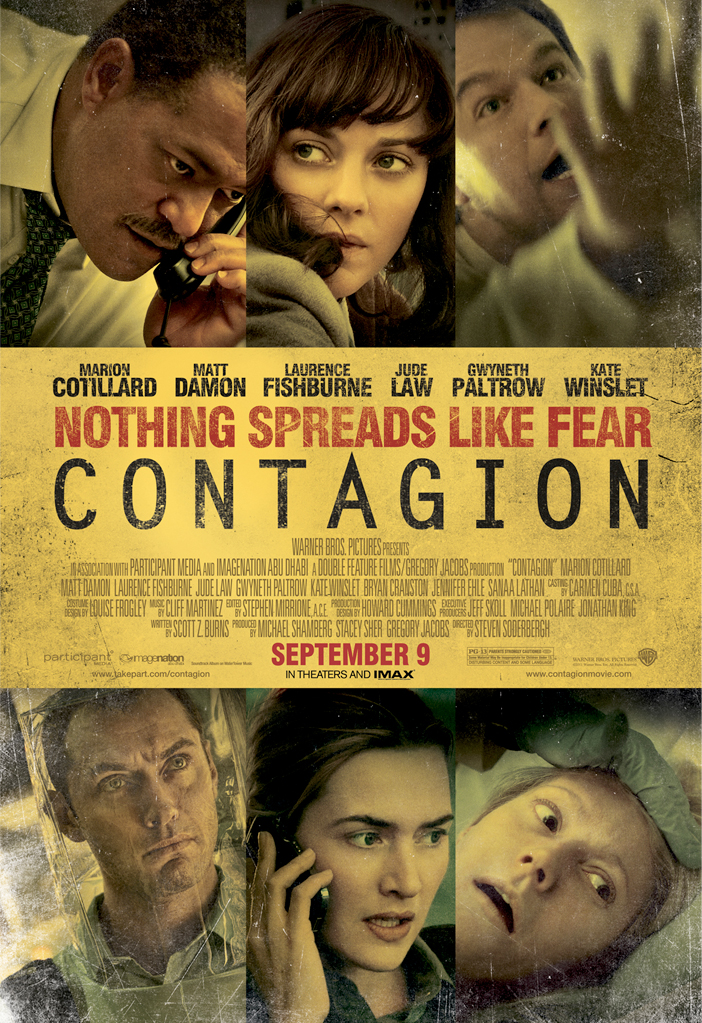
I had no idea that we touch our faces, on the average, of three to five times a minute, more than 3,000 times a day, and that with every surface we touch, we transfer (germs) (bacteria) (things that could make you sick) close to an entry to your body, like your nostrils and your mouth. Once you start thinking about NOT touching your face, you become aware of how often you touch your own face, unaware. Like flipping hair out of your eyes, or covering your mouth when you laugh, or a million other things like that. You become aware of all the things you touch between the time you wash your hands and touch your food. You think about who may have touched your fork, and how well it was washed.
For me, the scariest part of the movie, beyond how quickly the virus mutated and spread, was how quickly civil society broke down when cities were quarantined, when people were concerned food was growing scarce, when people thought they had to fight for survival. The rules for avoiding spreading the virus were not to meet, not to touch, to stay apart. It’s hard to help one another when those rules are in play, but those rules make it easier for those without rules to attack and take what they can.
I liked the music in the movie, too, very edgy.
Before I ever saw this movie, I heard an interview with the author on NPR. She was saying that when they came to her wanting to make this movie, she said “it cannot start in Africa. . . (there were a whole bunch of rules, which were hilarious because they were like every plot for a movie like this ever made) I knew I needed to see this movie, to see how it could be done and still be dramatic, and follow her rules.
There is one hilarious quote. A blogger in this movie gains enormous following. As he is tracking down one of the scientists for information, the scientist says to him:
Blogging is not writing. It’s just graffiti with punctuation.
Excuse me, gotta go wash my hands again.
Terrorism at the Mall of America
I’ve been listening to a very painful report on National Public Radio, Under Suspicion at the Mall of America, a report about counter-terrorism measures being taken at the Mall of America, a huge mall, in Minnesota. One reason I’ve always wanted to go there is that I think I remember it having a huge, huge swim area, with lots of water slides and wave machines, and it just looked like a lot of fun. When I look at the mall map, I don’t see any pool area. You know malls – they change, and it’s been years. It was probably a liability issue.
So this is the ten year anniversary of 9/11, an event so awful most of us barely want to think about it. There are some things that just go so deep, you could get lost in the horror of it all. Officials are warning of the possibility of anniversary acts of terrorism, and Mall of America has always felt itself to be a vulnerable symbol, due to its name.
This is a lengthy report of “suspicious” incidents at Mall of America. They make me want to cry. You can read the report, but if you listen to the audio (you just click on the audio symbol) it is a richer, more detailed report. Listen – and weep.
Under Suspicion at the Mall of America
Below is an excerpt:
A Missing Cellphone
Yet look what happened when Najam Qureshi’s father came under suspicion at the Mall of America.
Najam Qureshi was born in Pakistan, but he’s been a U.S. citizen since he was a teenager. Today, he manages computer systems for a major company near Minneapolis. He and his family live on a pretty suburban street.
Najam Qureshi’s father came under suspicion at the Mall of America after leaving his cellphone in the food court.
In January 2007, an FBI agent showed up on his doorstep. It turned out that a few weeks before, Qureshi’s father had left his cellphone on a table in the Mall of America’s food court. When the mall’s counterterrorism unit saw the unattended phone, plus someone else’s cooler and stroller, guards cordoned off the area. Qureshi’s father wandered back, looking for his phone, and the RAM unit interrogated him and then reported him to the Bloomington police. In turn, the police reported the incident to the FBI. The documents we obtained show that the mall’s reports went to state and federal law enforcement, in roughly half the cases. The incident with Qureshi’s father led the FBI to want to question Qureshi himself, in his own home.
“He asked me if I knew anybody in Afghanistan. And that was kind of like, what?! And, then he asked me if I had any friends in Pakistan,” Qureshi says.
The FBI also asked him if he knew anybody that would try to hurt the U.S. government, according to Qureshi.
“My reaction in my mind, was, ‘How dare this guy in my house, come in and say this,’ ” he recalls.
But mall officials stand by their program of identifying suspicious people.
“You’re talking about a handful of people that are complaining, out of the 750 million plus that have been through these doors since 1992,” Bausch says. “And we apologize if it, you know, if it caused them any inconvenience, I mean we really do.”
“Unfortunately the world has changed,” says Bausch. “We assume you’d want your family and friends to be safe if they are in the building. And we simply noticed something that we didn’t think was right.”
A commander with the Bloomington police said these reports would be kept on file for decades. When Qureshi found out that the 11-page report reading “suspicious person” would be kept that long, his eyes filled with tears.
“It shattered an image of the U.S. that I had, fundamentally. I don’t know, especially when I saw some of these reports. It’s definitely bothersome, how small things can just, you know, trickle up that quickly, and all of a sudden you’re labeled. And once you’re labeled, you’re basically messed up, right?”
In The Middle of the Storm
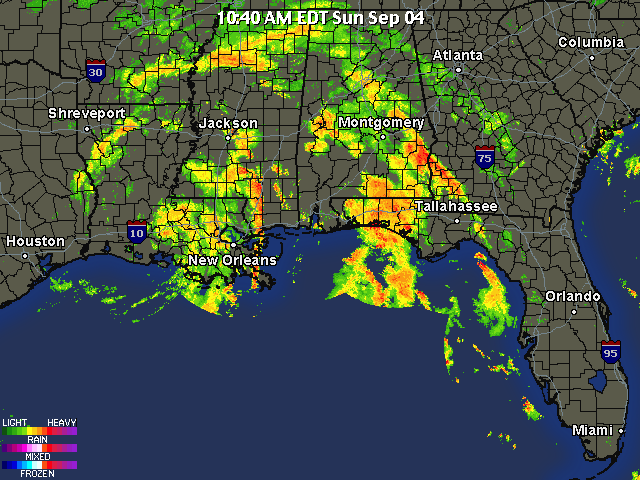
When you’re in the middle of the storm, it is hard to imagine just how BIG it is. It isn’t a hurricane, because the winds are not high enough, but oh man, the rain. Poor Pensacola has been about 10 – 15 inches short of its annual average, and I think we are getting all caught up this weekend.
AdventureMan is outside, picking up dead tree branches that came down last night. On our way to church, early this morning, we saw the electrical crews out trying to fix a line that went down. God bless these heroes who get out of bed on a national long weekend, early in the morning, so that people might have lights, and power, and air conditioning. We take them for granted, and yet they are everyday heroes.
Neighbors Key to Survival
“Americans don’t know their neighbors” my dinner guest said, in response to my asking him what surprises him most in his visit to this country. “In my country, we all know our neighbors. It’s important to know your neighbors.”
I agreed, and quoted him this article supporting his view that I heard on National Public Radio, one of those ideas I hear so often on NPR because they cover news other news sources ignore.
Below is just a portion of the story, which you can read in whole by clicking on this blue type. Even better, if you want, you can listed to the story yourself by clicking on the “Listen to the Story: All things Considered” button on this same page.

When Hurricane Katrina struck in 2005, one victim was political scientist Daniel Aldrich. He had just moved to New Orleans. Late one August night, there was a knock on the door.
“It was a neighbor who knew that we had no idea of the realities of the Gulf Coast life,” said Aldrich, who is now a political scientist at Purdue University in Indiana. He “knocked on our door very late at night, around midnight on Saturday night, and said, ‘Look, you’ve got small kids — you should really leave.’ ”
The knock on the door was to prove prophetic. It changed the course of Aldrich’s research and, in turn, is changing the way many experts now think about disaster preparedness.
Officials in New Orleans that Saturday night had not yet ordered an evacuation, but Aldrich trusted the neighbor who knocked on his door. He bundled his family into a car and drove to Houston.
“Without that information we never would’ve left,” Aldrich said. I think we would’ve been trapped.”
In fact, by the time people were told to leave, it was too late and thousands of people got stuck.
Because of his own experience in Katrina, Aldrich started thinking about how neighbors help one another during disasters. He decided to visit disaster sites around the world, looking for data.
Aldrich’s findings show that ambulances and firetrucks and government aid are not the principal ways most people survive during — and recover after — a disaster. His data suggest that while official help is useful — in clearing the water and getting the power back on in a place such as New Orleans after Katrina, for example — government interventions cannot bring neighborhoods back, and most emergency responders take far too long to get to the scene of a disaster to save many lives. Rather, it is the personal ties among members of a community that determine survival during a disaster, and recovery in its aftermath.
When Aldrich visited villages in India hit by the giant 2004 tsunami, he found that villagers who fared best after the disaster weren’t those with the most money, or the most power. They were people who knew lots of other people — the most socially connected individuals. In other words, if you want to predict who will do well after a disaster, you look for faces that keep showing up at all the weddings and funerals.
“Those individuals who had been more involved in local festivals, funerals and weddings, those were individuals who were tied into the community, they knew who to go to, they knew how to find someone who could help them get aid,” Aldrich says.
My visiting guest was from Lebanon, where neighbors have relied on one another for years as civil unrest rocks the country.
“I am guessing we move more often than your family and friends,” I ventured. “You are right, it is harder to establish long-lasting neighborly relations here where people come and go more often.”
Actually, we have settled in a fairly established neighborhood, where many people around us have lived for years and years, some all their lives. But we have only been here a year, and it takes time to build strong neighborly relations. But we are aware that connecting with our neighbors and staying connected is important in a part of the country vulnerable to life-threatening hurricanes and other natural emergencies.
You can listen to the entire report in 6 minutes and 3 seconds here.
Major Pettigrew’s Last Stand
 Major Pettigrew’s Last Stand by Helen Simonson
My rating: 5 of 5 stars
I loved this book. It follows all the themes I love – how convention blinds us, how our cultural assumptions make us unconsciously snobbish and leads us to hideous behavior, it is very cultural and also very cross-cultural. Major Pettrigrew is widowed, and his grief has made him old. At the beginning of the book, his life seems very dull and grey. It lightens as his friendship sparks with Mrs. Ali, a widow who runs a small convenience market in his small English village. They both love reading (of course I love that part!) and they talk books, and sparks of warmth kindle.
This book is also very uncomfortable for me, as Roger has a grown son who bullies his father. The book isn’t just cross-cultural, it’s cross-generational, and I see glimpses of myself in the boorish behavior of his son toward his father.
There are some amusing scenes, some wickedly insightful village-interaction scenes, some painfully introspective moments, and some truly grand moments when everything becomes clear and a person acts. For me, there was an added bonus in that as I read Mrs. Ali’s words, I could hear them so clearly, and she spoke in the voice of a dear friend. I could picture her, because I could see the sweet smiling face of a dear friend. It was like having a great visit.
<a href=
“We Have Lost Our Moral Compass”
There is something I need to confess, as I print my friend Amer’s most recent editorial from the Arab Times in Kuwait.
Amer is writing about the great loss of civility in Kuwait, a country where trade routes crossed, merchants ruled and differences were tolerated. While I lived in Kuwait, I was horrified at the flaunting of traffic rules and the reckless endangerment of the population because some people believed the laws did not apply to them.
Amer, with a few differences specific to Islam, your editorial, sadly, could be equally well applied many places in the United States today, where some people believe they should not have to patiently stand in line, or obey the traffic rules, or protect the quality of the food supplies or water sources that provide for the communities.
When we fail to restrain ourselves and our selfish greediness, we harm others – but we also harm ourselves. We damage the fabric of society that protects us from the chaos of anarchy. Well said, Amer.
We Have Lost Our Moral Compass
EVERY Ramadan we are inundated by articles and features highlighting the proper means of fasting, alms-giving, praying and other essential pillars of Islam. I am not going to do that.
Most citizens are decent, God-fearing individuals trying to improve their lot and the lives of their loved ones. I believe the Kuwaiti character in essence is one of integrity and generosity — we are a charitable people, evident by the Ramadan dinners we sponsor and the alms we pay (Zakat) — indeed we are almost always the first to rush in aid of others, local or internationally. We should be proud of this trait.
We are, however, far from perfect. Praying, fasting and spending alms on the needful are not enough to qualify us or other societies as superior Muslims.
Our Prophet (Peace Be Upon Him) stated, ‘The best amongst you are those who have the best manners and character.’
Recently, we have all been witness to a drastic deterioration in the way people treat one another and conduct their lives — a certain segment lack the proper traits, either due to absence of decent rearing, non-implementation of laws (which they view as ‘toothless’) or the gradual radicalism in society which encourages gender segregation, intolerance of foreigners and non-Islamic ideals and views.
Our society seems to have lost its moral compass; gaze around you, materialism and power is valued over integrity and honesty; harshness in tone is embraced, over humility and etiquette. An individual’s caliber is immaterial; what matters is how one can ‘benefit’ another, the extent of personal influence and how many laws one can break with impunity.
On the behavioral level, this is evident all around us, nothing is respected; people don’t wait their turn, they drive erratically, they walk into elevators without waiting for others to exit, they are rude to foreign workers, they disturb women in malls and public places, they cause a ruckus in movie theatres, road and traffic signs are ignored, municipality laws are ignored, smoking signs are ignored. The list goes on…
This personal methodology is poisoning society — we are all victims of and responsible for this collective, ethical Achilles’ heel.
Follow the law, pay your bills on time, stand in a queue, follow road signs and you’re regarded as a dimwit.
These days you get a taste of good manners when you travel to countries like the United States and the European Union where parents educate their children ‘not to point at others’, ‘scream’ and wait patiently for their turn in a queue, saying ‘please’ and ‘thank you.’
Even progressive GCC states such as the UAE — eager to attract foreigners and investment — do not tolerate any law breaking: speeding tickets affect the validity of your car license and insurance premiums; if unruly youths disturb or sexually harass women in public, security arrests them, shaves their heads, splashes their mugs in the papers, for example. People think twice before embarking on any moves which might offend the personal space or respect of others.
It’s the atmosphere of tolerance, openness and the implementation of laws that truly make an Islamic society, not the number of mosques built or how many foreigners converted to Islam. Where is Islam if society deems Expired Food Merchants and MPs and their ‘state benefactors’ — who dabble in tens of millions of corrupt money — for example, as ‘untouchables’?
People’s behavior forces one to ditch the law because the law is not really on one’s side, it’s not really being enforced — it’s an illusion. Additionally, we need to start embarking on ‘naming and shaming’ lawbreakers and criminals instead of shielding their identities from the public, who have a right to know.
The state apparatus — traditionally infatuated with forming committees, hosting seminars and running bloated campaigns — needs to execute them properly, namely by implementing a two-track initiative: On the one hand formulating an awareness campaign on ‘Islamic Moderation And Tolerance’ by highlighting the work of groundbreaking pioneers and world-renowned Moderate Islamic voices such as our very own Dr Naif Al-Mutawa (creator of the comic book series ‘The 99’) and Dr Reza Aslan, author of ‘No God But God,’ among other accomplished intellectual luminaries — so that younger generations may be able to benefit from their stimulating, refreshing views. Simultaneously, on the other track enforcing Civic and Constitutional Laws preaching freedom of speech, equality and appropriate justice — so individuals may learn to respect state laws and tolerate differing views – they need to realize grave repercussions are incoming, leading to imprisonment or worse, if they indulge in any lawbreaking or negative antisocial behavior. Ultimately, the State needs to step up to the plate and protect society, lest individuals take the law into their own hands and mob rule surfaces.
Islam without proper laws, justice for all and proper education is abridged, toothless — as a society we need to instill the values amongst ourselves and future generations, not just censure ‘external influences,’ the media or the West for our ills (many which are self created). Moreover, we need as a community to re-examine the way we conduct ourselves and treat others — to realize that no good can come from a society that obliquely persuades fraud, dishonesty and ill-treatment of others.
By: Amer Al-Hilal
Kuwait Tweeters to Face Trial
Kuwait makes AOL News: Huffington Post today, as two guys are arrested over Tweets offensive to royals:
Kuwait To Try Nasser Abul And Lawrence al-Rashidi Over Twitter Posts
KUWAIT (Reuters) – Kuwait will put on trial two citizens for criticizing Gulf Arab ruling families on social media site Twitter, a security official said on Monday.
Nasser Abul, a Kuwaiti Shi’ite Muslim, was arrested for posting criticisms of the Sunni Muslim ruling families in Bahrain and Saudi Arabia, and Lawrence al-Rashidi posted defamatory comments of Kuwait’s emir, he said.
He said both would remain in detention for two more weeks before a hearing is scheduled, where they will likely face charges of harming the Gulf Arab state’s interests and defaming the country’s ruler after being arrested earlier in June.
Democracy activists have used social media such as Facebook and Twitter to debate, organize and share information in Bahrain, where the kingdom’s Sunni rulers crushed a protest movement in March led mostly by the country’s Shi’ite majority.
Bahrain called in troops from Sunni-led neighbors such as Saudi Arabia and the United Arab Emirates to enforce its crackdown. OPEC member Kuwait, which has a Shi’ite minority, sent naval forces.
Bahrain questioned a rights activist in April for publishing an image which appeared to show signs of torture on a man who died in detention during the unrest. It is not clear if the case will be brought to court.
Gulf Arab states, run by closely-allied ruling families, are trying to prevent protest movements that brought down Egyptian and Tunisian leaders earlier this year from taking off in their patch.
(Reporting by Eman Goma; editing by Mark Heinrich)
Operation Blue Shepherd
I was shocked to hear about this operation on National Public Radio this afternoon, and to know it was Pensacola. What got my attention was one of the police officers saying that they were shocked to capture so many local people; they had expected to attract predators from surrounding states, but not so many locals. Truly sad.
And kudos to all the men in blue and officers of the court who are putting away these people who would prey on children, taking them off the game board.
You can read the entire article yourself at the Pensacola News Journal:
25 men accused of setting up child sex encounters in Pensacola sting
Twenty-five men were arrested this month in Pensacola during a weeklong undercover operation in which suspects are accused of using the Internet to set up sexual encounters with children. The suspects came to meet the minors at a home in northeast Pensacola only to find a slew of law enforcement officials waiting for them.
The sting, called Operation Blue Shepherd, began June 20 with 30 officers from local, state and federal agencies participating, according to a Pensacola Police Department press release. The results were announced at a news conference this morning at PPD.
Pensacola Police Capt. Paul Kelly said officers used various social networking and E-commerce sites to respond to advertisements of a sexual nature and to place similar advertisements.
The suspects specifically described various sexual acts they were going to do with the male and female children, ages 12 to 14, with whom they believed they were talking. All of the suspects, except one who took a taxi, drove to the undercover house with the intent to perform these sexual acts with the children. Upon arrival, they were arrested and questioned.
Kelly said officers were surprised to find so many eager participants from the immediate Pensacola area.
“We expected to have more violators traveling from outside the area. What this tells me is that these violators do not have to travel far to find their victims. They are much closer to home than we imagined. Most of them were not reluctant or frightened to approach the door of a stranger’s house. They literally pulled up to the house and walked quickly to the door eager to meet the child,” Kelly said.
Agencies participating in Operation Blue Shepherd were the State Attorney’s Office, Florida Department of Law Enforcement, Immigration and Customs Enforcement , Naval Criminal Investigative Service, Escambia County Sheriff’s Office, Santa Rosa County Sheriff’s Office, Okaloosa County Sheriff’s Office, Walton County Sheriff’s Office, Alachua County Sheriff’s Office, Gainesville Police Department, Fort Walton Beach Police Department, Tallahassee Police Department and the Federal Bureau of Investigation.
Thelma and Louise in Saudi Arabia
An editorial cartoon from my friend Grammy, in Texas, from today’s paper:

Doha Debates and Where Are You From?
The Baked Salmon Dijon for last night’s dinner took a little longer to cook because Joe Patti’s cuts the salmon steaks so thick (we cook two, split one and freeze the other for another night), so while I was waiting, I flipped around and found WSRE’s Doha Debate coverage.
Who knew?
I didn’t know I could still watch the debates in Pensacola! This one was about whether or not Egypt should postpone elections in the interest of forming a more representative democracy. The vote was 84% in favor; the two young supporters carried the house. 🙂 This was the March debate and you can hear the entire 48 minutes by clicking here.

The winning female debater used a slogan I had not heard, but I love, because it is graphic and memorable – “we do not want a fast-food democracy that brings only indigestion.” The younger debaters want to scrap the entire constitution and re-write it, claiming the current structure needs to be thoroughly revised in order for democracy to have a chance of success.
I love it that these issues have a forum for debate in Doha.
Following the debate was a cringe-worthy video about asking people where they are from. His point was that when he is asked where he is from, and he answers ‘The Bronx,’ people say “No, where are you REALLY from?’ and the implication is racist. He says it is the same as saying that his color is darker, therefore he is not like us, so he must not be from around here.
I’ve asked that question. Never meant it to be insulting, but I will stop now. Or I will only ask those with a slight accent, maybe. Wherever we have lived, we have been asked that question – but then, in Kuwait and Qatar, most of the work force is not Qattari or Kuwaiti. Even in Germany, however, where we might look a lot like them, we are asked where we are from. It used to be a courteous way of showing interest, or initiating a conversation.
One time in Doha, a local man asked me about my breeding, LOL. I told him I was a product of the American melting pot, and from the earliest settlers to the latest, my family includes just about a little of everything. We were at the veterinarian’s office, and I knew the purity of his dog’s blood lines mattered, and probably his own, but I also felt a little insulted, and I haven’t forgotten it. Doesn’t science teach us that diversity in blood lines is a good thing?
We are in the middle of a heat spell in Pensacola, early this year, and because we haven’t gotten anywhere near the normal rainfall, there are also wildfires. The firefighters are struggling to put out the fires, and also fighting heat exhaustion. AdventureMan is out watering all our new plantings, and our tomatoes, every morning, God bless him, because when the temperatures go high, I just want to stay inside.
Recent Comments
Kitchen on Isiais: Winding Down intlxpatr on Shampoo Ginger tigerbutterya0c5ff1d… on Shampoo Ginger intlxpatr on British Soldier Kidnapped, Esc… John on British Soldier Kidnapped, Esc… Wikipedia Donate Button

Amazina


Early Voting in Florida


