Anti Poverty Team Needs You in Escambia County
Volunteers Needed for Bridges to Circles poverty initiative!
If you are committed to making our community better by countering poverty or its impact on people and businesses in our community, come explore the innovative concepts from the trainers of Bridges to Circles. We believe this training will have a significant impact on how individuals relate to one another and to those living in poverty.
The Bridges to Circles poverty initiative, in collaboration with Unite Escambia’s Poverty Solutions Team, is actively working with families who desire to move from living below the poverty line to self-sufficiency. We are in need of community volunteers who are willing to serve as allies for these families.
If you are interested in volunteering please attend the Bridges Out of Poverty workshop on Thursday, October 14, 2010 and Hands-On ally training, Thursday, October 28, 2010. All training is conducted from 6-8 pm at the Catholic Charities Outreach Center, 1815 N. Sixth Avenue. For more information, contact Haley Richards, Bridges to Circles community organizer, at 429-7296, ext. 17 or email richardsh@cc.ptdiocese.org.
Thank you for supporting our efforts to reduce poverty in Escambia County!
Haley Richards
Bridges to Circles Community Organizer
Catholic Charities of NWFL
Office: (850)429-7296, ext 17 or (850)293-9565
Join us on Facebook!
Learn more at http://www.uniteescambia.com/
Chase Ends with Suspect Trying to Drown Police and Police Dog
I loved reading the papers in Kuwait. What criminals could be so incredibly STUPID, I would wonder. (Here is my all time favorite Kuwait story.)
This morning, AdventureMan asked “Have you read the paper? Some guy had a high speed chase, then he tried to drown the policeman AND the policeman’s dog!”
No, I hadn’t read it. It is almost to stupid to be believed. What I do love is that the idiot is named in the Pensacola News Journal story and, of course, that his mother says he couldn’t have done it, LOL.
Chase Ends With Officer Fighting To Save His Life
Gulf Breeze Police Department Sgt. Stef Neff knows things can go bad in just a few seconds in his line of work.
That’s what happened in Gulf Breeze early Saturday morning when a traffic stop ended with Neff fighting for his life with a suspect in Hoffman Bayou.
“There is no lonelier feeling than that,” said Neff, a 15-year veteran who survived the fight without serious injuries. “I didn’t have any way to call anybody else. It was me and him.”
The suspect — Kyle Estes, 21, of Navarre — was eventually captured but it took more than an hour as he struggled in the water with two other officers and a police dog.
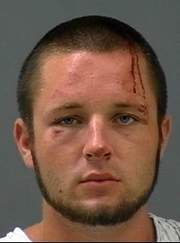
Estes remains in Santa Rosa County Jail today under $111,000 bond. He is facing a long list of charges related to Saturday’s fracas:
• Fleeing and eluding law enforcement officers.
• Obstruction of police.
• Aggravated battery.
• Resisting an officer.
• Driving while license is suspended or revoked.
• Hit and run.
• DUI with property damage.
The suspect’s mother hasn’t talked to him since the early morning battle, but she insists he is not violent by nature.
“It was totally out of character for Kyle to get violent like that,” Michelle Estes said today. “It was a very desperate and extreme attempt to get away from the police. I just think he didn’t want to get in trouble.”
The incident began when Gulf Breeze Police Officer Greg Baker tried to stop Estes at about 2 a.m. after seeing him speeding south on the Pensacola Bay bridge at about 95 mph, Neff said.
Baker followed Estes to Chanteclaire Circle, where Estes lost control of his vehicle and hit a cement wall, a mailbox and a tree, Neff said.
Estes jumped out the vehicle and ran. Neff and Gulf Breeze police officer Daylyn Wilson went to help Baker.
As Neff drove on Chanteclaire Circle, Estes ran by. Neff said he jumped out his vehicle, ran between some houses and pursued Estes to Hoffman Bayou.
Estes fell into the bayou from a rock embankment. Neff said Estes pulled him into the water.
“He tried to push me under the water,” Neff said. “He tried to drown me.”
Neff had no way to tell anyone where he was because his radio was disabled after being dunked in the water.
The Pensacola Police Department and Santa Rosa County Sheriff’s Office dispatched officers to help look for Neff.
Neff said he hit Estes in the head a few times with his flashlight as the two struggled in the water. He said Estes let him go after he hit him and started to swim across the bayou toward Laura Lane.
As Neff was coming out of the water, Wilson arrived. Neff told Wilson to head toward Laura Lane.
At first, Estes couldn’t be found after he swam away.
“He kind of hunkered down in some saw grass,” Neff said. “He just tried to wait us out.”
When Pensacola Police Officer Shawn Thompson made it to the area, he let his dog, Bandit, off his leash to search for Estes.
The dog found Estes hiding in the saw grass. Estes grabbed Bandit.
“Then he tried to drown the dog,” Neff said. “He was pulling the dog out into the bayou, holding him under the water.”
Thompson and Wilson jumped in to save Bandit. Estes started to swim away after taking some hits to the head with a flashlight, Neff said.
It wasn’t long before Estes was spotted under a pier. Neff and Santa Rosa County Sheriff’s Office Sgt. Judd White went into water and pulled Estes onto the pier.
None of the officers involved in the incident suffered serious injuries.
Estes was taken to Gulf Breeze Hospital, where he was treated for his injuries, and transported to jail.
Bandit was taken to a veterinarian.
“I think he’s doing fine now,” Pensacola Police Chief Chip Simmons said.
This story illustrates why police and fire crews and teachers and emergency room personnel are, to me, everyday heroes. Every day, they never know what might be out there to bite them.
Show Me the Money
Two themes came together, early this Sunday morning in Pensacola, first, as Father Harry spoke to us at Christ Church this morning on stewardship, and giving generously, and then later, as I was reading my Sunday Pensacola News Journal, an article on our elected officials, and their finances, their net worth and where their money is coming from.
Father Harry spoke about the rich man, at whose gate Lazarus begs, covered with sores, and then, at death, how the rich man asks God to send Lazarus to wet his lips, as he burns in the eternal hellfires, and Lazarus sits with God. He also asks God to send Lazarus to warn his rich family members that their choices, their lack of generosity, will have consequences, but God says (I paraphrase here) that Moses already told them, and earlier prophets, and that if the rich didn’t listen to them, they are not going to listen to Lazarus.
To me, it seems a given, that if you are blessed with plenty, then you have an obligation to help those who struggle. It isn’t necessarily money, it can be food, it can be time, it can be expertise, or – in my case – it can even be fabric. 🙂 We learn it in pre-school and kindergarten, don’t we? Share what you have, and everyone gets along.
It totally boggles my mind that many of our good friends, government and military people, have excellent health care under a highly socialized system – that’s what the military health care system is all about, we all have access to the same treatment. Many of the people who have access to medical treatment become rabid about supporting health care for those who don’t. Part of it seems to be “I earned it, and those lazy bums expect it for nothing.”
Most of my life, I’ve worked with ‘those lazy bums’ and have grown to have a lot of understanding and compassion for the circumstances that can make an entire family bone poor. Sometimes, it is poor choices – but how do people learn to make better choices without help? How do people aspire to more when they think that the ‘more’ is inaccessible to them?
The face of our nation changed after World War II when many more Americans gained access to higher education as a veteran’s benefit; prior to the GI Bill, higher education was only available to those comfortable people who could afford it.
Also in today’s Pensacola News Journal is an article about Study: Educating Women Saves Millions of Children which is an Associated Press Story about a study published this month in Lancet. “Educated women tend to use health services more and often make better choices on hygiene, nutrition and parenting,” the study (funded by the Bill and Melinda Gates Foundation) concludes.
And last, in the Pensacola News Journal, is an article that makes my heart sing, that makes me proud to live in a democracy, the article about how much our elected officials are worth, and where there money is coming from. I love it that we hold our leaders accountable, and that their wealth is (theoretically) transparent to us.
I’m a great advocate of wealth. I admire people who create wealth, who invest, who work hard for their money. The best of these people, and I mentioned Bill and Melinda Gates (above) for a reason, give back generously. Many people don’t start out rich, they start from little or nothing and build slowly slowly until they have reached a comfortable level. Sometimes, even in hard times, if you have built a strong foundation, that money just keeps multiplying, especially if it is invested with some diversity.
“It’s called the law of the harvest,” my Mormon friends told me when we were discussing how what you give comes back to you multiplied. It was so graphic, I’ve never forgotten it. There is nothing wrong with money. Money is just another tool, like a computer, or a hammer. It’s what you do with your money (tool) that makes the difference. Money is kind of like a seed, you plant and you harvest, but it is also like fertilizer – you spread it around, and amazing things happen.
Having money is a blessing, and giving it away is even more of a blessing. When you give, good things come back to you, multiplied. It’s the Law of the Harvest.
Looking for Ebonics Masters
I haven’t heard a word about ebonics for a long time, and then this, in today’s AOL News. I had thought it was one of those flash-in-the-pan things, here today and gone tomorrow. Have not heard a serious word about ebonics in, literally, years.
DEA Seeking Ebonics Experts for Narcotics Investigations
Allan Lengel
Contributor
(Aug. 23) — If you speak Ebonics, the federal government may have a job for you.
The Drug Enforcement Administration wants to hire people fluent in Ebonics to help monitor, transcribe and translate secretly recorded conversations in narcotics investigations, according to the website The Smoking Gun and DEA documents.
The Smoking Gun reports that up to nine Ebonics experts will work with the DEA Atlanta Division after obtaining “DEA Sensitive” security clearance.
Ebonics, or “Black English,” generally is defined as a nonstandard form of English spoken by African-Americans.
According to the job description, Ebonics experts will decipher the results of “telephonic monitoring of court ordered nonconsensual intercepts, consensual listening devices, and other media,” the website reported.
Rainbow to the Rescue in Pensacola
This post is about an amazing blessing. You won’t think it is a blessing at first, you will think it borders on disaster, but stop. Think about it.
Late this afternoon, our contractor friend was in putting bars in the guest suite that people can use to help navigate around, help lift themselves off the toilet, etc. We were busy looking for a stud for the shower bars when it started raining.
“That’s raining pretty hard.” he said.
“It rains like that all the time,” I said blithely.
But it really was coming down, and it wasn’t just for a few minutes, it poured, and it kept pouring. The lightning was really close and we heard a loud CRACK! and then BANG and the power transformer on the post near my house was hit, but my power must come from somewhere else because, by the Grace of God, we didn’t lose power.
“Oh no! This has never happened before!” I exclaimed as I saw water seeping in the guest suite where we were working. (This has been cleaned up a little bit for this family blog.)

I thought it was coming in under the French doors, but when I grabbed the old towels for soaking up purposes, I saw that there was more . . . coming from under the walls! Horrors! I was almost stopped still in my tracks – there aren’t enough towels in Pensacola to handle the amount of water seeping in!

“This is a task for Rainbow!” my contractor said, and ran for his truck, to exchange it for his Rainbow truck (he is both a contractor and a Rainbow franchise operator).
While Dave was gone, his assistant, Bobby, used their wet vac to get as much water up as he could, dumping the full tank several times out the window as we struggled. Finally, the rain slowed, and we could mop up the remaining wetness. He started a fan.

Dave came back with the big Rainbow truck and an intimidating amount of equipment. Now I will go into a parenthetical gripe about men and their toys. The biggest part of me is incredibly grateful to have this resourceful man who helps us with our construction and renovation needs, and then is there, like Superman, to the rescue, when disaster strikes. Another part of me wishes he didn’t have that excited gleam in his eye. My problem is his challenge – he loves the adrenalin.
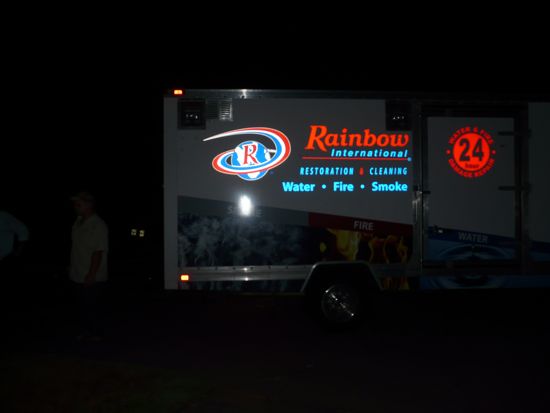
Honestly, it’s only a small part, and mostly it’s because I wish I didn’t have any problem at all. Dave has a meter that shows where water is still sitting in the grout between the tiles, and how it has soaked the baseboards and begun to creep up the sheet rock. He explains how in Florida, where the humidity is so high, the sheet rock can’t always dry out fast enough to avoid mold formation, and that even though it eventually may dry on its own, the mold can survive until the next moisture hits. Oh aarrgh!
Hours later, we have huge fans running, and we have dry air in oscilations being wafted into our walls to insure they dry thoroughly, but not too much. We have machines taking readings. Our insurance company says we are doing all the right things and the adjuster will come by on Monday or Tuesday.
This was supposed to be a quiet Saturday night. If it had been a normal quiet Saturday night, we might have been upstairs, watching some TV, listening to the lightening and not worrying too much about it. We would have gotten up in the morning and gone to church. We might not have even known our guest suite was flooded for days!
So honestly, I feel blessed. I am blessed that if this disaster had to happen, I had people with me who knew exactly what to do, and did it.
As they left, the Gulf Power people were out fixing the exploding power transformer, and I thought how many heroes there are on this earth, people who do their job under the worst circumstances, people who leave their families to serve because there are jobs that must be done.

God bless you, all of you, health workers, police, firemen, electricians, plumbers, emergency services, soldiers and sailors and airmen – all who sacrifice and serve. May you sleep well at night, and may God bless you and your families who support you.
I had a disaster, but I was surrounded by every resource I needed to deal with it. Thanks be to God.
If you have a disaster, and you live in the greater Pensacola area, I can recommend:
Rainbow International Restoration Services
David Murphy
O: 850-994-4411
Cell: 850-281-0232
Zeitoun by Dave Eggers
Do you remember being in university, and how when it came time to buy textbooks, the new ones were really, really expensive, and sometimes you couldn’t find it used and you just had to bite the bullet? Especially in political science and international relations, it didn’t take me long to figure out that many of the authors had one little idea, and they stretched it, kneaded it, elaborated upon it, made each different iteration a new chapter – but essentially, they took this one little idea, stretched it into a book and charged $30-$40 bucks for what might have made a good essay in Foreign Affairs or the New Yorker.
I often felt so cheated. I often find that when I look at the New York Times list of Best selling Non Fiction, most of the books look just like that.
When I bought Zeitoun, that day I just needed an escape, I didn’t know it was non-fiction. I had seen Zeitoun mentioned, even advertised in my very favorite magazine, The New Yorker. I fell in love with The New Yorker when I was a kid, even though I didn’t understand half of the comics, I thought they were hilarious. I still do. 🙂 When my New Yorker arrives, I read it cover to cover, and I often order books reviewed or recommended there.

I started Zeitoun shortly after watching the HBO series Treme´ about life just after Hurricane Katrina, so this book was timely and relevant. Zeitoun, a Syrian immigrant to the US whose wife is a Moslem convert, has a thriving painting and contracting business. When Katrina threatens, his wife and kids leave town, but he stays to watch over his multiple properties and businesses.
He survives the hurricane, and actually finds the change of pace enjoyable. He has a canoe he bought at a yard sale, and he rows around the neighborhood feeding dogs locked inside his neighbors houses, checking on his friends, rescuing stranded people or notifying rescue services where people need their help – he has a feeling he is exactly where he is meant to be, that he stayed on in New Orleans as part of God’s purpose for his life. He feels valuable and useful.
Then, one day, as he is checking on one of his rental properties, he is arrested, along with three friends, in the one house they know has water for showers and a working land line, which they all use to call their families. It is Zeitoun’s property. They are arrested by the National Guard.
One of Zeitoun’s friends, Nassar, has ten thousand dollars with him. Any of us who are expats can laugh – every expat has his cache of emergency escape money. Nassar, on hearing the hurricane was coming, withdrew his savings from the bank so it would be safe. The National Guard arrests them and takes all their money, wallets, identification and sends them off to jail, and in the chaos of post-Katrina New Orleans/ Louisiana bureaucracy, there is no paperwork and their families have no idea where they are.
Nassar and Zeitoun come into the worst of it, because they have Arab names, because of the large amount of cash Nassar has, and Homeland Security advisory that terrorist organizations could try to take advantage of the post-disaster confusion. It is seriously Kafka-esque; they are good men who are just in the wrong place at the wrong time with the wrong last names. Most of the meals served in the prison contain ham or bacon or pork. The system just stops working, and they never even get to telephone people who could clear their names and get them out.
I couldn’t stop reading. Eggers captures the sensual aftermath, the sewage, the foul water, the stink of rotting food and rotting bodies, and the bureaucratic nightmare of trying to prove you are innocent when you don’t even know the charges against you, and people are being picked up on mere suspicions.
While Zeitoun is eventually released from prison, and his construction and painting business flourishes, his family is not left untouched by the post-traumatic stresses the events surrounding Katrina. Every life resounds with the impact of Katrina and the damage inflicted on New Orleans. His friend Nassar never got his ten thousand dollars back.
I love books about people who come to America, create a business, and make a go of it. Zeitoun is one of the best – he isn’t afraid of hard work, and he loves his life and family. His story is well worth a read.
Zeitoun is available from Amazon.com for a mere $10.85 plus shipping, and while I own stock in Amazon, I don’t get any kind of payment for mentioning them in reviews. 🙂
Really Bad News for USA Olive Oil Lovers
Horrifying. I read the labels. I thought we could trust the labels. Thank God for independent testing. Bring on the Palestinian Olive oil!
Most ‘extra virgin’ olive oil bottles are actually cheaper mix
(See full article from WalletPop
More than two of every three bottles labeled imported extra virgin olive oil are either a cheaper grade of olive oil or adulterated with another type of oil, a University of California at Davis study found.
Top-selling brands including Bertolli, Filippo Berio, Carapelli, Pompeiian, Colavita, Mazola and Carapelli all had bottles that flunked the test — containing instead a cheaper virgin olive oil, the study by the university’s Olive Center found. Even a brand carrying the name of TV host Rachael Ray — who frequently touts her supposedly extra virgin olive oil — flunked the testing on two of three samples.
The chemical analysis did find that 90% of the California-packaged olive oils were indeed what they claimed to be. Two that were exactly what they claimed to be were Walmart’s Great Value brand and Costco’s Kirkland Organic.
“The intent of the study was to provide consumers and retailers with an accurate picture of the quality of olive oils now being marketed through grocery stores and other retail outlets in California,” Dan Flynn, executive director of the Olive Center, said in statement sent to Consumer Ally. “Our hope is that these findings will lead to improved methods for evaluating extra virgin olive oil, and increased consumer confidence that ‘extra virgin’ on the label means extra virgin in the bottle.”
Flynn said the United States is the world’s third-largest consumer of olive oil.
Consumer Ally contacted several of the largest manufacturers cited in the study, but only one immediately responded to the request to comment on the study. A Colavita official wanted to read the study before discussing.
A history of duping consumers believing they’re buying the rich-flavored and often pricey extra virgin olive oil led the federal government to enact more stringent olive oil standards, scheduled to take effect in October. In 2008, Connecticut became the first state to regulate olive oil after finding that some being sold included nut oils or soy oils, which could cause dangerous allergic reactions.
“Before this study, we had anecdotal reports of poor quality olive oil being sold as extra virgin,” Flynn said. “Now there is empirical proof.”
Some of the tests analyzed for problems that would affect flavor — the very essence of extra virgin olive oil. “Many of these oils just did not taste good,” Flynn said.
He cited the following reasons for the oil flunking the tests:
adulteration with cheaper refined olive oil
oxidation due to elevated temperature, light and or aging;
poor-quality oils made from damaged and overripe olives,
processing flaws or improper oil storage.
See full article from WalletPop: http://srph.it/9Svxpx
No Standards for Virgins or Extra Virgins in USA
I found this today on AOL News/Slashfood and it is a subject – long time readers will know – of interest to me. Ever since I read the article on The Olive Oil Scandal in The New Yorker I have been a religious reader of labels. I have discovered that in most of the US stores, the olive oil, virgin, extra virgin or otherwise is a blend of oils from Turkey, Spain, maybe even a South American country. To get olive oil from one country, I go to specialty shops. I have not seen one single bottle of my very favorite – Palestinian olive oil – and I wonder if it is even exported. I always bought it from my friends overseas; someone would bring in gallons and gallons of it and it was always so fresh tasting, and so tasty. It smelled so good you were tempted to eat a spoonful! No, no, I didn’t. The smell is unforgettable, and nothing I have tried in the US comes close. I can’t even find any California olive oil in the local stores!
Virgin? Extra virgin? Or something else entirely?
You never know what you’re really getting when you open a bottle of “100% extra virgin” olive oil, but the U.S. Department of Agriculture is hoping to change that with new standards for the green-gold oil set to roll out this fall, the Los Angeles Times reported.
The new rules come at a time when olive oil demand is surging. Americans bought 79 million gallons in 2008, up from 47 million gallons a decade earlier, the paper reported.
There are no federal rules that define “virgin” or “extra virgin” olive oil, Vito S. Polito, professor of plant sciences at UC Davis and co-chairman of the school’s Olive Center, a research group, told the Times. As a result, he said, “the U.S. has been a dumping ground for cheap olive oil for years.”
Bob Bauer, president of the North American Olive Oil Assn., said most of the olive oil on U.S. store shelves is legit, but his group alerts the FDA when problems occur.
Bauer told the Times 3 to 4 percent of the 200 to 300 samples his group tests each year are unadulterated or mislabeled, meaning they’re not as pure as they say they are or they’ve been combined with another type of oil.
“We’ve petitioned the FDA to create a standard of identity, which would define in black and white what olive oil is and is not,” Bauer told the Times. “They never acted on the petition.”
A spokesperson for the FDA told the Times that the agency does not regularly test olive oils for “adulteration,” but relies on information from the public or other groups.
The voluntary regulations being rolled out this fall set parameters for freshness and purity, fatty acid levels and ultraviolet light absorption, which can tell how fresh the oil is. USDA experts will also conduct tasting reviews, the Times reported.
Some worry that the regulations will be meaningless until they’re mandatory.
“It’s like saying you have to stop at stop signs, but there are no cops at the corner,” Paul Vossen, a University of California Cooperative Extension farm advisor for Sonoma County, told the paper. “Standards are a good start, but enforcement is important.”
It’s Easy To Tell a Spy
This story interests me because I grew up in Cold War America, and when I was going to high school in Germany, we were surrounded by propaganda urging us always to be careful about anything we said, in public or even in private.
“It’s easy to tell a spy” the public service announcements would go, and show someone in a cafe, or in line waiting for a bus, or in the library giving out information on where her husband or father was deployed or when such and such a unit was going to the border, and a nefarious person writing it down to send back to their leaders, always the dreaded Russians.
They’re back. Did they ever go away?

NEW YORK -Nine people charged with operating as Russian spies entrenched in American suburbia were making long-shot bids to be released from jail pending trial Thursday, even as authorities scoured a Mediterranean island for an alleged co-conspirator who disappeared after he was granted bail.
Hearings were set for federal courts in Boston, New York and Alexandria, Va., for all but one of the 10 people arrested over the weekend by federal authorities in the United States.
Police searched airports, ports and yacht marinas Thursday to find an 11th person who was arrested in Cyprus but disappeared after a judge there freed him on $32,500 bail. The man, who had gone by the name Christopher Metsos, failed to show up Wednesday for a required meeting with police.
Authorities also examined surveillance video from crossing points on the war-divided island, fearing the suspect might have slipped into the breakaway north, a diplomatic no-man’s-land that’s recognized only by Turkey and has no extradition treaties.
In the U.S., Donald Heathfield and Tracey Foley, of Cambridge, Mass., were scheduled to appear Thursday at a federal court in Boston. Mikhail Semenko, Michael Zottoli and Patricia Mills, all of Arlington, Va., were set for a hearing before Magistrate Judge Theresa Buchanan in U.S. District Court in Alexandria. Defendants Richard Murphy, Cynthia Murphy, Juan Lazaro and Vicky Pelaez were to go before a judge in New York.
All have been charged with being foreign agents. Officials said the suspects will all eventually be transferred to New York, where the charges were filed.
Not due in court Thursday was Russian beauty Anna Chapman, the alleged spy whose heavy presence on the Internet and New York party scene has made her a tabloid sensation. She was previously ordered held without bail.
Eight of the suspects were accused by prosectuors of being foreign-born, husband-and-wife teams who were supposed to be Americanizing themselves and gradually developing ties to policymaking circles in the U.S.
Most were living under assumed identities, according to the FBI. Their true names and citizenship remain unknown, but several are suspected of being Russians by birth.
Heathfield claimed to be a Canadian but was using a birth certificate of a deceased Canadian boy, agents said in a court filing. His wife, Tracey Foley, purported to be from Canada, too, but investigators said they searched a family safe deposit box found photographs taken of her when she was in her 20s that had been developed by a Soviet film company.
Juan Lazaro had said he was born in Uraguay and was a citizen of Peru; he was secretly recorded by the FBI talking about a childhood in Siberia, according to court documents.
Two, Chapman and Mikhail Semenko, were Russians who didn’t attempt to hide their national origin, FBI agents said, but they had a similar mission: blend in, network and learn what they could.
Britain’s Foreign Secretary William Hague said the U.K. was investigating whether Foley might have used a forged British passport. The British spy agency MI5 is also investigating the extent to which Foley and Chapman had links to London, and will likely seek to find out whether either attempted to recruit British officials as informants.
There is evidence that at least some of the alleged agents had success cultivating contacts in the business, academic and political worlds.
The criminal complaint alleges that either Heathfield or Foley sent messages to Moscow talking about turnover at the CIA that was supposedly “received in private conversation” with a former congressional aide. Other messages described Heathfield establishing contact with a former high ranking U.S. national security official, and with a U.S. researcher who worked on bunker-busting nuclear warheads.
Moscow thanked Cynthia Murphy for having passed along “very useful” information about the global gold market and instructed her to strengthen ties with students and professors at Columbia University’s business school, where she was getting a degree, according to the FBI.
Among other things, the Russians wanted “detailed personal data and character traits w. preliminary conclusions about their potential to be recruited by Service,” according to one intercepted message.
Clare Lopez, senior fellow at the Center for Security Policy and a professor at the Centre for Counterintelligence and Security and a former operations officer for the CIA, said the alleged plotters might have someday been able to produce valuable information, if left in place long enough.
“Their value is not just in acquiring classified information,” she said. “There’s a lot that goes on that’s not simply stealing secrets and sending them back to Moscow.”
Metsos was charged with supplying funds to the other members of the ring.
Cypriot Justice Minister Loucas Louca on Thursday admitted that a judge’s decision to release him on bail “may have been mistaken” and said authorities were examining leads on his possible whereabouts.
“We have some information and we hope that we will arrest him soon,” Louca told reporters, without elaborating.
Cyprus has for decades been a hotbed of espionage intrigue as spies converge on the eastern Mediterranean island at the crossroads of Europe, Africa and Asia.
More recently, former CIA agent Harold Nicholson, in prison for espionage, recruited his 24-year-old son Nathaniel to meet with Russian agents in cities around the world from 2006 to 2008 to collect money owed by his former handlers. One of those cities was the Cypriot capital, Nicosia.
Kuwait or Qatar or Pensacola?
Showering after my water-aerobics class, I could hear voices discussing a local political-social situation. A benefits agency has groups of families working in it, and they know all the tricks. They know how to insure more of their own family members hired, and they know how to help all their family members (and friends) take advantage of all the entitlements.
Expats abroad call it nepotism, and scorn it as a third-world corruption. In truth, it happens everywhere.
There is an ongoing schism taking place in Qatar and Kuwait, countries that have been gracious and welcoming to me. The nationals of Kuwait and Qatar control citizenship carefully. The citizen base is about 20% of the population, on a good day. The rest of the population are people who are in Kuwait and Qatar to work. Most there to work can never hope for citizenship. For many, the poverty in their home country is so brutal that no matter how hard the working conditions, at least it is a salary, and they can send something home so that, literally, their families can eat. They dream – like we do – of educating their children so that they will have a better, more secure life.
Here is the problem. When 80% of the population is NON-Kuwaiti, or NON-Qatari, your country starts to change. One way in which things have changes is that in a very short time, the highways have gone from very quiet to gridlock, due to a dramatic increase in drivers and cars. In Qatar, the situation is made worse by nationalization of the taxi service, resulting in so few taxis that hotels now use private limo services, because finding a taxi at peak times is near to impossible.
That’s one issue. The second issue is language. Imagine your elderly parents going into shops to buy something – in their own country – and the clerks don’t speak their language. As they are stumbling and bewildered, some noisy “workers” walk in, state their needs, are understood, conduct their business and exit before you even get served. This is happening in Kuwait and in Qatar; everyone is speaking English. In a country where the workers are Indian, Nepalese, Philipino, Saudi, Yemani, Omani, Lebanese, Syrian, French, Dutch, English, Australian, South African, American (and about thirty or forty others) the common language has evolved to be English, not Arabic.
How do you think you would feel if it were happening here? If the great majority of cars on the road were not “us” but “guests” in our country? If the clerks in stores couldn’t understand what you want, because although they are in your country, they don’t speak your language?
Another problem is what to do with the huge, disproportionate number of geographically single males brought in to work as builders, cleaners, heavy equipment operators, dishwashers, drivers, security guards and other fairly low-paid positions? In Kuwait and in Qatar, non-married sex is strictly forbidden, even holding hands in public is considered an affront to morality. These men are banned from malls where families might gather, and from other public places. Their existence is grim, and they often find themselves unpaid, or paid far less than they were promised for their labor.
Last, but not least, this very modest Gulf culture has people – foreign guest workers – parading themselves on their streets in various states of undress. Think about it – that’s how we look to them. We have no shame. We bare our faces. We flaunt the glory of our uncovered hair. Sometimes a shawl might drop and a glimpse of bare arm or even a hint of cleavage might shock the modest eyes of a believer.
In Pensacola, there are also fundamentalists who wear long skirts, long sleeves, and determinedly modest clothing. I wonder what these believers think about the skimpy clothing on the beaches, or in the malls?
Coming home has been a real eye opener. It was easy for me to be critical of things I saw in Qatar and in Kuwait. Coming home, we joke all the time about “Kuwaiti drivers” here in the US, but the real joke is – they sure look a lot like us.
Last week, we saw a man here make a U-turn right in the middle of the road, and rock as he tried to regain control of his truck, and almost blast right through a red light he didn’t see. The back of his truck was down, and items loose in the truck bed were heading toward the highway – fortunately he figured that out, and last we saw, he had stopped to fix his rear door. Maybe he wasn’t sober. Maybe he had had an argument with his wife or boss or someone and was not paying close attention to his driving. All I know is that we have seen a goodly number of inattentive drivers here, too.
When a bureaucracy gets corrupted, when the rules are not applied equally to all, when select groups get favored treatment – here in Pensacola, at the immigration department in Kuwait or in the traffic department in Qatar – everyone suffers. It’s a political problem, a social problem, and a systemic problem. God willing, if we are truly evolving as a species, we will find a way to create truly fair and transparent systems which will work as they are ideally intended to work.
It’s on us. We have to make it happen. We have to want it badly enough to make it happen, even making sacrifices for the greater good.
I don’t have any answers. I don’t know how to make us better people that we are, how to make ourselves make the right choices. I do know this – whether it is a tiny village in Germany, or an eagle’s aerie in Kuwait, or the lush life of Doha – we are all more alike, and share more similarities and problems, than we are different. If we could only learn to see through one another’s eyes, maybe we could find ways to resolve our differences and learn to cooperate.
Recent Comments
Kitchen on Isiais: Winding Down intlxpatr on Shampoo Ginger tigerbutterya0c5ff1d… on Shampoo Ginger intlxpatr on British Soldier Kidnapped, Esc… John on British Soldier Kidnapped, Esc… Wikipedia Donate Button

Amazina


Early Voting in Florida


