‘Kuwait could deport 11,000 expats’
From today’s Arab Times
‘Kuwait could deport 11,000 expats’
KUWAIT CITY, March 10: Kuwait will deport 11,000 expatriate workers after the issuance of a decision to close files of sponsors involved in human trafficking and establishment of illusory companies, reports Al-Qabas daily quoting a reliable source from the Ministry of Social Affairs and Labor. According to the source, the ministry has prepared a comprehensive report about the human trafficking cases in Kuwait, ahead of the US State Department Trafficking in Persons (TIP) Report, which will be released by the middle of this year.
The report states that Kuwait is bent on clearing its name over human trafficking accusations. It highlighted negative comments about Kuwait, which include the absence of a law to incriminate those involved in human trafficking and incompetence of personnel in charge of human trafficking victims. This has prompted the ministry to coordinate with its justice counterpart and other relevant government authorities to lay down a draft bill to curb human trafficking and people smuggling. The draft bill has been finalized and referred to the Cabinet, which will pave the way for its submission to the National Assembly for voting. Both ministries are also exerting efforts to establish a higher authority to support the expatriate workers.
Despite claims that Kuwait has taken positive steps to remove its name from the TIP watch list, Kuwait received a letter from the charge d’ affaires of the American Embassy in Kuwait mid-last year, warning that the country might retain its ranking in the watch list if it fails to take the necessary measures to curb human trafficking, and provide training to the Ministry of Social Affairs and Labor employees on how to deal with the victims of human trafficking.
The reports also mentioned the establishment of a shelter in Kheitan for expatriates who run away from their sponsors, indicating several international and Arab delegations visited and praised the center, but they all demanded for more procedures. In response to such demands, the Ministry of Social Affairs and Labor asked its education counterpart to provide more schools as temporary shelters for the expatriate workers, as well as its finance counterpart to allocate the required budget for the construction of shelters in various governorates.
Meanwhile, the report has also underscored the fact that the employees assigned at the shelter have undergone various training courses at Johns Hopkins University in the US, in addition to a workshop conducted under the supervision of the International Organization for Migration (IOM), which was held in Bahrain several months ago. The report has also confirmed that the human trafficking victims have been provided with the necessary services, such as psychological and medical services, through an integrated team, consisting of representatives from the concerned ministries.
The Most Dangerous Job in Kuwait
From today’s Al Watan:
KUWAIT: The operations room received a call informing them that an Asian domestic maid tried to commit suicide by stabbing herself while at her sponsor”s house in the Salmiya area. Police officers and medical teams rushed to the scene where paramedics administered emergency medical aid and rushed her to Mubarak Hospital, where she was admitted to the intensive care unit. However, on interrogating her, she alleged that she did not attempt suicide but that she had been stabbed. Investigations are underway to ascertain the authenticity of the statement.
OK. Stop and think about it. How do you stab yourself? I can imagine, if I were wanting to commit suicide, a hundred ways easier than trying to stab oneself. Don’t you think the police would have been suspicious from the very beginning?
Every time I read about another domestic committing suicide, I wonder. I have heard many many things.
I wonder how many women commit suicide by “jumping” off the balcony? Those who survive often say they were thrown, or pushed, by “the madam.”
One girl told me that every maid brought into the household where she works immediately has to have her hair cut very short (and unflattering) and to wear voluminous and ugly uniforms, because “the madam” is afraid her husband and sons will be attracted to the maids.
I wonder how many slaps, how much screaming, how many humiliations, how many approaches or attacks from male members of the household one endures before absconding?
Think about it. You’re from a really really poor country, and you leave behind family, even your own children, for the hope of earning enough money so that the children can go to school, and have a better life, so that maybe you can build your own little bungalow one day, not fancy, just a roof over your head. People who come here to earn a living have a lot of incentive to make it work. They will endure a great deal before seeking a way out.
I have so many friends who treat their household help like members of the family, teaching them new skills, helping them earn extra money, giving them food and clothing. I believe they are in the majority, the kind employers.
But so many stories of domestics being abused! Even if it is a mere, say 5%, what options does the domestic have? The brave ones, the self-confident ones, might go to the police, only to have her employers state that she stole something, and she finds herself under arrest, or quickly deported. Many cannot even leave the house, and have no telephone with which to call a friend in an emergency situation.
Will the new labor law have anything to say about protecting these very vulnerable family helpers from a dangerous or abusive employer? What effect does it have on children to see their parents treating employees like mere possessions? How does it impact our souls and our entrance into paradise when we don’t (as the Quran instructs) pay our employees their promised salary at the agreed upon time?
What will happen to this poor woman, stabbed, in a strange hospital, whose employers claim she stabbed herself?
“Praying on land not owned by the mosque is legally invalid”
From today’s Al Watan:
Furor over mosque demolition a ”political ploy”
Staff Writer
KUWAIT: The newest attempt to demolish a mosque located on stateـowned property gave raise to several concerns from the populace.
Prominent Shiite cleric in Kuwait Mohammed Baqir AlـMahri stated that praying on land not owned by the mosque is legally invalid.
He also condemned demands for the prosecution of the Chairman of the State Property Violation Committee, Mohammed AlـBader, who, he said, “must be honored for honoring the law and meeting the request of the Ministry of Awqaf for the removal of all mosques in violation.”
He went on to state that all the turmoil surrounding the removal of the mosque was “a ploy to gain votes,” in case of the dissolution of the council.
Member of the Municipal Council and the Chairman of the Development and Reform Commission Khalifa AlـKhorafi agreed with AlـMahri”s views and stated that Kuwait is suffering from a major crisis that reeks of a general lack of confidence and faith in most matters that concern the state.
He warned against hasty decisions and explained that the mosque was not a heritage monument and that it was mainly used as a storage space.
He pointed out that before the demolition of the mosque the council had ensured the availability of another mosque in the same area and that the permission of many preachers and scholars was taken long before the attempt to demolish the holy structure. He went on to state that all had agreed that it was illegal to pray in the mosque, a fact agreed to by Dr. Ajil AlـNashmi.
Meanwhile, lawyer Nawaf Sari praised the act of MPs against the demolition of the mosque and referred to it as a “glorious stand.” He said that there was no justification for the elimination of the mosque and that people should protect Islamic and religious beliefs whenever possible. He also demanded the persecution of Mohammed AlـBader and blamed him for the deterioration of the political system in the country.
I don’t understand. How can this be an issue? An old, run-down mosque was erected – illegally – on public property. Before the mosque was demolished, authorities informed and had consensus from the local clerics, and the mosque was only used for storage? What is furor about? Why is tearing down an old mosque an attack on Islamic beliefs? I see mosques torn down around Kuwait all the time – usually just before a newer, bigger mosque takes its place. In this case, they insured sufficient mosques were available before they demolished this one.
In Xanadu: A Quest by William Dalrymple
This book was on my (huge) “Read Me” stack, and I picked it up for a change of pace. As I started reading, I wondered “how did this get there?” My first instinct was it was a recommendation from Little Diamond. As I was reading, however, I came across a segment that was what our priest had read in church around the Feast of the Epiphany about the birthplace of the wise men who came seeking the Christ Child after his birth. I wrote down the title and ordered it from amazon.com (which has some copies used from 72 cents).

William Dalrymple wrote this book when he was a mere 22 years old. He and a travelling companion took off to trace Marco Polo’s journey from Jerusalem to Xanadu, where he was taking oil from the sanctuary lamp to Kubla Khan.
In a world where we have all been taught to be so careful, they take incredible risks. They travel on the cheap – staying in fleabag hotels, sometimes sleeping “rough”, i.e. out in the open. They travel any way they can – an occasional train, but more often a truck, a bus, whatever is going their way. One very long segment they travelled on top of a pile of coal.
They travel from Jerusalem up through Syria and into Turkey, then turn east and cross Iran, Pakistan and Afghanistan to China. They have some amazing adventures, see some astounding scenery and because of their mode of travel, have a lot of time to talk with their travelling companions or people in the cities where they are staying.
I am blown away that an unmarried couple would cross Iran, Pakistan and Afghanistan. I guess they told people they were married to share a room (they were on a budget) and they were only friends, not a couple, but what a risk. I am astonished that they were never asked to produce a marriage license or any proof of marriage when they stayed in hotels. I am astonished at the girls (one left in Lahore and another joined him, but these are girls who are friends, not anything more) would travel on the backs of trucks full of men, and never blink an eye.
The book is occasionally hilarious. Most of the hilarity results from foods they have to eat – sometimes it is the only food available – or from misunderstandings because of lack of a common language, or due to their frequent bouts of diarrhea, what I really liked about the author was that he was rarely pompous, and when he is funny, it is usually about some conversation he has had, or some mistake he has made.
One of my favorite parts of the book happens in Iran:
As we sat waiting for the bus to Tabriz, the next town on Marco Polo’s itinerary, we watched the mullahs speeding past in their sporty Renault 5s. Iran was proving far more complex than we had expected. A religious revolution in the twentieth century was a unique occurence, resulting in the first theocracy since the fall of the Dalai Lama in Tibet. Yet this revolution took place not in a poor banana republic, but in the richest and most sophisticated country in Asia. A group of clerics was trying to graft a mediaeval system of government and a pre-medieval way of thinking upon a country with a prosperous modern economy and a large and highly educated middle class. The posters in the bus station seemed to embody these contradictions. A frieze over the back wall of the shelter spoke out, in the name of Allah, against littering. On another wall two monumental pictures of the Ayatollah were capped with the inscriptions in both Persian and English:
BEING HYGENIC IS DIRECTLY RELATED ON THE MAN’S PERSONALITY
and:
ALLAH COMMANDS THE RE-USE OF RENEWABLE RESOURCES.
We had expected anything of the Ayatollah. But hardly that he would turn out to be an enthusiastic ecologist.
The challenge of this journey is to follow as closely as possible the path Marco Polo took, but two segments of the journey go through off-limits areas. They find a way into one, to discover later it is an atomic testing area, and the second, at the very end, around Xanadu, they find receptive Chinese officers who take them to have a brief glimpse of the ruins of Xanadu while booting them out of the area. As they stand in Xanadu, they repeat a poem that every American child grows up with in English Literature:
In Zanadu did Kubla Khan
A stately pleasure-dome decree:
Where Alph, the sacred river, ran
Through caverns measureless to man
Down to a sunless sea.
So twice five miles of gertile ground
With walls and twoers were girdled round:
And there were gardens bright with sinuous rills.
Where blossom’d many an incense-bearing tree:
And here were forests ancient as the hills,
Enfolding sunny spots of greenery.
(Coleridge)
I liked this book. Dalrymple is a history major, and often quotes from historical – even obscure – texts to illuminate what he observes. I think I may look at a couple more he has written since.
Compulsory premarital tests
From today’s Kuwait Times
KUWAIT: The Ministry of Health is preparing a draft law to make premarital blood tests compulsory for Kuwaiti citizens. It plans to refer the draft law to the Cabinet’s Fatwa and Legislative Department, which will then review it and suggest necessary amendments, reported Al-Rai. An official said that the committee would follow the standard procedure before referring it to Dr Ibraheem Al-Abdalhadi, the Ministry of Health’s Undersecretary, who in turn will refer it to the Minister of Health Roudhan Al-Roudhan. It will adopt the law immediately after different aspects of the law are approved by the department.
Does not clarify what the pre-marital tests will test for. I assume HIV/Aids, STDs . . . but will it also test genetic incompatibility?
Confessions of a Sudanese deserter
“Khalid”, a member of the Janjaweed tells about the Sudanese scorched earth policy in today’s BBC News:

The International Criminal Court is set to announce whether or not it is to issue a warrant for the arrest of the President of Sudan President al-Bashir, for alleged war crimes in Darfur.
The Sudanese government has always said the accusations are political but now one of the country’s former soldiers, who served in Darfur, has been telling his story to the BBC’s Mike Thomson.
Khalid (not his real name), a polite and softly spoken man from Darfur, seems reluctant to talk about his past. It is soon clear why.
“The orders given to us were to burn the villages completely,” he says.
“We even had to poison the water wells. We were also given orders to kill all the woman and rape girls under 13 and 14.”
Khalid, who is of black African origin, says he was forcibly recruited into President Omar al-Bashir’s Sudanese army in late 2002.
He and several other men where he lived were taken to the headquarters of his regiment which was based near the north-western Darfur town of Fasher.
He admits to having taken part in seven different attacks on Darfur villages with the help of Janjaweed militia.
The first one was in the Korma area in December 2002 several months before the conflict in Darfur officially began.
He claims to have been extremely reluctant to carry out the savage orders he was given.
“When they asked me to rape the girl, I went and stood in front of her,” he said.
“Tears came into my eyes. They said: ‘You have to rape her. If you don’t we will beat you.’ I hesitated and they hit me with the butt of a rifle.
“But when I went to the girl I couldn’t do it. I took her into a corner and lay myself on top of her as if I was raping her for about 10 to 15 minutes.
“Then, I jumped up and came out. They said: ‘Did you rape her?’ I said: ‘Yes, I did’.”
Khalid says that soon after this he and the other soldiers went back to base.
When they got there he was told to join another patrol immediately.
When he refused they beat and tortured him, inflicting severe burns on his legs and back.
He spent five weeks in a military hospital recovering from his injuries.
Before long, he said, he was ordered to join other brutal raids on Darfur villages.
I asked him what he was told to do with unarmed civilians who did not resist in any way.
“They told us, don’t leave anybody, just kill everybody,” he said.
“Even the children, if left behind in the huts, we had to kill them,” he said. “People would cry and run from their huts.
“Many couldn’t take their all their children. If they had more than two they had to leave them behind. If you saw them you had to shoot and kill.”
Khalid insists that he always fired over the heads of civilians and didn’t kill anyone himself despite the orders he was given.
He says he could do this without his fellow soldiers noticing but he admits that there was no way he could avoid carrying out orders to torch peoples homes.
The six-year conflict has spawned more than two million refugees
“I did take part,” he admitted. “They forced me. We had no choice. If you didn’t they would kill you.”
Did anyone refuse?
“Two of my colleagues refused and they were shot dead.”
You can read the entire article by clicking BBC NEWS: Dharfur
Dewey: The Small-Town Library Cat Who Touched the World
I’ll admit it, I was looking for a quick read, and after resisting this book for months, I picked it up. As much as I love cats, I am not that much into cute, nor am I particularly sentimental, and I don’t like having my emotions manipulated. Just one look at the adorable cat on the cover told me it was going to be one of those slick, fairly superficial feel-good kind of books.

See what I mean? Just look at that cover. Look how that cat just looks right into your eyes. This book is going to suck you in.
This book was a surprise. Yes, it was touching. Yes, it was about a tiny little kitten who almost died, stuffed in a below freezing book-return box in an northern Iowa country library in the middle of one of the coldest nights of the year, and yes, he ends up living in the library for almost 20 years and brightening the life of the people who come into the library. Yes, Dewey is adorable, and funny, and loveable. Yes, the book is an easy read.
It is also, surprisingly, an uncomfortable read. It is not overly sentimentalized. It is also the story of a woman, Vicky Myron, who grew up on one of the northern Iowa farms, and she tells us about the quality of a life that is no longer available in America, how the safe, secure, intertwined family life of rural Iowa has greatly disappeared. The hard times we are working our way through in 2009 is an echo of hard times suffered in rural America, as small farms are gobbled up by the more efficient super-farms, owned by conglomerates, not by families.
She tells us about her physical struggles with a disastrous childbirth, and its two year aftermath, and she tells us about how her marriage to a lovable alcoholic died, almost without her being aware it was dying. She doesn’t spare herself, as she discusses her problems, as a single mother, on welfare, trying to get a college education and raising her daughter, who couldn’t wait to move away from her. She talks about her challenges remodeling an old cement reading library into a modern, airy information resources center serving the town and the surrounding community, at the same time she is working on her Masters in Library Science. She describes her challenges dealing with the town bureaucracy. It is not always comfortable, or feel-good reading. It takes the book out of the superficial, and gives you something to think about.
Intertwined in all of this is Dewey Readmore Books, the cat who comes to live in the Spencer, Iowa, library, and who is eventually featured on TV shows around the world. He responds to requests that he pose, that he perform, he seems to know who needs a little love and is quick to give it – he is a great main character. For me, some of it was also uncomfortable, kind of a stretch – like that the cat would be in the window waving to her every morning when she came to work. Well . . . maybe . . . I’ve almost always had cats in my life, and few have every shown such consistent loyalty. Cats are . . . well, cats. It’s the way God made them. 😉
What I love is that this book is about libraries, and the amazing (mostly) women who run them. These librarians have had a huge influence on my life, and the life of AdventureMan, challenging us to explore outside our boundaries and supporting our aspirations, recommending new ideas and new ways of serving their communities. Librarians are part of the backbone of America.
I read this book in just a few hours. It just isn’t that complicated or challenging; it is an easy read. It has been a #1 New York Times bestseller, and copies of the book are still selling strongly. It currently ranks #105 in all time book sales on Amazon.com – can you imagine how many books that must be? The book is sweet, but #1? I can only imagine so many people are buying and reading it because it looks like 1) a Feel-Good book and 2) an easy read.
Eliot Pattison: Beautiful Ghosts
It almost always takes me a little while to get into Eliot Pattison’s books, and I can figure out why. He sets you down right in the middle of something going on, so you start off a little confused. You can read each of his Inspector Shan Tao Yun books as a stand-alone, but it helps to have read them in order – as I have.

Even though I have read them in order, I still find myself disoriented each time I start a new book. New names, a new situation, and it takes a few pages to get back in the rhythm of thinking about things in a new way. Within thirty pages, I am in a new world, and I am totally addicted. When I am reading one of the Inspector Shan Tao Yun books, I can hardly wait to get back to the book. My household chores suffer, my projects suffer – even AdventureMan suffers, as I seek to return to Tibet, the Tibetan Monks and the world of Chinese bureaucracy.
One of the things I love in this book – we saw a hint of it in the last book I reviewed, Bone Mountain – is that the worst of the bad characters can have a hint of humanity, and develop a full-blown redemption, as we are watching happen with the prison warden, Captain Tan. The process continues in Beautiful Ghosts. In this book, Pattison strikes several additional chords – he combines a good mystery with art, art thefts, public art and a little bit of history, a family reunion, father-son problems, and a lot of action. I’m a happy reader.
In Beautiful Ghosts, a murder happens, but it is hard to understand, at first, who was murdered, why the murder was committed, where the murder was committed as well as who committed the murder. One answer leads to another, and ultimately, to long buried treasures and long kept secrets.
A great tickle, for me, is that in this book Inspector Shan Tao Yun goes to my home town, Seattle, which he finds very strange, and grey and rainy. Pattison describes Chan’s bewilderment at how Americans live, and as Chan leaves Seattle, he comments on how he has not seen the sunshine in his entire time visiting there, working in co-ordination with an FBI office trying to track down some missing and stolen Tibetan art pieces, stolen from the hidden monasteries by corrupt Chinese bureaucrats.
Shan still stood, studying the strange buildings and the dozens of people who were wandering in and out of the open doorways off the huge main hall. There were shops, he realized, dozens of shops, two floors of shops. When he looked toward Corbett, the American was already ten feet in front of him. Shan followed slowly, puzzling over everything in his path. Adolescents walked by, engaged in casual conversation, seemingly relaxed despite the brass rings and balls that for some reason pierced their faces. He looked away, his face flushing, as he saw several women standing in a window clothed only in underwear. He saw more, nearly identical women, in another window adorned in sweaters and realized they were remarkably lifelike mannequins. One of the sweaters was marked at a few cents less than three hundred dollars, more than most Tibetans made in a year.
“Why did you bring me here?” Shan asked, as Crobett led him into a coffee shop and ordered drinks for both of them. “This place of merchants.”
“I thought you’d want to see America,” Corbett said with an odd, awkward grin, gesturing to a table, then sobored. “And this is where Abigail worked, before getting the governess job. People here knew her, told me stories about her, made her real for me.”
. . . .
Shan began to marvel at the rain itself. Beijing was a dry place, most of Tibet a near desert. He had not experienced so much rain since he was a boy, living near the sea. There were many qualities of American rain, and many types of rain clouds. One moment they were in a driving rain, like a storm, the next in a shower, the next in a drizzle that was little more than a thick fog. Once the water came down so violently, in such a sudden wind, that it struck at the car horizontally. . . .
You learn so much reading Eliot Pattison, more than I can absorb! There are detailed art works, there are geographic features, there are Buddhist customs, there are bureaucratic networks, there are mysteries of Chinese history and dynasties. There are tribal customs and learning to think like Tibetan monks.
Eliot Pattison is a gifted and poetic writer. If you like mysteries that turn out to be very complicated and which teach you a lot about a culture you have never experienced (or would like to learn more about) I would suggest you start at the beginning. These are the books about Inspector Chan in chronological order:
Skull Mantra
Water Touching Stone
Bone Mountain
Beautiful Ghosts
Pecking Order
There is so much labor here in Kuwait, and often, they do so little. I cannot imagine what it would be like to have a job, for example, sweeping the parking lot at the Avenues Mall, but I think, being who I am, I would push hard to get all the garbage and trash picked up, and the lot swept. It’s a job. It’s what I am paid to do. I would find hanging around, pretending to push a broom just too boring.
I can only guess that so many do so little because they are paid so little. It’s a kind of passive-aggressive way of getting back at your employer, who may have you bunking with 10 other men in one room, sharing one bathroom, trying to cook food on one hot plate. Men end up killing each other in these situations, as you might imagine.
What astounds me most, in Kuwait, is how some sort of pecking order develops, and you will have one person supervising one person. Or, as in this case, two people supervising one person.
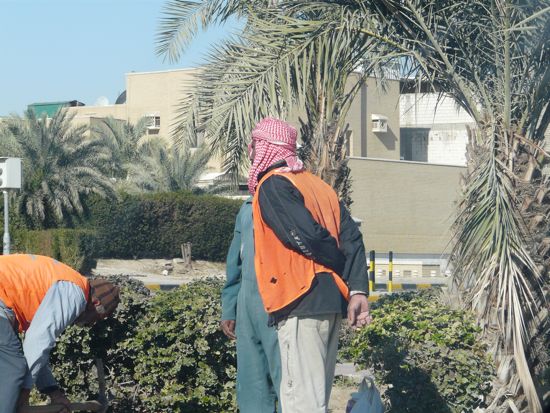
One person fixing the bricks, one person watching him do it. That does not seem like a smart use of human resources to me.
Flat Owners to be Prohibited from Sponsorship of Maids
Flat owners to be banned from sponsoring maids
From today’s Al Watan
Staff Writer
KUWAIT: As the number of maids employed in the country has alarmingly reached 560,000 the authorities have issued new instructions to regulate the presence of domestic laborers in the country.
According to sources at the Ministry of Interior, the ministry will not grant visas or residency permits to any nonـKuwaitis or expatriates seeking to hire domestic laborers as long as they live in apartments.
The only exception for expatriates seeking to hire maids, according to the sources, will be for those who have a compound surrounding their houses and in that case they will be required to provide a document authenticating that claim.
It has been gathered that the authorities have taken these measures in order to stem the visa trafficking trade in the country which usually results in the laborers ending up on the streets. The sources further disclosed that a special committee has been set up within the ministry to discuss issues pertaining to the issuance of visas and passports as well as issues concerning expatriate workers. They explained that the committee seeks to eliminate bureaucracy, centralization and to ensure justice and equality among companies and individuals.
Meanwhile, MPs Ahmed AlـSaadoun, Marzouq AlـHubaini, Ali AlـDeqbasi, Musallam AlـBarrak and Hassan AlـJohar submitted additional amendments to the Labor Law, calling for licensing a certain number of recruitment firms that specialize in hiring professional workers from abroad to join the local private sector. In the proposed amendments, the five MPs suggested that such recruitment firms would not be permitted to levy any recruitment charges on business owners or collect any fees from the recruited employees.
The proposal also forbids business owners from employing nonـKuwaitis without obtaining prior permission from the Ministry of Social Affairs and Labor.
Last updated on Monday 9/2/2009
Recent Comments
ExpatAlien on What Country am I Living … intlxpatr on Yellowstone: Old Faithful to C… Michelle on Yellowstone: Old Faithful to C… Cathy on No Grown-Ups in Charge intlxpatr on Waiting for Snow Wikipedia Donate Button

Amazina


Early Voting in Florida


 Here There and Everywhere