Favoring Co-ed Schools
Fascinating defense of integrated classrooms in today’s Arab Times, entitled Students Will Be Made More Comfortable under Co-ed written by Kuwait University student Dalal Nasser Al-Otaibi.
I learned how American Universities became co-ed, and why. (I had no idea; you grow up thinking these things are a given.) This article must have been used as a paper for a class, as it is well documented, cites sources, etc.
Inheritance of Loss
Most of the time, if I don’t like a book, I won’t even bother telling you about it. This book, The Inheritance of Loss, by Kiran Desai, is an exception for one reason – it IS worth reading.
Inheiritance of Loss showed up on the book club reading list for the year, and I ordered it. I read the cover when the book came, and it didn’t sound that good to me, so I read other books instead. The next time it came to mind was when a friend, reading the book, said she was having trouble with it, and asked me if I had started it. This friend is a READER, and a thinker. It caught my attention that she would have problems reading a book, so I decided to give it a try.
This is a very uncomfortable book. The characters live in the shadow of the Himalayan mountains. The most sympathetic character is a young orphaned girl, sent to live with her grandfather. With each chapter, we learn more about all the characters, how they came to be here, what they think, what their lives have looked like.
The author of this book has a very sour look on life. She has snotty things to say about every character. You can almost feel her peering around the corner, eyes slit with evil intent. She is that vicious neighbor who comes by and never says anything nice about anybody, and when you see her talking with your neighbor, you get the uneasy feeling she could be saying something mean about you, and she probably is.
The book covers a wide range of topics – Indian politics, Ghurka revolts, English colonization, Indian emigration to the US and UK, everyday vanities and pride in petty things, how people destroy their own lives, how people can be cruel to one another, oh it’s a great read (yes, that is sarcasm).
At the same time, this vicious unwelcome neighbor has a sharp eye for detail. You may not like what she is telling you, but you keep listening, because you can learn important tidbits of information from her. In my case, I learned a lot about how life is lived in a small mountain village in India, the struggles of illegals in America and how class lines are drawn, ever so finely, when people live together. I learned a lot about the legacy of colonialism, and the creep of globalization. This unwelcome neighbor has a sharp tongue, always complaining, and yet . . . some of her complaints have merit.
I don’t believe there was a single redeeming episode in the book. There was not a paragraph to feel good about. I am glad to be finished with the book – but, yes, I finished it, I didn’t just set it aside in disgust, or give it away without finishing.
Here is the reason I am telling you about this book – as uncomfortable as this book is to read, I have the feeling, upon finishing, that ideas and images from this book will stick with me for a long time. I have the feeling that it contributes to my greater understanding of how things work, how people think differently from other people, and on what levels we are very much the same.
Here is an excerpt from the book, at a time during which the Judge is a young Indian, studying in England:
The new boarding house boasted several rooms for rent, and here, among the other lodgers, he was to find his only friend in England: Bose.
They had similar inadequate clothes, similar forlornly empty rooms, similar poor native’s trunks. A look of recognition had passed between them at first sight, but also the assurance that they wouldn’t reveal one another’s secrets, not even to each other.
. . . Together they punted clumsily down the glaceed river to Grantchester and had tea among the jam sozzled wasps just as you were supposed to, enjoying themselves (but not really) as the heavy wasps fell from flight into their laps with a low battery buzz.
They had better luck in London, where they watched the changing of the guard at Buckingham Palace, avoided the other Indian students at Veeraswamy’s, ate shepherd’s pie instead, and agreed on the train home that Trafalgar Square was not quite up to British standards of hygiene – all those defecating pigeons, one of which had done a masala-colored doodle on Bose. It was Bose who showed Jemubhai what records to buy for his new gramophone: Caruso and Gigli. He also corrected his pronunciation: Jheelee, not Giggly. . . .
This it was that the judge eventually took revenge on his early confusions, his embarrassments gloved in something called “keeping up standards,” his accent behind a mask of a quiet. He found he began to be mistaken for something he wasn’t – a man of dignity. This accidental poise became more important than any other thing. He envied the English. He loathed Indians. He worked at being English with the passion of hatred and for what he would become, he would be despised by absolutely everyone, English and Indians both.
I consider this a review, and not particularly a recommendation. I read the book, I finished the book and I learned from the book. I didn’t like the book. I recommend it only as a challenge, for people who like to read and stretch their minds in new directions.
Salary Belongs to Husband?
Muna al-Fuzai had a column yesterday in the Kuwait Times entitled Kuwaiti Women Accept Discrimination. (You can read the whole article by clicking on the blue type.)
In this article is one small paragraph that sends shivers down my spine:
A religious Islamic ruling was made recently to approve the husband’s right to take his wife’s salary because the time she spent outside was his own and thus he is entitled to take her salary, which she has worked so hard to earn.
It doesn’t sound to me as if it has the weight of law – like the first question I ask is:
• “do all Islamic religious rulers believe this to be true, or is this one guy’s opinion?”
• is it possible for this ruling to receive enough support to make it law?
• if it becomes law in Kuwait, does this law apply to all people living in Kuwait, or just to Kuwaitis?
This, to me, is a very scary ruling.
I’ve been married to AdventureMan for a long time. We’ve always discussed finances together, and we’ve both agreed on how to allocate our money and salaries. Sharing is very different from my earnings being controlled by someone else, no discussion. Or maybe discussion, but not necessarily.
But I am not Kuwaiti. If you are working, have ever worked, or intend to work, how does this ruling strike you?
Naughty or Nice?
Blogger N. at One or the Other asks readers and visitors to vote on whether they are naughty or Nice? Blogger Fourme, rightly comments that we don’t have any definition of naughty or nice by which to define ourselves and that she will refrain from voting.
Most of the voters are naughty, by the way.
It gave me a big grin.
Isn’t “naughty” or “nice” greatly in the mind of the beholder?
Once, when I was the young wife of a young army officer, I got up my courage and wrote a letter to the editor. It turned out to be a controversial letter; I got one very sarcastic response from the authority I questioned, and then, a week later, all hell broke loose as readers from all over Europe bombed the one who replied. I felt scared, but a little proud to have raised the issue.
I was working in the library. THE COLONEL’S WIFE (that is how we thought of her) walked in and said to me “we don’t get our names in newspapers. It isn’t done.” And then she walked out.
Then I really felt scared. And I really felt naughty. And at the same time, I wouldn’t change a thing.
Sometimes, don’t you have to say something? When you see something that is not right? And is that really naughty?
Walking Old Damascus (2)
You know how it is, when you are flat-out totally in love, you can’t see the flaws. In moments of clarity, I can understand that there could be hardships to living in Damascus. There could be problems meeting the codes for historical preservation while trying to install modern plumbing. There could be bureaucrats to bribe, there could be problems with labor, I don’t know any of this, I am just guessing.
None of it matters to me, I am so head-over-heels happy. Thanks be to God, AdventureMan shares my insanity, and we are having a wonderful time walking, walking, walking. He is SO patient with me, and all the photos I have to stop to take.
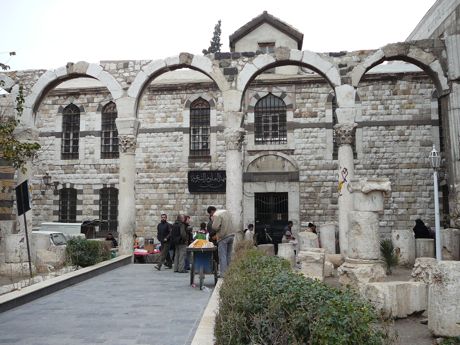
Today we visit the Ummayyad Mosque which also contains the tomb of John the Baptist. I think this is one of the reasons we love Damascus so much – the co-existence of Islam and Christianity, and the sharing of sacred spaces.
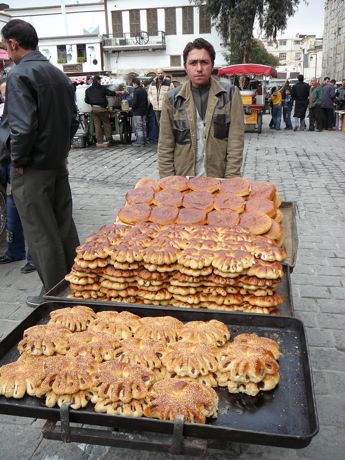
The parking area in front of the mosque is full of vendors. My favorite are the bread carts:
Non-Muslims have to go to the entrance where you can rent an abaya with a hood, so that you can visit the mosque. All visitors are welcome; entire tour groups are going through, French, German. You also have to take off your shoes, and the beautiful marble flooring is VERY cold! In some places, there is carpeting.
This is a tree-of-life detail from the treasury:

Once inside the Ummayad Mosque, they have that in-floor heating, so you can warm your tootsies back up while experiencing the magnificence of the mosque interior (please note the horseshoe arches):

The tomb of John the Baptist:

A funny story: as we are leaving the Mosque, AdventureMan says “where is this tomb of John the Baptist you wanted to visit?” and I looked at his in puzzlement. We had finished touring the whole mosque, and I had photographed the tomb.
“We already visited it!” I told him.
“When?” he asked.
“It was that beautiful tomb in the main mosque area surrounded by people praying!” I replied.
“No, that was somebody named Yahyah,” he corrected me.
“Yahyah is the name for John the Baptist,” I told him. Guess he would have appreciated it more if he had known at the time. I just assumed he knew.
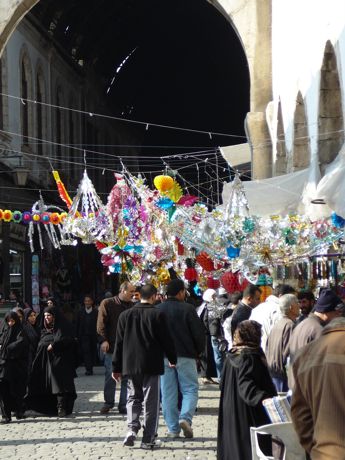
I must have been a magpie in another life. I don’t know why, but I love these glittery Chinese decorations. AdventureMan bought one for me, a golden crown with big red “jewels”. The shops always catch my eye:
This is a famous ice cream place in the Souk Hammadiyya:

This shop was on the traditional medicine shop street. It had herbs, and dried creatures which can be used in healing, and unusual soaps, and also seashells:

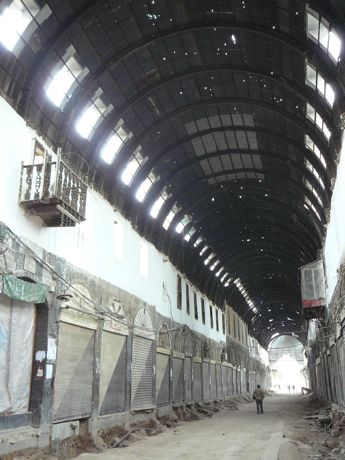
This is the traditional souk at the beginning of the Street Called Straight (al Mustaqeen) which is undergoing renovation. Just wanted you to see the bulletholes through the roof:
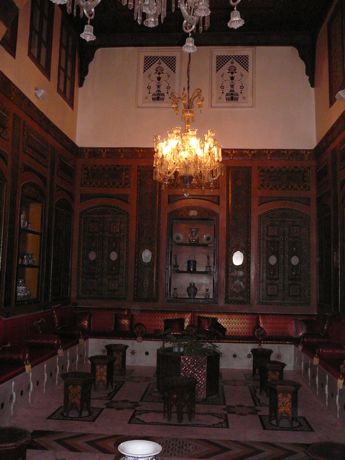
I don’t know if you could find a truly bad meal in Damascus. I think you would really have to try! We found this wonderful restaurant, Al Kawali, not too far from our hotel, and we loved their food and we loved the atmosphere, and we loved having the bread baked right under our noses:

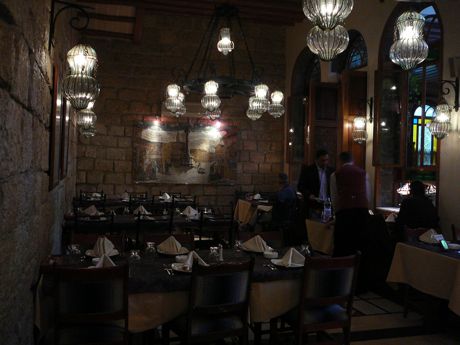
For those of you who, like me, are addicted to spaces and details – look at these gorgeous light fixtures, Damascene glass:

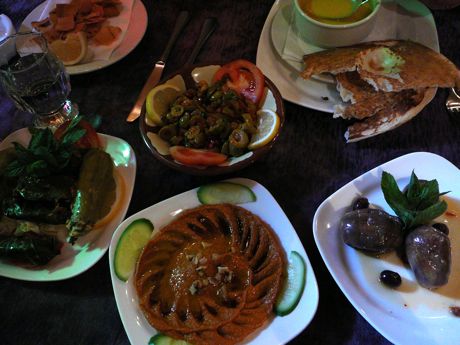
And last, but not least – we find the food so fabulous that we are eating too much. Our first time at Al Kawali, we order just some favorite mezze dishes and soup. When the tastes are so perfect, it takes less to fill you up, and this food is perfection.
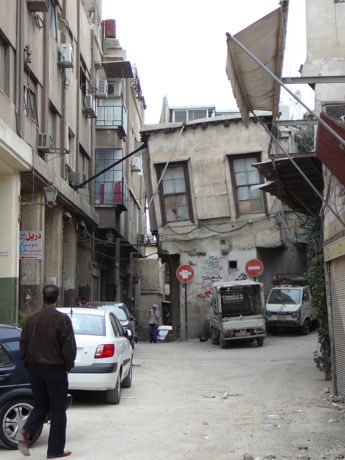
We found this old house as we were leaving Al Kawali to walk back to the hotel:
Freecycle
There was an article within the last few days in the Kuwait Times about Freecycle but this is not the recent article. It was the only article I could fine, from April 2007. The important thing is that it exists, and that setting up a Kuwait freecycle would be of benefit to many.
In the expat community, we do a lot of Freecycle on an informal basis. When we come, people help us out with things, and when we leave, we pass our things along. Sometimes we sell them, but often as not, we give them away and would love for them to fall into the right hands. We all hate waste.
(Oh my gosh! I just went to the Freecycle Website and found the Kuwait group and it has 122 members! Holy Smokes!) Click on the blue type and you can join the Kuwait group, too!
Don’t throw it away, someone might want it
Published Date: April 25, 2007
By Pete May
Our houses are full of them: old computers, fax machines, video players, fridges in the garage, vinyl records, unwanted armchairs – things we don’t want but still work. Research by gumtree.com reveals the British dispose of over £5.6bn worth of usable household items a year, including 1.35m working fridges and freezers, and 2.6m sofas. People out there want our redundant stuff – but how do we find them? A few weeks ago, I tried to shift a 10-year-old Apple Power Mac and a similarly ancient (in computer terms) Mac laptop. Both worked, so to throw them in a skip would have been wasteful and created toxic waste (computers can contain heavy metals and chemicals). I’d checked the likes of Computer Aid International (computeraid.org) and the Community Recycling Network (crn.org.uk). Both accepted PCs, but the words “10-year-old Apple Mac” resulted in polite rejection.
So I tried Freecycle, an online forum where people give away and pick up unwanted stuff, free of charge. It has 4,009 communities worldwide and, according to its online counter, 3,401,532 users. I joined my local group and tentatively posted my message: “Offered: Power Mac with printer and Powerbook laptop, bought in 1997 but working fine, need to be collected.” Within three hours I’d had 30 replies. Suddenly my Macs were seen as a valuable resource. Jenny wanted the laptop for her 11-year-old son who was “a Mac fanatic”, while Julie wanted it for her soon-to-be daughter-in-law; Ben needed computers for his charity in Zimbabwe. It wasn’t easy to decide whom to give them to.
Freecycle etiquette dictates that you don’t necessarily give things to the first emailer – and you must reject anyone you suspect wants to sell the goods. I opted for friendly sounding people who could collect immediately: Andy, who’d been on disability benefit for three years, and Ruth, a cash-starved student. Since then I’ve used Freecycle to shift two fax machines, a Zip drive, an office desk, a child’s desk, a malfunctioning Hoover, some kitchen shelves, a washing machine and my local vicar’s sofa bed. Our fridge-freezer went to a woman with cancer who was on a special diet and needed it for her store of juices. Our rubbish was helping someone fight for life. Then I visited SwapXchange, which offers items to swap from all over the country via its website (swapxchange.org). I exchanged a juicer and a Kenwood mixer for a bottle of organic wine apiece.
(Read the rest of the article by clicking on the BLUE Kuwait Times type, above.)
Pass it along. . . !
Fresh Start
I always get a burst of energy between Christmas and New Year’s. Truly, for me, new hope has come into the world. It doesn’t have to be rational, it’s just the way it is for me. I get all kinds of old messes cleaned up, I sort, I organize, I throw out or I hem/mend/ cut down to make something useful once again.
It made the dark months of winter pass more quickly in Seattle and in Germany, where many days go from black to dark grey and then back to black again. Here in Kuwait, with all the sunshine, it is just so much easier. Every day dawns in blues and pinks – how can life be bad when a day starts so beautifully?
There is one sharp sword hanging over me – taxes. *gnashing of teeth* I am pretty good about keeping receipts all in one place all year, but taxes for xpats can be complicated, and our tax guy sends a worksheet – like 14 pages – for us to fill out every year. It really isn’t that hard, but I dread it.
Over a year ago, the US government changed the way expats are taxed. Even worse, they snuck it in as an amendment, I think to a military appropriations or budget bill, and no one was aware of the implications until it was a done-deal. It is a nightmare. In one year, we went from qualifying for refunds to owing a burdensome debt of taxes. Aaarrgh.
I have a list of projects I want to do this year, some challenging, some just fun. Some projects left over from previous years I want to get done once and for all. I see 2008 as a great luxury, all those days, an entire year, stretching out before me in which I can get these things done. Woooo Hooooooo!
Christian vs Christian
This is just purely sad. You can read the whole story at BBC World News.
Unholy dust-up at Nativity church
Members of rival Christian orders have traded blows at the Church of the Nativity in Bethlehem, with four people reported wounded in the fray. Greek Orthodox and Armenian Apostolic priests were sweeping up at the church following the Christmas rites of the Western churches earlier in the week.
Reports say some Orthodox faithful encroached on the Armenian section, prompting pitched battles with brooms.
Intense rivalries at the jointly-run church can set off vicious feuds.
The basilica, built over the grotto in the West Bank town that is the reputed birthplace of Jesus Christ is shared by Roman Catholic, Greek Orthodox and Armenian religious authorities.
Palestinian police formed a human cordon to separate the battling dark-robed and bearded priests and deacons, said to number about 80, so that cleaning could continue.
Read the rest of the story here.
“Marionette . . . or Moron?”
This was sent by a good friend, 8 minutes by Keith Olbermann, ending with “Mr. Bush, you are a bold-faced liar.” This is from his December 6th broadcast.
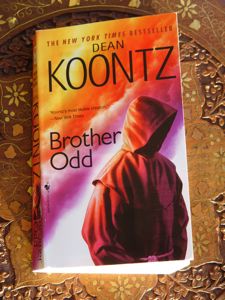
Brother Odd: Dean Koontz
I’ve always liked Dean Koontz; he knows how to be compassionate and funny at the same time. When I showed books I had bought, my long-time friend Momcat said “Oh, you’re going to like that book!” and oh, how right she was. I like it so much that now I have to go back and buy the previous ones to catch me up.
The main character, whose name, to his embarrassment, is Odd Thomas, has secluded himself in a monastery in search of spiritual peace. Or was he brought here for another reason? Odd Thomas has some very odd gifts; he can see the undeparted dead, for example, and he can sense things that normal humans can’t. You would think these would be very cool talents, but Odd is in his early twenties, and his talents only serve to isolate him and make him feel a little alien.
The monastery / nunnery is a good place for him, full of very human monks and nuns, some of them very wise and very compassionate, as well as competant. It’s a good place for Odd Thomas, a healing place and a place where his strange gifts are protected by his spiritual cohabitants. The monastic life attracts a lot of people trying to put their pasts behind them to seek spiritual goals, and also attracts those with their own agendas.
The monastery is well endowed, and contains a special school for young people who have physical and/or mental disabilities. Some can learn enough to return to society, and some will probably spend the rest of their shortened lives under the safety and care of the nuns – until, all of a sudden, a threat appears, directed at the children.
Dean Koontz writes interesting books. He often includes benign animals, he often focuses on threats to women and children, and while his books are not difficult to read, neither are they something you read and easily forget. Both AdventureMan and I read an earlier Dean Koonz book, Watchers, to which we have often referred through the years, as one of his characters ends up homeless and living in a car with her son. She talks about money just giving you more options, and about those who are one paycheck away from homelessness. It was an easy read, but he includes some tough ideas, things you find yourself mulling over even years later. That’s a good read in my book!
The only problem with this book was that it was so good I finished it in one flight. Good thing I had packed a back-up book in my carry-on!
Recent Comments
ExpatAlien on What Country am I Living … intlxpatr on Yellowstone: Old Faithful to C… Michelle on Yellowstone: Old Faithful to C… Cathy on No Grown-Ups in Charge intlxpatr on Waiting for Snow Wikipedia Donate Button

Amazina


Early Voting in Florida


 Here There and Everywhere