The Olive Oil Scandal

A good friend gave me a subscription several years ago to The New Yorker, and at the time I didn’t know how lucky I was. First, I loved the cartoons. A couple magazines later, I got pulled in by some of their excellent travel and political writing. Later, the fiction issues pulled me in and introduced me to authors I had never read before. In no time at all, I was totally addicted.
Now, when The New Yorker arrives, Adventure Man and I fight to see who gets to read it first! Often he wins; he skims it. He knows I will take too long getting through it.
It was the New Yorker magazine who informed me about the great olive oil scandal.
I love olive oil. I only use other oils in baked goods, where the olive oil might give an odd taste, we use olive oil almost exclusively. Or so I thought.
In the August 13 Issue of the New Yorker, Tom Meuller starts like this:
On August 10, 1991, a rusty tanker called the Mazal I docked at the industrial port of Ordu, in Turkey, and pumped twenty-two hundred tons of hazelnut oil into its hold. The ship then embarked on a meandering voyage through the Mediterranean and the North Sea. By September 21st, when the Mazal II reached Barletta, a port in Puglia, in southern Italy, its cargo had become, on the ship’s official documents, Greek olive oil. It slipped through customs, possibly with the connivance of an official, was piped into tanker trucks, and was delivered to the refinery of Riolio, an Italian olive-oil produce based in Barletta. There it was sold—in some instances blended with real olive oil—to Riolio customers
Between August and November of 1991, the Mazal II and another tanker, the Katerina T., delivered nearly ten thousand tons of Turkish hazelnut oil and Argentinean sunflower-seed oil to Riolio, all identified as Greek olive oil.
Riolio’s owner, Domenico Ribatti, grew rich from the bogus oil, assembling substantial real-estate holdings, including a former department store in Bari. He bribed two officials, one with cash, the other with cartons of olive oil, and made trips to Rome, where he stayed at the Grand Hotel, and met with other unscrupulous olive-oil producers from Italy and abroad. As one of Italy’s leading importers of olive oil, Ribatti’s company was a member of ASSITOL, the country’s powerful olive-oil trade association, and Ribatti had enough clout in Rome to ask a favor—preferential treatment of an associate’s nephew, who was seeking admission to a military officers’ school—of a high-ranking official at the Finance Ministry, a fellow-pugliese.
However, by early 1992 Ribatti and his associates were under investigation by the Guardia di Finanza, the Finance Ministry’s military-police force. One officer, wearing a miniature video camera on his tie, posed as a waiter at a lunch hosted by Ribatti at the Grand Hotel. Others, eavesdropping on telephone calls among Riolio executives, heard the rustle of bribe money being counted out. During the next two years, the Guardia di Finanza team, working closely with agents of the European Union’s anti-fraud office, pieced together the details of Ribatti’s crime, identifying Swiss bank accounts and Caribbean shell companies that Ribatti had used to buy the ersatz olive oil.
The investigators discovered that seed and hazelnut oil had reached Riolio’s refinery by tanker truck and by train, as well as by ship, and they found stocks of hazelnut oil waiting in Rotterdam for delivery to Riolio and other olive-oil companies.
The investigators also discovered where Ribatti’s adulterated oil had gone: to some of the largest producers of Italian olive oil, among them Nestlé, Unilever, Bertolli, and Oleifici Fasanesi, who sold it to consumers as olive oil, and collected about twelve million dollars in E.U. subsidies intended to support the olive-oil industry. (These companies claimed that they had been swindled by Ribatti, and prosecutors were unable to prove complicity on their part.)
You can read this entire fascinating article here: Tom Meuller: Slippery BusinessGive yourself plenty of time. It is an article well worth reading.
There is another good reference here: The Great Olive Oil Scandal from PalestinianOliveOil.org
Investigators have gathered evidence indicating that the biggest olive oil brands in Italy — Bertolli, Sasso, and Cirio — have for years been systematically diluting their extra-virgin olive oil with cheap, highly-refined hazelnut oil imported from Turkey. [1]
A 1996 study by the FDA found that 96 percent of the olive oils they tested, while being labeled 100 percent olive oil, had been diluted with other oils. A study in Italy found that only 40 percent of the olive oil brands labeled “extra-virgin” actually met those standards. Italy produces 400,000 tons of olive oil for domestic consumption, but 750,000 tons are sold. The difference is made up with highly refined nut and seed oils. [2]
EVEN THE BIGGEST OF THEM WILL MISLEAD THE PUBLIC…
“In 1998, the New York law firm Rabin and Peckel, LLP, took on the olive oil labeling misnomer and filed a class action suit in the New York Supreme Court against Unilever, the English-Dutch manufacturer of Bertolli olive oil. The firm argued that Bertolli’s labels, which read “Imported from Italy,” did not meet full disclosure laws because, even though the oil had passed through Italian ports, most of it had originated in Tunisia, Turkey, Spain or Greece. “Bertolli olive oil is imported from Italy, but contains no measurable quantity of Italian oil,” according to court documents.”
Curezone lists manufacturers of adulterated olive oil and marketers of the same oil. It is disgusting. We pay high prices for junk-olive oil. From Curezone.com/forums
The Guilty
Below is a list of known adulterated brands and dishonest distributors with links to information about their cases.
Adulterated brands of extra virgin olive oil
with country of origin
Andy’s Pure Olive Oil (Italy)
Bertolli (Italy)
Castel Tiziano (Italy)
Cirio (Italy)
Cornelia (Italy)
Italico (Italy)
Ligaro (Italy)
Olivio (Greece)
Petrou Bros. Olive Oil (California)
Primi (Italy)
Regale (Italy)
Ricetta Antica (Italy)
Rubino (Italy)
San Paolo (Italy)
Sasso (Italy)
Terra Mia (Italy)
Distributors caught selling adulterated olive oil
Altapac Trading
AMT Fine Foods
Bella International Food Brokers
Cher-Mor Foods International
D&G Foods
Deluca Brothers International
Gestion Trorico Inc.
Itaical Trading
Kalamata Foods
Les Ailments MIA Food Distributing
Lonath International
Mario Sardo Sales, Inc.
Petrou Foods, Inc.
Rubino USA Inc.
Siena Foods Ltd.
Vernon Foods
So who do we trust? How do we know that we are getting a quality, unadulterated product? This is fraud in an international scale!
Accident Aftermath
This time the crunch was different. This time, the initial BLAM crunch was followed by a heart-sickening series of crunches. I was on the phone dialing 777 even before I got to the window.
They have lovely women working for emergency services now, women who can stay calm and switch languages easily. Just hearing her voice calms me down as I report the accident, tell them to send an ambulance. The upside down car door is flipping open, and people are running to help the victim out. It’s a woman, and she is beautiful. She is also bleeding, and once they get her out, she is very still, too still.
The traffic police call me back and I tell them where the accident is, but thank God the woman is still on the phone and when he doesn’t understand, she fills in efficiently and accurately.
It takes them 21 minutes to arrive. The traffic police send one car, and on a busy street, they all gather around the woman and stare. The MOI also send a car. Not one of these police set up any kind of traffic control, cars on both sides of the road are stopping, people come running, just to look.
The ambulances take 22 minutes. When they leave, there are no sirens. I don’t think she survived. The medics appeared knowledgeable and efficient.
It’s the aftermath that bothers me now. On the ground, they left all the medical waste.

The last thing the medic did as he got into the ambulance was to throw his bloodied gloves on the ground:
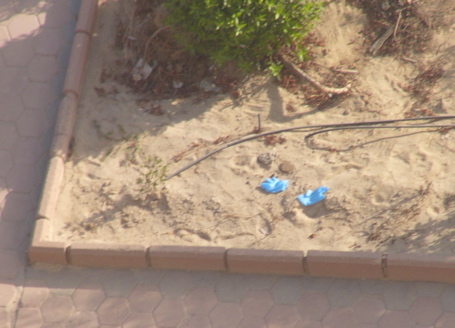
And then . . .the traffic cops left! There are two wrecks on one of the busiest thoroughfares in town, and no protection from the next speeding car! The wrecks are in the fast lane!
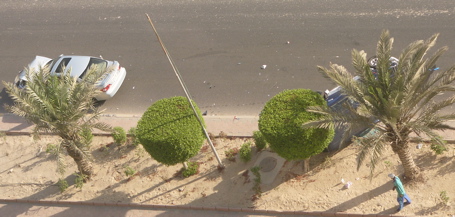
Don’t get me wrong. You know how I feel – police, ambulance medics, firemen – they are all heroes in my book. They risk their lives every day for the common good. The save lives, and they take pride in what they do.
They need a little training in accident management. When there is an accident, there needs to be a priority on getting there fast, and controlling the crowd, and routing traffic by efficiently. The medics need to pick up their waste.
There needs to be after-accident care, ensuring that someone stays until the wreckage is removed.
I had a house guest once who sat in my window and said “Oh my God. Oh my God! Oh! Oh! Oh!”
There are three separate u-turns we can see. Each one is another accident just waiting to happen. When the turn lanes back up, sometimes some people start honking, putting pressure on the lead person to make an unsafe turn. Please – resist the pressure. Take your time. Wait for a safe, truly safe interval.
Please, my friends, do one thing for me. Please, buckle your seat belts. And please, buckle up your children, put them in car-seats made to protect them, teach them from an early age to buckle-up, help it become so automatic they don’t even think about it.
African Leadership Prize to Chissano
This is from BBC News: Africa and you can read the entire article by clicking on the blue type BBC News.
Former Mozambique President Joaquim Chissano has won the first Mo Ibrahim prize rewarding a retired African head of state for excellence in leadership.
Mr Chissano, who is credited with bringing peace to Mozambique, had been seen as a frontrunner for the prize.

The prize, announced by former UN head Kofi Annan, is worth $5m (£2.5m) over 10 years, and then $200,000 a year.
Mobile phone millionaire Mo Ibrahim is funding the project in the hope it will help improve governments’ performance.
The Sudanese businessman also hopes it will increase Africa’s self-sufficiency and bring a day when the continent’s people no longer need to live on aid.
His decision not to seek a third presidential term reinforced Mozambique’s democratic maturity
Kofi Annan on Joaquim Chissano
Mr Annan chaired the panel that awarded the prize, billed as the largest of its kind.
Mr Annan praised Mr Chissano for “his most outstanding contribution” to peace and democracy.
“This remarkable reconciliation between opponents provides a shining example to the rest of the world and is testament to both his strength of character and his leadership,” Mr Annan said.
Wider role
After winning independence from Portugal in 1975 Mozambique suffered a civil war that lasted until 1992. Mr Chissano was president from 1986 to 2005. He also served as chairman of the African Union in 2003 and 2004, and has worked as a UN envoy.
Mr Annan praised Mr Chissano’s role at home and more widely in Africa.
“His decision not to seek a third presidential term reinforced Mozambique’s democratic maturity and demonstrated that institutions and the democratic process were more important than personalities,” he said.
“He was a powerful voice for Africa on the international stage and played an important role in pushing debt relief up the agenda.”
Mr Chissano is something as a rarity in Africa as a leader who has left office with his reputation intact, says BBC southern Africa correspondent Peter Biles.
My comment: I love a prize that says “I caught you doing something good.” Mr. Chissano had no idea, when he was leading Mozambique, or when he chose to step down from power, that he would be competing for this prize. He led as he led, and he stepped down from power (imagine!) because he thought it was the best thing for his nation.
Some people has scoffed, called it a patronizing award. As if every country in the world doesn’t have its corruption! Africa needs shining examples of selfless leaders who can put the interests of the country in front of their own. Africa needs leaders who can unite diverse populations, drawn into nations by colonial powers, not along lines of ethnicity or religious differences.
I love it when a person does something good, without seeking reward, and then is spot lighted for the good work they have done.
No E-mail Day
Productivity at the office is increasingly becoming an issue. The industry giant Intel has introduced “no e-mail days” to encourage Intel engineers to get off their behinds, move out of their cubicles and talk to one another, rather than sending an e-mail to a co-worker just a few steps away. You can read the entire story at BBC News: Technology.
With inboxes bulging with messages and many workers dreading the daily deluge of e-mail, some companies are taking drastic action.
Intel has become the latest in an increasingly long line of companies to launch a so-called ‘no e-mail day’.
On Fridays, 150 of its engineers revert to more old-fashioned means of communication.
In actual fact e-mail isn’t strictly forbidden but engineers are encouraged to talk to each other face to face or pick up the phone rather than rely on e-mail.
In Intel’s case the push to look again at the culture of e-mail followed a comment from chief executive Paul Otellini criticising engineers “who sit two cubicles apart sending an e-mail rather than get up and talk”
Visitors, Not Residents?
From yesterday’s Arab Times:
The General Immigration Department of the Ministry of Interior is studying a proposal to replace the term ‘resident’ — the status given to expatriates working in Kuwait, reports Al-Watan daily. The daily added this has been done to ‘fight’ attempts by international organizations asking Kuwait to grant citizenship to expatriates who have been working in the country for a long time. Meanwhile, a reliable source said ‘visitor’ will replace the term ‘resident’. The source also said the General Immigration Department has stopped receiving applications for self sponsorship after noticing an increasing number in applications over the past few months. According to knowledgeable sources the Assistant Undersecretary for Citizenship Affairs Major-General Sheikh Ahmad Al-Nawaf has issued instructions to take into account the demographic structure of the country while issuing work permits because Kuwaitis account for only 33 percent of the population compared to 67 percent expatriates.
Calling all us guest-workers “visitors” is just a dumb idea. Call us guest-workers, call us workers, but if you call us “visitors” then you run into problems with folks who are just coming in for a VISIT, i.e. visitors.
I have always preferred being a resident. When I come into Qatar or Kuwait and all the lines are long except the GCC lines, I can always take a chance that the guards will think I am married to one of you when I step into the GCC line. If the person at the desk says I am in the wrong line, I can always look confused and say “I am a resident!” It has worked – well, most of the time. 😉
This issue is hand-in-hand with the school issue. Times are changing, old traditions are not being observed, and the blame is falling on foreign influences. It’s kind of like that train has left the station – if you want to go back to old ways, you’ll have to get rid of automobiles, computers, mobiles, supermarkets, and most of all, that demon of all forces of modernization – television.
The Taliban managed to reinstate old traditions, and in doing so, to take Afghanistan right back to the stone age. It was not just the women who suffered – men who didn’t want to wear beards, men whose hair was too long, men who wanted to listen to music, men who wanted to discuss politics – all were punished, some were killed.
The real challenge here is how Kuwait, as a modern nations state with a lot of money, is going to move with the modern world, not against it.
“Committee” Cracks Down on Education in Kuwait
This is a small article from yesterday’s (October 16) Kuwait Times:
MOE Cracks down on foreign schools:
Kuwait: The council of undersecretaries at the Ministry of Education chaired by Minister of Education Nouriya Al-Sabeeh will discuss after Eid holidays the demands of the committee about the negative effects of some traditions to the Kuwait society.
(Excuse me? What committee is that? What negative effects of some traditions? Could you make this any more opaque? Or is the goal to have us ask these very questions?)
It continues:
The committee demands to stop foreign schools from making foreign trips until the regulations to control these trips and stop mixing girls and boys together have been issued. The committee also demands that foreign schools inform the ministry about any parties they intend to have and the agenda of that party to ensure that the nimistry is present and in order to make sure that the school abides by the MOE’s regulations.
The committee also asked the ministry to implement a plan for segregation among boys and girls in the high school classes, as it is more important than segregation at universities. The committee noted that segregation should start in school activities as a preliminary step an foreign schools should be instructed by this through a circular to be distributed to them.
Comment: Let’s face it, foreign schools have strange foreign ways, including the mixing of boys and girls. They believe it creates healthier relationships down the road when people learn to get along with all kinds of other people at a very young age.
Even now, fewer western families are coming to Kuwait because of the education situation. It is often discussed among expat groups that the quality of education available in Kuwait is slipping dramatically.
Of those expat families that do come, many are choosing to home-school to avoid the problems developing in the local schools, even the “foreign” schools. It seems to me that local people who send their kids to the better “foreign” schools do so because these schools have a reputation for providing a better level of education than the public schools – is this correct? It also seems to me that if the “foreign” schools are doing better than the local schools, perhaps it is a good idea to keep letting them do their thing, rather than regulate them too closely?
I saw a group of home-schooled kids on the beach recently, having PE. They were playing volleyball, big kids, little kids, boys and girls all together. They were having a wonderful time. They were polite, respectful and modestly dressed. There wasn’t a sign of romance, just good, healthy fun as they played.
A friend who teaches in one of the local schools tells me of little Abdul, whose pencil fell on the floor the other day and he said to her – his teacher – “Pick that up.” She just stood there, half in shock that he would speak to her – or to anyone – so disrespectfully. Abdul looked up at her with those charming big eyes and grinned. And said “You’re not going to pick it up, are you?” She laughed and said “No, you are!” and he did. Little Abdul is learning some strange foreign ways.
Some of you went to foreign schools, either here in Kuwait or elsewhere. What do you think?
EnviroGirl on Tap Water
Welcome, EnviroGirl, our Guest Blogger on Blog Action Day, and thank you for being our Guest Blogger!
Thanks, Intlxpatr, for inviting me to be your guest blogger.
Intlxpatr knows that I am passionate about drinking tap water, as well as encouraging others to do the same. I’ve almost always chosen to drink tap water over bottled water, primarily because it’s cheaper that bottled water, and it’s readily available (just turn on the faucet!).
Over the last year I’ve learned that there are even more reasons to drink tap water (at least in the U.S.). So I’ll quickly share with you a few reasons why you should save your money and drink tap water. If you want to do more research on the topic, I’ve included a few links below.
Why you should choose tap water over bottled…
1) Tap water is tested stringently for chemical and microbiological contaminants. It is regulated by the Environmental Protection Agency (EPA) and must comply with the Safe Drinking Water Act. Bottled Water is often regulated by the Food and Drug Administration (FDA), and does not fall under the Safe Drinking Water Act. (All water in the U.S. falls under the Safe Drinking Water Act.) This means that it is not tested as rigorously as tap water. In addition, your community water provider is required to send you a Consumer Confidence Report (CCR) every year. The CCR should inform you of the quality of your tap water and if any contaminants have been detected. Try finding this information on the label of a bottle of water.
2) Bottled water is not only more expensive to purchase, the environment costs are greater too. Bottled water must be shipped to your location, which means more fossil-fuel emissions into the air. After the water is consumed, the plastic bottle must be disposed of. If the bottle is not recycled, it will be tossed in a landfill where it will take about 700 years (plastic bottle recycling facts) to decompose.
3) Clean drinking water is a valuable resource. Recently, droughts and pressures from population growth have created water shortages. In communities experiencing water shortages, bottling water has become a hot topic because it depletes local drinking water supplies. Water use restrictions may be imposed on the community, while the bottled water company is still packaging and selling the amount of water it was permitted to use (For example – http://www.orlandosentinel.com/orl-bottledwater1307oct13,0,6642058.story). This also leads into the importance of conserving drinking water resources and implementing creative strategies such as water reuse (Info on water reuse – http://www.epa.gov/region09/water/recycling/index.html ).
Again, the information above regarding water quality is for tap water in the U.S. In countries that do not have adequate sanitation it is not advisable to drink tap water. If you live outside of the U.S., the World Health Organization (WHO) and the European Commission are two organizations that have water quality standards that many countries choose to adopt. You can search online to determine if your country follows any of these standards and if your tap water is safe to drink.
Links:
U.S. Safe Drinking Water Act:
http://www.epa.gov/safewater/sdwa/basicinformation.html
U.S. Environmental Protection Agency – Drinking Water:
http://www.epa.gov/safewater/
World Health Organization – Drinking Water:
http://www.who.int/water_sanitation_health/dwq/en/
European Commission – Drinking Water:
http://ec.europa.eu/environment/water/water-drink/index_en.html
Website for Water in the Middle East:
http://www.al-bab.com/arab/env/water.htm
National Resource Defense Council – Bottled Water Q & A:
http://www.nrdc.org/water/drinking/qbw.asp
Plastic bottle recycling facts (U.S.):
http://earth911.org/recycling/plastic-bottle-recycling/plastic-bottle-recycling-facts/
Aimee Leduc: Murder in the Marais
Not every book can be one of the best books you ever read. Some books are so good, so filled with nuance, insights and subtleties that even if they are made into a movie, they can’t begin to capture the experience of having read the book.

(available from Amazon.com at $10.40 new and from $1.97 + shipping used)
This isn’t one of those. As I read this book, as I followed the main character, Aimee LeDuc, through the streets of Paris, solving the mystery of who is killing Jews who survived the Holocaust – and why – I kept thinking “this is like reading a made-for-TV movie, you know, the ones that went almost straight to video/DVD?”
I was intrigued when Amazon recommended this series to me, but not surprised – remember, I read Donna Leon, James Lee Burke, and have a history of buying mysteries and detective stories set in exotic locations. But I only ordered one, to test the waters.
There isn’t a lot of depth. The author, Cara Black, gives her main character Aimee LeDuc about as much substance as a cartoon character. She changes clothes a lot, she has very interesting friends, she is smart, and sassy, and savvy, and more than a little edgy. And . . . I kept reading. I even think I will buy another one, just to see. I’m not enamored, but . . . I am intrigued, mildly intrigued, intrigued enough to give it another shot.
There is something about the book that keeps me reading. Could it be the Paris setting? 🙂 Could it be the gritty reality of Aimee’s interactions? Could it be that her shallowness is deceptive, and that if I read more books in the series I will understand her better? Could it be her amazing cast of characters, including her partner, a computer-savant-dwarf?
She includes a lot of Paris-reality. Aimee’s apartment has serious heating problems, and she often takes a hot bath just to warm up – as long as the hot water lasts. In her Paris it rains. In her Paris, dealing with the bureaucracy, while not particularly corrupt, is endlessly frustrating. Her Paris is peopled with people a whole lot like us, warts and all. For me, this is a plus.
Cara Black is a little skimpy on motivation; the plot reminds me of The DaVinci Code, it doesn’t really hang together all that well. In spite of all that, I found myself enjoying riding through Paris in the rain on a little mo-ped, crashing through the back of the Issa Miyake showroom and grabbing some items from the bin to disguise me as I escaped, and grabbing a croissant here and there, smelling the Tarte Tatin from the alleyway . . . I did not enjoy the fight on the slick tiles of the Paris rooftops at all.
If you like mysteries, you need to get acquainted with Cara Black’s Aimee LeDuc, just to be able to have an opinion when another detective-loving-book-reader asks. If you already have stacks of books waiting to be read – this is a good one for reading in airports while waiting for a delayed flight.
(Side Note: The Marais is the old Jewish Quarter of Paris, and it is in the process of serious gentrification. There is an old post-card and poster store located there, with items to die for – at prices to match. It is also near the Musee Carnavalet, probably one of the best museums in Paris.
Hôtel Carnavalet
23, rue de Sévigné
75003 Paris
Standard : 01 44 59 58 58
Fax : 01 44 59 58 11)
Travel Dilemma
We love Syria. I used to take trips around Syria with a group of archaeologists; we stayed weird places and saw the most remote and obscure places just to see them, just to see what we could see. It was so much fun; Syria is so beautiful. We most often went there in winter, and I remember how COLD it could be, even into April.

We requested visas weeks ago. No visas. This week we got a state department advisory saying travel in Syria was not advisable because of the embassy incident that happened in September 2006 – like over a year ago. Yeh, right. It couldn’t be that travel there is riskier because of the recent Israeli incursion?

Adventure Man suggested maybe we go to Paris, thinking Paris would make it all better. Then Morocco, knowing I also love Morocco. I am thinking maybe Larnaca, maybe Salalah, maybe Beirut. There is a part of me that is still hoping the visas will come through and I don’t want to commit to anything else. Aaaarrrrrgggghhhhhhhh!
Fireman Threatened
This morning, Adventure Man said “is this for me?” as he came across one of the scraps of newspaper left lying around in the living room. Sometimes they are – an exhibit at the Dar al Funoon, the opening of the new Tarek Rajeb Calligraphy Museum – but this time, it isn’t for him, not directly, it is for you.
From yesterday’s (October 8, 2007) Kuwait Times:
Fireman Threatened
A car caught on fire in Ardiya and firemen rushed tothe scene to put the fire out. When they finished their job and began writing their report, they saw liquor bottles inside the car. Shortly thereafter, detectives came by and told the firemen to forget about what they saw.
When the firemen said they wouldn’t and that they would report the matter, the detectives threatened the firemen at gunpoint.
Comment: Even Adventure Man had to laugh at that one, and said “it’s the Wild West out there, cowboys running around everywhere.”
Firemen and policemen are heroes in my book. And Kuwait has some good ones, true heroes. The bad ones, using their power for selfish gain – seem to be multiplying. Will the new face of the police force – bringing in non-Kuwaitis – make the force better, i.e. impartial enforcers of the law – or worse?
Recent Comments
intlxpatr on Shampoo Ginger tigerbutterya0c5ff1d… on Shampoo Ginger intlxpatr on British Soldier Kidnapped, Esc… John on British Soldier Kidnapped, Esc… intlxpatr on British Soldier Kidnapped, Esc… Wikipedia Donate Button

Amazina


Early Voting in Florida


 Here There and Everywhere