Ramadan for Non-Muslims
Ramadan started last night; it means that the very thinnest of crescent moons was sighted by official astronomers, and the lunar month of Ramadan might begin. You might think it odd that people wait, with eager anticipation, for a month of daytime fasting, but the Muslims do – they wait for it eagerly.
A friend explained to me that it is a time of purification, when your prayers and supplications are doubly powerful, and when God takes extra consideration of the good that you do and the intentions of your heart. It is also a time when the devil cannot be present, so if you are tempted, it is coming from your own heart, and you battle against the temptations of your own heart. Forgiveness flows in this month, and blessings, too.
We have similar beliefs – think about it. Our holy people fast when asking a particular boon of God. We try to keep ourselves particularly holy at certain times of the year.
In Muslim countries, the state supports Ramadan, so things are a little different. Schools start later. Offices are open fewer hours. The two most dangerous times of the day are the times when schools dismiss and parents are picking up kids, and just before sunset, as everyone rushes to be home for the breaking of the fast, which occurs as the sun goes down. In olden days, there was a cannon that everyone in the town could hear, that signalled the end of the fast. There may still be a cannon today – in Doha there was, and we could hear it, but if there is a cannon in Kuwait, we are too far away, and can’t hear it.
When the fast is broken, traditionally after the evening prayer, you take two or three dates, and water or special milk drink, a meal which helps restore normal blood sugar levels and takes the edge off the fast. Shortly, you will eat a larger meal, full of special dishes eaten only during Ramadan. Families visit one another, and you will see maids carrying covered dishes to sisters houses and friends houses – everyone makes a lot of food, and shares it with one another. When we lived in Tunisia, we would get a food delivery maybe once a week – it is a holy thing to share, especially with the poor and we always wondered if we were being shared with as neighbors, or shared with as poor people! I always tried to watch what they particularly liked when they would visit me, so I could sent plates to their houses during Ramadan.
Just before the sun comes up, there is another meal, Suhoor, and for that meal, people usually eat something that will stick to your ribs, and drink extra water, because you will not eat again until the sun goes down. People who can, usually go back to bed after the Suhoor meal and morning prayers. People who can, sleep a lot during the day, during Ramadan. Especially as Ramadan moves into the hotter months, the fasting, especially from water, becomes a heavier responsibility.
And because it is a Muslim state, and to avoid burdening our brothers and sisters who are fasting, even non-Muslims refrain from eating, drinking, touching someone of the opposite sex in public, even your own husband (not having sex in the daytime is also a part of fasting), smoking is forbidden, and if you are in a car accident and you might be at fault, the person might say “I am fasting, I am fasting” which means they cannot argue with you because they are trying to maintain a purity of soul. Even chewing gum is an offense. And these offenses are punishable by a heavy fine – nearly $400 – or a stay in the local jail.
Because I am not Muslim, there may be other things of which I am not aware, and my local readers are welcome to help fill in here. As for me, I find it not such a burden; I like that there is a whole month with a focus on God. You get used to NOT drinking or eating in public during the day, it’s not that difficult. The traffic just before (sunset) Ftoor can be deadly, but during Ftoor, traffic lightens dramatically (as all the Muslims are breaking their fast) and you can get places very quickly! Stores have special foods, restaurants have special offerings, and the feeling in the air is a lot like Christmas. People are joyful!
Accident Management
Thunk!

The sound is unmistakable. I hear it now and then. I look out and a truck has hit a bus, on a busy corner, near a busier turn-off.
I sigh. I dial 777. Thanks be to God, they answer promptly these days and within 30 seconds, there is someone on who can speak English. She asks good questions, she is efficient, and 1 minute later I am off the phone.
34 minutes later the police show up. I am guessing they are kind of busy, it is rush hour time.
Here is my question. In the US, in the EU and in many countries where I have lived, we are required to carry warning triangles, flares, etc. and if you are in an accident, you are required to put the warnings out, like 20 meters back from the accident, to prevent further problems.
I never see that happen. Honestly, I can’t even watch, it’s too heart stopping, because an accident is just an invitation to another accident until the police come and get the accidentees out of the road.
What are the official requirements in Kuwait if you are involved in an accident, other than waiting for the police to arrive?
Second question: at the same intersection we frequently have those traffic stops where the police block traffic to a narrow flow and check papers. I see people all the time talking to police and there is a body-language thing I don’t understand. Arms held straight, raised up, elbows bent and then brought down, straight, both at the same time. It might be supplication, begging for pity, throwing themselves on the mercy of the police because they don’t have papers, but it is not a gesture I know. I never see anyone cry (a favorite ploy of speeding girls in the US) and I am wondering if crying would work here?
Azan Insult
This is from last week’s Arab Times, one of those things I clip because they are interesting and then sometimes I forget. My Kuwait readers will wonder why I am even bothering, maybe this isn’t so interesting, but to me, it is one of those things that illustrate a difference in how we think.
Man Insulted in Azan Row:
Director of an unidentified department of the Ministry of Awqaf and Islamic Affairs has filed a complaint with the Andalus Police Station accusing a Kuwaiti man of humiliating him and threatening to cause him harm, reports Al-Rai daily.
A knowledgeable sourse said the man works as a muezzin at a mosque in Sulaibikhyat and the suspect accused him of calling the faithful for prayers earlier than the time assigned by the ministry.
The source added residents of the area had sent letters of complaints to the ministry stressing the muezzin should abide by prayer timings issued by the ministry.
A source added the man is a political activist and has a file at State Security.
The source also said the man visited the director and humiliated him in a very negative manner. The man reportedly called the official on the phone and called him a donkey and threatened to cause him harm.
Here’s what I love – in Kuwait, the muezzins are LIVE! In every other Islamic country in which I have lived, it has been recordings, but here, they are LIVE! One woman told me that their muezzin was fired because at the end of the call to prayer, music started playing, and everyone knew he had left a recording.
Each muezzin starts the call to prayer at a slightly different time, so you hear a chorus of individual voices raising their voices to say “God is great” and to call the people to prayer, a sound as beautiful as the church bells of western countries, which fulfill a similar function. You can hear the sound of the call to prayer here:
And in how many countries would exact time be an issue when calling people to prayer? Life is sweet, living in a country where time to pray is an important issue.
And here is what I find intriguing – in the west, when we call someone a donkey, it is a very mild insult. I have heard that here, being called a donkey is like one of the very worst things you can call a person. Please, local friends, can you tell me why donkey would be such a bad insult?
Nemirovsky: Suite Francaise
Within five seconds of starting this book, you are in Paris, flurrying with the Parisians. It’s hot, it’s June, it’s 1940 and the Germans are coming, it is time to get out of town. We are in the middle of preparations to evacuate, with several families, couples and individuals as they make their preparations.
Have you ever been evacuated from a house or hotel due to sudden fire? Have you ever wondered why, in the seconds you had to prepare to leave, you made the choices you did? I groaned as I lived with people carefully packing their linen tablecloths and bird cages; but it’s different when it is not YOU. What I admire so much about Irene Nemirovsky’s book is that you are THERE, you feel so much a part of it. I can tell you what it was like, the desperation as “we” evacuated Paris, and later, as we lived with the enemy using our house for billeting.
The Suite Francaise is two parts, Storm and Dolce. As you reach the end of Dolce, you have a strong feeling that there should be more, and indeed, as you read, seeking satisfaction, the appendices, you discover the book was intended to have four or five sections. The interpreter who put the manuscript together, filling in from Nemirovsky’s notes, has done a masterful job on the two sections that were somewhat complete, but, unfortunately, Nemirovsky, a Catholic, had a Jewish parent, and that was enough to get her arrested, transported to a concentration camp and executed, all within a very short time. The correspondence between her husband had the authorities, in the short time between her arrest and death, is desperate, and chilling.
You can’t help but be heartsick at the loss to this world of such great talent. You can’t help but wonder what this book, as good at it is, might have been as a larger whole?
Nemirovsky, above all, has an acute eye for French thinking, French manners, French mannerisms, and above all, for French class distinctions. The dialogues are SO perfectly believable, as are the depictions of the manner in which people under the worst kind of stress can behave with both inhuman kindness and insensitive cruelty toward one another.
You know how I am always wondering what my cat is thinking. . . I share an excerpt of the book with you. I believe Nemirovsky knows what a cat is thinking!
The cat poked his nose through the fringes of the armchair and studied the scene with a dreamy expression. He was a very young cat who had only ever lived in the city, where the scent of such June nights was far away. Occasionally he had caught a whiff of something warm and intoxicating, but nothing like here, where the smell rose up to his whiskers and took hold of him, making his head spin. Eyes half closed, he could feel waves of powerful, sweet perfume running through him: the pungent smell of the last lilacs, the sap running through the trees, the cool, dark earth, the animals, birds, moles, mice, all the prey, the musky scent of fur, or skin, the smell of blood . . . His mouth gaping with longing, he jumped on to the window sill and walked slowly along the drainpipe. This was where a strong hand had grabbed him the night before and thrown him back . . . but he would not allow himself to be caught tonight.
He eyed the distance from the drainpipe to the ground. It was an easy jump, but he appeared to want to flatter himself by exaggerating the difficulty of the leap. He balanced his hindquarters, looking fierce and confident, swept his long black tail across the drainpipe and, ears pulled back, leapt forward, landing on the freshly tilled earth. He hesitated for a moment, then buried his muzzle in the ground. Now he was in the very black of night, at the heart of it, at the darkest point. He needed to sniff the earth: here, between the roots and the pebbles, were smells untainted by the scent of humans, smells that had yet to waft into the air and vanish. They were warm, secretive, eloquent. Alive. Each and every scent meant there was some small living creature, hiding, happy, edible . . . June bugs, field mice, crickets and that small toad whose voice seemed full of crystallized tears . . . The cat’s long ears – pink triangles tinged with silver, pointed and delicately curly inside like the flower on bindweed – suddenly shot up. He was listening to faint noises in the shadows, so delicate, so mysterious, but, to him alone, so clear: the rustling wisps of straw in nests where birds watch over their young, the flutter of feathers, the sound of pecking on bark, the beating of insect wings, the patter of mice gently scratching the ground, even the faint bursting of seeds opening. Golden eyes flashed by in the darkness. There were sparrows sleeping under the leaves, fat blackbirds, nightingales; the male nightingales were already awake, singing to one another in the forest and along the river banks.
And I imagine that the above all took place in the space of about 15 – 30 seconds!
If Nemirovsky can capture a cat’s thoughts so eloquently, just imagine what she can do with the French!
The second part of the Suite, Dolce, takes place in a small farming village and ties many of the evacuees from Storm loosely with the village and subsequent events. In Dolce, we live with a young married Frenchwoman in the home of her mother-in-law who blames her for enjoying life while her own son, the young woman’s husband, is a prisoner of war in Germany. If that weren’t bad enough, soon a young German officer is sent to live with them.
We have lived among the evacuating Parisians, in Storm, and now, in Dolce, we are living in the provinces, with it’s stultifying conventions. There are whole passages where the restrictions of polite French countryside society make it so suffocating, you almost have trouble breathing. And yet, as they do in every society, the young find ways around the conventions, risk their lives, risk their reputations, and live thinking that no-one sees what they are doing, while the elders bite their lips in horror. Fascinating reading. Nemirovsky’s genius to to make you feel you really are THERE.
Donna Leon: Death in a Strange Country
Recently I discovered, to my disgust, that I have purchased two Donna Leon books I have already read. I bought them from England, and now they have been published in the US under different titles. Aaaarrrgh! I hate it when that happens.
I have a good friend I want to pass these books along to, an amazing woman who has no idea how amazing she is. When she talks about her early years as a private detective, she refers to herself, with a perfectly straight face, as a “Dickless Dick.”
After I read this book, I passed it along to Adventure Man, who loved it. He aloud to me from it late at night, and we both laughed. Here is the the excerpt he liked, he could identify with it:
In their bedroom, he saw that she had placed a long red dress across the bed. He didn’t remember the dress, but he seldom did remember them and he thought it best not to mention it. If it turned out to be a new dress and he remarked on it, he would sound like he thought she was buying too many clothes, and if it was something she had worn before, he would sound like he paid no attention to her and hadn’t bothered to notice it before. He sighed at the eternal inequality of marriage, opened the closed, and decided that the grey suit would be better.
He, of course, is Commissario Guido Brunetti, Donna Leon’s chief investigator, consumately Venetian, very married, and fighting a lonely battle against the louche corruption of the Italian bureaucracy.
And this book is about the death of an American military man in Venice, except that of course, it turns out to be about something much much bigger. Leon has several axes grinding in this one, but the biggest is illegal dumping, and the arrogance of countries who dump their toxic wastes on smaller countries, eyes wide open, knowing full well that horrorific consequences may result – and not caring.
My favorite part is when Commissario Brunetti visits the American base outside of Venice for the first time:
He left the place and went to stand outside, content to get a sense of the post while waiting for his driver to return. He sat on a bench in front of the shops and watched the people walking past.
A few glanced at him as he sat there, dressed in suit and tie and clearly out of place among them. Many of the people who walked past him, men and women alike, wore uniform. Most of the others wore shorts and tennis shoes, and many of the women, too often those who shouldn’t have, wore halter tops. They appeared to be dressed either for war or for the beach. Many of the men were fit and powerful; many of the women were enormously, terrifyingly fat.
Cars drove by slowly, their drivers searching for parking spaces: big cars, Japanese cars, cars with that same AFI number plate. Most had the windows raised, while from the air-conditioned interiors blared rock music in varying degrees of loudness.
They strolled by, amiable and friendly, greeting one another and exchanging pleasant words, thoroughly at home in their little American village here in Italy.
Donna Leon has a sharp eye for detail, doesn’t she? Don’t you feel like you were sitting there on the bench with Commissario Brunetti, seeing through his eyes?
Reading Donna Leon transports you to another world, Venice, and the joy of reading has less to do with solving the crime than being able, for a short time, to stop and drink coffee while tracking down a criminal, eating a meal or two with Brunetti and his family, experiencing the frustrations of the Venetian bureaucracy in all its radiant corruption, walking along the canals so early in the morning that the delivery men haven’t even begun yet making their deliveries . . .
And yet the problems addressed in the Leon books are part of a greater world picture, and Leon has an enormous capability to draw blurry lines with increasing clarity as we watch how international corruption works hand in hand blindly taking profits while dribble by dribble degrading the world for future inhabitants.
Get an Early Lead and Hold It
The title line is from an old joke: a high school football coach tells his team the secret of winning – Get an early lead and hold it.
Many of you have asked about why it even matters to me what the Yemeni Star is all about. So I am going to tell you a secret from my childhood, a secret that got me through school with good grades.
It’s in two parts. The first is about getting an early lead – it’s called The Halo Effect and it is like getting an early lead and holding it. You work really hard and get good grades when you are young, and those early grades influence the later graders to give you the benefit of the doubt as you move up the grades. It doesn’t always work, but often enough that it has been given it’s own name.
The second secret is to develop an area of interest to YOU. For me, it was the stars. I loved (and still love!) stars, constellations, comets, heavenly rhythms, music of the planets, etc. For me it is God’s hand on this vast, cosmic scale. So I first started writing early reports on stars, constellations, etc. You know, how you have to write science projects?
From the constellations, I branched out into mythology – what a great study. So many references in daily life and literature refer to mythical beings and happenings, and if you don’t have a clue, you miss a whole level of richness. Like if someone refers to a Sisyphusian endeavor, you don’t have to run go look it up, you know they are referring to an almost impossible task. Between astronomy and mythology, there was enough material that I could take previous reports every year and ramp ’em up for the next year. I usually learned something, but the most important thing I learned was that I could succeed without having to re-invent the wheel every year.
If you can develop a particular field that interests you, your school life can be a lot more interesting. And believe me, we all know how deadening the school experience can be, unless you have really good teachers who can make it come alive for you. You have the most amazing tools available to you – a world of information, via the ‘net, and GoogleEarth – GoogleSky,, Wikipedia, and all kinds of illustrations available to add depth to your papers and reports. You are truly a generation who can have a lot of fun learning, if you take responsibility for your own education.
(Big hurrahs and shouts out here for Elijah, Swair, Magical Droplets,, MacoholicQ8, and all my other teaching friends, my classroom-warriors friends, heading back to do battle with and enlighten reluctant minds; you are my heroes!)

WordPress: Where Did Feedback Go?
When I first joined WordPress, there was a place you could click at the top of the page and write FeedBack. What was really really cool was that WordPress was small enough that you usually got an answer on the same day, even if your question was really stupid, like a lot of mine were, because I was just beginning.
There is a great FAQ place, but I couldn’t always understand the answers. Like you know when you know the meaning of each individual word, but when they are strung together, it might as well be an alien language from outer space, you just can’t get the meaning?
So today I wanted to give them some feedback – and FeedBack is GONE! They didn’t even say anything! It’s just gone! Or . . . . am I missing something? At the bottom of my dashboard, it says “use the feedback link at the top right of your page” but . . . am I going blind? I don’t see the feedback link anymore?
Here is what I want:
I love it that I can see statistics for each individual post. Some of my wierdest posts – like Tudo’s Vietnamese Restaurant in Pensacola written back in March can still get a high number of hits, and I like being able to see a post’s history.
And what I would really like is to be able to see ALL my posts in rank order by the number of hits. So like then I could see at a glance what my Top 10, Top 25 were, all time, through the history of the blog.
But . . .WordPress, you no longer want any feedback?
Friday Fishin’ and New Weekend
The fish must be running today. When I got up, there were about 25 fishing boats, the old fashioned shuwi. just off the coast. Sorry, they are about a kilometer off the shore, so I can’t get a great photo. I found a photo at agmgifts however, that shows what the boats look like:
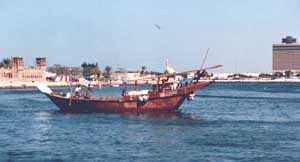
Weather Underground says it’s going to be 118° F/ 48°C today – how can they bear it? Some of the boats have no cover? How can they be out under the hot, scorching sun with no cover?
For my non-Kuwait readers, this is a very special weekend, a Thursday-Friday-Saturday weekend, to celebrate the shift to a Friday – Saturday weekend. It has been a long time coming; Kuwait is one of the last countries in the Gulf to make the shift. We were also living in Qatar when the shift to Friday – Saturday happened, but in Qatar, there was no uproar. Here, some people were outraged, saying that Saturday was the Jewish day, and it was a fire-and-brimstone kind of sin to take a day off on the Jewish day.
The government announced the weekend would switch to Friday-Saturday, and then the National Assembly announced that no, it wouldn’t, it would remain Thursday – Friday. Then the government offices started sending out notices to the people working there, and to customers, etc. giving new working hours, and here we go, Friday – Saturday. I am hearing rumors that even Saudi Arabia is considering the change, the last great hold out.
It brings the working week into closer alignment with the rest of the world, having more business days in common. It will make the traffic in Kuwait even worse than it already is.
Kuwait Bans Melmac

Today on the front page of the Kuwait Times is the announcement of a ban by the Ministry of Commerce on selling any goods containing melamine, stating it was “based on information received from the Customs Department and office of the Secretary-General of the Gulf Cooperation Council, and has to do with melamine containing urea formaldehyde, which is banned” because it is “believed to be harmful to health.”
I was so curious, I had to Google “Melamine kitchenware + danger” because, to the best of my knowledge, Kuwait is now the only country in the entire world to ban melamine.
Melamine appeared in dog and cat food, and is believed to have been the cause of some early poisonings in the US, but as far as I can see, that came from insecticides, not from eating off melmac.
On the same front page is an article about hundreds of camels dropping dead in Saudi Arabia, also believed poisoned by a insecticide contaminated feed. Is there some relationship?
It isn’t an issue in our house; we don’t have melamine. But I have this irrational fondness for Melmac, because there used to be a show called Alf, about an alien that lived with an American family, and he was from the planet Melmac, which always cracked me up. I can’t imagine the generations of Americans – and others – who have eaten off Melmac dishes without any serious effects. How can this be? Is Melmac now formulated differently from before? Are Melmac plate users going to succumb to some serious problems because they ate off Melmac plates?
And why is Kuwait the only country in the world banning Melmac?
The Arab Way (2)
Here is when the Arab way doesn’t work. . .well, it does work, but not in your favor. I was taking my car in for some repairs a couple weeks ago; they told me “just bring it in, we will take care of it” and fool! I believed them!
So I get there, seek desperately for a parking space, and go inside. I take a number. Not too bad. Only five people in front of me.
Five people. But here comes Bashir, and he sits himself down right at the counter, no number. The clerk finishes with number 34 – and Bashir shakes hands with him, greets him, makes small talk with him – and takes care of him.
Meanwhile Ali and his four brothers walk in. They have a number. They want to sit down, but I am on the far end of the couch so only Ali sits down. He tells his brothers they can sit, but with a big wolfy grin – like a dare. Let’s see which one of you will sit next to a WOMAN. And not one of them will. The manager walks over to Ali, greets him and they chat and then Ali and his brothers are all taken to another area, where they get specialized service.
Old Abdul shuffles in next, and I know I am screwed. OK, OK, I tell myself, you have a choice, you can laugh or you can stew. If you stew, you just ruin your own day – it’s not going to change anything. So I just laugh.
Eventually, I get seen, and the dealership makes the problem go away, and I think to myself that in the US this would have cost a lot more, I would have waited a lot longer, and I wouldn’t have all this material for a blog entry.
The Arab ways works – but it works best if you are an Arab, if you are a Moslem, and if you have connections. I am betting it also helps to be male, but I have seen women who knew how “to be preferred”, too. 😉
Recent Comments
ExpatAlien on What Country am I Living … intlxpatr on Yellowstone: Old Faithful to C… Michelle on Yellowstone: Old Faithful to C… Cathy on No Grown-Ups in Charge intlxpatr on Waiting for Snow Wikipedia Donate Button

Amazina


Early Voting in Florida


 Here There and Everywhere