Revolutionary Government: South Africa
AdventureMan and I have a soft spot for South Africa, not the least of which for the dramatic and radical way they transformed from apartheid government to democratic government. It is not to say South Africa has been without problems – there are still problems. But the manner in which they confronted and dealt with their past and then moved on allows change to happen, change in the heart.
Today’s meditation from Forward Day by Day:
FRIDAY, May 30
Psalm 85:3. You withdrew all your wrath; you turned from your hot anger. (NRSV)
But for the grace of God and the work of extraordinary leaders such as Nelson Mandela and Desmond Tutu, the fall of apartheid in South Africa could have been marked by one of the worst bloodbaths ever seen.
The incendiary ingredients were all present: a repressive minority regime that ruled by violence, fear, and fiat over a majority population denied fundamental human rights and forced to live a subservient existence.
There was upheaval, but the nation never fell into anarchy as it radically changed its government, thanks largely to the Truth and Reconciliation Commission.
Chaired by Tutu, then the Anglican Archbishop of Cape Town, the commission held hearings throughout the country. Victims told their stories of torture, killing, and degradation, sometimes confronting the accused.
The goal was not vengeance or justice but truth-telling to clear a path for healing. Powerful emotions were released. There were tearful confessions and apologies. There was forgiveness. The people of South Africa managed to turn from their hot anger and begin building a new nation.
Can we do the same? Where can we forsake our anger for the liberating power of forgiveness?
Leadership – A Memorial Day Meditation
This is today’s Forward Day by Day reading, and I think it is perfect for Memorial Day, a day in which we celebrate those who fought and gave their lives that we might live free:
MONDAY, May 26 Rogation Day
Matthew 13:14. You will indeed listen, but never understand, and you will indeed look, but never perceive.
The daughter of the young clergyman looked and she did perceive.
She had taken a bus trip with her father to their home country so she could obtain an identification card at the age of eighteen. Before the bus left, the driver asked if someone would pray for a safe journey. Her father walked to the front of the bus and led the passengers in prayer. Later, at a rest stop, the priest noticed some trash littering the area. After other passengers walked past heedlessly, he scooped it up and put it in a trash bin.
The acts seemed minor, and he thought no more about them. But later, his daughter asked him to read her homework—a profile of a leader. He did and was humbled and amazed.
The profile was about him. Citing those two examples and others, the daughter described how his behavior reflected his values. She wrote, “Leadership is not a title, but it is about the way you live your life.”
She had done much more than see her father’s actions. She had perceived their meaning and importance in the context of their faith.
Pregnant Sudanese Woman Sentenced to Death for ‘Apostasy’
She is also charged with adultery, for marrying a Christian man and (gasp) having sex with him. Now pregnant with her second child, Mariam claims she has never been a Muslim, was raised Christian, but the judge is applying new and strict Sharia laws.

As you might guess, I do not usually use Fox News as a news source, but this is an update on a story I am following:
International outrage grows for Sudanese woman sentenced to death for apostasy
Published May 16, 2014FoxNews.com
Meriam Ibrahim and Daniel Wani married in a formal church ceremony in 2011. The couple has an 18-month-old son, Martin, who is with Meriam in jail.
International outrage is mounting over the death sentence a Sudanese judge ordered for the pregnant wife of an American citizen — all because she refuses to renounce her Christian faith.
Meriam Ibrahim, 26, was sentenced Thursday after being convicted of apostasy. The court in Khartoum ruled that Ibrahim must give birth and nurse her baby before being executed, but must receive 100 lashes immediately after having her baby for adultery — for having relations with her Christian husband. Ibrahim, a physician and the daughter of a Christian mother and a Muslim father who abandoned the family as a child, could have spared herself death by hanging simply by renouncing her faith.
“We gave you three days to recant but you insist on not returning to Islam,” Judge Abbas Khalifa told Ibrahim, according to AFP. “I sentence you to be hanged to death.”
But Ibrahim held firm to her beliefs.
“I was never a Muslim,” she answered. “I was raised a Christian from the start.”
Ibrahim was raised in the Christian faith by her mother, an Orthodox Christian from Ethiopia. She is married to Daniel Wani, a Christian from southern Sudan who has U.S. citizenship, according to sources who spoke on condition of anonymity.
“I was never a Muslim. I was raised a Christian from the start.”
– Meriam Ibrahim
The cruel sentence drew condemnation from Amnesty International, the U.S. State Department and U.S. lawmakers.
“The refusal of the government of Sudan to allow religious freedom was one of the reasons for Sudan’s long civil war,” Rep. Chris Smith, R-N.J., chairman of the House congressional panel that oversees U.S. policy in Africa, said in a statement. “The U.S. and the rest of the international community must demand Sudan reverse this sentence immediately.”
Amnesty International called the sentence a “flagrant breach” of international human rights law and the U.S. State Department said it was “deeply disturbed” by the ruling, which will be appealed.
Khalifa refused to hear key testimony and ignored Sudan’s constitutional provisions on freedom of worship and equality among citizens, according to Ibrahim’s attorney Al-Shareef Ali al-Shareef Mohammed.
“The judge has exceeded his mandate when he ruled that Meriam’s marriage was void because her husband was out of her faith,” Mohammed told The Associated Press. “He was thinking more of Islamic Shariah laws than of the country’s laws and its constitution.”
Ibrahim and Wani married in a formal ceremony in 2011 and have an 18-month-old son, Martin, who is with her in jail. The couple operate several businesses, including a farm, south of Khartoum, the country’s capital. Wani fled to the United States as a child to escape the civil war in southern Sudan, but later returned. He is not permitted to have custody of the little boy, because the boy is considered Muslim and cannot be raised by a Christian man.
Sudan’s penal code criminalizes the conversion of Muslims into other religions, which is punishable by death. Muslim women in Sudan are further prohibited from marrying non-Muslims, although Muslim men are permitted to marry outside their faith. Children, by law, must follow their father’s religion.
Islamic Shariah laws were introduced in Sudan in the early 1980s under the rule of autocrat Jaafar Nimeiri, whose decision led to the resumption of an insurgency in the mostly animist and Christian south of Sudan. An earlier round of civil war lasted 17 years, ending in 1972. In 2011, the south seceded to become the world’s newest nation, South Sudan.
Sudanese President Omar Bashir, an Islamist who seized power during a 1989 military coup, said his county will implement Islam more strictly now that the non-Muslim south is gone. A number of Sudanese have been convicted of apostasy in recent years, but they have all escaped execution by recanting their faith. Religious thinker and politican Mahmoud Mohammed Taha — a vocal critic of Nimeiri — was sentenced to death after his conviction of apostasy and was executed at the age of 76 in 1985.
Ibrahim’s case first came to the attention of authorities in August, when members of her father’s family complained that she was born a Muslim but married a Christian man. They claimed her birth name was “Afdal” before she changed it to Meriam. The document produced by relatives to indicate she was given a Muslim name at birth was a fake, Mohammed said.
Ibrahim refused to answer the judge when he referred to her as “Afdal” during Thursday’s hearing.
Ibrahim was initially charged with having illegitimate sex last year, but she remained free pending trial. She was later charged with apostasy and jailed in February after she declared in court that Christianity was the only religion she knew.
The US-based Center for Inquiry is demanding that all charges against Ibrahim be dropped, saying the death sentence is a clear violation of the International Covenant on Civil and Political Rights, which forbids persecution or coercion of religious beliefs and the right to marry.
“Religious belief must never be coerced and free expression must never be punished, through threat of imprisonment, violence, or any other means,” the group wrote in a letter to Sudan’s UN ambassador, H.E. Hassan Hamid Hassan. “This cannot go unanswered, and the world will not stand for it.”
Fox News’ Joshua Rhett Miller and The Associated Press contributed to this report.
Heroes At The Dinner Table
“That’s Jollaf rice!” the Nigerian journalist said, a note of delight in her voice. She is famous for her passion and persistence drawing attention to the environmental issues in the Niger delta related to oil extraction and production. I told her that here in the Gulf, it’s called Jambalaya, but we all agreed that it very likely had African roots. She delighted my heart; she had three helpings.
When we have visitors from foreign countries, I try to serve foods they can identify – grilled vegetables, a chicken dish, several salads, a dessert. This time, because we had no Moslems, we used a real Cajun sausage in the jambalaya (pork), and jumbo shrimp.
The award-winning Finnish environmentalist has his own online website and a goal of planting 100 million trees by 1017. He is well on his way, visiting and planting trees in new countries every week. He also has his own band and has a CD out with Finnish music.

Our South African guest manages a large rhino reserve, protecting the rhinos from those who would kill them for their horns, thinking it renews sexual energy. Poor rhinos! He was quiet, but an acute observer, and the highlight of the evening was as he sang the haunting South African national anthem, Nkosi Sikelel’, with the Finnish guest. They did not sing all 11 verses (!) in all the different languages; just one verse, it was very moving:
Our own sweet environmentalist was with us. We think our son and his wife are super heroes; they fight for justice and a clean environment. This evening, our son stayed at home with the grandchildren and his wife, who works with clean water, was able to join and talk shop over dinner with her counterparts from other parts of the world.
It isn’t so easy anymore to get these dinners on the table, off the table, dessert served, etc. I used to be able to do these easily, for more than 20 people, but I also had help, LOL! But these dinners give us so much joy that I can’t imagine giving them up any time soon.
Chimamanda Ngozi Adichie: Americanah
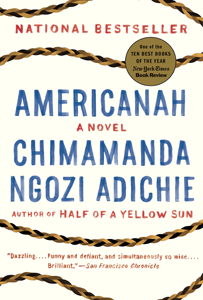
“Ouch! Ouch, Chimanda! Stop!”
(Oh wait.)
Don’t stop.
It’s me who can’t stop. I read everything Chimamanda Ngozi Adichie writes. I only started reading her by accident, when I was facilitating the Kuwait Book Club I never intended to belong to, and found myself reading so many books by authors I had never heard of. We were reading Half Of a Yellow Sun and all of a sudden, I WAS Nigerian. She can do that. She uses the senses, she uses the thoughts in our head. We are really not so alien, us and the Nigerians I start to think. I have Nigerian friends, from the church. We all get along. We have a good time together.
“Not so fast!” Chimamanda tells me in Americanah, her newest book, which I put off buying until I could find it in paperback. “You are very different! You think differently! And growing up in a country where there are black and white, race becomes an issue that it is not when you are black, and everyone is black, and you are growing up in Nigeria.”
Hmmm. OK. That makes sense. I mean, I thought I was Nigerian because in Half of a Yellow Sun, I was Igbo, living in an academic community in Nigeria, and hmmmm. You’re right, Chimamanda, there were no white people around. Just us Nigerians.
Chimamanda, with her sharp, all-seeing eyes, her sharp ears and her sharp tongue make me cringe as she comes to the USA and comes up against assumptions many have about Africa. Do you even know where, exactly, Nigeria is? Do you know where Ghana is? Most Americans can find Egypt on a map of Africa, and MAYBE South Africa, but the rest is . . . mostly guesswork. Because we send clothing and food aid to African countries, we have the idea that all Africans are poor, but that is not so, and is insulting to the middle-class and upper class Africans who travel elsewhere for leisure – and education.
I don’t know how much of Chimamanda Ngozi Adichie’s book is autobiographical and how much is fiction. I know that her observations are acute, she nails expat friendships, she spotlights our blind spots and hypocricies, and she holds you in her grip because she is no less harsh with herself – if, indeed, her Ifemelu, the main character in Americanah, is reflecting Chimamanda’s own experience. The experiences, coming here, the overwhelming differences in manners and customs, even volume of voice and width of hand expression, are so immediate, so compelling, so well described that they have to have been experiences she herself had, and had the eyes to see. She must have taken notes, because she totally nails the expat experience.
Book ads and book reviews focus on Americanah as a book about being black in America, and it truly is that – as seen from the eyes of a non-American black, as she often reminds us.
She is hard on herself, returning to Nigeria, and quick to note that much of the change is in herself and her changed perspective. While I love the romantic storyline, I was disappointed by the fantasy ending, given how self-disciplined Adichie is at keeping it real in every other facet of the novel. On the other hand, I am still trying to think of an ending that would work for me, and I can’t. While her ending wraps it all up neatly, it’s the one part of the book where her sharpness dulls.
One of the things I liked best about the book was going behind the scenes, being Nigerian, going to school, having coffee, working, going to parties with other Nigerians, chatting with my girlfriends. We’ve done things with nationals of different countries before, but you know as soon as you walk in that your presence changes things. Chimamanda Ngozi Adichie takes me with her and no one knows I am there, observing, learning, figuring out how things are done when it’s “just us” Nigerians.
Here’s why I am a Chimamanda Ngozi Adichie addict. She keeps it real. She has eyes that see, and ears that hear, and a gift for capturing what she sees and hears and a gift for writing it down. She has insight, into herself, into others, into character and motivations. She is sophisticated and unpretentious, she admires and she mocks, but when she mocks, it is as likely to be self-mockery as mockery of another person, class, ethnicity or nation. Reading Adichie, I understand our similarities – and our differences. I believe she would be a prickly friend to have, but I would chose her as a friend.
Awards
● Winner of the 2013 National Book Critics Circle Award for Fiction
● One of The New York Times’s Ten Best Books of the Year
● Winner of the The Chicago Tribune 2013 Heartland Prize for Fiction
● An NPR “Great Reads” Book, a Washington Post Notable Book, a Seattle
Times Best Book, an Entertainment Weekly Top Fiction Book, a Newsday Top 10 Book, and a Goodreads Best of the Year pick.
Swapnil Chaturvedi: Private Excretion
There really are everyday heros, if you have the eyes to see. This man is bringing dignity to the poor, who have no place to pee and poop privately. He left a fine job in the United States to start a campaign to provide private toilets for the countless poor in India who live without any toilets at all, and are forced to perform their daily functions in public.
Swapnil Chaturvedi’s life had all the trappings of the American dream — a college degree, prestigious engineer job, wife and daughter.
But when he returned home to India in 2007 after four years of living comfortably in the U.S., he was horrified by the country’s lack of basic sanitation, and decided to leave his cushy life behind to help, Mental Floss reported.
Fifty-three percent of Indian households defecate in the open, because they don’t have access to working toilets — a practice that leads to malnutrition, stunted growth, poor cognition, disease and other hampering conditions, according to the World Bank.
Even when there are toilets available, many locals decline to use them because they’re not vented properly. Women and girls often choose to defecate outside because the communal restrooms aren’t secure — leaving users vulnerable to getting harassed and attacked by onlookers.
“Men often gather around toilets and if we ignore them they try to touch and feel us,” Afsana, a young resident of Bawana, told CNN-IBN.
Women like Afsana are the reason that Chaturvedi has committed to his work.
“If somebody asked me why I started this business, there is only one reason: for women’s dignity,” Chaturvedi said in an interview about his company.
In 2011, he launched Samagra Sanitation –- a program based in Pune that works with existing communal restrooms and incentivizes locals to change their hygiene habits.
The company improves ventilation, accessibility and cleanliness in communal bathrooms. It also turns locations into community centers that offer rewards program for users, among other perks, to inspire people to take advantage of the facility, according to the company’s website.
Samagra, which is a Gates Foundation grantee, dubbed its program the “LooRewards Model.” It has already gotten involved in three slums in Pune, providing services to more than 3,300 people daily.
But Chaturvedi says he’s just getting started. He wants to see his program expand to help more than 50,000 people daily, which is why he launched an IndieGoGo campaign in the hopes of raising $50,000 to achieve his goal.
“We can live without Facebook, we can live without smartphones,” he said. “But we cannot live without relieving ourselves.”
Empowerment
I’m working with a group, one of whose goals is empowerment. They are all from the same country, but not the same parts of the country, nor the same ethnicities, but they all get along well with one another and the group does fine. I admire each of them, and even better, I like these women.
(Photo removed 17 Aug 2021 due to potential political impact on participants)
Here’s the LOL, empowered people have ideas and opinions. We have a format to adhere to, and empowered people come up with other ideas and alternatives. Here’s the problem: other ideas and alternatives, especially good ones, mean a lot of extra focus, it creates more work for facilitators and program managers. Sometimes you need permissions, sometimes you need transportation arrangements, and always, you need to assure a delegate’s safety. All this on top of the changes that will have to be made because of this unusual weather.
First, yesterday as I met the group, I had to apologize for the weather – usually mild, sunny Pensacola was having a howling storm; sheets of water being blown by a raging wind, tree limbs falling, the sky grim and dark and grey the entire day. In the midst of this, I was with one delegate on a tour of the Port of Pensacola, where it was like being in the middle of a huge storm at sea, with squalls. The man giving the tour carried on, they had a great discussion while the wind howled around us and at times the rain fell so hard on the tin roof that we couldn’t hear one another.
 (Those lines you see coming in through the door are wind blown rain. The drops on the camera lens – ditto)
Here is what I truly admire about this group, all their empowerment is for the good, their suggestions are making this visit even more productive and helping them exceed their goals. Their alternatives were doable, and will be accomplished. I can also tell you that at the end of a day dealing with a lot of good ideas and changes, my brain is happily fried. Guess the LOL is on me.
Jesus Declares All Foods Clean
I watched a woman eat a cockroach yesterday. (When did all restaurants start having TV’s in them??) It was at the worst time, I was eating lunch, and the only thought that allowed me to continue was thinking about this verse, where Jesus declares all foods clean.
Christians who are looking for where Jesus the Christ declared all things clean (halal, kosher) look to Mark 7. Today, in Forward Day by Day, the author of the meditation combines todays lectionary readings with Matthew 12:34: For from the fulness of the heart the mouth speaks.
Mark 7:15. There is nothing outside a person that by going in can defile, but the things that come out are what defile.
Words are powerful. Our speech, for better or worse, can either build up the kingdom of God or attack it. We might want to dismiss the power of words, but all we have to do is look to history.
Throughout history, often before the murder of a people, propaganda started. People would listen to the hateful speech of their leader, and then they would act (or not act). “They are just words,” people would say, but those words wormed their way into a nation’s mind, allowing callousness and cruelty to grow.
At the same time, the words of great men and women inspired nations to work toward equality. Their words moved individuals to change or to act. Even in our personal lives, we can all think of those healing words of a dear friend. We can also remember the cruel taunts of bully. Words are important.
Words come from within us, and once they are released into the world, they live. Within each of us is the potential for the infliction of great harm or the gift of grace. We must choose our words carefully because our hearts, our souls, and even our lives depend upon our words.
Only in Kuwait: The Original
Sigh. These are, sadly, true. I have seen them myself. I used to make people mad; I always carried a camera, and when I would see able bodied young men park in the handicapped spots, I would take their photos. They would get really mad. I knew I might be risking my life, so I tried to be careful, but I was also hoping they would feel shame, and stop doing it.

Talal Al-Ghannam is a very brave Kuwaiti for printing these “Only in Kuwait . . . ” columns.
Only In Kuwait
These are the things you won’t find in other modern countries or even ones that are poorer, but only in Kuwait.
1. Only in Kuwait people APPEAL to the government to apply the law.
2. Only in Kuwait handicapped parking places are seized by ordinary people.
3. Only in Kuwait many people like to park on the pavement and on green landscapes.
4. Only in Kuwait you could get killed for a parking space.
5. Only in Kuwait you could get beaten if you did not let a maniac driving behind you to pass.
6. Only in Kuwait policemen are beaten by mobs.
7. Only in Kuwait many policemen play with their smart phones rather than monitor the roads.
8 .Only in Kuwait many police stations have only one policeman.
9. Only in Kuwait you need a fancy car on the road to be respected.
10. Only in Kuwait you need three months to get an appointment in a hospital unless you are really sick.
11. Only in Kuwait the majority of Kuwaitis travel out of town when there is a two-day holiday.
12. Only in Kuwait the majority of employees get sick suddenly when there is a holiday coming up.
13. Only in Kuwait we see people spitting or urinating in the streets.
14. Only in Kuwait we see maniacs driving on the shoulder of the road, throwing up gravel to break your car’s windshield.
15. Only in Kuwait some Kuwaitis say ‘kaifi ana Kuwaiti’, meaning I am a Kuwait, I can do whatever I want.
16. Only in Kuwait you see many Kuwaitis able to deport expatriates. I will rest my pen for now until the next article.
By Talal Al-Ghannam
local@kuwaittimes.net
Recent Comments
ExpatAlien on What Country am I Living … intlxpatr on Yellowstone: Old Faithful to C… Michelle on Yellowstone: Old Faithful to C… Cathy on No Grown-Ups in Charge intlxpatr on Waiting for Snow Wikipedia Donate Button

Amazina


Early Voting in Florida


 Here There and Everywhere