David, and Where is Yambio, South Sudan?
A year ago, we had an extraordinary experience. We often entertain delegates visiting from other countries, and this time we had three African journalists, and, strictly by chance, they all turned out to be Christian. Most of our gatherings are strictly ecumenical, but these were joyful, praying Christians, and the evening took a turn we never anticipated.
“So how did you find Jesus?” one woman asked David, from the newest country in the world, South Sudan. Inside, I was shocked, and when I am shocked, my tendency is to laugh, I don’t know why, it is just the way I am wired. Every culture is so different. In the South, people might ask that of one another, particularly if you worship in a fundamental sect, but our sect is more formal, and to inquire into another’s spiritual life can be perceived as intrusive.
David, however, was not taken aback. “It’s a long story,” he said, and we all settled into comfortable chairs to listen better. It was Christmas, the decorations were up, the lights all twinkling and we had eaten. A good time for a story.
It was a long story. It started with a little boy in a happy family, who one day was told to run! Run! Run into the forest and hide! The riders were coming! His family grabbed a very few things and ran.
His family ran for years. His family ran into forests, across borders, into dry arid spaces. Sometimes some of the children would get separated from their parents for a while, but they would keep asking, and eventually meet up again, only to face separation again. Their whole lives were running, from the Janjaween, from border police, from robbers.
At one point, he and a brother stayed in a church, and a priest taught them about Jesus. Simple stories, simple songs, and he drew letters and numbers in the dirt – that was his early schooling. It was a haven of peace for him.
Many years later, the family was reunited in their village in the new country of South Sudan. Miraculously, every member of his family survived, indeed, most of his village survived. They had maintained lines of communication through all those years of running and separation, and were so thankful. Most of all, now, they were thankful – they had a church in their village. David had learned to love learning, and had completed his education and had found a wonderful job.
“I don’t know the book like you do,” he told us, “I only know it like a little child sitting at the feet of that priest, but I am learning.”
I can’t help but think that David knows more than he thinks. David holds his belief in Jesus like a child, simple and direct. His testimony is powerful and unforgettable. I am in awe, even a year later, of his story and testimony.
Today the church prays for the diocese of Yambio, in the South Sudan:

Jesus Discloses Signs of the End of Times
Because we are also reading Revelations at this time of the Lectionary readings, I thought at first that is what I was reading, but no, these are the words of Jesus, talking about the signs leading to the end of times – wars and rumors of wars, lawlessness, famine, nations rising against nations, oh yikes. Sounds a whole lot like today.

(I love that this image has Jesus and his disciples looking like people of the Middle East 🙂 You find the most amazing things on the internet, and I found this on an Egyptian Coptic website, where you can also hear all kinds of Coptic Christian music and chants. St. Takla.org )
Matthew 24:1-14
3 When he was sitting on the Mount of Olives, the disciples came to him privately, saying, ‘Tell us, when will this be, and what will be the sign of your coming and of the end of the age?’ 4Jesus answered them, ‘Beware that no one leads you astray. 5For many will come in my name, saying, “I am the Messiah!”* and they will lead many astray. 6And you will hear of wars and rumours of wars; see that you are not alarmed; for this must take place, but the end is not yet. 7For nation will rise against nation, and kingdom against kingdom, and there will be famines* and earthquakes in various places: 8all this is but the beginning of the birth pangs.
9 ‘Then they will hand you over to be tortured and will put you to death, and you will be hated by all nations because of my name. 10Then many will fall away,* and they will betray one another and hate one another.11And many false prophets will arise and lead many astray. 12And because of the increase of lawlessness, the love of many will grow cold.13But anyone who endures to the end will be saved. 14And this good news* of the kingdom will be proclaimed throughout the world, as a testimony to all the nations; and then the end will come.
Jesus Gets Tough With Believers

Today’s readings in the Lectionary readings is from Matthew are some of the hardest for believers. We all like to think we are excelling in doing good, we focus on the outward appearances, and he outlines where we fail – and where we need him, desperately, if we want to enter the Kingdom:
Matthew 23:13-26
13 ‘But woe to you, scribes and Pharisees, hypocrites! For you lock people out of the kingdom of heaven. For you do not go in yourselves, and when others are going in, you stop them.*
15Woe to you, scribes and Pharisees, hypocrites! For you cross sea and land to make a single convert, and you make the new convert twice as much a child of hell* as yourselves.
16 ‘Woe to you, blind guides, who say, “Whoever swears by the sanctuary is bound by nothing, but whoever swears by the gold of the sanctuary is bound by the oath.” 17You blind fools! For which is greater, the gold or the sanctuary that has made the gold sacred? 18And you say, “Whoever swears by the altar is bound by nothing, but whoever swears by the gift that is on the altar is bound by the oath.” 19How blind you are! For which is greater, the gift or the altar that makes the gift sacred?20So whoever swears by the altar, swears by it and by everything on it;21and whoever swears by the sanctuary, swears by it and by the one who dwells in it; 22and whoever swears by heaven, swears by the throne of God and by the one who is seated upon it.
23 ‘Woe to you, scribes and Pharisees, hypocrites! For you tithe mint, dill, and cummin, and have neglected the weightier matters of the law: justice and mercy and faith. It is these you ought to have practised without neglecting the others. 24You blind guides! You strain out a gnat but swallow a camel!
25 ‘Woe to you, scribes and Pharisees, hypocrites! For you clean the outside of the cup and of the plate, but inside they are full of greed and self-indulgence. 26You blind Pharisee! First clean the inside of the cup,*so that the outside also may become clean.
Your Emotional Intelligence
AOL News has this fascinating article on successful people and emotional intelligence:
How Emotionally Intelligent Are You? Here’s How To Tell
The Huffington Post | By Carolyn GregoirePosted: 12/05/2013 8:39 am EST | Updated: 12/05/2013 2:22 pm EST


What makes some people more successful in work and life than others? IQ and work ethic are important, but they don’t tell the whole story. Our emotional intelligence — the way we manage emotions, both our own and those of others — can play a critical role in determining our happiness and success.
Plato said that all learning has some emotional basis, and he may be right. The way we interact with and regulate our emotions has repercussions in nearly every aspect of our lives. To put it in colloquial terms, emotional intelligence (EQ) is like “street smarts,” as opposed to “book smarts,” and it’s what accounts for a great deal of one’s ability to navigate life effectively.
“What having emotional intelligence looks like is that you’re confident, good at working towards your goals, adaptable and flexible. You recover quickly from stress and you’re resilient,” Daniel Goleman, psychologist and author of Focus: The Hidden Driver of Excellence, tells The Huffington Post. “Life goes much more smoothly if you have good emotional intelligence.”
The five components of emotional intelligence, as defined by Goleman, are self-awareness, self-regulation, motivation, social skills and empathy. We can be strong in some of these areas and deficient in others, but we all have the power to improve any of them.
Not sure how emotionally intelligent you are? Here are 14 signs you have a high EQ.
1. You’re curious about people you don’t know.

Do you love meeting new people, and naturally tend to ask lots of questions after you’ve been introduced to someone? If so, you have a certain degree of empathy, one of the main components of emotional intelligence. Highly Empathetic People (HEPs) — those who are extremely attuned to the needs and feelings of others, and act in a way that is sensitive to those needs — have one important thing in common: They’re very curious about strangers and genuinely interested in learning more about others.
Being curious about others is also a way to cultivate empathy. “Curiosity expands our empathy when we talk to people outside our usual social circle, encountering lives and worldviews very different from our own,” Roman Krznaric, author of the forthcoming Empathy: A Handbook For Revolution, wrote in a Greater Good blog post.
2. You’re a great leader.

Exceptional leaders often have one thing in common, according to Goleman. In addition to the traditional requirements for success — talent, a strong work ethic and ambition, for instance — they possess a high degree of emotional intelligence. In his research comparing those who excelled in senior leadership roles with those who were merely average, he found that close to 90 percent of the difference in their profiles was due to emotional intelligence, rather than cognitive ability.
“The higher the rank of a person considered to be a star performer, the more emotional intelligence capabilities showed up as the reason for his or her effectiveness,” Goleman wrote in Harvard Business Review.
3. You know your strengths and weaknesses.
A big part of having self-awareness is being honest with yourself about who you are — knowing where you excel, and where you struggle, and accepting these things about yourself. An emotionally intelligent person learns to identify their areas of strength and weakness, and analyze how to work most effectively within this framework. This awareness breeds the strong self-confidence that’s a main factor of emotional intelligence, according to Goleman.
“If you know what you’re truly effective at, then you can operate from that with confidence,” he says.
4. You know how to pay attention.

Do you get distracted by every tweet, text and passing thought? If so, it could be keeping you from functioning on your most emotionally intelligent level. But the ability to withstand distractions and focus on the task at hand is a great secret to emotional intelligence, Goleman says. Without being present with ourselves and others, it’s difficult to develop self-awareness and strong relationships.
“Your ability to concentrate on the work you’re doing or your schoolwork, and to put off looking at that text or playing that video game until after you’re done … how good you are at that in childhood turns out to be a stronger predictor of your financial success in adulthood than either your IQ or the wealth of the family you grew up in,” Goleman says. “And we can teach kids how to do that.”
5. When you’re upset, you know exactly why.

We all experience a number of emotional fluctuations throughout the day, and often we don’t even understand what’s causing a wave of anger or sadness. But an important aspect of self-awareness is the ability to recognize where your emotions are coming from and to know why you feel upset.
Self-awareness is also about recognizing emotions when they arise, rather than misidentifying or ignoring them. Emotionally intelligent people take a step back from their emotions, look at what they’re feeling, and examine the effect that the emotion has on them.
6. You can get along with most people.

“Having fulfilling, effective relationships — that’s a sign [of emotional intelligence],” says Goleman.
7. You care deeply about being a good, moral person.

One aspect of emotional intelligence is our “moral identity,” which has to do with the extent to which we want to see ourselves as ethical, caring people. If you’re someone who cares about building up this side of yourself (regardless of how you’ve acted in past moral situations), you might have a high EQ.
8. You take time to slow down and help others.

If you make a habit of slowing down to pay attention to others, whether by going slightly out your way to say hello to someone or helping an older woman onto the subway, you’re exhibiting emotional intelligence. Many of us, a good portion of the time, are completely focused on ourselves. And it’s often because we’re so busy running around in a stressed-out state trying to get things done that we simply don’t take the time to notice (much less help) others.
“[There’s a] spectrum that goes from complete self-absorption to noticing to empathy and to compassion,” Goleman said in a TED talk on compassion. “The simple fact is that if we are focused on ourselves, if we’re preoccupied — which we so often are throughout the day — we don’t really fully notice the other.”
Being more mindful, in contrast to being absorbed in your own little world, plants the seeds of compassion — a crucial component of EQ.
9. You’re good at reading people’s facial expressions.

Being able to sense how others are feeling is an important part of having a good EQ. Take this quiz from UC Berkeley to find out just how skilled you are at reading others’ emotions.
10. After you fall, you get right back up.

How you deal with mistakes and setbacks says a lot about who you are. High EQ individuals know that if there’s one thing we all must do in life, it’s to keep on going. When an emotionally intelligent person experiences a failure or setback, he or she is able to bounce back quickly. This is in part because of the ability to mindfully experience negative emotions without letting them get out of control, which provides a higher degree of resilience.
“The resilient person isn’t papering over the negative emotions, but instead letting them sit side by side with other feelings,” Positivity author Barbara Fredrickson told Experience Life. “So at the same time they’re feeling ‘I’m sad about that,’ they’re also prone to thinking, ‘but I’m grateful about this.’”
11. You’re a good judge of character.

You’ve always been able to get a sense for who someone is pretty much right off the bat — and your intuitions are rarely wrong.
12. You trust your gut.

An emotionally intelligent person is someone who feels comfortable following their intuition, says Goleman. If you’re able to trust in yourself and your emotions, there’s no reason not to listen to that quiet voice inside (or that feeling in your stomach) telling you which way to go.
13. You’ve always been self-motivated.
Were you always ambitious and hard-working as a kid, even when you weren’t rewarded for it? If you’re a motivated self-starter — and you can focus your attention and energy towards the pursuit of your goals — you likely have a high EQ.
14. You know when to say “no.”

Self-regulation, one of the five components of emotional intelligence, means being able to discipline yourself and avoid unhealthy habits. Emotionally intelligent people are generally well equipped to tolerate stress (a bad-habit trigger for many of us) and to control their impulses, according to Goleman.
The Church Remembers John of Damascus
Today the church remembers John of Damascus, our good friend who once was the American Consul in Damascus is visiting with us, and we mourn the loss of peace and security in Damascus, and Syria, and the heartless loss of so many lives, the destruction of beautiful Homs, and so many other villages, named and unnamed, and the use of nerve gas on Syrian people.
I love it that he is most often shown wearing a keffiye

The Liturgical Calendar: The Church Remembers
Today the church remembers John of Damascus, Priest, c. 760.
The son of an important official in the court of the Muslim Caliph of Damascus, John had an easy rapport with the Muslims among whom he was reared, and readily succeeded to his father’s office in the Caliph’s court. Later, he abandoned the wealth and comfort of the fashionable life of Damascus and joined a religious community in Palestine.
As he lived the rigorous life of a monk in the stark wilderness near the Dead Sea, his own strong personality began to emerge. He soon distinguished himself as a theologian and scholar. His chief published work extant is The Fount of Knowledge. He is recognized as a “Doctor of the Universal Church.”
However, John of Damascus is most widely remembered for his contributions to Christian worship. He wrote many fine hymns, including two Easter ones that are still popular today: “Come ye faithful raise the strain…” and “The Day of Resurrection, earth tell it out abroad!” He effectively defended the doctrine of the Real Presence in the Eucharist, the veneration of the Lord’s Mother, and use of icons. He became involved in an international religio-political struggle called the “Icononclastic Controversy” which reached violent proportions and shook the Byzantine world. His life was saved in this controversy by his powerful Muslim friends.
We give thanks for John and for all those who have upheld the truth of our faith and the glory of our worship. Amen.
A First For AdventureMan
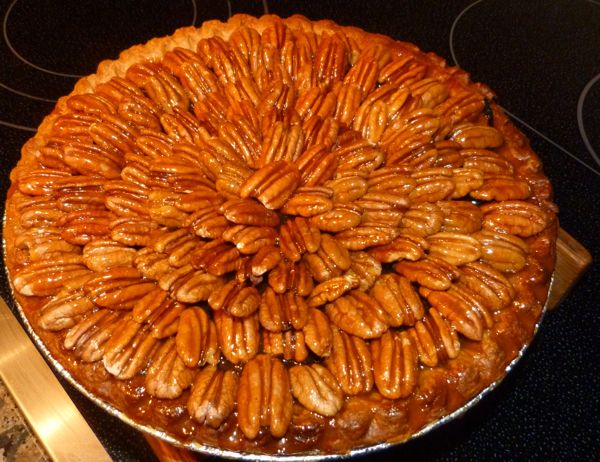
You may think this is ‘just’ a beautiful pecan pie, but it is better than that. This is AdventureMan’s very first pie, ever. He debated even making it for the Great Gathering, because there are so many truly gifted cooks in the family, but in the end, being the courageous soul he is, he tackled it. It looks exactly like the photo of the pie in Southern Living magazine which inspired his effort. I don’t think I have ever seen a more beautiful pecan pie. 🙂 Bravo! Bravo, AdventureMan!
If You Lived Here, I’d Know Your Name: Heather Lende

“You have to read this!” said my book friend, “You’re from Alaska! It’s about a woman who lives in some small town and writes obituaries!”
I grinned politely and put the book in my bag. Some books sound more interesting than other books – I’ve always loved adventures and mysteries and murders – add a little drama to the day-to-day-ness of everyday life. A woman who writes obituaries? Hmmm, not so much.
But spending my afternoons tending to my sweet little 3-month-old granddaughter means I often sit, anchored by the soundly sleeping baby who I don’t want to disturb, even by twitching. I have one hand free – and you can only play so much iPhone Sudoku.
An Alaskan friend had also recommended this book, so early this week I picked it up and started reading.
Oh. my. goodness. Yes, Haines is a small town, but oh the drama of writing obituaries. Oh, the things you learn about your neighbors and the surprises you get learning about their earlier lives. I love the way Heather Lende weaves the writing of the town obituaries with the current ongoing dramas in her own life and in the lives of her friends and makes it work.
It’s not unlike where I grew up, although my hometown had a hospital. We also had moose and bear and elk in our back yards, and learned to treat wildlife with respect, and that the best option was to back away slowly. There are the same senseless deaths from auto accidents, fishing boat accidents and unexpected changes in weather. There is the same feeling of wonder, almost every day of your life, knowing how very lucky you are to live in the midst of such awe-inspiring beauty. It’s hard for me to imagine being an unbeliever living in Alaska.
It’s also a great book to read before going to bed. Some of the books I read are too exciting or too disturbing to read before bed; books that infiltrate your dreams with images and situations that give you a restless night. While Lende deals with death and sadness and drama, there is an underlying message of hope in the neighborliness of your neighbors, the security of living in a town where everybody knows everybody else, in the civility even of people who strongly disagree with one another. If You Lived Here, I’d Know Your Name gives you peaceful sleep. She ties it all together with an ending that rips your heart out; you will never forget this book once you read it. After reading, you will feel like you have lived in Haines, Alaska.
The paperback version is available from Amazon.com for $9.73. No, I no longer own stock in Amazon.com.
Rape Victim Should Have Just Closed Her Legs: Defense Attorney
Ignorance and outrageous statements on rape are rampant world-wide. Today, this story from New Zealand, via AOL HuffPost World:
This week’s example of how not to handle a rape trialhave comes to you from New Zealand, where a defense attorney is being criticized for saying a sexually assaulted woman should have kept her legs shut.
Speaking to a Wellington District Court jury on Wednesday, defense lawyer Keith Jefferies claimed that his client, George Jason Pule, a bouncer at a local club, had merely engaged in consensual sex with the victim, as quoted by local paper The Dominion Post.
Jefferies’ “proof”? The drunk 20-year-old woman did not attempt to stop Pule’s advances after he convinced her to follow him down an alley.
“All she would have had to do was to close her legs,” Jefferies told the jury in his closing argument, per the Post. “[I]t’s as simple as that.”
Pule had attempted to claim that the victim had filed a false rape charge because she regretted having sex with him, reports the Post.
Despite his best efforts, Jefferies’ client was ultimately convicted on the rape charge and is currently awaiting sentencing.
It’s been a difficult month so far for victims advocates in New Zealand, with the Wellington trial following news of an alleged “teen rape club, ” known as the “Roast Busters,” operating in New Zealand. Members of the group, which is currently being investigated by police, are said to have boasted about getting underage girls drunk and sexually assaulting them.
“This whole situation is horrific,” Wellington Rape Crisis Center’s Natalie Gousmett said in a press release. “First we have the abhorrent behaviour of the members of the rape group, causing serious harm to the victims they have targeted. Then we have appalling coverage by media, including extreme victim-blaming. … All of this demonstrates the rape culture in [New Zealand], which is extremely harmful to survivors.”
Gousemett went on to note that victims who “are told they are at fault for being raped” are far less likely to come forward and receive the support they need.
In an effort to counteract the problem, advocacy groups have launched a new public service campaign called “Who Are You,” urging New Zealanders to keep “an eye on your mates when you’re out –- You look after them, they look after you. It’s all about having fun and making it home safely.”
“if You Can’t Prevent Rape, You Enjoy It”: Ranjit Sinha
The Chief of India’s Central Bureau of Investigation said this! Was he snorting cocaine in a drunken stupor? Of course he is apologizing, but his careless remark demonstrates the sentiments buried deep in his culture’s heart – it’s only women. Not worth much, not like us men. Outrageous.

NEW DELHI (AP) — India’s top police official apologized Wednesday for saying, “If you can’t prevent rape, you enjoy it,” a remark that has outraged women across the country.
Central Bureau of Investigation chief Ranjit Sinha made the remark Tuesday during a conference about illegal sports betting and the need to legalize gambling. The CBI, the country’s premier investigative agency, is India’s equivalent of the FBI.
Sinha said at the conference that if the state could not stop gambling, it could at least make some revenue by legalizing it.
“If you cannot enforce the ban on betting, it is like saying, ‘If you can’t prevent rape, you enjoy it,'” he said.
The remarks have caused outrage across India, which in the past year has been roiled by widespread protests following the fatal gang rape of a 23-year-old woman on a bus in New Delhi.
On Wednesday, Sinha said that his comments had been taken out of context and misinterpreted, and that he was sorry if he had caused hurt.
Angry activists, however, called for his resignation.
Communist Party of India (Marxist) leader Brinda Karat said Sinha’s comments were offensive to women everywhere.
“It is sickening that a man who is in charge of several rape investigations should use such an analogy,” Karat told reporters. “He should be prosecuted for degrading and insulting women.”
The New Delhi attack on the young woman last December caused nationwide outrage and forced the government to change rape laws and create fast-track courts for rape cases. New laws introduced after the attack make stalking, voyeurism and sexual harassment a crime. They also provide for the death penalty for repeat offenders or for rape attacks that lead to the victim’s death.
“Great is Your Faith!”
Jesus only commented positively on a person’s faith three times, and two of those times the supplicant was not Jewish, but other, in this case, a Canaanite woman. All she cared about was her daughter. He even says no, he won’t help her, he is there for the Jews. As she persists, as she argues with Jesus and makes her case, he relents, he feels enormous compassion for this woman in her plight, and as he heals her daughter, he makes this extraordinary statement calling attention to her belief. No legalistic requirements, he just heals.

Matthew 15:21-28
21 Jesus left that place and went away to the district of Tyre and Sidon.22Just then a Canaanite woman from that region came out and started shouting, ‘Have mercy on me, Lord, Son of David; my daughter is tormented by a demon.’ 23But he did not answer her at all. And his disciples came and urged him, saying, ‘Send her away, for she keeps shouting after us.’ 24He answered, ‘I was sent only to the lost sheep of the house of Israel.’ 25But she came and knelt before him, saying, ‘Lord, help me.’ 26He answered, ‘It is not fair to take the children’s food and throw it to the dogs.’ 27She said, ‘Yes, Lord, yet even the dogs eat the crumbs that fall from their masters’ table.’ 28Then Jesus answered her, ‘Woman, great is your faith! Let it be done for you as you wish.’ And her daughter was healed instantly.
Recent Comments
ExpatAlien on What Country am I Living … intlxpatr on Yellowstone: Old Faithful to C… Michelle on Yellowstone: Old Faithful to C… Cathy on No Grown-Ups in Charge intlxpatr on Waiting for Snow Wikipedia Donate Button

Amazina


Early Voting in Florida


 Here There and Everywhere