Swapnil Chaturvedi: Private Excretion
There really are everyday heros, if you have the eyes to see. This man is bringing dignity to the poor, who have no place to pee and poop privately. He left a fine job in the United States to start a campaign to provide private toilets for the countless poor in India who live without any toilets at all, and are forced to perform their daily functions in public.
Swapnil Chaturvedi’s life had all the trappings of the American dream — a college degree, prestigious engineer job, wife and daughter.
But when he returned home to India in 2007 after four years of living comfortably in the U.S., he was horrified by the country’s lack of basic sanitation, and decided to leave his cushy life behind to help, Mental Floss reported.
Fifty-three percent of Indian households defecate in the open, because they don’t have access to working toilets — a practice that leads to malnutrition, stunted growth, poor cognition, disease and other hampering conditions, according to the World Bank.
Even when there are toilets available, many locals decline to use them because they’re not vented properly. Women and girls often choose to defecate outside because the communal restrooms aren’t secure — leaving users vulnerable to getting harassed and attacked by onlookers.
“Men often gather around toilets and if we ignore them they try to touch and feel us,” Afsana, a young resident of Bawana, told CNN-IBN.
Women like Afsana are the reason that Chaturvedi has committed to his work.
“If somebody asked me why I started this business, there is only one reason: for women’s dignity,” Chaturvedi said in an interview about his company.
In 2011, he launched Samagra Sanitation –- a program based in Pune that works with existing communal restrooms and incentivizes locals to change their hygiene habits.
The company improves ventilation, accessibility and cleanliness in communal bathrooms. It also turns locations into community centers that offer rewards program for users, among other perks, to inspire people to take advantage of the facility, according to the company’s website.
Samagra, which is a Gates Foundation grantee, dubbed its program the “LooRewards Model.” It has already gotten involved in three slums in Pune, providing services to more than 3,300 people daily.
But Chaturvedi says he’s just getting started. He wants to see his program expand to help more than 50,000 people daily, which is why he launched an IndieGoGo campaign in the hopes of raising $50,000 to achieve his goal.
“We can live without Facebook, we can live without smartphones,” he said. “But we cannot live without relieving ourselves.”
Empowerment
I’m working with a group, one of whose goals is empowerment. They are all from the same country, but not the same parts of the country, nor the same ethnicities, but they all get along well with one another and the group does fine. I admire each of them, and even better, I like these women.
(Photo removed 17 Aug 2021 due to potential political impact on participants)
Here’s the LOL, empowered people have ideas and opinions. We have a format to adhere to, and empowered people come up with other ideas and alternatives. Here’s the problem: other ideas and alternatives, especially good ones, mean a lot of extra focus, it creates more work for facilitators and program managers. Sometimes you need permissions, sometimes you need transportation arrangements, and always, you need to assure a delegate’s safety. All this on top of the changes that will have to be made because of this unusual weather.
First, yesterday as I met the group, I had to apologize for the weather – usually mild, sunny Pensacola was having a howling storm; sheets of water being blown by a raging wind, tree limbs falling, the sky grim and dark and grey the entire day. In the midst of this, I was with one delegate on a tour of the Port of Pensacola, where it was like being in the middle of a huge storm at sea, with squalls. The man giving the tour carried on, they had a great discussion while the wind howled around us and at times the rain fell so hard on the tin roof that we couldn’t hear one another.
 (Those lines you see coming in through the door are wind blown rain. The drops on the camera lens – ditto)
Here is what I truly admire about this group, all their empowerment is for the good, their suggestions are making this visit even more productive and helping them exceed their goals. Their alternatives were doable, and will be accomplished. I can also tell you that at the end of a day dealing with a lot of good ideas and changes, my brain is happily fried. Guess the LOL is on me.
Jesus Declares All Foods Clean
I watched a woman eat a cockroach yesterday. (When did all restaurants start having TV’s in them??) It was at the worst time, I was eating lunch, and the only thought that allowed me to continue was thinking about this verse, where Jesus declares all foods clean.
Christians who are looking for where Jesus the Christ declared all things clean (halal, kosher) look to Mark 7. Today, in Forward Day by Day, the author of the meditation combines todays lectionary readings with Matthew 12:34: For from the fulness of the heart the mouth speaks.
Mark 7:15. There is nothing outside a person that by going in can defile, but the things that come out are what defile.
Words are powerful. Our speech, for better or worse, can either build up the kingdom of God or attack it. We might want to dismiss the power of words, but all we have to do is look to history.
Throughout history, often before the murder of a people, propaganda started. People would listen to the hateful speech of their leader, and then they would act (or not act). “They are just words,” people would say, but those words wormed their way into a nation’s mind, allowing callousness and cruelty to grow.
At the same time, the words of great men and women inspired nations to work toward equality. Their words moved individuals to change or to act. Even in our personal lives, we can all think of those healing words of a dear friend. We can also remember the cruel taunts of bully. Words are important.
Words come from within us, and once they are released into the world, they live. Within each of us is the potential for the infliction of great harm or the gift of grace. We must choose our words carefully because our hearts, our souls, and even our lives depend upon our words.
Only in Kuwait: The Original
Sigh. These are, sadly, true. I have seen them myself. I used to make people mad; I always carried a camera, and when I would see able bodied young men park in the handicapped spots, I would take their photos. They would get really mad. I knew I might be risking my life, so I tried to be careful, but I was also hoping they would feel shame, and stop doing it.

Talal Al-Ghannam is a very brave Kuwaiti for printing these “Only in Kuwait . . . ” columns.
Only In Kuwait
These are the things you won’t find in other modern countries or even ones that are poorer, but only in Kuwait.
1. Only in Kuwait people APPEAL to the government to apply the law.
2. Only in Kuwait handicapped parking places are seized by ordinary people.
3. Only in Kuwait many people like to park on the pavement and on green landscapes.
4. Only in Kuwait you could get killed for a parking space.
5. Only in Kuwait you could get beaten if you did not let a maniac driving behind you to pass.
6. Only in Kuwait policemen are beaten by mobs.
7. Only in Kuwait many policemen play with their smart phones rather than monitor the roads.
8 .Only in Kuwait many police stations have only one policeman.
9. Only in Kuwait you need a fancy car on the road to be respected.
10. Only in Kuwait you need three months to get an appointment in a hospital unless you are really sick.
11. Only in Kuwait the majority of Kuwaitis travel out of town when there is a two-day holiday.
12. Only in Kuwait the majority of employees get sick suddenly when there is a holiday coming up.
13. Only in Kuwait we see people spitting or urinating in the streets.
14. Only in Kuwait we see maniacs driving on the shoulder of the road, throwing up gravel to break your car’s windshield.
15. Only in Kuwait some Kuwaitis say ‘kaifi ana Kuwaiti’, meaning I am a Kuwait, I can do whatever I want.
16. Only in Kuwait you see many Kuwaitis able to deport expatriates. I will rest my pen for now until the next article.
By Talal Al-Ghannam
local@kuwaittimes.net
Donna Leon and The Golden Egg
“What are manners?”
“What is ‘nice’, what does it mean?”
“What is ‘kind’?” the most adorable little boy in Pensacola asked me. It was bath time, a time when we have some of our best conversations, and you never know where the conversation will go.
I love these conversations because I have to think, too, but most of all, because I love to watch this little boy’s mind grow in grasping concepts and perceptions. He is four; his class in school is on the letter “U” this coming week, and already he can sound out words in the books we read together. He knows what a globe is, and how it differs from a map. He knows his address, and he can point to Pensacola on the globe.
He knows things because we talk to him, and because he goes to school and his teachers talk to him. His mind is wide open and he is eager to learn, and he asks the most wonderful questions.

Donna Leon’s Commissario Guido Brunetti has a new case that troubles him. He knows the dead man, not well, but he would see him in his quarter, and he often saw him helping out at the local laundry. He assumed the man was deaf and retarded, everyone knew that. When the dead man has no papers, in bureaucratic Italy, no birth certificate, no medical records, no finance records, no record of social aid (he is poor as well as disabled) Brunetti is troubled. How could such a familiar figure be so undocumented?
His mother is no help; her stories are transparent lies about travel to France and her son having grown up in the country with people whose name she cannot remember.
It is a troubling book. If you read Donna Leon, you will understand how close and wonderful and articulate Brunetti’s family is, how loved and cherished their children. We eat meals with them, we understand how the Venetian vernacular distinguishes those to whom one speaks more frankly and those to whom one lies. Brunetti’s a detective; the things he sees often trouble him, but this case troubles him more than most.
I can’t tell you more without spoiling the ending. All I can tell you is that it will encourage you to love your children, hold them closely, and give them all the benefits in their life-toolbox of attention, instruction and loving discipline that a parent (and grandparent!) can give.
More Radar on Qatar Roads to Trap Violators
Qatar makes some great laws – like fining those who go through red lights, or who drive near the speed of light. . . but when the violators turn out to be mostly young Qattari men, who pays the fines? Does anyone pay the fines?
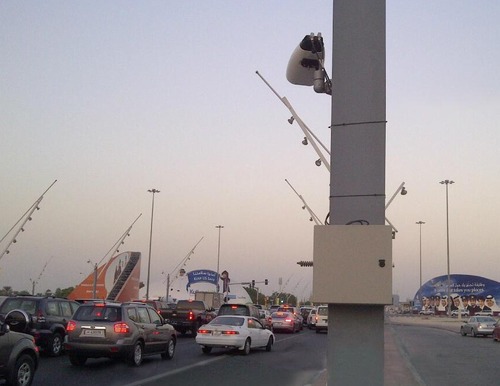
From Doha News:
In an effort to tackle bad driving in Qatar, the Ministry of Interior plans to set up speed radars every two to four kilometers on major roads, Traffic Department Director Brig. Mohamed Saad Al Kharji has said.
Additionally, some 120 radars are being installed to catch drivers who overtake others from the right lane, the Qatar Tribune reports Al Kharji as saying.
He added that the software of speed radars that are already installed on the roads would be updated so that they could also catch such violators.
No timeline for when the cameras would be installed was disclosed. But last fall, the MOI announced it would be rolling out radars to catch queue-jumpers.
Using the “slow” right lane to overtake vehicles in the left lane is a traffic violation punishable by a QR500 ticket, but among one of several rules flouted by motorists here.
Enforcement
In Qatar, traffic violators are rarely pulled over by police officers, despite brief campaigns to step up enforcement. In 2012, plainclothes police officers began ticketing drivers who overtook other vehicles on the right.
And at the end of last year, the traffic department began a three-month campaign to ticket those who violate road rules, including drivers who hadn’t fastened their seat belts, used their phones while driving, and rode without a license.
Both initiatives were lauded by many residents who said enforcement is key to improving safety on the roads, but neither seem to have lasted.
“Why Do Americans Do This?”
AdventureMan and I were with a group of delegates from Iraq yesterday, taking them on a visit to a variety of Pensacola sites. They are here visiting through the GCCDC, on the IVLP program, studying elections and campaign strategies in the USA.
One stop we make with many delegates is the First Methodist program Serving the Hungry. Two days a week, led by Jerry Vititow and supported by many happy, willing volunteers, they serve a hot lunch to the hungry, varying in numbers but never less than fifty or so.
The delegates learn about the program, then don aprons and serve up the trays. It is often one of the highlights of the trip.
One delegate raises his hand to ask a question.
“We see this everywhere,” he starts, “Americans who are working for nothing and smiling. Why do they do this?” He was genuinely perplexed.
Jerry explained that it wells up from many sources, a yearning to give back some of the blessings we have received, an eagerness to serve those who have less, maybe just an eagerness to serve. “It’s part of what we believe in,” he sums it up.
The delegates had a wonderful time.
Idaho Legislators to Vote on Ag-Gag Bill

In this April 22, 2010 file image from video provided by the United States Humane Society, a Hallmark Meat Packing slaughter plant worker is shown attempting to force a “downed” cow onto its feet by ramming it with the blades of a forklift in Chino, Calif. (Humane Society of the United States via AP)
Idaho’s legislature is considering what’s been dubbed the “ag-gag bill” that would impose penalties for trespassing and filming without permission in farming facilities.
What prompted the push is a video by animal activists, showing workers stomping on cows, beating and dragging them at the Bettencourt Dairy in Hansen, Idaho in 2012.
The bill’s sponsor says this video is the work of “agri-terrorists” bent on harming the industry. The activists counter that they’re just exposing animal abuse.
The penalty would be a misdemeanor charge punishable by a year in jail and a $5,000 fine.
Scott Graf of Boise State Public Radio in Idaho joins Here & Now’s Jeremy Hobson with details.
I will tell you truthfully, I cannot even watch this video, taken by Mercy for Animals. They are doing brave and compassionate work, check out all their films on YouTube. People being cruel or negligent to those who cannot defend themselves – children or animals, prisoners, the elderly – make me physically sick. The Idaho bill would prohibit anyone filming – under threat of penalty of law – under false pretenses.
So like people who KNOW they are being filmed are going to abuse the animals? Abuse occurs when there is no penalty, or when no one will know. I know Mercy for Animals will continue their work, but will be fined, heavily, if caught and prosecuted.
NPR reports that the owner had no idea about the abuse and himself was sickened when he saw the film, immediately firing five people. He has installed his own video cameras to monitor his employees.
Who are we? What is in our hearts that would allow us to cause hurt and pain to the helpless?
Hilarious Pensacola Blog: Dicksblog
Note to my Qatar, Kuwait and Saudi Arabian readers – YES. This is legal. This is what free speech looks like. This anonymous blogger can poke fun – and does – at everyone. He probably will want to remain anonymous because he does not discriminate in who he pokes and won’t have any friends if people figure out who he is, but yes. Yes. YES. This is legal, this is freedom of speech. He won’t go to jail.
Poking fun at appearance-over-substance Mayor Ashton Hayward, who made national news this week as he prayed, and rethought his ban on homeless people using blankets in Pensacola: Dicksblog goes viral:

Rape Goes Unpunished in US Military
This is disgusting. We’ve all known it’s true. The warrior culture protects those cowards who impose themselves sexually on both men and women. God willing, things will change. It’s already started, with the relieving of those in power who have imposed themselves on women who came forward with their complaints. Let there be more, until this culture is wiped clean of their disgrace.
Rape isn’t about sex. It’s about power. Rape is a personal violation.
It’s time for the good men and women in the military to police this up, to stop the outrage. Expose those bullies and cowards who prey on others.
Military Sex Abuse Investigation: Documents Reveal Chaotic Punishment Record
AP
by RICHARD LARDNER and YURI KAGEYAMA
TOKYO (AP) — At U.S. military bases in Japan, most service members found culpable in sex crimes in recent years did not go to prison, according to internal Department of Defense documents. Instead, in a review of hundreds of cases filed in America’s largest overseas military installation, offenders were fined, demoted, restricted to their bases or removed from the military.
In about 30 cases, a letter of reprimand was the only punishment.
More than 1,000 records, obtained by The Associated Press through the Freedom of Information Act, describe hundreds of cases in graphic detail, painting a disturbing picture of how senior American officers prosecute and punish troops accused of sex crimes. The handling of allegations verged on the chaotic, with seemingly strong cases often reduced to lesser charges. In two rape cases, commanders overruled recommendations to court-martial and dropped the charges instead.
Even when military authorities agreed a crime had been committed, the suspect was unlikely to serve time. Of 244 service members whose punishments were detailed in the records, only a third of them were incarcerated.
The analysis of the reported sex crimes, filed between 2005 and early 2013, shows a pattern of random and inconsistent judgments:
—The Marines were far more likely than other branches to send offenders to prison, with 53 prison sentences out of 270 cases. By contrast, of the Navy’s 203 cases, more than 70 were court-martialed or punished in some way. Only 15 were sentenced to time behind bars.
—The Air Force was the most lenient. Of 124 sex crimes, the only punishment for 21 offenders was a letter of reprimand.
—Victims increasingly declined to cooperate with investigators or recanted, a sign they may have been losing confidence in the system. In 2006, the Naval Criminal Investigative Service, which handles the Navy and Marine Corps, reported 13 such cases; in 2012, it was 28.
In two cases, both adjudicated by the 1st Marine Aircraft Wing, the accusers said they were sexually abused after nights of heavy drinking, and both had some evidence to support their cases. One suspect was sentenced to six years in prison, but the other was confined to his base for 30 days instead of getting jail time.
Taken together, the cases illustrate how far military leaders have to go to reverse a spiraling number of sexual assault reports. The records also may give weight to members of Congress pushing to strip senior officers of their authority to decide whether serious crimes, including sexual assault cases, go to trial.
“How many more rapes do we have to endure to wait and see what reforms are needed?” asked Sen. Kirsten Gillibrand, D-N.Y., chair of the Senate Armed Services personnel subcommittee. She leads a vocal group of lawmakers from both political parties who argue that further reforms to the military’s legal system are needed.
Air Force Col. Alan Metzler, deputy director of the Defense Department’s Sexual Assault Prevention and Response Office, said the department “has been very transparent that we do have a problem.” He said a raft of changes in military law is creating a culture where victims trust that their allegations will be taken seriously and perpetrators will be punished.
The number of sexual assault cases taken to courts-martial has grown steadily — from 42 percent in 2009 to 68 percent in 2012, according to DOD figures. In 2012, of the 238 service members convicted, 74 percent served time.
That trend is not reflected in the Japan cases. Out of 473 sexual assault allegations within Navy and Marine Corps units, just 116, or 24 percent, ended up in courts-martial. In the Navy, one case in 2012 led to court-martial, compared to 13 in which commanders used non-judicial penalties instead.
The authority to decide how to prosecute serious criminal allegations would be taken away from senior officers under a bill crafted by Gillibrand that is expected to come before the Senate this week. The bill would place that responsibility with the trial counsel who has prosecutorial experience.
Senior U.S. military leaders oppose the plan.
“Taking the commander out of the loop never solved any problem,” said Sen. Lindsey Graham, R-S.C., the personnel subcommittee’s top Republican. “It would dismantle the military justice system beyond sexual assaults. It would take commanders off the hook for their responsibility to fix this problem.”
Gillibrand and her supporters argue that the cultural shift the military needs won’t happen if commanders retain their current role in the legal system.
“Skippers have had this authority since the days of John Paul Jones and sexual assaults still occur,” said Lory Manning, a retired Navy captain and senior fellow at the Women in the Military Project. “And this is where we are.”
___
Lardner reported from Washington. Associated Press writer Leon Drouin-Keith in Bangkok and AP researcher Rhonda Shafner in New York contributed to this report.
Recent Comments
intlxpatr on Shampoo Ginger tigerbutterya0c5ff1d… on Shampoo Ginger intlxpatr on British Soldier Kidnapped, Esc… John on British Soldier Kidnapped, Esc… intlxpatr on British Soldier Kidnapped, Esc… Wikipedia Donate Button

Amazina


Early Voting in Florida


 Here There and Everywhere