Undoing Public Disclosure, One Small Move at a Time
I am appalled. I have scoured the TV News, have looked through newspapers – not a word! I steam at corruption in Kuwait and Qatar and Saudi Arabia, and then a small NPR Report on yesterday’s news alerts me to a measure, passed in Congress, WITHOUT A WHISPER!
(oh? I was shouting? Sorry. Carried away. Outraged) You can access the NPR station and listen to the entire repulsive report by clicking here.
Congress Repeals Financial Disclosure Requirements For Senior U.S. Officials
by EYDER PERALTA

A tourist takes cover underneath an umbrella while snapping a photo of the U.S. Capitol on March 6, 2013 in Washington, DC.
Chip Somodevilla/Getty Images
Joining the Senate, the House of Representatives approved a measure today that repeals a requirement that top government officials post financial disclosures on the Internet.
The House, like the Senate, acted quietly without a vote. Instead, they sent the measure to the president’s desk by unanimous consent.
The provision was part of the Stop Trading on Congressional Knowledge Act (Stock), which became law in March of 2012. The act was intended to stop members of congress from profiting from nonpublic information.
As NPR’s Tamara Keith reported, at the time, Sen. Joe Lieberman called the law “the most significant congressional ethics reform legislation to pass Congress in at least five years.”
“That law mainly addressed conflict-of-interest policies for members of Congress and their staffs, but it also included a requirement that the financial disclosure forms filed by some 28,000 high-ranking federal employees be posted online.
“While those forms are public records, they must be requested individually from employing agencies. The Stock Act envisions online posting first on agency sites and later in a central, searchable database.
“The posting requirement was delayed three times out of concerns about the potential for identity theft and other crimes against career employees, as well as security risks to the government.”
The Sunlight Foundation, which advocates for a more open government,called today’s repeal an “epic failure.”
The foundation explained that instead of addressing specific security concerns, Congress has acted broadly.
For instance, they note, the president, vice president, members of Congress, congressional candidates and individuals subject to Senate confirmation are still required to make their financial disclosures public. But the change in law now makes the posting of those disclosures on the Internet optional.
Sunlight adds:
“Not only does the change undermine the intent of the original bill to ensure government insiders are not profiting from non-public information (if anyone thinks high level congressional staffers don’t have as much or more insider information than their bosses, they should spend some time on Capitol Hill) but it sets an extraordinarily dangerous precedent suggesting that any risks stem not from information being public but from public information being online.
“Are we going to return to the days when the public can use the Internet to research everything exceptwhat their government is doing? Will Congress, in its twisted wisdom, decide that information is public if journalists, academics, advocates and citizens are forced to dig through file cabinets in basements in Washington, DC to find it? And does anyone think that makes us safer?
“As my colleague Tom Lee noted, ‘This approach is known as ‘security through obscurity.’ Essentially, the idea is that rather than fixing a system’s flaws, you can just make the system opaque or unusable or unpopular enough that those flaws never surface.'”
Update at 5:35 p.m. ET. 30 Seconds:
NPR’s Tamara Keith tells us the House procedure took exactly 30 seconds.
Correction at 5:29 p.m. ET. An earlier version of his post said the House followed the Senate. In fact, the Senate voted Thursday and the House voted today.
Shadrach, Meshach and Abednigo Survive the Test of Fire
Some of the stories you come across in the Bible are so horrifying – and so human – that they still have a compelling immediacy. People do the most horrible things to one another, it mystifies me. This King, Nebuchadnezzar, is so incensed that his Jewish bureaucrats won’t bow down and worship his statue that he orders them cast into a furnace, which he heats seven times hotter than normal. That’s pretty angry!
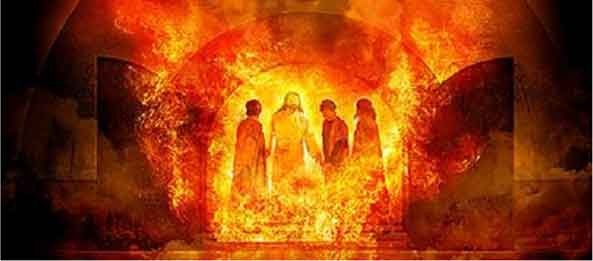
Daniel 3:19-30
19 Then Nebuchadnezzar was so filled with rage against Shadrach, Meshach, and Abednego that his face was distorted. He ordered the furnace to be heated up seven times more than was customary, 20and ordered some of the strongest guards in his army to bind Shadrach, Meshach, and Abednego and to throw them into the furnace of blazing fire. 21So the men were bound, still wearing their tunics,* their trousers,* their hats, and their other garments, and they were thrown into the furnace of blazing fire.
22Because the king’s command was urgent and the furnace was so overheated, the raging flames killed the men who lifted Shadrach, Meshach, and Abednego. 23But the three men, Shadrach, Meshach, and Abednego, fell down, bound, into the furnace of blazing fire.
24 Then King Nebuchadnezzar was astonished and rose up quickly. He said to his counsellors, ‘Was it not three men that we threw bound into the fire?’ They answered the king, ‘True, O king.’
25He replied, ‘But I see four men unbound, walking in the middle of the fire, and they are not hurt; and the fourth has the appearance of a god.’* 26Nebuchadnezzar then approached the door of the furnace of blazing fire and said, ‘Shadrach, Meshach, and Abednego, servants of the Most High God, come out! Come here!’
So Shadrach, Meshach, and Abednego came out from the fire. 27And the satraps, the prefects, the governors, and the king’s counsellors gathered together and saw that the fire had not had any power over the bodies of those men; the hair of their heads was not singed, their tunics* were not harmed, and not even the smell of fire came from them.
28Nebuchadnezzar said, ‘Blessed be the God of Shadrach, Meshach, and Abednego, who has sent his angel and delivered his servants who trusted in him. They disobeyed the king’s command and yielded up their bodies rather than serve and worship any god except their own God. 29Therefore I make a decree: Any people, nation, or language that utters blasphemy against the God of Shadrach, Meshach, and Abednego shall be torn limb from limb, and their houses laid in ruins; for there is no other god who is able to deliver in this way.’ 30Then the king promoted Shadrach, Meshach, and Abednego in the province of Babylon.
When I read this, I think of the recent legislation proposed in Kuwait against insulting God or his prophets. Let men insult. Let them build their gods, their statures, let them pursue their little gods of vanity, power and wealth. The one true God laughs. He holds all the true power. He doesn’t need our protection; he is in charge.
In Florida, some friends complain about “the law that says our kids can’t pray in school.” There is no law that says kids can’t pray in school. Kids pray in school all the time! I did, specially when I had a really hard test I hadn’t prepared adequately for 🙂 What the law says is that no one can make all pray together, using the same words, as we did at one time. It’s not such a bad thing; even as Christians, we don’t all share the same beliefs. You might not want your children praying a prayer I might compose 🙂 because I might have a dogmatic belief a little different from your own. Our job is to teach our children to pray; the Holy Spirit will be with them, and put the words in their hearts.
Pierre Teilhard de Chardin
Today in our Lectionary, the church honors Pierre Tielhard do Chardin, a man who thought about God and the nature of the world and tried to figure out a logical explanation for the state of the world. He was condemned by the church for some of this thoughts, which were not in line with Catholic dogma. I’ve always thought that people who, like the Apostle Thomas, need to seek an explanation and need to see the evidence, are at pondering God and his ways, and in my mind, God must dance with joy – or with amusement – to be so pondered.
PRAYER
Eternal God, the whole cosmos sings of your glory, from the dividing of a single cell to the vast expanse of interstellar space: We bless you for your theologian and scientist Pierre Teilhard de Chardin, who perceived the divine in the evolving creation. Enable us to become faithful stewards of your divine works and heirs of your eternal kingdom; through Jesus Christ, the firstborn of all creation, who with you and the Holy Spirit lives and reigns, one God, for ever and ever. Amen.

PIERRE TEILHARD DE CHARDIN
SCIENTIST AND MILITARY CHAPLAIN, 1955
Pierre Teilhard de Chardin (May 1, 1881 – April 10, 1955) was a French philosopher and Jesuit priest who trained as a paleontologist and geologist and took part in the discovery of Peking Man. His theological and philosophical works came into conflict with the Catholic Church and several of his books were censured.
Pierre Teilhard de Chardin was born in Orcines, close to Clermont-Ferrand, in France on May 1, 1881. When he was 12, he went to the Jesuit college of Mongré, in Villefranche-sur-Saône, where he completed baccalaureates of philosophy and mathematics. Then, in 1899, he entered the Jesuit novitiate at Aix-en-Provence where he began a philosophical, theological and spiritual career. Teilhard studied theology in Hastings, in Sussex (UK), from 1908 to 1912. There he synthesized his scientific, philosophical and theological knowledge in the light of evolution. From 1912 to 1914, Teilhard worked in the paleontology laboratory of the Musée National d’Histoire Naturelle, in Paris, studying the mammals of the middle Tertiary period.
Mobilised in December 1914, Teilhard served in World War I as a stretcher-bearer in the 8th Moroccan Rifles. For his valour, he received several citations including the Médaille militaire and the Legion of Honour.
In 1923 he traveled to China with Father Emile Licent, who was in charge in Tianjin of a laboratory collaborating with the Natural History Museum in Paris. Licent carried out considerable basic work in connection with missionaries who accumulated observations of a scientific nature in their spare time. Teilhard would remain there more or less twenty years. From 1926 to 1935, Teilhard made five geological research expeditions in China. They enabled him to establish a first general geological map of China. He joined the ongoing excavations of the Peking Man Site at Zhoukoudian as an advisor in 1926 and continued in the role for the Cenozoic Research Laboratory of the Geological Survey of China following its founding in 1928. During this tima and after, he also made a great number of travels throughout the world, studying and lecturing.
Teilhard died on April 10, 1955 in New York City, where he was in residence at the Jesuit church of St Ignatius of Loyola. He is buried on what is now the grounds of the Culinary Institute of America, in Poughkeepsie, NY.
In 1925, Teilhard was ordered by the Jesuit Superior General Vladimir Ledochowski to leave his teaching position in France and to sign a statement withdrawing his controversial statements regarding the doctrine of original sin. Rather than leave the Jesuit order, Teilhard signed the statement and left for China. This was the first of a series of condemnations by certain ecclesiastical officials that would continue until long after Teilhard’s death. The climax of these condemnations was a 1962 monitum (reprimand) of the Holy Office denouncing his works. It states:
“The above-mentioned works abound in such ambiguities and indeed even serious errors, as to offend Catholic doctrine… For this reason, the most eminent and most revered Fathers of the Holy Office exhort all Ordinaries as well as the superiors of Religious institutes, rectors of seminaries and presidents of universities, effectively to protect the minds, particularly of the youth, against the dangers presented by the works of Fr. Teilhard de Chardin and of his followers.”.
Teilhard’s writings, though, continued to circulate — not publicly, as he and the Jesuits observed their commitments to obedience, but in mimeographs that were circulated only privately, within the Jesuits, among theologians and scholars for discussion, debate and criticism. As time passed, it seemed that the works of Teilhard were gradually becoming viewed more favourably within the Church. However, the 1962 statement remains official Church policy to this day.
In his posthumously published book, The Phenomenon of Man, Teilhard writes of the unfolding of the material cosmos, from primordial particles to the development of life, human beings and the noosphere, and finally to his vision of the Omega Point in the future, which is “pulling” all creation towards it. He was a leading proponent of orthogenesis, the idea that evolution occurs in a directional, goal driven way, argued in terms that today go under the banner of convergent evolution. Teilhard argued in Darwinian terms with respect to biology, and supported the synthetic model of evolution, but argued in Lamarckian terms for the development of culture, primarily through the vehicle of education.
Teilhard makes sense of the universe by its evolutionary process. He interprets complexity as the axis of evolution of matter into a geosphere, a biosphere, into consciousness (in man,) and then to supreme consciousness (the Omega Point.)
Teilhard himself claimed his work to be phenomenology. Teilhard studied what he called the rise of spirit, or evolution of consciousness, in the universe. He believed it to be observable and verifiable in a simple law he called the Law of Complexity / Consciousness. This law simply states that there is an inherent compulsion in matter to arrange itself in more complex groupings, exhibiting higher levels of consciousness. The more complex the matter, the more conscious it is. Teilhard proposed that this is a better way to describe the evolution of life on earth, rather than Herbert Spencer’s “survival of the fittest.” The universe, he argued, strives towards higher consciousness, and does so by arranging itself into more complex structures.
Teilhard here proposed another level of consciousness, to which human beings belong, because of their cognitive ability; i.e. their ability to ‘think’, and to set things to purpose. Human beings, Teilhard argued, represent the layer of consciousness which has “folded back in upon itself”, and has become self-conscious. So in addition to the geosphere and the biosphere, Teilhard posited another sphere, which is the realm of human beings, the realm of reflective thought: the noosphere. The noosphere has been compared to C. G. Jung’s theory of the collective unconscious.
Finally, the keystone to his phenomenology is that because Teilhard could not explain why the universe would move in the direction of more complex arrangements and higher consciousness, he postulated that there must exist ahead of the moving universe, and pulling it along, a higher pole of supreme consciousness, which he called Omega Point.
Teilhard re-interpreted many disciplines, including theology, sociology, metaphysics, around this understanding of the universe. A main focus of his was to re-assure the converging mass of humanity not to despair, but to trust the evolution of consciousness as it rises through them.
Daniel and the Vegetarian Diet
Most people I know these days are trying to eat less meat. In the readings for today, we start the story of Daniel, a story every Christian child learns in Sunday School, but when you read as an adult, you see different things. This morning, doing the readings from the Lectionary, I smiled to see that Daniel and his companions wanted only vegetables; they were working very hard not to violate their food laws.

I also wonder if not eating meat was helpful in the den of lions; maybe they smelled less interesting as vegetarians? Then again, lions eat impalas, wildebeest, all sorts of vegetarians, so that probably was not a factor . . . 🙂
Daniel 1:1-21
1In the third year of the reign of King Jehoiakim of Judah, King Nebuchadnezzar of Babylon came to Jerusalem and besieged it. 2The Lord let King Jehoiakim of Judah fall into his power, as well as some of the vessels of the house of God. These he brought to the land of Shinar,* and placed the vessels in the treasury of his gods.
3 Then the king commanded his palace master Ashpenaz to bring some of the Israelites of the royal family and of the nobility, 4young men without physical defect and handsome, versed in every branch of wisdom, endowed with knowledge and insight, and competent to serve in the king’s palace; they were to be taught the literature and language of the Chaldeans. 5The king assigned them a daily portion of the royal rations of food and wine. They were to be educated for three years, so that at the end of that time they could be stationed in the king’s court. 6Among them were Daniel, Hananiah, Mishael, and Azariah, from the tribe of Judah. 7The palace master gave them other names: Daniel he called Belteshazzar, Hananiah he called Shadrach, Mishael he called Meshach, and Azariah he called Abednego.
8 But Daniel resolved that he would not defile himself with the royal rations of food and wine; so he asked the palace master to allow him not to defile himself. 9Now God allowed Daniel to receive favour and compassion from the palace master. 10The palace master said to Daniel, ‘I am afraid of my lord the king; he has appointed your food and your drink. If he should see you in poorer condition than the other young men of your own age, you would endanger my head with the king.’
11Then Daniel asked the guard whom the palace master had appointed over Daniel, Hananiah, Mishael, and Azariah: 12‘Please test your servants for ten days. Let us be given vegetables to eat and water to drink. 13You can then compare our appearance with the appearance of the young men who eat the royal rations, and deal with your servants according to what you observe.’ 14So he agreed to this proposal and tested them for ten days. 15At the end of ten days it was observed that they appeared better and fatter than all the young men who had been eating the royal rations. 16So the guard continued to withdraw their royal rations and the wine they were to drink, and gave them vegetables. 17To these four young men God gave knowledge and skill in every aspect of literature and wisdom; Daniel also had insight into all visions and dreams.
18 At the end of the time that the king had set for them to be brought in, the palace master brought them into the presence of Nebuchadnezzar, 19and the king spoke with them. And among them all, no one was found to compare with Daniel, Hananiah, Mishael, and Azariah; therefore they were stationed in the king’s court. 20In every matter of wisdom and understanding concerning which the king inquired of them, he found them ten times better than all the magicians and enchanters in his whole kingdom. 21And Daniel continued there until the first year of King Cyrus.
A Woman Scorned
I subscribe to a website called GoodReads.com, where I keep track of the books I read and get great recommendations from seeing what my GoodReads friends are reading. They also send me a newsletter a couple times a month, one a general newsletter, and one customized based on authors it sees me reading regularly. This morning, I got the general newsletter (which I actually do skim) and when I reached the end, I read this chilling poem.
Chilling?
When we lived in Kuwait, the first two lines of the poem were a reality. A first wife whose husband was taking a second wife set fire to the celebration tent where the women were celebrating. While the bride escaped, several lives were lost in a horrifying fire, fed by an accelerant.
Joan Colby captures the power and rage of the woman, scorned, in every culture.
A Woman Scorned
by Joan Colby (Goodreads Author)
A woman scorned sets fire to the tent
Where the new wife is celebrating.
Carves her name and yours into a tree
Then chops that tree down with her nail file.
Cages a bird and teaches it to speak
In a language where every verb is an obscenity.
Combs her hair with broken glass until
It glitters like a million diamonds
That you stroke until your hands bleed rubies.
Watches how you sit quietly near the water
While she poisons the tea she is about to serve.
Drives a team of black horses down the avenue
Of your lovers whipping them white as judges.
Climbs through the window that you forgot to secure
Wearing a burglar suit sewn of her eyelashes.
Picks a bouquet of jimson weed, hydrangea,
Lily of the valley, poison ivy, rhododendron
To prove the base and beautiful can both be lethal.
Paints graffiti on the wall of your Facebook
And for good measure stamps a letter with your heartsblood.
Enters your dream unbidden
Wearing the scarlet dress you once admired.
Paces up and down, up and down
Before your place of business.
Removes all the signposts pointing to
The street you used to live on when you were happy.
Mom Hugs; Babies Brains Get Bigger :-)
I saw this on one of the parenting posts on AOL and loved it. Hug your babies, yes, hug them and hug them again! Make their brains grow BIG and strong!

“You’re Not Southern – You’re Arab!”
My mind works in quirky ways, and yesterday as I was setting up for the hands-on Heirloom Feathers workshop with Cindy Needham, one of the good local Pensacola quilters was telling her how you can tell a Southerner from a Northerner.
“If you go to a Southerner’s house, they’ll ask you first thing if you’d like a drink of water, or iced tea or something, but if you go into a Northerner’s house, you can sit there for five hours and they won’t offer you ANYTHING!”
I grinned to myself, no, I have learned to censor these thoughts. But I couldn’t help it.
“You’re not a Southerner,” I am thinking, “You’re ARAB!”
I thought about a long ago trip through Morocco, we have a rental car and on our way from Ouazazarte to Marrakesh, on an isolated stretch of the road, we see a car in trouble. We stop and ask if we can help, if the man would like a lift to the next town. He tells us no, he wants to stay with the car, but asks if we would go to such and such service station and tell his uncle he needs help, and where he is.
Of course.

We drive into town, find the service station, and find the young man’s uncle, who is the owner. He sends help.
Did I mention it was Ramadan? No eating or drinking in public from dawn to dusk?
The owner insisted we come into his house, and seated us in his diwaniyya, and sent in mint tea and luscious almond-filled dates to refresh us. We said “No! No! It’s Ramadan!” but he told us it was his honor. He sat while we drank and ate.
Such enormous hospitality. Such grace. We only stayed a very short time; we still had a long drive, but I’ve never forgotten his hospitality.
Then again, it was Southern Morocco. 🙂 Maybe he was Southern.
The Prophet Jeremiah Ponders the Ways of the Wicked
Today the prophet Jeremiah sounds like a modern man – asking why, when we know what is good and what is bad, that some choose bad, and seem to do just fine – even better than the rest of us?
From the Holy Week readings in The Lectionary:
Jeremiah 12:1-16
12You will be in the right, O Lord,
when I lay charges against you;
but let me put my case to you.
Why does the way of the guilty prosper?
Why do all who are treacherous thrive?
2 You plant them, and they take root;
they grow and bring forth fruit;
you are near in their mouths
yet far from their hearts.
3 But you, O Lord, know me;
You see me and test me—my heart is with you.
Pull them out like sheep for the slaughter,
and set them apart for the day of slaughter.
4 How long will the land mourn,
and the grass of every field wither?
For the wickedness of those who live in it
the animals and the birds are swept away,
and because people said, ‘He is blind to our ways.’*
A Thorny Sermon: The Prodigal Son
From today’s Lectionary reading, the Gospel:
GOSPEL: Luke 15: 1 – 3, 11b – 32 (RCL)
Luke 15: 1 – 3, 11 – 32 (Roman Catholic)
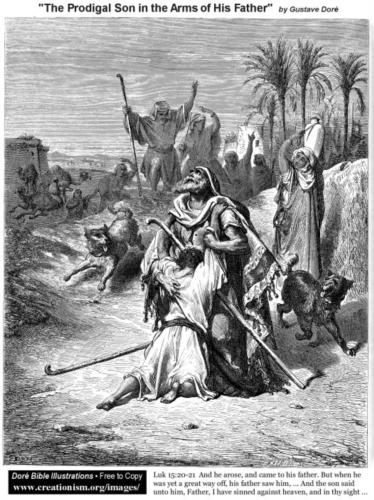
Gustave Dore: The Prodigal Son in the Arms of his Father
Luke 15:1 (NRSV) Now all the tax collectors and sinners were coming near to listen to him. 2 And the Phar’isees and the scribes were grumbling and saying, “This fellow welcomes sinners and eats with them.”
3 So he told them this parable:
11 Then Jesus said, “There was a man who had two sons. 12 The younger of them said to his father, “Father, give me the share of the property that will belong to me.’ So he divided his property between them. 13 A few days later the younger son gathered all he had and traveled to a distant country, and there he squandered his property in dissolute living.
14 When he had spent everything, a severe famine took place throughout that country, and he began to be in need. 15 So he went and hired himself out to one of the citizens of that country, who sent him to his fields to feed the pigs. 16 He would gladly have filled himself with the pods that the pigs were eating; and no one gave him anything.
17 But when he came to himself he said, “How many of my father’s hired hands have bread enough and to spare, but here I am dying of hunger! 18 I will get up and go to my father, and I will say to him, “Father, I have sinned against heaven and before you; 19 I am no longer worthy to be called your son; treat me like one of your hired hands.” ‘
20 So he set off and went to his father. But while he was still far off, his father saw him and was filled with compassion; he ran and put his arms around him and kissed him. 21 Then the son said to him, “Father, I have sinned against heaven and before you; I am no longer worthy to be called your son.’ 22 But the father said to his slaves, “Quickly, bring out a robe–the best one–and put it on him; put a ring on his finger and sandals on his feet. 23 And get the fatted calf and kill it, and let us eat and celebrate; 24 for this son of mine was dead and is alive again; he was lost and is found!’ And they began to celebrate.
25 “Now his elder son was in the field; and when he came and approached the house, he heard music and dancing. 26 He called one of the slaves and asked what was going on. 27 He replied, “Your brother has come, and your father has killed the fatted calf, because he has got him back safe and sound.’
28 Then he became angry and refused to go in. His father came out and began to plead with him. 29 But he answered his father, “Listen! For all these years I have been working like a slave for you, and I have never disobeyed your command; yet you have never given me even a young goat so that I might celebrate with my friends. 30 But when this son of yours came back, who has devoured your property with prostitutes, you killed the fatted calf for him!’
31 Then the father said to him, “Son, you are always with me, and all that is mine is yours. 32 But we had to celebrate and rejoice, because this brother of yours was dead and has come to life; he was lost and has been found.'”
Sometimes people will leave off the part about the elder son, and just concentrate on the return of the younger son, focusing on the father watching always, hoping for the return of the younger son, ready to forgive and welcome before the words can even get out of the younger son’s mouth.
It is wonderful, and reassuring, for those of us sinners.
Many, however – including me – can also identify with the oldest son who says “I’ve always done everything right and you’ve NEVER given me a tiny goat, much less a fatted calf, and you’re throwing this party for the son who blew his entire fortune on louche living???”
It doesn’t seem fair, does it? Isn’t that really the point of the story, that we can’t behave our way into heaven, it is sheer grace, the love of the heavenly creator, that allows us in? It’s not an easy concept to wrap my mind around, so today I struggle to take it in, and I give thanks for Father Neil who tackles the hard questions and doesn’t just sweep them under the carpet because they are inconvenient. (The sermon isn’t up yet, but when it is available, you will find it here)
START with Sea of Poppies, by Amitav Ghosh

I recently wrote a book review on River of Smoke, by Amitav Ghosh, which held me spellbound, so riveting that I had to order Sea of Poppies, which is actually the first volume of the trilogy. I had heard a review of River of Smoke on NPR and although it was written as the second volume in a trilogy, it can be read as a stand-alond.
Yes. Yes, it can be read as a stand-alone, but it is so much easier, I can state with authority, if you read them in order. Once I started Sea of Poppies, I also discovered an extensive glossary in the back, several pages, a list of the words, annotated with suggested origins, and it adds so much color to an already brilliantly colored novel. Much of both novels uses words from many cultures, and words that have been formed by another culture’s understanding of the words (some hilarious). If you like Captain Jack Sparrow, you’re going to love the polyglot language spoken by ship’s crews from many nations trying to communicate with one another. It can be intimidating, but if you sort of say the words out loud the way they are written at the beginning, you begin to find the rhythm and the gist of the communication, just as if you were a new recruit to the sea-going vessels of the early 1800’s. I loved it because it captured the difficulties encountered trying to say the simplest things, and the clever ways people in all cultures manage to get around it, and make themselves understood.
Sea of Poppies starts in a small Indian village, with one of the very small poppy gardens, planted on an advance from an opium factory representative, thrust upon the small farmer, with the result that most small Indian farmers converted their entire allotment from subsistence foods to poppies. Ghosh walks us through an opium processing factory, which is a little like walking through the circles of hell. We meet many of the characters we will follow in River of Smoke, and learn how this diverse group bonded into one sort of super-family through their adventures – and misadventures – together.
It is an entirely engrossing work. Sea of Poppies was short listed for the Man Booker award, and was listed as a “Best Book of the Year” by the San Francisco Chronicle, Chicago Tribune, Washington Post and The Economist. The theme is the opium trade, leading to the Opium Wars, with China, and is a chilling indictment of how business interests manipulate a population’s perceptions of national interests to justify . . . well, just about anything, in the name of profit.
The theme is woven through human stories so interesting, so textured, so compelling, that you hardly realize you are reading history and learning about the trade, cultures, travel, clothing, traditions, religions, food, and motivations as you avidly turn the pages.
I can hardly wait for the third volume. Get started now, so you’ll be ready for it when it comes out!
Recent Comments
ExpatAlien on What Country am I Living … intlxpatr on Yellowstone: Old Faithful to C… Michelle on Yellowstone: Old Faithful to C… Cathy on No Grown-Ups in Charge intlxpatr on Waiting for Snow Wikipedia Donate Button

Amazina


Early Voting in Florida


 Here There and Everywhere