“Diesel’s in Time Out”
“Where’s Diesel?” AdventureMan asked our Happy Little Boy, who is now talking up a storm and we are loving every minute of it.
“Oh, Diesel’s in Time-Out,” Happy Little Boy replies, as he continues to roll one of the locomotives around the wooden track. Sometimes he likes to set it up on the table, and have the trains drive off the edge. “Accident!” he crows!
“Why is Diesel in Time-Out? What did he do?” AdventureMan asks.
“Diesel hit Thomas!”

“And Diesel hit Percy!” (big eyes popping out of head!)

“AND Diesel hit Mr. ToppemHat! He had to go to Time-Out!”

He is learning so much, and we love hearing what is going on in his life. We are so glad to live so near, and to be able to be a part of his life.
Wooo HOOO, Saudi Arabia Allowing Female Olympic Athletes
It hasn’t been so long in our own country since Title IX made it possible for more and more women to participate in athletic events, making funding possible, giving women in the United States an opportunity to participate in healthy athletic activities.
RIYADH, June 25 (Reuters) – Saudi Arabia will allow its women athletes to compete in the Olympic Games for the first time ever in London this summer, the Islamic kingdom’s London embassy said on its website.
Human rights groups had called on the International Olympic Committee to bar Saudi Arabia from competing in London, citing its failure ever to send a woman athlete to the Olympics and its ban on sports in girls’ state schools.
Powerful Muslim clerics in the ultra-conservative state have repeatedly spoken out against the participation of girls and women in sports.
“I think this is a victory for Saudi sportswomen and hopefully it will promote sports and women’s health awareness for the Saudi society,” said Lina al-Maeena, co-founder of Jeddah United Sports Company, a rare women’s exercise club that runs a female basketball team.
In Saudi Arabia women have a lower legal status than men, are banned from driving and need a male guardian’s permission to work, travel or open a bank account.
Under King Abdullah, however, the government has pushed for them to have better education and work opportunities and will allow them to vote in future municipal elections, the only public polls held in the kingdom.
Saudi women will be able to compete in the London Olympics only if they reach the qualifying standard for their event, and the Games opens in just over one month, on July 27.
“The kingdom of Saudi Arabia is looking forward to its complete participation in the London 2012 Olympic Games through the Saudi Arabian Olympic Committee, which will oversee the participation of women athletes who can qualify for the Games,” said a statement published on the embassy website.
The woman most likely to compete under the Saudi flag in London, show jumper Dalma Malhas, was ruled out on Monday when the World Equestrian Federation (FEI) said the 20-year-old’s mare Caramell KS had been sidelined by injury for a month during the qualifying period and had missed a June 17 deadline.
“Regretfully the Saudi Arabian rider Dalma Rushdi Malhas has not attained the minimum eligibility standards and … will not be competing” at the London Olympics, FEI secretary general Ingmar De Vos told the FEI website (www.fei.org).
Malhas won individual bronze at the junior Olympics in Singapore in 2010, but without official support or recognition.
In April the head of the General Presidency of Youth Welfare, which regulates sport in Saudi Arabia, said it would not prevent women from competing but they would not have official government endorsement.
The government’s role would be limited to ensuring that Saudi women’s participation “is in the proper framework and in conformity with sharia”, he said.
The IOC said on Monday that talks with the Saudis were “ongoing” and that “we are working to ensure the participation of Saudi women at the Games in London”.
The head of the kingdom’s Olympic mission, Khalid al-Dakheel, told Reuters on Sunday that he was unaware of any developments allowing women to participate.
Top Saudi clerics, who hold government positions and have always constituted an important support base for the ruling al-Saud royal family, have spoken against female participation in sports.
In 2009 a senior cleric said girls risked losing their virginity by tearing their hymen if they took part in energetic sport.
Physical education is banned in girls’ state schools in the kingdom, but Saudi Arabia’s only female deputy minister, Noura al-Fayez, has written to Human Rights Watch saying there is a plan to introduce it. (Reporting by Angus McDowall and Asma Alsharif; editing by Tim Pearce)
“Nobody wins. We’ve all lost.”
Guilty. A fitting end to a sorry story. A man who used his position to prey on the most vulnerable, poor children. He brought down one of America’s heroes, Joe Paterno, and cast a stain on a stellar football school. Although he is convicted, as one victim’s mother states, there are no winners here – the kids will have to live with his betrayal for the rest of their lives. My guess is he still believes he did nothing wrong. These guys tell themselves that their victims are willing. Put the man away.
BELLEFONTE, Pa.—Jerry Sandusky was convicted Friday of sexually assaulting 10 boys over 15 years, a swift and emphatic end to a case that shattered Penn State University’s Happy Valley image and brought down Hall of Fame football coach Joe Paterno.
Sandusky, a 68-year-old retired defensive coach who was once Paterno’s heir apparent, was found guilty of 45 of 48 counts and is almost certain to spend the rest of his life in prison.
The jury of seven women and five men, including nine with ties to Penn State, deliberated more than 20 hours over two days.
Sandusky showed little emotion as the verdict was read. Judge John Cleland revoked his bail and ordered him taken to the county jail to await sentencing in about three months. Many of the charges carry mandatory minimum sentences.
Sandusky half-waved toward his family in the courtroom as the sheriff led him away. Outside, he calmly walked to a sheriff’s car with his hands cuffed in front of him.
The accuser known in court papers as Victim 6 broke down in tears upon hearing the verdicts, and a prosecutor embraced him and said, “Did I ever lie to you?”
The man, now 25, testified that Sandusky called himself the “tickle monster” in a shower assault. He declined to comment to a reporter afterward, but his mother said: “Nobody wins. We’ve all lost.”
Almost immediately after the judge adjourned the case, loud cheers could be heard from a couple hundred people gathered outside the courthouse as word quickly spread that Sandusky had been convicted. The crowd included victim’s advocates and local residents with their children.
As Sandusky was placed in the cruiser to be taken to jail, someone yelled at him to “rot in hell.” Others hurled insults and he shook his head no in response.
Lead defense attorney Joe Amendola was interrupted by cheers from the crowd on courthouse steps when he said, “The sentence that Jerry will receive will be a life sentence.”
Eight young men testified in a central Pennsylvania courtroom about a range of abuse, from kissing and massages to groping, oral sex and anal rape. For two other alleged victims, prosecutors relied on testimony from a university janitor and then-graduate assistant Mike McQueary, whose account of a sexual encounter between Sandusky and a boy of about 10 ultimately led to Paterno’s firing and the university president’s ouster.
Sandusky did not take the stand in his own defense, which Amendola said was a last-minute strategy change.
Defense attorney Karl Rominger said it was “a tough case” with a lot of charges and that an appeal was certain. He said the defense team “didn’t exactly have a lot of time to prepare.”
Amendola praised the prosecution, the judge and the jury and added: “Jerry indicated he was disappointed with the verdict, but obviously he has to live with it.” He said he would appeal.
Pennsylvania Attorney General Linda Kelly thanked the accusers who testified, calling them “brave men.”
She said she hoped the verdict “helps these victims heal … and helps other victims of abuse to come forward.”
Jerry Sandusky faces up to 442 years in prison. (AP Photo)
“One of the recurring themes in this case was: Who would believe a kid?” she said. “The answer is: We here in Bellefonte, Pa., would believe a kid.”
Sandusky repeatedly denied the allegations, and his defense suggested that his accusers had a financial motive to make up stories, years after the fact. His attorney also painted Sandusky as the victim of overzealous police investigators who coached the alleged victims into giving accusatory statements.
But jurors believed the testimony that, in the words of lead prosecutor Joseph McGettigan III, Sandusky was a “predatory pedophile.”
One accuser testified that Sandusky molested him in the locker-room showers and in hotels while trying to ensure his silence with gifts and trips to bowl games. He also said Sandusky had sent him “creepy love letters.”
Another spoke of forced oral sex and instances of rape in the basement of Sandusky’s home, including abuse that left him bleeding. He said he once tried to scream for help, knowing that Sandusky’s wife was upstairs, but figured the basement must be soundproof.
Another, a foster child, said Sandusky warned that he would never see his family again if he ever told anyone what happened.
And just hours after the case went to jurors, lawyers for one of Sandusky’s six adopted children, Matt, said he had told authorities that his father abused him.
Matt Sandusky had been prepared to testify on behalf of prosecutors, the statement said. The lawyers said they arranged for Matt Sandusky to meet with law enforcement officials but did not explain why he didn’t testify.
Amendola said Sandusky reluctantly agreed not to testify in his own behalf because the son would have been called by the prosecution as a rebuttal witness and the defense feared that would destroy any chance of acquittal.
Defense witnesses, including Jerry Sandusky’s wife, Dottie, described his philanthropic work with children over the years, and many spoke in positive terms about his reputation in the community. Prosecutors had portrayed those efforts as an effective means by which Sandusky could camouflage his molestation as he targeted boys who were the same age as participants in The Second Mile, a charity he founded in the 1970s for at-risk youth.
Sandusky’s arrest in November led the Penn State trustees to fire Paterno as head coach, saying he exhibited a lack of leadership after fielding a report from McQueary. The scandal also led to the ouster of university president Graham Spanier, and criminal charges against two university administrators for failing to properly report suspected child abuse and perjury.
The two administrators, athletic director Tim Curley and now-retired vice president Gary Schultz, are fighting the allegations and await trial.
The family of Paterno, who died exactly five months before Sandusky’s conviction, released a statement saying: “Although we understand the task of healing is just beginning, today’s verdict is an important milestone. The community owes a measure of gratitude to the jurors for their diligent service. Our thoughts and prayers continue to be with the victims and their families.”
In a statement, Penn State praised the accusers who testified and said that it planned to invite the victims of Sandusky’s abuse to participate in a private program to address their concerns and compensate them for claims related to the school.
Sandusky had initially faced 52 counts of sex abuse. The judge dropped four counts during the trial, saying two were unproven, one was brought under a statute that didn’t apply and another was duplicative.
Seventy Times Seven
I come from a great mixture of nationalities, but two of them, the Irish and the German, specialize in carrying grudges for a long time. I once lived in a small German village, where a woman told me that her family did not speak to this other family, nor that family to them. Their grandmothers had some great falling out – nearly 100 years ago – and while no one can remember what it was about, the families still don’t speak.
Seventy times seven – it goes against the grain, doesn’t it? Jesus said so many earth-changing things, like “Love your neighbor as yourself” and to take care of the poor and the prisoners and the widows and children – people who are considered, even in today’s society, to have less value. To let go of your angry feelings, to forgive – that is hard work.
And yet, he spells out how very damaging our grudges are – to US! If we can get over our selves, and our own selfish instincts, our lives are so much happier and so much more productive . . .
Matthew 18:21-35
21 Then Peter came and said to him, ‘Lord, if another member of the church* sins against me, how often should I forgive? As many as seven times?’ 22Jesus said to him, ‘Not seven times, but, I tell you, seventy-seven* times.
23 ‘For this reason the kingdom of heaven may be compared to a king who wished to settle accounts with his slaves. 24When he began the reckoning, one who owed him ten thousand talents* was brought to him; 25and, as he could not pay, his lord ordered him to be sold, together with his wife and children and all his possessions, and payment to be made. 26So the slave fell on his knees before him, saying, “Have patience with me, and I will pay you everything.” 27And out of pity for him, the lord of that slave released him and forgave him the debt. 28But that same slave, as he went out, came upon one of his fellow-slaves who owed him a hundred denarii;* and seizing him by the throat, he said, “Pay what you owe.”
29Then his fellow-slave fell down and pleaded with him, “Have patience with me, and I will pay you.” 30But he refused; then he went and threw him into prison until he should pay the debt.
31When his fellow-slaves saw what had happened, they were greatly distressed, and they went and reported to their lord all that had taken place. 32Then his lord summoned him and said to him, “You wicked slave! I forgave you all that debt because you pleaded with me. 33Should you not have had mercy on your fellow-slave, as I had mercy on you?” 34And in anger his lord handed him over to be tortured until he should pay his entire debt. 35So my heavenly Father will also do to every one of you, if you do not forgive your brother or sister* from your heart.’
The Paris Wife by Paula McLain
The Paris Wife
Pauline Mclain

“This isn’t going to end well” you tell yourself when you start reading
this book, and you tell yourself not to read any further but you can’t
stop. This is a very good girl who meets a bad boy – what is it about
bad boys, anyway? You know you should go for the serious guy, the one
who will always have a good job, be a good provider for the family, a
good father to your children. You know all this, and you choose the bad
boy anyway. Why?
Hadley Richardson is a good girl at one of those transitional times in
history; world war I had ended, the damaged young men, including Ernest
Hemingway, are back from war, it is the 1920’s and the world is turned
upside down. When they meet, the chemistry is hot and strong. Their
friends warn Hadley against marrying “Hem” but when the attraction is
so hot and high, who can listen?
You know from the beginning that she is just the first wife, so most of
the book is full of dread, waiting to find out just how awful it is all
going to be. The early years, living in Paris, being dirt poor while
Hemingway gets started with his writing, are good years. They meet lots
of interesting expats living in Paris, they drink a lot, they are off
to Spain for the bullfights, and to Austria for the skiing, on the move
a lot, even once the baby comes.
It’s a fascinating book, a snapshot of the roaring 1920’s, of the
transitional era when women started becoming less submissive and more
free, and of a relationship between a nice girl and a talented but
damaged and self-destructive man. You’ll hate having to put it down.
Post review add: I finished this book while in Zambia and wrote the review. I really want to read A Movable Feast, now, Hemingway’s last book before he killed himself, written about this marriage. I understand it is a nostalgic tribute to his first marriage and to Hadley.
We watched Hemingway and Gelhorn last night, and watched him leave Pauline, the false friend who snatched him from Hadley (this is not a spoiler, folks, this is history) for Gelhorn, and then in anger at Gelhorn, turn to the woman who would become his last wife. She is protrayed as a total twit.
The movie, Hemingway and Gelhorn, was only mildly interesting; Kidman was her glorious self but there was zero chemistry, her romance with Hemingway barely believable. And he comes off as a real jerk. The jerk part is consistent with The Paris Wife, but while The Paris Wife is more sympathetic to Hemingway, portraying him as damaged but vulnerable, in Hemingway and Gelhorn, he is just arrogant, egotistic and obnoxious. Still, after you read The Paris Wife, it is interesting to see the rest of the story.
BERNARD MIZEKI
Not bad, slept the night until 0530, and then found this in The Lectionary readings for today. To think I was so near, so close to the anniversary of his disappearance. . .
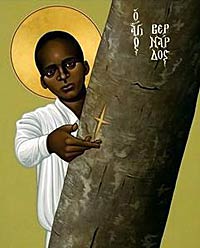
CATECHIST AND MARTYR IN AFRICA (18 JUNE 1896)
Bernard Mizeki was born in Portuguese East Africa (Mozambique) in about 1861. When he was twelve or a little older, he left his home and went to Capetown, South Africa, where for the next ten years he worked as a laborer, living in the slums of Capetown, but (perceiving the disastrous effects of drunkenness on many workers in the slums) firmly refusing to drink alcohol, and remaining largely uncorrupted by his surroundings. After his day’s work, he attended night classes at an Anglican school.
Under the influence of his teachers, from the Society of Saint John the Evangelist (SSJE, an Anglican religious order for men, popularly called the Cowley Fathers), he became a Christian and was baptized on 9 March 1886. Besides the fundamentals of European schooling, he mastered English, French, high Dutch, and at least eight local African languages. In time he would be an invaluable assistant when the Anglican church began translating its sacred texts into African languages.
After graduating from the school, he accompanied Bishop Knight-Bruce to Mashonaland, a tribal area in Southern Rhodesia (now Zimbabwe), to work there as a lay catechist. In 1891 the bishop assigned him to Nhowe, the village of paramount-chief Mangwende, and there he built a mission-complex. He prayed the Anglican hours each day, tended his subsistence garden, studied the local language (which he mastered better than any other foreigner in his day), and cultivated friendships with the villagers. He eventually opened a school, and won the hearts of many of the Mashona through his love for their children.
He moved his mission complex up onto a nearby plateau, next to a grove of trees sacred to the ancestral spirits of the Mashona. Although he had the chief’s permission, he angered the local religious leaders when he cut some of the trees down and carved crosses into others. Although he opposed some local traditional religious customs, Bernard was very attentive to the nuances of the Shona Spirit religion. He developed an approach that built on people’s already monotheistic faith in one God, Mwari, and on their sensitivity to spirit life, while at the same time he forthrightly proclaimed the Christ. Over the next five years (1891-1896), the mission at Nhowe produced an abundance of converts.
Many black African nationalists regarded all missionaries as working for the European colonial governments. During an uprising in 1896, Bernard was warned to flee. He refused, since he did not regard himself as working for anyone but Christ, and he would not desert his converts or his post. On 18 June 1896, he was fatally speared outside his hut. His wife and a helper went to get food and blankets for him. They later reported that, from a distance, they saw a blinding light on the hillside where he had been lying, and heard a rushing sound, as though of many wings. When they returned to the spot his body had disappeared. The place of his death has become a focus of great devotion for Anglicans and other Christians, and one of the greatest of all Christian festivals in Africa takes place there every year around the feast day that marks the anniversary of his martyrdom, June 18.
by James Kiefer
“Never for Acclaim, Always for Country”
This weekend the CIA also honors fallen warriors, and in a new level of transparency, shares some of those names. It’s devastating to lose a loved one in the military, and I cannot imagine what it was like to lose a loved one and not to even be able to tell people your loved one was lost in service to his or her country. Heartfelt thanks to all those who have served silently and anonymously and sacrificed identity and history for our nation. You know who you are. 🙂
From ABC News:

Out of the shadows in death: The CIA honors its fallen
By Suzanne Kelly CNN – When you’re a spy, you have to accept the fact that everything you do will go unnoticed by most people during your life. Sometimes that secrecy even follows you in death, with a simple star carved into a marble wall at Langley being the only memorial to your service.
Sometimes though, in death, the names come out, along with just enough information to piece together a glimpse of what life — and death — have been like for CIA spies over the past three decades.
This past Monday, 15 names were added to what’s known by insiders as the “Book of Honor.” When a name is inscribed in the book, it allows family and friends of the fallen to publicly acknowledge in general terms, how their loved ones spent their lives, and how they died.
The names and brief stories shared with a crowd said to number in the hundreds gathered in the CIA lobby, told a story of an Agency spread far and wide; the story of an Agency not only consumed with tracking down terrorists, but sometimes becoming victims of the hunted.
Jeffrey R. Patneau, described by CIA Director David Petraeus as a “young can-do officer,” was killed in Yemen in September 2008. Yemen has become a hotbed of al Qaeda activity and is where a recent al Qaeda in the Arabian Pensinsula (AQAP) plot to bring down an airliner with a difficult-to-detect new explosive material, was recently foiled by undercover operatives.
Five of those honored this year died on April 18, 1983, when terrorists targeted the U.S. Embassy in Beirut, killing 63 people. Phyliss Nancy Faraci had also been one of the last four Americans evacuated from the Mekong Delta when Saigon fell, according to an Agency spokesman. She died in Beirut along with Deborah M. Hixson, Frank J. Johnston, and a married couple, James F. and Monique N. Lewis. Petraeus noted the Embassy bombing as the place where the Agency “first caught sight of the adversary we face today.”

To get a sense of just how widespread the CIA presence has been over the years, Matthew K. Gannon was killed in the December 1988 bombing of Pan Am Flight 103 over Lockerbie, Scotland; Molly N. Hardy was killed in the 1998 suicide bombing of the U.S. Embassy in Nairobi; Leslianne Shedd died when hijackers downed the plane she was on over the Indian Ocean in November 1996; Jacqueline K. Van Landingham was killed in Pakistan in March 1995; Barry S. Castiglione died during the ocean rescue of a colleague in 1992 in the waters off El Salvador; Lawrence N. Freedman was killed in Somalia in December 1992; Thomas M. Jennings, Jr. died in Bosnia in 1997; Freddie R. Woodruff was killed in Georgia in 1993; and Robert W. Woods died in a plane crash during a humanitarian mission to Ethiopia in 1989.
Petraeus told the group of gathered mourners and friends that the officers who have died for the mission “all heard the same call to duty and answered it without hesitation — never for acclaim, always for country.”
One more star has been carved into that wall so far this year, bringing the number of stars representing fallen officers to 103. We don’t know who the latest person was, or how they died, but maybe someday, we will.
Copyright 2012 Scripps Media, Inc. All rights reserved. This material may not be published, broadcast, rewritten, or redistributed.
Speaking Truth to our Neighbor
Oh aaarrgh. I do my morning readings, and then I go to Forward Day by Day for a short meditation and to find out what part of the world we are praying for today. Today, the commentary hits on our neighbor . . . my weak point. We are to love God and to love one another. Even in traffic, even in lines in the bank. We are to love that obnoxious woman talking loudly about her personal life on her cell phone, and the aggressive guy who barges in front of you as if he were entitled. Oh aarrgh.
Thursday, may 24
Ephesians 4:17-32. Let all of us speak the truth to our neighbors, for we are members of one another.
How well do you know your neighbors? Do you know their names, their heritage, or anything more than what they drive and a vague awareness of their schedule?
Our busy schedules and desire for privacy often keep us from getting to know the people who live close to us. And why not speak the truth to them? We are neighbors after all.
We might want to expand our definition of neighbor to include those driving next to us on the road, anyone sitting next to us on the bus or train, the person standing next to us in line at the bank. How do we speak the truth to them? Do we tell them the truth, or do we tell them something else? For instance, if you are in a hurry and someone seems to be taking a long time at the teller’s window, would you say, “What is taking you so long?” or would you say, “I am really in a hurry and feeling really impatient at this moment. Would you mind if I go ahead of you?”
When we speak the truth in love to someone, we gain respect and grow closer to being one with each other.
PRAY for the Diocese of Chotanagpur (North India) http://www.anglicancommunion.org/tour/diocese.cfm?Idind=425
Recent Comments
ExpatAlien on What Country am I Living … intlxpatr on Yellowstone: Old Faithful to C… Michelle on Yellowstone: Old Faithful to C… Cathy on No Grown-Ups in Charge intlxpatr on Waiting for Snow Wikipedia Donate Button

Amazina


Early Voting in Florida


 Here There and Everywhere