Doc by Mary Doria Russell

Mary Doria Russell is one of my favorite authors because she tackles large topics fearlessly, humorously and with great compassion. I first read her many years ago in a novel called Children Of God; you can read it stand-alone as I did, but I should have read The Sparrow, which preceded it. That one is about the Jesuits who take the Gospel into outer space, and has some laugh-out-loud moments in the midst of utter hopelessness. Yes. She’s that kind of author, my kind of woman.
Here is the ending Question and Answer from an interview at the back of Doc, an interview with John Connelly:
Q: Authors are often asked what advice they’d give young writers. I would like to ask you a similar question: What do you think the worst advice a young writer could get is?
Mary Doria Russell: Major in English. Join a writer’s group. Blog.
My advice is to major in and do something REAL. Have an actual 3-D life of your own. And please, shut up about it until you’ve got something genuinely wise or useful or thoughtful to share. Then again, I’m a cranky old lady! What the hell do I know?
Reading a book about legendary heroes of the Old West is not something I looked forward to, so the book languished on my “to read” pile until one day I picked it up just because it is written by Mary Doria Russell, and because she has knocked my socks off with every book I’ve read by her.
It starts off slow, summing up the early genteel years of John Henry Holliday in Georgia, just prior to, during and after the War Between the States. At 22 he is diagnosed with acute tuberculosis, and is advised that a drier climate out West might provide him with a more comfortable life, as short as it was likely to be. He had trained as a dentist, so he had a skill. Times were hard, and while he was a very very good dentist, it was a good thing he also had skills with card playing, to supplement his income when people didn’t have the money to go to the dentist.
Don’t skip over the early years, because what happens in the early years resonates into his years living in the West. The majority of the book takes place in Dodge, a border town where laws are made over a card game and by the men who will profit from them. Lives are hard, and short. While it is surely the wild west, the focus is on the relationships Doc builds – Wyatt and Morgan Earp (all the Earp brothers), Bat Masterson, the gals . . . here is where Russell’s artistry shines; the cardboard figures begin to become real people. We start to like one or two, admire another, despise one more.
Here’s what I love about Mary Doria Russell – without being at all preachy, she makes you stop and think about some of the values you hold most dear. Once you get west, 80% of the women featured in the book are prostitutes. Most of the characters drink heavily, and routinely use drugs which are today restricted to prescriptions. There is corruption, and murder, and arson, and abortion, and contraception, and adultery, and there is no one character who is purely good or purely evil, they are all complicated, just as we are. She can lead you to dislike a character, who at just the right moment knows just the right thing to say, and suddenly, you see that character differently, because another facet of his or her character has been revealed.
In the questions at the back of the book, we are asked if we were to meet Doc Holliday, would we like him? I had to ask the question the other way around – if I were to meet Doc Holliday, how would he perceive me? I found myself thinking outside the box, found myself thinking that if I knew my life were going to be very very short, would I want to hang around with normal people, dull, predictable people? Maybe people who look better on the outside than they are, or think more highly of themselves than they ought? Doc Holliday hung around with lawmen and gamblers and prostitutes and bartenders; his patients were law-abiding church-going citizens. Who gave greater color and meaning to his life? Who were more likely to be down-to-earth and practical and unpretentious?
There is an absolutely delightful segment about a Jesuit priest from an old Hungarian aristocratic family who finds himself riding out to visit all the small Catholic Indian parishes on a donkey, replacing a highly popular priest who is very sick; he is teased and mocked and treated with disrespect. One night, cold and wet, covered with dirt and filth in the desert, he has an epiphany that changes his life. Mary Doria Russell books have these luminous moments, worth reading the entire book for, and which will bring a smile of memory to your face long after you have finished reading the book.
By Secret Ballot
I hear people talking back and forth; feeling one another out. Most assume their friends will vote Republican; it’s Republican country up here in the westernmost part of Florida. Yards are littered with Romney – Ryan signs, with a few timid Obama signs here and here in a yard or on a car fender.

My Dad taught us, when we were very young, that the only appropriate answer when asked how one would vote is “I am voting by secret ballot.” He taught us how precious the right is to cast your vote and to know that no one can intimidate you into voting for someone else, because we vote by secret ballot. No husband can command his wife, no father can command his family, no minister can command his church. We each vote our individual conscience.
So we have the luxury of worrying whether we will vote the right candidates into office. We can only do the best we can with the information we have. I don’t want opinions, I want to see where a candidate stands on the issues that are important to me. And, in the end, I trust in the Lord:
Psalm 20
Now this I know:
The Lord gives victory to his anointed.
He answers him from his heavenly sanctuary
with the victorious power of his right hand.
7 Some trust in chariots and some in horses,
but we trust in the name of the Lord our God.
8 They are brought to their knees and fall,
but we rise up and stand firm.
9 Lord, give victory to the king!
Answer us when we call!
When I hear people moaning in the locker room, or jeering in the parking lot, I walk right by. It’s not my problem. I vote my conscience, and I leave the outcome in the Lord’s hands.
Daily Readings on Gossip
I grew up in a culture that thrives on gossip and speculation. Today’s reading from The Lectionary reminds me to gurd my tongue; never to repeat a conversation, unless not to repeat it would be a sin, as in murder or abuse.
Sirach 19:4-17
4 One who trusts others too quickly has a shallow mind,
and one who sins does wrong to himself.
5 One who rejoices in wickedness* will be condemned,*
6 but one who hates gossip has less evil.
7 Never repeat a conversation,
and you will lose nothing at all.
8 With friend or foe do not report it,
and unless it would be a sin for you, do not reveal it;
9 for someone may have heard you and watched you,
and in time will hate you.
10 Have you heard something? Let it die with you.
Be brave, it will not make you burst!
11 Having heard something, the fool suffers birth-pangs
like a woman in labour with a child.
12 Like an arrow stuck in a person’s thigh,
so is gossip inside a fool.
13 Question a friend; perhaps he did not do it;
or if he did, so that he may not do it again.
14 Question a neighbour; perhaps he did not say it;
or if he said it, so that he may not repeat it.
15 Question a friend, for often it is slander;
so do not believe everything you hear.
16 A person may make a slip without intending it.
Who has not sinned with his tongue?
17 Question your neighbour before you threaten him;
and let the law of the Most High take its course.*
My Wealth and My Treasure . . .
Blessings abound when you have faithful friends! Blessings on my friends, and know I am thinking of you as I write this, each and every one-in-a-thousand 🙂 From today’s readings in The Lectionary:
Sirach 6:5-17
5 Pleasant speech multiplies friends,
and a gracious tongue multiplies courtesies.
6 Let those who are friendly with you be many,
but let your advisers be one in a thousand.
7 When you gain friends, gain them through testing,
and do not trust them hastily.
8 For there are friends who are such when it suits them,
but they will not stand by you in time of trouble.
9 And there are friends who change into enemies,
and tell of the quarrel to your disgrace.
10 And there are friends who sit at your table,
but they will not stand by you in time of trouble.
11 When you are prosperous, they become your second self,
and lord it over your servants;
12 but if you are brought low, they turn against you,
and hide themselves from you.
13 Keep away from your enemies,
and be on guard with your friends.
14 Faithful friends are a sturdy shelter:
whoever finds one has found a treasure.
15 Faithful friends are beyond price;
no amount can balance their worth.
16 Faithful friends are life-saving medicine;
and those who fear the Lord will find them.
17 Those who fear the Lord direct their friendship aright,
for as they are, so are their neighbours also.
Your Vote – The Power of We (Blog Action Day 2012)
This year, in the United States we are going through a vicious process, that of choosing one candidate over another for political office. Many people are so put-off by the mechanics of the process that they opt out of the choosing altogether. Others are just too busy to vote, beset by the needs of family, job, car pool, church, social activities, etc. in spite of the ease with which one can ask for and receive an absentee ballot.
You need only live in a country where people have no meaningful vote to quickly learn the value of your vote. Your vote may be just one, but in a democracy, where just one vote can turn an election – your vote counts. Together, with other voters of your persuasion, your vote counts.
There has never been a country where women have the vote and men don’t. Sadly, the opposite is true; there are still countries where women are not considered fully qualified to vote. Less than 100 years ago, our own country was one of them. Yes, it’s true, we didn’t get the vote until 1920. I reprint the following from a post I wrote several years ago, a post I have never forgotten, because it was so shocking to me when I read the price these women paid that I might freely vote today.
“The doctor admonished the men: ‘Courage in women is often
mistaken for insanity.’”
We may have different preferences for who gets elected; that doesn’t matter to me. What matters to me is the power of we – that we care enough about our country and its policies to exercise our right as citizens, to get out there and vote.
This is reblogged from July 17, 2008:
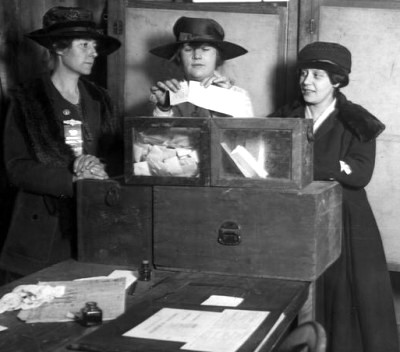
WHY EVERY WOMAN SHOULD VOTE
This is the story of our Grandmothers, and Great-grandmothers, as they
lived only 90 years ago. It was not until 1920 that women were granted
the right to go to the polls and vote.
Thus unfolded the ‘Night of Terror’ on Nov. 15, 1917, when the warden at
the Occoquan Workhouse in Virginia ordered his guards to teach a lesson
to the suffragists imprisoned there because they dared to picket Woodrow
Wilson’s White House for the right to vote. The women were innocent and
defenseless. And by the end of the night they were barely alive. Forty
prison guards wielding clubs and their warden’s blessing went on a
rampage against the 33 women wrongly convicted of ‘obstructing sidewalk
traffic.’
They beat Lucy Burn, chained her hands to the cell bars above her head
and left her hanging for the night, bleeding and gasping for air. They
hurled Dora Lewis into a dark cell, smashed her head against an iron bed
and knocked her out cold. Her cell mate, Alice Cosu, thought Lewis was
dead and suffered a heart attack. Additional affidavits describe the
guards grabbing, dragging, beating, choking, slamming, pinching,
twisting and kicking the women.
For weeks, the women’s only water came from an open pail. Their
food–all of it colorless slop–was infested with worms. When one of the
leaders, Alice Paul, embarked on a hunger strike, they tied her to a
chair, forced a tube down her throat and poured liquid into her until
she vomited. She was tortured like this for weeks until word was
smuggled out to the press.
So, refresh my memory. Some women won’t vote this year because–why,
exactly? We have carpool duties? We have to get to work? Our vote
doesn’t matter? It’s raining?
Last week, I went to a sparsely attended screening of HBO’s new movie
‘Iron Jawed Angels.’ It is a graphic depiction of the battle these women
waged so that I could pull the curtain at the polling booth and have my
say. I am ashamed to say I needed the reminder.
All these years later, voter registration is still my passion. But the
actual act of voting had become less personal for me, more rote.
Frankly, voting often felt more like an obligation than a privilege.
Sometimes it was inconvenient.
My friend Wendy, who is my age and studied women’s history, saw the HBO
movie , too. When she stopped by my desk to talk about it, she looked
angry. She was–with herself. ‘One thought kept coming back to me as I
watched that movie,’ she said. ‘What would those women think of the way
I use–or don’t use–my right to vote? All of us take it for granted
now, not just younger women, but those of us who did seek to learn.’ The
right to vote, she said, had become valuable to her ‘all over again.’
HBO released the movie on video and DVD. I wish all history, social
studies and government teachers would include the movie in their
curriculum. I want it shown on Bunco night, too, and anywhere else women
gather. I realize this isn’t our usual idea of socializing, but we are
not voting in the numbers that we should be, and I think a little shock
therapy is in order.
It is jarring to watch Woodrow Wilson and his cronies try to persuade a
psychiatrist to declare Alice Paul insane so that she could be
permanently institutionalized. And it is inspiring to watch the doctor
refuse. Alice Paul was strong, he said, and brave. That didn’t make her
crazy. The doctor admonished the men: ‘Courage in women is often
mistaken for insanity.’
Please, if you are so inclined, pass this on to all the women you know.
We need to get out and vote and use this right that was fought so hard
for by these very courageous women. Whether you vote democratic,
republican or independent party – remember to vote.
History is being made.
Teachers’ Expectations Evoke Life-Changing Achievement
Yes, this is a long article from National Public Radio, but it’s important. I want you to read it, and if you have the time, go to the website – you can click on the blue type above – and listen to it yourself, because it is life changing for us, and for how we treat our children, too.
Do it at a time when you have time to listen. It caught me by surprise, but I was so enthralled, I stayed for the entire segment. Children with the greatest challenges can succeed, if they are nurtured and mentored. Any child can be a success; there are no losers. This is powerful stuff. 🙂
by ALIX SPIEGEL
In my Morning Edition story today, I look at expectations — specifically, how teacher expectations can affect the performance of the children they teach.
The first psychologist to systematically study this was a Harvard professor named Robert Rosenthal, who in 1964 did a wonderful experiment at an elementary school south of San Francisco.
The idea was to figure out what would happen if teachers were told that certain kids in their class were destined to succeed, so Rosenthal took a normal IQ test and dressed it up as a different test.
“It was a standardized IQ test, Flanagan’s Test of General Ability,” he says. “But the cover we put on it, we had printed on every test booklet, said ‘Harvard Test of Inflected Acquisition.’ ”
Rosenthal told the teachers that this very special test from Harvard had the very special ability to predict which kids were about to be very special — that is, which kids were about to experience a dramatic growth in their IQ.
After the kids took the test, he then chose from every class several children totally at random. There was nothing at all to distinguish these kids from the other kids, but he told their teachers that the test predicted the kids were on the verge of an intense intellectual bloom.
As he followed the children over the next two years, Rosenthal discovered that the teachers’ expectations of these kids really did affect the students. “If teachers had been led to expect greater gains in IQ, then increasingly, those kids gained more IQ,” he says.
But just how do expectations influence IQ?
As Rosenthal did more research, he found that expectations affect teachers’ moment-to-moment interactions with the children they teach in a thousand almost invisible ways. Teachers give the students that they expect to succeed more time to answer questions, more specific feedback, and more approval: They consistently touch, nod and smile at those kids more.
“It’s not magic, it’s not mental telepathy,” Rosenthal says. “It’s very likely these thousands of different ways of treating people in small ways every day.”
So since expectations can change the performance of kids, how do we get teachers to have the right expectations? Is it possible to change bad expectations? That was the question that brought me to the Curry School of Education at the University of Virginia, where I met Robert Pianta.
Pianta, dean of the Curry School, has studied teachers for years, and one of the first things he told me when we sat down together was that it is truly hard for teachers to control their expectations.
“It’s really tough for anybody to police their own beliefs,” he said. “But think about being in a classroom with 25 kids. The demands on their thinking are so great.”
Still, people have tried. The traditional way, Pianta says, has been to sit teachers down and try to change their expectations through talking to them.
“For the most part, we’ve tried to convince them that the beliefs they have are wrong,” he says. “And we’ve done most of that convincing using information.”
But Pianta has a different idea of how to go about changing teachers’ expectations. He says it’s not effective to try to change their thoughts; the key is to train teachers in an entirely new set of behaviors.
For years, Pianta and his colleagues at the Curry School have been collecting videotapes of teachers teaching. By analyzing these videos in minute ways, they’ve developed a good idea of which teaching behaviors are most effective. They can also see, Pianta tells me, how teacher expectations affect both their behaviors and classroom dynamics.
Pianta gives one very specific example: the belief that boys are disruptive and need to be managed.
“Say I’m a teacher and I ask a question in class, and a boy jumps up, sort of vociferously … ‘I know the answer! I know the answer! I know the answer!’ ” Pianta says.
“If I believe boys are disruptive and my job is control the classroom, then I’m going to respond with, ‘Johnny! You’re out of line here! We need you to sit down right now.’ ”
This, Pianta says, will likely make the boy frustrated and emotionally disengaged. He will then be likely to escalate his behavior, which will simply confirm the teacher’s beliefs about him, and the teacher and kid are stuck in an unproductive loop.
But if the teacher doesn’t carry those beliefs into the classroom, then the teacher is unlikely to see that behavior as threatening.
Instead it’s: ” ‘Johnny, tell me more about what you think is going on … But also, I want you to sit down quietly now as you tell that to me,’ ” Pianta says.
“Those two responses,” he says, “are dictated almost entirely by two different interpretations of the same behavior that are driven by two different sets of beliefs.”
To see if teachers’ beliefs would be changed by giving them a new set of teaching behaviors, Pianta and his colleagues recently did a study.
They took a group of teachers, assessed their beliefs about children, then gave a portion of them a standard pedagogy course, which included information about appropriate beliefs and expectations. Another portion got intense behavioral training, which taught them a whole new set of skills based on those appropriate beliefs and expectations.
For this training, the teachers videotaped their classes over a period of months and worked with personal coaches who watched those videos, then gave them recommendations about different behaviors to try.
After that intensive training, Pianta and his colleagues analyzed the beliefs of the teachers again. What he found was that the beliefs of the trained teachers had shifted way more than the beliefs of teachers given a standard informational course.
This is why Pianta thinks that to change beliefs, the best thing to do is change behaviors.
“It’s far more powerful to work from the outside in than the inside out if you want to change expectations,” he says.
In other words, if you want to change a mind, simply talking to it might not be enough.
7 Ways Teachers Can Change Their Expectations
Researcher Robert Pianta offered these suggestions for teachers who want to change their behavior toward problem students:
Watch how each student interacts. How do they prefer to engage? What do they seem to like to do? Observe so you can understand all they are capable of.
Listen. Try to understand what motivates them, what their goals are and how they view you, their classmates and the activities you assign them.
Engage. Talk with students about their individual interests. Don’t offer advice or opinions – just listen.
Experiment: Change how you react to challenging behaviors. Rather than responding quickly in the moment, take a breath. Realize that their behavior might just be a way of reaching out to you.
Meet: Each week, spend time with students outside of your role as “teacher.” Let the students choose a game or other nonacademic activity they’d like to do with you. Your job is to NOT teach but watch, listen and narrate what you see, focusing on students’ interests and what they do well. This type of activity is really important for students with whom you often feel in conflict or who you avoid.
Reach out: Know what your students like to do outside of school. Make it a project for them to tell you about it using some medium in which they feel comfortable: music, video, writing, etc. Find both individual and group time for them to share this with you. Watch and listen to how skilled, motivated and interested they can be. Now think about school through their eyes.
Reflect: Think back on your own best and worst teachers, bosses or supervisors. List five words for each that describe how you felt in your interactions with them. How did the best and the worst make you feel? What specifically did they do or say that made you feel that way? Now think about how your students would describe you. Jot down how they might describe you and why. How do your expectations or beliefs shape how they look at you? Are there parallels in your beliefs and their responses to you?
Psalm 55; Old Wisdom for Today
I’ve always liked this Psalm, from today’s readings in the Lectionary. It captures the worst betrayal, that of a friend, with whom you have shared meals and confidences. It captures the dichotomy of diplomacy, when one speaks with words ‘soft as butter’ which are, in truth, as steely as drawn swords. It captures the curse of the violent, those who cause strife and bloodshed and who die young.
Psalm 55
To the leader: with stringed instruments. A Maskil of David.
1 Give ear to my prayer, O God;
do not hide yourself from my supplication.
2 Attend to me, and answer me;
I am troubled in my complaint.
I am distraught 3by the noise of the enemy,
because of the clamour of the wicked.
For they bring* trouble upon me,
and in anger they cherish enmity against me.
4 My heart is in anguish within me,
the terrors of death have fallen upon me.
5 Fear and trembling come upon me,
and horror overwhelms me.
6 And I say, ‘O that I had wings like a dove!
I would fly away and be at rest;
7 truly, I would flee far away;
I would lodge in the wilderness;
Selah
8 I would hurry to find a shelter for myself
from the raging wind and tempest.’
9 Confuse, O Lord, confound their speech;
for I see violence and strife in the city.
10 Day and night they go around it
on its walls,
and iniquity and trouble are within it;
11 ruin is in its midst;
oppression and fraud
do not depart from its market-place.
12 It is not enemies who taunt me—
I could bear that;
it is not adversaries who deal insolently with me—
I could hide from them.
13 But it is you, my equal,
my companion, my familiar friend,
14 with whom I kept pleasant company;
we walked in the house of God with the throng.
15 Let death come upon them;
let them go down alive to Sheol;
for evil is in their homes and in their hearts.
16 But I call upon God,
and the Lord will save me.
17 Evening and morning and at noon
I utter my complaint and moan,
and he will hear my voice.
18 He will redeem me unharmed
from the battle that I wage,
for many are arrayed against me.
19 God, who is enthroned from of old,
Selah
will hear, and will humble them—
because they do not change,
and do not fear God.
20 My companion laid hands on a friend
and violated a covenant with me*
21 with speech smoother than butter,
but with a heart set on war;
with words that were softer than oil,
but in fact were drawn swords.
22 Cast your burden* on the Lord,
and he will sustain you;
he will never permit
the righteous to be moved.
23 But you, O God, will cast them down
into the lowest pit;
the bloodthirsty and treacherous
shall not live out half their days.
But I will trust in you.
“I Am The Good Shepherd”
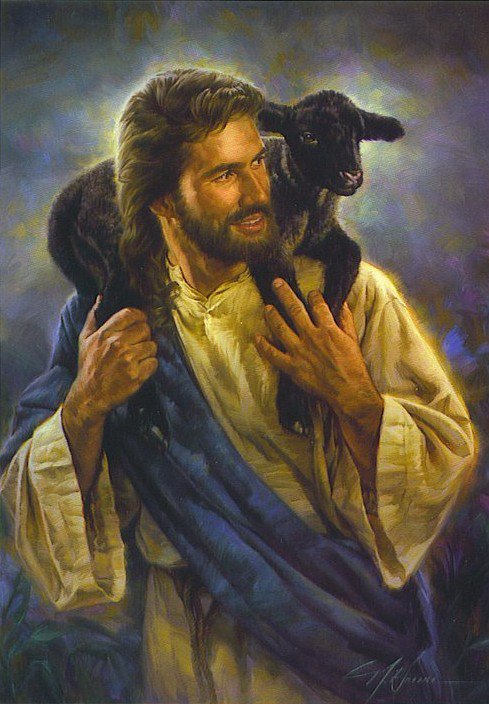
Every time I read those words from the Gospel of John, I am transported back to our first tour in Jordan, sitting outside our little villa near fourth circle, watching the shepherd and the sheep go by. Dusk is falling, you can hear multiple calls to prayer issuing from nearby mosques, and the shepherd is crossing back to their night time pastures.
But there is a ditch, a deep ditch, for new sewer and water lines, and there is only a thin board by which to cross.
One by one, he carries the sheep across. It takes a long time. The sheep are restless, but with a few words, he calms them. They don’t stray, they wait for him to lift and carry them across. Once across, they wait for the rest to follow before they all head on their way. The shepherd is grimy and dusty, covered with mud from ferrying the sheep across the ditch.
The sheep know the shepherd’s voice, and when faced with a new threat, they trust that he will deliver them safely. Sheep are pretty stupid. On their own, they can get into all kinds of trouble. If they have a good shepherd, they are safe.
This is today’s Gospel reading from John:
John 10:1-18
10‘Very truly, I tell you, anyone who does not enter the sheepfold by the gate but climbs in by another way is a thief and a bandit. 2The one who enters by the gate is the shepherd of the sheep. 3The gatekeeper opens the gate for him, and the sheep hear his voice. He calls his own sheep by name and leads them out. 4When he has brought out all his own, he goes ahead of them, and the sheep follow him because they know his voice. 5They will not follow a stranger, but they will run from him because they do not know the voice of strangers.’ 6Jesus used this figure of speech with them, but they did not understand what he was saying to them.
7 So again Jesus said to them, ‘Very truly, I tell you, I am the gate for the sheep. 8All who came before me are thieves and bandits; but the sheep did not listen to them. 9I am the gate. Whoever enters by me will be saved, and will come in and go out and find pasture. 10The thief comes only to steal and kill and destroy. I came that they may have life, and have it abundantly.
11 ‘I am the good shepherd. The good shepherd lays down his life for the sheep. 12The hired hand, who is not the shepherd and does not own the sheep, sees the wolf coming and leaves the sheep and runs away—and the wolf snatches them and scatters them. 13The hired hand runs away because a hired hand does not care for the sheep. 14I am the good shepherd. I know my own and my own know me, 15just as the Father knows me and I know the Father. And I lay down my life for the sheep. 16I have other sheep that do not belong to this fold. I must bring them also, and they will listen to my voice. So there will be one flock, one shepherd. 17For this reason the Father loves me, because I lay down my life in order to take it up again. 18No one takes* it from me, but I lay it down of my own accord. I have power to lay it down, and I have power to take it up again. I have received this command from my Father.’
Ten Shot While Kuwaiti Youngsters Are ‘Just Having Fun’
As AdventureMan and I read the Pensacola News Journal, we often wonder if we knew what we were getting into. Shootings in Pensacola are frequent. Killings, by gun, by beating, by knife – are equally frequent. Pensacola has one of the highest violent death rates per capita in the nation. Just this week a 72 year old man shot a preacher at his church because he thought the preacher was having an affair with his 69 year old wife. He then tried to enter the child care center where she was caring for small children, still with his loaded weapon. The paper quotes his wife as saying he has mental health issues.
What are people with mental health issues doing with loaded guns???
My Southern friends ask me if we more strictly regulate guns, how will they protect themselves, that the ‘bad guys’ will still have guns. Right now, they can protect themselves, they also have the right to shoot to defend their property? I can’t answer. All I know for sure is that the more people who carry guns, the more likely guns are to be used when the instinct strikes, whether it is a real threat or a perceived threat.
And then – there are these Kuwaiti teens, shooting passers-by, and when arrested, still carrying the shotgun used, say that they were ‘just having fun.’
KUWAIT: Jahra detectives, in cooperation with criminal investigation detectives, have arrested two Kuwaiti 17-year-old juveniles on charges of misuse of a hunting gun, which resulted in the shooting and wounding of 10 people in Jahra area. Police received several reports of pedestrians being wounded after they were shot by unknown assailants. Following an investigation, the juveniles were arrested with the gun still in their possession. They confessed to the shootings, claiming they were only having a good time. The teens were sent to concerned authorities. Later, Ministry of Interior officials called upon citizens and expatriates to watch their children and prevent them from behaving in ways that might cause harm to others, as the parents could be held liable for their children’s acts.
By Hanan Al-Saadoun, Staff Writer
Kuwait Times
The link refers to ‘hunting gun misuse.’ Because they are Kuwaiti, and because they are young, they are unlikely to have any severe punishment. They are likely to be released into the custody of their parents. Where were these parents when their children wounded ten innocent people? What lesson do these young men, 17 years old, learn if they can shoot ten people and be charged with ‘misuse’ of a weapon?
The only good thing I can think of in this case is that these youngsters had so little self-discipline that they never learned to shoot straight, thus no one was killed. They weren’t just lacking in any compassion for their fellow human beings, they were also bad shots. (I’m from a hunting culture. That’s an insult.)
Recent Comments
intlxpatr on Shampoo Ginger tigerbutterya0c5ff1d… on Shampoo Ginger intlxpatr on British Soldier Kidnapped, Esc… John on British Soldier Kidnapped, Esc… intlxpatr on British Soldier Kidnapped, Esc… Wikipedia Donate Button

Amazina


Early Voting in Florida


 Here There and Everywhere