Amitav Ghosh and River of Smoke

The National Public Radio website recommended this book as one of the best historical fiction reads, and I had never heard of it, so I ordered it. I ordered it in spite of the little voice I had in my head reminding me that this was the second in a trilogy, that the first is Sea of Poppies. I was too eager. I wanted to jump right in, and the review said it could be read stand-alone. I had read Ghosh’s Glass Palace a couple years ago for book club, loved it, and was eager to read this one.
With a raging cold and no possible way I can be around humanity, it was a good time to start. Just picking up the book, it has a dense feel. Once you start, it is like being suddenly in a whirlpool, drowning in new words, characters who have more than one name and more than one identity, whirling between England, Mauritius, Hindustan, Gujerat, Hong Kong, Macau and China, whirling between cultures and professions and trades, but oh, what a ride.

It would have been helpful to be reading River of Smoke on an iPad, where I could poke at a new word and it would give me the meaning, but in truth, you can guess a lot of the meaning of the vocabulary from the context. The seafarers all speak a language sort of like Jack Sparrow, a pidgen language filled with simplified grammar and with words from many nations and cultures. It forces you to slow down. It’s worth it. It would also be nice if you could poke on a place-name and have Google Earth show you where it is. There used to be a website called Google Books, and you could put in a book and it would show you the places in which actions in the book took place; that would be particularly handy reading this book, provide context in place-relations.
But reading slowly is it’s own reward. This book has depth, depth of character, depth of textures and senses, and depth of morality. I love a book like this where you can smell the smoke drifting over the water, where you can smell the sewer and bloated animal corpses floating outside the foreign hongs of the Canton traders, you can feel the textures of the textiles and see their colors, you can taste the exquisiteness of Macau cuisine and you can hike in a Hong Kong not yet settled by anyone, Chinese or foreign.
The scope of time covered by the major part of the story is short, although there are years of back-stories for several characters. The period is 1837-8, during which the Chinese Emperor decides to put teeth in the long established edict against opium trade to China. The edict had been in place, but not enforced, and China watched her citizens sink into opium addiction and lowered productivity. The traders were making fortunes – shiploads of money. Opium was grown in India and shipped from there to China.
When the ban against shipping opium into China is announced, many traders believe it is just another attempt to attain greater bribes on the part of the mandarins, and decline to obey. There is great debate, and while it is lively in the book, it is based on documents from that era, many of the arguments word for word. Traders stood to loose a great deal of money, in truth, it would ruin most of them to lose their shipments.
There is a side story I also like, that of the botanical trade between China and England, and the importation of many of the garden plants we take for granted today, which were unknown until sent from China. Camellia – one of which is the plant for tea, did you know that? Roses, azaleas, orchids – many many familiar plants would be missing from our gardens were it not for their introduction during this period.
Ghosh gives us disparate characters of many cultures and upbringings, and slowly weaves them together, each one tangential to all the others, some closely interwoven. It is a fascinating read, and I can’t wait for the next volume. I may have to go back and read Sea of Poppies while I am waiting.
Obama and US Politics Today
LOL! This week’s New Yorker Magazine cover:

Online at the New Yorker you will also find this hilarious article by Andy Borowitz:
JANUARY 15, 2013
REPUBLICANS ACCUSE OBAMA OF USING POSITION AS PRESIDENT TO LEAD COUNTRY
POSTED BY ANDY BOROWITZ
Read more: http://www.newyorker.com/online/blogs/borowitzreport/2013/01/republicans-accuse-obama-of-using-position-as-president-to-lead-country.html#ixzz2IRa0GZf7
WASHINGTON (The Borowitz Report)—Responding to reports that President Obama is considering signing as many as nineteen executive orders on gun control, Republicans in Congress unleashed a blistering attack on him today, accusing Mr. Obama of “cynically and systematically using his position as President to lead the country.”
Spearheading the offensive was Rep. Steve Stockman (R-Texas), who charged the President with the “wanton exploitation of powers that are legally granted to him under the U.S. Constitution.”
Calling him the “Law Professor-in-Chief,” Rep. Stockman accused Mr. Obama of “manipulating a little-known section of the Constitution,” Article II, which outlines the power of the President.
“President Obama looks down the list of all of the powers that are legally his and he’s like a kid in a candy store,” Rep. Stockman said. “It’s nauseating.”
The Texas congressman said that if Mr. Obama persists in executing the office of the Presidency as defined by the Constitution, he could face “impeachment and/or deportation.”
Noting that the President has not yet signed the executive orders on gun control, Rep. Stockman said that he hoped his stern words would serve as a wake-up call to Mr. Obama: “Mr. President, there’s still time for you to get in line. But if you continue to fulfill the duties of President of the United States that are expressly permitted in the Constitution, you are playing with fire.”
Satanists Plan Rally For Rick Scott
Don’tcha just love Florida? You elect a governor who barely escapes conviction of multiple counts of fraud against the government, who slashes funds to education and environment, and states Florida will not participate in Obamacare (he’s had to back off that one), and now, he is backed by Satanists, LLLOOLLLL! Found this article on AOL/Huffpost:
Florida Governor Rick Scott, who suffers dismal approval ratings, has at least garnered favor with one unlikely group — Satanists.
On January 25, the members of the Satanic Temple will gather on the steps of Scott’s office in Tallahassee as a show of solidarity with the Governor, whom they believe “has shown unwavering fortitude and progressive resolve in his defense of religious liberty,” according to a press release.
Specifically, they’re referring to Scott’s recent approval of Senate Bill 98 that permits school districts to allow students to read inspirational messages of their choosing at assemblies and sporting events. It went into effect on July 12.
“The Satanic Temple embraces the free expression of religion, and Satanists are happy to show their support of Rick Scott who — particularly with SB 98 — has reaffirmed our American freedom to practice our faith openly, allowing our Satanic children the freedom to pray in school,” the release continues.
The bill dictates that school officials are not permitted to mediate, approve, or participate in these “inspirational messages,” which expand upon the two minutes of silence for quiet prayer or mediation previously observed in Florida public schools.
Although the word “prayer” was axed from early drafts of the bill, the legislation was largely seen as a way to sneak religion back into schools.
Backers of the bill, who likely didn’t have the Satanic Temple in mind, might be surprised at the group’s tenets, which include a dedication to American patriotism, the golden rule, compassion, as well as family values, according to their web site.
The groups states that while they support separation of church and state in that it protects freedom of religion, they also note that “secular authority devoid of religious guidance is an abomination, and secular authorities should not be inhibited from receiving religious guidance regarding issues of serious moral and society-wide spiritual import.”
So where does Satan come in? The temple believes he is “God’s proxy” on Earth and represents the central role of knowledge and wisdom in life.
“Satan was the force of design that urged humanity toward refined pleasures of the Arts and Sciences,” according the web site. “It was He who first brought the fruit of knowledge to Humankind that thereafter we might live not as naked brutes in the wild, but develop our cultural splendor into ever more aesthetically and technologically advanced heights.”
Their gathering in Tallahassee will be a “satanic coming out,” temple spokesperson Lucien Greaves told the Miami Helard’s Naked Politics blog. “This is not a hoax. This is for real.” More than 100 members are expected to attend the 1 p.m. rally.
WOW! New YMCA For Pensacola in Maritime Park?
Fresh from the Pensacola News Journal Page:
Wow. Wow. Wow.
A $5 million pledge by Quint and Rishy Studer has kick-started a drive to build a new downtown Pensacola YMCA on a waterfront site at Community Maritime Park.
Studer said this afternoon he is interested in seeing a new YMCA downtown because of the positive impact it can have on children and adults, on community health and on residential development in the downtown area.
Studer said his pledge is contingent on the YMCA being located on a waterfront site at the southwest corner of the park, and that the project move forward at a rapid pace.
“We told them (the YMCA board) if they are serious, this has to move quickly,” Studer said. “Emotionally, Rishy and I can’t take another long, drawn-out things like with the stadium. We can’t take getting beat up again.”
Studer said the YMCA project, tentatively estimated at about $10 million, would be an excellent fit for the Maritime Park.
“There is a vacant piece of property there and either there’s going to be nothing on it, or a private developer will build something, or there can be a YMCA there.”
Brian Hooper, chair of Mayor Ashton Hayward’s Urban Development Advisory Committee, said a new YMCA in the downtown area was a key recommendation of the report released last month.
“One of the most common suggestions we heard from the public was the strong desire to see a family-oriented community center downtown,” Hooper said. “As our final report recommended, a new YMCA in downtown Pensacola would provide those who live and work in the community with a centrally-located hub for recreation, wellness, learning, and community. And I’m excited to see that many of our recommendations — such as this one — are already being acted upon.”
In addition to Studer’s pledge, community benefactor Terri Levin said she is co-chairing the YMCA fundraising committee.
Levin also said she will be making a dollar pledge to the project but has not yet decided the amount.
Pensacola developer Eric Nickelsen and real estate developer Joe Buehler are co-chairing the steering committee.
Nickelsen said the 10-person, all-volunteer YMCA steering committee, which includes former Mayor Mike Wiggins and former Pensacola City Councilman Ron Townsend, is meeting later this month to recommend a site to the Y’s board of directors. It’s
expected the recommended site will be the CMPA’s waterfront parcel.
Nickelsen said the YMCA project is in the early stages of development, but has considerable momentum.
“Apparently there is good feeling among our committee members that we can be successful in our fund raising campaign,” Nickelsen said.
Pecans From Texas – Such Generosity!
When I was living in Kuwait, and my son married, one of my new daughter-in-law’s aunts sent me pecans from Texas. She didn’t just send me a pound or two, she sent like 15 pounds of pecans! It was a wondrous gift, and oh, we had pecan muffins, pecan date pies, pecans in everything. Pecans in Kuwait cost dear, you can’t imagine, and these pecans were TASTY, so so good. She tells me it is because they are from Texas, where everything tastes better. 😉

At Thanksgiving, she gave me a HUGE bag of pecan meats.
“I want you to have pecans from TEXAS!” she told me. Her car was packed with sweet gifts for all her nieces and nephews and all the little ones related to her in any remote way. It’s just the way she is. She can’t help it, she is wired to be loving and generous.
AR, I am so thankful you are in my life! I am enjoying every cup of pecans I use, and although I have used a lot, there are so many pecans left it is like I haven’t used any! You are so generous, and I am enjoying your pecans so much! All of Pensacola is enjoying your pecans!
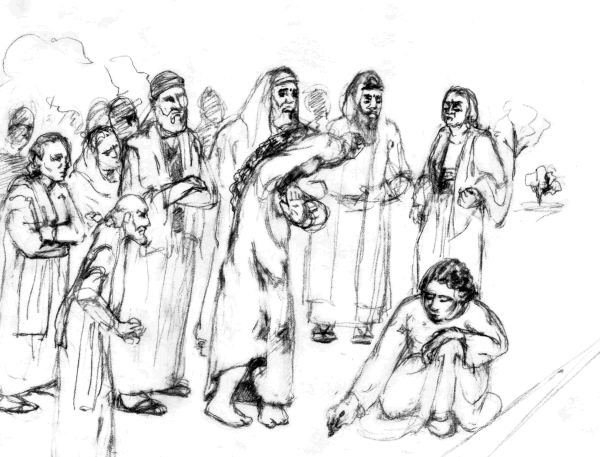
Jesus and the Woman to be Stoned for Adultery
I’ve always loved this passage, along with the woman at the well, and the woman who touched the hem of his garment to be healed from a bleeding disease – Jesus was kind to women, in a time and culture where a pious man would not speak to a woman.
Hilary Mantel captures the stunning experience in Eight Months on Ghazzah Street, where she asks a man at a counter for an item and he looks right past her. She repeats her request and he acts as if she isn’t there. Her husband walks up, asks, and receives an answer. Cultural biases most often do not favor women. In this regard, Jesus – and the prophet Mohammed – changed everything, and treated women as equal people. It’s amazing to me how many of the Jesus anecdotes featuring females survived; it must have been astonishing in his time to treat females – property – with such compassion and humanity.
Footnote to this passage from The Lectionary: The most ancient authorities lack 7.53—8.11; other authorities add the passage here or after 7.36 or after 21.25 or after Luke 21.38, with variations of text; some mark the passage as doubtful.
John 7:53-8:11
53Then each of them went home, 81while Jesus went to the Mount of Olives. 2Early in the morning he came again to the temple. All the people came to him and he sat down and began to teach them. 3The scribes and the Pharisees brought a woman who had been caught in adultery; and making her stand before all of them, 4they said to him, ‘Teacher, this woman was caught in the very act of committing adultery. 5Now in the law Moses commanded us to stone such women. Now what do you say?’ 6They said this to test him, so that they might have some charge to bring against him. Jesus bent down and wrote with his finger on the ground. 7When they kept on questioning him, he straightened up and said to them, ‘Let anyone among you who is without sin be the first to throw a stone at her.’ 8And once again he bent down and wrote on the ground.* 9When they heard it, they went away, one by one, beginning with the elders; and Jesus was left alone with the woman standing before him. 10Jesus straightened up and said to her, ‘Woman, where are they? Has no one condemned you?’ 11She said, ‘No one, sir.’* And Jesus said, ‘Neither do I condemn you. Go your way, and from now on do not sin again.’]]*
Pensacola Christmas Parade 2012
A perfect evening. Got there minutes before the one mile runners came by, parking at our church and walking to our favorite spot, meeting up with our son, his wife, and the adorable little boy who truly gets everything that is happening. This is his third parade; he always loved the lights and loud noises, but this year, he GETS it, gets the floats and the bands and the BEADS!
“I love this tradition,” my daughter-in-law says, leaning over to kiss me as we meet up to watch the parade and do a little-boy-transfer. He is coming to spend the night with us. He has his own room in our house.
ZOOOOOMMMMM! the motorcycle police accompany the runners, EEERRRRRRRROOOOOOOOOWWWWWWWW the fire engine, all lights and noise comes by at the beginning of the parade, and then a high school band from New Orleans with a killer beat leads the parade. Wooooo HOOOOOOOO, shouts Intlxpatr, totally into another cultural experience. 🙂
One of the optical shops had running eyeballs, totally hilarious!


“Beads! Beads!”

This float was giving out Chobani yoghurt

“Beads! Beads! More beads!” People taller than I were catching beads – and then passing them on to the little children. So kind, so generous.


My favorite, of course, a pirate ship:
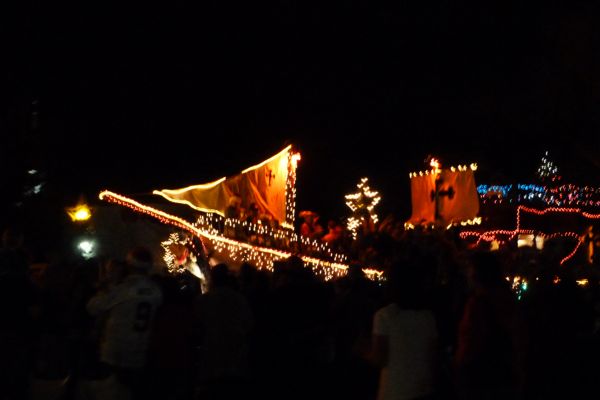
This parade is great fun. Here is a thing I love about Pensacola. About 50,000 people attend. Many walk from nearby neighborhoods, others drive down and park – there is still plenty of parking in Pensacola. People gather peacefully. There is no fighting over great spots; there are a lot of great spots from which you can watch the parade. At the end of the parade, everyone disperses peacefully – no fighting. In fifteen – twenty minutes the crowd is GONE, 50,000 people gone home, peacefully. It is a great community, all walks of life, all having a great time watching this home town Christmas parade.
Early this morning, the morning after, we started a new tradition – we got a long stick with a hook, and went after some of the beads stuck up in the trees. AdventureMan and Q got started while I went to church, meeting up with some experts who gave them tips – and beads. Such is the kindness of strangers, and the brotherhood of bead chasers. 🙂

John of Damascus
This morning, as I read my Lectionary readings, I noticed I had skipped the Saint yesterday (I was trying to get a lot done) and it was John of Damascus. Checking the blog, I can see I printed this several years ago – 6 years! – but because it was new to me all over again, I am printing it again for you.
It is fascinating to me. John of Damascus defended the use of icons in worship. He distinguished between using an icon as an aide, and worshipping an icon. He was defended by his powerful position with a khalif, a Moslem who believes that images are forbidden. And we think WE live in interesting times . . . 🙂
JOHN OF DAMASCUS
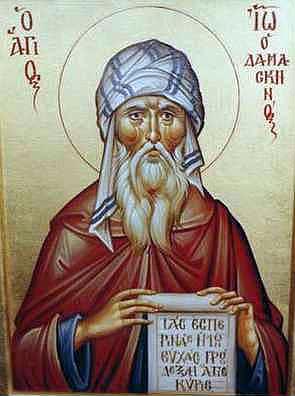
(I love this photo because he is wearing a gutra 🙂 )
HYMN-WRITER, DEFENDER OF ICONS (4 DEC 750)
John is generally accounted “the last of the Fathers”. He was the son of a Christian official at the court of the moslem khalif Abdul Malek, and succeeded to his father’s office.
In his time there was a dispute among Christians between the Iconoclasts (image-breakers) and the Iconodules (image-venerators or image-respectors). The Emperor, Leo III, was a vigorous upholder of the Iconoclast position. John wrote in favor of the Iconodules with great effectiveness. Ironically, he was able to do this chiefly because he had the protection of the moslem khalif (ironic because the moslems have a strong prohibition against the religious use of pictures or images).
John is also known as a hymn-writer. Two of his hymns are sung in English at Easter (“Come ye faithful, raise the strain” and “The Day of Resurrection! Earth, tell it out abroad!”). Many more are sung in the Eastern Church.
His major writing is The Fount of Knowledge, of which the third part, The Orthodox Faith, is a summary of Christian doctrine as expounded by the Greek Fathers.
The dispute about icons was not a dispute between East and West as such. Both the Greek and the Latin churches accepted the final decision.
The Iconoclasts maintained that the use of religious images was a violation of the Second Commandment (“Thou shalt not make a graven image… thou shalt not bow down to them”).
The Iconodules replied that the coming of Christ had radically changed the situation, and that the commandment must now be understood in a new way, just as the commandment to “Remember the Sabbath Day” must be understood in a new way since the Resurrection of Jesus on the first day of the week.
Before the Incarnation, it had indeed been improper to portray the invisible God in visible form; but God, by taking fleshly form in the person of Jesus Christ, had blessed the whole realm of matter and made it a fit instrument for manifesting the Divine Splendor. He had reclaimed everything in heaven and earth for His service, and had made water and oil, bread and wine, means of conveying His grace to men. He had made painting and sculpture and music and the spoken word, and indeed all our daily tasks and pleasures, the common round of everyday life, a means whereby man might glorify God and be made aware of Him. (NOTE: I always use “man” in the gender-inclusive sense unless the context plainly indicates otherwise.)
Obviously, the use of images and pictures in a religious context is open to abuse, and in the sixteenth century abuses had become so prevalent that some (not all) of the early Protestants reacted by denouncing the use of images altogether. Many years ago, I heard a sermon in my home parish (All Saints’ Church, East Lansing, Michigan) on the Commandment, “Thou shalt not make a graven image, nor the likeness of anything in the heavens above, nor in the earth beneath, nor in the waters under the earth — thou shalt not bow down to them, nor worship them.” (Exodus 20:4-5 and Deuteronomy 5:8-9) The preacher (Gordon Jones) pointed out that, even if we refrain completely from the use of statues and paintings in representing God, we will certainly use mental or verbal images, will think of God in terms of concepts that the human mind can grasp, since the alternative is not to think of Him at all.
(Here I digress to note that, if we reject the images offered in Holy Scripture of God as Father, Shepherd, King, Judge, on the grounds that they are not literally accurate, we will end up substituting other images — an endless, silent sea, a dome of white radiance, an infinitely attenuated ether permeating all space, an electromagnetic force field, or whatever, which is no more literally true than the image it replaces, and which leaves out the truths that the Scriptural images convey. (One of the best books I know on this subject is Edwyn Bevan’s Symbolism and Belief, Beacon Press, originally a Gifford Lectures series.[note – now out of print])
C S Lewis repeats what a woman of his acquaintance told him: that as a child she was taught to think of God as an infinite “perfect substance,” with the result that for years she envisioned Him as a kind of enormous tapioca pudding. To make matters worse, she disliked tapioca. Back to the sermon.) The sin of idolatry consists of giving to the image the devotion that properly belongs to God. No educated man today is in danger of confusing God with a painting or statue, but we may give to a particular concept of God the unconditional allegiance that properly belongs to God Himself. This does not, of course, mean that one concept of God is as good as another, or that it may not be our duty to reject something said about God as simply false. Images, concepts, of God matter, because it matters how we think about God. The danger is one of intellectual pride, of forgetting that the Good News is, not that we know God, but that He knows us (1 Corinthians 8:3), not that we love Him, but that He loves us (1 John 4:10).
(Incidentally, it was customary in my parish in those days for the preacher to preach a short “Children’s Sermon,” after which the children were dismissed for Sunday School, and the regular sermon and the rest of the service followed. What I have described above was the Children’s Sermon. I remained for the regular sermon, but found it a bit over my head — a salutary correction to my intellectual snobbery.)
In the East Orthodox tradition, three-dimensional representations are seldom used. The standard icon is a painting, highly stylized, and thought of as a window through which the worshipper is looking into Heaven. (Hence, the background of the picture is almost always gold leaf.) In an Eastern church, an iconostasis (icon screen) flanks the altar on each side, with images of angels and saints (including Old Testament persons) as a sign that the whole church in Heaven and earth is one body in Christ, and unites in one voice of praise and thanksgiving in the Holy Liturgy.
At one point in the service, the minister takes a censer and goes to each icon in turn, bows and swings the censer at the icon. He then does the same thing to the congregation — ideally, if time permits, to each worshipper separately, as a sign that every Christian is an icon, made in the image and likeness of God, an organ in the body of Christ, a window through whom the splendor of Heaven shines forth.
My prayer for us all for today is that we may each be that window through which the splendor of Heaven shines forth.
The Power of Kindness to Change Lives
This week AdventureMan and I have been blessed, greatly blessed. We have met some wonderful people and heard some amazing things. Two stories in particular have shaken the earth for me.
“How It Happened for Me”
The first story is about a friend we met from the newest country on earth, South Sudan. A group of us were sitting together when one woman turned to this man from the South Sudan and asked “How did you find Jesus?”
This was not a religious gathering, so it is an unusual question on a social evening. But this quiet, modest man responded “I will tell you. It is a long story. It starts when I was only five months, not a baby, five months in my mother’s womb.”
He told us of a life with no security. His parents and family fled to the forest, and were on the run continually most of his life – until recently. He told of a life trying to find safe places, sometimes being separated from his parents.

He told of a priest who, when he and his brothers and sisters were very young, taught them to say “God bless Mother and God bless Father and God bless my brothers and sisters and watch over us always.” He was kind to the children, and taught them that God loves them, that God is kind. He said they did not know who this God was, but he and his brothers and sisters said this prayer every night, to keep his family safe. He said they learned other simple prayers. There would be rare times when someone would teach them a letter, or some numbers, drawing in the sand, or the floor of the forest, simple, quick lessons.
“So I don’t know all the stories you do,” he said. “I don’t even know the bible very well, we never had educated priests, just simple men who taught us simple prayers. Only later did we become more educated.”
As we listened, we had huge lumps in our throats. I could hear Jesus’ voice saying that we must believe as little children, and this man had the pure simple faith of a child, a memory from his earliest years, as he prayed for his family to be safe in a world where life was continual chaos and a struggle to survive.
“When I understood about God,” he went on, “there wasn’t even a church or a pastor-man who could baptize me; I had to believe for many years before I could become a Christian.”
As a footnote, he told us that somehow, most of his village managed to survive, helping one another. His entire family made it through, his parents are still alive. The village children little by little gained education, becoming doctors, lawyers, professionals of all kinds. His village now has a church, a simple church, not always staffed, but a church. The war is ended. For him, the simplicity of peace is all he ever wanted.
We will never forget his, and his story. We have met an extraordinary human being.
Today, we went to a lunch, invited by a friend, to raise funds for public education. LOL, this is what I used to do; I worked for an education foundation and raised money for public education. I love this kind of thing. I knew just what to expect – lots of success stories, stellar achievements, and a gentle pitch.
Whoa! Wrong! Darling kids – check. Recognition of important guests – check. Gentle pitch – no way! They got right to business; you will see this form, please take your pens RIGHT NOW and fill it out and give what you can, education funds seem to get cut more every year and we are trying to do more with less and less. Give NOW. CHECK!
The final speaker was a local businessman and patron-of-just-about-everything, a man who also brought baseball to Pensacola. He talked about his own public education. He talked about his speech impediment, and his deafness, he talked about his short stature and his inability to sit still and concentrate. He talked about teachers who identified him and instead of treating him as an obstacle, made him believe they were glad to have him in their class. He talked about teachers who gave him special assignments, who taught him math by having him calculate baseball averages. He knew their names, these saints who kept him in school, no matter how discouraged he might be.
He graduated with a 1.9 grade point, and had no intention of going to college, but ended up astonishing everyone by doing well on the ACT test and having a guidance counselor who found him just exactly the right environment where he could flourish on the college level.
Important people usually enjoy telling you the great things they have done. This man focused on his disabilities, his humiliations and his weaknesses, and how the kindness of educators had pulled him out of a very dark place and set him on the road for the success he is today.
I am willing to bet that the education foundation gained a lot of donors today. We were caught by surprise. We can defend against the powerful and successful, but when the heart speaks from vulnerability and failure, our hearts respond. This man is a success, but he gives credit to those who looked at him with caring eyes, with caring hearts, who lifted him and helped him on his way to the incredible (wealthy) success he is today, with a flourishing business and innumerable local charities who are grateful for his support.
What a week! And it’s only Tuesday! I wonder what the rest of the week will bring?
Recent Comments
intlxpatr on Shampoo Ginger tigerbutterya0c5ff1d… on Shampoo Ginger intlxpatr on British Soldier Kidnapped, Esc… John on British Soldier Kidnapped, Esc… intlxpatr on British Soldier Kidnapped, Esc… Wikipedia Donate Button

Amazina


Early Voting in Florida


 Here There and Everywhere