Operation Blue Shepherd
I was shocked to hear about this operation on National Public Radio this afternoon, and to know it was Pensacola. What got my attention was one of the police officers saying that they were shocked to capture so many local people; they had expected to attract predators from surrounding states, but not so many locals. Truly sad.
And kudos to all the men in blue and officers of the court who are putting away these people who would prey on children, taking them off the game board.
You can read the entire article yourself at the Pensacola News Journal:
25 men accused of setting up child sex encounters in Pensacola sting
Twenty-five men were arrested this month in Pensacola during a weeklong undercover operation in which suspects are accused of using the Internet to set up sexual encounters with children. The suspects came to meet the minors at a home in northeast Pensacola only to find a slew of law enforcement officials waiting for them.
The sting, called Operation Blue Shepherd, began June 20 with 30 officers from local, state and federal agencies participating, according to a Pensacola Police Department press release. The results were announced at a news conference this morning at PPD.
Pensacola Police Capt. Paul Kelly said officers used various social networking and E-commerce sites to respond to advertisements of a sexual nature and to place similar advertisements.
The suspects specifically described various sexual acts they were going to do with the male and female children, ages 12 to 14, with whom they believed they were talking. All of the suspects, except one who took a taxi, drove to the undercover house with the intent to perform these sexual acts with the children. Upon arrival, they were arrested and questioned.
Kelly said officers were surprised to find so many eager participants from the immediate Pensacola area.
“We expected to have more violators traveling from outside the area. What this tells me is that these violators do not have to travel far to find their victims. They are much closer to home than we imagined. Most of them were not reluctant or frightened to approach the door of a stranger’s house. They literally pulled up to the house and walked quickly to the door eager to meet the child,” Kelly said.
Agencies participating in Operation Blue Shepherd were the State Attorney’s Office, Florida Department of Law Enforcement, Immigration and Customs Enforcement , Naval Criminal Investigative Service, Escambia County Sheriff’s Office, Santa Rosa County Sheriff’s Office, Okaloosa County Sheriff’s Office, Walton County Sheriff’s Office, Alachua County Sheriff’s Office, Gainesville Police Department, Fort Walton Beach Police Department, Tallahassee Police Department and the Federal Bureau of Investigation.
Adaobi Tricia Nwaubani: I Do Not Come to You by Chance
This book, the first novel from Adaobi Tricia Nwaubani, is hilarious, with moments of pathos, and a fresh point of view.
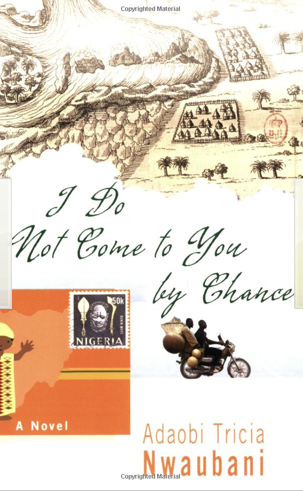
Amazon.com recommended it to me as I was busy buying books by author Chimamanda Ngozi Adichie; I thought ‘OK, I’ll read a series of Nigerian books as part of my summer reading.
Young Kingsley Ibe is the family’s first born male, and with that status goes many privileges – and responsibilities. After graduating with a Masters in Chemical Engineering, he has no success in his search for a job with an oil company in Nigeria, and consequently loses the love of his life, Ola, to another who has secure employment.
Worse, his retired father has a stroke, and the family discovers that with all the fees required, they haven’t enough for his continued care, so Kingsley must approach his uncle, Boniface Mbamalu, more familiarly known as Cash Daddy, for funds to transfer his father to a long term care facility, and, later, for his father’s funeral.
Serious Kingsley’s eyes nearly pop as he sees the life his uncle is living, cars, women, designer watches, shoes, suits and all the trappings of new wealth. Soon, his uncle makes a convincing case for Kingsley coming to work for him, the better to help out his family of mother, brothers and sister, now that he is the senior male in the family.
Kingsley discovers he has a gift for the work – which is writing 419s, those scam letters which I frequently publish in this column. I loved being on the inside, learning how strong possibility e-mail addresses are netted, how response e-mails are massaged – not unlike fund raising techniques by charitable organizations in the US. Kingsley’s education helps him achieve enormous financial success in a very short time – but he finds that all the cash and designer goods in the word do not solve his problems nor make him happy.
I learned a lot about how successful many of these scammers are, and how the money made is spread throughout the Nigerian communities. The author takes a balanced view, balancing the way the cash makes life easier for people – a lot of people, because the rich man has many obligations to his community, balanced against the disgust, and sick fear felt by his religious mother and aunt, and his one time girlfriend, when they learn the work he is doing. They are disappointed that a man of such promise has sunk to making so much money in a dishonest way. The book also does not deal sympathetically with those who have given or lost money to the scammers, nor, in my opinion, does the ending satisfy.
This is one of the funniest parts of the book – a group of Nigerian scammers is about to meet with a representative of a major US investment firm. He thinks he will be meeting with the Nigerian Minister of Transportation to discuss building a new airport; the reality is that Cash Daddy, in disguise, will be pretending to be the minister. Kingsley protests that Cash Daddy looks nothing like the minister, and Cash Daddy responds:
“Let me tell you something . . . Me, I really like these oyibo people. They’re very very nice people. See how they came and showed us that the ground where we’ve been dancing Atilogwu has crude oil under it. If not for them, we might never have found out. But Kings,” he dragged in his dangling foot and sat up in the tub, “white man doesn’t understand black man’s face. Do you know tht I can give you my passport to travel with . . . Even if your nose is ten times bigger than my own, they won’t even notice?”
It was a fascinating book. I understand better now why 419 scams work. (419 is the section of the Nigerian criminal code making scam e-mails a crime; thus the crime is called ‘a 419’) There are some very funny and very insightful moments in the book. It is no where near the level of literature that you experience with Chimamanda Ngozi Adichie, but there is more humor, and the book shows a more modern day Nigeria. Not a bad summer read, but not great literature.
Chimamanda Ngozi Adichie: The Thing Around Your Neck

Chimamanda Ngozi Adichie has compiled a series of elegant vignettes in her most recent book, The Thing Around Your Neck. I had just read Half of a Yellow Sun, and was still wallowing in stunned admiration, when I heard an interview with the author on BBC, and learned she had written this book, The Thing Around Your Neck.
I loved Half of a Yellow Sun. I loved Purple Hibiscus. I felt I began to understand just a little bit about life in transitional Nigeria, with all the social and political forces blowing to and fro, straining the very fabric of nationhood.
In The Thing Around Your Neck, something else happens. It shares with Cutting for Stone and other books I like the impressions of those who come to live in the USA for the first time.
“Would that the wee wee giftie gi’e us, To see ourselves as others see us . . . ”
I’ve had a lot of experience going to live in foreign countries. One of the things I learned is that most of what I learn the first couple years isn’t much. You learn a lot of things wrong. You filter everything through your own cultural biases; you judge, you interpret, you try to make sense of things that just seem wrong.
I love to watch Chimamanda Ngozi Adichie’s characters do this in reverse, come to America and make judgements based on their own cultural expectations. I love to see us through these eyes.
Once, many many years ago, we entertained a Nigerian in our home, and when we served dinner, steaks, he looked at his plate and said “This would feed my family for a week.” We kind of laughed. We kind of thought he was exaggerating, or even kidding. We just didn’t know. We had never seen anyone truly hungry, we had always lived in this land of plenty. We had no idea what we didn’t know. We saw only what we knew.
Each story is a gem. Each treats the expat experience, coming here, or the reverse, coming to America and then going back and seeing Nigeria through eyes which have changed.
One story I had read before, in the New Yorker magazine and loved reading again, The Headstrong Historian. It starts with a smart woman, weaving her way among the ways of her people, whose husband’s family wants her husband to take another wife. He doesn’t want to. These two chose each other, and managed to live their lives together as best they could, by their own standards. Her son disappoints her, but her granddaughter – she sees her husband’s brave, courageous spirit in the eyes of her little grand daughter. You’ll have to read the story to find out the rest.
Other stories have to do with newlyweds, with students, with love and marriage and affairs – the full spectrum of human experience, through Nigerian expat eyes. There are settings common from all three books, the college campus at Nsukka, a prison outside of town, small villages outside the city. If you read all her books, you recognize place: “Aha! I’ve been her before, in Purple Hibiscus!” You learn how to bribe the guards so you can bring in food for your imprisoned family member, you learn to keep your eyes down to show respect, you learn how Nigeria smells when the rains come, and how dry and dusty it gets during the harmattan.
I’m just sorry there isn’t another book by this author – yet – that I can read!
I guess these books that I love deal with a theme dear to my heart – that we are culturally blind to so many things, and that as human beings we are more alike than we are different. Short of packing up all our lives and our assumptions and moving to many different countries, the best we can hope for in learning different ways of thinking is for books like these by Chimamanda Ngozi Adichie, which show us how differently we perceive things, depending on our cultures, and how alike we are in the things that we feel, as human beings.
Jeannette Walls: The Glass Castle

The Glass Castle was a hugely popular best seller in the USA, and it must have been while I was gone. A part of me remembers reading a little bit about it and deciding it wasn’t my kind of book, but after reading Half Broke Horses, I had forgotten what the subject matter was and was excited to have another Jeannette Walls book I could read.
Big mistake. This book is nothing like Half Broke Horses.
Or maybe it is. Maybe what I loved about Half Broke Horses was the voice of an amazing woman, and maybe what kept me reading The Glass Castle is the voice of an amazing child who tells a heart breaking story. Or maybe it isn’t so heartbreaking, because the children survive. They are scarred and damaged, but never so damaged or loony or self-deceived as their parents.
I don’t like reading books about kids whose parents don’t take good care of them. Oprah chose a lot of those books in her book club. These books depress me. I cannot imagine how parents can be so self-absorbed, how they can take on the responsibilities of children and then not put those children first. How can they?
The Glass Castle stars the daughter of Lily Casey Smith, who is the mother of Jeannette Walls, and her husband, who is Jeannette’s father. The book opens with little three year old Jeannette proudly cooking up a hot dog. Her mother is busy painting and has told her to find something to eat. Her nightgown catches fire, and she is terribly burned. She spends a long time in the hospital, which ends with her father taking her out in a hurry, bundling her into the car, already loaded with her family, and “doing the skedaddle” which is leaving town just in front of the bill collectors.
This is her life. From time to time, their alcoholic Dad will take a job and bring home some of the paycheck (he drinks and gambles most of it) and when he won’t work, on rare occasion, their mother will take a teaching job, but the kids have to get her out of bed in the morning, have to grade her papers and make her lesson plans. Often there is not enough for the family to eat. They don’t stay in one place; they ‘skedaddle’ before they are evicted for non-payment of rent. They eat cold food – when they eat – because the parents didn’t pay the electric bill.
The Dad is smart, charming and cajoling, and when he is sober, the kids learn amazing things from him, and educated engineer. Unfortunately, he is not often sober. He chases after alcohol and he chases after women; the people in the towns where they live know it and the children learn to know it, too, to their constant humiliation. When he wheedles money off his kids, and promises to repay, he asks “Have I ever let you down?” The answer is so stunningly obvious as to be heartbreaking – Yes. Yes, again and again and again.
The Mother is equally irresponsible. One time, when the family is starving, she is in bed and occasionally goes under the covers, where Jeannette discovers her mother has a chocolate bar hidden that she can eat – while her children go hungry.
The author’s voice is never self pitying, she just lays it all out and leaves us to draw our own conclusions. Each child escapes the family as soon as possible; the children plan and save their money to get out, first sending off the oldest sister, then Jeannette, then the son. They all head for New York, where they find work and support themselves. Like bad pennies, Mom and Dad show up in New York, cadge meals and money and join the ranks of the homeless in New York, going from food pantry to soup kitchen, and diving dumpsters for their worldly needs.
This is not a feel good novel. The good part about it is that children can survive this kind of criminal neglect, and become a successful author as Jeannette Walls has done. I am so glad I read Half Broke Horses first, because her grandmother is such an admirable character, whereas her parents are scum and I just felt so angry when I read the matter-of-fact descriptions of their behavior that I was glad they were not where I could get my hands on them.
I don’t know any parents as bad as Rose Mary and Rex Walls, but I know I believe this – if you choose to marry, and if you choose to have children, know that children require time, and love, and energy, and patience. Know that if you have grand ambitions, or an addiction, or a character flaw, you won’t be able to provide for your children’s physical, emotional and spiritual needs, unless you are willing to sacrifice your own needs and wants. While the children in the book loved their parents, they recognized that their parents were sadly lacking in the parenting roles. The way these children were neglected will make me remember this book for a long time.
Would I recommend it? Yes. It is a gripping book, at times even horrifyingly humorous, as when Jeannette figures out how to find lunch food in the garbage cans when all the other kids have finished eating. It is not a feel-good book. It is a horrifying indictment of self-absorbed, neglectful parents, parents you will love to hate.
If I sound a little overwrought, it’s because I worked with the homeless. We were able to help many, but I also ran into families like this family, families who would prefer not taking any help if it meant they had to play by the rules, you know, rules like “you have to take care of your children.” We had all kinds of classes and forums and mentors to help with learning skills, like feeding children well on a small budget, learning to discipline, simple skills, survival skills.
The problem is that these skills require self-discipline, and many of the parents would rather not take help than have to exercise self-discipline. I saw women who would sacrifice their children for their current boyfriend, a woman who was severely angry with her daughter for reporting a family member had molested her, a man who didn’t want to take a job that would ‘tie him down’ when his family was starving. I saw this, with my own eyes, and there is no way you can MAKE people take good care of their children. You have to ask if the children are better off with these parents, or ‘in the system.’ Not a pretty choice.
This book, too, is on Amazon.com. Reading it is like watching a disaster on CNN. You don’t want to believe it is happening and you can’t look away.
Jeannette Walls: Half Broke Horses
About a month ago, I picked this up off the stack of “Read Me’s” . . . ummm . . . errr . . . one of the stacks of “Read Me’s.” (If there is some sort of emoticon for mild embarrassment, insert it here; one of my fatal flaws is acquiring book I WANT to read and having more books than I have time to read.)

I think Amazon recommended Half Broke Horses to me, and I didn’t know why. They keep track of what I buy and make recommendations, which over the many years I have been using Amazon.com to buy books has become more and more relevant to the kinds of things I actually buy and read. So I bought Half Broke Horses, and another one recommended by the same author, then put them in the stack. It is only because I had read whatever I put on top of them that I ended up reading.
I casually started reading, without a lot of anticipation. The first chapter starts off in the early early days of our country, in the wilds of West Texas, as a girl and her younger brother and sister are out checking the cows, who suddenly go crazy, even jumping over fences which under almost every circumstance successfully pen them in. The young girl recognized something strange was going on and figured it was a flash flood coming, got her siblings up in the tree and keeps them awake all night, as the flood hits, hoping the tree will hold and not wash away.
What is your first thought, reading that? Mine was – Where are her parents?? No one is out searching for them?
The next day, the flood recedes enough for them to make their way home back to a primitive dwelling hollowed out in the high side of a riverbank, dirt floors, dirt crumbling down on them, dark, small, smokey. Yes, there is a mother and a father, and they love their children, but these are very different times. These are hard times, where there is no grocery store, no nearby doctor, where babies die and children have fatal accidents all the time. Life can be short and brutal. The kids have some schooling, mostly at home, they learn to read and write and add and subtract, so they can keep track of home related business. They also work hard, every child has work around the ranch that needs doing, and work comes first or the family won’t survive.
The heroine, Lily Casey Smith, is a real person, the grandmother of the author, Jeannette Walls. This is called a true-life novel. From all the stories she heard about her grandmother growing up, and from knowing her grandmother, and from all the legends about her grandmother she was able to verify, she built a skeleton, and then filled it in with conversations and even a few events that she had to imagine.
Lily Casey left her family at 15 to ride her horse 25 days across Texas to take a teaching job in a one-room schoolhouse. (My jaw dropped, too!) After several years of teaching, she goes to Chicago to become educated and licensed as a teacher, marries, annuls the marriage, returns home, finds a teaching job, races horses, marries again, has children, has a huge ranch, loses the huge ranch, manages a huge ranch . . . her story is bigger than life, but so is the person of her grandmother, who never falls apart, but looks life in the eye and copes with it. Better than coping, she dominates.
Her major opponents are tough economic times, and dramatic and devastating weather conditions. Rain can fail to fall for months, cattle can die in an unexpected cold snap. At the best of times, you have enough to eat and a roof over your head.
I never wanted the book to end, and, in a sense, it didn’t. Jeannette Walls big best seller, The Glass Castle, takes up with just a little overlap where Half Broke Horses leaves off.
Here is what I loved: I loved the voice of Lily Casey Smith. She’s the kind of woman I want for a friend. She’s smart. She has a sense of how things work in the world. She experiences tragedies, but she doesn’t let them hurt her self-confidence. She can be beaten, but she always gets up again. She’s a problem solver. She never once lets being a woman get in the way of being the person she was born to be. She overcomes. She doesn’t sugar coat; she tells it as she sees it. And you know you can count on what she says to be the truth as she believes it. I truly hated for this book to end.
You can find this book at Amazon.com used under a dollar to new hardcover around $15. It is worth every cent.
Listmaker
“Why are you smiling?” AdventureMan asked as he read the Sunday paper on our bed, the ceiling fan whirling madly to cool him down after his post-Church yard work – feeding the birds, shoveling up all the birdseed hulls, putting recycle materials into the compost bin.
I was doing something I do only rarely, changing purses. At the last minute, all in navy, I decided to do the navy purse instead of the tan. Now, back home, I was re-transfering all the important things, and checking pockets for stuff that accumulates and needs to be thrown away.
“I found a list,” I began. “It says:
fruit cake
kick board
book
peanut brittle
photos in frames
calendar
soap”
He laughed. “I know exactly what that was, “he remembered, “my Christmas box.”

More specifically, my tag on the outside of the box reminding me of what was inside when I had to affix a customs tag to send the box to hubby in Kuwait. These days, as I send boxes, I (mostly) no longer have to fiddle with customs tags or leaving the box open until I get to the post office so that customs officers can affirm what I included in the box. Every time I send a box, still, I think of those customs tags and give thanks not to have to do those irksome little steps.
I keep my lists now, in a folder marked, predictably,
-
To Do Lists
This one goes in there. On days when I feel bad about myself, or overwhelmed, I can look at my to-do lists and have a record that my time was not mis-spent. I can see all the little chores and fix-it projects we have finished, all the dinners we have done, house guests we have had . . . These little to-do lists keep track of the little things you do that take up so much time, and then at the end of the year, you ask yourself “where did the time go.” These help me know that I didn’t waste the time, I used the time, a little here, a little there, to bring order out of chaos in our daily existence, to brighten a life, maybe to help others, or to meet a goal I have already forgotten.
Some of the lists, like the moving lists, remind me of God’s gracious hand in helping me to do the things I’ve had to do, and could never have managed without his help. When I read some of them, I almost laugh out loud thinking “I did all that??”
It also reminds me how very happy I am to have AdventureMan back home with me, not far away at Christmas time. 🙂
A Year’s Supply of Kleenex from Kuwait and Mrm.
When we returned from our roadtrip to the Doha reunion and wedding in Pittsburgh, I found this waiting for me:

Yes. Yes. Yes, you see it correctly. A year’s supply of oud-scented Kleenex from Kuwait. I am guessing these are the ones sent by my friend Mrm . . . and oh, what a laugh it gave me. Mrm, it’s the little things that count, and it is your big-hearted generosity that matters, sending me FIFTEEN boxes of oud-scented Kleenex. I just can’t stop laughing, it is so extravagant and so sweet, and just exactly what I wanted. Mrm, I think this is your doing, and thank you.
I only met up with three bloggers, and Mrm and her friend were two of the three. It was an equally funny beginning, meeting up at the Starbucks in Fehaheel and each of us thinking we had been stood up because we were at different Starbucks. Soon after, they came to my eyrie in Fintas, and what great times we had from then. 🙂 I would have missed a whole layer of life in Kuwait had I not met up with Mrm, but – as those who know Mrm know – she has a way of getting what she wants, and making everyone around her glad at the same time. I had so much fun with you and Chirp, and I learned so much from you.
Thank you, Mrm. For everything. 🙂 I will think of you more than a thousand times as I use this Kleenex. Thank you. 🙂
A God of Infinite Mercy
This morning, Father Neal Goldsborough of Christ Church Pensacola gave a sermon that held us all totally spellbound. It had to do with the fundamentalist preacher who – once again – forecast the coming rapture, which he says was scheduled for yesterday. (I wonder what he has to say today? He was wrong once before, in 1994. Or maybe people were raptured yesterday, but all the folk I know are, like me, sinners who didn’t make the cut.)

Father Neal talked about his service in the chaplain corp overseas, and faiths which exclude based on narrow rules, specific rules, churches and religions who say ‘this is the only way and all the rest of you are damned to everlasting fire” whether they use those words or paraphrases. He pointed to Jesus, who broke the rules of his time and flagrantly spent time with sinners, and the unclean, and showed them by his love and by his actions what the infinite love and mercy and forgiveness of Almighty God looks like.
It couldn’t have come at a better time for me.
Soon, I will be meeting up with three women who are particularly dear to me, friends for many years in Qatar, friends who worshipped at the Church of the Epiphany in Doha, Qatar. The new Anglican Church of the Epiphany is being built on land dedicated to church use by His Highness Sheikh Hamad bin Khalifa Al-Thani, the Emir of Qatar, and will be used by many denominations.
My friends and I all returned to the USA within months of one another, and have been sending e-mails with “reply to all” as we struggle with our re-entry into our old church communities. We struggle with the hatreds and prejudices and ignorance about our Moslem brothers and sisters, and we struggle with the narrow strictures imposed by our churches and study groups. I thank God to have these wonderful women among whom we can share our dismay and our hurting hearts, and re-inforce the lessons we learned living in a very exotic, and sometimes alien culture, but which had so many wonderful and mighty lessons to teach us. I often joke that in my life, God kept sending me back to the Middle East (Tunisia, Jordan, Saudi Arabia, Qatar and Kuwait) until he saw that I finally got it. My sisters-in-faith were quicker studies than I was. 🙂
It was a breath of the Holy Spirit I felt this morning, as Father Neal spoke about God’s mercy, his plan to redeem ALL of his creation, God’s desire for our love and our service. I couldn’t help it, it made me weep with relief to know my church is a church that serves God by including, rather than excluding, and which mercifully welcomes sinners like me.
Here is the really cool part. Christ Church Pensacola has recently begun putting the sermons online. If there is one thing Christ Church has, it is great sermons – and if you want to hear Father Neal’s sermon, you can click HERE, in a few days and you can hear his sermon for yourself. 🙂 Look for the May 22 sermon by Father Neal Goldsborough.
Hilarious Book by Kuwaiti Author Danderma
Wooooo HOOOOO, Danderma! Published!
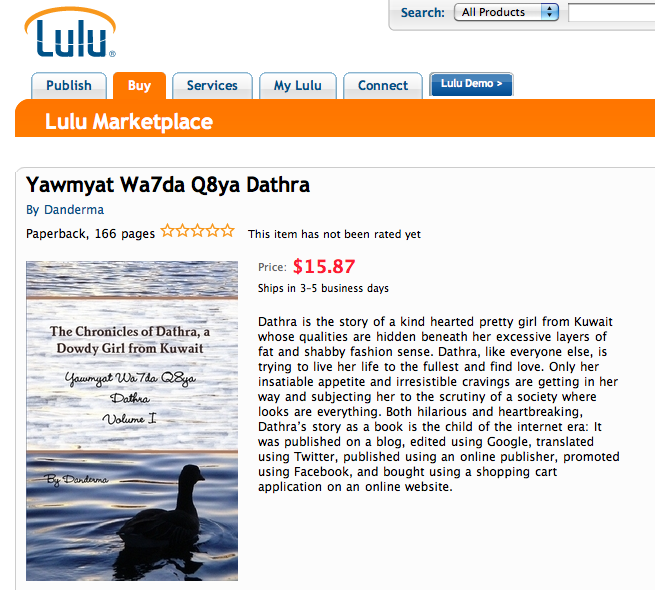
It’s easy to get addicted to Danderma / Dathra; she is unpretentious, sharply insightful, and hilarious. She pokes fun at herself – and at the society in which she (dys)functions. Side-splittingly funny stuff.
By the book or download Here.
Lunch in Paris (A Love Story With Recipes) by Elizabeth Bond
I just finished this book, and I need to review it so that I can pass it along to my daughter-in-law, who sees France, as I do, through eyes of love. Americans either love France or hate it, for some reason France evokes strong emotions one way or the other.

This author is a New Yorker, and her experiences are not my experiences, because her culture is not my culture. New York is a culture all its own. On the other hand, her experiences as an expat are universal, and her insecurity with the language, the culture and the customs are magnified by her commitment to marrying a French man and living in France for the rest of her life.
For the record, I really loved this book.
Can you read a recipe and have a pretty good idea what it is going to look like and how it will taste? In my family, we read cook books for fun. The recipes Elizabeth Bond has included are great recipes, a great start on French cooking the simple and fresh way. Even someone who has never cooked French food can make most of the dishes she creates in this book. In my very favorite chapter, A New Year’s Feast, there are several recipes for North African dishes I have eaten and loved – and oh, I am eager to try these! Chicken Tajine with Two Kinds of Lemon! Tajine with Meatballs and Spiced Apricots! Oh, YUMMMM!
In one part of the book, the author talks about some very basic differences between how Americans approach life and how the French view life:
I watched the couples walking around the lake. “Maybe it’s the New Yorker in me. I’m too used to rushing around. But everyone here is so relaxed, it’s like they’re moving in slow motion.”
“Why should they rush? They’re not going to get anywhere.”
Sometimes I really have no idea what he is taling about.
“You will never understand. You come from a place where everything is possible.” We lay side by side on the grass, our eyes half closed.
“It’s Henry Miller that said, ‘In America, every man is potentially a president. Here, every man is potentially a zero.’ ”
And then he told me a story.
“When I was sixteen it was time to decide what kind of studies I would pursue. I was the best in the class in Math and Physics, but also the best in Literature. I went to the school library and the woman behind the desk gave me a book. It was called All the Jobs in the World. I looked through it. I found two things I liked: scientific researcher and film director. I brought the book to the front and showed her my choices. ‘Ah non,’ she said, ‘You forgot to look at the key.’ And she pointed to the top of the page. Next to each job were the dollar signs – three dollar signs if the job paid a lot of money, one dollar sign if it paid very little. Next to the dollar sign was a door. If the door was wide open it was very easy to tet this job, if the door was open just a little bit, it was very hard. ‘Regard,‘ she said, ‘You have picked only jobs with no dollar signs and a closed door. Tu n’y arriveras jamais. You will never get there.”
‘You should become an engineer,’ she said. My parents never met anyone who did these other things. We don’t come from that world. They had no friends they could call to get me a job. They were afraid I would fail and they couldn’t help me. They were afraid I would have no place in the society. And I didn’t have the force to do it myself. I didn’t want to disappoint them. So I became an engineer.”
“It’s just like that here. If you want to do something different, if you head sticks up just a little, they cut it off. It’s been like that since the Revolution. You know the saying, Liberte,’ Egalite,’ Fraternite,’ equality is right in the middle. Everyone has got to be the same.
Of all the stories Gwendal has told me, before or since, this one shocked me the most. Never in my life, not once, had anyone ever told me there was something I couldn’t do, couldn’t be.
Have you ever known an expat wife (a woman who has married a man of another culture and lived in his country)? Expat wives are some of the bravest women I have ever met. No matter how long you have been married to a man of another culture, you can still be surprised.
The expat wives I have known have been smart, gifted people, woman who have been blessed to see the world through the eyes of more than one culture, and it changes everything. Their children are amazing – most will speak – and think – in more than one language. They have a sort of international fluidity, as well as intercultural fluency. It isn’t everyone’s choice, but those who chose it often live lives you and I can only begin to imagine. Elizabeth Bond has opened the door a little, and shared some of those experiences with us.
The book I bought has Reader’s Groups questions in the back, and they are good questions. Read the questions first; it gives you food for thought as you read through her experiences.
Recent Comments
ExpatAlien on What Country am I Living … intlxpatr on Yellowstone: Old Faithful to C… Michelle on Yellowstone: Old Faithful to C… Cathy on No Grown-Ups in Charge intlxpatr on Waiting for Snow Wikipedia Donate Button

Amazina


Early Voting in Florida


 Here There and Everywhere