When Royalty Comes to Dine
I know I dream, but most of the time I can’t remember. Most of the dreams I can remember are the equivalent to university exam dreams, you know, the dreams you have for years after you graduate about missing the class and having to take the exam? Most of the dreams I remember are packing dreams – it’s time to go, and I haven’t finished packing. Oh aarrgh!
Recently I had a different dream. This is so hilarious I can’t begin to figure out what it is about. Royalty is visiting in our town. Like English royalty, and I vaguely recognize Princess “Fergie” and Elizabeth I, they are all dressed in period costume and are sort of posed around looking royal.
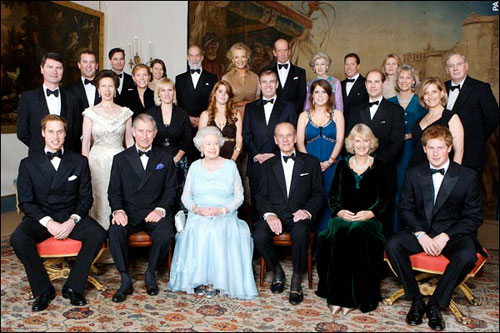
I realize that no one has taken care of making sure they have events scheduled that honor them, so I invite them to dinner, and then for the rest of the dream, I am so busy trying to make sure that they are sufficiently ‘honored’ that I keep worrying about what I am going to do about dinner. No one seems to be at all concerned except me. The royals are all just looking royal, very good sports, but how am I going to be a good hostess – taking care of them now – and still get dinner on the table? I could order out, but I think they are expecting a home cooked meal? I am not living overseas anymore, where I might have hired help; this one is on me.
Fortunately, I wake up.
I don’t know why I can even remember this dream, most of all I remember the feeling that I have offered up something and I don’t really have the resources to keep my promises. Oh aaarrgh!
Good Enough
This is from Rick Warren’s Daily Hope send out for today, and for me, it really hits home. So many times I hesitate to step up to the plate, waiting until I am sure my skills are what is needed, when what is really needed is just for someone to have the courage to step up, to speak out.
The best ‘Christian’ person I know, who follows this Christian principle, was born Muslim. She is always the first to serve, and the last to take anything. She is the first to give and the first to start cleaning up after an event. She is never afraid to get her hands dirty, or to defend the dignity of ‘the least of these.’
Real servants do their best with what they have. Servants don’t make excuses, procrastinate, or wait for better circumstances. Servants never say, “One of these days” or “When the time is right.” They just do what needs to be done.
The Bible says, “If you wait for perfect conditions, you will never get anything done” (Ecclesiastes 11:4 NLT).
God expects you to do what you can, with what you have, wherever you are. Less-than-perfect service is always better than the best intention.
One reason many people never serve is that they fear they are not good enough to serve. They have believed the lie that serving God is only for superstars. Some churches have fostered this myth by making “excellence” an idol, which makes people of average talent hesitant to get involved.
You may have heard it said, “If it can’t be done with excellence, don’t do it.” Well, Jesus never said that! The truth is, almost everything we do is done poorly when we first start doing it — that’s how we learn.
At Saddleback Church, we practice the “good enough” principle: It doesn’t have to be perfect for God to use and bless it. We would rather involve thousands of regular folks in ministry than have a perfect church run by a few elites.
Kuwait or Qatar or Pensacola?
Showering after my water-aerobics class, I could hear voices discussing a local political-social situation. A benefits agency has groups of families working in it, and they know all the tricks. They know how to insure more of their own family members hired, and they know how to help all their family members (and friends) take advantage of all the entitlements.
Expats abroad call it nepotism, and scorn it as a third-world corruption. In truth, it happens everywhere.
There is an ongoing schism taking place in Qatar and Kuwait, countries that have been gracious and welcoming to me. The nationals of Kuwait and Qatar control citizenship carefully. The citizen base is about 20% of the population, on a good day. The rest of the population are people who are in Kuwait and Qatar to work. Most there to work can never hope for citizenship. For many, the poverty in their home country is so brutal that no matter how hard the working conditions, at least it is a salary, and they can send something home so that, literally, their families can eat. They dream – like we do – of educating their children so that they will have a better, more secure life.
Here is the problem. When 80% of the population is NON-Kuwaiti, or NON-Qatari, your country starts to change. One way in which things have changes is that in a very short time, the highways have gone from very quiet to gridlock, due to a dramatic increase in drivers and cars. In Qatar, the situation is made worse by nationalization of the taxi service, resulting in so few taxis that hotels now use private limo services, because finding a taxi at peak times is near to impossible.
That’s one issue. The second issue is language. Imagine your elderly parents going into shops to buy something – in their own country – and the clerks don’t speak their language. As they are stumbling and bewildered, some noisy “workers” walk in, state their needs, are understood, conduct their business and exit before you even get served. This is happening in Kuwait and in Qatar; everyone is speaking English. In a country where the workers are Indian, Nepalese, Philipino, Saudi, Yemani, Omani, Lebanese, Syrian, French, Dutch, English, Australian, South African, American (and about thirty or forty others) the common language has evolved to be English, not Arabic.
How do you think you would feel if it were happening here? If the great majority of cars on the road were not “us” but “guests” in our country? If the clerks in stores couldn’t understand what you want, because although they are in your country, they don’t speak your language?
Another problem is what to do with the huge, disproportionate number of geographically single males brought in to work as builders, cleaners, heavy equipment operators, dishwashers, drivers, security guards and other fairly low-paid positions? In Kuwait and in Qatar, non-married sex is strictly forbidden, even holding hands in public is considered an affront to morality. These men are banned from malls where families might gather, and from other public places. Their existence is grim, and they often find themselves unpaid, or paid far less than they were promised for their labor.
Last, but not least, this very modest Gulf culture has people – foreign guest workers – parading themselves on their streets in various states of undress. Think about it – that’s how we look to them. We have no shame. We bare our faces. We flaunt the glory of our uncovered hair. Sometimes a shawl might drop and a glimpse of bare arm or even a hint of cleavage might shock the modest eyes of a believer.
In Pensacola, there are also fundamentalists who wear long skirts, long sleeves, and determinedly modest clothing. I wonder what these believers think about the skimpy clothing on the beaches, or in the malls?
Coming home has been a real eye opener. It was easy for me to be critical of things I saw in Qatar and in Kuwait. Coming home, we joke all the time about “Kuwaiti drivers” here in the US, but the real joke is – they sure look a lot like us.
Last week, we saw a man here make a U-turn right in the middle of the road, and rock as he tried to regain control of his truck, and almost blast right through a red light he didn’t see. The back of his truck was down, and items loose in the truck bed were heading toward the highway – fortunately he figured that out, and last we saw, he had stopped to fix his rear door. Maybe he wasn’t sober. Maybe he had had an argument with his wife or boss or someone and was not paying close attention to his driving. All I know is that we have seen a goodly number of inattentive drivers here, too.
When a bureaucracy gets corrupted, when the rules are not applied equally to all, when select groups get favored treatment – here in Pensacola, at the immigration department in Kuwait or in the traffic department in Qatar – everyone suffers. It’s a political problem, a social problem, and a systemic problem. God willing, if we are truly evolving as a species, we will find a way to create truly fair and transparent systems which will work as they are ideally intended to work.
It’s on us. We have to make it happen. We have to want it badly enough to make it happen, even making sacrifices for the greater good.
I don’t have any answers. I don’t know how to make us better people that we are, how to make ourselves make the right choices. I do know this – whether it is a tiny village in Germany, or an eagle’s aerie in Kuwait, or the lush life of Doha – we are all more alike, and share more similarities and problems, than we are different. If we could only learn to see through one another’s eyes, maybe we could find ways to resolve our differences and learn to cooperate.
The Alabama Muttawa
As we were driving into Alabama this morning (not such a big deal as it sounds, as we live right on the border of Alabama) we passed through Foley, where we found a large group of Alabama members of the committee to prevent vice and promote virtue:

They find a busy corner and parade their signs, hold up their Bibles, and read aloud from the bible to passing motorists. No switches to hit women in shorts or sundresses or swimming suits, no authority to tell people how to behave, only armed with conviction. It’s a very gentle kind of moral authority, encouraging people to make the right choice.
Saudi Woman Attacks Muttawa
I found this on AOL News
“People are fed up with these religious police, and now they have to pay the price for the humiliation they put people through for years and years,” she was quoted as saying. “This is just the beginning and there will be more resistance.”
(May 18) — An angry young Saudi Arabian woman has left her mark on a religious policeman who approached her for illegally socializing with an unmarried young man.
According to the Saudi daily Okaz, the woman strongly objected to the policeman’s interference and repeatedly punched him so hard that he ended up in the hospital with bruises to his face and body.
The couple, believed to be in their 20s, were strolling through an amusement park in the city of Al-Mubarraz when the policeman asked them to confirm their relationship to one another.
Hasan Jamali, AP
In Saudi Arabia, women aren’t allowed to drive or to appear in public without a male guardian.
For unknown reasons, the man collapsed while being questioned, and the woman jumped in with fists flying, Okaz reported, according to arabianbusiness.com.
No statement on the incident has so far been made by the religious police – formally titled the Commission for the Promotion of Virtue and Prevention of Vice – or by the regular police, the Arab site and The Jerusalem Post reported.
If the unidentified woman is charged she could face a long prison term, as well as body lashes.
“To see resistance from a woman means a lot,” Wajiha Al-Huwaidar, a Saudi women’s rights activist, told The Media Line News Agency, The Post reported.
“People are fed up with these religious police, and now they have to pay the price for the humiliation they put people through for years and years,” she was quoted as saying. “This is just the beginning and there will be more resistance.”
“The media and the Internet have given people a lot of power and the freedom to express their anger,” she added. Whatever the religious police do ends up all over the Internet, she said, which gives them “a horrible reputation and gives people power to react.”
Under Saudi law, women are not allowed to drive, be seen in public without a male guardian and socialize with unrelated men.
A decision to open the country’s first co-educational university last year was strongly criticized by a senior Saudi cleric, who was then fired by King Abdullah, The Post reported.
How To Be a Southern Lady
You’d think moving back to your own country would be a piece of cake, wouldn’t you? We nomads know better. Young people who travel to other countries to go to school know better. Military people know better. Missionaries know better. Diplomats know better. Anyone who has spent time living abroad know that it works both ways – you have an impact where you are living, and where you are living has an equal impact on you. You may go back, but you are never the same.
With this move, AdventureMan and I have been too busy trying to get settled and to take care of the incredible amount of bureaucratic detail it takes to relocate. Even with AdventureMan ‘retired’, the days are flying by, and we don’t know why we are so busy.
For one thing, I am doing my own housework, and I am finding I am not very good at it. Like I am good at getting laundry done, and even folded, but I haven’t ironed in a long time, and the things that need ironing are stacking up. I have bought a beautiful new ironing board, and a beautiful iron . . . and some starch, the liquid kind I like, not the spray kind. . . but I haven’t set it up, and I haven’t ironed, not a thing. I have discovered that all my packed things looked a lot better after hanging in the closets for a week, most of the wrinkles fell out, lucky me. But . . . the day of reckoning is coming.
The worst part, for me, is cleaning my floors. My floors are supposed to be beautiful; wood and tile floors. They actually ARE beautiful, maybe two days a week, the day I clean them and the next day, but five days a week, they need work. I wish I had asked my cleaning lady in Doha how she got my floors so beautifully clean. I wish I had paid more attention. I keep looking in the store for some miracle, a machine that will clean them in a heartbeat and make them all shiny. . .
The wonderful thing about moving into this culture – and it truly is a different culture from the one in which I was raised – is that we have our wonderful son and his wonderful wife to give us hints on what to do and not to do, and we have his wife’s wonderful family.
Mostly, I try to keep my eyes open. Southern women admire things extravagantly, and after living for so many years in the Middle East and Gulf, learning to admire extravagantly goes against all my instincts.
In the MIddle East, when you admire extravagantly, you can make people nervous. Some people worry about attracting “the evil eye” of jealousy, evil intentions, people who envy you and wish you harm. Some people, if you admire something, will give it to you! It’s true, those stories, it has happened to me. So now I have to un-learn my lessons in retraint and learn to appreciate, if not extravagantly, at least enough to be polite.
One of my wife’s relatives gave us a house-warming gift, an iced-tea maker, with a darling card that states Rule #1 is that every Southern Hostess knows that a pitcher of iced tea is a MUST for all occasions. I like iced tea, but I have never kept it on hand to serve, and I guess I need to start!
Her second rule was one that made me burst out laughing – “A Southern Lady, the most interesting ones anyway, know that rules are made to be broken.”
“Just be prepared for people to leave your home saying “Bless her heart, she must be getting forgetful. There was no iced tea!”
And then rule #3 – “The only correct and acceptable way to criticize anyone is to add ‘bless his/her heart!’ and then, anything goes!”
At a party at her house this weekend, I learned a couple more – the first rule being that when you are invited to a great big family dinner, bring dessert! Thank God, I did take a little guest gift, but now I know – bring dessert! And it had better be sweet!
The next rule is would make any Kuwaiti or Qattari feel right at home – spare nothing in making our guests comfortable. This Southern Hostess had seating areas inside the beautiful air conditioned home, and also seating outside for those who don’t mind a little heat. She had a big basket loaded with all kinds of insect repellents to keep her guests from being bitten. She took time with each guest, and although she was running her little bottom off getting everything organized, she made it all look easy, and as if she was having a good time. I have a sneaking suspicion the truly was enjoying having all the people around and that her great big heart loves taking care of the crowd. She was the essence of gracious hospitality. Did I mention she has also lived in Kuwait?
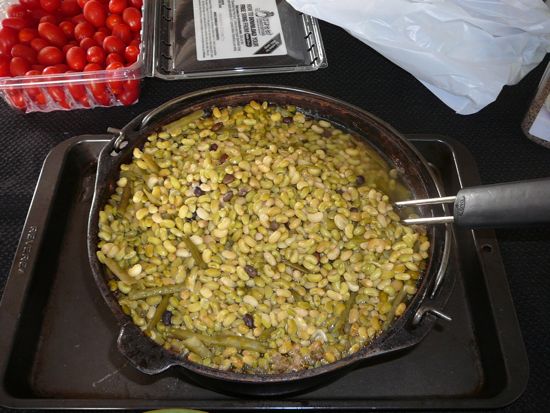
Dinner was “Perlow” an old Southern tradition, made in a huge old kettle from her husband’s mother, and hung from a tripod over a roaring fire to cook. The actual cooking was the men’s work as they sat outside drinking iced tea:

Home grown peas and beans mix – delicious!
Serving up the perlow:
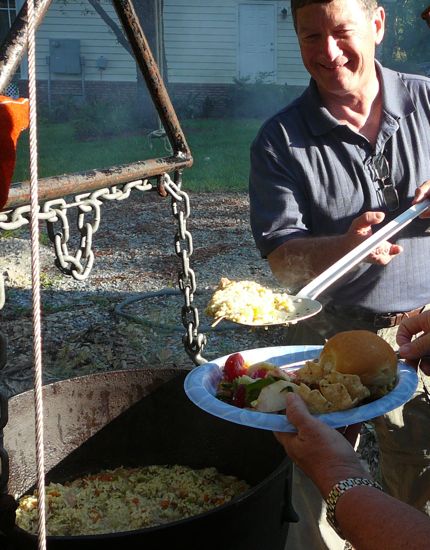
My Middle East / Gulf friends would be comfortable eating this meal – Perlow is a variation of Pilaf, and very similar to Biryani. No alcohol served. No pork. Lots and lots of fabulous sweet desserts.
It’s funny, I used to tell people in Kuwait and Qatar that it was a lot like Alaska; when the weather got too bad, you just stay inside most of the time. When the weather gets good, you go outside as much as you can. When it’s too hot/cold, you run from your air conditioned/heated car to your air conditioned / heated store or movie theater, or restaurant, and then back to your air conditioned / heated car and back to your air conditioned/ heated house.
In the same way, I am beginning to wonder if the South and the Middle East know how much they have in common? In Pensacola, on Saturdays, we have the religious people on the corners shouting at passing cars, not a whole lot different from the volunteer morality police in Saudi Arabia. In the South, as in the Middle East, ‘family’ isn’t just blood, it’s also who you’re married into, and there is a lot of emphasis on family getting together and spending time together. In the South, as in the Middle East, men tend to gather in one area, women in another.
In the South, they drink iced tea; in the Middle East, it’s hot tea. Both have passionate patriots, fundamental believers and a tradition of gracious hospitality. Both have a passion for hunting and fishing. Nobody much likes obeying the rules in either culture. Maybe I’m still in the MIddle East?
Pocket Park with a View
As we were winding our way home from lunch, we came across a tiny parking area – two cars worth – and a pocket park with a view to die for.
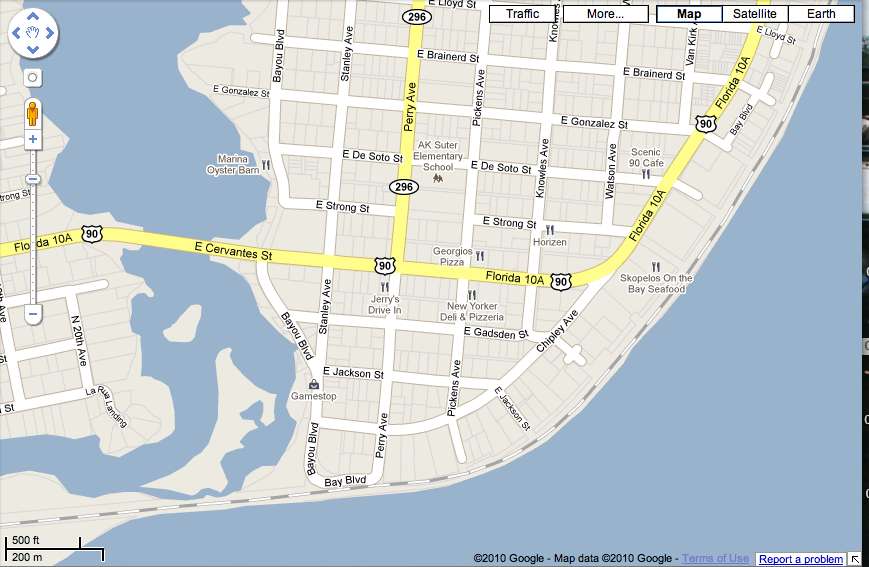
The park is about where it says Chipley Avenue, and has a view of the Garcon Point bridge; a perfect place to watch the sun rise, if you are a sunrise person, which . . .I am!


The park was donated by a gift from a woman who is memorialized in a tiny plaque in the park:
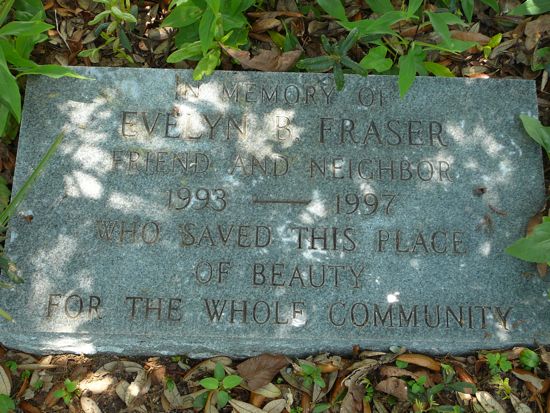
Isn’t that a beautiful legacy to leave behind when you depart this world?
Missing Dottie
My Mom sent an e-mail today about an old friend, she’s not doing well. She lived next door to us in Alaska, and would take care of me and my sister when Mom needed to leave us with someone. She was older, so we weren’t really friends then, but we became friends as adults, years later, when AdventureMan and I moved to the Tampa Bay area and my friend and her husband lived just blocks away.
I’ve been missing my old friend; twice when I moved, she was there, the big-sister-I-never-had, helping me to move in while AdventureMan was far away. The first time, she loaned us her truck for several weeks while we settled and searched for another car. When I moved back to Seattle, she cleared out my overgrown garden, and then unpacked all the china and crystal and washed it and put it away in the cabinet. She was so much fun.
Through the years, she loved life and lived it to it’s fullest. She loved her time living in Egypt, and in Ramallah, and she travelled and sailed just about everywhere in the world. She exercised and watched her weight. She passed all the best books along to me, and kept up with the news. She was fit and active, and engaged with the world around her.
Statistically, and in all probability, she would never have seemed a risk for Alzheimer’s. I’m still angry about it. This should never have happened to her. It isn’t fair. She should be laughing, enjoying her grandchildren, dancing, swimming, sailing, running, biking, cooking, entertaining – all the things she loved. She DESERVES better. And I guess I am angry because I am selfish, and I want her to be around for ME. And I know that all this is stupid and childish, I should just accept and be calm, but it’s just so unfair and it makes me so angry. She is still in this world, although we don’t know for how long, but then again, she isn’t, not really, she is not a part of this world any longer, she just exists. It’s not right and it’s not fair and Alzheimer’s is a robber and a thief.
Tax Day Tea Party in Pensacola
We don’t really understand the Tea Party. It is clearly against Obama, but then again, it is clearly the party of “against” and it is hard to find anything it is for. This is a problem; it is easy to tear down, and it is a lot more difficult to create – to formulate solutions which will provide benefits for the majority of participants.
As we were approaching our hotel, we saw this huge crowd of ‘protesters’ who appeared to be partying. But every sign was different! As 15 April is Tax Day, the day our income taxes are due, maybe about 10% were carrying signs that had to do with taxes, preferably NO taxes. The rest of the signs protested other things – constitutional amendments (what – women voting? black people being counted as full people? the repeal of prohibition?), no abortion, putting God first – it was a total potluck of causes.
The weather was mild, the sun was shining, there was a breeze – great day for an incoherent protest, LOL. I took pictures from the safety of our car, although everyone seemed very friendly:






Here is what cracks us up. Pensacola is a highly military reliant community. There is a huge military presence here, from Eglin Air Force Base to the Pensacola Naval Air Station. Pensacola is glad to have the military business. So where do they think the money comes from that pays the military salaries, and thus, gets spent in their economy, at their businesses? Few Americans have saved enough to comfortably retire, who do they think is contributing to their Social Security support, and Medicare, and Medigap? Tax dollars! Who do they think supports public education, and guarantees law and order? Who do they think runs the justice system? Who do they think provides emergency fire and medical services? Tax dollars! Who builds and maintains the roads and bridges, insures safety in our food supplies, construction and medicines? Our government, supported by our tax dollars!
Do I like paying taxes? No! Not one bit! But in the interest of the greater good, we pay our taxes honestly, and thank God to live in a society with order, thanks to our tax dollars.
Pensacola/Escambia County Honors WWII Vets
To understand how significant this is, you need to know that Pensacola is not a wealthy area, suffering more than 10% unemployment. Pensacola and Escambia County were hit hard by Hurricanes Ivan and Dennis, and are still recovering, but when asked to support this effort, exceeded – and nearly doubled – the charitable contribution:
The sixth trip of Emerald Coast Honor Flight is scheduled to depart from the Pensacola Gulf Coast Regional Airport this morning, taking a group of Northwest Florida’s WWII veterans to see the WWII Memorial.
This is from the Pensacola News Journal for today:
The Escambia County School District is the major sponsor for the April 14 flight, which will take 98 World War II veterans to Washington, D.C.
More than $114,000 was raised through individual donations. Teachers made personal donations to sponsor a veteran, often doing so in honor of their own loved ones who served during WWII. Students saved pennies and participated in school activities such as the “Hats Off To Veterans” day hosted at N. B. Cook.
All of the funds given were donations made by employees, students, schools, parents and community members.
In October, the district set a goal to sponsor 50 veterans, but within six weeks, the goal had been exceeded. On March 16, Superintendent Malcolm Thomas presented a ceremonial check to Emerald Coast Honor Flight, representing the largest donation ever made to the organization.
“I’m so incredibly proud of Escambia County’s staff, teachers and students,” Thomas said in a news release. “They really stepped up to the challenge to honor our local veterans by sending them on Honor Flight.”
The veterans, whose ages range from 82 to 95, will have guardians to escort them throughout the entire day. A cherished war time memory , “mail call,” will be re-created on the flight to Washington, with letters of appreciation from students and employees being distributed to each of the veterans.
Bryce Cox, a fourth-grade student from N. B. Cook Elementary, wrote one of the letters.
“I wrote ‘Thank you for serving our country and protecting it and I hope you have fun on the Honor Flight,” Bryce said.
A big homecoming celebration is planned upon the veterans’ return to Pensacola. Escambia County School District high school bands, cheerleaders and NJROTCs will be participating.
The public is invited to welcome home the veterans as at 7 p.m. at the Pensacola Gulf Coast Regional Airport.
Wooo HOOOO on you, Pensacola and Escambia County!
Recent Comments
intlxpatr on Shampoo Ginger tigerbutterya0c5ff1d… on Shampoo Ginger intlxpatr on British Soldier Kidnapped, Esc… John on British Soldier Kidnapped, Esc… intlxpatr on British Soldier Kidnapped, Esc… Wikipedia Donate Button

Amazina


Early Voting in Florida


 Here There and Everywhere