Amsterdam Sights
Walking into the airport in Amsterdam was – for a change – fun. They have Christmas decorations up, and my eyes are starved for Christmas. Well . . . . looking now, I see the huge Camels banner through the decorations. Bah! Humbug! These are “holiday” decorations.


And then these! I have never seen such large packets, nor such enormous warnings:

Mom’s Fruit Cake Updated
The basics are below, and the basics make the fruit cake. This year, once again, I am alcohol-less in Kuwait, as alcohol is illegal here, but during Ramadan I stocked up on some other local specialities – the glaceed cherries in red and green, the golden currants from Iran, the tiny red berries from Iran, delicious dried peaches, chunks of dried papaya, dried apricots, and the juiciest prunes I have ever tasted. Thanks to a care package, I will also be using fresh, delicious Texas pecans! Wooo Hooooo!
Every year is different, depending on where I am!
Here is the original blog entry, which to date has been one of the all-time statistical wonders. Thanks, Mom!
Wooo Hooooooo! The fruitcakes are in the oven, and already the house smells wonderful. I’ve been making these cakes since I got married. I don’t think I have missed a year, but I may have. I grew up smelling these delicious cakes every winter. I don’t think my Mom makes them every year any more. I wish I were close enough to pop one into her refrigerator for their holidays.
Mom’s Fruit Cake
Even people who think they HATE fruit cake like this fruit cake. It has a secret ingredient – chocolate!
This is the original recipe. I remember cutting the dates and prunes with scissors when I was little; now you can buy dates and prunes without pits and chop them in the food processor – a piece of cake!
1 cup boiling water
1 cup sugar
1/2 cup lard or butter
1 T. cinnamon
1 t. cloves
3 Tablespoons chocolate powder
1/4 cup jelly
1 cup seeded raisins
1 cup chopped walnuts
1/2 cup candied citron
1/2 cup cut prunes
1/2 cup cut dates
Put all in a pan on stove and bring to a boil. Boil for three minutes. Let cool. Add:
2 cups flour
1 teaspoon baking soda
Flavor with lemon
Bake at 350° in loaf pans for one hour. Makes 2 normal bread loaf sized cakes.
My variations: I put in about three times the fruit, the difference primarily in the candied citron – I prefer using whole candied cherries, because they are so pretty when the loafs are cut. This recipe doubles, or quadruples with no problems.
Pans: Mom used to line all the pans with brown paper and grease the paper. That’s a lot of trouble.
I grease the pans, then dust with more of the chocolate powder. Use a good quality chocolate, not cocoa.
When the cakes come out of the oven, let them cool for ten minutes, loosen them with a knife, then they will shake out easily. Let continue to cool until they are totally cool, then wrap in plastic wrap, with several layers, then foil, then seal in a sealable plastic bag. Let them age a couple months in a corner of your refrigerator.
I never make these the same any two years in a row. This is the first year, ever, that I won’t be using any brandy – alcohol in Kuwait being against the law. Yeh, I have some friends who laugh and say “you can get it anywhere!” but we made a decision to obey the law. Only rarely do I regret it . . . sigh . . .fruitcakes really need brandy.
Update: If you are in a country where brandy is available, and if you want to use brandy, here is how to use it in this recipe. You know how raisins get all dried out and taste yucky in fruitcakes? The night before you intend to make the fruitcakes, take all the raisins you intend to use (depending on how many fruitcakes you intend to make) and put them in a glass container. Pour brandy over them, to cover. Microwave just to the boiling point. Let stand in the microwave overnight.
The next day, you can drain that brandy and use it in a stew or something, and in the meanwhile, you now have plump, juicy raisins to use in your fruitcake, and just a hint of brandy flavor. Yummmm!
Grandma’s Ginger Cookies (for 3baid)

This is a very soft dough. It is easier to work with if you chill it before rolling, but even then the rolling pin and rolling board should be well floured, and you need to work fast, before the dough gets too soft again.
Preheat the oven to 400°F / 200°C
1 cup molasses (Brer Rabbit Green Label)
1 cup sugar
1 cup hot water
3 teaspoons baking soda
3 teaspoons baking powder
2 teaspoons ground ginger
1 teaspoon cinnamon
1 teaspoon salt
5 cups flour
Add hot water to molasses, sugar and shortening. When well mixed, and cool, stir in sifted dry ingredients.
Roll out to 3/8″ thick, sprinkle with sugar and cut with cookie cutters. Place on lightly greased cookie sheet.
If you are making gingerbread boys and girls, use raisins or small hard decorations for eyes and buttons, and a small slice of candied cherry for the mouth.
(Grandma said use Brer Rabbit Green Lable Molasses, but here in Kuwait, use whatever molasses you can find! I have seen some honey-molasses that looks like it would make a good gingerbread cookie.
Pop in the oven, bake for 10 minutes – maybe a little longer if your cookies are thick. They should be soft and chewy, but cooked through.
Pumpkin Roll Dessert
Halloween is fast approaching, and pumpkins have flooded the markets. Around now, the price should be approaching rock bottom!
To make this recipe, you need a jelly-roll pan. It is like a cookie sheet, only the sides are just a little bit higher. You also need a clean cloth dishtowel.
You think you can’t do this, but you can. And once you have done it, a whole new and fabulous realm of desserts opens up before you. Chocolate with mint stuffing, Raspberry with blueberry stuffing – oh, the possibilities are endless.
It’s simpler than it looks. You will laugh when you have done your first, laugh at all your anxieties. Woooo Hoooooo, you did it!
Pumpkin Cheesecake Roll
This is a great Thanksgiving or Christmas dessert when you are sick of the same-old same-old desserts. Plus, one of these old fashioned rolled desserts always looks very elegant!
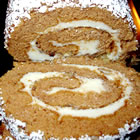
(Photo courtesy Allrecipes.com)
Cake:
Powdered sugar
3/4 cup flour
1/2 teaspoon baking powder
1/2 teaspoon baking soda
1/2 teaspoon cinnamon
1/2 teaspoon cloves
1/4 teaspoon salt
3 large eggs
1 cup granulated sugar
2/3 cup canned pumpkin
1 cup chopped walnuts
Filling:
1 package cream cheese
1 cup sifted powdered sugar
6 Tablespoons softened butter
1 teaspoon vanilla flavoring
Powdered sugar
Preheat oven to 375 degrees. Grease 15” x 10” jelly roll pan. Line with waxed paper, grease and flour paper (there is a reason!) Sprinkle a flat tea towel or dish cloth (flat woven, not terry cloth) with powdered sugar.
Combine flour, baking powder, baking soda, cinnamon, cloves and salt in small bowl. Beat eggs and sugar in a larger mixer bowl until thick. Beat in pumpkin, stir in the flour mixture. Spread evenly in prepared jelly roll pan, sprinkle with chopped nuts.
Bake 13 – 15 minutes or until top of cake springs back when touched. Immediately loosen and turn cake out of pan onto prepared tea-towel. Carefully peel off paper. Roll up cake and towel together, starting with narrow end. Cool on wire rack.
Beat cream cheese, powdered sugar, butter and vanilla in small mixer bowl until smooth. Carefully unroll cake, remove towel, and spread cream cheese mixture over cake. Roll cake back up again (it will want to be in the rolled position after cooling that way) Wrap in plastic wrap and refrigerate at least one hour.
Sprinkle with powdered sugar before serving.
Christmas for Expats
By the time October hits, it is almost too late for many expats to be thinking about Christmas. Packages have to be in the mail in time for a December 25th delivery, and that can mean different things in different countries.
Even travel and delivering the gifts yourself has become more challenging; one of the changes 9/11 made in all our lives is that we can no longer travel with wrapped gifts; baggage inspectors must be able to look at everything we pack, which means a mad scramble on the arriving end to get everything wrapped and labled before delivery.
We all face that universal problem – what to get for the people who already have everything?
So I sent to Find Me a Gift.
Here were some of their suggestions:
Become a Lord or a Lady – Buy Yourself a Title
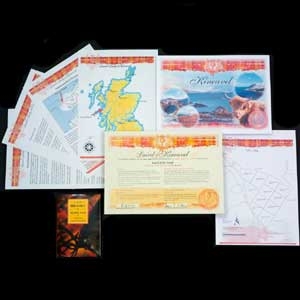
Name a Star

Neiman Marcus always has outrageous and imaginative gifts for the people who have everything, and this year one of the catalog items is a Top Stars Orchestra concert for only $1,590,000.00
(Their 100 year anniversary catalog is a must-see, even if just for the giggles)
And, of course, here in Kuwait you can make a donation of time, goods or money to Operation Hope – Kuwait to help Sheryll Mairza with her 2007 goal of feeding and providing winter clothing for 7,000 poor laborers here who are unprepared for the cold winter to come.
What’s in Your Toolbox?
What do you give a young adult, graduating high school, who has just about everything he wants? What do you give him that he doesn’t even know he wants?
It was Christmas, and we were trying to figure out what to give our son. We eventually decided on a tool box, and we had a lot of fun filling it – hammers, fasteners, screw drivers and Phillips screw drivers in various sizes, nails, putty, screws, a level, a measuring tape . . . he like it, but he was a little underwhelmed.
Until he got to college. At the end of the first week, when he called us, we could hear the joyful confidence in his voice.
“Guess what!” he said. It wasn’t really a question, he was going to tell us.
“No-one else has a tool-box here! All the other kids need help putting their bunks together (there was some smart entrepreneur who was marketing loft-like bunk beds and room-customizing kits to all the incoming students, making, I am willing to bet, a fortune) and I’m the one with the tool box!”
We could hear the smile on his face.
And isn’t that life? The more tools you have in your toolbox, the better equipped you are to handle what life throws at you? Even the unexpected – if you have the right tools.
For me, those tools have been varied.
• Reading books has introduced me to new ways of thinking.
• Learning foreign languages gives me different perspectives.
• Living in foreign countries helps conquer ignorant ideas about people of other cultures.
• I can eat a wide variety of cuisines without fear
• I can swim, use a rifle, cook, and speak in public without my voice quavering
• I can laugh. Thanks be to God.
All these tools have been acquired, some, like patience and kindness, at great price.
So what are your tools? What has helped you deal with what life throws your way? What tools have you grown to deal with life’s challenges?
The Nativity of John the Baptist
This will be a long, technical post that you can skip if religious matters don’t interest you. It is aimed at my colleagues who enjoy comparing points of religion.

This week, we celebrated the feast of the birth of St. John, known as The Baptist. There were several scriptural readings (see below which is from the online Lectionary on my blogroll)
We had a reading I hadn’t heard before:
An account of the mercy of thy Lord bestowed upon his servant Zachariah, when he called upon his lord in low tones, praying: My Lord, my very bones have become feeble and my head has turned hoary with age, but never have my supplications to Thee, Oh Lord, remained unfruitful. I am apprehensive of the behavior of my relations after my death, and my wife is barren. I beg Thee, therefore, do Thou bestow upon me from Thyself a successor to be my heir and to be the heir of the blessings of the House of Jacob; and to make him one who should be pleasing in Thy sight, O Lord . . . .
(it tells of Johns conception and birth)
We commanded Yahya (John): Hold fast the Book; and we bestowed upon him wisdom while he was still young, as a token of tenderness from Ourself and to purify him. He grew up righteous, and was dutiful towards his parents and was not haughty or rebellious. Peace was on him on the day of his birth, and on the day of his death, and peace will be on him on the day he will be raised up to life again.
As I am hearing this reading, I am thinking “I am pretty familiar with our scriptures, and while it sounds familiar, I don’t think I have ever heard this reading before,” and I thought maybe it was from one of the less often read books that not all churches agree is part of the scripture.
And then – the reader said “This reading on John is from the Qu’ran.”
I was amazed. First – I had no idea John was mentioned in the Qu’ran. I know Jesus is in the Qu’ran, and my Saudi women friends told me Jesus’ name is in there more than the name of the Prophet Mohammed. (Peace be upon all the prophets!) But I had no idea John was in the Qu’ran, Chapter 19, which is called the book of Maryam, and also tells of the life and ministry of Jesus.
Second – I’ve never heard the Qu’ran read in a Christian church service before, but why not? It added, not subtracted, from our understanding of John. I thought it was pretty cool.
Here is what our Lectionary has to say about John the Baptist:
THE BIRTH OF JOHN THE BAPTIST
(24 JUNE NT)
Our principal sources of information about John the Baptist are
(1) references to his birth in the first chapter of Luke,
(2) references to his preaching and his martyrdom in the Gospels, with a few references in Acts, and
(3) references in Josephus to his preaching and martyrdom, references which are consistent with the New Testament ones, but sufficiently different in the details to make direct borrowing unlikely.
According to the Jewish historian Josephus (who wrote after 70 AD), John the Baptist was a Jewish preacher in the time of Pontius Pilate (AD 26-36). He called the people to repentance and to a renewal of their covenant relation with God. He was imprisoned and eventually put to death by Herod Antipas (son of Herod the Great, who was king when Jesus was born) for denouncing Herod’s marriage to Herodias, the wife of his still-living brother Philip. In order to marry Herodias, Herod divorced his first wife, the daughter of King Aretas of Damascus, who subsequently made war on Herod, a war which, Josephus tells us, was regarded by devout Jews as a punishment for Herod’s murder of the prophet John.
In the Book of Acts, we find sermons about Jesus which mention His Baptism by John as the beginning of His public ministry (see Acts 10:37; 11:16; 13:24). We also find accounts (see Acts 18:24; 19:3) of devout men in Greece who had received the baptism of John, and who gladly received the full message of the Gospel of Christ when it was told them.
Luke begins his Gospel by describing an aged, devout, childless couple, the priest Zechariah and his wife Elizabeth. As Zechariah is serving in the Temple, he sees the angel Gabriel, who tells him that he and his wife will have a son who will be a great prophet, and will go before the Lord “like Elijah.” (The Jewish tradition had been that Elijah would herald the coming of the Messiah = Christ = Annointed = Chosen of God.) Zechariah went home, and his wife conceived. About six months later, Gabriel appeared to the Virgin Mary, a kinswoman of Elizabeth, and told her that she was about to bear a son who would be called Son of the Most High, a king whose kingdom would never end. Thus Elizabeth gave birth to John, and Mary gave birth six months later to Jesus.
After describing the birth of John, Luke says that he grew, and “was in the wilderness until the day of his showing to Israel.” The people of the Qumran settlement, which produced the Dead Sea Scrolls, sometime use the term “living in the wilderness” to refer to residing in their community at Qumran near the Dead Sea. Accordingly, it has been suggested that John spent some of his early years being educated at Qumran.
All of the gospels tell us that John preached and baptized beside the Jordan river, in the wilderness of Judea. He called on his hearers to repent of their sins, be baptized, amend their lives, and prepare for the coming of the Kingship of God. He spoke of one greater than himself who was to come after. Jesus came to be baptized, and John told some of his disciples, “This is the man I spoke of.” After His baptism by John, Jesus began to preach, and attracted many followers. In fact, many who had been followers of John left him to follow Jesus. Some of John’s followers resented this, but he told them: “This is as it should be. My mission is to proclaim the Christ. The groomsman, the bridegroom’s friend, who makes the wedding arrangements for the bridegroom, is not jealous of the bridegroom. No more am I of Jesus. He must increase, and I must decrease.” (John 3:22-30)
John continued to preach, reproving sin and calling on everyone to repent. King Herod Antipas had divorced his wife and taken Herodias, the wife of his (still living) brother Philip. John rebuked him for this, and Herod, under pressure from Herodias, had John arrested, and eventually beheaded. He is remembered on some calendars on the supposed anniversary of his beheading, 29 August.
When John had been in prison for a while, he sent some of his followers to Jesus to ask, “Are you he that is to come, or is there another?” (Matthew 11:2-14) One way of understanding the question is as follows: “It was revealed to me that you are Israel’s promised deliverer, and when I heard this, I rejoiced. I expected you to drive out Herod and the Romans, and rebuild the kindom of David. But here I sit in prison, and there is no deliverance in sight? Perhaps I am ahead of schedule, and you are going to throw out the Romans next year. Perhaps I have misunderstood, and you have a different mission, and the Romans bit will be done by someone else. Please let me know what is happening.”
Jesus replied by telling the messengers, “Go back to John, and tell him what you have seen, the miracles of healing and other miracles, and say, ‘Blessed is he who does not lose faith in me.'” He then told the crowds: “John is a prophet and more than a prophet. He is the one spoken of in Malachi 3:1, the messenger who comes to prepare the way of the LORD. No man born of woman is greater than John, but the least in the Kingdom of God is greater than John.”
This has commonly been understood to mean that John represents the climax of the long tradition of Jewish prophets looking forward to the promised deliverance, but that the deliverance itself is a greater thing. John is the climax of the Law. He lives in the wilderness, a life with no frills where food and clothing are concerned. He has renounced the joys of family life, and dedicated himself completely to him mission of preaching, of calling people to an observance of the law, to ordinary standards of virtue. In terms of natural goodness, no one is better than John. But he represents Law, not Grace. Among men born of woman, among the once-born, he has no superior. But anyone who has been born anew in the kingdom of God has something better than what John symbolizes. (Note that to say that John symbolizes something short of the Kingdom is not to say that John is himself excluded from the Kingdom.)
Traditionally, the Birth of Jesus is celebrated on 25 December. That means that the Birth of John is celebrated six months earlier on 24 June. The appearance of Gabriel to Mary, being assumed to be nine months before the birth of Jesus, is celebrated on 25 March and called the Annunciation, and the appearance of Gabriel to Zechariah in the Temple is celebrated by the East Orthodox on 23 September. At least for Christians in the Northern Hamisphere, these dates embody a rich symbolism. (NOTE: Listmembers living in Australia, New Zealand, South Africa, southern South America, or elsewhere in the Southern Hemisphere, press your delete keys NOW!) John is the last voice of the Old Covenant, the close of the Age of Law. Jesus is the first voice of the New Covenant, the beginning of the Age of Grace. Accordingly, John is born to an elderly, barren woman, born when it is really too late for her to be having a child, while Jesus is born to a young virgin, born when it is really too early for her to be having a child. John is announced (and conceived) at the autumnal equinox, when the leaves are dying and falling from the trees. Jesus is announced (and conceived) at the vernal equinox, when the green buds are bursting forth on the trees and there are signs of new life everywhere. John is born when the days are longest, and from his birth on they grow steadily shorter. Jesus is born when the days are shortest, and from his birth on they grow steadily longer. John speaks truly when he says of Jesus, “He must increase, but I must decrease.”
(Of course, it is to be noted that none of this symbolism proves anything, since the Scriptures do not tell us that Jesus was born on 25 December. The symbolism of the dates is used by Christians, not as evidence, but as material for the devout imagination.)
FIRST LESSON: Isaiah 40:1-11
(Isaiah speaks of someone who will cry out, “Prepare the way of the LORD.”)
PSALM 85
(The long exile is over, God has retored his people, mercy and truth are reconciled.)
SECOND LESSON: Acts 13:14b-26
(Paul preaches about Christ, and how the prophets, including John the Baptist, all pointed forward to him.)
THE HOLY GOSPEL: Luke 1:57-80
(The birth of John the Baptist; his father Zechariah’s song of praise.)
by James Kiefer
Appetizer Puffs
These little bite sized morsels are just cream puffs made small. When you take them out of the oven, you cut the tops off as soon as you can touch them, and pull out the dough pieces inside. When cool, and just before serving, you fill them with savory mixtures:
• grated Gouda cheese mixed with port wine and a little cream cheese
• chopped shrimp mixed with a little chopped celery and mayonnaise
• chopped ham and a tiny bit of mustard and mayonnaise
• crabmeat with a tiny bit of mayonnaise
• chopped up crisp bacon with a little horseradish and mayonnaise
• grated cheddar with finely chopped pimentos and a little mayonnaise
• chopped clams with sour cream
• Chopped and drained tomato, with tiny mozzarella and chopped basil
• Kuwait: flaked, cooked hammour w/tiny bit of sour cream and a little bit of “Kuwaiti spices”
• flaked, cooked tuna with a little aioli mayonnaise and cilantro
. . . . . use your own favorite combinations!
1 cup water
1/2 cup butter
1 cup flour
4 eggs
Heat oven to 400 degrees. Heat water and butter to strong rolling boil. Stir in flour, stir vigorously over low heat about one minute or until mixture forms a ball. (You’ll know it when you see it.)
Remove from heat, beat in eggs, one at a time, continue beating and beating until smooth. Drop dough by tiny spoonfulls 2” apart onto UNGREASED baking sheet. Bake 35 – 40 minutes or until puffed and golden. Cool away from drafts. Cut off tops, pull out filaments of dough.
Fill just before serving so they don’t get soggy. Remember to put the top back on! These are easy to make, easy to serve and even fun to make with children.
Additional options: You can also make these sweet, filling with Creme Chantilly (whip up cream, add a little SIFTED [yes, it matters] powdered sugar and a little vanilla) and still serve by fingers, or you can pour a little chocolate sauce over the top and serve in a bunch of three or four on a plate as profiteroles. The blessing of these puffs is their versatility!

Photo from all recipes.com
Seattle Earthquakes
This is for AbdulAziz. I had just posted my Pacific Northwest Bouillabaisse when I read his comment on the Seattle Houseboat Culture, and his experience with a Seattle earthquake.
In 1996, we bought a house in a Seattle suburb. We had been living in Florida, and I never liked it. In the Tampa Bay area, it was always too hot, too humid, I never felt like I had my normal energy. I was so delighted to get back to the Pacific Northwest.
“No more sinkholes!” I told my husband. “No more hurricanes! You’re going to love Seattle.”
We had just moved in. I was in our bedroom reading, my husband and son and a visiting friend were playing a board game in the living room and all of a sudden the game seemed to be getting a little rowdy. They must be wrestling or something, because the house was shaking. But the shaking got more and more violent, the entire house was shaking back and forth on its foundation. I could hear my husband in the dining room telling them to stop, and then realizing that the chandelier was swaying so violently because it was an earthquake.
That winter, the day after Christmas was a huge snowstorm, all the electricity went out for several days and we were totally snowed in, cold, freezing cold, no heat.
My husband has never let me forget it. I have photos of him, out in his big coat and fur hat, shovelling the acres of snow off the drive so we could get over to my parents and . . . shovel more snow.
“No hurricanes!” he taunts me. “No sinkholes! But earthquakes and snowstorms! Welcome to the Pacific Northwest!”
KLM, Bureaucracy and Customer Service
It is so easy to complain when you live overseas. We complain about Wasta, we complain about corruption – and all it takes is another trip out of Kuwait to see that it exists everywhere. Bureaucracies exist to encourage arbitrary decisions, bribes, and meanness to the customer.
But every now and then, you find a brave soul who stands up for right, who uses policy like a rapier against the lazy, and I met one of those this morning.
I am connecting in Amsterdam, and I have thousands and thousands of miles I never use. Mostly I have been booking flights on a relatively short term basis, and when your family needs you is not the time to be trying to dicker over free tickets, etc. So as I entered the business lounge, I asked the very nice woman behind the desk if an upgrade was possible for the next leg of the trip.
Her fingers flew across the keyboard as she checked this, she double checked that, and then said “you would have to pay 150 Euros to upgrade + 25,000 miles”. Piece of Cake. For a 10 hour flight? 150 Euros! Here’s my money.
No no, I had to go downstairs and pay. And downstairs, it is six, when ticketing is supposed to open, but they are very very busy ignoring the customers. They have coffee to get, greetings to exchange, water to distribute, computers to boot – no, no, ticketing open at 6:00 does NOT mean they are ready to serve the customer at six, only that they are in the general area at around six.
And they were not happy to have a customer. The counter lady gave me the same information as the lady upstairs – 150 Euros + miles, and then she took my ticket to the ticketing lady behind her, who gave it a glance and said no, it was impossible, my card was KLM and the ticket was on a Northwest flight. I said “You are partners! This card is supposed to work on all the partner airlines” and she said “no, the regulations say that your class of ticket cannot be upgraded on Northwest.”
I don’t usually let things get under my skin, but the sheer blatancy of her desire to get rid of me annoyed me. I said that this was not right, and not fair, and she shrugged her shoulders and smiled.
Smiled! Whew! I could almost feel the fire coming out of my ears and eyes!
Back upstairs in the lounge, I checked in with the same lady who had helped me before and told her what the ticketing bureaucrat had said. I was calm, but also very angry. So was she. “That’s just WRONG” she said, and got on the phone. 45 minutes later, she was still at it. She would verify all her information, call ticketing, and the ticketing lady would still say “No!”
Finally, I signed up for a shower, and washed away all the frustration while the dear lady in the business lounge continued to get people involved. By the time I came back out, fresh and sweet and clean, she gleamed in triumph! “You have your ticket!” she said, her voice triumphant!
So downstairs I headed once more to pay. The ticketing lady was totally snippy to me, taking her time, shaking her head in disgust, until I asked her name and wrote it down. Suddenly, she was all sweetness and light, and like magic, my new improved boarding pass appeared.
Al hamd’allah.
But here is what bugs me. I’ve worked many many jobs that required keeping customers happy. I am really good at it. I take pride in it. In the long run, I believe, good will pays the biggest dividends. And when I can make something good happen for someone, it’s like something good happens for me, too . . .
So what possible reason would people in roles where they interface with the public have for being rude? unhelpful? snippy? to take visible joy in saying no?
I can imagine that being an airline counter service agent at this time of the year, with all the delays and confusions, and abuse they have to take could be dis-spiriting. I can sympathize that they have to deal with people who all want special treatment. I’m just another person asking for an upgrade. But at the same time, doesn’t it make them feel worse to be rude and unhelpful?
Do you deal with the public? Are you ever rude? What pushes your buttons, what can make you rude to a customer? And as a customer, how do you handle a rude employee?
Recent Comments
intlxpatr on Yellowstone: Old Faithful to C… Michelle on Yellowstone: Old Faithful to C… Cathy on No Grown-Ups in Charge intlxpatr on Waiting for Snow intlxpatr on Waiting for Snow Wikipedia Donate Button

Amazina


Early Voting in Florida


 Here There and Everywhere