James Lee Burke and the Creole Belle
James Lee Burke is number one on my guilty-pleasures list.

I first met his main character Dave Robicheaux in A Morning For Flamingos, a book I picked up in a military library at Lindsay Air Station, a post that doesn’t even exist any more. In the cold dark endless winter in Wiesbaden, Germany, James Lee Burke lit up my life. I had thought I was picking up just another escapist mystery novel, but when James Lee Burke puts words together to describe the way a storm moves in over the bayou, prose becomes poetry.
There is a downside. Whether it is his character Dave Robicheaux, the former New Orleans cop, now head homicide investigator in New Iberia, Louisiana, or his Hackberry Holland series set in West Texas, James Lee Burke’s books are filled with extreme violence and disturbing images that live in your head for a long time.
I’ve recommended James Lee Burke to friends, some of whom have said “Why do you read this trash??? It is HORRIBLE! It is full of over-the-top violence!”
And then again . . . he is writing about some really really bad people. They are out there. There are people who exist who inflict cruelty. I don’t understand it, I can’t begin to fathom where the urge would come from, but I’ve seen it. It’s out there. James Lee Burke pulls up that rock and exposes the dark happenings underneath.
On one level, as I started reading Creole Belle, I thought “Oh James Lee Burke, stop! Stop! It’s the same old formula! A downtrodden victim (often a beautiful woman) cries for help. You and Clete start looking for information and end up beating people up and then they retaliate by threatening your family! There is a rich, beautiful woman who seems vulnerable and who you kind of like, but she is complicated. There are rich amoral people who keep their hands clean, but who are calling the shots and never go to jail! Stop! Stop!”
Well, I should say that, and maybe I should stop. Then he starts talking about the smoke from the sugar cane fields and the bridge over the Bayou Teche, and the big Evangeline oak in St. Martinsville, and I am a goner. I’m sucked in, I’m hooked.
I detest the violence and the images. I keep coming back because James Lee Burke has some important things to say.
I’d love to have him to dinner. I’d love for him and our son to have a chance to talk about Law Enforcement. Here is what James Lee Burke has to say in Creole Bell:
There are three essential truths about law enforcement: Most crimes are not punished; most crimes are not solved through the use of forensic evidence; and informants product the lion’s share of information that puts the bad guys in a cage.
My son hates shows like CSI, and Law and Order, where the evidence convicts the criminals. He says it raises unreal expectations in juries, and makes it harder to get a conviction.
We watched a Violation of Parole hearing, or actually a series of hearings, where the judge asked each individual whose parole was about to be revoked what had happened when he or she was re-arrested. In each case, the parolee had done something stupid; drove a car with an expired license, drove to another state, was arrested driving drunk, etc. EVERY time. The judge made his point, I believe.
From Creole Belle:
But if Caruso was the pro Clete thought she was, she would avoid the mistakes and geographical settings common to the army of miscreants and dysfunctional individuals who constitute the criminal subculture of the United States. Few perpetrators are arrested during the commission of their crimes. They get pulled over for DWI, an expired license tag, or throwing litter on the street. They get busted in barroom beefs, prostitution stings, or fighting with a minimum-wage employee at a roach motel. Their addictions and compulsions govern their lives and place them in predictable circumstances and situations over and over, because they are incapable of changing who and what they are. Their level of stupidity is a source of humor at every stationhouse in the country. Unfortunately, the pros – high end safecrackers and jewel thieves and mobbed-up button men and second story creeps – are usually intelligent, pathological, skilled in what they do, middle class in their tastes and little different in dress and speech and behavior from the rest of us.
And then there are paragraphs like this that discuss the human experience, and have a far wider application than the book:
No one likes to be afraid. Fear is the enemy of love and faith and robs us of all serenity. It steals both our sleep and our sunrise and makes us treacherous and venal and dishonorble. It fills our glands with toxins and effaces our identity and gives flight to any vestige of self-respect. If you have ever been afraid, truly afraid, in a way that makes your hair soggy with sweat and turns your skin gray and fouls your blood and spiritually eviscerates you to the point where you cannot pray lest your prayers be a concesion to your conviction that you’re about to die, you know what I am talking about. This kind of fear has no remedy except motion, no matter what kind. Every person who has experienced war or natural ctastrophe or man-made calamity knows this. The adrenaline surge is so great that you can pick up an automobile with your bare hands, plunge through glass windows in flaming buildings, or attack an enemy whose numbers and weaponry are far superior to yours. No fear of self-injury is as great as the fear that turns your insides to gelatin and shrivels your soul to the size of an amoeba.
Last, but not least, this is what keeps me coming back to James Lee Burke, so much so that I buy the book almost as soon as it is released. James Lee Burke isn’t afraid to take on the big guys. He “gives voice to those who have no voices.” (Proverbs 31:8) His focus is always on the dignity of the common man, the dignity of hard work, done well, and on the dignity of doing unexpected kindnesses to those who have no expectation of kindness.
. . . All was not right with the world. Giant tentacles of oil that had the color and sheen of feces had spread all the way to Florida, and the argument that biodegradation would take care of the problem would be a hard sell with the locals. The photographs of pelicans and egrets and seagulls encased in sludge, their eyes barely visible, wounded the heart and caused parents to shield their children’s eyes. The testimony before congressional committees by Louisiana fisher-people whose way of life was being destroyed did not help matters, either. The oil company responsible for the blowout had spent an estimated $50 million trying to wipe their fingerprints off Louisiana’s wetlands. They hired black people and whites with hush-puppy accents to be their spokesmen on television. The company’s CEO’s tried their best to look ernest and humanitarian, even though the company’s safety record was the worst of any extractive industry doing business in the United States. They also had a way of chartering their offshore enterprises under the flag of countries like Panama. Their record of geopolitical intrigue went all the way back to the installation of the shah of Iran in the 1950’s. Their even bigger problem was an inability to shut their mouths.
They gave misleading information to the media and the government about the volume of oil escaping from the blown well, and made statements on worldwide television about wanting their lives back and the modest impact that millions of gallons of crude would have on the Gulf Coast. For the media, their tone-deafnessness was a gift from a divine hand. Central casting couild not have provided a more inept bunch of villains.
James Lee Burke has a voice, and he uses it. He could just cash in on his reputation as an Edgar Award winning author, but he uses his voice to speak out against injustice and corruption. He is a champion of the people. I’ve written several book reviews, and taken some trips just because I wanted to see James Lee Burke country; if you are interested in those, you can read them here.
I have a concern about this series, in that this book ended differently than all the others. So differently it made me seriously question whether Burke intends to continue writing about Dave Robicheaux or if Dave is about to hang up his shield and call it a day. He’s a guilty pleasure I am not yet ready to give up.
Not the Day We Expected – Even Better
LOL, as our Friday dawned with thunder and lightning, our day totally changed. We had thought we would rush to our water aerobics class, rush home, hand up our clothes, head out to meet friends for Italian food near Destin, and then come home.
With the thunder and lightning, however, we knew there couldn’t be a class, and so we had an unexpected holiday from exercise, sort of puttered around the house taking care of things that needed taking care of, and headed off to meet up with our friends. We had a great time, great conversations, and they mentioned – as have other friends – how much they enjoyed The Best Exotic Marigold Hotel, and that we really needed to see it. After long, fond farewells, we headed home, via the beach, which we always love. So far, it was a much cooler day, only reaching the 80’s as we drove along, due to the cloud cover.
AdventureMan suggested we look at the GulfBreeze4, a really fun little theatre we love to go to where they show a lot of foreign movies or quirky movies that didn’t make it to the big screen, and there it was, the Best Exotic Marigold Hotel, and we were just in time for the afternoon showing.

It is a delightful movie. It has a lot of fun moments, some sad moments, many very human moments. You know me, I especially love the cross-cultural moments, and the thought that people can grow and adapt – no matter what age. We really enjoyed the movie.
And, when we left, we just had to have Indian food. We stopped at Taste of India on the way home and had Talli. It was one of those nights when almost every table was taken, but they had room for us.
“How spicy?” our favorite waitress asked.
“Spicy,” we stated emphatically.
“Oh!” she exclaimed, “Indian spicy!” and we said “Yes!”
When it came, it tasted like being back in Kuwait, eating food my friends had prepared. Not dumbed down food. Good, strong spicy food. We couldn’t even eat it all; but we know how good it will taste tomorrow. We brought a lot of it home 🙂
So it wasn’t the day we expected, but we feel blessed by the day we had. Good friends, good conversation, lots of laughing, good movie and a good time at Taste of India. A great day altogether.
Leaving Nsefu for Chongwe; The Most Exciting Moment of our Trip
Early, early the next morning we heard a crashing and crunching – sounds we can easily identify as elephant. At first we continue sleeping, our only morning for sleeping in, but I can’t resist, I have to get up, and lo! The elephant is between our cabin and the next, obliviously chomping and breaking and tearing the tree for an early breakfast.
I decide to get up and get dressed so I can get the iPad charged before the generator goes off at 10, but I can’t go out until the elephant has departed, and she heads in the direction of the lodge, which is where I need to be. Deb Tuttle, the walking guide, walks with me once we see the elephant walk a little further down the valley, I’m able to get the iPad charging and grab a cup of coffee so to be able to say farewell to some of the guests whom we will not see again.
Sunrise over Nsefu:

Travel agents heading out on a Robin Pope Walking Safari:

Making Toast is the favorite job in the winter, close to the hot coals:

It is so nice to be able to pack in daylight! My iPad is at 100%; I have finished The Paris Wife and am starting Wolf Hall, which also holds my attention. While carrying books is bulky, this constant underlying awareness of needing to recharge camera batteries and iPad is also a deterrence. I find I am less desperate about the camera batteries, I always carry at least one back-up so I always have a charged spare, but when the iPad goes, it has to be recharged before we can use it again.
A couple of the travel agents who didn’t know each other had to bunk together in Nsefu. I don’t feel sorry for them; they get to come free. It seems to me, though, is hard to come on these trips as a single person and not feel the odd one out when the game drives go out. They say it is no problem, but I’ve been the odd one on trips to Kawazaa, etc., when AdventureMan wanted to do some activity and I wanted to do something else. It is possible, anything is possible, but sometimes it is just a little awkward. Sometimes people are nice; sometimes they are not so happy to have someone else with them. We are finding that the best of all worlds is to come with your own little traveling group.
The first time we came as a small group was with our son and his wife. We were able to do game drives with people who share our preferences, have people to talk to at dinner if everyone else has their group, etc. We like meeting up with other people, and at the same time, it gives you more confidence to have a group with you, if the other people are all absorbed in one another, or not great company.
The most difficult people are those who don’t understand that this is not a predictable experience – that’s why it is an adventure. There is no guarantee that the lion will crawl over the lip of the riverbank just in front of your car. There is no guarantee you will find the same great, shaggy maned lion at the salt pans that the other guests found the day before. There are NO guarantees, and so you have to treasure all the moments, great and small, and if you are blessed with an extraordinary experience, you celebrate, but honestly, just being here is cause for celebration. Those whose noses get out of joint because you might have seen something they haven’t aren’t a lot of fun to be around. We had one experience when a group that had been friendly to us got all sour and disgruntled because we had seen the lions at the salt pan and they had not. Hey! The lion don’t always show up! The leopard are elusive. This experience is one that totally has to be lived in the moment.
You have to love the smell of the campfire in the morning, and be willing to sacrifice your one morning of sleeping in to spot the elephant chomping outside your bathroom wall. You have to love the little elephant shrew as much as the elephant. There are some drives that are just quiet. It’s like you can’t expect Christmas every day, and if it were Christmas every day, it wouldn’t be special any more.
Just before Holly arrives to open up the Bend Over Store (LOL, it’s a trunk full of goodies) we are blessed with one last elephant crossing! Two days earlier, the elephant were crossing back and forth like a street in New York, then yesterday – not an elephant! It was so unearthly quiet! Today, groups are massing once again, and crossing. We love watching the baby elephants as they learn how it is done.
Drinking; getting ready to cross:

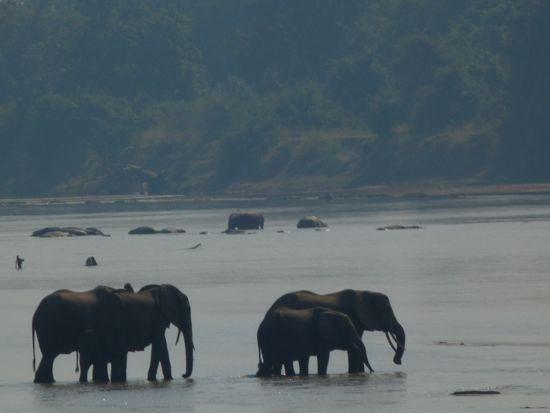

Mom, wait!

On the way to Mfuwe airport, we see Eland – we’ve been looking and looking for these large elk-like ungulates, they are shy and elusive, but Jonah spots them off in the distance, a parting gift from Nsefu.
We have an all-too-brief mad dash through Tribal Textiles, where we ‘invest’ in tablewares, cushion covers and deco for children’s rooms. AdventureMan befriends one of the Tribal Textile cats while I am busy shopping. I have cleared out my backpack so I would have space to put my purchases. 🙂
We have a full flight from Mfuwe to Lusaka, and not a lot of time to spare before our next flight. Smooth flight to Lusaka, just minutes to pick up luggage and transfer to next ProFlight flight, this one is not even on the departure board, only eight passengers, our party of four and a German family from Bavaria. At the very last minute another man comes running, running to catch the plane, we are all busy chatting, it is already a family. They are en route to Chiawa.
It’s a short flight, but here comes the most exciting moment in our day. The pilot is looking at a cheat sheet and the suddenly the plane is saying loudly “Pull Up! Pull Up!Terrain! Terrain!”
The pilots are looking confused and annoyed, one still looking at the instruction sheet, a mountain is rising in front of us, the plane is banking and the loud voice keeps saying “Pull up! Pull up! Terrain!”
I thought I had a movie of all this. I remember making a movie, thinking that if these are my last moments, I will record what happened and try to store the iPad in a place where it might be safely found. Of course, as it turns out, we landed safely and . . . somehow, I don’t have the movie. I must have shut it off too quickly and it didn’t save; I was in a hurry – just in case those were my last moments. I have to admit I am disappointed not to have it to share with you.
Waiting at the airstrip is Victor, our guide, and we rode with him and Chris, who turns out to be one of the owners of Chongwe, to the Chongwe River Camp.
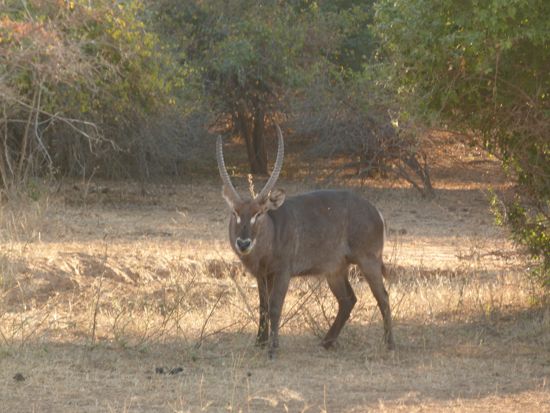
(This is a waterbuck we passed on our way into camp, and again on our way out of camp the next morning; so so sad, part of the circle of life and death, but as we departed Chongwe, his bloated body was in the same field; they suspect he was bitten by a snake and died.)
Arrival is lovely, we are greeted at a tall stand, so we are not climbing in and out of the Land Cruiser, we walk right out onto this stand and down the steps. Flossie greets us and then they tell us that we have been upgraded and put in the family suite.
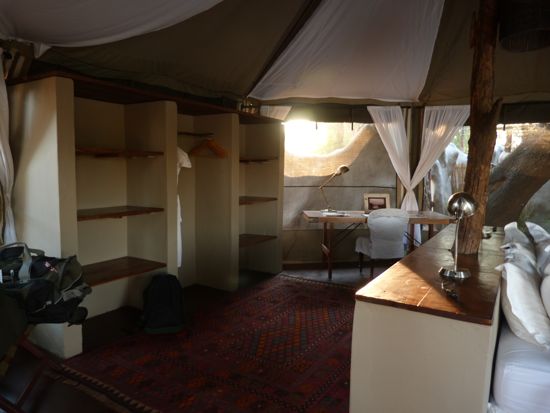
The Family Suite . . . As soon as we see it, we remember. We had totally forgotten . . . we loved our cabins at Chongwe, we were delighted with all the amenities, and we also remember our first boat trip riding by a place that looked like a fantasy from 1001 Nights, a tented living room and dining room, with carpets and nice furniture and linen tablecloths and gleaming candles – it was so lovely. We remember, it was the family suites. And now, the family suite was ours!
We were a little dazed by our good fortune, we couldn’t believe this lovely place was ours. Our butler, Steve, offered us drinks, Flossie, the camp hostess showed us to our bedroom/bathroom/dressing areas and explained how everything worked, where the electrical outlets and switches were, how the double shower works, where the bath oils were for the claw-footed bathtub, gave us the white cotton pique robes and the fluffy thick Turkish Towels.
This is our sleeping area:

This is our dressing area:
This is the view from our tent toward where the Chongwe River meets the Zambezi River:

This is our bathroom, with a two-person shower and claw-foot tub 🙂

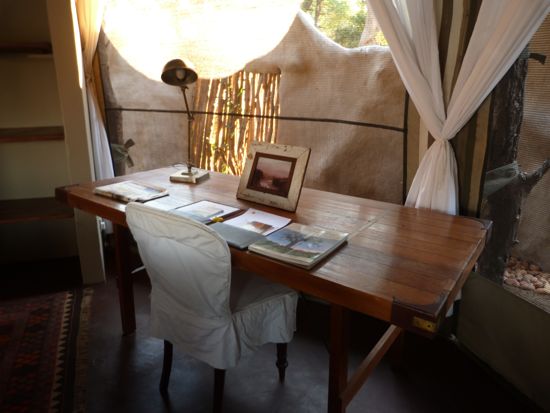
And this is the desk area, also where we can charge our batteries and electronics:
This is our dining room:
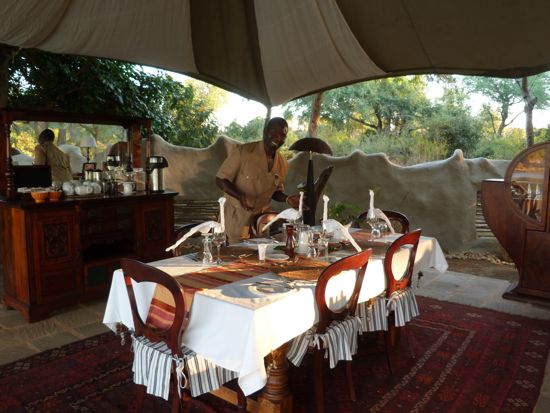
The Family Room:

This is the view out over our swimming pool to the Chongwe and Zambezi Rivers, and the hippo pods:
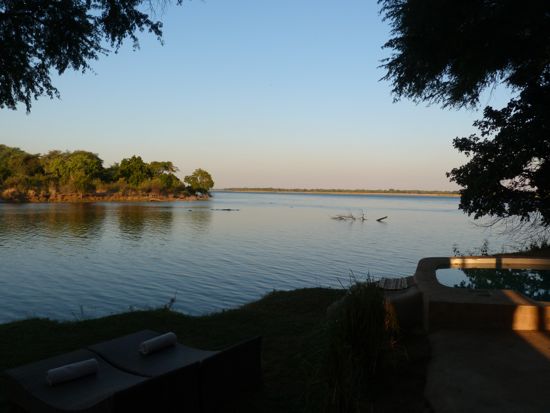
There are woven mats and kelim carpets, and we feel at home, if home can be a huge octagonal tent with an indoor / outdoor feel. Victor comes back, pulling up in a boat next to our swimming pool,to take us for a sundowners up the Chongwe and then back down into the Zambezi.

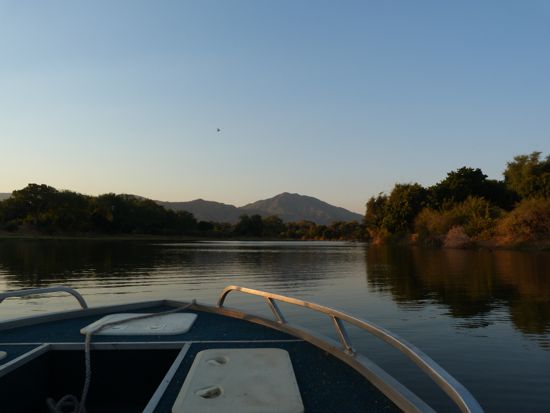
And Victor has fishing equipment with him for the fishing enthusiast in our party. He is able to cast to his heart’s content with a rod and reel trying to hook a Tiger Fish (catch and release) but no luck.

We see lots of animals coming down to drink at dusk, just across the Chongwe:


Our first Chongwe sunset:

Dusk settles on the Zambezi:

After sundowners, we head back and go to our luxurious tents to clean up, then reassemble around the fire to have a glass of wine before dinner.
The ultimate luxury is privacy. We have met such lovely people in the camps, and still, I am who I am, it is hard for me to exert myself to be charming every night at the end of a long day. I do fine at breakfast around a campfire. I manage at lunch, although after an early start and a long game drive, I am usually eager for a quick snooze. But by night, at the end of the game drive, all I want is comfort food, quick, like tomato soup and a cheese sandwich, not so much chit chat and good night, see you all in the morning when I am more chipper.
I recognize there are people who do well later in the day. I recognize that there is this thing called civilized behavior. I do have manners, I know what is important, and . . . yet . . . late in the day, I have the nature of a curmudgeon. I need some quiet. AdventureMan and our friends are out having a great conversation in our living room area, I can hear them, I delight that they are having such a great conversation, and I really, really need to be in here, writing up my notes. By the grace of God, they understand me and have compassion on me. I am able to join them a little later, and we have a lovely laughter-filled dinner in our private dining room and then off to bed – we have a full day tomorrow in Chongwe!
The butler, Steve, does wonderful napkins:

We did nothing to deserve this beautiful upgrade. We loved the spacious tents we had the last time we were in Chongwe River Camp, but this . . . this is a totally unexpected, undeserved blessing, it just fell in our laps, and we are so appreciative. We feel so cherished, so blessed, so beautifully taken care of. We go to sleep with the sound of hippos . . . . .ZZZzzzzzzzzzzzzzzzzzzzzzzzzzz . . . . . .
“Never for Acclaim, Always for Country”
This weekend the CIA also honors fallen warriors, and in a new level of transparency, shares some of those names. It’s devastating to lose a loved one in the military, and I cannot imagine what it was like to lose a loved one and not to even be able to tell people your loved one was lost in service to his or her country. Heartfelt thanks to all those who have served silently and anonymously and sacrificed identity and history for our nation. You know who you are. 🙂
From ABC News:

Out of the shadows in death: The CIA honors its fallen
By Suzanne Kelly CNN – When you’re a spy, you have to accept the fact that everything you do will go unnoticed by most people during your life. Sometimes that secrecy even follows you in death, with a simple star carved into a marble wall at Langley being the only memorial to your service.
Sometimes though, in death, the names come out, along with just enough information to piece together a glimpse of what life — and death — have been like for CIA spies over the past three decades.
This past Monday, 15 names were added to what’s known by insiders as the “Book of Honor.” When a name is inscribed in the book, it allows family and friends of the fallen to publicly acknowledge in general terms, how their loved ones spent their lives, and how they died.
The names and brief stories shared with a crowd said to number in the hundreds gathered in the CIA lobby, told a story of an Agency spread far and wide; the story of an Agency not only consumed with tracking down terrorists, but sometimes becoming victims of the hunted.
Jeffrey R. Patneau, described by CIA Director David Petraeus as a “young can-do officer,” was killed in Yemen in September 2008. Yemen has become a hotbed of al Qaeda activity and is where a recent al Qaeda in the Arabian Pensinsula (AQAP) plot to bring down an airliner with a difficult-to-detect new explosive material, was recently foiled by undercover operatives.
Five of those honored this year died on April 18, 1983, when terrorists targeted the U.S. Embassy in Beirut, killing 63 people. Phyliss Nancy Faraci had also been one of the last four Americans evacuated from the Mekong Delta when Saigon fell, according to an Agency spokesman. She died in Beirut along with Deborah M. Hixson, Frank J. Johnston, and a married couple, James F. and Monique N. Lewis. Petraeus noted the Embassy bombing as the place where the Agency “first caught sight of the adversary we face today.”

To get a sense of just how widespread the CIA presence has been over the years, Matthew K. Gannon was killed in the December 1988 bombing of Pan Am Flight 103 over Lockerbie, Scotland; Molly N. Hardy was killed in the 1998 suicide bombing of the U.S. Embassy in Nairobi; Leslianne Shedd died when hijackers downed the plane she was on over the Indian Ocean in November 1996; Jacqueline K. Van Landingham was killed in Pakistan in March 1995; Barry S. Castiglione died during the ocean rescue of a colleague in 1992 in the waters off El Salvador; Lawrence N. Freedman was killed in Somalia in December 1992; Thomas M. Jennings, Jr. died in Bosnia in 1997; Freddie R. Woodruff was killed in Georgia in 1993; and Robert W. Woods died in a plane crash during a humanitarian mission to Ethiopia in 1989.
Petraeus told the group of gathered mourners and friends that the officers who have died for the mission “all heard the same call to duty and answered it without hesitation — never for acclaim, always for country.”
One more star has been carved into that wall so far this year, bringing the number of stars representing fallen officers to 103. We don’t know who the latest person was, or how they died, but maybe someday, we will.
Copyright 2012 Scripps Media, Inc. All rights reserved. This material may not be published, broadcast, rewritten, or redistributed.
Jesmyn Ward and Salvage the Bones

You are fifteen, poor, black, and motherless as this book opens. Dad drinks, and isn’t around much. You are the only girl in a family of brothers. Having sex is no big deal, and there is one guy you really like, Manny.
Your oldest brother’s pit bull is having puppies, and you are having trouble with throwing up most of what you eat, especially every morning. Dad says a hurricane is coming, but he’s said that before, no big deal.
As this book opens, it has the feel of a myth of the nightmare kind. We know, because we have the benefit of hindsight, that the impending storm, Katrina, will be catastrophic. The Batiste family has already suffered a catastrophic storm with the death of their Mama, just after the birth of her last child. Throughout the book, we watch these children suffer the daily absence of their mother, raising one another, squabbling, but tenderly looking after one another.
If someone had told me about this book, I don’t think I would have wanted to read it. Amazon.com kept telling me I needed to read it, so finally, I did. From the opening page, I was in a world utterly alien from my own, and yet a world I could understand and inhabit. There are worse things than being poor, and one of them is heartless. This family has heart; they are loyal to one another, they look after one another and they sacrifice for one another. For all the violence – and there is a lot of violence – there is also beauty.
There is the familial love, and there is the love between Skeet, the oldest brother, and his dog, China. There is friendship, and good people who give you refuge in the aftermath of the storm. There is the stunning numbness of surviving the worst hurricane ever.
Jesmyn West has a deft touch, with the language, with the interweaving of the Medea myth, with non-verbal communication, with the complexities of families and love. This is a book worth reading.
Hardest Day of the Year
Today is beautiful, after endless days of clouds and rain, clear, sunny, not quite so hot, yes, the pollen is flying about, but all in all, not such a bad day.
And yet, the hardest day of the year, the church year.
Our Gospel reading for today, from The Lectionary:
John 13:36-38
36 Simon Peter said to him, ‘Lord, where are you going?’ Jesus answered, ‘Where I am going, you cannot follow me now; but you will follow afterwards.’ 37Peter said to him, ‘Lord, why can I not follow you now? I will lay down my life for you.’ 38Jesus answered, ‘Will you lay down your life for me? Very truly, I tell you, before the cock crows, you will have denied me three times.
In my walk as a Christian, I am struck at how often his disciples, those who walked with Jesus, lived with Jesus, believed in Jesus and served Jesus with all their hearts – how often they misunderstood Jesus. He often had to correct their idea of what he was trying to tell them about life, about the kingdom of heaven. Peter, one of his earliest disciples, one who loves Jesus utterly, is about to deny his Lord and Master three times.
On Good Friday, we are all Peter.
“You Brought the Sunshine!”
When I arrived in Seattle, my best friend from University said “You brought the sunshine!”

(This week’s weather in Seattle)
Now, when I fly back to Seattle, it takes a mere half day, not a day and a half. When I leave early enough, I can arrive mid-day, and beat the rush hour traffic. You’d think after driving in Kuwait and Qatar that I would find Seattle traffic tame, but Germany, with it’s wide-laned autobahn, and Pensacola, with it’s laid back version of going-home traffic have spoiled me.
Seattle is beautiful, although my trip is one of those more stressful ones, with things to be done to manage changing circumstances. My Mom may – or may not – have had a stroke. What is verifiable is that she has been very very sick, too sick to live on her own any longer, sick enough to need hospitalization, and professional monitoring from now on. The sisters have handled mountains of work and desperate calls for assistance, and now it is my turn to do what I can.
I stayed in Mom’s condo, but it was a little soulless, all her favorite pieces of furniture moved to her new place, her plants languishing, the stuff and detritus of life waiting to be cleared out.
Thank God for my best friend, and for the sunshine.
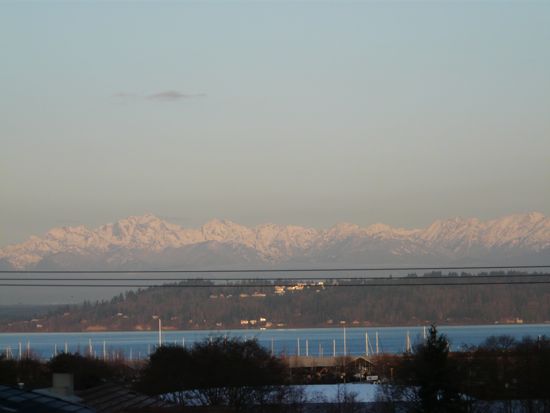
The sun just beginning to color the mountains as it rises off in the east.
The sisters had a full day of business, money, finances, and Mom’s recovery plan. We get a little goofy after a while; it’s a family culture. Our way of handling the worst, worst of times is laughter, and there were several times we were almost breathless from laughing. Yeh, I guess some would find it inappropriate, but for us, for our family, I think it is how we survive.
My second day there, we had a joyful family wedding. It was one of the sweetest events I have attended in a long time, and I loved the way the bride and the groom looked at each other, that they enjoyed their own wedding, smiling, laughing, dancing. Their signature was over everything; the colors (Purples!) and the food and the music and the ceremony, it was all perfectly thought through and delightful.
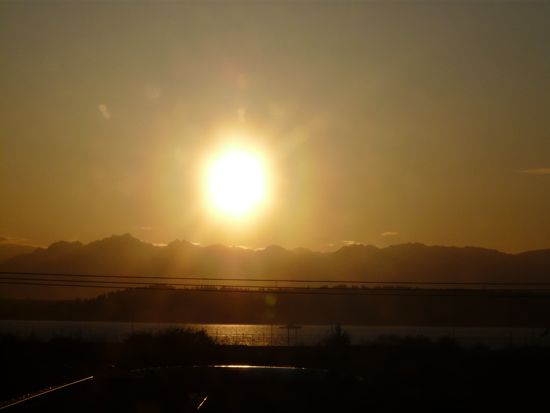
Sun setting in the west over the Olympic mountains
The rest of the trip was just hard work. And now, back in Pensacola, I have flights booked already for my next trip back. All part of life’s circle, I guess.
Through all this, we have met with kind, helpful people, who have made all the sorting out easier. Thanks be to God.
Driving in Qatar
Almost every day, the two articles garnering the greatest number of hits have to do with new traffic rules in Kuwait and in Qatar. I think I wrote the posts in 2009. Here is what the US Department of State has to say to US Nationals about driving in Qatar:
TRAFFIC SAFETY AND ROAD CONDITIONS: While in Qatar, you may encounter road conditions that differ significantly from those in the United States. The information below concerning Qatar is provided for general reference only and is subject to change at any time. Current traffic regulations may be obtained through the Ministry of Interior’s Traffic Police.
Short-term visitors should obtain a valid International Driving Permit prior to arrival and should not drive in Qatar on a U.S. driver’s license. New and prospective residents should obtain a permanent Qatari Driving License immediately after arrival. To obtain a Qatari driver’s license, U.S. citizens need to pass a driving exam, including a road test. Short-term visitors and business travelers can also obtain a Temporary Qatari Driving License by presenting their U.S. driver’s license at any branch of Qatar’s Traffic Police.
Traffic accidents are among Qatar’s leading causes of death. Safety regulations in Qatar are improving, thanks to a more stringent traffic law adopted in October 2007 and a country-wide traffic safety campaign. However, informal rules of the road and the combination of local and third-country-national driving customs often prove frustrating for first-time drivers in Qatar. The combination of Qatar’s extensive use of roundabouts, many road construction projects and the high speeds at which drivers may travel can prove challenging. The rate of automobile accidents due to driver error and excessive speed is declining but remains higher than in the United States. In rural areas, poor lighting, wandering camels and un-shouldered roads present other hazards.
Despite the aggressive driving on Qatar’s roads, drivers should avoid altercations or arguments over traffic incidents, particularly with Qatari citizens who, if insulted, have filed complaints with local police that resulted in the arrest and overnight detention of U.S. citizens. Drivers can be held liable for injuries to other persons involved in a vehicular accident, and local police have detained U.S. citizens overnight until the extent of the person’s injuries were known. Due to its conservative Islamic norms, Qatar maintains a zero-tolerance policy against drinking and driving. Qatar’s Traffic Police have arrested Americans for driving after consuming amounts of alcohol at even smaller levels normally accepted in the U.S.
Any motor vehicle over five years old cannot be imported into the country. For specific information concerning Qatari driver’s permits, vehicle inspection, road tax and mandatory insurance, please contact either the Embassy of the State of Qatar in Washington, DC or the Consulate General of the State of Qatar in Houston, Texas.
There are things that the Department of State is too diplomatic to tell you, and that people living there will not write for fear of having a travel ban put against them, a case filed against them for ‘insulting’ a national or the government.
The beautiful roads in Qatar were wonderful when they had a tenth of the cars on the road they have now. There are two categories of “most dangerous.” One category is the expat $200 car held together with gum and rubber bands that breaks down in the worst possible place, or has a blow-out, or hits someone because the driver not only doesn’t have a license, he also doesn’t know how to drive.
Although there are rules about what trucks are allowed to haul and how it is to be tied down, the laws are ignored and unenforced. It is still important never to travel behind or beside a truck carrying cement blocks. They look like they are not secured. They are not secured. Watch out, too, for any truck delivering bottled water (that makes a huge mess all over the roundabout) or sheep or cows, which regularly overturn.
The worst hazard of all is Qatari male drivers between 11 and 35 years old. They own the roads. They will drive on the sidewalks, down the wrong way of a six lane highway to get to the roundabout, through red lights. They will push you into an unsafe roundabout with the Hummer daddy bought for their 12th birthday. If you insult a Qatari young male driver in any way, they may block you, stop you and threaten you, and no one, least of all the police, will come to your aid. They know no speed limits, blow through stop lights, harass female expat drivers, and they pay no fines for traffic violations. For a short time, the law was applied somewhat equally to all, but there were so many outraged Qataris paying the humungous fines that no one enforced the law against the Qataris anymore, and you rarely see the police stopping anyone except the poorest of the poor.
If you want to drive in Qatar, you will want a sturdy car to get over the unpaved areas and the roads torn up for infrastructure improvements, as well as for protection against the aggressive Qatari male drivers and the accidents that may not be your fault but cannot be avoided. You will want to drive only during the lowest traffic times of the day, if possible. Even during the summer, when much of the population goes elsewhere, anywhere, to avoid the heat, night traffic on the major ring roads, the major arterial roads and on the Corniche is gridlock.
The Department of State will also not tell you that if you are ever in trouble on the road, you are certain to have many kind older Qatari men stop and render assistance. They will insist on giving you water, and fixing whatever they can fix, or at the very least waiting with you until help comes. If they think you are lost as you journey around Qatar, they will make sure you get where you are going. There is a long tradition of taking good care of the guest, and of civility among the Qataris, but mostly it seems to kick in when they mature – like around 35 or so.
This may not be the truth for everyone; we all have our own stories, horror stories and stories of kindness. It’s a little bit of the wild west, driving in Qatar.
Unity in Diversity
As so often happens, when I read Forward Day by Day, an illumination of the daily readings in the Lectionary, I think “Oh! This is meant for me.”
My heart is heavy as the Syrian peoples in Homs and Hama are bombarded, and babies, children, mothers, non-combatants – all are killed, whether they are fighting or not. I remember the shivers as we would pass the headquarters of the Mukhabarat, or secret police, which we called ‘the fingernail factory’ and I am shamed at our shallowness and callowness, as the reality of people tortured and damaged just for the example of it. While I know that the troubles are political, they are following religious lines. Homs and Hama have always resisted the rule of the Alawites, and have suffered horribly, 30 years ago, at the hands of Bassam Al-Assad’s father, who almost leveled Hama. I know, because I visited there shortly afterwards. It was a silent ghostland, a beautiful city, deserted and haunted.
Who is next, Assad? After the cities of Homs and Hama – oh, and don’t forget Deraa – will you start hitting the Christian villages, even though the Syrian Christians are at the very least, neutral, and many support you? The monster of tyranny is not easily sated, and to survive, there must be constant sacrifices to keep the people in fear, or else they won’t be obedient.
This is all heavy on my heart. I lave loved Syria, all of it, not just Damascus. When will we learn to live in peace with one another?

(Image of Hama from WikiMedia)
John 17:20-26. The glory that you have given me I have given them, so that they may be one, as we are one, I in them and you in me.
This verse is taken from the so-called high priestly prayer of Jesus for the unity of the church. What is our understanding of unity in the church? From the outset there was a great diversity of Christian groups. Diversity arose from differing practices and religious customs as well as from the difficulty of interpreting authentically the mystery of the person of Jesus.
What is meant by the unity of all Christians? An imposed uniformity in which everyone must bow their heads and obey without freedom of expression and cultural variations? That would be more harmful than beneficial. That idea persisted for a long time and led to the imposition of strict uniformity in religious practice worldwide. It was pernicious.
Today we realize that there can be unity in diversity. It is important to highlight the diversity of cultures while maintaining unity. The unity that Jesus wanted was based on love, compassion, and mercy—not uniformity.
PRAY for the Diocese of Bukuru – (Jos, Nigeria)
Ps 30, 32 * 42, 43; Ezekiel 39:21-29; Philippians 4:10-20
Depends Who Writes the Obituary . . .
I am sorry, but this totally cracks me up. I found in on AOL Huffpost and it is about a Tampa family, where the one writing the obituary gets to insert his point of view. We all have families; they each have their points of view.
When I am reading the obituaries, the ones that crack me up are the ones who have clearly written their own obituaries and had them ready to go when their time is up. Many of the ones written by men are a little grandiose, the ones written by women are more matter-of-fact. You can usually tell what they found most important about the life they lived. Now and then, you find someone original, with a sense of humor and proportion about themselves, who talk about hunting, or their dogs, or sailing. There are people I wish I had met when I read their obituaries; maybe we should all publish pre-death summaries of our lives so far . . . Oh wait . . . that’s a blog, LOL!
When AdventureMan says “that’s not how I remembered it!” I always say (you’ve heard it before, you can say it along with me) “Get your own blog, AdventureMan!” But it is true, the one who is doing the blog gets to skew the history, LLOOLL!
By Laura Rowley
One of my first assignments in my first real job in journalism was writing obituaries for The Milwaukee Journal. I found it a little daunting at first, this job of writing about the dead. But that changed after a phone call with a woman whose daughter had died in a car crash overseas with her husband and toddler.
It was my job to call the family for the story, and I assumed the mother would hang up on me. Instead she spoke for an hour, sobbing, telling me stories about her extraordinary daughter and son-in-law, and the grandchild she had barely gotten to know. At the end of the call she said, “Thank you, my husband won’t talk with me about this.”
In every call I made after that I had a different attitude. I realized that the obituary is a place where ordinary people have the opportunity to honor the people they love in a very public way.
That is, unless the survivor is self-centered enough to believe the obituary is about him, as appears to be the case with Angelo “A.J.” Anello of Florida. Anello placed an obituary for his mother Josie, who died on February 11, taking the opportunity to insult his siblings Ninfa and Peter with the following line:
“She is survived by her Son, ‘A.J.’, who loved and cared for her; Daughter ‘Ninfa’, who betrayed her trust, and Son ‘Peter’, who broke her heart.”
The source of this rivalry between these post 50 siblings? Money. Ninfa Simpson told the Tampa Bay Times that her brother A.J. became more controlling over their mother once their father died, which A.J. denied. The two told the paper that the third sibling, Peter, has been estranged from the family for more than 25 years. The Tampa Bay Times also reported that:
Simpson says Anello drained the mother’s savings and maxed out her credit cards. Anello says Simpson and her husband used their mother’s Social Security checks to go on vacations to Branson, Mo., and Alaska.
Both siblings deny the other’s allegations.
A.J. told the Tampa Bay Times that he was merely conveying what his mother said through the obituary; nevertheless, an alternative version of Josie Anello’s obituary — which does not include evidence of the siblings’ feud — has also been published.
What do you think about Josie Anello’s obituary? Let us know in the comments, and watch the below video to hear more about this unbelievable family rift.
Recent Comments
ExpatAlien on What Country am I Living … intlxpatr on Yellowstone: Old Faithful to C… Michelle on Yellowstone: Old Faithful to C… Cathy on No Grown-Ups in Charge intlxpatr on Waiting for Snow Wikipedia Donate Button

Amazina


Early Voting in Florida


 Here There and Everywhere