Grenada, Spain; One of the Most Beautiful Cities on Earth
Did you know the Spanish word for pomegranate is “grenade?” I didn’t know that either, but pomegranate is one of my favorite fruits. When I was a little girl, my mother would buy me a pomegranate now and again (these were not common where I grew up) because of the legend of Persephone. I was heavy into Greek and Roman mythology and she encouraged my explorations.
Grenada in named for the pomegranates. They grow everywhere in Grenada, and were in full fruit when we visited. After some of the rainy touring days we had, Grenada shone forth in warm sunshine and blue skies with perfect clouds for photo-taking. We toured the town, and then (dramatic pause) (hushed voice) we visited the Alhambra.
What I have loved about this journey is the intermingling of Arabic in the Spanish; Guadalquivir River “wadi al kebir”, Alhambra “al hamra”, and it really is very red. And it really is very beautiful, so very beautiful in glorious detail. I’m going to bore you with more photos than you ever wished to see because . . . well, I hate to be rude, but . . . it’s my blog. I love each and every photo.

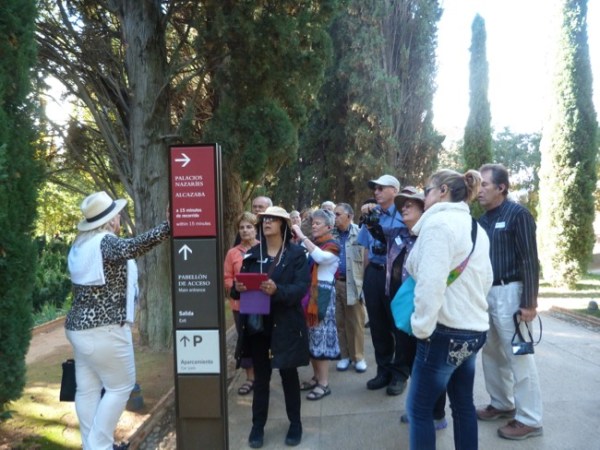
This is our group, gathering around our guide to enter the Alhambra.
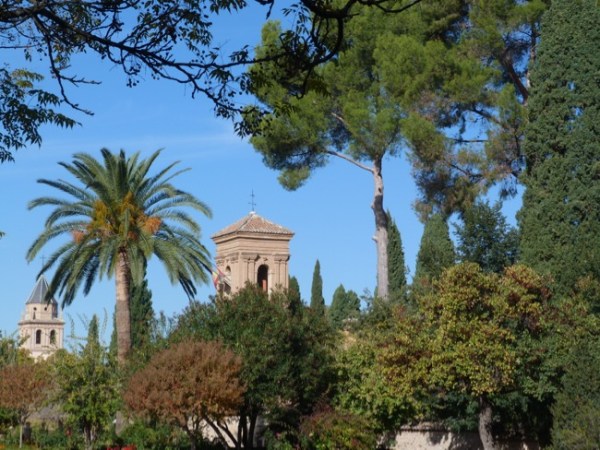
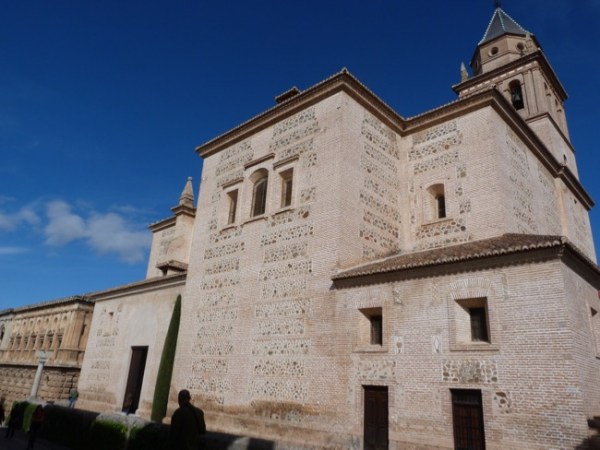
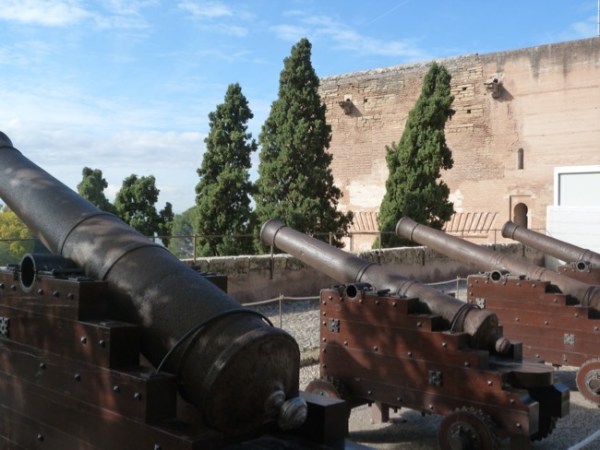
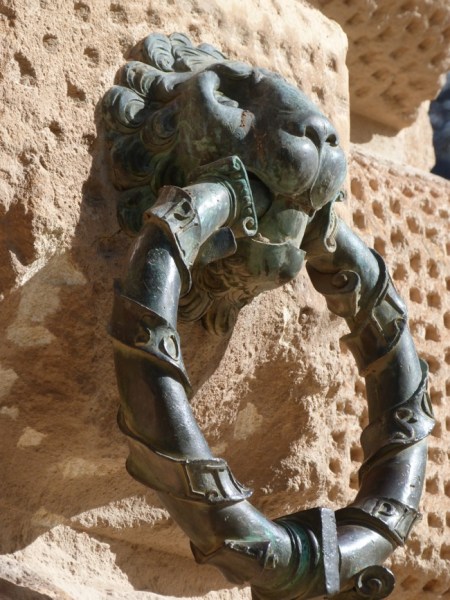

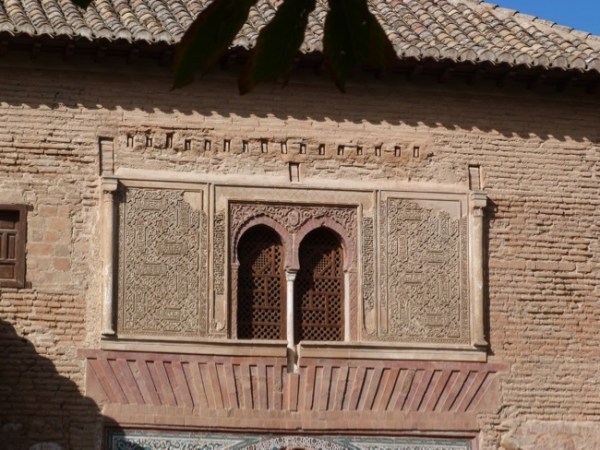






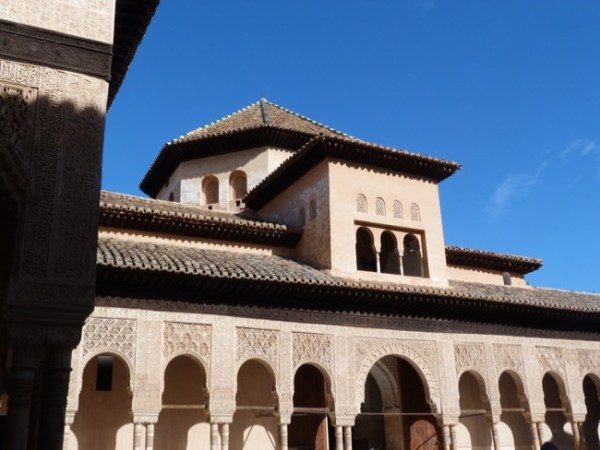
If this were a fabric, I would have a dress made of it. I loved the intricate intersection, and the blending of the blue and cream and brown.


This is my favorite photo, for any number of reasons, cats, light and shadow, intricate tracery on columns, etc. but it is also a reminder of a very strange occurrence. I had just finished taking this shot, hunched down for a low angle, when a young woman in a group of four came along and shoved others, and then me, out of the way. Literally, she took my arm and started to move me and said “we’re taking a group photo now.”
Normally, I tend to defer, but her arrogance, and her disregard for the feeling of others prickled me, and so I pulled my arm away and looked at her cooly, and said “as soon as I am done with my photo, I will move and you can take your shot. Or you can shoot it from another angle.” I don’t know why I did that, I am surprised at myself. I don’t like to cause trouble. But who has the right to shove others out of the way???
That is the memory this photo brings back.

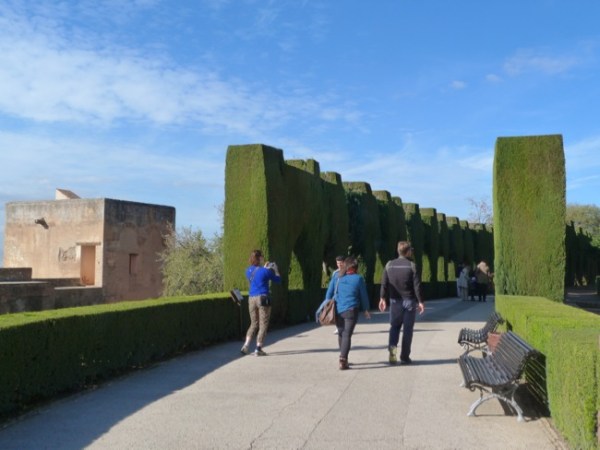
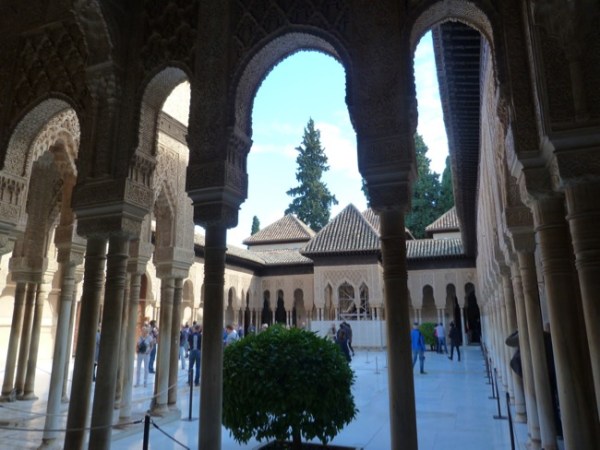
Please look at this photo, not that it is anything special but because there are people in it. I want you to appreciate how really, really, very hard it was to take some of these photos without people in them. I had to wait and wait, sometimes, (gasp!) I even got separated from my group for a short time, in the interest of getting an unimpeded shot. We were there at a lovely time of the year, perfect weather, and we thought there would not be too many tourists. We were astonished, in Seville, in Cordoba, in Grenada just how many tourists there were.


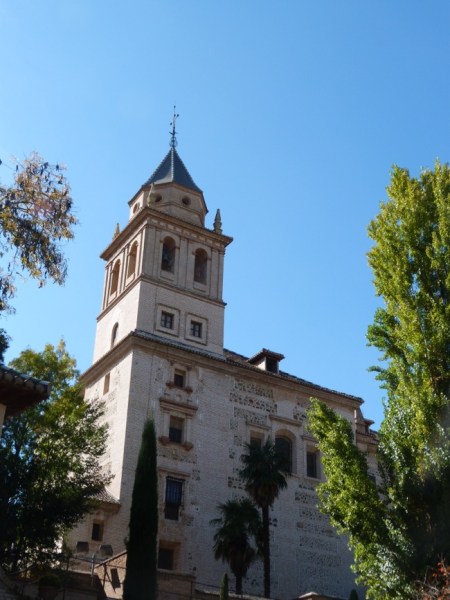
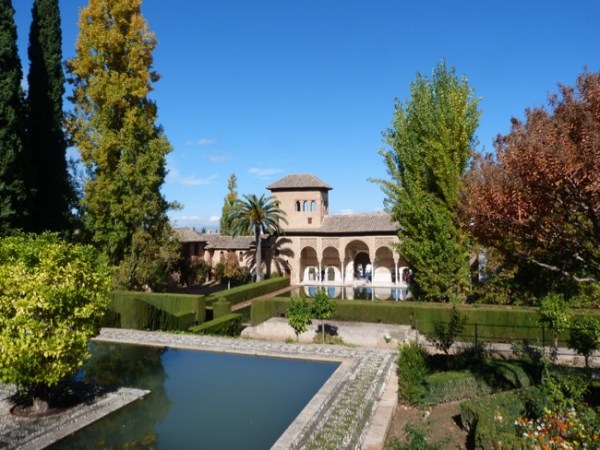
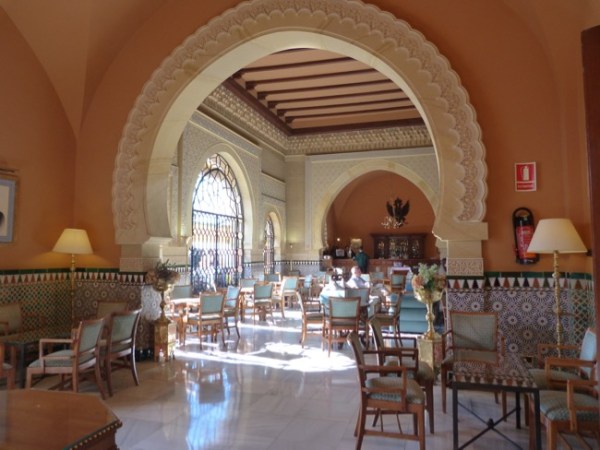
And here is where AHI Travel did something really right. This is the last day of the tour, tomorrow we all disembark and head for the Malaga airport and from there, to places scattered around the world. Just a short walk from the Alhambra is a beautiful hotel, beautifully situated, the Alhambra Palace. We’ve made note of it because we intend to come back to Grenada, and we want to stay in this hotel. This is where we ate lunch.


Our group had a closed in verandah with a beautiful view. Lunch was served in courses, and each was carefully prepared, and delicious. Very very clever way to end the tours on a high note 🙂

The room was beautiful. The table service was beautiful.

The view was beautiful.

After the meal, we got back on the bus to head back for the ship. Once on board, we had a Smithsonian meeting and then another lecture and then dinner, and something happened that has not happened to me for a long time, I had to pack at the last minute. Our suitcases had to be outside our door before we went to bed so they could be loaded to go, very early the next morning, to the airport.
I was coming down with something. I felt hot and feverish, and my nose was running. All my life, I have had nightmares about last minute packing. I hate doing last-minute anything, I am a planner, I like having a certain amount of control over my life, even though it is an illusion, it is an illusion I work hard to maintain. How did this happen to me? How is it that I am packing at the last minute, feverish and anxious?
It all got done. Fortunately, there are a limited number of places you can put things. For some reason, I am not able to download all our boarding passes, so we have only the first ones and will have to get the rest at the airport. I know where my passport is (I never have found the one I lost somewhere in my office) and my tickets and somehow we are finished and all is well by bedtime. I just hate that feeling of being rushed; when I am rushed, I make mistakes.
Every now and then something good happens. There is a huge line in Malaga, but our new friends also have tickets that put us in another line, and we get through quickly, with no problems. We say goodbye, we’ve exchanged e-mail addresses, and we go our separate ways. We have time to relax.
We arrive in Paris barely on time, and it is a Sunday morning with long lines at security, and there is no way out, we have to stand in line. We watch one very elderly man, unsteady, but with a great sense of humor, cope as he has to go through the full-body scan. Even though it is a few days before the bombing, security is tight. The airport is a nightmare. We have no idea where our next gate is, and we are almost running, as it is already our boarding time and we are not there. We have to go down this hall and that, then down to some gate where we catch a bus, then from that bus to somewhere else where we get to our plane with five or ten minutes to spare. That is cutting it way to close for me, but I know by now that I am coming down with one of the world’s worst colds and I sleep all the way from Paris to Atlanta, waking up now and ten to drink some Pomegranate Pizazz with honey to make the cold go away.
Not only does the cold not go away – I very generously shared it with AdventureMan. We both felt so bad we were sleeping all the time and didn’t even notice the jet lag 🙂 so by the time we were well again, we were also sleeping on Pensacola time. As soon as we were well, we got the super-strong flu shots to protect ourselves from anything worse than we’ve just had. 🙂
Palais Medina and Spa in Fes, Morocco
We were delighted to get to our hotel in Fes, the Palais Medina and Spa Hotel. Our room was very comfortable, but my shoes were muddy from Volubilis, and I forgot to take a photo of the room because I really, really needed to wash my shoes off and hope they would dry by the next day as we hike around Fes. It was very large, very beautiful, had a seating area and a huge bathroom. The bed was marvelous.
The Hotel had some quirks. As we were about to board the elevator, others from our ship were getting off and saying “We are NOT going to stay here!” and we wondered what that was all about. On our floor, the hallway was so dimly lit that we struggled to figure out where the card went into the door. But the room was lovely, comfortable, quiet, and it had a wonderful view.
We hurried down to dinner, seeing a sign that said “group dining” we knew where to go.
(I didn’t take this photo; I lifted it from the hotel website, but it looks like the room we stayed in)

From the elevator area into the lobby area:

View at night from our balcony looking left
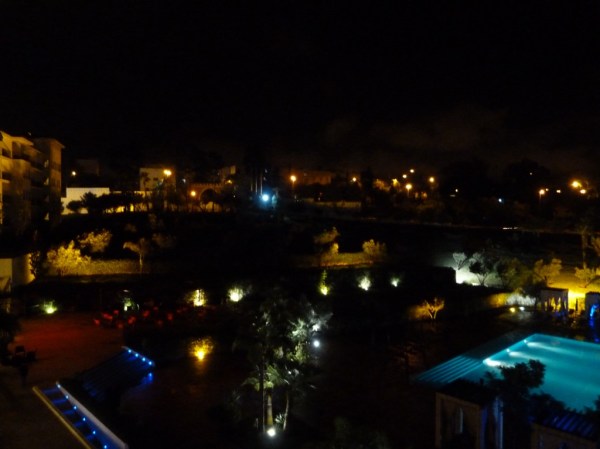
View early in morning looking out

More view. It really was a lovely room.

This has to be one of the worst experiences of the tour, tied with trying to get through Charles DeGualle to catch our Atlanta flight. The dining room was chaos.
“Grab a place, quickly; they are already starting to take the food away!” one fellow passenger urged us. We found places with friends, then went to search the inevitable buffet. There were still plenty of salad-y things, but entree pickings were slim. People in this hotel were elbowing one another out of the way, as if they had never seen food before, and this food was not worth elbowing anyone out of the way. It was buffet food, and the message it sent me was “this hotel takes groups because we have to in order to stay afloat, but we hate groups.” Dinner was purely awful. I can’t even remember what we found to eat, but except for a pumpkin soup, it was not good and not memorable food except for being not-good.
You’d think it would be hard to screw up breakfast, but breakfast was worse. They had those two little coffee maker things, and long lines waiting for both tea and coffee. Worse – there were no coffee cups! Not one! After a while a few showed up, and what happened when fewer coffee cups than coffee drinkers were available showed us just how very thin the veneer of civilization is. This was our experience at this ultra-first-class hotel. Horrors!
Lesson learned: I did spot a restaurant separate from the group dining restaurant. Knowing now what I know, I would choose to pay for a good Moroccan meal at the private-dining restaurant. Morocco just isn’t that expensive, and Moroccan cuisine is delicious, worth paying for! I would never settle for a mediocre meal, paid for as part of our tour, just because it was paid for. Life is too short!
On the other hand, it was late, we had a long day, I still needed to make sure my shoes were cleaned, and we just wanted to grab a bite and go. This was a nice hotel, but not a stellar experience.
HOME by Somali poet Warsan Shire
An old friend from high school posted this on FaceBook today, and I found it so moving and so true that I had to repost it here:
HOME
Warsan Shire
no one leaves home unless
home is the mouth of a shark
you only run for the border
when you see the whole city running as well
your neighbours running faster than you
breath bloody in their throats
the boy you went to school with
who kissed you dizzy behind the old tin factory
is holding a gun bigger than his body
you only leave home
when home won’t let you stay.
no one leaves home unless home chases you
fire under feet
hot blood in your belly
it’s not something you ever thought of doing
until the blade burnt threats into
your neck
and even then you carried the anthem under
your breath
only tearing up your passport in an airport toilets
sobbing as each mouthful of paper
made it clear that you wouldn’t be going back.
you have to understand,
that no one puts their children in a boat
unless the water is safer than the land
no one burns their palms
under trains
beneath carriages
no one spends days and nights in the stomach of a truck
feeding on newspaper unless the miles travelled
means something more than journey.
no one crawls under fences
no one wants to be beaten
pitied
no one chooses refugee camps
or strip searches where your
body is left aching
or prison,
because prison is safer
than a city of fire
and one prison guard
in the night
is better than a truckload
of men who look like your father
no one could take it
no one could stomach it
no one skin would be tough enough
the
go home blacks
refugees
dirty immigrants
asylum seekers
sucking our country dry
niggers with their hands out
they smell strange
savage
messed up their country and now they want
to mess ours up
how do the words
the dirty looks
roll off your backs
maybe because the blow is softer
than a limb torn off
or the words are more tender
than fourteen men between
your legs
or the insults are easier
to swallow
than rubble
than bone
than your child body
in pieces.
i want to go home,
but home is the mouth of a shark
home is the barrel of the gun
and no one would leave home
unless home chased you to the shore
unless home told you
to quicken your legs
leave your clothes behind
crawl through the desert
wade through the oceans
drown
save
be hunger
beg
forget pride
your survival is more important
no one leaves home until home is a sweaty voice in your ear
saying-
leave,
run away from me now
i dont know what i’ve become
but i know that anywhere
is safer than here.
“HOME,” by Somali poet Warsan Shire
Expendables; Pray for Paris

I have to take a break from my trip stories to express an opinion.
We are The People of the Book. Suicide is not an option. The most precious gift we are given, of the many gifts, is the gift of life. One of the most heinous crimes against God / Allah is to shed innocent blood.
A callous theocracy sends “inspired” martyrs, testosterone-hopped-up jihadists to kill themselves, and to take as many victims as they can with them.
By what stretch can they claim to do God’s will? Where is the submission to the word of God? Where is the peaceful Islam of the Prophet Mohammed?
Bureaucracy With a Heart
Did I tell you we’ve been stationed with two embassies, and at the second, I worked as a Foreign Service Officer? I know how busy and how harried the diplomats are, and I know how beleaguered the consular offices are with requests for visas and tourists who have lost their passports. They see it every day.
I lost my passport. My bad. Totally on me. I can’t expect anyone to feel obligated to help me out, but fortunately, there are mechanisms in place to expedite. You have to pay extra, but it’s worth it when you have a trip booked.
I told you about our run to New Orleans to submit paperwork and my delight to learn I would have a new passport soon.
I told you about the phone call telling me they needed a RECENT photo, not the same one that was on my last (never used, bright shiny new never used) passport.
I’ve been on edge all day. I’m away this weekend on a religious retreat, and I wasn’t feeling very religious. I was feeling nervous. I wonder if my passport reached New Orleans, or did it fall somewhere between the cracks? I wonder if Fridays are even work days at the passport center? What if it doesn’t get there and I don’t even know?
A short time ago, I got a phone call, from the same bureaucrat who called me about the photo. She was just calling to tell me that the passport is ready and will go out expedited this afternoon. She knew I would be concerned, and just wanted me not to worry.
I almost cried in gratitude. Who thinks of compassion when dealing with a bureaucracy? It was pure grace.
In the lifetime of our nation, we have elected some real doozies in high public office. Presidents, Senators, Representatives, Governors – some real characters. I don’t worry too much when lunatics run for high office, I thank God we have a solid bureaucracy, rarely corrupted; a bureaucracy that keeps plugging along when things get crazy. And thank God for this one particular officer who had a heart to reassure me that my passport is on the way. God bless her mightily.
To Have Diplomatic Immunity, You Actually Need Diplomatic Credentials
Not only did Sheikh Khalid bin Hamad al Thani rent this house before he fled the USA fearing arrest for reckless driving, but now Saudi Prince Majed Abdelaziz Al-Saud rents the same house and is arrested after forcing some young woman to have oral sex. She was seen escaping the house and crawling over the wall to get away. Sorry guys. You may get away with these things in Qatar and Saudi Arabia, but not in the USA. And it’s just embarrassing to claim diplomatic immunity when it’s so easy to prove you have none. We have to play by your rules when we live in your country. It’s called being a good guest. Please pay us the same courtesy. It’s our country.
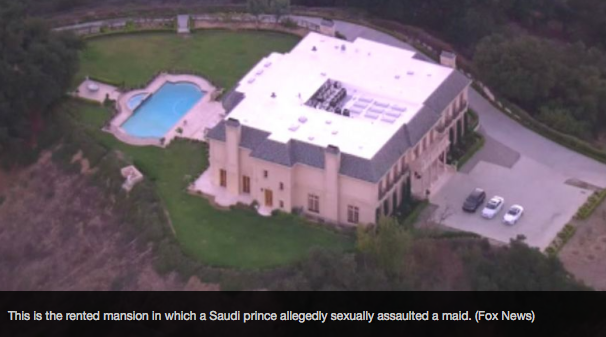
From today’s AOL News/Fox News:
A Saudi prince was arrested Wednesday at a compound near Beverly Hills in connection with an alleged sex crime after a bleeding woman was seen trying to flee the grounds.
Majed Abdulaziz Al-Saud, 28, was arrested on suspicion of forced oral copulation of an adult, according to the Los Angeles Times. Police were called to the gated compound after a caretaker at the home reported the disturbance. The Times, citing jail records, reports Al-Saud was freed on $300,000 bail Thursday afternoon. LAPD officer Drake Madison told the newspaper the suspect was booked after 4 p.m.
Capt. Tina Nieto said the police department has a consul liaison that checks with foreign nations’ consulates regarding a certain person’s diplomatic immunity. Nieto said Al-Saud doesn’t have immunity in this case.
Tennyson Collins, a neighbor, told the Times he saw a bleeding woman trying to scale the property’s 8-foot wall on Wednesday. When Collins returned home from work, police followed his car through the gates and then onto the property. He said officers escorted about 20 people out of the compound, most of them staff members.
Police said Al-Saud was renting the home, which Zillow values at $37 million. Collins said different foreign nationals have been renting out the home for weeks at a time over the past year.
Earlier this month, a Qatari prince, Sheikh Khalid bin Hamad al Thani, was videotaped racing a yellow Ferrari through Beverly Hills at speeds of up to 100 miles per hour, blowing through stop signs and frightening residents. Al Thani later denied driving recklessly and claimed he had diplomatic immunity, Beverly Hills police said. Authorities consulted with the State Department and the Qatar consulate and determined he did not have diplomatic immunity, police Chief Dominick Rivetti said during a Sept. 17 news conference.
Al Thani reportedly flew back to Qatar before he could be arrested.
Qatar Sheikh Khalid bin Hamad Al-Thani Flouts US Law, Forced to Flee Country

Sorry, Sheikh Khalid, you do not have diplomatic immunity and you are not above the law. This is from AOL AutoBlog:
A prominent Qatari national has reportedly fled the United States after a video ostensibly showing his Ferrari racing through the streets of Beverly Hills went viral. Although the exact identity of the driver remains unclear, it is believed that the yellow LaFerrari was owned by Sheikh Khalid bin Hamad Al-Thani, a member of the ruling family of Qatar, the country’s former interior minister and a well-known racing enthusiast.
The video below, which has already attracted some 1.5 million views (but contains language that may not be safe for the workplace), shows the yellow hybrid hypercar racing with reckless abandon against a white Porsche 991 GT3 through the swanky Los Angeles neighborhood. The Ferrari is shown scraping its chin spoiler on the road before pulling back into the driveway (alongside a black Bugatti Veyron) with smoke billowing out its engine bay. Neither of the European exotics appear to show much regard for traffic laws, running stop signs as they speed through a residential area. The Ferrari appears to be wearing Qatari plates, while the Porsche does not appear to be carrying plates at all – just some racing decals on the doors and hood.
According to reports, the Ferrari belongs to Sheikh Khalid, but the identities of the drivers behind the wheel of either car has not been ascertained. The Al-Thanis are known for their supercar collection, which is shipped around the world for the enjoyment of royal family members. Their signature teal and black exotics are a regular site around London.
The Beverly Hills Police Department confirmed that, when approach by officials, the driver claimed diplomatic immunity – which the driver may not actually have. “It is against a federal law for someone to claim diplomatic immunity when they don’t have it,” said police chief Dominick Rivetti. The Ferrari was not, according to reports, registered with the State Department as belonging to a credentialed diplomat. Al-Thani has since reportedly fled the country, and taken his cars with him.
Walter Palmer, “Tiny-Dick” Hunter
While we lived in Germany and Qatar and Kuwait, we went every year to Africa. On the smaller flights out of Johannesburg to Windhoek or into Zimbabwe or Zambia, we would encounter swaggering men, hanging out in the aisles, talking loudly, usually with big bellies, all decked out in safari gear/ersatz military camo. At first, I thought they were mercenaries of some sort, they seemed to be so full of themselves. Then a stewardess told me they were the “tiny-dick” hunters.
I had never heard the term. These are men, who, to make themselves feel good, pay thousands of dollars to be taken to an animal, like Cecil, the lion below, to kill. They have these hunts in the United States, too, where semi-tamed lions are shot at game farms, trapped, and fed, only to be sacrificed to the egos of the “tiny-dick” men.
Walter Palmer says he was told all the permits were in order. A news article on NPR yesterday tells how this famous lion from a protected game reserve was lured across the boundary so that Walter Palmer could shoot his with is little bow and arrow. Walter Palmer has broken the rules and lied before. He has a history of imagining that the boundaries do not apply to him.
I love it that his shameful behavior has been outed, and that his name and his detestable hobby are now known internationally as a man who would shoot a beloved lion for the sake of his ego. Below is the story from Associated Press via AOL News:

BLOOMINGTON, Minn. (AP) — A Minnesota dentist who went on a guided bow hunting trip for big game in Zimbabwe said that he had no idea the lion he killed was protected and that he relied on the expertise of his local guides to ensure the hunt was legal.
Walter Palmer, who has a felony record in the U.S. related to shooting a black bear in Wisconsin, released a statement Tuesday after Zimbabwean authorities identified him as the American involved in the July hunt. They said Palmer is being sought on poaching charges, but Palmer said he hasn’t heard from U.S. or Zimbabwean authorities.
“I had no idea that the lion I took was a known, local favorite, was collared and part of a study until the end of the hunt,” said Palmer, a dentist who lives in the Minneapolis suburb of Eden Prairie. He said his guides had proper permits, and to his knowledge, everything was handled properly.
“I deeply regret that my pursuit of an activity I love and practice responsibly and legally resulted in the taking of this lion,” he said.
The 55-year-old was identified by the Zimbabwe Conservation Task Force, the Safari Operators Association of Zimbabwe and police as the American facing poaching charges for the crossbow killing of Cecil, a well-known lion. Local authorities allege the lion was lured from a protected area and killed in early July. Zimbabwean conservationists said the American allegedly paid $50,000 for the trip.
The lion’s death has outraged animal conservationists and others, including U.S. Rep. Betty McCollum, a Minnesota Democrat. In a statement late Tuesday, the congresswoman called for an investigation by the U.S. Attorney’s Office and the U.S. Fish and Wildlife Service to see whether any U.S. laws were violated.
Ingrid Newkirk, president of People for the Ethical Treatment of Animals, condemned the lion’s killing in a statement.
“To get a thrill at the cost of a life, this man gunned down a beloved lion, Cecil with a high-powered weapon,” the PETA statement said.
Palmer’s hired spokesman, Jon Austin, said he believed Palmer was in the Minneapolis-St. Paul area Tuesday. No one answered the door at Palmer’s home, and a woman who came out of his dental office in nearby Bloomington said he wasn’t there or taking patients Tuesday. Phone calls to listed home numbers went unanswered.
According to U.S. court records, Palmer pleaded guilty in 2008 to making false statements to the U.S. Fish and Wildlife Service about a black bear he fatally shot in western Wisconsin. Palmer had a permit to hunt but shot the animal outside the authorized zone in 2006, then tried to pass it off as being killed elsewhere, according to court documents. He was given one year probation and fined nearly $3,000.
Doug Kelley, a former federal prosecutor and Palmer’s attorney in the bear case, was unavailable for comment Tuesday, according to his assistant.
Palmer has several hunts on record with the Pope and Young Club, where archers register big game taken in North America for posterity, said Glenn Hisey, the club’s director of records. Hisey said he didn’t have immediate access to records showing the types and number of animals killed by Palmer, but he noted that club records involve legal hunts “taken under our rules of fair chase.”
Although African game wouldn’t be eligible, Hisey said he alerted the group’s board that Palmer’s ethics were being called into question. He said Palmer’s domestic records could be jeopardized if he’s found to have done something illegal abroad.
A Facebook page for Palmer’s Minnesota dental practice was taken offline Tuesday after users flooded it with comments condemning Palmer’s involvement in the hunt. Hundreds of similar comments inundated a page for his dental practice on the review platform Yelp, which prior to Tuesday had only three comments.
Some people left stuffed animals at the door to his shuttered office Tuesday in a sign of protest.
Palmer is properly licensed and able to practice in the state, according to the Minnesota Board of Dentistry. Board records show that Palmer was the subject of a sexual harassment complaint settled in 2006, with Palmer admitting no wrongdoing and agreeing to pay a former receptionist more than $127,000.
A Revolutionary Document
“Shisha, what’s all this Fourth of July stuff? What is the Fourth of July?”
“It’s a birthday! It’s the birthday of the United States of America!”
Have you ever read the Declaration of Independence? It is an extraordinary document.
Happy Birthday, United States of America!
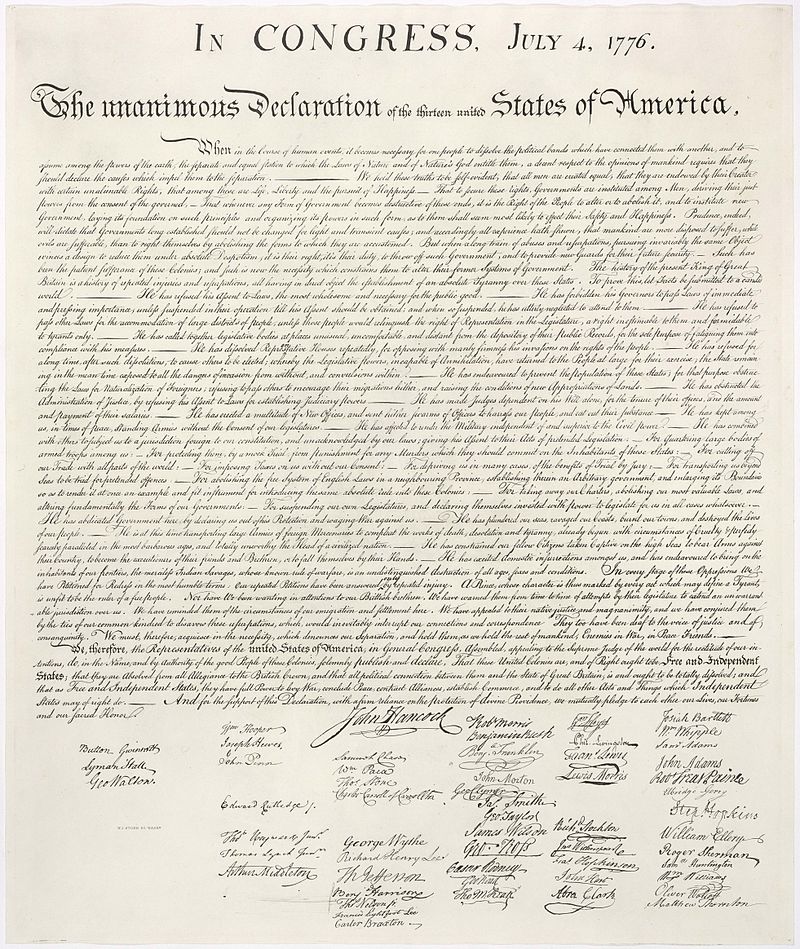
The Declaration of Independence: A Transcription
IN CONGRESS, July 4, 1776.
The unanimous Declaration of the thirteen united States of America,
When in the Course of human events, it becomes necessary for one people to dissolve the political bands which have connected them with another, and to assume among the powers of the earth, the separate and equal station to which the Laws of Nature and of Nature’s God entitle them, a decent respect to the opinions of mankind requires that they should declare the causes which impel them to the separation.
We hold these truths to be self-evident, that all men are created equal, that they are endowed by their Creator with certain unalienable Rights, that among these are Life, Liberty and the pursuit of Happiness.–That to secure these rights, Governments are instituted among Men, deriving their just powers from the consent of the governed, –That whenever any Form of Government becomes destructive of these ends, it is the Right of the People to alter or to abolish it, and to institute new Government, laying its foundation on such principles and organizing its powers in such form, as to them shall seem most likely to effect their Safety and Happiness. Prudence, indeed, will dictate that Governments long established should not be changed for light and transient causes; and accordingly all experience hath shewn, that mankind are more disposed to suffer, while evils are sufferable, than to right themselves by abolishing the forms to which they are accustomed. But when a long train of abuses and usurpations, pursuing invariably the same Object evinces a design to reduce them under absolute Despotism, it is their right, it is their duty, to throw off such Government, and to provide new Guards for their future security.–Such has been the patient sufferance of these Colonies; and such is now the necessity which constrains them to alter their former Systems of Government. The history of the present King of Great Britain is a history of repeated injuries and usurpations, all having in direct object the establishment of an absolute Tyranny over these States. To prove this, let Facts be submitted to a candid world.
He has refused his Assent to Laws, the most wholesome and necessary for the public good.
He has forbidden his Governors to pass Laws of immediate and pressing importance, unless suspended in their operation till his Assent should be obtained; and when so suspended, he has utterly neglected to attend to them.
He has refused to pass other Laws for the accommodation of large districts of people, unless those people would relinquish the right of Representation in the Legislature, a right inestimable to them and formidable to tyrants only.
He has called together legislative bodies at places unusual, uncomfortable, and distant from the depository of their public Records, for the sole purpose of fatiguing them into compliance with his measures.
He has dissolved Representative Houses repeatedly, for opposing with manly firmness his invasions on the rights of the people.
He has refused for a long time, after such dissolutions, to cause others to be elected; whereby the Legislative powers, incapable of Annihilation, have returned to the People at large for their exercise; the State remaining in the mean time exposed to all the dangers of invasion from without, and convulsions within.
He has endeavoured to prevent the population of these States; for that purpose obstructing the Laws for Naturalization of Foreigners; refusing to pass others to encourage their migrations hither, and raising the conditions of new Appropriations of Lands.
He has obstructed the Administration of Justice, by refusing his Assent to Laws for establishing Judiciary powers.
He has made Judges dependent on his Will alone, for the tenure of their offices, and the amount and payment of their salaries.
He has erected a multitude of New Offices, and sent hither swarms of Officers to harrass our people, and eat out their substance.
He has kept among us, in times of peace, Standing Armies without the Consent of our legislatures.
He has affected to render the Military independent of and superior to the Civil power.
He has combined with others to subject us to a jurisdiction foreign to our constitution, and unacknowledged by our laws; giving his Assent to their Acts of pretended Legislation:
For Quartering large bodies of armed troops among us:
For protecting them, by a mock Trial, from punishment for any Murders which they should commit on the Inhabitants of these States:
For cutting off our Trade with all parts of the world:
For imposing Taxes on us without our Consent:
For depriving us in many cases, of the benefits of Trial by Jury:
For transporting us beyond Seas to be tried for pretended offences
For abolishing the free System of English Laws in a neighbouring Province, establishing therein an Arbitrary government, and enlarging its Boundaries so as to render it at once an example and fit instrument for introducing the same absolute rule into these Colonies:
For taking away our Charters, abolishing our most valuable Laws, and altering fundamentally the Forms of our Governments:
For suspending our own Legislatures, and declaring themselves invested with power to legislate for us in all cases whatsoever.
He has abdicated Government here, by declaring us out of his Protection and waging War against us.
He has plundered our seas, ravaged our Coasts, burnt our towns, and destroyed the lives of our people.
He is at this time transporting large Armies of foreign Mercenaries to compleat the works of death, desolation and tyranny, already begun with circumstances of Cruelty & perfidy scarcely paralleled in the most barbarous ages, and totally unworthy the Head of a civilized nation.
He has constrained our fellow Citizens taken Captive on the high Seas to bear Arms against their Country, to become the executioners of their friends and Brethren, or to fall themselves by their Hands.
He has excited domestic insurrections amongst us, and has endeavoured to bring on the inhabitants of our frontiers, the merciless Indian Savages, whose known rule of warfare, is an undistinguished destruction of all ages, sexes and conditions.
In every stage of these Oppressions We have Petitioned for Redress in the most humble terms: Our repeated Petitions have been answered only by repeated injury. A Prince whose character is thus marked by every act which may define a Tyrant, is unfit to be the ruler of a free people.
Nor have We been wanting in attentions to our Brittish brethren. We have warned them from time to time of attempts by their legislature to extend an unwarrantable jurisdiction over us. We have reminded them of the circumstances of our emigration and settlement here. We have appealed to their native justice and magnanimity, and we have conjured them by the ties of our common kindred to disavow these usurpations, which, would inevitably interrupt our connections and correspondence. They too have been deaf to the voice of justice and of consanguinity. We must, therefore, acquiesce in the necessity, which denounces our Separation, and hold them, as we hold the rest of mankind, Enemies in War, in Peace Friends.
We, therefore, the Representatives of the united States of America, in General Congress, Assembled, appealing to the Supreme Judge of the world for the rectitude of our intentions, do, in the Name, and by Authority of the good People of these Colonies, solemnly publish and declare, That these United Colonies are, and of Right ought to be Free and Independent States; that they are Absolved from all Allegiance to the British Crown, and that all political connection between them and the State of Great Britain, is and ought to be totally dissolved; and that as Free and Independent States, they have full Power to levy War, conclude Peace, contract Alliances, establish Commerce, and to do all other Acts and Things which Independent States may of right do. And for the support of this Declaration, with a firm reliance on the protection of divine Providence, we mutually pledge to each other our Lives, our Fortunes and our sacred Honor.
Celebration at the Seville
“I think we ended up exactly where we were meant to be,” AdventureMan said as we drove away, and I love him for thinking that, and saying that. I think so, too.
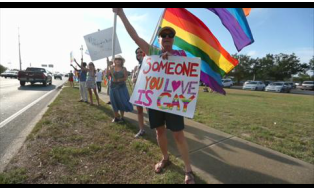
It’s been an amazing week.
I’m tempted to say, about so many of the subjects, “I don’t have a dog in that fight,” and yet, somehow, I do.
Our Supreme Court is been so greatly conservative that I had no hopes that so many decisions would come down on the side of what I consider human dignity.
We have great medical coverage, thanks to what is truly socialized medicine – life time medical care through career military service coupled with the medicare that United States citizens receive when we turn 65. So when people complain about “socialized medicine,” I just laugh and say I love my socialized medicine. It pays almost all my medical bills.
So why does it matter to me that others have affordable health care?
I worked with the homeless for a year, with homeless families. It was a program; we provided housing, some food, and counseling, and guided our residents into degree programs, assistance programs that would lead them to an ability to self-sustain.
What I learned, over and over, was stunning. Many women with children are one man away from homelessness. Women with children are exceedingly vulnerable. When a child gets sick, unless you are protected by family, the child cannot go to day care and Mama has to stay away from work to take care of them. Too many absences and that job disappears. No insurance, and the costs are those hugely exaggerated sums you see on your reconciliation sheets your insurance sends – what the cost is, what insurance pays, what your share is. IF you have insurance, your insurance company has negotiated the costs, and those costs are considerably less than if you don’t have insurance. The least able to pay are charged the most. Is that fair? I thank God for affordable care, so that all people have access to decent health care for themselves, and for their children.
It was teetering on the balance. Which way would the Supreme Court decide on this technicality? By the grace of God, the majority opinion was that law is tough enough to write and often mis-written and corrected before the ultimate wording is finalized. This was no exception; it needed refinement but the intent was clear. Affordable care is the law.
The poor and the minorities are not to be discriminated against in housing, either, the Supreme Court decided. Again, it’s not my fight, no one has ever discriminated against us, except for being military (and the implication was that military was riff raff). The significance here was that even if the discrimination was not clearly intentional, if it was discrimination, it was not allowed. It levels the field; makes life more fair for all of us.
And last. That people who want to marry will have the dignity of that right. That those people will have the same legal rights, rights that guarantee inheritance, rights that guarantee access to the partner that becomes hospitalized, rights to make legal decisions as a legal married couple. Again, AdventureMan and I, one man and one woman, are married, so we don’t have a dog in the fight – except that as human beings, we want the laws to be fair, and humane, and applicable to all. We have no say over how we are wired or who we love, and, as we see it, no right to restrict others from what we have chosen for ourselves.
We’ve had a great day. We went to early service, where Father Goldsborough spoke as a Southerner, and how his views have changed, and how he believes that if the Confederate flag is a cause of grief and horror to those whose family were once enslaved, that that flag should be retired. Yes, keep it as history, display it in museums, but not as a part of a public, governmental display. He is a courageous man.
And while I agree that it is time for the flag to be retired, the flag is just a symbol.
It is a kid that killed the bible study participants in South Carolina. It was a kid with a powerful GUN. So why are we not talking about gun control? I have the feeling that a lot of people are willing to pull down the Confederate flag in hopes that it will keep the attention off the fact that people with problems who have access to guns are the problem. Sure, you can kill with a knife, or a car, or a hundred other ways, but nothing beats a gun for killing efficiently, and no gun beats an automatic weapon for super efficient killing.
I headed straight for the commissary to do some weekly grocery shopping, while AdventureMan spent time in the garden. I got the groceries unloaded, and dinner started. AdventureMan came in and invited me to lunch at my favorite place, Five Sisters.
When we got to Five Sisters, every table was full and lines and groups of people were scattered around waiting. We headed to the Fish House for some fish and grits, but it was the same story. So we headed for Saville, where we found a parking place and while it was crowded, very crowded, we got a place in the Palace Bar, which we like anyway, and we liked that it was away from the music and we could talk.
After we ordered, I said “I think we are in the middle of a celebration,” and he agreed. We were surrounded by a very large group of guys about our age, but we had to guess they were gay, and they were all very celebratory. In fact, much of the restaurant was moving from table to table, hugging and exchanging greetings and congratulations.
The last time I remember feeling this way was in Alaska, last year, for The Celebration, where all the tribes gather to share culture and dances.
On our way out, I leaned over and said “Congratulations! We wish you happiness!” and they thanked us and we left.
Except, LOL, I had dropped my sunglasses, and we had to go back in. “Stop, stop!” our friends at the next table asked us, and thanked us again for our ‘kind words.’ But they needed to talk. It wasn’t about the right to get married, they explained, each jumping over the other in speech in eagerness to explain, “it is about legal rights in hospitals” said one “the right to be who we are” said another. These were men about my age, and they needed to be heard. I told them that I remember Juneau, Alaska, and I don’t remember any gay people. I said there must have been, but I never knew of any, and one man said “that was me! Imagine growing up knowing you are seriously different, that you like boys and not girls, and who do you talk to? There was NO-ONE!”
These guys had been married for varying amounts of time, but this weeks Supreme Court decision eliminated the anxiety that things could change, that a change in president could signal a cascade of change in state laws and the hard-won battles would have to be fought again. “The only person left in my family who would have the right to say whether to take me off life-support or not is a person who would likely say “pull the plug!” and my husband would have no say at all, before this decision!” one said, and the husband added “and she could keep me out of his hospital room, even though we’ve been married for years!”
I would have loved to hear more, but this was their celebration. It was like one huge wedding celebration, so much love, so much happiness, so much joy.
“I can be who I am!” one said to me, with such emotion. “I can be who I am!”
I almost cried with joy for him, for all of them. They have seen such change, from living their lives in hiding to being able to live legally, freely, as who they are. We were moved by their joy, moved beyond words. We felt so honored to have been able to share a little of their joy, even though – this isn’t our dog, this isn’t our fight, it isn’t our win.
Except, except that as human beings, maybe it all IS our dog, and is our fight. Maybe it is our win. Maybe, as Jesus says, we are all connected, we are all meant to love one another, and as weird as we are, as eccentric, as different, maybe we are all meant to love one another and to live in peace with one another. Maybe the dignity of every human being is relevant to my own . . .
It’s a heady thought for a celebratory Sunday.
Recent Comments
tigerbutterya0c5ff1d… on Shampoo Ginger intlxpatr on British Soldier Kidnapped, Esc… John on British Soldier Kidnapped, Esc… intlxpatr on British Soldier Kidnapped, Esc… John Smith on British Soldier Kidnapped, Esc… Wikipedia Donate Button

Amazina


Early Voting in Florida


 Here There and Everywhere