Flashing Lights to Warn of Speed Trap: Free Speech?
I’ve done it – warned other drivers of a speed trap ahead. And I have benefited from other drivers warning me. And I am fully aware that for a law and order kind of girl, that is contradictory behavior. So the question is . . . are we allowed?
From AOL Auto News:
When Michael Elli of Missouri flashed his headlights to warn other drivers of an upcoming speed trap in Ellisville Mo. he didn’t think he was doing anything illegal.
After he received a ticket for obstruction of justice, which carried a $1,000 fine, he fought back, saying the warning was protected free speech. Eventually prosecutors in Missouri dropped the charges, but now Elli and the American
“Those who use their First Amendment rights to warn others to drive cautiously should not be punished for their message,” said Tony Rothert, legal director of the ACLU-EM. “After all, the purpose of traffic laws is to promote safety, not generate revenue.”
Is flashing your headlights protected free speech? It depends on where in the U.S. you are. Florida, Utah and Tennessee, Ohio, New Jersey and Pennsylvania have all deemed that warning other drivers with a flicker of your high beams is protected by the first amendment of the U.S. Constitution. Alaska and Arizona have laws strictly forbid headlight flashing in any situation.
Police Know Where We Are and Where We Go
This is not good news for people who don’t want other people knowing where they have been. I don’t see how it’s any different from cameras in big cities that are used by the police to see what cars went through at a time of a crime, for example. If you don’t have anything to hide, is this invasive? Where property crimes are increasing, where there is an increase in violent crime or assaults, these re tools to keep the majority of the population safer from the predators – in my opinion. Can you change my mind?

From AOL Auto News:
Police License Plate Scanners Record Driver’s Locations
Unregulated cameras store information indefinitely
Government surveillance isn’t just in our phone records and search engine history, but on our roads as well.
That’s what the Center For Investigative Reporting found when researching the small cameras popping up on police cars across the country known as license plate scanners. License plate scanners allow police officers to quickly scan thousands of license plates a day, looking for runaway criminals or stolen cars. In California there are very few limits on these readers and almost no transparency. These cameras record time and place of your vehicle, and even can store a picture record of your whereabouts.
Michael Katz-Lacabe, a security consultant, requested the records from the San Leandro, Calif., police department of every time his car was scanned. He was amazed at the frightening amount of information police had recorded. His two cars were scanned 112 times since 2009, and average of about twice a week. There was even a picture of him and his two daughters getting out of his Toyota Prius in their driveway.
The Center For Investigative Reporting points out that the use of license plate scanners has been growing quickly and quietly across the country. Read their fascinating story here to learn more.
“So There We Were, Two Naked Guys in the Shower and . . . . “
LOL, no, no, this is not going where you think it might go, but it got my attention, too!
AdventureMan was in the locker room with one of his exercise/aerobics buddies, cooling down from his water aerobics class when this story started, and was sharing the story with me later, at lunch, as we exchangin details of our mornings.
“. . . And he asked ‘do you know what today is?’ and I said ‘Yes! It’s the 63th anniversary of the beginning of the Korean War,” AdventureMan responded.
Guy talk. Guys discuss their combat experience in different wars. Combat is so intense, it imprints memories the way childbirth does in women, or a huge traumatic event, like the Iraqi invasion of Kuwait, or 9-11, or the Kennedy assassination, or the Tsunamis that hit Japan and washed entirely over the Maldives – experiences when the earth beneath your feet shifts, and things you once took for granted are shaken forever.
Who said guys don’t connect? AdventureMan has another old friend he needs to get in touch with today, to tell him he is thinking of him; Korean War veterans are largely forgotten in the tallying of combat in our country.
Pensacola is a wonderful place to be a military veteran. There is a Veteran’s hospital, and veteran-friendly policies at the clinics, commissaries and BX/PXx. Today we had lunch at Mellow Mushroom, where every Tuesday they give 20% off to all active duty and retired servicemen and women. Home Depot and Lowe’s give 10% off on every purchase, even plumbers, electricians, contractors, banks, theaters and many stores often give military discounts. And they thank us for our service. :0
To those of you who served in the Korean conflict: Thank you for your service.
What Are Kuwait Traffic Laws?
You all know me – I am a law and order kind of gal. I like order, I like laws, especially those voted on by the people. I like laws which can be enforced, and are enforced, equally, for all people equally in the country. Oh? I did? I said EQUALLY twice?
We are all equal before the law.
Now here is the tricky part. Have you ever seen a listing of traffic laws in Kuwait? Can you find a listing of laws, violations, and their charges? When we apply for driver’s licenses in almost any country, we get a little booklet to memorize, with the laws written inside it. The laws are clear. Clear laws are enforceable.
I’ve looked at the MOI website. I see something that looks like it might be a traffic code in Arabic. I have looked everywhere; I cannot find one in English. I find no reference to any handbooks for people applying for their driver’s license.
How can you enforce a law if the law is not published? Is there a code somewhere listing violations and fines? I published one many years ago, something that all the expats were sending around as ‘the new Kuwait traffic rules’ but IF it was, there was never anything in the paper about it to confirm its validity.

If you are going to have a major campaign to enforce traffic codes, you might want to publish the laws . . . in all major languages use today in Kuwait.
From the Kuwait Times:
Ali vows to rid traffic ‘disease’
Interior Ministry Assistant Undersecretary Maj Gen Abdulfattah Al-Ali
KUWAIT: Interior Ministry Assistant Undersecretary Maj Gen Abdulfattah Al-Ali stressed that all traffic violation-related deportations are in accordance with the law. Speaking at a press conference at the Kuwait Journalists Association (KJA) headquarters, Ali said that deporting people for traffic violations was also adopted by the US and other countries worldwide. “The problem is that we were very tolerant with violators and this does not mean that law violation is a right for motorists,” he underlined, urging all human rights organizations who have criticized Kuwait’s traffic police to examine human rights in their respective countries before talking about Kuwait.
“We have filed over 70,000 traffic citations including 43,000 serious ones such as running red lights, driving under the influence of alcohol, driving on the wrong side and many others,” he elaborated, pointing out that those already deported did not want to respect the traffic laws they had repeatedly violated. Ali added that the results of studies of traffic problems revealed many and that once one problem was solved, another emerged immediately.
“We have various problems… including the fact that motorists speak many languages and dialects which requires a large number of specialists to develop their traffic awareness,” he explained, noting that the traffic remedy strategy started by diagnosing the “disease” by studying random “specimens” at different times of the day at places with heavy traffic flows such as Jleeb Al-Shuyoukh, Shuwaikh Industrial Area, Amman Street, Bnaid Al-Gar, Khaitan, Farwaniya and Fahaheel.
“The specimens showed some major problems such as domestic drivers using private vehicles as taxis, taxi and large vehicle drivers who do not hold general driver’s licenses and people driving without licenses at all,” he said, adding that this called for strict law enforcement.
“Traffic in Kuwait is like an old sick man who once treated for one aliment develops another,” he noted, adding that 18 traffic inspection teams dressed in civilian clothes had been formed and deployed in various places. “Fortunately, traffic police only file 100 daily citations in Jleeb compared to 1,000-1,500 in the past”, he concluded.
The Secret Lives of Baba Segi’s Wives by Lola Shoneyin

I don’t know what it is about summer reading, but now and then I go on a theme-fest; a couple years ago it was Nigerian literature, and, once hooked . . . when my friend who is now living in Lagos recommended The Secret Lives of Baba Segi’s Wives, I ordered it right away, thinking from the title it would be maybe light and sweet and humorous.
From the start, that assumption was blown. This is a direct and edgy Nigeria, darker, rougher and full of family secrets, domestic details and messy relationships.
It is a very Nigerian book – this is a good thing. There are cultural things that are not explained, but it all ends up making sense in the end. There are foods I have never heard of – ekuro with shrimp sauce, asun. There is a rudeness in the way they speak to one another, (“Is this a parking lot?” “Do I look like a parking attendant?”), a crudeness in the constant need to carry small bills for bribes, even on public streets. People speak their minds, with little or no mitigation, depending on the status of the person and their own personal goals and agendas.
At the weekly meeting of wives, the senior wife, Iya Segi, doles out rations of household supplies to the other wives, including chocolate powder and hair conditioner . . . and as the senior wives complain about the new wife thrown in their midst, she says:
“You will trip over in your hate if you are not careful, woman. Your mouth discharges words like diarrhea. Let Bolanle draw on every skill she learned in her university! Let her employ every sparkle of youth! Let her use her fist-full breasts. Listen to me, this is not a world she knows. When she doesn’t find what she came looking for, she will go back to wherever she came from.”
There is a whole other world in that one paragraph – a whole other way of seeing life and expressing thoughts. The culture may be alien, but I thoroughly enjoyed being a tiny mouse in the corner at that meeting – and others – and inside the minds of the wives, of Baba Segi, of the driver – so many good stories, so many points of view, and I learned things from behind those high compound walls and closed and locked doors that I might never otherwise have learned. Alien as it was, for me, this was a very good book, new ways of looking at things, and a great recommendation from my friend in Lagos.
“I Will Wipe out the word WASTA from the Traffic Dictionary”
Wooo HOOOO on You, Major General Abdulfattah Al-Ali!
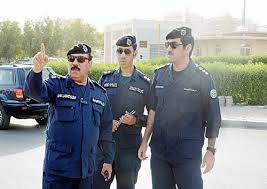
Sometimes, when you are reading a newspaper looking for content, the most significant articles can be little small ones:
Major Al-Ali vows to redraw traffic map
KUWAIT: “I have orders from higher authorities to organize the traffic and the law will be implemented strictly, Assistant Interior Ministry Under Secretary for Traffic Affairs Major General Abdelfattah Al-Ali said. “I will change the traffic map within six months and wipe out the word wasta from the traffic dictionary ,” he added. “I have strict orders from higher authorities to organize traffic and the law will be implemented very strictly,” Major Ali said.
The Kuwait Times got his title wrong; it is Major GENERAL, not Major, LOL, that’s a big difference. It appears he has the clout – and the backing – to make a brave and steadfast stand:
“WIPE OUT THE WORD WASTA FROM THE TRAFFIC DICTIONARY”
I can hardly believe my eyes. This is going to be very painful for young Kuwait men, who have learned – from prior experience – that the rules do not apply to them. IF Major General Abdulfattah Al-Ali can maintain his strong position, there may be more young Kuwait men who live to be grown-up men, there may be fewer heart-wrenching funerals, far fewer trips to the emergency room (did you know that some of the best head-trauma physicians in the world are in the ER’s in Qatar, Kuwait, and the UAE? There’s a reason for that.) The days of seeing babies on their daddy’s laps in traffic may be over. People may actually start wearing seatbelts!
Wooo HOOO on You, Major General Abdulfattah Al-Ali. You are a brave and courageous man, with a vision for a safer future for Kuwait.
11,800 Deported: Kuwait Deportations Continue “Without an End Date”
I still have a large contingent of loyal readers from Kuwait, but by early this morning, I could see something was up:
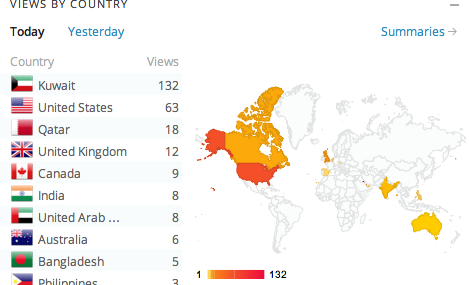
It’s not often that I have 132 Kuwait hits before noon.
So I checked the Kuwait Times:
Expat deportations will continue: Traffic chief – 11,800 deported in two-and-a-half months
KUWAIT: Major General Abdulfattah Al-Ali’s name has become synonymous with extensive traffic campaigns, aimed at enforcing the law at all costs, including implementation of mass deportations. The senior Interior Ministry official, who takes pride in deporting 11,800 people and impounding 3,000 vehicles during his tenure as head of the Ahmadi Security Department over the past two and a half years, told a local daily that deporting expatriates for serious violations will continue without an end date. “Administrative deportation of violating expatriates is not going to stop, especially of those carrying passengers illegally, in which case a person would be in violation of traffic and labor regulations,” Maj Gen Al-Ali, the Interior Ministry’s Assistant Undersecretary for Traffic Affairs, told Al-Rai on Friday.
He added that any ticket can be disputed “by a request to refer the case for traffic department investigations”. In the series of crackdowns that started late April, at least 2,000 traffic violations were registered, including 1,000 tickets issued directly on the street, while thousands of people were reportedly deported. Moreover, Maj Gen Al-Ali revealed that the ministry collected KD4 million, out of the KD24 million owed in traffic fines, during the same period. In that regard, the senior official pointed out that only KD8 million worth of fines are registered against individuals, while the rest are against companies and state departments. Out of the KD8 million, KD6 million is registered against expatriates, Maj Gen Al-Ali said. “Cases are soon to be filed with the traffic court in order to issue travel ban orders against people with more than KD80 in fines owed to the ministry,” he added.
Al-Rai published Maj Gen Al-Ali’s statement yesterday, along with a transcript of an interview with Al- Watan TV during which he defended the ongoing campaigns. “Our procedures are necessary to save lives, with average statistics indicating that 450 people are killed and 3,000 are injured annually due to traffic accidents,” he explained. During the interview, Maj Gen Al-Ali insisted that all drivers are equal when it comes to implementation of the law. “There have been doctors among the people deported, including a surgeon caught driving without a license for three years,” he said, before confirming news reports that he had taken a decision to impound a vehicle owned by Minister of Cabinet Affairs Sheikh Mohammad Al-Abdullah Al-Sabah on grounds of repeated violations committed by his personal driver. Meanwhile, the senior official urged any person who had obtained a license through illegal means to dispose of it “because once caught, they are going to be charged with forgery”. —Al-Rai, Al-Watan
Pensacola: Fiesta of Five Flag Parade
I’ve never lived anywhere with so many parades, and as Pensacola cools down a little and an offshore breeze blows away the heat of the day, a parade sounds like fun. Tonight is the Fiesta of Five Flags Parade. I can’t think of a parade since Lent, so maybe this is the kick off of the new season. Pensacola has an active and lively social scene, with all these Mardi Gras Krewes, and the older our grandson gets, the more of the parade we get to see! I think we got through three quarters of the parade tonight, and oh what fun.
The people on the floats are having a great time. They have these great alter-egos, get to wear elaborate costumes, and there may be some alcohol involved, LOL. The people on the ground are having a great time, you can really get into the waving and trying to catch the beads. Some of the beads are prettier than others, but as AdventureMan says, it’s all plastic. Having said that, you should see him scramble! He is good at catching beads.
And oh my, they are so good to the kids, with stuffed toys, beads, ice cream bars, frisbees, trinkets, including pieces of eight!
Honestly, there are some things in life I will never get tired of – parades and fireworks. I feel so blessed to live in Pensacola.
These photos are not in the right order because I just did a group dump into the photo gallery, and it scrambled them when they were inserted into the blog entry.
The parade always starts with the Pensacola motorcycle police, with flashing lights and roaring engines!

I love that they decorate the horses tails:
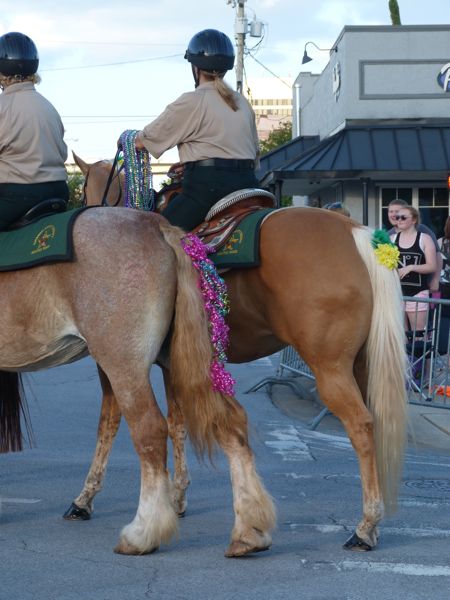
And then AdventureMan pointed out they also rubbed glitter into the horses haunches to make them pretty 🙂

So many beads! We got to the parade a mere ten minutes before it began, but it was more lightly attended, and we were able to be right up front. Our little grandson had a great view, and people were so kind giving him beads, throwing him beads, toys, etc.
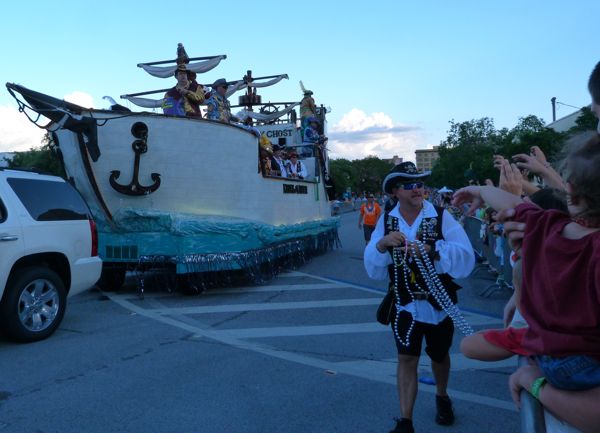

Look at all those beads they plan to throw! There was a throne on this float with King Tut!


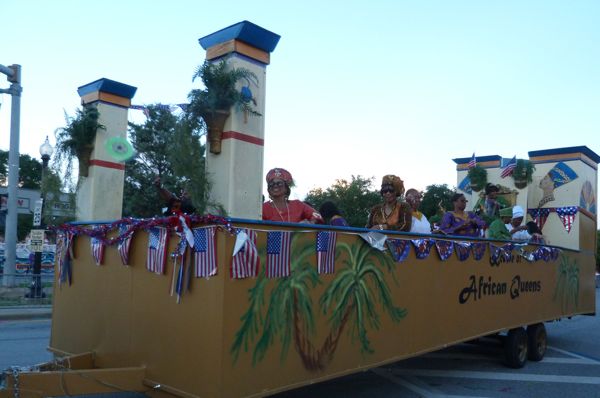
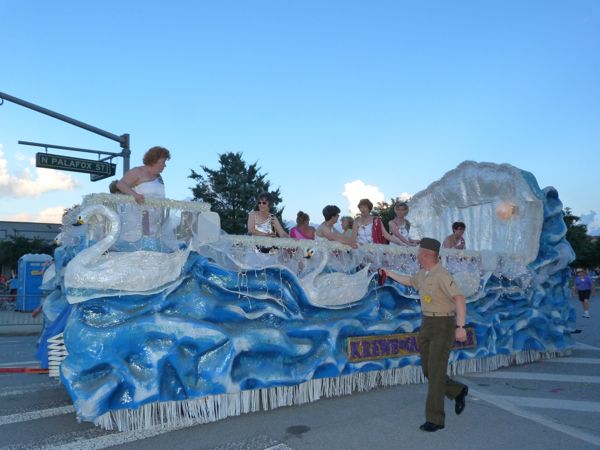
These ladies were having a grand time!


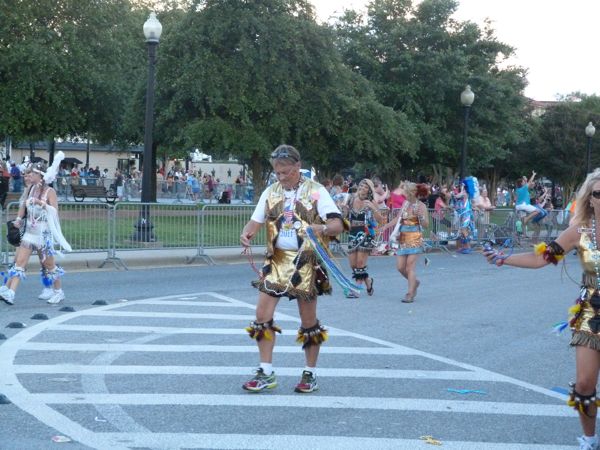
The Mayoki Indians seemed to be the Krewe having the best time of all, with two floats loaded with beads, and more ‘foot Indians’ handing and throwing beads into the crowds:




The flame throwing baton twirler got lots of applause:

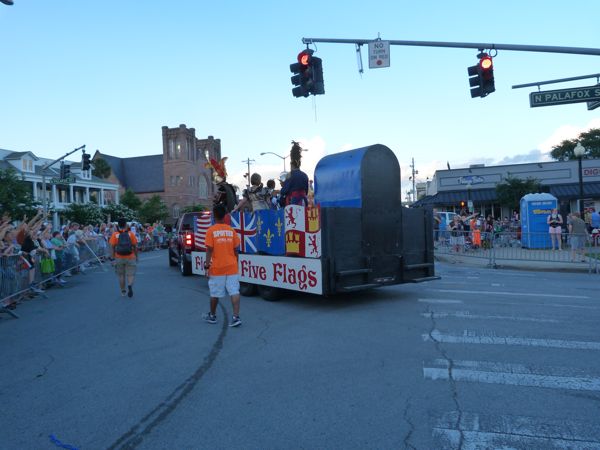




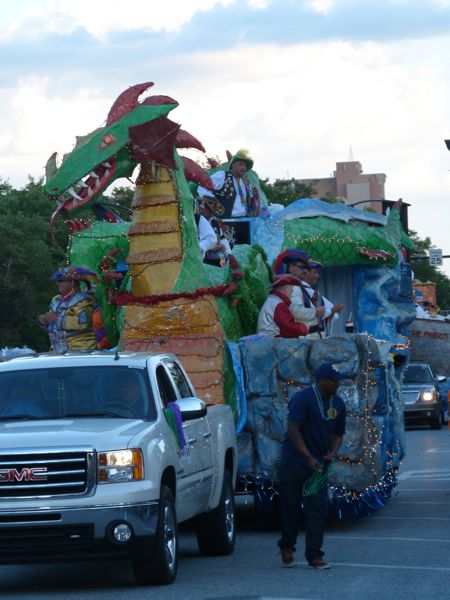

We saw our little grandson rubbing his eyes and asked if he was ready to go home, and he was. One of these days he will be old enough we will see an entire parade. I had a minor concern that Tropical Storm Andrea would blow in bad weather and make the parade unlikely, but nothing of the sort, we had great weather, a lovely evening and a wonderful time making good memories with our little grandson.
Recent Comments
intlxpatr on Shampoo Ginger tigerbutterya0c5ff1d… on Shampoo Ginger intlxpatr on British Soldier Kidnapped, Esc… John on British Soldier Kidnapped, Esc… intlxpatr on British Soldier Kidnapped, Esc… Wikipedia Donate Button

Amazina


Early Voting in Florida


 Here There and Everywhere