The Tiger’s Wife by Tea Obreht
The Tiger’s Wife was the perfect book to get me from Pensacola to Seattle, and through the Atlanta airport, full of bustle on a Sunday, packed flights, no quiet, no privacy. Thank God for a good, engrossing book, that takes you totally out of where you are to a world where things are not always what they seem.

The book is set in an unnamed country in East Europe which has just come out of a war, and the main character and her best friend are en route across a border which did not exist before the war, on an aid mission to immunize children who were once neighbors, and are now in a different country.
The primary relationship in the book is the bond between a young girl and her grandfather, and the stories he tells her as they walk up to the zoo, the Jungle Book he reads to her as they visit the animals, and the stories she finds for herself as she participates in the post-war rebuilding. It is a fascinating book because what she is writing about is not always what she is really writing about; the stories and legends and experiences are metaphors for another reality and a life lesson.
I don’t want you to think that this is one of the mindless airport books I sometimes tell you about. If it were, I would tell you “this is not great literature; this is an airport read.” Not this book. This book is literature. This book has meaning, and events you will think about and talk over with other readers long after you have finished the book.
In the back of The Tiger’s Wife is an interview in which one of my favorite new authors, Jennifer Egan (A Visit From the Good Squad) interviews Tea Obreht about her writing process, her life, her vision, etc. Fascinating reading, too, and also reader’s guide questions help you see things you might need to see and might otherwise miss.
Hilarious Carlsberg Commercial
Thank you Hayfa – where do you find these???
The Travellers’ Dilemma
The restaurants were full this Saturday in Pensacola, all the nice restaurants; there is a Beth Moore conference in town and all the ladies are out to lunch. We were lucky, we walked in just before the crowd and snagged a table at one of our favorite Pensacola restaurants, The Fish House. Great meal, great service, great conversation, and we were out in under an hour. Wooo HOOO.
Have you noticed many of the good restaurants don’t take reservations these days, not unless you are a large group, like six or more? Maybe as the economy starts to lift again, that will change. It’s just odd.
Meanwhile, I have a couple flights tomorrow, and now that I am not flying overnight, or half the world, and now that we are retired, I am flying sardine class. And the airlines don’t serve food. If you buy food in the airport, your choices are limited, and expensive, and it can be messy.
So I’ve been thinking about what to take. I need something nutritious. I need something that tastes good. I need something that can be eaten sort of subtly; now that there is not a real meal time, you might be eating with people who don’t have anything. So you also need something you can share.
It can’t have an offensive smell. We love those Japanese crackers, but in a confined space, all of a sudden you notice how FISHY they smell. Ditto sushi, LOL. Can’t eat Wasabi peas, either, because they are also odor causing, in their own way. No garlic; some people cannot abide garlic or onions.
It can’t be something that might leak in my carry on. It can’t be something that needs a utensil. It can’t be too salty, or carry too many calories. It can’t be loudly crunchy, like carrots or celery.
Do you see the problem?
AdventureMan says “You worry about things like that?” He is genuinely puzzled. But yeh, I think about these things, and try to anticipate a problem so that there ISN’T a problem.
I finally decided on some Chex Mix, and some trail mix (nuts and fruits). You can eat a little at a time, you can share.

I figure I can pick up some coffee at the airport where I change flights. I love the seasonal Peppermint Mochas, Gingerbread Lattes, etc. It’s a most wonderful time of the year 🙂

What do you take on a long flight when you will not be provided a meal?
Who Gets Into Heaven?
Today at Christ Church in Pensacola, when Father Neal Goldsborough gave the sermon, I had a very un-churchlike urge to get up and dance for joy. He was preaching on Matthew 25: 31 – 46, where Christ the King sits in majesty and judges who will have the kingdom of heaven, and who will burn in the lake of fire.

Here was today’s reading:
Matthew 25:31-46
New International Version (NIV)
The Sheep and the Goats
31 “When the Son of Man comes in his glory, and all the angels with him, he will sit on his glorious throne. 32 All the nations will be gathered before him, and he will separate the people one from another as a shepherd separates the sheep from the goats. 33 He will put the sheep on his right and the goats on his left.
34 “Then the King will say to those on his right, ‘Come, you who are blessed by my Father; take your inheritance, the kingdom prepared for you since the creation of the world. 35 For I was hungry and you gave me something to eat, I was thirsty and you gave me something to drink, I was a stranger and you invited me in, 36 I needed clothes and you clothed me, I was sick and you looked after me, I was in prison and you came to visit me.’
37 “Then the righteous will answer him, ‘Lord, when did we see you hungry and feed you, or thirsty and give you something to drink? 38 When did we see you a stranger and invite you in, or needing clothes and clothe you? 39 When did we see you sick or in prison and go to visit you?’
40 “The King will reply, ‘Truly I tell you, whatever you did for one of the least of these brothers and sisters of mine, you did for me.’
41 “Then he will say to those on his left, ‘Depart from me, you who are cursed, into the eternal fire prepared for the devil and his angels. 42 For I was hungry and you gave me nothing to eat, I was thirsty and you gave me nothing to drink, 43 I was a stranger and you did not invite me in, I needed clothes and you did not clothe me, I was sick and in prison and you did not look after me.’
44 “They also will answer, ‘Lord, when did we see you hungry or thirsty or a stranger or needing clothes or sick or in prison, and did not help you?’
45 “He will reply, ‘Truly I tell you, whatever you did not do for one of the least of these, you did not do for me.’
46 “Then they will go away to eternal punishment, but the righteous to eternal life.”
When he started out, I was a little nervous, because I was afraid he was going to talk about the fat sheep and the thin sheep, but that was the reading from Ezekiel:
(Ezekiel 34:11-16
New International Version (NIV)
11 “‘For this is what the Sovereign LORD says: I myself will search for my sheep and look after them. 12 As a shepherd looks after his scattered flock when he is with them, so will I look after my sheep. I will rescue them from all the places where they were scattered on a day of clouds and darkness. 13 I will bring them out from the nations and gather them from the countries, and I will bring them into their own land. I will pasture them on the mountains of Israel, in the ravines and in all the settlements in the land. 14 I will tend them in a good pasture, and the mountain heights of Israel will be their grazing land. There they will lie down in good grazing land, and there they will feed in a rich pasture on the mountains of Israel. 15 I myself will tend my sheep and have them lie down, declares the Sovereign LORD. 16 I will search for the lost and bring back the strays. I will bind up the injured and strengthen the weak, but the sleek and the strong I will destroy. I will shepherd the flock with justice.
20 “‘Therefore this is what the Sovereign LORD says to them: See, I myself will judge between the fat sheep and the lean sheep. 21 Because you shove with flank and shoulder, butting all the weak sheep with your horns until you have driven them away, 22 I will save my flock, and they will no longer be plundered. I will judge between one sheep and another. 23 I will place over them one shepherd, my servant David, and he will tend them; he will tend them and be their shepherd. 24 I the LORD will be their God, and my servant David will be prince among them. I the LORD have spoken.
Since I might be mistaken for one of the fatter sheep, you can understand why I was a little nervous. Also, I had a huge “AHA!” moment living in Jordan, as the shepherd and his sheep and goats passed by my house daily. The sheep were incredibly stupid, but they trusted their shepherd, and the shepherd took good care of them. While they were excavating channels to put in underground pipes in our area, I watched the shepherd carry each sheep across the little wooden walk way, because they were too afraid to do it on their own. The goats would do it, but I still wouldn’t want to be a goat. I don’t really want to be a sheep either.
And I digress.
Here’s what Father Neal said about our gospel reading. He said Jesus doesn’t say you have to have invited him into your heart. He said that if you feed the hungry, give some water to the thirsty, welcome the stranger, clothe the needy, look after the sick and visit those in prison, ypu’re in. You’re righteous.
It’s exactly what I’ve been looking for, something scriptural to support what my heart knows – that there are those who are not Christians who are going to be in the kingdom of heaven, too. It’s not a matter of saying these words or those words, or believing exactly as “they” tell us we must believe, it is a matter of serving the king by tending to and serving his sheep. He LOVES the least of these. It gives me hope; even I might have a chance of inclusion.
6 Things a Marriage Counselor Would Tell You
We have celebrated 38 years of marriage, and we still read these articles. 🙂 It’s all true – marriage takes work. I found this today on AOL Everyday Health
6 Things a Marriage Counselor Would Tell You
Every relationship has its bumps — but these expert tips can help feuding duos smooth things out again.
By Jennifer Acosta ScottMedically reviewed by Lindsey Marcellin, MD, MPH
A relationship free of spats, scrapes, and squabbles? That’s a thing of fairy tales (though we’re willing to bet that even Cinderella and Prince Charming had their problems).
Real-life matrimony — that has its ups and down. And while it’s certainly not fun to clash with your sweetheart, disagreements don’t signal the demise of your relationship. “There are always ways to resolve issues, overcome obstacles, and build a stronger bond because of it,” says Lori Bizzoco, a relationship expert and founder of Cupid’s Pulse, a Web site that provides relationship advice to couples.
What’s more? Each relationship (even the best of the best) has room to grow. But not everyone can afford to see a professional marriage counselor — and some marriages simply need a quick tune-up. That’s why we went to top relationship experts to find out the best ways to resolve disagreements, keep things fun, and ensure an emotionally health partnership for the both of you.
Here’s your at-home guide to boosting your marriage or long-term partnership (you may be surprised how well these work!).
1. Fight. It may sound contradictory, but arguments between couples can actually be a sign that the relationship still has a good foundation. “Indifference to each other tells me a marriage is in big trouble,” says Susan Fletcher, PhD, a psychologist in the Dallas area. “Couples who care enough to fight still care about each other.” Next time you find yourself in a war of words with your partner, don’t give up and walk away: Use the disagreement as a jumping-off point for coming to a resolution — and then kiss and make up!
2. If you love her, let her grow. Most people develop and change as they get older — but according to Bizzoco, this often comes as a surprise to a spouse. “Often we get so wrapped up in the relationship and think we know someone so well that we don’t allow them the freedom to be anything more than the person they were when we met them,” Bizzoco says. But embracing these changes can be extremely beneficial to a relationship. So if your husband wants to take up golf or your wife wants to return to school for another degree, encourage them to follow these interests (your spouse will appreciate the support).
3. Be the A-Team. It may sound cheesy, but the phrase is an apt term for the “us first” attitude that couples should have when it comes to their relationship. “This means that they consult, discuss, and make decisions as a couple and do not put other relationships, children, or extended family before this primary relationship,” says Karol Ward, LCSW, a psychotherapist in New York. If you put your partner first, he will feel cherished and valued — an important emotion for your marriage.
4. Add some oomph to your “Hello!” When you’ve been separated from your spouse for some time (even if it was just for the work day), greeting him enthusiastically, rather than just glancing up, can be a great way to show you care. “It sounds silly, but think about the feeling that it creates when you give them just a few moments of attention,” Bizzoco says. Your special greeting can be anything from a simple hug to a sexy dance move. Coming home will be even sweeter than before.
5. Don’t forget your manners: Say “Thanks.” It’s easy to get wrapped up in what your partner does wrong — and too often, we lose sight of what they’re doing right. Every night, get in the habit of writing down three good things about your spouse — something nice he did (it really was sweet how he DVR’d The Notebook for you), a fond memory you have of her (remember that trip to the Caribbean?), or one of his many good qualities (that cute butt, of course). “This keeps you feeling more positive toward him, which will benefit your relationship,” says Elizabeth Lombardo, PhD, a psychologist and therapist in Wexford, Pa. And it can benefit you, too: When you’re in the middle of a knock-down fight, think back to your list to remember the reasons you’re in the relationship.
6. Get good feedback. Even if your relationship is as old as the hills, it’s never too late to ask your partner this one simple question: “How do you know that I love you?” Listen carefully to the response. If nothing else, Ward says, you’ll discover which of your actions are the most appreciated and which behaviors to maintain moving forward.
Follow these relationship “musts” — and you may never need to call up a marriage counselor.
Last Updated: 10/11/2011
“How Was Your Day?”
We were all standing in line, a very long line, at Pensacola’s Greek Festival at The Annunciation Greek Orthodox Church when my son asked how our day was. (AdventureMan and the Happy Baby were off exploring.)
“Oh, it was GREAT!” I enthused. “Time passes so much faster when you’re retired and you spend your time having fun!”
“So what did you do?” he asked.
“Oh! We went to water aerobics, and stopped by the bank to cash a check so we would have money for the weekend. Then your Dad vacuumed so I can mop the floors tomorrow, while I cleaned upstairs, dusted, did the bathrooms, etc. At lunch we went to Chow Time, and drove down here to check out parking, and then I had a quilting meeting this afternoon, and then we met you!”
As I finished, their faces were somewhere between blank and confused . . . and I realized my idea of fun was a relative thing.
Here is what is fun. Fun is getting to CHOOSE when you vacuum or mop the floors, or wipe down the blinds, or clean the bathrooms. Fun is having the time to do it even on a weekday, not having to scramble on Sundays to get it all done, like we used to. Fun is not having gobs of money, but having enough that we can go to the bank and take some out when we need it for the weekend. Fun is meeting up with our son and his wife and our grandson because our schedule isn’t full with business meetings, and working late at the office. Fun is having groups we belong to because we really want to.
The truth is, in many ways, we are busier than we ever have been, but it is busy-ness of our own choosing.
Fun is even babysitting your grandson when he gets sick, just because you can, or helping carry him around a big festival, taking turns, so everyone gets to eat. It’s fun because we can, and because this is what we have chosen.
EnviroGirl and I picked up the dinners while AdventureMan and L&O Man scouted for seats in the tent so we could sit and eat dinner – moussaka, chicken, lamb, all kinds of specialities. There was also a very long dessert line – this festival is all about the food, and the music and dancing. I’ve taken some photos for you, but once we had the food, I didn’t get a chance to get any more photos. We only had to stand in line about thirty minutes; although there is a huge crowd, there is also a system, and they get people in and through the serving lines very efficiently.






Non-Profits: Something From Nothing
Here is what I love – people who get an idea, and make the world a better place because they have a vision and make a plan so that the vision can become a reality.
The Gulf Coast Citizens Diplomacy Council
I volunteer for the Gulf Coast Citizens Diplomacy Council. The one in Pensacola was started from nothing by a young woman with a vision, Gina Melancon Gissendanner. Her organization, her Board of Directors, her members and her resources deep within the Pensacola community have welcomed several hundred of the US Department of States International Visitor’s Leadership program delegates, bringing awareness – and dollars – to Pensacola.
When the visitors come into town, they have activities, tours and visits with professional counterparts that give them new strategies and resources to take back with them to their home countries. While here, they meet local people, shop in local stores and dine in local homes.
I love this program. From nothing, this young woman has created an organization with a far-reaching legacy. Thanks to her innovative and relevant programs, the international delegates leave here with happy memories of their time in Pensacola, and they go home and tell their friends and neighbors about their time here.
This weekend, we crossed paths with three more organizations, creating a better world, each in their own way.
The Master Gardeners
“You have to come to the sale at the County Extension Office!” our aqua aerobics friends told us. “It is so much fun, and they have Florida-hardy plants available at really good prices.”
OK! Finding ourselves awake and ready to hit the road early on a Saturday morning, we headed for the County Extension office, and the Master Gardener’s Sale. Now, I may get some of the details in this story wrong, but this is what I think I have been told. . . Several years ago, county extension offices (who answer questions about soil and growing things) found themselves deluged with questions, with too few people to answer them. They started a program – and I believe it is nation wide – training people in all aspects of growing things in the local area.

People who signed up for the training also signed up for a commitment to volunteer, and pass their knowledge along. Slowly, slowly, we have begun to know these people.
The sale was a lot of fun. While gardeners love a challenge, like growing flowers in Florida that aren’t supposed to grow here (like me, I am trying to grow bougainvillea, which isn’t really good at getting through cold winters, but maybe if I find the right protected spot, I can get it going and keep it going until it develops a deep root system and an ability to withstand the minimally cold winters we have in Pensacola) and they also love to share their knowledge.

There was an experienced, knowledgeable and enthusiastic Master gardener about every ten steps at the sale, and we could ask all the questions we ever wanted, and they just loved talking with us and giving all the answers. Free! There was no admission charged, the plants were reasonably prices (and many were very cool plants) and it was just a great place to pass a Saturday morning.
We’ve been told the Spring Sale is THE best sale – we can hardly wait.

When we left, AdventureMan said “Every one of them seemed so comfortable in their own skin.” I think he is right. I think working in the earth with your hands helps ground you. 🙂
The Master Gardeners are those people you find in Home Depot and Lowes, giving information on gardening in Florida, and at special booths at Arts Fests, in the schools, and working the beds at the County Extension office. They are volunteers. They do this work for the love of making the world a more beautiful place.
The Butterfly House
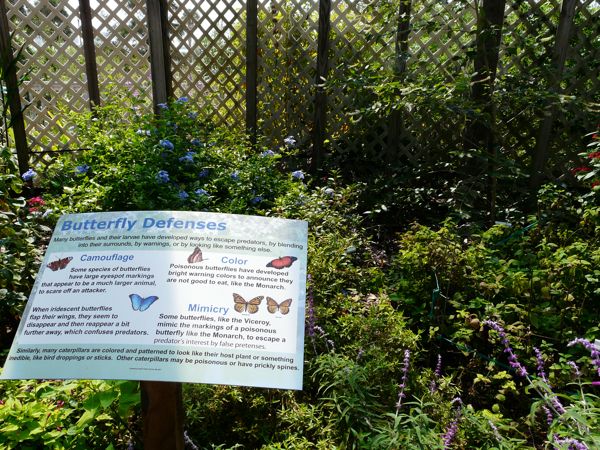
Our next stop was the Monarch Madness festival at the Panhandle Butterfly House in Navarre, where there was also an Arts Fest in progress. The volunteers at the Butterfly House all wore these terrific T-shirts with a caterpiller on the front and Monarch butterfly on the back. They had a great system, too, for getting a lot of people through the butterfly house in an organized and civil way, still giving people a lot of time to ask questions, and with lots of really cool activities for children to do, to help them understand the life cycle of these beautiful and short-lived creatures.





The Manna Food Pantries, Pensacola
I’m lucky. I work on a church committee where the chair brings in representatives from all the major charities in Pensacola to talk with us about what they do. The Manna Food Pantries is, in my humble opinion, a poster-child for how a non-profit should operate. Providing food for those who are hungry, for those going through tough times – and there are more than you might think – is truly part of God’s work for us here on earth. Manna Food Pantries collect and distribute food to the hungry. This morning, we had two Manna vans at the church and people were bringing in their full bags to donate.
It’s been a very tough year in Pensacola. The tough times just go on and on. You can prepare for tough times, save your money, gather your resources, but when tough times linger, sometimes those resources run dry. Manna has been faced with just such a time; resources are drying up, donations were down and the need is greater than ever. Manna hit the front page this week two days in a row, and is getting great coverage on radio, in the churches, in social groups – they are very very good at getting the message out, and the message is clear: We need your continued support, food, money, now more than ever.
They are brilliant at managing their volunteers, and many have been with them for years and years.
All these organizations are only able to exist because people believe in giving of their time and efforts in the hopes of making the world a little better, a little more beautiful, a little more peaceful, a little more hopeful – one person at a time.
Where are you going to put your efforts? What organizations do you support – and why?
The Marital Contract in California?
This guy is hilarious – found this on AOL Huffpost this morning:
A Modest Proposal: Why Can’t Couples Have a Proxy Statement for Their “Merger & Acquisition”?
William Quigley
The recent debates over gay marriage, civil unions and what exactly marriage even means today reminded me of how antiquated our marriage and family laws have become. They don’t take into account how the nature of wealth has vastly changed over the last few decades. I am neither an advocate nor an opponent of marriage but I do believe that the financial obligations we assume when entering into a marriage contract, including the court-ordered redistribution of personal wealth that takes place upon divorce, are not well understood by most of our citizens. Even lawyers I have known have been confused about the differences between spousal versus child support. If Chris Anderson really wanted to investigate the long tail, he should have taken a look at the potential length of California spousal support terms.
California has always been the leader in divorce and alimony law, and I think it is time the state started addressing the profound inequities alimony judgments have created. In short, alimony has evolved into a pension plan for the less successful spouse. In many cases, this pension commitment becomes a lifelong burden for the paying spouse, regardless of who initiated the divorce and under what conditions the marriage dissolved. It promotes unproductive behaviors as well, such as the alimony recipient avoiding employment in order to maximize spousal support. The spousal support payer may reluctantly forgo re-marriage as well, fearing the income of his/her new partner will be combined for the purposes of calculating higher support payments. If the state believes that promoting marriage among the population is a public good (a reasonable belief), then it needs to reduce the severe financial penalties associated with divorce. And since many marriages do end in divorce, it makes sense to acknowledge, upfront, the consequences of that likely outcome.
One marriage-neutral option would be to provide every couple with a simple disclosure form that highlights the financial obligations they are about to assume.
This disclosure form could easily fit on just a single page, with disclosures of the following sort:
1. The State of California recognizes your marriage as a legally binding contract.
2. By entering into marriage in this state, you agree to assume all debts incurred by your spouse during the marriage, whether or not you were aware of these debts when incurred, and whether or not you personally benefited from them in any way.
3. You also agree to provide monetary payments to your spouse in the event your marriage dissolves and you are the higher income earner. The amount and length of these payments will be decided by a court of law.
4. The State can and will use its court and police powers to enforce the financial obligations you are assuming in the event of divorce, including the garnishment of your wages and your incarceration in the state prison system for your failure to comply with court ordered spousal payments
5. If your spouse so chooses, he/she may divorce you at anytime. In so doing, he/she may be legally entitled to receive monetary payments from you for a time period that may extend to the rest of your natural life. These spousal support payments may exceed 50% of your income, could be adjusted upward if you remarry and as a result have more disposable income, and they cannot be eliminated though bankruptcy.
6. The conduct of your spouse, including him/her having one or multiple out-of-wedlock affairs, does not change your legal obligation to provide spousal support.
7. If you are the higher earning spouse, you may be required to pay your lower earning spouse’s divorce related legal bills. This is the case regardless of which spouse initiated the divorce and regardless of the conduct of either spouse during the marriage
8. If you have questions or concerns about what financial obligations you are about to assume, it may be advisable to consult with a family law attorney before signing your marriage contract.
The most important point to highlight when it comes to marriage is that the State of California recognizes it as a legally binding contract. Too often that simple fact is misunderstood or ignored by the couple getting married. In fact, curiously, the one thing the state absolutely does not care about is whether or not a couple is “in love.” There is no requirement to be “in love” to be legally married in the State of California, or any other state for that matter. Only in recent human history — perhaps the last 150 years — has the predominant purpose of marriage been associated with romantic love. It has nearly always been, and remains in much of the world, primarily an efficient method of property redistribution. In the end, the state, and your future divorce lawyer, care only about one thing: the legal enforceability of the marriage contract as it relates to the financial obligations borne by the higher wage earner.
Our society has become accustomed to warning its citizens of potential legal and financial hazards every time they enter into a contract, even those of relatively small consequence. We as a society like to be informed when we are assuming a financial obligation, particularly one that is potentially large and open-ended. Isn’t it odd then that while we require our citizens to initial car rental forms (just in case they didn’t realize that they will be charged $6 a gallon to fill the gas tank), we let 18 year olds get married without so much as a tap on the shoulder about the greatest financial liability they will likely ever assume? Keep in mind that we are talking about state-sanctioned marriage, a legally enforceable contract. Shouldn’t such a contract, with its profound lifelong financial repercussions, only be assumed by those fully informed of its potential consequences? This is why I completely support a marriage financial obligation disclosure form.
Emergency Message for U.S Citizens: Demonstration Notice 14-2011
Emergency Message for U.S Citizens � Demonstration Notice 14-2011
September 20, 2011
Please circulate the following message without additions or omissions
immediately to all U.S. citizens within your area of responsibility.
An anti-corruption demonstration is planned for the early evening hours at
Determination Square on Wednesday, September 21 in downtown Kuwait City. An
increased police and security presence is expected in and around the capital.
There are also reports of possible demonstrations in support of Bidoon rights on
Wednesday, September 21 in the cities of Jahra, Al-Sulaibyah and Al-Ahmadi. An
increased police and security presence is also expected in these areas.
Spontaneous and planned demonstrations take place in Kuwait from time to time in
response to world events or local developments.
At times, even demonstrations intended to be peaceful can turn confrontational and possibly escalate into violence. Do not let curiosity get the best of you; avoid the areas of demonstrations and exercise caution if within the vicinity of any large gatherings. Please stay current with media coverage of local events, be aware of your surroundings, and practice personal security awareness at all times.
For the latest security information, U.S. citizens living and traveling abroad
should regularly monitor the Department of State’s Bureau of Consular Affairs
Internet website, where the current Worldwide Caution, Travel Warnings, Travel
Alerts, as well as the Country Specific Information for Kuwait can be found.
Up-to-date information on security can also be obtained by calling
1-888-407-4747 toll-free in the United States and Canada or, for callers outside
the United States and Canada, a regular toll line at 1-202-501-4444. These
numbers are available from 8:00 a.m. to 8:00 p.m. Eastern Time, Monday through
Friday (except U.S. federal holidays). You can also download our free Smart
Traveler App for travel information at your fingertips and follow us on Twitter
and the Bureau of Consular Affairs page on Facebook as well.
The U.S. Embassy is located at Al-Masjid Al-Aqsa Street, Block 6, Plot 14,
Bayan, Kuwait. If you are a U.S. citizen in need of emergency assistance in
Kuwait, you may reach the U.S. Embassy by calling +965-2259-1001 and requesting
the duty officer.
U.S. citizens living or traveling in Kuwait are encouraged to enroll in the
Department�s Smart Traveler Enrollment Program (STEP) so that they can obtain
updated information on travel and security. U.S. citizens without internet
access may enroll directly with the nearest U.S. Embassy or Consulate. By
enrolling, U.S. citizens make it easier for the Embassy or Consulate to contact
them in case of emergency. For additional information, please refer to “A Safe
Trip Abroad”.
This message may be accessed on the Embassy website, http://kuwait.usembassy.gov
Please note that the Consular Section is closed for U.S. and most local
holidays. The current holiday schedule for 2011 is posted on
http://kuwait.usembassy.gov/holidays.html
Contagion
As we rushed into the house, we both headed immediately to our bathrooms to wash our hands. Twice. And I also washed my face.
Contagion is a very intelligent movie. It is scary, but not in the Friday the 13th kind of scary, or in the Night of the Living Dead kind of scary, although come to think of it, there were some elements in common with the original Night of the Living Dead. No, what makes Contagion scary is that it could happen so easily.

I had no idea that we touch our faces, on the average, of three to five times a minute, more than 3,000 times a day, and that with every surface we touch, we transfer (germs) (bacteria) (things that could make you sick) close to an entry to your body, like your nostrils and your mouth. Once you start thinking about NOT touching your face, you become aware of how often you touch your own face, unaware. Like flipping hair out of your eyes, or covering your mouth when you laugh, or a million other things like that. You become aware of all the things you touch between the time you wash your hands and touch your food. You think about who may have touched your fork, and how well it was washed.
For me, the scariest part of the movie, beyond how quickly the virus mutated and spread, was how quickly civil society broke down when cities were quarantined, when people were concerned food was growing scarce, when people thought they had to fight for survival. The rules for avoiding spreading the virus were not to meet, not to touch, to stay apart. It’s hard to help one another when those rules are in play, but those rules make it easier for those without rules to attack and take what they can.
I liked the music in the movie, too, very edgy.
Before I ever saw this movie, I heard an interview with the author on NPR. She was saying that when they came to her wanting to make this movie, she said “it cannot start in Africa. . . (there were a whole bunch of rules, which were hilarious because they were like every plot for a movie like this ever made) I knew I needed to see this movie, to see how it could be done and still be dramatic, and follow her rules.
There is one hilarious quote. A blogger in this movie gains enormous following. As he is tracking down one of the scientists for information, the scientist says to him:
Blogging is not writing. It’s just graffiti with punctuation.
Excuse me, gotta go wash my hands again.
Recent Comments
ExpatAlien on What Country am I Living … intlxpatr on Yellowstone: Old Faithful to C… Michelle on Yellowstone: Old Faithful to C… Cathy on No Grown-Ups in Charge intlxpatr on Waiting for Snow Wikipedia Donate Button

Amazina


Early Voting in Florida


 Here There and Everywhere