Two Saints of the Church
Here is the prayer given for today in the Lectionary:
PRAYER (traditional language)
Loving God, we offer thanks for the ministries of Edward Thomas Demby and Henry Beard Delany, bishops of thy Church who, though limited by segregation, served faithfully to thy honor and glory. Assist us, we pray, to break through the limitations of our own time, that we may minister in obedience to Jesus Christ; who with thee and the Holy Spirit livest and reignest, one God, now and for ever. Amen.
BISHOPS, 1928, 1957
Delany, Henry Beard [Feb. 5, 1858-April 14, 1928] was the second African American bishop in the Episcopal Church, being elected Suffragan Bishop of North Carolina in 1918. He is probably better known as the father of Sadie and Bessy Delany, authors of the popular book, Having Our Say, which chronicled their lives.
Edward Thomas Demby [Feb. 13, 1869-Oct. 14, 1957] was the first African American bishop in the Episcopal Church. He served his first parish in Mason, Tenn. He became “Suffragan Bishop for Colored Work in Arkansas and the Province of the Southwest” in 1918. His career has been covered in a book, Black Bishop.
As we begin to transition from the Lenten season to the great feast of Easter, my heart takes hope from the courage of those who stood in the face of prejudice and exclusion, and focused on doing their jobs and doing them with grace. I think of how hate blinds us. I think of how Catholics and Protestants slaughtered one another, how Mormons were driven West, how Sunnis and Shiites are clashing in Iraq, how Christians and Moslems are battling to the death, and when I am near to losing hope, I try to focus on how earlier conflicts have almost totally disappeared. We are all believers. We believe in the one true God. We squabble like children over his inheritance.
“Love Your Enemies and Pray for those who Persecute You”
Today’s reading in The Lectionary is the heart of the Christian faith. Jesus told us many things that turned the world upside down. If we as Christians, truly practiced the teachings of the Christ, what a different world this would be:
Matthew 5:38-48
38 ‘You have heard that it was said, “An eye for an eye and a tooth for a tooth.”
39 But I say to you, Do not resist an evildoer. But if anyone strikes you on the right cheek, turn the other also;
40 and if anyone wants to sue you and take your coat, give your cloak as well;
41 and if anyone forces you to go one mile, go also the second mile.
42 Give to everyone who begs from you, and do not refuse anyone who wants to borrow from you.
43 ‘You have heard that it was said, “You shall love your neighbour and hate your enemy.”
44 But I say to you, Love your enemies and pray for those who persecute you,
45 so that you may be children of your Father in heaven; for he makes his sun rise on the evil and on the good, and sends rain on the righteous and on the unrighteous.
46 For if you love those who love you, what reward do you have? Do not even the tax-collectors do the same?
47 And if you greet only your brothers and sisters,* what more are you doing than others? Do not even the Gentiles do the same?
48 Be perfect, therefore, as your heavenly Father is perfect.
If YOU were to pray for your enemies, who would you pray for?
I tried it one time, almost as a challenge to God, I didn’t believe it would change anything but I would do it because it was required – and it turned out well – for God. When you pray for your enemy, you open a door for change to happen, unexpected change, miraculous change, transformational change.
As a young woman, I studied power and it’s application, reading books from many cultures on strategies of winning. This gospel summarizes a totally unexpected and wildly successful use of the spiritual power in each one of us, the God-given power to turn evil to good, to bring friendship out of enmity.
So today I challenge you. Is there someone in your life whose very presence makes you miserable? Pray for that person. As often as that person comes to mind, send up a prayer. I challenge you to see what happens in your life.
Hotel at the Corner of Bitter and Sweet by Jamie Ford
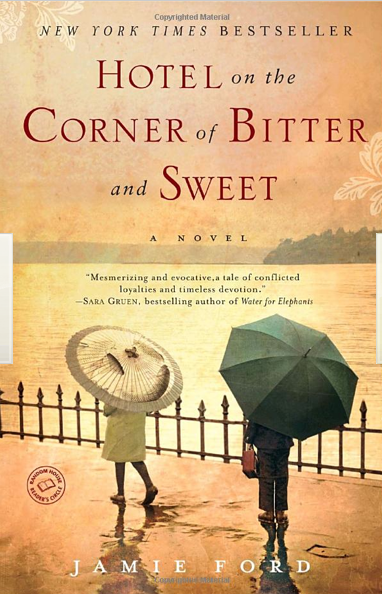
This book had everything going for it, and still I had a hard time getting into it. The book was given by Little Diamond to my Mom – Little Diamond often passes along the very best, thought-provoking books, and in our family we pass the best along, so I knew it would be good. I love the title. The book is set in a part of Seattle now called – euphemistically – The International District, but as I was growing up, and among older Seattle-ites, it is called Chinatown, even though that is not politically correct, or geographically correct. Chinatown was never Chinatown, it was a group of distinct populations – Chinese, Japanese, later Vietnamese, Korean, even later Ethiopian, Sudanese, Somali, Pakistan . . . you could call it immigrant-ville, I suppose, if you were really, really politically incorrect. My Chinese friends still call it Chinatown.
Last, but not least, Jamie Ford started this book as a short story at a camp run by Orson Scott Card, one of my favorite authors, especially to recommend to young people. Orson Scott Card knows how to capture the painful contradictions of being teens and young adults, the conflicts with parents, the loves, requited and un, and most of all, he understands how the young see things clearly as unfair; it’s only later when we start seeing shades of grey.
In spite of all those positives, I hated his voice. I hated the smug little Chinese boy he started as, a scholarship student, first generation born in the US, mocking his parents, fighting off bullies. . . Here is what I hated the most. He had a girlfriend, and he didn’t understand chivalry, like walking her home. He protected her, but he was a pretty self-absorbed little boy.
I kept reading because he had some interesting friends. I liked his friend the jazz player, and I liked the gruff lunchroom lady, and I liked his friend Keiko. I understood his parents pushing him to excel, and their not understanding the struggles this caused Henry; I liked his parents. Because the book jumps around in time, I also liked his wife, and felt annoyed that Henry was all caught up in this old romance when he had a perfectly good wife, but I kept reading.
I am so glad I did. About a third into the book, we begin to see Henry transform into the man he will become. He gets help, he gets mentoring from unexpected people, and he becomes more likable.
The book also deals with a terrible time in US history, a time when we turned on our own citizens and sent our citizens of Japanese descent to concentration camps right here in the USA. The Japanese were a class act; most of them were hurt and outraged, but compliant. Many men volunteered to fight in the war in spite of this slap in the face, this accusation of potential treason. It is a shameful time in our own history, and particularly so for Henry, who loves a Japanese girl, Keiko.
By the end, I loved this book. I hope you will, too.
‘Lost Boy’ Casts Vote for Independence
I found this today on NPR News and it delights me for a number of reasons. For one thing, I didn’t know David Eggars (you remember him from Zeitoun) had helped with the writing of ‘What Is The What?’. Second, who knew that any of these kids would survive? Survive, write a book, thrive, go back to the Sudan, give to the country – and vote. Every now and then in this sad world you hear a good story. This is one.
January 10, 2011
During Sudan’s civil war, in which some 2 million people died, Valentino Achak Deng fled to Ethiopia on foot. Separated from his family for 17 years, Deng is one of Sudan’s so-called Lost Boys, children who were orphaned or separated from their families during the brutal war.
Now, voting is under way in Southern Sudan in a referendum that is expected to split Africa’s largest country. Among those voting this week are the Lost Boys, including Deng, whose life became a best-selling novel in America and who has returned to his homeland to build a school.
After a peace agreement between north and south, Deng returned to Juba, the capital of Southern Sudan, in 2006. He says when he got there, the place was still a wreck.
“On some of these roads, you could see old war tanks. On some of these roads, in some neighborhoods you could see the bones and skulls of dead people,” he recalls now, driving around Juba.
Now, as Southern Sudan appears headed for independence, Deng is optimistic — and Juba looks a lot better. Paved roads, now lined with hotels and restaurants, arrived for the first time in 2007.
Juba is a booming city, one of incredible contrast: Barefoot women selling piles of gravel by the side of the road sit next to a Toyota dealership.
Peace is spurring investment and consumer demand. Juba’s growth is driven by Southern Sudan’s oil revenue as well aid from foreign governments and nongovernmental organizations.
Deng grew up in a tiny village called Marial Bai. In the 1980s, northern bombers and Arab militias came.
“They bombed Marial Bai, destroyed it, killed everything, burned crops and livestock,” he says.
Deng was there when the fighting came. He says he “ran away with the rest.” He was 9 years old.
Deng joined thousands of Lost Boys, who spent months trekking across Sudan to refugee camps in Ethiopia. His experience is captured in What Is the What, a novel by Dave Eggers, which reads like a modern-day story of Job.
The boys, some naked, march across an unforgiving landscape, facing Arab horsemen, bombing raids, lions and crocodiles.
Deng eventually resettled in the U.S., where he attended college and was mentored and sponsored by ordinary Americans.
In 2007, he returned to start a high school in Marial Bai, where there was none.
“We have 250 students. Our annual budget now stands at about $200,000 because the school is free,” he says.
The school is funded by Deng’s private foundation. He says most donations come from Americans touched by his story and the plight of Southern Sudan.
Deng, now 32, has just cast his vote for independence. He says that for a Sudanese child of war, his life’s journey is almost inconceivable.
“I never imagined I would be the person I am right now,” he says.
The Gauntlet
Today dawned clear and beautiful after a day of rain yesterday. It’s a good thing, today I ‘run the gauntlet,’ i.e. I make my run to the military facilities.
It’s across town. Across town in Pensacola is a piece of cake – it’s not like trying to get across Doha, or across Kuwait City; you’re not stuck forever on the ring roads with the arrogant and the rude and the inconsiderate-at-best or even worse – the oblivious.
No, it’s a mere fifteen minutes of sedate driving. I go to the hospital pharmacy, and IF they have the medication I have prescribed, they will fill it – for free. I fill my tank; gas is cheaper and there is no tax. I pop by the Navy Exchange to pick up my expensive hope-in-a-bottle, which is cheaper there. No tax. And now . . . sigh . . . it is time to go to the commissary.
I don’t go that often. While I can find most things there, it can be hit or miss. Prices are better, and there are no taxes, but it isn’t Publix. When you go to check out, everyone waits in one long snakey line, and one at a time, as a cashier becomes available, they check you out. It isn’t that bad. As a process, it goes fairly quickly.
Although the prices are pretty good and there is no tax, you are obligated to tip the bag people who bag and carry out your groceries, and there is a surcharge added onto your bill to cover commissary operation costs. I still think overall we save money.
No, the reason I dread the commissary is the other customers. These are military people and former military people, these are MY people! And they are rude! The aisles are crowded with scowling, aggressive people. The older they are, the worse they are! You think of older people being kindly and polite, but something is wrong with this picture at the commissary, where so many are pushy and rude and look at you like ‘get out of my way!’ I try to stay out of their way, but there are so many of them!
Actually, I try to stem the tide of ill-will by being particularly polite and cheerful. I’m not sure it does much good. Sometimes cheerfulness only seems to make cross and crabby people crosser and crabbier.
On the way to the car, I was chatting with the bagger, and he told me this year was fairly mellow, not like last year.
“What happened last year?” I had to ask.
“Oh, last year they put turkeys on sale,” he responded as he loaded the bags into the back of the car. “Even though you were only allowed to buy two, some people were cheating and buying more, and a couple fist-fights broke out.”
Fist fights? In the commissary? Over turkeys? And who has room in their freezers for more than one turkey?
I resolve not to make another trip to the commissary until I absolutely have to.
Amer Al Hilal on Kuwait’s Ban on DSLR Cameras
Woooooo Hooooo Amer Al-Hilal, a man I am proud to call my friend. It takes such great courage to speak out when something is going terribly wrong, and Amer knows how to do it articulately, rationally, and as the gentleman he is.
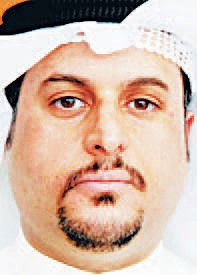
From his article in the Arab Times:
Camera ban regressive idea
‘Don’t stifle home-grown talent’
For a country that possesses a Constitution which safeguards civil liberties and freedom of speech, Kuwait sporadically sure likes toying with those liberties such as tentatively banning the Blackberry service, shutting down You Tube, impeding public gatherings and marches, banning and censoring books, literature, films and magazines which are available elsewhere in the Gulf.
This week according to media reports, and highlighted extensively in local Weblogs and Twitter, a palpable growing outcry is directed at the tentative plans by The Ministry of Information, Ministry of Social Affairs and Ministry of Finance to outlaw public photography and relegate it to journalism purposes only. This has allegedly resulted in the ban of Digital Single Lens Reflex Cameras (DSLRs) in public places. If this charade is true, then it bodes ill for this country, another regressive move into the annals of ignorance.
During the 1980s video cameras and photographic equipment were also shunned by the authorities. I remember visiting Failaka in 1985 and being confronted by a military officer who demanded I hand in my bulky video camera until I left the island. These types of infringements in the name of security were insignificant — we still had an attempt on HH the Amir, explosions at Foreign Embassies in Kuwait and an actual invasion.
Why does this country always attempt to stifle home-grown talent? Banning cameras in public places is demoralizing to all the passionate, talented young Kuwait men and women who have excelled in this field and love their hobby, not to mention visitors who attempt to document their travels here. Moreover, banning DSLR cameras is irrational and counterproductive if you think about it; in this day and age of iPhones, Blackberries, 5 MP plus camera phones, Google Earth and the like, anyone can take photograph of anything, quietly, without fanfare, which makes the potential DSLR ban even more preposterous.
I have just returned from a trip to Dubai where I witnessed dozens of tourists proudly using their cameras to document Burg Khalifa and the other picturesque locations. No one stopped them, impeded them or asked them what they were doing and you know why, because they respect people’s rights and are intent on making their country more appealing. UAE is able to manage security matters confidently because they have proper security and ID processes in place: eye scanners at airports and entry points, proper electronic government, high fines for breaking the law, a brilliant CCTV system in place in every street corner (not the shoddy black and white choppy, streaming-like quality of the limited equipment we have here) — they truly invest in their infrastructure, maintain it and upgrade it.
If Kuwait is serious about its security then it should invest in the same caliber of CCTV and not the bargain basement tenders that usually go towards ineffective systems (i.e. Highway signs with the useless ‘no mobile’ plasma screen) belonging to members of the matching ministry who want a ‘piece of the action’. The sad reality is the government sector here would rather ban something than actually strive to improve it through sheer hard work and effective processes. It’s just easier to ban; a question of laziness and neglect.
Needless to say, Kuwait seems unfazed when foreign jets infiltrate our airspace and take aerial shots of our oil refineries and military installations, or when agents and their local conspirators are found to possess blueprints and photographs of said installations, but no, lets go after the ‘little guy’, the amateur photographer or tourist on the street taking pictures. It’s a hypocritical, spineless action by the authorities.
Moreover, I suspect the issue is not just relegated to security, a myriad of reasons could have led to the support of this ban, fundamentalists who felt cameras and pictures are a ‘Tool of the Devil,’ government officials and ministries disgraced at seeing shots of Kuwait’s dilapidated infrastructure, environment and mismanagement on weblogs, internet forums and magazines. You cannot conceal the squalid side of Kuwait; it is there for everyone to see.
Furthermore, this law against public photography will not be enforced, just as seatbelt, no mobile while driving, no litter, no smoking areas, and other ‘laws’ cannot be enforced in this Land of Confusion.
Amer Al-Hilal is webmaster of http://www.hilaliya.com and can be reached at amer@hilaliya.com.
Gulf Coast Citizen Diplomacy Council
I have a friend from church; she is a woman I admire greatly. Older than I am, though not much, she participates in the Spartacus Program at the “Y”, she is good at running things, she is good at making phone calls and even sounds like she enjoys them, she enjoys social life and she sparkles.
She is always thinking.
“I think I know just the group for you!” she exclaimed as we were working on a project. “Have you heard about the Gulf Coast Citizen Diplomacy Council?”
No, no, I hadn’t heard about that. Having lived here six months now, there is a lot I don’t know.
She told me all about it and she was right. It is right up my alley. The Gulf Coast Citizen Diplomacy Council greets foreign visitors and performs a variety of services, escorting them to appointments, showing them the area, even taking them shopping or inviting them for a dinner in your private home, all in the name of hospitality and showing the best side of this beautiful part of the United States.
The Gulf Coast Citizen Diplomacy Council is a non-partisan, non-profit organization whose mission is to create and encourage collaboration between like-minded community stakeholders who value sharing the Central Gulf Coast with the rest of the world by:
° Facilitating professional and personal interaction for international leaders during official visits to the Central Gulf Coast
° Enhancing respect and communication through international exchanges and alliances
Forging cultural, educational, and business relationships with the global community through citizen diplomacy
° Promoting greater understanding of global affairs in our community through a balance of public events, educational activities, and the International Visitor Leadership Program
° Promoting the Central Gulf Coast as an important center of commerce, culture, and tourism
How cool is that? Even AdventureMan is excited about joining this club; we are so grateful for all the wonderful hospitality shown us through many years of adventures abroad. We feel grateful for an opportunity to be hosts in turn.
In this club I am not so alien. The club members are people who have a broad world view. I met other people who have lived or visited in Qatar or Kuwait, and other parts of the world where I have never been. Oh, what fun.
Many of the members are former military, and I found myself listening to a discussion of an upcoming meeting. As this is a community that parties hearty during Mardi Gras, I assumed it must be the name of a Krewe, a Mardi Gras social club, all these high-testosterone men were discussing camellias, must be a code word for some secret society, right?
Wrong. As it turns out, many people here, men and women, are passionate about gardening, and there is a club devoted to turning out perfect camellias, and they are having a show coming up in December. I learn new things ever day. 🙂
The Gulf Coast Citizen Diplomacy Council was only founded a short couple years ago, and has already won awards for its programs and hospitality. A truly impressive group. 🙂
Demon Cat From Hell at the East Hill Animal Hospital
The Qatari Cat occasionally has a little problem with cleanliness and hygiene, and since we don’t know if it might be a sign of something serious, we booked an appointment with a vet, the vet everyone talks about as being the best vet in town, so caring. We’ve visited her operation on open house day and we were impressed with her professionalism and knowledge, so we called her.
It was a really really good thing we did. When it came time to take him to the vet, I just plonked the cat cage down next to him, picked him up and put him inside, before he even really knew what was happening. He complained all the way to the vet, but nothing serious, like our diabetic cat who hated car motion and always threw up and defecated when we would take her places. 😦
We signed in, visited with the three little kittens seeking adoption, and then, our name was called. We took QC into an examination room where the assistant weighed him and stroked him and told him how sweet he was. He ate it up. He was as good as gold.
The vet came in, and took a look, said it didn’t look serious but that sometimes you see this problem in big cats and long haired cats, so they would just clean him up a little and shave his bottom.
“Hold him down like this,” she showed her assistant, and the Qatari cat cooperated. Er, well, he cooperated until the first vibration of the razor hit his hind-end hairs, at which time he did an instantaneous transformation into The Demon Cat From Hell, twisting, howling, hissing, trying to bite or scratch, little legs going in reverse, back writhing . . .
“I can’t hold him!” the assistant cried, and she hid her terror, but her voice trembled.
“Get the towel,” the vet said calmly, as she held him down with her two strong hands while the demon-cat-from-hell told her he intended great harm to her as soon as he could get free. She threw the towel over his head, which only made him madder and squirmier, but as the vet tech struggled and held the Qatari Cat down, the vet calmly continued with the “grooming.”
“We use these to clean the bottoms,” she said, pulling out those antiseptic wet-wipes we all carry around to wash our hands when there is no water around.
I just laughed. I have chased the Qatari cat around with warm wet cloths, with wet wipes, with towels . . . he does not like anyone messing with his bottom.
“Now that you’ve shaved him, I think he’ll be OK until the next time,” I said.
Trust me, Qatari Cat, when he is rational, knows I am the alpha. He obeys me. I can tell him to come in out of the garage and he will come; I can pat the bed and he will come lie down next to me. He knows my signals and he acknowledges my Queen-of-the-food-supply-and-warm-body status. Mess with his bottom, however, and all rational thought (in cat terms, rational thought, not our terms) flies out the window as the basest of instincts takes over.
Here is the sweet part. The clinic wrote us a thank you note for our visit. When it came in the mail, I was almost afraid to open it, afraid they would tell us that unfortunately, their practice is full right how and that they would like for us to find another vet for the Qatari Cat. Not so. It was a genuine thank you note, thanking us for our visit. They are totally a class act.
Getting it Wrong
With all my years of living abroad, with all the experience I’ve had keeping my head down, observing, and trying to look and act like the locals, you’d think I’d get it right in my own country, right?
Wrong.
Well, most of the time I get it close enough. Sometimes I am overdressed at the Target or Home Depot. Rarely am I underdressed, but today I was. I looked around the church and I was one of very very few women in short sleeves. Almost every woman was wearing a jacket with either full length sleeves or 3/4 sleeves. Oops, I thought. When you are new, you especially need to try to look like those around you. It must be a calendar thing, not a temperature thing, because the temperatures today are back up in the 80’s; that is not long sleeve weather in my book, but it is in the Southern Lady Book.
One week I wore purple shoes – I love my purple shoes. I realized, too late, that they might go a lot of places, but probably not to our church. Oops.
Florida is particularly hard because there are the long-time Floridians and then those who are more newly arrived. I learned this the last time I lived in Florida, when, thanks be to God, I had an old Florida friend who told me all the inside scoop to help me pass. That was about 20 years ago, though, and some of the information has gotten a little outdated. The first rule, though, is not to look like a tourist. No little sundresses – and if you get a sunburn, you should have T-shirt marks on your arms so people will know you’ve been out fishing or working in the garden. No T-shirts with beachy sayings; T-shirts from the Breast Cancer Run or the Junior League Marketplace are OK.
My big dilemma right now has to do with legwear. I overheard some of the younger women in the locker room at aqua aerobics laughing about ‘old lady’ stockings, and I realized they meant nylon stockings. I haven’t worn them for a long time, except for once or twice in Seattle when I was back in the winter and had to go to funerals, but I don’t know what ladies are wearing in the place of nylon stockings. Nylon stockings in Qatar and Kuwait were pretty much irrelevant; when the temperatures are in the 120’s F, you simply don’t bother, wearing nylons is unthinkable.
You almost can’t even find nylon stockings in Florida, and a lot of the women seem to finesse the matter entirely by wearing pants, or not wearing stockings at all, which you can do in the summer, and of course you can wear pants in the winter, but what do you wear in the winter if you want to wear a skirt? It does get cold in Pensacola, and my legs are going to need some protection. I have a good supply of colored tights, which I have seen some younger women wearing, but this is one of those times when I feel like I have been gone from my own culture for too long and I am out of touch.
As I looked around the women at church today, I also had the funny idea that almost every woman in that church would do just fine in Qatar or Kuwait, they are covered to the elbow – and beyond – and they are covered to the knee, at the very least, with clothing that is mostly not too tight. Just as wearing long sleeves seems to be more cultural than weather-driven, covering your hair in the Islamic countries is more cultural than religious. Mohammed, the Prophet, told the women to ‘cover their adornments;’ it was the men who decided that hair is an adornment. My Saudi women friends told me that it originally meant ‘cover your breasts’. It’s cultural, not religious.
Still working out what works – and what doesn’t – in Pensacola. Praying that all my ‘oops’ are little ones.
A Day in Flomaton, Alabama
All we knew when we started the day was that we wanted to explore a little bit north of Pensacola, maybe even up into the part of Alabama that is across the state line to the north (as opposed to the part of Alabama that is across the state border to the west). We thought we were having a very boring day until we wandered into Flomaton, and AdventureMan discovered a railroad museum.
Flomaton is at the very top of the map:

The railroad museum was also an older house, now the museum, and an older 2 room cabin out back, moved from its original location. Here is a recreation of the old front parlor:


The Railroad Collection room:

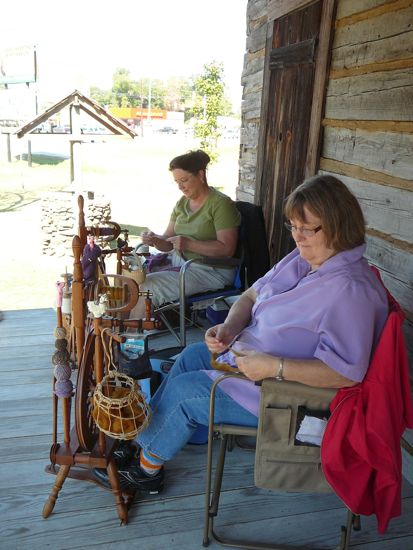
The log cabin was out back of the house, and had two women spinning wool into yarn on the porch, who very graciously allowed me to take their photo:
Inside the log cabin – we were told the couple who lived in this cabin had 12 children; they slept on the floor on pallets at night:


At the museum, there was a flyer about “Back to your hometown weekend” in Alabama, which just happened to be that very weekend. The town was full of returning people, there had been a parade and fireworks the night before (three former homecoming queens told me about this) and there was a street fair to celebrate Home Town Flomaton. 🙂
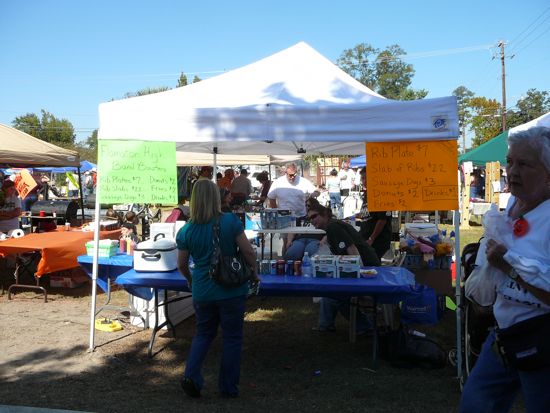
It was nearly lunchtime. We could smell Barbecue. The street fair was just a block away and there was parking right there, right by the fair. It was so much fun:

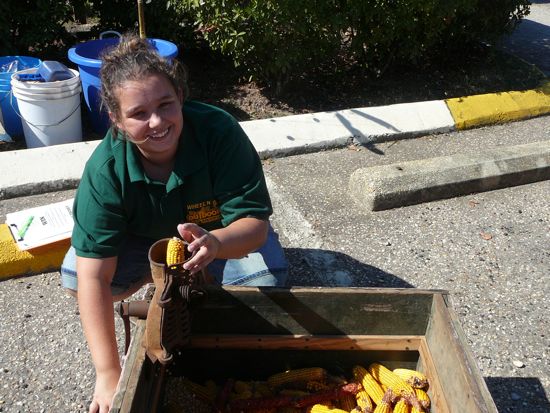
People were so kind and so helpful. This young woman was grinding corn, and we speculated that it must have been a great modern invention, and a real time saver, when it was invented. A woman passing by said she remembers her own mother using the same machine; all the corn was then taken to be ground, and stored in large airtight bottles in a dark ‘keeping room’ with preserves and food to get them through the winter.

This band was playing blues, gospel and country music, and they were pretty good!



As we stood and watched the choir, another woman welcomed us, and told us we really needed to see the new library (it was gorgeous!) and if we hurried, we could catch the Raptor Show at Otter Point. A Raptor Show!


Inside, there was a butterfly house, and several displays of local natural life:

There was also a wonderful hiking trail out over the wetlands, well maintained and beautiful:

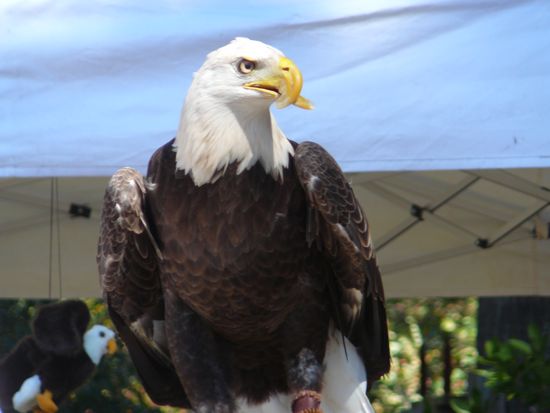
The Raptor presentation was very well done, informative and funny, on many levels. They had a large audience of children, who learned a lot, and also adults like us, who also learned a lot. The bald eagle’s beak is deformed by PCB’s, which, although banned back in the 1970’s, are still present in the environment in quantities high enough to cause birth deformities. The only reason they were able to adopt the bald eagle, a protected species, was that while he can hunt, he cannot tear his food apart with his malformed beak.
It was a day full of gracious hospitality. People were so kind to us, and went out of their way to make us feel welcome and to explain what we were looking at. For a day that started with no clear goal, we felt like we had been abundantly blessed by happening across this beautiful October day in Flomaton, Alabama.
Recent Comments
ExpatAlien on What Country am I Living … intlxpatr on Yellowstone: Old Faithful to C… Michelle on Yellowstone: Old Faithful to C… Cathy on No Grown-Ups in Charge intlxpatr on Waiting for Snow Wikipedia Donate Button

Amazina


Early Voting in Florida


 Here There and Everywhere