Buying a Car the Civilized Way
“Did you know USAA has a car buying service?” AdventureMan asked me. Well, yes, sort-of, but I’ve been not wanting to think about buying a new car with all the house-buying stuff and paper-filling out stuff and packing stuff and making lists.
On the other hand, every day I have to rent a car is money down the drain.
“I’ll just check it out,” I thought to myself.
It was so easy. You go online and tell the car buying service where you live and what you want to buy. They send your name and phone number and e-mail (since I don’t want car salespeople calling me in the middle of the night because they don’t understand about time zones, I only gave them my e-mail) to dealerships who participate in USAA’s program.
USAA also sent me a list of car dealerships in my area and a Certificate for me to print with their agreed upon price. That simple. The certificate prices were significantly lower than anything I had been offered at the dealership I visited, and these were guarantee.
Within hours, three dealerships had e-mailed me. I chose the closest, worked with a WOMAN to get what I wanted at the price I was willing to pay, and not one item more. She was courteous and helpful and respectful! She got me everything I wanted. She named an out-the-door price that I could live with.
The only downside is that the dealership is 35 minutes away, in Fort Walton Beach. The upside is that they have been known to deliver, and 35 minutes just isn’t that far. Like from Fintas to downtown Kuwait City in heavy traffic, or from my house to the Ritz Carleton in Qatar. I can live with that.
Yes. Yes, Daggero, you guessed it right, I am buying another Rav4, one with brakes that work. I’m not scared off by Toyota’s troubles. It’s like eating in a restaurant that has just re-opened after being closed for health violations; you know it’s never going to be cleaner than it is right now. 😉 I love the way the Rav4 is sort of small, I am sort of small, too. I love that it turns on a dime, and that I am high enough to look over most of the traffic, but small enough to park in a tiny parking spot. It’s an SUV, but a modest SUV, with good mileage per gallon, and a great record for reliability and repairs.

Here is what I love about this transaction. I did my homework. I know what I want. I know what is a reasonable price to pay. I am getting a better price than I expected. There are no games – here’s what I want, here is what I am getting and here is what it is going to cost, and that includes title and licensing. How cool is that? I feel like when you do business like this, everyone is a winner.
And a shout-out to Marisa at Quality Toyota at Fort Walton Beach for making the process easy and non-threatening and civil. Working with her to buy my new car was a pleasure.
Keep Another’s Confidence
This is from a wonderful website by by Rick Warren, who writes about the Purpose Driven Life and who sends out daily inspirational messages. I love this one.
Connect be keeping someone’s confidence
by Rick Warren
“A gossip betrays a confidence, but a trustworthy man keeps a secret.” Proverbs 11:13 (NIV)
If relationships are going to work, we have to be confidential with information.
Are you the kind of person that someone can trust with confidential information? We tend to think of gossip as one of those little sins, a misdemeanor sin. But when God talks about gossip, He puts it on a list with things like sexual immorality and murder.
Why? Because it is incredibly destructive to relationships.
What is gossip? Gossip is talking about a situation with somebody who is neither a part of the solution nor a part of the problem. And if we’re honest with ourselves, what we’re doing is making ourselves feel a little more important at somebody else’s expense. We’re talking about their hurts and their problems, but in a way that makes us feel a little bit superior to them. That’s the danger and the hurt of gossip.
There’s a story in the Old Testament about a family that struggled with gossip. Moses had a sister name Miriam who one day got caught up in gossiping about Moses amidst the rest of the people. God called them together – Moses and Miriam. He spoke with Miriam and told her what she’d done wrong and immediately He gave her leprosy.
But look at what God did next; he invited Moses to pray for Miriam’s healing – to pray for the one who gossiped against him.
Some of you have been deeply hurt by gossip. The story of Moses and Miriam suggests God would say to you, “Pray for that person’s healing, the one who gossiped against you. That way you can be released from the hurt that’s come into your life.”
Perhaps you’re the one whose been gossiping. You’ve been the one talking about other people. This story is in the Old Testament to remind us how serious gossip is, how hurtful it can be to people no matter what side of the situation you’re on.
The truth is, when you keep confidences it makes your relationships healthier. It enables you to keep connecting with others in positive and genuine way.
What is so interesting to me is that Islam has the same prohibitions against gossip, called back-biting, and puts a high level of prohibition against it. The prophet Mohammed warned against it repeatedly.
I love it that Rick Warren puts it into context by warning that it destroys relationships.
Breast Cancer Support Group Forms in Qatar
Breast cancer support group launched in Doha
By Ourouba Hussein
From today’s Gulf Times
The first breast cancer support group in Qatar was launched yesterday with 25 survivors as members.
Qatar National Cancer Society (QNCS) chairman Sheikh Khalid bin Jabor al-Thani said at a press conference that the organisation has been working for the last 10 years to set up the group, which would provide support to patients “who are newly diagnosed with the disease”.
He explained that the 25- member support group included Qatari and non-Qatari survivors or those who are still under treatment.
Sheikh Khalid said that QNCS was preparing to host a scientific conference on cancer control in April.
“The organisation will also launch a campaign to combat cancer in women and increase awareness to promote prevention and treatment of this disease,” he said.
Wife of the US ambassador Ellie LeBaron, a leading supporter of the cause, observed that the group included women who had suffered breast cancer, in addition to a member of their families.
“The Cancer Survivors’ Group aims to raise awareness of the importance of early detection, which has a great impact on the success of treatment, as well as telling the newly diagnosed that they can fight it and succeed”, she said.
“Many of the women with breast cancer are looking for answers to questions about chemotherapy and radiation treatment, as well as the chances of recovery,” she said.
Breast cancer survivors in the group, spoke about their experiences with the disease and treatment and emphasised that the mental support they received played a major role in their healing process.
Qattari Cat Goes Wild

It was like the ninth circle in Hell. We had been told this was the best clinic in town, so when we thought the Qatteri Cat was having a problem, we made an appointment, and braved the Doha drive-time traffic to get there, only to discover that there were like 25 people milling around the waiting room, most holding animals loose in their arms, and a feeling of desperation in the air.
The customer service was shocking. I watched one man, big guy, football-player type, sway and his knees nearly buckle as the curt woman behind the desk said in her loud voice “Oh! Your cat didn’t make it! Your’s was the little grey cat, right?” He was devastated. I was horrified that the news could be delivered so callously, and so loudly.
Many of the people without appointments had kittens bought at the Souq al Waqif. You know I love the Souk al Waqif, but if you buy an animal there, you are buying an animal who already has strikes against it, and people who breed them just for sale, with no regard for ethical treatment of another living creature. You are buying trouble, and big veterinarian bills. It’s gotten so bad for me, I can’t even walk through the bird/animal area anymore. I can’t bear to see the way the animals are treated.
We got to see the vet over an hour later. He was nice, very professional, very knowledgeable, and I cannot imagine what it is like having to run a veterinary service under these hellish conditions.
One of his handlers walked in, looked at me coldly and said “Is this your cat?” I said yes, and she continued on “this is the worst cat I have ever handled. He is EVIL! He is VICIOUS! He is the cat from hell. Is he like this at home?”
Imagine saying something like that to a customer!
I felt like I had been punched in the stomach. The Qatteri Cat had a rough beginning in life. I met his first owners, and the women in the family didn’t like him. When he came to live with us, he loved – and trusted – AdventureMan from the beginning, but it took me a long while to win his trust. He was skinny and always watching my feet and hands; he would flinch if I moved too quickly. He had been mistreated.
He has bitten me twice, in his seven years living with us, both times when other cats were around and he was scared. When he is scared, or when he is in pain, all his natural instincts kick in. I give him a short time-out in a confined environment (the bathroom!), and everything is fine. He’s a cat. No, he is not vicious at home. He is a SWEET cat!
He has never misbehaved at a vet clinic, never. At the clinic in Kuwait, he couldn’t wait to get out of the cage; the female Italian vet told him what a handsome big boy he was and he was putty in her hands. I have to admit it, I felt a twinge of jealousy. He had eyes only for her!
The Qattari Cat is a cat who wants to co-operate. It doesn’t matter how good the vet is, if the staff is unprofessional, discourteous to the point of rudeness, and ignorant about handling animals, we won’t go back. We won’t risk him being handled cruelly. I cannot imagine why they keep this woman on their staff.
But I couldn’t resist taking a flash photo of QC to illustrate this post, with demonic, gleaming eyes, LLOOOLLLL!
The Law of the Harvest
A small group was huddled, talking about volunteer work, and how people are afraid to commit, when the duties are actually very light, and easily accomplished, then we drifted into giving generously . . .
“It’s called The Law of the Harvest” one of my favorite women popped in as I was trying to explain that when you give, open-handedly, give with your heart, it all comes back to you multiplied.
We all turned to her. “Remember the seeds? You sow the seeds and then it is multiplied?”
Of course! It’s so simple! Why didn’t I think of that?
Volunteer Day at Animal Friends Kuwait
God bless the work of your hands, all you who work to help those who have no voices, who rescue the animals, give them food and shelter, and adopt them.

Animal Friends and K’S PATH will be hosting its bi-annual Shelter Open Day where everyone is invited to come out, visit with the animals and learn all about their rescue and care. Visitors will be able to walk the dogs, cuddle the cats, play with the puppies, brush the donkeys, watch the baboons and so much more. The weather is beautiful, so come and make a day of it.
When: Friday 29 January, 2010, 11:00am to 3pm
Where: Animal Friends Shelter and K’S PATH sanctuary in Wafra
Cost: Free, although we certainly appreciate donations
Notes: Please leave your own pets at home and refreshments will be available for sale.
Huge Yard Sale — antiques, collectibles, book worm’s treasure trove, gently used infant clothing and toys, gently used adult clothes and shoes, Indonesian teak furniture, home wares, gourmet kitchen gadgets, dishes, pots and pans and so much more. Come on over and rummage through the goods and you might find a treasure. All funds will go to support Animal Friends.

When: Saturday 6 February, 2010, 10:00am to 3pm
Where: Fintas, Block 4, Street 11, House 29
Notes: Refreshments will be available for sale.
The Party House
We stumbled into the upstairs lounge, all four of us, sleep muzzy and disheveled, but then again, it was 3 in the morning.
“What is that?” asked Mr. Ambassador, who is no longer Ambassador anymore, but still gets to be called that. He was asking about a wailing, like that of an injured cat, only accompanied by music.
I blushed to the roots of my hair. Fortunately, it was dark. No one could see the depth of my humiliation
“It’s the party house.”
This was punctuated by shrieks of laughter from the new influx of ‘hostesses’ invited to entertain the male guests when they ceased their karaoke singing. Doors slamming, karaoke machine at it’s highest setting, the party is in full swing.
AdventureMan broke the ensuing horror-filled silence.
“We are SO sorry. It hardly ever happens. Most of the time they aren’t even there. You just happen to be here on the ONE night.”
With the beautiful weather, we have our windows open. We make up the beds in the rooms on the other side of the house, close all the windows, and turn on the air conditioning to muffle the alcohol-fueled revelry.
“Can’t you do anything? Can’t you complain?” my good friend, the ambassador’s wife, whispered to me.
“It’s their compound. We tried complaining. Nothing happens. I can’t tell you how embarrassed I am that this would happen while you are here, as our guests,” I replied.
She laughed – diplomatically – and brushed my embarrassment aside. She’s a good friend.
Community Police Graduate
Community policing is necessary when we neglect to police ourselves. . . if, for example, we find ourselves throwing a tissue out of our car window as we drive along, littering the pristine streets of Doha. If we bully someone because we want that parking spot he is driving into, if we disrupt the peace and quality of life of others by our behavior.
I notice, in this story from the Gulf Times, that women are a part of this program, and that they are wearing uniforms, and hijab, and that those uniforms are very modest and also that they are wearing pants. Please see the previous article.
I commend Qatar for this visionary program, helping the community police itself, and for including women from the very first class.
46 take part in community policing basic course
Graduates with officials at the convocation ceremony
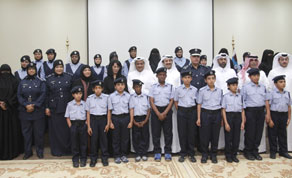
The Police Training Institute (PTI) recently held a ceremony to mark the graduation of participants in the first batch of the Community Policing Basic Course, under the auspices of Minister of State for Interior Affairs HE Sheikh Abdullah bin Nasser bin Khalifa al-Thani.
Some 46 students from various security departments took part in the course, which lasted seven weeks, said a spokesperson.
The ceremony was attended by the chairman on the Central Municipal Council, HE Nasser al-Kaabi; director of the PTI, Brigadier Mohamed Hassan Youssef al-Saei as well as other ministry officials.
Brigadier al-Saei explained that the course has been conducted to “enhance the role and mechanisms of community policing,” as well as helping to create partnerships with various social institutions to help with national security.
The PTI director added that the graduates of this course will be able to translate the Ministry of Interior’s aims and strategies to encourage understanding between various communities and to help the police to be able to prevent crimes before they are committed.
Brigadier Rashid Shaheen al-Atheeque, chairman of the steering committee of community policing, said: “The graduation of the first course of community policing is one of the stages of qualifying the national cadres at the Ministry of Interior to work in the national project.”
“Qatar is currently witnessing progress in all aspects of development in economic and social fields – this increases the role of all sectors in the country to face all kinds of challenges brought with this development,” he said, adding: “These factors require the improvement of capabilities to keep pace with development.”
Brigadier al-Atheeq explained that the ministry had pursued the initiative of community policing to help reduce crime throughout all institutions, and said that they had pursued the objective with the co-operation of the Supreme Council for Family Affairs as well as other ministries and companies, working towards the National Vision 2030.
He explained that the concept will initially be employed in the North Security Department from April 2010, with plans to apply it across the board from 2011.
Representing the director of the Ummul Qura Independent School for Boys, teacher Areezah al-Yami described the noticeable benefits of introducing the community policing programme in the school over the past year.
Stieg Larsson and The Girl With the Dragon Tattoo
I needed some escape time, so I started The Girl With the Dragon Tattoo, a mystery by Stieg Larsson, set in Sweden. I love these detective stories set in other countries; I can learn something as I pass the time reading an exciting mystery. And part of my heritage is Swedish, so I thought this should really be fun.

It wasn’t, at least not at the beginning. At the beginning, I didn’t like any of the characters, and they were always eating sandwiches that sounded awful, like liverwurst and egg. I felt like the characters didn’t have any moral center, like they drifted from day to day without neither conscience nor a plan. The main character, Mikael Blomkvist, is about to go to prison for libel; he printed a story about a major industrialist which turned out to be false, and he protected his source. We don’t really know the whole story, not until the end, which makes it hard to evoke a lot of sympathy for Blomkvist.
He is contacted by another industrialist, and asked to solve a mystery, if possible, about the disappearance, 40 years ago, of his niece, Harriet Vanger. Blomkvist would investigate under the cover of writing an autobiography of his employer and his family. There are members of the family who object. In many ways, it isn’t a very nice family.
Blomkvist gets an assistant, a deeply troubled and flawed young woman, Lisbeth Salander, with a gift for investigation. There is a lot of violence, sexual violence, and mutilation of animals. One of the points I credit Larsson with making is the amount of violence against women in Sweden, which goes on under a seemingly civilized veneer. The truth, as I see it, is that there is violence against women in every society; in some it is better documented than in others. In some, it is better punished that others. It exists in all societies, in all countries.
Another think I ended up liking about the book was that the main character, Blomkvist, who writes financial analysis, takes the press to task for printing what passes for financial news without critically reading and evaluating, which he feels is a responsibility of the press. At one point, as people quail with fear that the stock exchange will drop dramatically, he is interviewed and explains that the stock market is based on perceptions, while the Swedish economy is based on production and services; that while the markets may fail, the economy can still be going strong.
Slowly, the book tightens up. Actually, by the end, I was hooked. The only question in my mind is – did I like it enough to read another?
The book is available, new, from Amazon.com at $6.00 plus shipping.
Recent Comments
ExpatAlien on What Country am I Living … intlxpatr on Yellowstone: Old Faithful to C… Michelle on Yellowstone: Old Faithful to C… Cathy on No Grown-Ups in Charge intlxpatr on Waiting for Snow Wikipedia Donate Button

Amazina


Early Voting in Florida


 Here There and Everywhere