Peace on Earth, Good Will Towards Men
Today’s reading in Forward Day by Day is a difficult teaching from the prophet Amos, telling us that no, God isn’t on our side. God loves us, and he loves our allies as much as he loves us. And . . . he also loves our enemies – as much as he loves us.

THURSDAY, December 10 International Human Rights Day
Amos 9:1-10. Are you not like the Ethiopians to me, O people of Israel?
Amos is the Bible’s first universalist. Gods in ancient times, including Israel’s god, were seen as localized deities, inhabiting a certain place and exercising power on behalf of the people who lived there, whom they favored over other people. A god’s authority was rather like that of a modern sheriff–one had to pay attention to it, but its jurisdiction was limited by geography.
Then Amos, speaking on behalf of Israel’s god, said the chosen people were no different in God’s eyes than the Ethiopians. If God had done something special for Israel, he had done something special for everyone else, too, including Israel’s sworn enemies. God has no favorites and his authority extends everywhere. In his brusque, in-your-face manner, Amos says one nation is no more precious than another.
In this day of immigration controversy, ethnic suspicion, religious absolutism, xenophobic frenzy, and false patriotism, Amos speaks a sobering word: “You’re no different from anyone else. I love you, but I love your enemy, too, and if you don’t also love your enemy, you are no friend of mine.”
Cheaters Leave Digital Tracks
No, not another post about cheetahs – this is about cheaters.
Today in AOL: Sphere
(Dec. 3) — Tiger Woods has long since mastered the use of every club in his golf bag. Yet he, like many Americans, apparently is still learning the hazards of communicating too openly by modern methods such as text messaging.
Woods is certainly not alone. As communication technology continues to evolve, unfaithful partners are finding it easier to keep in touch with their illicit lovers — but it’s also a lot easier to get caught.
The golf champion has said only that “I have let my family down” through unspecified “transgressions.” But one of his alleged mistresses, Jaimee Grubbs, says she still has 300 text messages sent to her by Woods. In one, Grubbs tells RadarOnline.com, Woods says, “Send me something very naughty. … Go to the bathroom and take [a picture].”
Us Weekly magazine has also posted a voice mail Grubbs says is from Woods, warning that his wife has examined his cell phone and may have discovered the former cocktail waitress’ name via caller ID.
“Any electronic means of communication — a cell phone call, an e-mail or a text message — will leave some sort of trail behind,” said Ed Edmister, a private investigator and computer forensic expert at Integrity Security & Investigation Services, which has branches in California and Virginia. “Even if you toss your phone in an incinerator or dump your computer in a lake, there are still records kept by phone and Internet companies. Digital forensics has become a huge field.”
Of course, not every spouse needs to hire a private investigator, or send in a partner’s cell phone to one of the dozens of companies that specialize in recovering deleted text messages and call logs. Sometimes, the evidence is hiding in plain sight.
Take the case of Tony, a 38-year-old Jacksonville, Fla., man who did not want to use his real name for this article. After eight years of marriage, Tony began an affair with a younger woman. “We sent text messages to each other all the time,” Tony said. “I carried my cell phone with me wherever I went.”
After staying out late one night with his mistress, Tony slept in while his wife and two sons ate breakfast together in the kitchen. His cell phone, carelessly left in a coat pocket, chirped to indicate a text message had been received. “My 8-year-old son picked it up and read the message aloud,” Tony recalled. “It said, ‘Good morning, honey. Have a good day.'”
Tony’s wife snatched the phone from her son’s hand, headed into the bedroom and confronted her husband. Six months later, the couple divorced.
“Infidelity is so much easier today,” said Ruth Houston, author of “Is He Cheating on You? 829 Telltale Signs” and a widely cited infidelity expert. “In the past, a potential cheater would go to a bar or a nightclub — very risky stuff when you’re in a marriage. Now you can sit down in your home and click on a mouse and find willing partners.”
Thanks to unreliable self-reporting, trustworthy infidelity statistics are difficult to come by. But a recent study sponsored by the National Science Foundation, and reported in The New York Times, showed marked increases in infidelity among both men and women from 1991 to 2006.
“Infidelity is definitely on the rise because of technology,” Houston said.
Even in innocuous ways, the Internet can bring together aspiring adulterers. After all, the Web is quick to sort users into affinity groups. Two people who meet in a dedicated chat room already have some interest in common, and that can foster a rapid sense of intimacy.
“Women, especially, crave emotional intimacy,” Houston said. “E-mail or chatting can start off innocently, but if there are actual connections, relationships develop quickly.”
In any case, adulterers are slow to grasp that modern communication devices are not nearly as private and secure as many people believe. Just ask South Carolina Gov. Mark Sanford, whose e-mails to his mistress, Maria Belen Chapur, were first made public by The State, a Columbia, S.C., newspaper.
Kwame Kilpatrick, the former mayor of Detroit, suffered a similar turn in the electronic pillory. Some 6,000 text messages from his mistress’ pager were posted online by The Detroit Free Press and helped lead to his conviction on perjury charges.
Those politicians are certainly not the only ones to be caught with their virtual pants down. Digital technology, which has democratized almost everything it touches, is making adultery accessible to the masses.
Debate on Media Freedom in Doha, Qatar
From today’s Gulf Times:
Debate on Qatari press law
The Doha Centre for Media Freedom (DCMF) will hold a roundtable discussion on the Qatari press law that dates back to 1979, on Wednesday, at The Ritz-Carlton Doha, an official said yesterday.
According to the official, under the discussion will be the need for a Qatari media, and the view concerning modification and changes to the accrual Press Law, in order for it to match the requirements of the current era.
Discussions will be moderated by DCMF deputy director general Maryam al-Khater, while senior media officials of the country, editor-in-chiefs, senior journalists, heads of media organisations and others are expected to be in attendance.
After an introductory presentation of the most-recent study prepared by DCMF on the Press Law, comprising recommendations, suggestions, and analyses, the floor will be opened to what is expected to be a “vigorous debate”, the official said.
“The DCMF calls on all media specialists to exercise their right of expression by participating in this gathering and sharing their thoughts about the possibility of amending the negative provisions of the law for journalists’ rights as well as adding provisions which respond to their ambitions,” the official added.
The event coincides with the National Day for Human Rights, which falls on November 11 every year.
There was an earlier report, on June 24th, that most of the original members of the DCMF had resigned:
Media Freedom Centre team leaves office
DOHA: Robert Ménard, director- general of the Doha Centre for Media Freedom and his team have left the Centre.
“We no longer have either the freedom or the resources to do our work,” said Menard, in a statement issued yesterday.
The heads of the assistance, research and communications departments have also left the Centre, said the statement.
The Center was set up on the initiative of H H Sheikha Mozah bint Nasser Al Missned and Reporters Without Borders in December 2007.
Ménard, who became director-general on April 1, 2008, was the founder of Reporters Without Borders, which he headed for 23 years.
I imagine this is going to be a very interesting “vigorous” debate, of interest to all those who write – or blog – on Qatar. One of the things I notice in both Kuwait and Qatar is that in the interest of self-preservation, the newspapers self-censor. For example, when a crime is committed, if it is an Asian, or even, rarely, a westerner, the name of the criminal can be printed. If it is a local citizen, they do not print the names, not ever, unless it is a rare case where the defendant is convicted and appeals – on rare occasions, the name will appear then. In order to spare the family the embarrassment, I have been told, but I would think that the fear of embarrassing the family would have a strong deterrent effect on young men, for example, who think it is OK to abduct, rape and humiliate young men and women, without fear of having their crime made public.
In Kuwait, they publish the crimes committed, at least. In Qatar, you would think from reading the papers, that these crimes don’t exist. They do. They aren’t reported.
I think it is very cool that in Qatar, many of these issues are opened for public debate, as in this media debate, and in the ongoing Doha Debate series.
Scam of the Day: Short and Sweet
LLOOLL @ 100% legitimate and risk free!
Dear sir,
I am Mr.Kumalo Donald a transfer supervisor on investment in HSBC Bank,United Arab Emirates , I have a transaction of 50/50% mutual benefit worth $9.5 million dollars, If interested please respond to my personal e-mail ( kumalodonald@aol.com ) for more detail and processing. is 100% legitimate and risk free.
Best Regards !
Kumalo Donald
United Arab Emirates
Suq al Waqif Coffee Shops closed
You gotta read the small items in the newspapers – that’s where a lot of the real news is. Today, in the Gulf Times is this tiny little article about shops being closed in the Souq al Waqif for serving shisha to underage people. Who knew? There is a legal age for smoking shisha?
Coffee shops closed
A number of coffee shops at the Souq Waqif were closed by the Doha Municipality for not complying with the health regulations, according to a report in a local Arabic newspaper.
The report said closure notices were put up by the municipality inspectors on the doors of the non-complying coffee shops.
Among the recently detected violations was the offering of Shish to teens under 18, which the report said, was in breach of the contracts signed by the Old Souq department and tenants of the coffee shops.
However, coffee shop managers at the Souq pointed out that asking customers their age could cause anger, particularly with female customers, who just opt to move to another outlet.
Expose Violators to Protect Consumers?
This article is from the Qatar Peninsula but it applies equally in Kuwait, in Seattle, in Pensacola . . . when a restaurant violates a health code, shouldn’t those results be made public? They are serving the public, they take our money, shouldn’t we know the state of hygiene and the safe-practices they observe – or don’t observe?
We still remember a time in Monterey, California when we walked into one of the most popular Chinese restaurants in town and found a table, without having to wait. It was astonishing. There were few customers that night. The next day in the paper we found it had been closed for health-code violations. We took comfort in knowing that when it re-opened, it had to pass a re-check, and it was probably the cleanest it had ever been, or would be for a time to come. 🙂
Restaurateurs want names of eateries violating rules to be made public
Web posted at: 9/27/2009 23:45:38
Source ::: THE PENINSULA
DOHA: The identity of the eateries punished for flouting health and safety rules should be disclosed by the authorities concerned, feel a number of restaurateurs in the city.
Not disclosing the name of an erring eating outlet is unadvisable since it can make all the eateries of a locality suspect in the eyes of patrons, say restaurateurs.
This happens especially as the authorities do mention the area an erring eatery is located in but fight shy of publishing its name in local newspapers.
Al Sharq Arabic newspaper in its weekly online survey took up this issue this time and an overwhelming 94 percent of the respondents said they were in favor of disclosing the identity of an erring eateries.
Only five percent said they did not back the idea, while one percent said they were undecided.
Written Communication, Plusses and Minuses
I was e-mailing back and forth this morning with a dear friend who is traveling. She was about to visit an old school friend, and before visiting, dug out all the letters she had received from the friend – an enormous collection – and read through them all. She said it was a very moving experience, and I could tell that even before visiting her friend, she was feeling close from having read all those letters.
When was the last time you got a letter?
I have some letters my husband has written, saved away. 🙂 Most of my written communications these days are done by e-mail, instant-message, or texting. I used to have files of e-mails, but as they grew bigger and bigger, I sort of stopped saving them, except for important ones, or business-related ones.
These blogs are also written communication, but more like books, less personal and you never really know who is reading on any given day, and who isn’t, so like it is not the most reliable way to communicate something important, especially to one person or a small group of people; e-mail just makes more sense. Or picking up the telephone, which I don’t do all that often as I am not so much of a telephone person and many people I would call are in different time zones.
But it makes me wonder what record we will have of these times? I told my friend when I was in college, I worked part time in the university xerox department, and most things in the Northwest Collection came to me. I could read them as I copied them – diaries, letters, to-do lists, shopping lists – ephemeral things, but written on paper, and they give us a tiny peephole into the daily lives of people who lived a couple hundred years ago.
Think of your life, and how things have changed, even if you are in your twenties. Two hundred years from now, people will have so many questions about our lives, how we lived, why we did the things we did. With fewer lasting pieces of paper, will the record be so complete?
Think of our electronic storage devices – remember floppy disks? My computer wouldn’t even be able to read a floppy disk! Think of the tiny little USB devices we are saving onto now – how long will that technology last? In another generation, it will be as opaque and accessible as the ancient inscribes stones buried in the deserts.
As we go more and more paperless, how are we saving the ephemera?
As I upload a couple years worth of photos to be printed, I think of the scrap booking craze, how you take a few photos and decorate all around them, but do the resulting albums give you truth, or do they give you a fantasy of the truth?
I think of the photographs from a hundred years ago – people with somber faces. Serious faces. No one ever smiled for the photos. There are photos of my earliest relatives in Seattle, they are truly a grim looking bunch, I think it was the style then, and I have a feeling that they didn’t look like that most of the time; our family culture is pretty jokey. So I am also wondering about family lore, family history and realities. Like most of us expunge the photos of us that are unflattering – and destroy letters we would never want anyone to read. In so doing, we don’t change the real history, but we do change the transmission of history! Much of what gets transmitted ends up being censored, by us!
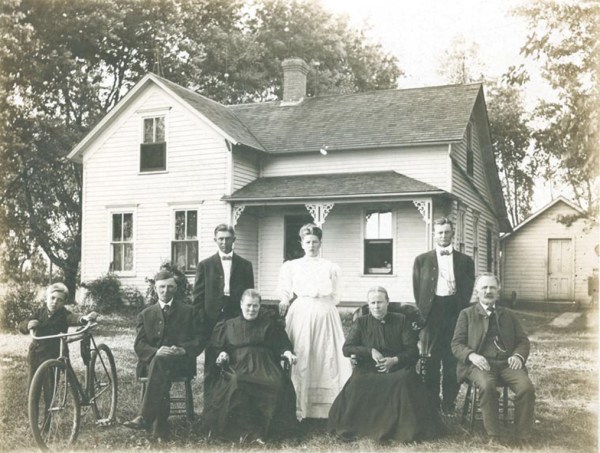
(This is not my family, just a photo from the early 1900’s from rootsweb.ancestry.com)
For years, I have taken my photos and put them in books – and they are heavy. But we actually take them out and look at the photos from time to time, whereas now, most of my photos are stored on the computer, and rarely do I take the time to upload them to be printed. I wonder what the photographic record will be, if there will be a downturn in photos showing what was going on because so few are printed in a relatively lasting format.
I have so much on the internet – photos, writing, etc. What is something happens to the internet. I haven’t even been saving back ups of the blogs. I used to, like the first six months, but, frankly, so much of it is trivial that I stopped backing it up. And if I lost everything, would it be a tragedy – or a huge relief? I think of friends who have lived through terrible events and who live their lives more lightly now – fewer purchases, fewer emotional turmoils – going through something horrible can truly streamline your life.
I guess I am just babbling.
Be Careful What You Wear in Qatar, and about Sharing Your Faith says US Embassy
This is from yesterday’s Peninsula. What is equally interesting is the article placement – front page of the newspaper, above the fold.
Recently, several families received notice that their employment was no longer required – or possible – in Qatar. All were members of the same church. They had 30 days to leave. The embassy got involved, and shortly before the required departure, the families got a second letter, this one saying “never mind.”
This is a conservative country.
Be careful with what you wear in Qatar, US tells citizens
Web posted at: 7/13/2009 2:28:8
Source ::: The Peninsula/ BY SATISH KANADY
DOHA: The United States has advisedd its citizens living and visiting Qatar against wearing revealing and ‘provocative’ clothes. It advised US citizens not to go about on public beaches in bath towels. The Mission also discouraged sleeveless shirts and blouses, halter tops and shorts.
Western bathing attire must be worn only at hotel pools and private beaches, it said. US citizens must also avoid visiting labour or work camps, an updated and revised country specific information for Qatar posted on the embassy website said. The warden message that reminded US citizens that it was Islamic traditions that provide the foundation of Qatar’s customs, laws and practices said: “Foreign visitors are expected to remain sensitive to Islamic beliefs and practices and not dress up in a revealing or provocative manner including wearing of sleeveless shirts and blouses, halter tops and shorts. Western bathing attire is to be worn only at hotel pools and private beaches”.
The embassy also cautioned US nationals about discussing religious issues, or answering questions about a religion. The warden message has strictly warned against conversion. “Religion and religious practices are quite sensitive issues in Qatar. Therefore, discussing religious issues should be treated with care and sensitivity. Proselytizing is illegal in Qatar. Attempting to convert a member of one religion to another, “sharing one’s faith” with someone of a different faith, and similar practices can be deemed violations of Qatari law, with deportation or even prison the consequence,” the embassy warned.
The embassy also issued strict guidelines to US citizens involved in charitable activities. “Charitable activities, both religious and non-religious, must be approved in advance by Qatar Authority for Charitable Activities (QACA)
THE PENINSULA
Which Ear Do you Use for the Phone?
This article is from BBC Health News, posted Wednesday, 24 June.
It was mildly interesting to me until I got to the part about phones. Yes, I think I hear and process better with my right ear, but I have always used my left ear for phones. I assumed most people do. So I asked AdventureMan, who is left handed, and he said he picks up his phone and listens with his right ear, but that is also because he needs his left hand for taking notes. Aha! And I use my right hand for taking notes.
So my question is – which ear do YOU use, and are you right handed or left-handed? I think it would make a difference.
Right ear is ‘better for hearing’
The left-side of the brain processes much of what is heard in the right ear
If you want to get someone to do something, ask them in their right ear, say scientists.
Italian researchers found people were better at processing information when requests were made on that side in three separate tests.
They believe this is because the left side of the brain, which is known to be better at processing requests, deals with information from the right ear.
The findings are reported online in the journal Naturwissenschaffen.
We can also see this tendency when people use the phone, most will naturally hold it to their right ear
Professor Sophie Scott, of University College London
In the first study, 286 clubbers were observed while they were talking with loud music in the background.
In total, 72% of interactions occurred on the right side of the listener.
In the second study, researchers approached 160 clubbers and mumbled an inaudible, meaningless utterance and waited for the subjects to turn their head and offer either their left or their right ear.
They then asked them for a cigarette.
Overall, 58% offered their right ear for listening and 42% their left.
In the third study, the researchers intentionally addressed 176 clubbers in either their right or their left ear when asking for a cigarette.
The researchers obtained significantly more cigarettes when they spoke to the clubbers’ right ear compared with their left.
Brain
In conclusion, the researchers said: “Talk into the right ear you send your words into a slightly more amenable part of the brain.
“These results seem to be consistent with the hypothesised specialisation of right and left hemispheres.”
Professor Sophie Scott, of the Institute of Cognitive Neuroscience at University College London, agreed.
“Most people process speech and language on the left-hand side of the brain and while it is not cut-and-dry a lot of what goes in our right ear will be dealt with by the left-side of the brain.
“The other side of the brain is more involved in things such as interpreting emotion and that is why we have these kind of findings.
“We can also see this tendency when people use the phone, most will naturally hold it to their right ear.”
Recent Comments
intlxpatr on Shampoo Ginger tigerbutterya0c5ff1d… on Shampoo Ginger intlxpatr on British Soldier Kidnapped, Esc… John on British Soldier Kidnapped, Esc… intlxpatr on British Soldier Kidnapped, Esc… Wikipedia Donate Button

Amazina


Early Voting in Florida


