No Sunrise in Kuwait
You will not find me complaining about the rain. I am imagining what a difference this steady downpour is going to make in very short time. People who think of “desert” have no idea of the life in the desert waiting to spring forth at the slightest sign of moisture. It doesn’t take much – and I believe we are going to see some amazing things soon in Kuwait.
I was up for the sunrise this morning . . . no sunrise appeared. This is about the best I could do:

I thought the heavy downpour last week had washed my windows clean, but I think some dust must have come and stuck to the wet windows. Or else the rain is not so clean . . . 😦 Please pardon my streaked windows!
Life interrupts blogging. We had an emergency that had us out on highway 40 to help out a friend in Eqaila. We was a terrible accident on 40; truck jacknifed and hit two cars. Traffic was totally gridlocked waiting for the ambulances and police to arrive. Folks, please be careful out there.
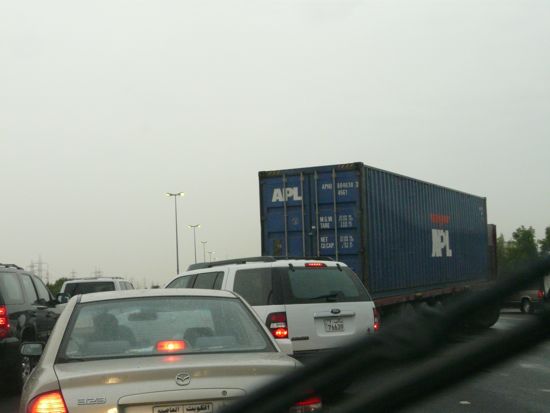
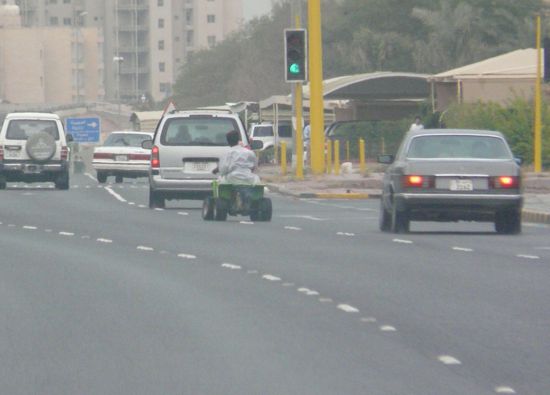
And please, mothers, fathers, protect your children. Anyone who doesn’t need to be on the roads should be at home. These kids, riding on the slick highways, barely visible, are taking a huge risk:
GQSSC – Hot on Her Heels – Q8Dutchie!
I don’t know why I find these photos so moving . . . so poignant . . . but I do! New contestant Q8Dutchie is close on the heels of our first entrant, Ansam, with these great sand and surf photos:


What I don’t understand, and what I marvel at, is why when we know the footprints are indented, do they look the opposite, as if they are coming out of the sand? It must be a trick of the shadows. Woo Hooo, Q8Dutchie!
The Great Kuwait Sand and Surf Challenge
OK, so here it is, the new photo challenge. You will have three weeks. All your photos must be in to me or posted on your blog and linked to me by Saturday, November 22. The poll will go up then, and voting will continue to November 29, when the polls will close and new winners will be announced.
Sand and Surf can be anything related to beach activities – tidal pools, boating . . . this contest is open to Kuwaitis, residents of Kuwait, and people who have an attachment to Kuwait. We don’t require that the scene be recognizably Kuwait, because well, sand is sand and surf is surf. The photos do not have to be Kuwait, but we want them to be entered by someone remotely Kuwait-related.
Ready on the right!
Ready on the left!
Photographers, take your target!
Fire!
Off topic but related – on the top floor of the Al Rayya Shopping Center (attached to the Marriott Hotel near Dasman Circle) is a really intriguing photo exhibit. It looks to me like all Kuwaiti, and some of the photos are purely spectacular. Some are very moving. I don’t want to give too much away, but if you enjoy photography, this exhibit is worth a visit.
Heading for the Desert
Every now and then I wish I were a man. When I was a little kid, our dads would all head out on a big boat, going hunting. Mostly, women stayed home. Some women hunted, but it is hard work, and, I think, maybe men don’t always want women along when they go out hunting, they want to (in Alaska) drink and party and play cards and talk crude and don’t want anyone around reminding them to mind their manners.
The truth is I don’t know what they do. I can only imagine, based on things I’ve heard, movies, my imagination.
Today, my neighbors are headed out to hunt. How do I know? They have their falcon with them. It is perfect weather – clear, relatively cool, the heat has definitely broken, it is wonderful to be able to drive without any air conditioning. . . .
I know, I know, there is still this kid in my heart that thinks that going hunting with a FALCON is very very cool.

Warning Triangles, Flares, and Traffic Control
There was another accident outside my house last night, and I almost didn’t even call the police, but then . . . I did. I thought “It’s useless to call.” And then I thought “But at lease it’s SOMETHING I can do to help.” I am guessing people would have thought I was crazy if I had gone out and started trying to direct traffic (LOL; isn’t that a funny thought?) This time the polite man on duty took all my information and the police didn’t call back. A road warrior (traffic police) arrived nearly an hour later, but with the slick roads in my area, I can imagine they were very busy, and there didn’t appear to be any injuries to people, only to cars.
What is scary to me is how easy it would be for another car to come plowing into the accident. It’s night, it’s dark, people are in a hurry to get home and they have their route down pat, so they are on automatic pilot. Most of the time, they go past at a fairly fast speed.
Aren’t people required to carry warning triangles and flares here? Even just setting up a warning triangle a hundred feet back would have helped last night. A flare would have gotten attention and slowed traffic. People directing traffic around the accident would have helped. For an hour, those involved in the accident just stood around, so vulnerable. It’s a small thing, but it might help, in Kuwait, where even these very basic precautions are ignored.
Menace on the Roads
LOL, AbdulAziz sent these fabulous close-to-sunset-in-Kuwait photos. Here is the first:

Isn’t that beautiful?
And here is the one taken just before it:
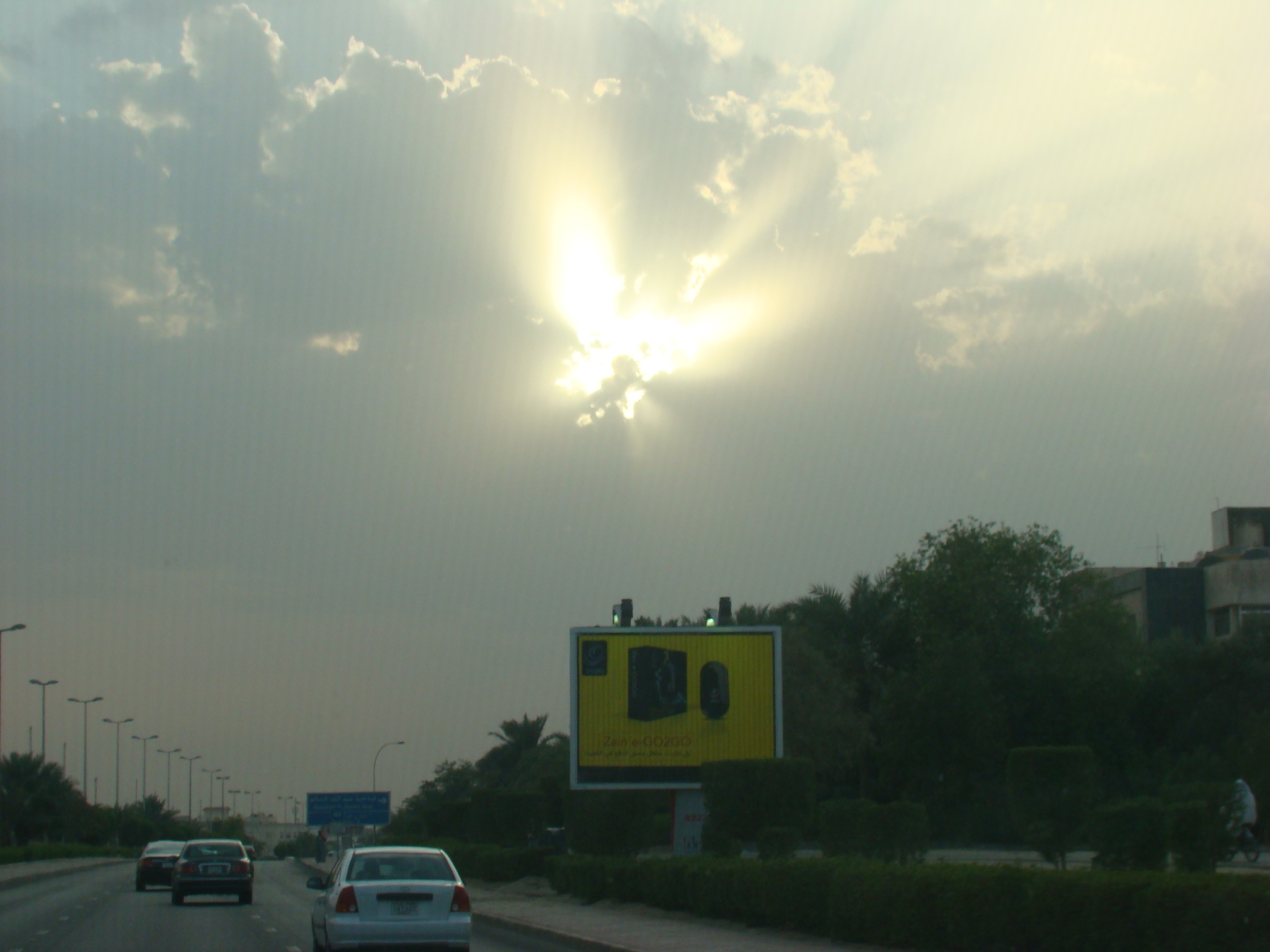
AbdulAziz, I hope you were at a stoplight when you took these photos! I imagine you driving down the road, camera in one hand, one eye on the photo and one on your rear view mirror and you might come into conflict with one of those bus drivers! Watch out!
Rain in Kuwait
Lots of rain, peals of thunder, lightning strikes and lots of rain! The Qatteri Cat is totally freaked out, running from the leaking window with it’s new drip drip drip to the windows – he thinks the rain drops are bugs or something, and makes that eh-eh-eh-eh-eh sound cats make when they see birds. Rain!
I am laughing; who would think this PacificNorthwest gal would be celebrating rain – we get so much rain out there in the PNW. But even when there was a huge rainstorm here in Kuwait last year, we didn’t see any where we live, or only a drop or two, not even enough to smear a window or create a puddle. Now Rain! Real rain!

When it started, I was driving. We got home as soon as we could; the first rains turn the highways into grease slicks.

Remember – this is not California, where people might stop and dance for joy at the parking lights. (California has droughts, too.) Dancing for joy only allowed in the privacy of your own home!
Update – an hour later it is still raining, and I have towels under several of my windows to collect the intrusion!
New Buses, Mixed Blessing
As many of you may remember, I am a supporter of public transportation. I would SO much rather have the time to read a book or magazine than to be stuck in traffic. When I saw the bright, modern, fast new buses hit the streets recently in Kuwait – during the last year – instead of the clunky slow, old buses they had, my heart rejoiced.
Hmm. Not so fast.
I drive on a major local road regularly. The buses have become a menace. They drive way fast. They halt, and then merge back into traffic as if they have the right of way, which as we all know, in Kuwait there is no right of way. I guess they figure that because they are big, and faster, they are king of the road. I can tell you for a fact, they don’t like being passed by a woman. Imagine, being chased down by a bus!
Buses cause accidents on Sixth Ring Road
KUWAIT: Sixth Ring Road was the scene of two accidents caused by public buses.
A man driving a small car suffered serious injuries when he hit a public bus after the bus driver lost control of his vehicle and hit the barrier and then stopped at the middle of the road. The man was taken to the hospital by a fellow citizen to seek medical assistance.
Ten minutes later, another bus driver repeated the same scenario of the first accident except as he hit the barrier he also hit a small car. The car driver suffered serious injuries and was taken to hospital to seek medical assistance. The two buses caused serious traffic congestion but police officers managed to move them to the side of the road and continue the traffic flow.
I don’t know what training the drivers receive before they head out in their buses. I have a suspicion that it isn’t much. I think they need to be trained in safe driving practices, and warned against aggression on the roads. I think they need to use their rear view mirrors, their signals, and they need to be an example of proper driving, because they are a visible, public model of state policy.
Fighting for Muslim Women’s Rights
BBC News reports on a fascinating conference taking place right now in Barcelona regarding Women’s Rights in Islam:
Fighting for Muslim women’s rights
Some of the world’s leading Islamic feminists have been gathered in Barcelona for the third International Congress on Islamic Feminism, to discuss the issues women face in the Muslim world.
Some of the women taking part in the conference explained the problems in their home countries, and where they hoped to make progress.
ASMA BARLAS, Author, Pakistan
Religions always come into cultures, they don’t come into abstract and pure spaces. Islam came into a very patriarchal, tribal and misogynistic culture. One of the deepest damages to Islam has been its reduction to “Arabisation”.
I’m not going to say that the Arabs are particularly misogynistic in a way that nobody else is, but I do think there are very particular traits and attitudes towards women that have crept into Islam.
I have a friend who has been studying the interface between what he calls the Persian models and the Arabist models of Islam in the subcontinent and surprise, surprise: the Arabist models are misogynistic, authoritarian, unitarian and the Persian models are much more plural and tolerant.
This is a fight on two fronts – on the one hand we are struggling against the kinds of oppression dominant in Muslim patriarch societies and, on the other, Western perceptions of Islam as necessarily monolithic, and confusing the ideals of Islam with the reality of Muslim lives.
If we read the Koran as a totality rather than pulling out random verses or half a line, that opens all kinds of possibilities for sexual equality.
RAFIAH AL-TALEI, journalist, Oman
Oman is relatively liberal, women are free to choose what to wear, and can choose their jobs and education. And the law does not require us to wear any particular form of clothing. But there are strong social and cultural factors – coming from the fact that we are in Arabia – that limit women.
As a journalist, it has not been hard for me to work among men, but it has been hard for some of my colleagues whose families told them this was not “appropriate” work for them.
The biggest difficulties are the social and cultural factors, and some aspects of law. For example, women who marry a foreigner cannot pass on their nationality to their children, whereas men in that situation can.
Religion is not an issue in our struggle, although there are problems with family law about divorce and marriage status. Omani laws are based on sharia law. Sharia is fair, but it is the wrong interpretations that are the problem. Male judges often don’t understand the principal goals of sharia.
We feel the law is fair, but ends up being unfair for women because of how judges interpret it.
Cultural and social factors often get mixed up with religion. Educated women can be more empowered and separate the two, but many don’t dare challenge the conventions.
NORANI OTHMAN, Scholar-activist, Malaysia
I don’t think it is any more difficult to be an Islamic feminist than a non-Muslim, or secular feminist.
Asian Muslim states have very different traditions to Middle Eastern countries
Feminists in general have to face up to political and cultural obstacles, to achieve our objectives of women’s rights. Even Western feminists have had a similar history – having to engage with certain religious beliefs not conducive to gender equality.
Perhaps the only distinctive difference peculiar to Muslim feminists is that we are caught in the cross-currents of modernisation and a changing society, due to a modern economy on the one hand and the global resurgence of political Islam on the other.
Political Islam wants to impose a world view about the gender order that is not consistent with the realities and the lived experiences of Muslim men and women in contemporary society.
Our detractors would hurl empty accusations at us – calling us Western, secular or anti-Islamic
There is a difference between South East Asian Muslim countries and the ones in the Middle East – culturally we are less patriarchal, we can always respond to our detractors by pointing out we don’t have the cultural practices that they do.
Our detractors would hurl empty accusations at us – calling us Western, secular or anti-Islamic.
Our arguments are rooted within Islam – we want renewal and transformation within the Islamic framework. They don’t like that.
We have a holistic approach, seeking gender equality within the Islamic framework, supported by constitutional guarantees. We see that these are not inconsistent with the message of the Koran, particularly during its formative stages. We have to understand the history and cultural context and extract the principle that will be applicable in modern times.
SITI MUSDAH MULIA, Academic, Indonesia
In my experience, I find that it is very difficult to make Indonesian Muslim women aware that politics is their right.
In Indonesian society, politics is always conceived as cruel and dirty, so not many women want to get involved, they think it is just for men.
According to the [radicalist] Islamic understanding, women should be confined to the home, and the domestic sphere alone
We try to make women understand that politics is one of our duties and rights and they can become involved without losing their femininity.
Personally, I’m non-partisan, I’m not linked to one political party because, in Indonesia, the political parties often discriminate against women.
I struggle from outside the political sphere to make it women-friendly, to reform political parties and the political system.
One day, I hope to be involved more directly, if the system becomes more women-friendly. We have passed a law about affirmative action and achieving 30% female representation, but we won’t see if it is implemented until after 2009 elections. We are waiting.
In Indonesia, some groups support us, but some radical groups oppose what we are trying to achieve. They accuse me, accuse feminist Muslims, of being infidels, of wanting to damage Islamic affairs.
According to their Islamic understanding, women should be confined to the home, and the domestic sphere alone.
AMINA WADUD, Academic, United States
There are many more conversations going on today between different interpretations of Islam. Some interpretations are very narrow, some are more broad, principled, ethically-based.
Unless we have sufficient knowledge about Islam, we cannot bring about reform of Islam. I am not talking about re-interpretation, I am talking more about gender-inclusive interpretation.
Islam and feminism are not mutually exclusive
We have a lot of information about men’s interpretations of Islam, and of what it means to be a woman in Islam. We don’t have equal amounts of information about what women say it means to be a good woman in Islam.
Now it’s time for men to be active listeners, and after listening, to be active participants in bringing about reform.
There is a tendency to say that it is Islam that prohibits women from driving a car, for example, when women drive cars all over the world except in one country. So then you know it is not Islam. Islam has much more flexibility, but patriarchy tends to have the same objective, and that is to limit our ability to understand ourselves as Muslims.
I have always defined myself as pro-faith and pro-feminism.
I do not wish to sacrifice my faith for anybody’s conception of feminism, nor do I sacrifice the struggle and actions for full equality of women, Muslim and non-Muslim women, for any religion. Islamic feminism is not an either/or, you can be Muslim and feminist and strive for women’s rights and not call yourself a feminist.
FATIMA KHAFAJI, Consultant, Egypt
In Egypt, Islamic feminism is a way for women activists to reach a large number of ordinary women in the villages and in urban low-income areas, using a framework of Islam. So there would be a reference to Islam when talking about women’s rights. Experience has shown that that is an easy way to get women to accept what you’re saying.
Not many women get information about women’s rights easily, so you have to counter what has been fed to them, to both men and women, from the strict, conventional, religious people who have more access to women.
They have their own idea of women’s rights in Islam – that is, patriarchal, still limiting opportunities for women. But women have been receiving this concept for ages, through the radio, TV, mosques, so the challenge is how to give them another view, of enlightened Islam, that talks about changing gender roles. It’s not an easy job.
Historically, in Egypt in the feminist movement, there have been both Muslim and Christian women. It has never been a problem. Unfortunately nowadays, it has become a problem. Religious discrimination has been dividing people very much. We have to think carefully about how to supersede the differences.
With family law, we’re aiming to change the philosophy of the law itself. Traditional family law puts women down. I can see this whole notion of “women do not have control over their bodies” in so many laws, in the penal code and family law. For example, sexual harassment is happening because men think the control of women’s bodies is a matter for them. Even the decision whether to have children is the decision of men. This whole notion has to be changed in a dramatic way if we are really going to talk about women’s rights in Egypt.
Interesting Twist on Hijab
From today’s Al Watan:
”Policewomen must comply with Islamic attire”
Al Watan staff
KUWAIT: In reaction to a statement by the Director General of Sheikh Saad AlـAbdullah Academy on policewomen”s uniforms, MP Mohammed Hayef noted that the current uniform requirements for female police contravene with the spirit of Islamic law as well as the Constitution, which guarantees personal freedom.
According to him, the announced uniform will ban policewomen for wearing a veil, even if they chose to do so.
The lawmaker reiterated his resolve to stand against the uniform to ensure that Islamic law is observed.
He also criticized the period during which policewomen will undergo training, arguing that 12 hours is too long for the female conscripts, considering their physical abilities.
Describing the training period as similar to hard labor, he called on the relevant authorities to reconsider their decision on this particular matter.
Last updated on Tuesday 28/10/2008
What do you think? I think that there are ways of covering your hair that are not inconsistent with being a policewoman. If the uniform forbids hijab, in my mind, that is as bad as the parliament requiring hijab, for the same reason – wearing hijab or not wearing hijab is a personal decision between a woman and her God. It is not to be mandated by state or mankind. Instead of getting into a big fracas about it, why not have a fashion-design contest to design a professional headgear that a covered woman could CHOOSE to wear as part of her uniform?
As to the 12 hours – well LLLLOOOLLLL! How many hours of hard labor per day do women put in with taking care of children, cleaning, shopping and meal preparation, not to mention family obligations? Working a 12 hour day training to be a policewoman? Piece of cake!
Women in all parts of the world are working as soldiers, police, fire protection, etc. They train as hard as the men, and they get the job done. Think of the female doctors in Kuwait, and the hours they work! Think of their sacrifice! Our estrogen issues are no more diverting and/or debilitating than male testosterone issues!
(thank you, thank you, I’ll get off my soapbox now)
Recent Comments
intlxpatr on Shampoo Ginger tigerbutterya0c5ff1d… on Shampoo Ginger intlxpatr on British Soldier Kidnapped, Esc… John on British Soldier Kidnapped, Esc… intlxpatr on British Soldier Kidnapped, Esc… Wikipedia Donate Button

Amazina


Early Voting in Florida


