Meat and Fish at the Sultan Center
It doesn’t take long before you live in a country long enough that you don’t see with the same eyes as when you came. Last week, as I was shopping, I was looking for something to fix for dinner. Normally, I just see something and grab and go, but my attention was caught by how expensive everything was, and then again, by the fact that American ground beef was twice as expensive as New Zealand ground beef, and both were really really expensive – it’s ground beef!
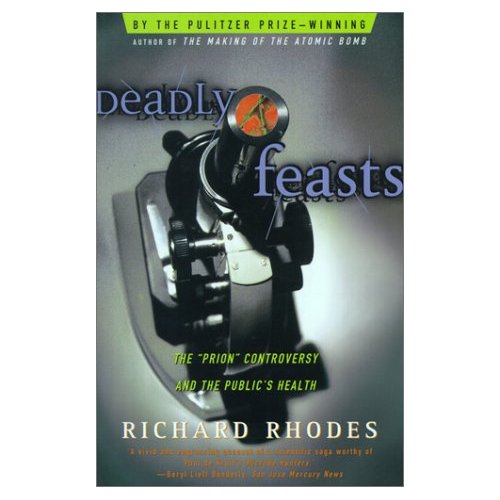
I’ve been careful about meat ever since I read Deadly Feasts about ten years ago. The book is a medical mystery, it traces the identification of Mad Cow Disease, and how vulnerable we all are. The human variant takes ten years to develop – all because tainted meat enters our food supply, because meat producers are too greedy to pass up a cow who is stumbling and falling down.
Even those who keep it out of the human food chain often process fallen cows for animal food.
And none of that has anything to do, really, with this post. The point is, for once, instead of rushing by, I was paying attention. When you pay attention, you start to see things (again) (or for the first time.) Here, you see things routinely that you don’t see in the United States:
Lamb’s brains:

Lamb’s heart:

Sheep’s feet:

Fresh Quail:

Kuwaiti Shoom:

Saudi Shrimp (these look big, but Kuwaiti shrimp, in season, are even bigger, and the sweetest shrimp you have ever tasted):

Iranian Squid:

Nuabi (a fish caught locally)
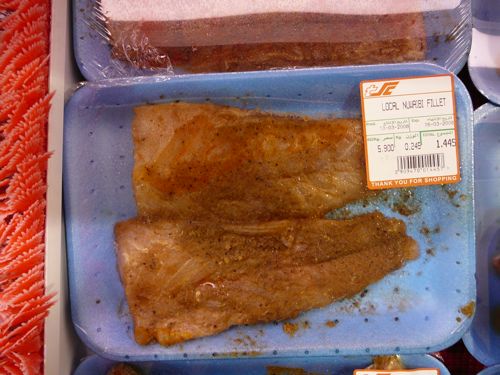
I love Kuwaiti seafood, and this is the one I love the best of all, Kuwaiti Zubaidi:
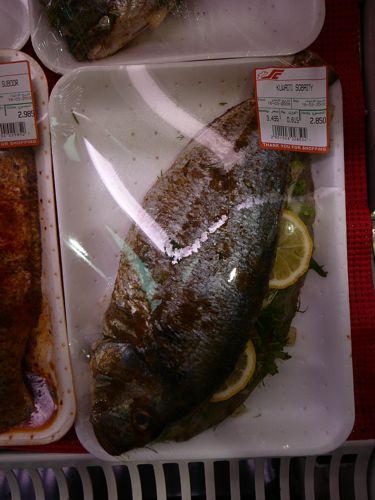
For those of you in the US, you can multiply the prices by four for an approximate idea of how much the food costs in dollars. The dollar is slipping here, as everywhere else, prices are going up, and we are taking the double whammy.
The seafood is out of this world. Even though expensive, local caught seafood is about what we would pay for seafood in the US. Vegetables IN SEASON can be reasonable. When I want iceburg lettuce, I pay about $3/ head. I have wonderful friends who are sharing their bumper crops of vegetables this year, and oh! they are SO good, so tasty! One of my friends has tried some heirloom tomatoes, and they are doing well!
Pet Import and Export Service
Many people write asking about how we got the Qatteri cat into Kuwait, and I have to tell them that the woman who helped us is no longer here. Recently a friend passed along a card to me – there is a new woman providing the import/export help, and for those of you with people coming to work with your companies who have pets, this woman helps get the paperwork for either bringing a pet into the country or getting your pet out. She knows the bureaucracy and she knows how to get the job done.
She is also well connected with all services involved with animals; as well as import/export, she can arrange grooming and boarding, and will meet you at the airport with the papers necessary for bringing your animal into Kuwait – assuming you have arranged this with her in advance.
Here is her e-mail address – please share it with your HR departments for their resources:
petpassage@yahoo.com
A Case of Two Cities with Inspector Chen: Qiu Xiaolong
When my sister Sparkle recommends a book, I have learned to listen. I think I ordered this book about six months ago, but never cared enough to actually read it. After reading a recent Donna Leon (like dessert, I use it as a reward for reading something more challenging) I decided it was time to tackle Qiu Xiaolong.
I believe A Case of Two Cities is the first in the series; I tried very hard to make sure it was. When I first started reading it, it was difficult, but it didn’t take long to adjust. When you read a detective story written in a foreign culture, you have to park your old way of thinking, and quickly adapt to a new way of thinking. First, you have to learn what that new way of thinking is. They don’t just tell you at the beginning of the book “Here are the differences in values – you will notice . . .” no, but Qiu Xiaolong is courteous enough to take us by the hand and lead us gently into the Chinese way of thinking, the Chinese way of getting things done, and the technicalities of Chinese detective work.
As we meet Inspector Chen, a published poet, and a detective, ten pages into the book, a new anti-corruption campaign is starting in Shanghai, and Inspector Chen has been given a special assignment – a qinchai dacheng – as “Emperor’s Special Envoy with an Imperial Sword.” Even though imperial days are long gone, this warrant gives him emergency powers to search and arrest without reporting to anyone – and without a warrant. He is to seek and find Xing, a corrupt businessman who has caused huge loss to the national economy and is in danger of tarnishing the Chinese national image, and Xing’s associates.
Just as in the Donna Leon books about Commissario Guido Brunetti, and the Bowen books about Gabriel duPre, and James Lee Burke’s books about New Orleans, and Cara Black’s books about Aimee LeDuc, the detectives and investigators have to walk a fine line between going after the criminal and overstepping their warrant – stepping on the toes of those also engaged in corruption so entrenched that it has become a way of life. Each of these detectives has to maneuver that treacherously fine line – who determines when corruption has become too much? It usually puts their own lives in danger at some point, as those manipulating the system and making a fortune out of it do not want to be caught, do not want to be exposed, and will go to great lengths to protect their ill-gotten gains.
And just as in the above books, the book is more about the actual process than the crime itself. Inspector Chen must go about his task indirectly, having chats here and there, gathering threads of information with which he tries to weave a plausible tapestry of events.
As I was reading A Case of Two Cities, I kept making AdventureMan take me out for Chinese food! The meetings are often held over food, and the descriptions are mouth-watering.


Best of all, when you read these books, you get a tiny little glimpse into another way of thinking, another way of doing business. We are all human, we all have the same needs, and we differ in how we go about getting those needs met. We differ in the way we think. It helps to enter another way of living, another way of thinking, it helps to visit through these books so that we can increase our own understanding that our way of doing things is not the only way, maybe (gasp!) not even the “right” way! Maybe (crunching those brain cells really hard to output this thought) there is more than one “right” way?
More Mubarakiya Sights
It seems to be heating up quickly. The months when perusing the souks in daylight hours are coming to an end. We are trying to make the most of it while we can. A few more quick snaps from the Mubarakiyya Market on a quiet Friday:
Vegetable market public art I hadn’t spotted before:

Traditional clothing-seller:

Bath supplies:

Foodstuffs:

Those of you who live here walk right by these stalls all the time, and never notice that they are disappearing. I have been perusing old books about Kuwait, even some not so old, and Kuwait is changing so rapidly that even books only 10 years old or so have become outdated by the rapid passage of time.
For those of you not in Kuwait, there are malls. There are SO many modern malls. As in other countries, some are more upscale than others, but they are malls. In most, you are not supposed to take photos. In most, you will see the same stores you will see in any other country. Mubarakiyya is special because it is still an active market in the old style.
Lazy Mubarakiyya Friday
For our non-Kuwaiti friends, Friday is the day off in Kuwait if you only have one day off, Friday and Saturday for a few. It’s the perfect time of the year to visit the Mubarakiyya Souks – not too hot, not too cold and always something interesting to see. Grab your friends and family, and have lunch in the square where all the restaurants are.
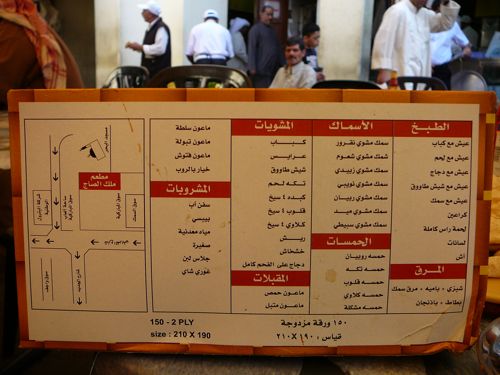
In our two years of visiting the restaurant, we never realized the menu was on the bottom of the kleenex box:
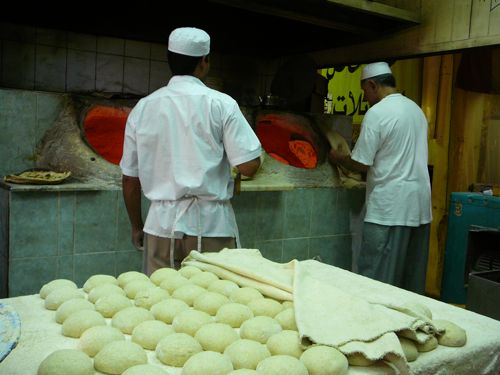
Bread making:
So good!
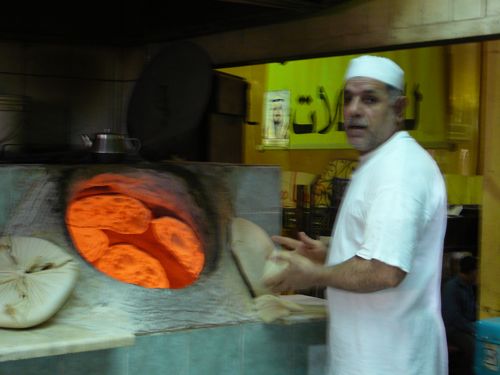
Kebab making:

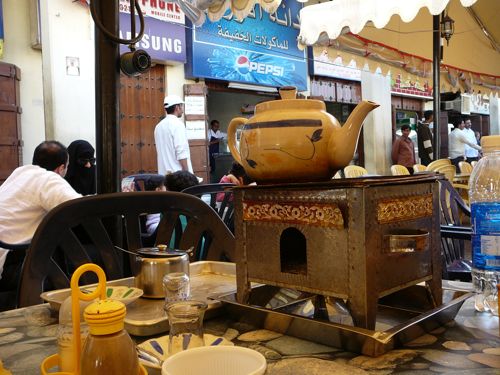
Busy in the tea stall:
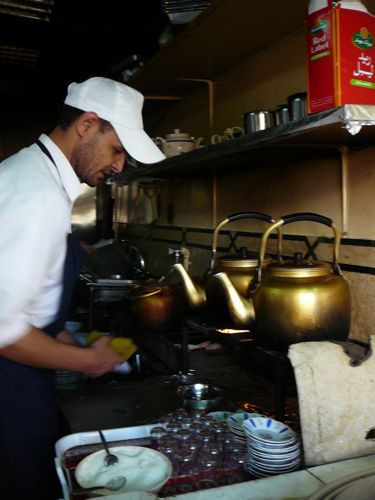
The tea stays HOT on the table tea-grill:
Photography Contest
I received this in the e-mail this morning – I wonder if there is any requirement to BE Muslim? I like the idea of the contest and thought I would pass it along to you, which is (I am guessing) the reason someone sent it to me:
Audio Visual & Cinematic Department of Culture in the East Azerbaijan provience in cooperation with the E-A Society for Artistic Photography is going to plan the “First International Artistic Photography Contest on Islamic Unity”.The organizers belive that there are many symbolic – abstractor real subjects around the world of Islam & Muslems that can be artisticly photographed – exhibited and saved to show the next generatins as well as gathering all muslems in one community.
The Contest will be held with the regulations as below:
1. All photographers form all over the world can participate.
2. Both B&W and Colour photos are accepted (up to 10 photos)
3. A copy of photos(1000 pixel) must be sent for judging and the accepted works will be asked to be sent or printed
in large size in full resolution after the first selections by the jury. (negatives and slide films can be scanned or printed in small size 13*18 cm to send)
4. Selected photos will not be returned. and will be exhibited in galleries. and will not be returned.
5. All selected photos will be published in a book and will be sent to the winners and those whose works are selected.
6. There will be 10 prize winners who wil be invited to attend the exhibition and the Winners Award Ceremony.
7. All rights of accepted photos belong to the photographers and organizers will only use photos to publish a catalogue and hold exhibitions.
8. All other unpredicted terms will be decided by the organizer.
9. Workshops will be held by the organizers during the contest.
10. Attach your name, address and the title of the work on the rear of each work.
Prizes:
Winners will receive An honorary diploma and prizes in cash as below:
1 st Prize (1000 euros in cash(
2 nd Prize (800 euros in cash)
3 rd Prize (500 euros in cash(
And From 4th to 10th selected by the jury (300 euros for each(
Closing date for arrivals of entries: 3/April/2008
Judging and announcement to the winners / selected works: 4/ May/2008
Exhibition: winners award ceremony 23/May/2008
All entries must be sent to:
info@akseensejam.ir
Corruption at the Morgue
Where is the Kuwaiti detective novel? I follow Guido Brunetti in Donna Leon’s series on Venice, Dave Robicheaux, the James Lee Burke detective in a small town just outside New Orleans, and now, Investigator Chen, who is a chief investigator in China, but where, oh where is the Kuwait detective / mystery? It is just waiting to be written.
In yesterday’s Kuwait Times is an article I would love to link you to, but it isn’t there, not even when I search “female coroner” from the headline on page 3. Did you know Kuwait had a female coroner, a la Kathy Reich’s Temperance Brennan and Patricia Cornwell’s Kay Scarpatta? As you read the article, it makes sense, as the bodies are kept semi-segregated in the morgue, and women work on women (some of the time) and men on men.
I’m impressed. Any time a woman takes on a traditionally men’s job, it takes a whole lot of courage. I imagine the requirements to be a coroner here are similar to other countries – you have to have a medical degree (be a doctor) and then have advanced training in forensics. So when Nawal Boshehri speaks out, I listen. She’s got my attention.
Nawal Boshehri says conditions in the morgue are awful. From a personal point of view, she has been sexually molested by her superior and frozen in her position over false accusations that she has not been going to work or signing in or out. She has asked the minister of interior to look into her complaints.
As an institution, she reports serious issues – labs that lack necessary equipment, to do tests, such as those that measure drugs and alcohol in the bloodstream, outdated machinery, rusty machinery, lack of ventilation (in a morgue! horrors!) and she states they are constantly in fear of getting infections.
She claims that reports have sometimes been manipulated and twisted to give prosecutors the wrong technical information that would sometimes end up setting a guilty person free, and that one time they certified a murder had been insane without him ever having been examined by any mental health professionals. She was once asked to provide a report that made one citizen swap places with the assaulted expatriate, so that the assaulted expatriate would appear to be the guilty party.
She adds that she fears for her life. She says “a senior coroner at the department falsified reports, namely those related to detainees, who underwent police brutality during interrogations. He usually did this as favors to his colleagues to help them get promoted instead of being punished for their brutality.” She added that because she has reported these things, she fears for her own life.
Every nation has corruption. Corruption is chaotic, and when you get serious about rule of law, you still have corruption, but you do your best to root it out. You report it when it happens. I think that Nawal Boshehri has enough confidence in Kuwait’s institutions to go public with her allegations. While it may appear dirty laundry, that she CAN go public is a very positive sign. I can imagine she fears for her life, and yet, she seems to be fighting to retain her job. That’s very brave.
That the Kuwait Times will publish the article on page three, in three columns, that is also very brave, and speaks well of the increasing confidence in a free press.
Wouldn’t this make a great detective novel?
Deemaland
You know, I always visit my commenters to make sure they are not someone marketing drugs or enlargements or some kind of objectionable filth, and also because I often find a blog I haven’t seen before, and I really like.
I found one like that yesterday – Deemaland. When you go there, the first thing you see is this:
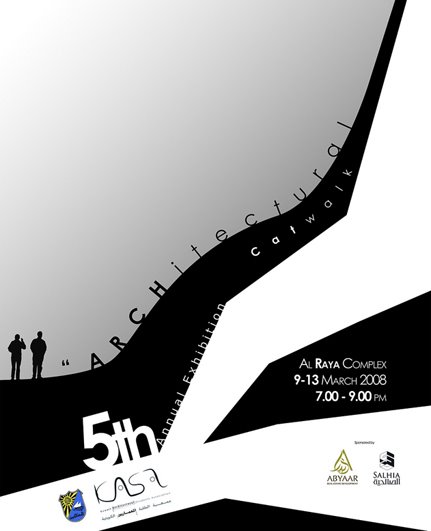
Oh my friends, is that gorgeous, or what?
Then, she tells us about an exhibit:
9-13 Mar. 2008
Event: “Architectural Catwalk”
5th Annual Exhibition of Architecture
Host: Kuwait Architectural Student Association [KASA]
Type: Exhibition of the students work.
Location: Al-Raya Complex, Sharq district, Kuwait City.
(the exhibition is in the Ground floor of the mall side)
Only on HER blog, even the information looks artistic.
This woman has an EYE. She publicizes events that otherwise might go unnoticed. Go visit Deema’s starkly beautiful blog. Also, take a look at her gorgeous Flicker photos.
College Level Classes for Older Adults
AdventureMan and I fantasize about what retirement will look like, even though it is a few years ahead of us. It helps to think about what is coming and how we are going to handle it.
We have a house near my Mom, and Mom sent AdventureMan a clipping from the local paper about classes being taught for “older adults” (WHEN did THAT happen, we wonder, when did we become “older” adults???) with the sweet note that AdventureMan could teach a few classes.
Here are some of the classes offered at the college near us:
Africa: A Closer Look
The Canterbury Tales, Part I and Part II
Civil Liberties and Security
Current Issues Forum
End of Life Decisions
Geology of National Parks
The History of the Supreme Court
Jazz: Can You Dig it?
The Many Faces of Hinduism
Native Basketry of the columbia Plateau, Northwest Coast and Arctic Alaska
The Poetry of Billy Collins
The War of 1812
He’s excited about the idea. So as we were planning to pray together before he left for the day, we were chatting excitedly.
“You could teach some classes on buying hand woven carpets! or on Arabic culture! or you could teach about some aspect of Africa!” I suggest. (I have my own projects that keep me very busy.)
“I was thinking more about organizational classes – managing organizations, financial management, that kind of thing . . ” he responded, “You know, like organizing your life . . .”
(I can see that manic gleam come into his eye and I know what is coming next might well be something I don’t want to hear. . .)
“I’ve got it!” he exclaims, and he starts laughing, because he is already cracking himself up. “I can teach a class called . . . HOW TO ORGANIZE YOUR WIFE! Ha ha hahahahahahahahahhahahahahhahahahahhahahhahahah.”
I can’t help it. I am laughing too. But it’s not THAT funny, AdventureMan.
Old Mosque Near Mubarakiyya
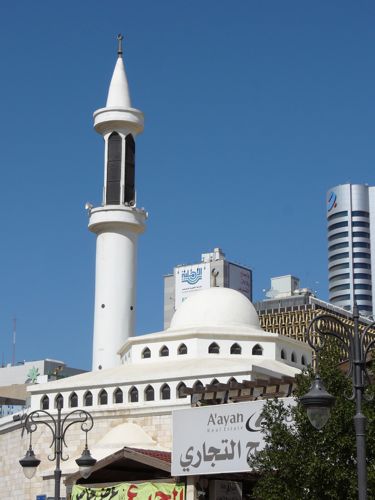
I really wanted to include this photo just to show you how very blue the sky was yesterday. The white of this mosque’s minaret provides contrast:
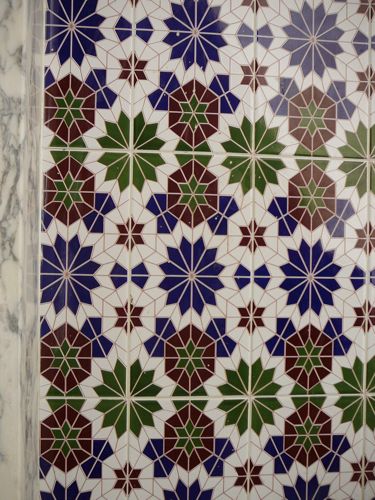
Just as the Sabille is placed on the street to provide water for the thirsty, the local mosques usually have a place to wash before prayers.This washing is required and is called Wudu. Some places are very utilitarian, but the mosque above, and the nearby women’s mosque, have a beautiful place for washing:
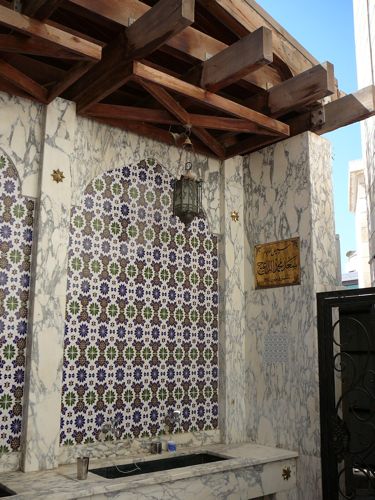
The tile pattern is intricate:
Recent Comments
intlxpatr on Shampoo Ginger tigerbutterya0c5ff1d… on Shampoo Ginger intlxpatr on British Soldier Kidnapped, Esc… John on British Soldier Kidnapped, Esc… intlxpatr on British Soldier Kidnapped, Esc… Wikipedia Donate Button

Amazina


Early Voting in Florida


