College Level Classes for Older Adults
AdventureMan and I fantasize about what retirement will look like, even though it is a few years ahead of us. It helps to think about what is coming and how we are going to handle it.
We have a house near my Mom, and Mom sent AdventureMan a clipping from the local paper about classes being taught for “older adults” (WHEN did THAT happen, we wonder, when did we become “older” adults???) with the sweet note that AdventureMan could teach a few classes.
Here are some of the classes offered at the college near us:
Africa: A Closer Look
The Canterbury Tales, Part I and Part II
Civil Liberties and Security
Current Issues Forum
End of Life Decisions
Geology of National Parks
The History of the Supreme Court
Jazz: Can You Dig it?
The Many Faces of Hinduism
Native Basketry of the columbia Plateau, Northwest Coast and Arctic Alaska
The Poetry of Billy Collins
The War of 1812
He’s excited about the idea. So as we were planning to pray together before he left for the day, we were chatting excitedly.
“You could teach some classes on buying hand woven carpets! or on Arabic culture! or you could teach about some aspect of Africa!” I suggest. (I have my own projects that keep me very busy.)
“I was thinking more about organizational classes – managing organizations, financial management, that kind of thing . . ” he responded, “You know, like organizing your life . . .”
(I can see that manic gleam come into his eye and I know what is coming next might well be something I don’t want to hear. . .)
“I’ve got it!” he exclaims, and he starts laughing, because he is already cracking himself up. “I can teach a class called . . . HOW TO ORGANIZE YOUR WIFE! Ha ha hahahahahahahahahhahahahahhahahahahhahahhahahah.”
I can’t help it. I am laughing too. But it’s not THAT funny, AdventureMan.
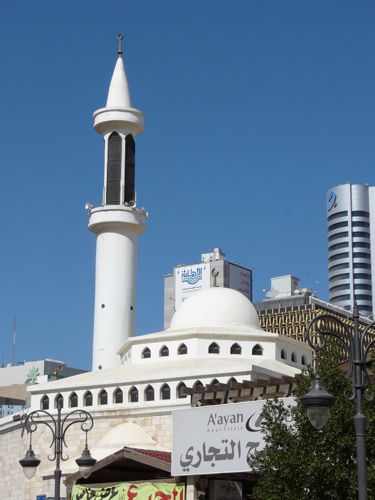
Old Mosque Near Mubarakiyya
I really wanted to include this photo just to show you how very blue the sky was yesterday. The white of this mosque’s minaret provides contrast:
Just as the Sabille is placed on the street to provide water for the thirsty, the local mosques usually have a place to wash before prayers.This washing is required and is called Wudu. Some places are very utilitarian, but the mosque above, and the nearby women’s mosque, have a beautiful place for washing:
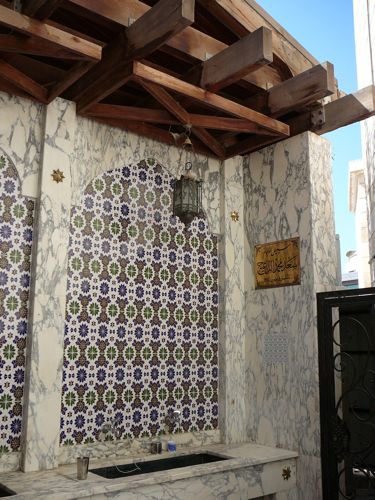
The tile pattern is intricate:

Twilight 7 Mar 2008
Last night had to be one of the most beautiful nights I have seen in Kuwait. The weather was perfect. The haze lifted – have you noticed that Fridays are often the least hazy day of the week?
Is it less automobile traffic? Is it some factory not active on Fridays which pours out pollutants during the week? For some reason, if there is a really clear day in Kuwait – and that is a big “if” – it will be a Friday.
People were eating outside everywhere it was possible. The weather was warm, without being hot. It had a different feel to it; it felt like living in a more European country. Last night, when it got dark, you could even see stars in the sky – 90% of the nights in Kuwait, it is too hazy to see all but one or two of the very brightest stars with the naked eye.
Here is what it looked like at twilight:
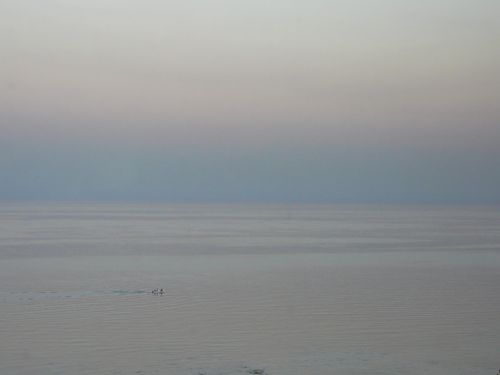
Yes, there is still that worrisome band of thick hazy something on the horizon, but at twilight, it goes that lovely purple grey color, surrounded by bands of pink in the water and the sky as the sun is setting. A total WOW.
Goat Grope
I love living in Kuwait. Just when you start to take everything for granted, you get a little jaded, you even start driving a little like a Kuwaiti, something happens that reminds me I’m really not in Kansas, and I get a big grin. The other day, on a back highway, we came across a whole herd of camels. We used to see these all the time in Qatar, but this is my first time seeing camels just out roaming in such large numbers in Kuwait. Just reminds me how amazing life is, this little girl from Alaska is out watching a camel herd in Kuwait. Just too amazing for me.
In the middle of the most opulent housing areas in town, you will hear roosters crowing. Sometimes, near the Eid festivals, you will hear sheep baaaaaahhhhhh-ing.
Leaving a local store recently, I heard a very very loud, desperate cry, like “NNNNNAAAAAAAAAAAAAAAAAAAAAAaaaaaaHHHHHHHHHHHHHHHHHHHHHHHHHHHHHHHHH” and I looked around and there was a woman, and her son, and a very reluctant, very large, totally freaked out goat. The little lady has one of those camel whips, and she is whipping the hell out of the goat, the son is pulling on the muzzle, the goat has his feet dug in and is rearing back and howling for dear life.
Goats really are not my favorite creatures. I find them very . . . hmmmm.. . . . goaty. They have these filthy beards that always have stuff caught in them, they have these weird cold eyes that sort of pop out of their heads, and there is nothing cute about them, but this goat’s screaming really got me. At the same time, watching these two grown-ups with this very very stubborn goat made me laugh. To get the goat across the road, the son had to pull with all his strength, and the little old woman had to get behind and push. I wish I could have taken that photo, but I was busy turning my car around to go back and get any shot I could get.
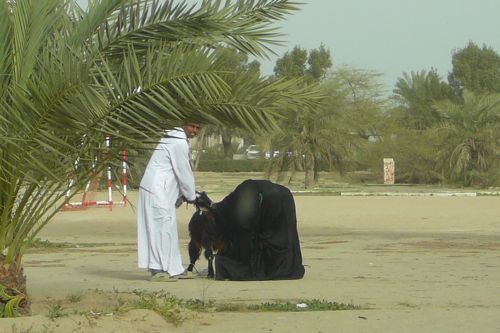
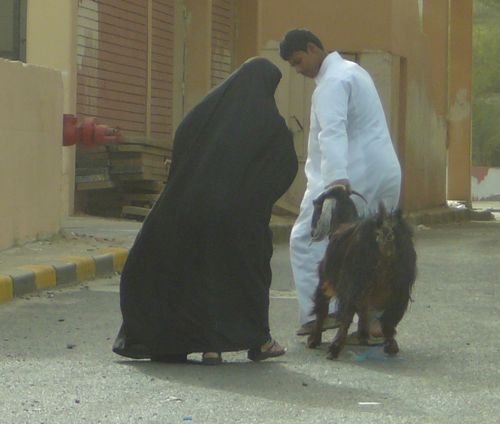
And THAT is why I tell you to always carry your cameras in your car!
Al Ahmadi Minaret
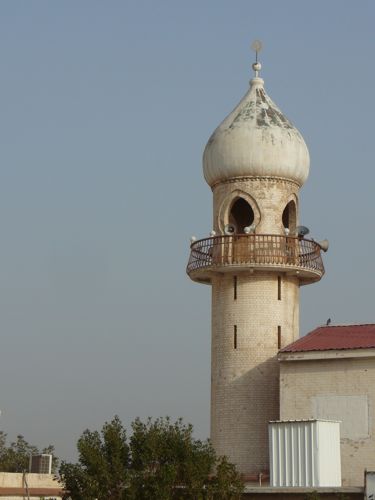
I see a lot of new mosques going up in Kuwait, and I see a lot of renovations. I just wish someone would spruce up this beautiful old minaret in Al Ahmadi. Looks to me like it is well-built, just needs a new coat of paint. And then I start to wonder, do mosques have committees, like churches do? We have the committee for the church grounds, the committee to take care of the altar, the committee to welcome new members, the committee to work with church school programs for the children . . . it goes on and on!
Do mosques have citizens committees?
And Everything Went Wrong
Five minutes ago there was another accident outside my house. I was on the phone before I even spotted it, calling 777.
The guy who hit the other guy is backing up and . . .DRIVING AWAY! There must be 20 witnesses with cell phones looking dumbfounded as he is driving away, but not so dumbfounded they are not taking photos of the car with their cell phones and writing down the license number. I am sorry, whoever was the hitter was dumber than dumb.
777 rings and rings. Some man finally answers, sounding annoyed, and when I ask for the traffic police, he says something – it didn’t sound very nice – and hung up on me. (The women must have gone home. They are always polite, efficient, and competant.) When I dialed the local police directly (yep, we’ve talked before so I DO have their number) NO ONE answers.
It is time for prayer, but . . . 20 minutes later, the hit car is still causing all kinds of traffic problems and no one can do anything because no police are coming.
Update – two minutes later, there are cops, there is an ambulance, and there are 20 people showing photos to the police of the numbskull who hit and run. Don’t you just love technology?
Sabille Shop
I love sabilles. Sabilles are localized charity, “in a dry and thirsty land” they are provided by generous souls that the thirsty might have cool, fresh water to refresh thenselves in the heat of the day. You will see them at mosques, along city streets, in every neighboorhood. They come in fanciful shapes; if you type “sabille” into the HT&E search window, you will see more. I love the Kuwait Liberation Tower ones, and also the water-tower wannabes, but I also like the ones that look like old castles or old doors or jugs. I love it that people go to the trouble to make something utilitarian interesting, even artistic.
Recently, I found a shop in the Wafa Mall that sells sabilles:

The shop is called Fine Things, and also has some fancy presentation boxes and this, which looks like a mail box to me, but might be for collecting charitable donations, or . . . ? I might be totally wrong. Your guess is as good as mine:
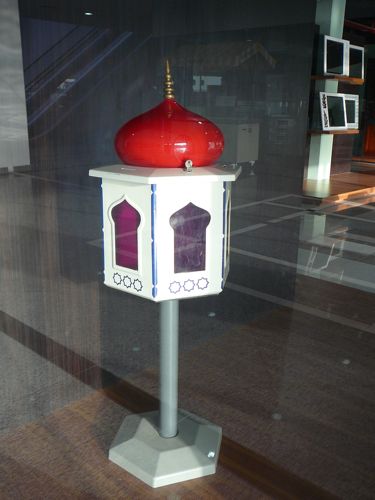
I like this tiny little mall because it has commercial kitchen supply shops with all kinds of display cases and things you don’t find very often. There is also a mattress shop; I always laugh when there is a family shopping there for mattresses because the parents don’t say “NO!” to their kids, so the kids are JUMPING ON THE MATTRESSES! The salesmen seem unable to ask the parents to make them stop.
Dharfur: The Janjaweed are Back
Lynsey Addario for The New York Times:
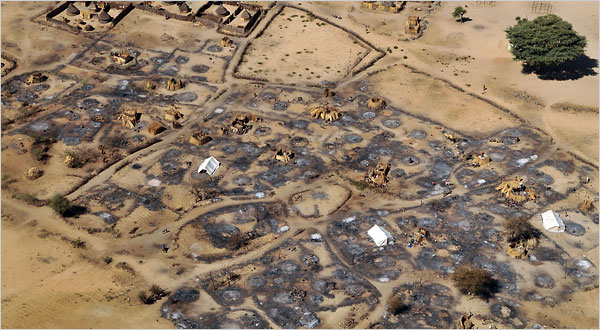
SULEIA, Sudan — The janjaweed are back.
They came to this dusty town in the Darfur region of Sudan on horses and camels on market day. Almost everybody was in the bustling square. At the first clatter of automatic gunfire, everyone ran.
The militiamen laid waste to the town — burning huts, pillaging shops, carrying off any loot they could find and shooting anyone who stood in their way, residents said. Asha Abdullah Abakar, wizened and twice widowed, described how she hid in a hut, praying it would not be set on fire.
“I have never been so afraid,” she said.
The attacks by the janjaweed, the fearsome Arab militias that came three weeks ago, accompanied by government bombers and followed by the Sudanese Army, were a return to the tactics that terrorized Darfur in the early, bloodiest stages of the conflict.
Such brutal, three-pronged attacks of this scale — involving close coordination of air power, army troops and Arab militias in areas where rebel troops have been — have rarely been seen in the past few years, when the violence became more episodic and fractured. But they resemble the kinds of campaigns that first captured the world’s attention and prompted the Bush administration to call the violence in Darfur genocide.
Aid workers, diplomats and analysts say the return of such attacks is an ominous sign that the fighting in Darfur, which has grown more complex and confusing as it has stretched on for five years, is entering a new and deadly phase — one in which the government is planning a scorched-earth campaign against the rebel groups fighting here as efforts to find a negotiated peace founder.
The government has carried out a series of coordinated attacks in recent weeks, using air power, ground forces and, according to witnesses and peacekeepers stationed in the area, the janjaweed, as their allied militias are known here. The offensives are aimed at retaking ground gained by a rebel group, the Justice and Equality Movement, which has been gathering strength and has close ties to the government of neighboring Chad.
Government officials say that their strikes have been carefully devised to hit the rebels, not civilians, and that Arab militias were not involved. They said they had been motivated to evict the rebels in part because the rebels were hijacking aid vehicles and preventing peacekeepers from patrolling the area, events that some aid workers and peacekeepers confirmed.
Please read the rest of the article HERE.
My husband and I have long supported an organization called Medecins Sans Frontiers / Doctors Without Borders. Wherever there is human misery, these brave doctors go and serve those suffering, and their life-saving work is performed under the worst possible conditions. They don’t look at politics. They look at human suffering, and do their best to alleviate it, or to do what they can. These heroic doctors are serving in Dharfur – while they can. When Medicins Sans Frontiers have to pull out, you know that the situation is as bad as it can be.
The accept donations from anyone, anywhere. Be generous.
Donna Leon: Suffer the Little Children
After reading Zanzibar Chest I decided it was time to give myself a break, and I allowed myself another Donna Leon book, this one Suffer the Little Children. I am currently reading another detective series, recommended by my sister, set in China. What they all seem to have in common is a very tired, sad, jaded view of corruption in society, and particularly among the poorly paid police. Sigh.

In this book, a Doctor and his wife are invaded in the middle of the night by the carabinieri, a kind of police in Venice. I am not sure how the two agencies differ, maybe it is like the difference between state police and local police in the US, but when the paper was faxed over coordinating with Brunetti’s office, it got lost somewhere, and the action was never coordinated, and Brunetti gets a call in the middle of the night.
The doctor and his wife have adopted a child illegally. They bought an unwanted child from an Albanian woman, paid for her pregnancy expenses, paid a huge fee to her, and then had the child taken from them. Here is the saddest part of the story – the child’s mother doesn’t want the child, the illegally adopting parents want him back desperately, but the child is sent to a state orphanage, because of the illegal adoption.
It is a very sad book.
Here is why I read Donna Leon – some of her paragraphs are just brilliant. Memorable. Unforgettable.
“Brunetti’s profession had made him a master of pauses: he could distinguish them in the way a concert-master could distinguish the tones of the various strings. There was the absolute, almost belligerent pause, after which nothing would come unless in response to questions or threats. There was the attentive pause, after which the speaker measured the effect on the listener of what had just been said. And there was the exhausted pause, after which the speaker needed to be left undistrubed until emotional control returned.
Judging that he was listening to the third, Brunetti remained silent, certain that she would eventually continue. A sound came down the corridor: a moan or the cry of a sleeping person. When it stoped, the silence seemed to expand to fill the place.”
When you read Donna Leon, you forget you live anywhere else. For one brief moment, you become Venetian, you live in Guido Brunetti’s shoes. The speak the Venetian dialect, you think like a Venetian. What an escape!
The paperback edition will be out in April for $7.99 at Amazon.com for $7.99 plus shipping.
“So Many Christians!”
My Kuwaiti friend was shaking his head in disbelief. He had been to the old city to pay a condolence call on a Friday, and happened by the Lighthouse compound near the Sheraton circle on a Friday morning, just as some of the services were getting out.
“I had NO idea!” he looked at me in absolute amazement.
I just laughed. When we first got here, we attended church on that compound; our church moved off only months ago, when the road construction work got seriously under way and parking increasingly became a problem. It was the most amazing experience on earth – there were the Indian Men’s Catholic services and the Philipine Evangelical service and the rock-music evangelical service and the staid Anglican services and the family Philipine Catholic services and . . . well, you get the picture. There are an amazing number of expatriate Christians in Kuwait. At any one time on the compound, there are about twelve different services going on, and no sooner does one finish and the participants exit, than the new group is coming in.
Now, churches meet all over Kuwait. They met in villas, they meet in schools, they meet in every neighborhood. Today, in our church, we asked for blessings on Kuwait, on the Emir and his family, and those in leadership positions in Kuwait. We prayed for the leaders of all the countries in our congregation (English, Irish, Scottish, South African, Chinese, Indian, Nigerian, Kenyan, Dutch, Egyptian, Ethiopian, American, Australian {I have forgotten a few, I am sure} . . . lots and lots of blessings!) Most of all, we thank God for the freedom to worship in Kuwait.

(This is not our church in Kuwait. This is the Church of the Holy Sepulcher, in Jerusalem. I was looking for a church that looked more Middle Eastern than Western, and this is what I could find!)
Our pastor also has a blog, q8bridge about which he says “The purpose of this blog is to enable a bridge to be built between Christians and Muslims, especially those living in Kuwait. Through questions and dialogue we hope to promote deep friendships and mutual understanding.”
He examines the beliefs we have in common, and where we differ, and some of the reasons why we differ. I urge you to have a look.
Recent Comments
Kitchen on Isiais: Winding Down intlxpatr on Shampoo Ginger tigerbutterya0c5ff1d… on Shampoo Ginger intlxpatr on British Soldier Kidnapped, Esc… John on British Soldier Kidnapped, Esc… Wikipedia Donate Button

Amazina


Early Voting in Florida


